Scalable Collapsed Inference for High-Dimensional Topic Models
Rashidul IslamandJames Foulds Department of Information Systems University of Maryland, Baltimore County
{islam.rashidul,jfoulds}@umbc.edu
Abstract
The bigger the corpus, the more topics it can potentially support. To truly make full use of massive text corpora, a topic model inference algorithm must therefore scale efficiently in 1) documents and 2) topics, while 3) achiev-ing accurate inference. Previous methods have achieved two out of three of these criteria si-multaneously, but never all three at once. In this paper, we develop an online inference algorithm for topic models which leverages
stochasticityto scale well in the number of documents,sparsityto scale well in the num-ber of topics, and which operates in the col-lapsed representationof the topic model for improved accuracy and run-time performance. We use a Monte Carlo inner loop in the on-line setting to approximate the collapsed vari-ational Bayes updates in a sparse and efficient way, which we accomplish via the Metropolis-Hastings Walker method. We showcase our algorithm on LDA and the recently proposed mixed membership skip-gram topic model. Our method requires only amortized O(kd) computation per word token instead ofO(K)
operations, where the number of topics occur-ring for a particular documentkd ≪the total number of topics in the corpusK, to converge to a high-quality solution.
1 Introduction
Topic models are powerful tools for analyzing to-day’s massive, constantly expanding digital text information by representing high-dimensional data in a low-dimensional subspace. We can re-cover the main themes of a corpus by using topic models such as latent Dirichlet allocation (LDA) to organize, understand, search, and explore the documents (Blei et al.,2003).
Traditional LDA inference techniques such as variational Bayes and collapsed Gibbs sampling do not readily scale to corpora containing mil-lions of documents. To scale up inference, the main approaches are distributed algorithms (New-man et al.,2008) and stochastic algorithms (Hoff-man et al., 2010, 2013). Stochastic algorithms, such as stochastic variational inference (SVI), op-erate in an online fashion, and hence do not need to see all of the documents before updating the topics, so they can be applied to corpora of any size, without expensive distributed hardware (Hoffman et al.,2010). The “collapsed” represen-tation of topic models is also frequently important, as it leads to faster convergence, efficient updates, and lower variance in estimation (Griffiths and Steyvers, 2004). The stochastic collapsed vari-ational Bayesian inference (SCVB0) algorithm, proposed by (Foulds et al.,2013), combines the benefits of stochastic and collapsed inference.
is a distributed approach to the MHW method which adopts a data-and-model-parallel strategy to maximize memory and CPU efficiency. How-ever, it is not an online approach, and furthermore requires multiple expensive computer clusters to converge faster. Tensor methods are another ap-proach to speeding up topic models (Anandku-mar et al., 2014;Arora et al., 2012), which the-oretically guarantee the recovery of the true pa-rameters by overcoming the problem of local op-tima. These techniques use the method of mo-ments instead of maximum likelihood estimation or Bayesian inference, which leads to lower data efficiency, and sometimes unreliable performance. In this work, we propose a highly efficient and scalable inference algorithm for topic mod-els. We develop an online algorithm which lever-ages stochasticityto scale well in the number of documents,sparsityto scale well in the number of topics, and which operates in the collapsed rep-resentation of topic models. We thereby combine the individual benefits of SVI, SSVI, SCVB0, and MHW into a single algorithm. Our approach is to develop a sparse version of SCVB0. Inspired by SSVI, we use a Monte Carlo inner loop to approx-imate the SCVB0 variational distribution updates in a sparse and efficient way, which we accom-plish via MHW method. To show the generality of our algorithm, we explore the benefits of our in-ference method for LDA and another recently pro-posed topic model, MMSGTM, with experiments on both small and large-scale datasets.
2 Background
To build the foundation for our proposed method, in this section we provide the necessary back-ground on LDA and MMSGTM topic models and their associated inference algorithms. This is fol-lowed by a description of the MHW sampler for reducing topic model sampling complexity.
2.1 Latent Dirichlet Allocation and SCVB0
Probabilistic topic models such as LDA (Blei et al., 2003) use latent variables to encode co-occurrence patterns between words in text corpora and other bag-of-words represented data. In LDA, we assume that theDdocuments in a corpus are each from mixture distributions of K individual topicsϕk,k ∈ {1, ..., K}, each of which are
dis-crete distributions over words. For a document j of length Nj, the local (document-level)
vari-ablesθjare a distribution over topics drawn from a
Dirichlet prior with parametersαkand for each
to-ken, global variables (corpus-level)ϕkare drawn
from a Dirichlet prior with parametersβw. Due to
conjugacy, we can marginalize out topics Θand distributions over topicsΦ, and perform inference only on the topic assignmentsZ in the collapsed representation of LDA (Griffiths and Steyvers, 2004). For scalable and accurate inference, Foulds et al. (2013) proposed a stochastic collapsed vari-ational inference algorithm, SCVB0. The SCVB0 approach computes a variational discrete distribu-tionγij over theKtopic assignment probabilities
for each wordiin each documentj, but does not maintain the γ variables that increase the mem-ory requirement of original batch CVB0 algorithm (Asuncion et al., 2009). SCVB0 iteratively up-dates eachγij using
γijk :∝
NwΦ
ijk+βwij
NZ k +
∑
wβw
(NjkΘ+αk) (1)
for each topic k, with jth document’s ith word wij. TheNZ, NΘ, andNΦ are referred to as
CVB0 statistics, where NZ is the vector of ex-pected number of words assigned to each topic, each entryj,kof matrixNΘ, and each entryw, kof matrixNΦare the expected number of times documentj, and word ware assigned to topick, respectively, across the corpus. To do stochastic updates of these variables, one sequence of step-sizesρΦ forNΦ andNZ and another sequence ρΘ for NΘ are maintained. The update ofNjΘ for every tokeniof documentjwith an online av-erage of the current value and its expected value is
NjΘ := (1−ρΘt )NjΘ+ρΘt Cjγij (2)
where Cj is the document length. In practice, it
is too expensive to updateNΦafter every token. This leads to the use of minibatch updates with the average of theM per-token estimates of the form Yij, which is aW ×Kmatrix with thewijth row
beingγij and with zeros in the other entries:
NΦ:= (1−ρΦt)NΦ+ρΦtNˆΦ (3)
where NˆΦ = |MC|∑ij∈MYij, NˆZ =
C
|M|
∑
ij∈Mγij, andCis the number of words in
the corpus. The SCVB0 algorithm outperforms stochastic VB (Hoffman et al., 2010) on large corpora by converging faster and often to a better solution (Foulds et al., 2013). However, the SCVB0 algorithm does not leverage sparsity, and hence requiresO(K)operations per word token.
2.2 MMSG Topic Model
To show the generality of our approach to topic models other than LDA, we will also apply our method to a recent model called the Mixed Mem-bership Skip-gram Topic Model (MMSGTM) (Foulds,2018), which combines ideas from topic models and word embeddings (cf. also (Das et al., 2015;Liu et al.,2015)). MMSGTM’s generative model for words and their surrounding context is:
• For each wordwiin the corpus
– Sample a topiczi ∼Discrete(θwi)
– For each wordwc∈context(i)
∗ Sample a context word wc∼Discrete(ϕzi).
The inferred model can then be used to train em-beddings for topics and words, although we do not consider this here. The MMSGTM admits a collapsed Gibbs sampler (CGS) which efficiently resolves the cluster assignments. With Dirichlet priors on the parameters, the CGS update is
p(zi =k|.) :∝(Nw(Φ)ik−i+αk)×
|context∏(i)|
c=1
Nw(Φ)−i
ck +βwc +N (i,c)
wc
Nk(Z)−i+∑wβw+c−1
, (5)
whereαandβare parameter vectors for Dirichlet priors over the topic and word distributions,NwΦ
i andNΦ
wc are input and output word-topic counts (excluding the current word),NZis the total topic counts in output word-topic counts, andNw(i,cc ) is
the number of occurrences of wordwcbefore the
cth word in the ith context. MMSGTM exploits the MHW algorithm, which scales sub-linearly in K, but not in the number of training documents.
2.3 Metropolis-Hastings-Walker Sampler
The MHW method (Li et al.,2014), which is a key component of our approach, uses a data structure called an alias table which allows sampling from
a discrete distribution in amortized O(1) time. Assuming initial probabilitiesp0, p1, ..., pl−1of a
distribution overloutcomes and average of prob-abilitiesa= 1l, the alias tableAcan be formed as follows (Marsaglia et al.,2004):
• Initialize: forifrom0tol−1
– Aalias[i] =iandAprob= (i+ 1)a
• Do the following stepsn−1times – Find smallestpiand largestpj
– SetAalias[i] =jandAprob =i×a+pi
– pj :=pj−(a−pi)andpi :=a .
Then, to sample frompusing the alias table: • Rolll-sided fair die to choose elementiofA • IfRand(1)< Aprob[i]returni,
else returnAalias[i].
Li et al. (2014) cache alias table samples, avoid-ing the need to store the table. Once the supply of samples is exhausted they compute a new alias ta-ble. They draw samples from the Gibbs sampling update, analogous to γij in Equation 1, in
amor-tizedO(kd)time by decomposing the update into
p(zij=k|.)∝NjkΘ
NwΦijk+βwij
NZ k +
∑
wβw
+αk
NwΦijk+βwij
NZ k +
∑
wβw
(6)
where the first term, sparse inkd, admits sampling
in O(kd) time, and the second term is dense but
slow changing. A Metropolis-Hastings (M-H) up-date is used to correct for approximating the CGS update with a proposal distributionq(k)based on the stale alias samples. Foulds et al. (2018) pro-pose to apply simulated annealing to optimize in-stead of sample, and which improves mixing for the MMSGTM. This is achieved by raising the model part of the M-H acceptance ratio for a new samplez(inew) ∼q(k)to the power of T1
j at
itera-tionj:
p(accept zi(new)|.) = (7)
min(1,(p(z (new)
i )
p(z(iold))) 1 Tj q(z
(old)
i )
q(zi(new))).
3 Sparse Stochastic CVB0
SparseSCVB0 Original SCVB0 SVI units unit net hidden output neural networks neurons model synaptic input neuron response cell support kernel margin function vector svm machines data clustering cluster clusters algorithm model problem matrix pca linear principal eigenvectors eigenvalues eigenvalue eeg time data brain activity signal analysis word words character recognition characters trained input cells cell cortex response firing cortical inhibitory circuit current circuits figure input analog filter
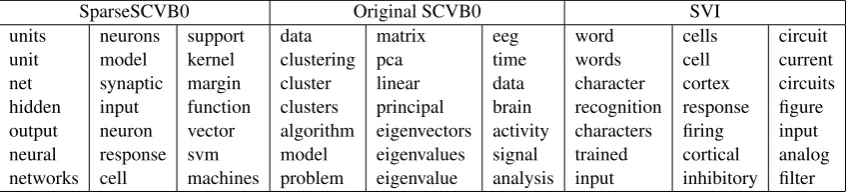
Table 1: Randomly selected example topics, while models trained on the NIPS corpus forK= 500.
Algorithm 1SparseSCVB0 for TM Inference
Randomly initializeNG,NL;NZ:=∑wNwG;
doSparse=trueorf alse
foreach minibatchM do
ˆ NG:= 0
;NˆZ := 0 foreach documentjinMdo
foreach tokeniinjdo
γij(pseudo):= 0
foreach samplesinSdo
drawz(new)i ∼q(k)
//via efficient sampling or
cached alias samples accept or rejectzi(new)via Eq.7
if(accept),zi:=z (new) i
γ(pseudo)ij [zi] :=γ (pseudo) ij [zi] +S1 end for
NL
j := (1−ρLt)NjL+ρLtCjγ (pseudo) ij if(not burn-in pass),
//update estimates forior for
each context word ofi:
ˆ
NwGij:=Nˆ G wij+
C
|M|γ (pseudo) ij
ˆ
NZ:=NˆZ+ C
|M|γ
(pseudo) ij elseif(doSparse),NjL[k]< τ ρ
L
tCjCj:= 0 end for
end for
updateNG:= (1−ρG
t )NG+ρGtNˆG
updateNZ:= (1−ρGt)NZ+ρGtNˆZ end for
number of documents but also in the number of topics, while gaining the benefits of collapsed in-ference. We refer to our method as the sparse stochastic collapsed variational Bayesian infer-ence (SparseSCVB0) algorithm.
In SparseSCVB0, we obtain sparsity by sub-stituting sparse Monte Carlo approximations γij(pseudo) for the original SCVB0 variational dis-tributionsγij. The justification for this procedure,
also used by (Mimno et al.,2012), is that the ex-pected value of an average over one-hot samples from a distribution is equal to that distribution:
Esi∼p(s)
[∑S
i=1δk(si)
S ] = 1 S S ∑ i=1
Esi∼p(s)
[ δk(si)
] = 1 S S ∑ i=1 ∑ k′
δk(si =k′)p(si=k′) =p(s=k).
Thus, the overall procedure is still a valid stochas-tic optimization algorithm. We approximate the inner loop sampler in time sublinear in K, con-structingγ(pseudo)by generating Ssamples from
γij using the MHW method. To describe the
general form of our algorithm, we introduce SparseSCVB0 statistics: local (e.g. document-level) expected countsNL, global (corpus-level) expected counts NG, and total expected topic counts NZ. We approximate local sufficient
statisticsNLfor each tokeniin documentjvia:
NjkL ≈CjEγ(pseudo) ij
[∑s∈Sδzs ij=k
S ]
.
Since γ(pseudo) is sparse, we can efficiently up-date these statistics using only its non-zero entries. This approach allows us to learn high-dimensional topic models efficiently on very large corpora. Be-fore updating global parameters in a similar fash-ion, it may also be beneficial to perform a small number of burn-in passes to learn the local param-eters NL (Foulds et al., 2013). For large-scale
SparseSCVB0 Original SCVB0 SVI infection infected infections host infectious antiviral inoculation human humans chimpanzee macaque monkey primates chimpanzees liver hcv hbv hepatic hepatitis hepatocytes cirrhosis decreased decrease increased increase decreases decreasing dramatically dna replication chromatin origins ssdna primase xenopus medication patients medications prescribed patient prescription pharmacy mutations mutation mutated crosses missense mut hpf hormone invasive androgen hormones testosterone chr hormonal intensive icu delirium occurrences sedation haloperidol psychotropic
Table 2: Randomly selected example topics, while models trained on the PubMed corpus withK= 1,000.
SparseSCVB0 Original SCVB0 SVI
[image:5.595.77.516.71.156.2]band music released show song live records town city road south river village school blood treatment disease patients medical health effects army war division battle forces corps infantry data system software computer systems version bit gold silver diamond golden bronze diamonds pit president political court senate constitution politics elected japanese china chinese japan people countries asia engine test center small gas engines base
Table 3: Randomly selected example topics, while models trained on the Wikipedia corpus forK= 1,000.
4 SparseSCVB0 for LDA
To deploy SparseSCVB0 for LDA, we use the M-H proposal distribution from (Li et al., 2014) which involves drawing samples exactly from document-specific sparse terms or approximately using cached samples from the alias table:
q(k) := PL PL+QG
pL(k) +
QG
PL+QG
qG(k) (8)
wherepL(k) andqG(k) represent the sparse and
dense part, respectively from Equation 6 and PL =
∑
kpL(k), QG =
∑
kqG(k). When PL
PL+QG > RandU nif(1), we sample from the
sparse part inO(kd) time depending on only the
non-zero entries of NjL (analogous to NjΘ), as NjL is sparse in the LDA setting. Otherwise, we sample from the dense part in amortized O(1) time using the alias method. Unfortunately, due to the stochastic update, any entry ofNjL never becomes exactly zero, however it may maintain a very small value. To address this, we apply a spar-sification heuristic, where we thresholdNjLafter burn-in passes for each document iteration. We parameterize the threshold asτ ρL
tCjCj; whereCj
is the length of thej document, ρLt
Cj is the step
size for the last token of this document, and con-stant0 < τ ≤1controls the sparsity. In our pre-liminary experiments, we found that, somewhat counter-intuitively, the Monte Carlo and sparsi-fication approximations actually improve conver-gence in early iterations. We believe that this
is because they help SCVB0 escape the initial high-entropy regime, during which convergence of variational algorithms is poor (Salakhutdinov et al., 2003). This property makes the benefit of annealing insignificant, so we do not use simu-lated annealing for LDA inference, fixingTj = 1.
An additional optimization of SparseSCVB0 for LDA inference can be performed by “clump-ing” (Teh et al.,2007;Foulds et al.,2013), where one update of the local parameters is performed for each distinct word type in each document. This is performed by fixing the variational dis-tribution, and scaling the update by number of copies of the distinct word type in the document. If we observe the distinct word type waj, which
occursmaj times in documentj, the update is
NjL:= (1−ρLt)majNL
j
+ (1−(1−ρLt)maj)C
jγaj(pseudo). (9)
5 SparseSCVB0 for MMSGTM
Input word = learning
Top words in top 2 topics for the input word
NIPS SparseSCVB0 algorithms algorithm reinforcement problem problems|learning gradient descent rate weight machine Original SCVB0 learning networks network algorithm neural|propagation function reinforcement gradient algorithms
[image:6.595.302.526.154.249.2]Wikipedia SparseSCVB0 university school college education students research|public center science schools article information Original SCVB0 students school education university college schools|center year program degree systems information
Table 4: Top words in the top2topics for an input word using original SCVB0 and SparseSCVB0 for MMSGTM.
context wordwcuniformly from the context of the
current word, wc ∼ U nif orm(|context(wi)|),
and then sample a word based on the chosen con-text word’s contribution to the update:
q(k) :∝ N
G
wck+βwc
NkZ+∑wβw
(10)
where NwG
c is analogous to the output context word-topic counts NΦ
wc of original MMSGTM model. The proposal samples via the alias method in amortized O(1) time, instead of O(kd) time,
since it does not involve the sparse term. We use this proposal to approximate the CVB0 up-date for the model, which is a deterministic ver-sion of Equation 5, neglecting to exclude the cur-rent assignment of zi. We update NwGi
(analo-gous to NΦ
wc) for each current word wi locally, but update NwGc and Nz via minibatch counts
ˆ
NwG
cand ˆ
NZ, respectively, for each context word wc of current word wi. Unlike for LDA, Cj in
the local updates represents the total number of input word j in the corpus. As we draw multi-ple output words from each topic assignment, the effective temperature of the MMSGTM model is much lower than for standard LDA which may cause problems with mixing and leads it to get stuck in the initial regime. Following Foulds et al. (2018), we perform simulated annealing which varies the M-H acceptance ratio to improve mix-ing. We parameterize the temperature schedule as Tj =T0+λκ
µj
D, whereT0is the target final
tem-perature,κ ≤ 1, constant µcontrols the amount of temperature reduction after each document it-erationjandλcontrols the initial temperature.
6 Experiments
In this section we study the performance of our SparseSCVB0 1 algorithm, on small as well as large corpora to validate the proposed method for
1
Code implementing SparseSCVB0 can be found at
https://github.com/dr97531/SparseSCVB0.
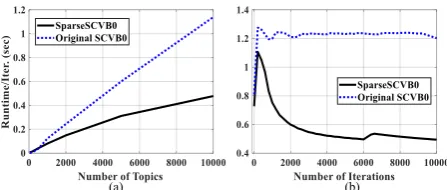
Figure 1: Comparison of runtime per iteration for LDA in terms of: (a) number of topics K and (b) number of iterations when K = 10,000. Original SCVB0 is linear inK, while SparseSCVB0 is sublinear inK.
topic models such as LDA and MMSGTM, and to compare with other state-of-the-art algorithms.
6.1 Experimental Environment and Datasets
We compared SparseSCVB0 to SCVB0 and SVI. For a fair comparison, we implemented all of them in the fast high-level language Julia V0.6.2 (Bezanson et al.,2017). We conducted all exper-iments on a computer with 64GB memory and an Intel Xeon E5-2623 V4 processor with 2.60 GHz clock rate, 8×256KB L2 Cache and 10MB L3 Cache. As we only use one single thread for sampling across all experiments, only one CPU core is active throughout the experiment with only 256KB available L2 Cache.2
We usedNIPS,Reuters-150,PubMed Central, andWikipediaas representative very small, small, medium, and large-scale datasets, respectively. TheNIPScorpus has1740scientific articles from years 1987-1999 with 2.3M tokens, due to Sam Roweis. The newswire corpus Reuters-150 con-tains15,500articles with dictionary size of8,350 words. PubMed Centralhas320M tokens across 165,000scientific articles and a vocabulary size of around 38,500 words. The Wikipedia cor-pus contained4.6million articles from the online
2Since SSVI relies on multiple complex implementation
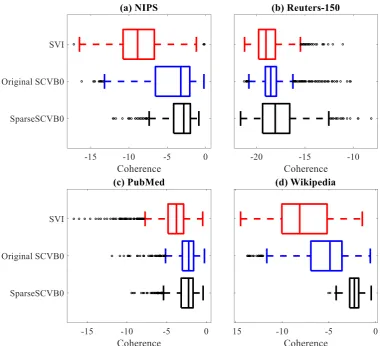
Figure 2: Per-topic coherence for LDA whenK = 1,000on (a) NIPS, (b) PubMed, and (c) Wikipedia. Spars-eSCVB0 completely outperforms other models for large-scale corpus.
network data communication information communicate connection prison prisoners prisoner imprisoned jail escaped detained guards dog dogs shepherd hounds bred coat scent instinct eating companion
song sung sing singing sings sang songs recorded melody tune votes vote cast elections voted candidate parties majority election
wind winds blowing speed blows direction high low blown chill hour hours noon time daylight minutes midnight morning seconds
Table 5: Randomly selected topics from a 10,000 -topic model trained using SparseSCVB0 on Wikipedia
encyclopedia. We used the dictionary of 7,700 words which was extracted by Hoffman et al. (Hoffman et al.,2013). There were811M tokens in the corpus.
6.2 Performance for LDA
We implement SparseSCVB0, original SCVB0 and SVI algorithms using the clumping optimiza-tion (Teh et al., 2007) technique. In all LDA ex-periments, each algorithm was trained using mini-batches of size 20 for the NIPS corpus and 100 for other corpora. For PubMed and Wikipedia, we chose mini-epoch subsets of size 5,000
doc-uments and processed for 5 passes. We used a step-size schedule of (scaleη+t)κ as in original SCVB0
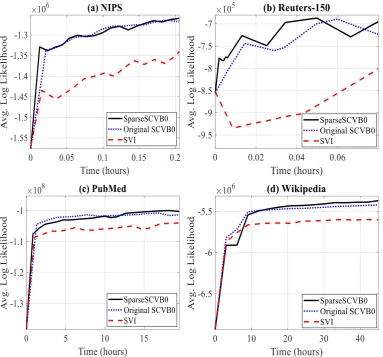
Figure 3: Comparison of average log-likelihoodvs.Time for LDA on (a) NIPS, (b) PubMed, and (c) Wikipedia.
iteration on the number topics and the number of iterations. In Figure1(a), SparseSCVB0 is com-pared to original SCVB0 in terms of the average runtime per document iteration as a function of the number topics. We see that original SCVB0 requires average linear runtime due toO(K) op-erations to compute collapsed variational distribu-tion, while the average runtime for SparseSCVB0 grows sublinearly inK, due toO(kd) operations
instead ofO(K)operations. SparseSCVB0 starts with approximatelyO(K)operations in its initial stage of iterations, but it starts getting a benefit from sparsification heuristic after burning in, as shown in Figure1(b) forK= 10,000.
To evaluate the performance in terms of learned topic quality, we start by comparing all of the al-gorithms in qualitative experiments (see Table1, Table2, and Table3) where we show randomly se-lected example topics, while all the models were trained on the NIPS, PubMed, and Wikipedia cor-pus for K = 500, K = 1,000, and 1,000,
re-spectively. To get a quantitative insight we evalu-ated the topics using the per topic coherence met-ric, which measures the semantic quality of a topic based on theW most probable words for the top-ics (Mimno et al., 2011), thereby approximating the user viewing experience. In Figure2, we see that SparseSCVB0 generates better quality topics with higher coherence scores than the other two models forK= 1000withW = 10after running all the models on each corpus for the same amount of time. The coherence performance of Spars-eSCVB0 increases substantially in the case of the large-scale corpus (Figure 2(c)), since it gets the opportunity to use its runtime advantage and pro-cess more documents than the other algorithms.
Figure 4: Comparison of runtime per iteration for MMSGTM in terms of: (a) number of topicsKand (b) number of iterations whenK= 5,000. SparseSCVB0 runs in amortizedO(1)time, while original SCVB0 is linear inK.
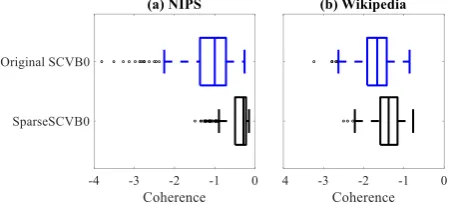
Figure 5: Per-topic coherence for MMSGTM,K = 500, on (a) NIPS and (b) Wikipedia. SparseSCVB0 has higher coherence scores for both the small and large corpora.
and trained the model on the rest of the corpus. Then, we split each test document in half, esti-mated local parameters on first half and finally computed the log-likelihood of the remaining half of the document. Figure3shows the comparison of average log-likelihood versus wall-clock time for all four corpora. In terms of log-likelihood, SparseSCVB0 provides an approximately similar result to original SCVB0 for the small corpus, but it converged to a better solution than others in the case of large corpora like Wikipedia (see Fig-ure3(c)), likely due to its processing a larger num-ber of documents.
SparseSCVB0 enables the large-scale computa-tion needed to learn high-dimensional topic mod-els that could not feasibly be trained using previ-ous methods due to their runtime complexity in the number of documents and/or topics. We show randomly selected topics from the LDA model withK = 10,000in Table5. This big topic model was trained for 36hours using SparseSCVB0 on Wikipedia. We performed a dense initialization, running original SCVB0 for the first 5 hours, which was found to help avoid local optima.
6.3 Performance for MMSGTM
We also conducted experiments to evaluate the performance of SparseSCVB0 for MMSGTM and compare with original SCVB0. In all MMSGTM experiments, we kept the same step size schedule for global parameters as scale = 1.0, η = 5.0 andκ = 0.9, but for local parameter updates we maintain a separate step-size schedule of (scaleη+t)κ
for each input word, withtreferring to the number of times we processed this input word, whileηand κ values remained the same. For simulated an-nealing of SparseSCVB0, we usedT0 = 0.00001,
κ= 0.9,µ= 5andλ=|context|with acontext size of5. We kept the same number of document burn-in passes as we did for the LDA experiments. In Figure4, we show the runtime improvement of SparseSCVB0 over original SCVB0 for MMS-GTM in a similar experiment to the one for LDA. For MMSGTM, SparseSCVB0 substantially out-performs original SCVB0 by processing each doc-ument in amortizedO(1)time. We provide qual-itative results in the case of MMSGTM model by showing several top words in the top2topics for an input word using original SCVB0 and Spars-eSCVB0 in Table4 forK = 500. As for LDA, SparseSCVB0 allows us to generate topics with higher coherence scores compared to the original SCVB0 after running for the same amount of time (Figure5) on both small and large corpora.
7 Conclusions
This paper introduced SparseSCVB0, a sparse version of the SCVB0 inference algorithm which performs fast, scalable high-dimensional topic model inference. SparseSCVB0 leverages stochasticity to scale well in both the corpus size and in the number of topics. It operates in the col-lapsed representation of topic models which leads to fast convergence while providing an improved variational bound. We show that SparseSCVB0 reduces the operational complexity for the varia-tional Bayes update of online topic models from O(K)toO(kd)time for LDA and amortizedO(1)
[image:9.595.68.293.243.346.2]References
Animashree Anandkumar, Rong Ge, Daniel Hsu, Sham M Kakade, and Matus Telgarsky. 2014. Ten-sor decompositions for learning latent variable mod-els. The Journal of Machine Learning Research, 15(1):2773–2832.
Sanjeev Arora, Rong Ge, and Ankur Moitra. 2012. Learning topic models–going beyond SVD. In
Foundations of Computer Science (FOCS), 2012 IEEE 53rd Annual Symposium on, pages 1–10. IEEE.
Arthur Asuncion, Max Welling, Padhraic Smyth, and Yee Whye Teh. 2009. On smoothing and inference for topic models. InProceedings of the 25th Confer-ence on Uncertainty in Artificial IntelligConfer-ence, pages 27–34. AUAI Press.
Jeff Bezanson, Alan Edelman, Stefan Karpinski, and Viral B Shah. 2017. Julia: A fresh approach to nu-merical computing. SIAM review, 59(1):65–98.
David M Blei, Andrew Y Ng, and Michael I Jordan. 2003. Latent Dirichlet allocation. Journal of Ma-chine Learning Research, 3(Jan):993–1022.
Rajarshi Das, Manzil Zaheer, and Chris Dyer. 2015. Gaussian LDA for topic models with word embed-dings. In Proceedings of the 53rd Annual Meet-ing of the Association for Computational LMeet-inguistics and the 7th International Joint Conference on Natu-ral Language Processing (Volume 1: Long Papers), volume 1, pages 795–804.
J. R. Foulds. 2018. Mixed membership word embed-dings for computational social science. Proceedings of the 21st International Conference on Artificial In-telligence and Statistics (AISTATS).
James Foulds, Levi Boyles, Christopher DuBois, Padhraic Smyth, and Max Welling. 2013. Stochas-tic collapsed variational Bayesian inference for la-tent Dirichlet allocation. InProceedings of the 19th ACM SIGKDD International Conference on Knowl-edge Discovery and Data Mining, pages 446–454. ACM.
Thomas L Griffiths and Mark Steyvers. 2004. Find-ing scientific topics. Proceedings of the National Academy of Sciences, 101(suppl 1):5228–5235.
Geoffrey E Hinton. 2002. Training products of experts by minimizing contrastive divergence. Neural Com-putation, 14(8):1771–1800.
Matthew Hoffman, Francis R Bach, and David M Blei. 2010. Online learning for latent Dirichlet alloca-tion. InAdvances in Neural Information Processing Systems, pages 856–864.
Matthew D Hoffman, David M Blei, Chong Wang, and John Paisley. 2013. Stochastic variational infer-ence. The Journal of Machine Learning Research, 14(1):1303–1347.
Aaron Q Li, Amr Ahmed, Sujith Ravi, and Alexan-der J Smola. 2014. Reducing the sampling com-plexity of topic models. InProceedings of the 20th ACM SIGKDD International Conference on Knowl-edge Discovery and Data Mining, pages 891–900. ACM.
Yang Liu, Zhiyuan Liu, Tat-Seng Chua, and Maosong Sun. 2015. Topical word embeddings. In AAAI, pages 2418–2424.
George Marsaglia, Wai Wan Tsang, Jingbo Wang, et al. 2004. Fast generation of discrete random variables.
Journal of Statistical Software, 11(3):1–11.
David Mimno, Matt Hoffman, and David Blei. 2012. Sparse stochastic inference for latent Dirichlet allo-cation. Proceedings of the 29th International Con-ference on Machine Learning.
David Mimno, Hanna M Wallach, Edmund Talley, Miriam Leenders, and Andrew McCallum. 2011. Optimizing semantic coherence in topic models. In
Proceedings of the Conference on Empirical Meth-ods in Natural Language Processing, pages 262– 272. Association for Computational Linguistics.
David Newman, Padhraic Smyth, Max Welling, and Arthur U Asuncion. 2008. Distributed inference for latent Dirichlet allocation. InAdvances in Neural Information Processing Systems, pages 1081–1088.
Ruslan Salakhutdinov, Sam T Roweis, and Zoubin Ghahramani. 2003. Optimization with EM and expectation-conjugate-gradient. In Proceedings of the 20th International Conference on Machine Learning (ICML-03), pages 672–679.
Yee W Teh, David Newman, and Max Welling. 2007. A collapsed variational Bayesian inference algo-rithm for latent Dirichlet allocation. In Advances in Neural Information Processing Systems, pages 1353–1360.