Proceedings of NAACL-HLT 2019, pages 3467–3476 3467
Learning to Describe Unknown Phrases with Local and Global Contexts
Shonosuke Ishiwatari† Hiroaki Hayashi‡ Naoki Yoshinaga§ Graham Neubig‡ Shoetsu Sato† Masashi Toyoda§ Masaru Kitsuregawa¶§
†The University of Tokyo ‡Carnegie Mellon University
§Institute of Industrial Science, the University of Tokyo ¶National Institute of Informatics
†§¶{ishiwatari,ynaga,shoetsu,toyoda,kitsure}@tkl.iis.u-tokyo.ac.jp
‡{hiroakih, gneubig}@cs.cmu.edu
Abstract
When reading a text, it is common to become stuck on unfamiliar words and phrases, such as polysemous words with novel senses, rarely used idioms, internet slang, or emerging enti-ties. If we humans cannot figure out the mean-ing of those expressions from the immediate
localcontext, we consult dictionaries for def-initions or search documents or the web to find otherglobal context to help in interpre-tation. Can machines help us do this work? Which type of context is more important for machines to solve the problem? To answer these questions, we undertake a task of de-scribing a given phrase in natural language based on its local and global contexts. To solve this task, we propose a neural description model that consists of two context encoders and a description decoder. In contrast to the existing methods for non-standard English ex-planation (Ni and Wang, 2017) and defini-tion generadefini-tion (Noraset et al.,2017;Gadetsky et al.,2018), our model appropriately takes im-portant clues frombothlocal and global con-texts. Experimental results on three existing datasets (including WordNet, Oxford and Ur-ban Dictionaries) and a dataset newly created from Wikipedia demonstrate the effectiveness of our method over previous work.
1 Introduction
[image:1.595.308.526.221.382.2]When we read news text with emerging entities, text in unfamiliar domains, or text in foreign lan-guages, we often encounter expressions (words or phrases) whose senses we do not understand. In such cases, we may first try to figure out the mean-ings of those expressions by reading the surround-ing words (localcontext) carefully. Failing to do so, we may consult dictionaries, and in the case of polysemous words, choose an appropriate mean-ing based on the context. Learnmean-ing novel word senses via dictionary definitions is known to be
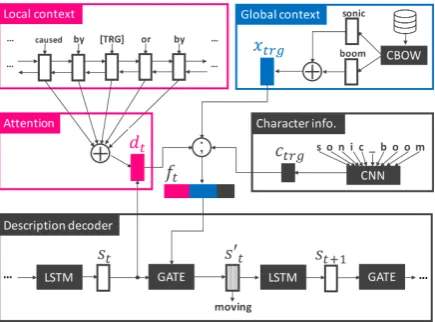
Figure 1: Local &GlobalContext-awareDescription generator (LOG-CaD).
more effective than contextual guessing (Fraser,
1998;Chen, 2012). However, very often, hand-crafted dictionaries do not contain definitions of expressions that are rarely used or newly created. Ultimately, we may need to read through the entire document or even search the web to find other oc-curances of the expression (globalcontext) so that we can guess its meaning.
Al-though these research efforts revealed that both lo-cal and global contexts are useful in generating definitions, none of these studies exploited both contexts directly to describe unknown phrases.
In this study, we tackle the task of describing (defining) a phrase when given its local and global contexts. We presentLOG-CaD, a neural descrip-tion generator (Figure1) to directly solve this task. Given an unknown phrase without sense defini-tions, our model obtains a phrase embedding as its global context by composing word embeddings while also encoding the local context. The model therefore combines both pieces of information to generate a natural language description.
Considering various applications where we need definitions of expressions, we evaluated our method with four datasets including Word-Net (Noraset et al., 2017) for general words, the Oxford dictionary (Gadetsky et al.,2018) for pol-ysemous words, Urban Dictionary (Ni and Wang,
2017) for rare idioms or slang, and a newly-created Wikipedia dataset for entities.
Our contributions are as follows:
• We proposea general task of defining
un-known phrases given their contexts. This
task is a generalization of three related tasks (Noraset et al., 2017; Ni and Wang,
2017;Gadetsky et al.,2018) and involves var-ious situations where we need definitions of unknown phrases (§2).
• We propose a method for generating nat-ural language descriptions for unknown phrases with local and global contexts
(§3).
• As a benchmark to evaluate the ability of the models to describe entities, webuild a
large-scale dataset from Wikipedia and Wikidata
for the proposed task. We release our dataset and the code1to promote the reproducibility of the experiments (§4).
• The proposed method achievesthe
state-of-the-art performanceon our new dataset and
the three existing datasets used in the related studies (Noraset et al., 2017; Ni and Wang,
2017;Gadetsky et al.,2018) (§5).
1https://github.com/shonosuke/ ishiwatari-naacl2019
2 Context-aware Phrase Description Generation
In this section, we define our task of describing a phrase in a specific context. Given an unde-fined phrase Xtrg = {xj,· · ·, xk} with its
con-text X = {x1,· · ·, xI} (1 ≤ j ≤ k ≤ I), our
task is to output a descriptionY ={y1,· · · , yT}. Here,Xtrgcan be a word or a short phrase and is included inX. Y is a definition-like concrete and concise sentence that describes theXtrg.
For example, given a phrase “sonic boom” with its context “the shock wave may be caused by
sonic boom or by explosion,” the task is to gen-erate a description such as “sound created by an object moving fast.” If the given context has been changed to “this is the first official tour to sup-port the band’s latest studio effort, 2009’s Sonic Boom,” then the appropriate output would be “al-bum by Kiss.”
The process of description generation can be modeled with a conditional language model as
p(Y|X, Xtrg) = T
Y
t=1
p(yt|y<t, X, Xtrg). (1)
3 LOG-CaD: Local & Global
Context-aware Description Generator
In this section, we describe our idea of utilizing local and global contexts in the description gener-ation task, and present the details of our model.
3.1 Local & global contexts
When we find an unfamiliar phrase in text and it is not defined in dictionaries, how can we humans come up with its meaning? As discussed in Sec-tion 1, we may first try to figure out the mean-ing of the phrase from the immediate context, and then read through the entire document or search the web to understand implicit information behind the text.
3.2 Proposed model
Figure 1shows an illustration of our LOG-CaD
model. Similarly to the standard encoder-decoder model with attention (Bahdanau et al.,2015; Lu-ong and Manning,2016), it has a context encoder and a description decoder. The challenge here is that the decoder needs to be conditioned not only on the local context, but also on its global context. To incorporate the different types of contexts, we propose to use a gate function similar to Noraset et al.(2017) to dynamically control how the global and local contexts influence the description.
Local & global context encoders We first
de-scribe how to model local and global contexts. Given a sentence X and a phrase Xtrg, a bi-directionalLSTM(Gers et al.,1999) encoder gen-erates a sequence of continuous vectors H =
{h1· · ·,hI}as
hi =Bi-LSTM(hi−1,hi+1,xi), (2)
where xi is the word embedding of wordxi. In
addition to the local context, we also utilize the global context obtained from massive text. This can be achieved by feeding a phrase embedding xtrgto initialize the decoder (Noraset et al.,2017)
as
y0 =xtrg. (3)
Here, the phrase embeddingxtrg is calculated by
simply summing up all the embeddings of words that consistute the phraseXtrg. Note that we use a randomly-initialized vector if no pre-trained em-bedding is available for the words inXtrg.
Description decoder Using the local and global
contexts, a description decoder computes the conditional probability of a description Y with Eq. (1), which can be approximated with another LSTMas
st=LSTM(yt−1,s0t−1), (4)
dt=ATTENTION(H,st), (5)
ctrg =CNN(Xtrg), (6)
s0t=GATE(st,xtrg,ctrg,dt), (7)
p(yt|y<t, Xtrg) =softmax(Ws0s0t+bs0), (8)
where st is a hidden state of the decoder LSTM
(s0 =~0), andyt−1 is a jointly-trained word
em-bedding of the previous output wordyt−1. In what
follows, we explain each equation in detail.
Attention onlocalcontext Considering the fact
that the local context can be relatively long (e.g., around 20 words on average in our Wikipedia dataset introduced in Section 4), it is hard for the decoder to focus on important words in local contexts. In order to deal with this problem, the ATTENTION(·)function in Eq. (5) decides which words in the local contextX to focus on at each time step.dtis computed with an attention
mech-anism (Luong and Manning,2016) as
dt= T
X
i=1
αihi, (9)
αi=softmax(UhhTi Usst), (10)
where Uh and Us are matrices that map the
en-coder and deen-coder hidden states into a common space, respectively.
Use of character information In order to
cap-ture the surface information ofXtrg, we construct character-level CNNs (Eq. (6)) following ( No-raset et al., 2017). Note that the input to the CNNs is a sequence of words inXtrg, which are concatenated with special character “ ,” such as “sonic boom.” FollowingNoraset et al. (2017), we set the CNN kernels of length 2-6 and size 10,30,40,40,40respectively with a stride of 1 to obtain a 160-dimensional vectorctrg.
Gate function to control local & global contexts
In order to capture the interaction between the lo-cal and global contexts, we adopt a GATE(·) func-tion (Eq. (7)) which is similar to Noraset et al.
(2017). The GATE(·)function updates the LSTM output st to s0t depending on the global context
xtrg, local context dt, and character-level
infor-mationctrgas
ft= [xtrg;dt;ctrg] (11)
zt=σ(Wz[ft;st] +bz), (12)
rt=σ(Wr[ft;st] +br), (13)
˜
st=tanh(Ws[(rtft);st] +bs), (14)
s0t= (1−zt)st+zts˜t, (15)
whereσ(·),and;denote the sigmoid function, element-wise multiplication, and vector concate-nation, respectively. W∗ andb∗ are weight
ma-trices and bias terms, respectively. Here, the up-date gateztcontrols how much the original
hid-den statestis to be changed, and the reset gatert
controls how much the information fromft
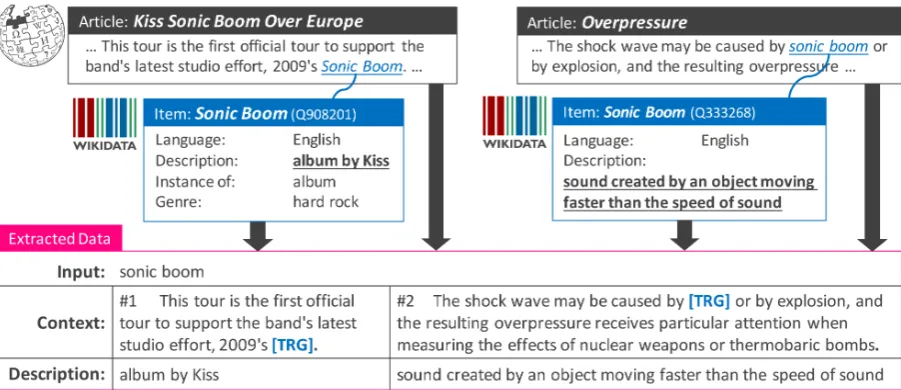
Figure 2: Context-aware description dataset extracted from Wikipedia and Wikidata.
4 Wikipedia Dataset
Our goal is to let machines describe unfamiliar words and phrases, such as polysemous words, rarely used idioms, or emerging entities. Among the three existing datasets, WordNet and Oxford dictionary mainly target the words but not phrases, thus are not perfect test beds for this goal. On the other hand, although the Urban Dictionary dataset contains descriptions of rarely-used phrases, the domain of its targeted words and phrases is lim-ited to Internet slang.
In order to confirm that our model can generate the description of entities as well as polysemous words and slang, we constructed a new dataset for context-aware phrase description generation from Wikipedia2 and Wikidata3 which contain a wide variety of entity descriptions with contexts. The overview of the data extraction process is shown in Figure2. Each entry in the dataset consists of (1) a phrase, (2) its description, and (3) context (a sentence).
For preprocessing, we applied Stanford Tok-enizer4 to the descriptions of Wikidata items and the articles in Wikipedia. Next, we removed phrases in parentheses from the Wikipedia arti-cles, since they tend to be paraphrasing in other languages and work as noise. To obtain the con-texts of each item in Wikidata, we extracted the
2
https://dumps.wikimedia.org/enwiki/ 20170720/
3
https://dumps.wikimedia.org/ wikidatawiki/entities/20170802/
4https://nlp.stanford.edu/software/ tokenizer.shtml
sentence which has a link referring to the item through all the first paragraphs of Wikipedia arti-cles and replaced the phrase of the links with a spe-cial token[TRG]. Wikidata items with no descrip-tion or no contexts are ignored. This utilizadescrip-tion of links makes it possible to resolve the ambiguity of words and phrases in a sentence without human annotations, which is a major advantage of using Wikipedia. Note that we used only links whose an-chor texts are identical to the title of the Wikipedia articles, since the users of Wikipedia sometimes link mentions to related articles.
5 Experiments
We evaluate our method by applying it to describe words in WordNet5 (Miller, 1995) and Oxford Dictionary,6 phrases in Urban Dictionary7 and Wikipedia/Wikidata.8 For all of these datasets, a given word or phrase has an inventory of senses with corresponding definitions and usage exam-ples. These definitions are regarded as ground-truth descriptions.
Datasets To evaluate our model on the word
de-scription task on WordNet, we followedNoraset et al.(2017) and extracted data from WordNet us-ing thedict-definition9toolkit. Each entry in the data consists of three elements: (1) a word, (2) its definition, and (3) a usage example of the
5https://wordnet.princeton.edu/ 6https://en.oxforddictionaries.com/ 7https://www.urbandictionary.com/ 8
https://www.wikidata.org
Corpus #Phrases #Entries Phrase Context Desc. length length length
WordNet
Train 7,938 13,883 1.00 5.81 6.61
Valid 998 1,752 1.00 5.64 6.61
Test 1,001 1,775 1.00 5.77 6.85
Oxford Dictionary
Train 33,128 97,855 1.00 17.74 11.02 Valid 8,867 12,232 1.00 17.80 10.99 Test 8,850 12,232 1.00 17.56 10.95
Urban Dictionary
Train 190,696 411,384 1.54 10.89 10.99 Valid 26,876 57,883 1.54 10.86 10.95 Test 26,875 38,371 1.68 11.14 11.50
Wikipedia
Train 151,995 887,455 2.10 18.79 5.89 Valid 8,361 44,003 2.11 19.21 6.31
[image:5.595.72.293.68.304.2]Test 8,397 57,232 2.10 19.02 6.94
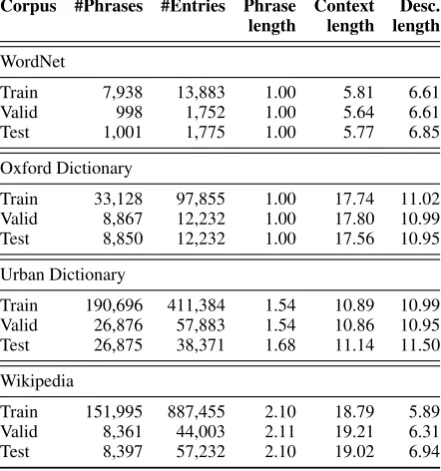
Table 1: Statistics of the word/phrase description datasets.
Corpus Domain Inputs Cov. emb.
WordNet General words 100.00%
Oxford Dictionary General words 83.04% Urban Dictionary Internet slang phrases 21.00% Wikipedia Proper nouns phrases 26.79%
Table 2: Domains, expressions to be described, and the coverage of pre-trained embeddings of the expressions to be described.
word. We split this dataset to obtain Train, Valida-tion, and Test sets. If a word has multiple defini-tions/examples, we treat them as different entries. Note that the words are mutually exclusive across the three sets. The only difference between our dataset and theirs is that we extract the tuples only if the words have their usage examples in Word-Net. Since not all entries in WordNet have usage examples, our dataset is a small subset ofNoraset et al.(2017).
In addition to WordNet, we use the Oxford Dic-tionary followingGadetsky et al. (2018), the Ur-ban Dictionary followingNi and Wang(2017) and our Wikipedia dataset described in the previous section. Table1 and Table2show the properties and statistics of the four datasets, respectively.
To simulate a situation in a real application where we might not have access to global context for the target phrases, we did not train domain-specific word embeddings on each dataset. In-stead, for all of the four datasets, we use the same
Global Local I-Attn. LOG-CaD
# Layers of Enc-LSTMs - 2 2 2
Dim. of Enc-LSTMs - 600 600 600
Dim. of Attn. vectors - 300 300 300 Dim. of input word emb. 300 - 300 300 Dim. of char. emb. 160 160 - 160
# Layers of Dec-LSTMs 2 2 2 2
Dim. of Dec-LSTMs 300 300 300 300
Vocabulary size 10k 10k 10k 10k
[image:5.595.73.290.350.412.2]Dropout rate 0.5 0.5 0.5 0.5
Table 3: Hyperparameters of the models
pre-trained CBOW10 vectors trained on Google news corpus as global context following previous work (Noraset et al.,2017;Gadetsky et al.,2018). If the expression to be described consists of mul-tiple words, its phrase embedding is calculated by simply summing up all the CBOW vectors of words in the phrase, such as “sonic” and “boom.” (See Figure1). If pre-trainedCBOW embeddings are unavailable, we instead use a special [UNK]
vector (which is randomly initialized with a uni-form distribution) as word embeddings. Note that our pre-trained embeddings only cover26.79%of the words in the expressions to be described in our Wikipedia dataset, while it covers all words in WordNet dataset (See Table 2). Even if no reliable word embeddings are available, all mod-els can capture the character information through character-levelCNNs (See Figure1).
Models We implemented four methods: (1)
Global (Noraset et al., 2017), (2)Local (Ni and
Wang,2017) withCNN, (3)I-Attention(Gadetsky et al.,2018), and our proposed model, (4) LOG-CaD. TheGlobalmodel is our reimplementation of the best model (S + G + CH) inNoraset et al.
(2017). It can access the global context of a phrase to be described, but has no ability to read the lo-cal context. TheLocalmodel is the reimplemen-tation of the best model (dual encoder) inNi and Wang(2017). In order to make a fair comparison of the effectiveness of local and global contexts, we slightly modify the original implementation by
Ni and Wang(2017); as the character-level encoder in theLocal model, we adopt CNNs that are ex-actly the same as the other two models instead of the originalLSTMs.
The I-Attention is our reimplementation of
the best model (S + I-Attention) in Gadetsky
Model WordNet Oxford Urban Wikipedia
Global 24.10 15.05 6.05 44.77
Local 22.34 17.90 9.03 52.94
I-Attention 23.77 17.25 10.40 44.71
LOG-CaD 24.79 18.53 10.55 53.85
Table 4:BLEUscores on four datasets.
Model Annotated score
Local 2.717
[image:6.595.306.525.59.264.2]LOG-CaD 3.008
Table 5: Averaged human annotated scores on Wikipedia dataset.
et al.(2018). Similar to our model, it uses both local and global contexts. Unlike our model, how-ever, it does not use character information to pre-dict descriptions. Also, it cannot directly use the local context to predict the words in descriptions. This is because theI-Attention model indirectly uses the local context only to disambiguate the phrase embeddingxtrgas
x0trg =xtrgm, (16)
m=σ(Wm
PI
i=1FFNN(hi)
I +bm). (17)
Here, the FFNN(·)function is a feed-forward neu-ral network that maps the encoded local contexts hi to another space. The mapped local contexts
are then averaged over the length of the sentence
X to obtain a representation of the local context. This is followed by a linear layer and a sigmoid function to obtain the soft binary maskmwhich can filter out the unrelated information included in global context. Finally, the disambiguated phrase embeddingx0trgis then used to update the decoder hidden state as
st=LSTM([yt−1;x0trg],st−1). (18)
All four models (Table3) are implemented with the PyTorch framework (Ver. 1.0.0).11
Automatic Evaluation Table 4 shows the
BLEU (Papineni et al., 2002) scores of the out-put descriptions. We can see that theLOG-CaD
model consistently outperforms the three baselines in all four datasets. This result indicates that us-ing both local and global contexts helps describe the unknown words/phrases correctly. While the
11http://pytorch.org/
Input: waste
Context: #1 #2
if the effort brings no compensating gain it is awaste
We waste the dirty water by channeling it into the sewer
Reference: useless or profitless activity
to get rid of
Global: to give a liquid for a liquid
Local: a state of being as-signed to a particular purpose
to make a break of a wooden instrument
I-Attention: a person who makes something that can be be be done
to remove or remove the contents of
LOG-CaD: a source of something that is done or done
[image:6.595.307.526.310.492.2]to remove a liquid
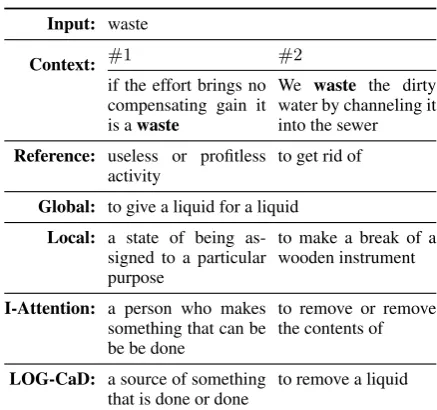
Table 6: Descriptions for a word in WordNet.
Input: daniel o’neill
Context: #1 #2
after being enlarged by publisher daniel o’neill it was report-edly one of the largest and most prosperous newspapers in the united states.
in 1967 he returned to belfast where he met fellow belfast artist
daniel o’neill.
Reference: american journalist irish artist
Global: american musician
Local: american publisher british musician
I-Attention: american musician american musician
LOG-CaD: american writer british musician
Table 7: Descriptions for a phrase in Wikipedia.
I-Attentionmodel also uses local and global
con-texts, its performance was always lower than the
LOG-CaD model. This result shows that using
local context to predict description is more effec-tive than using it to disambiguate the meanings in global context.
In particular, the low BLEU scores of Global
andI-Attentionmodels on Wikipedia dataset
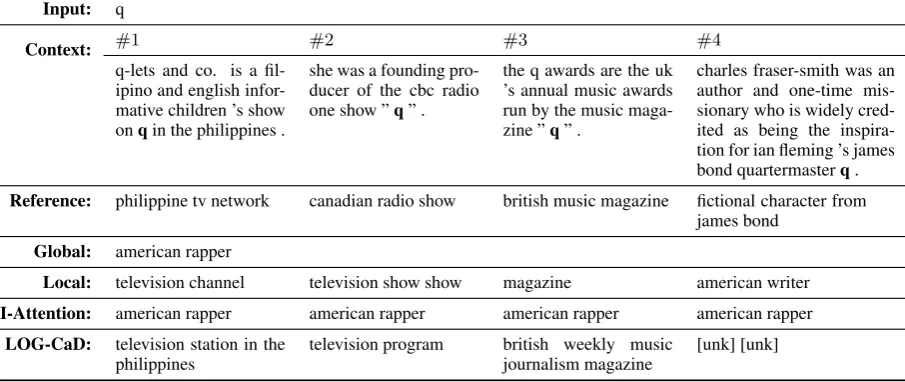
Input: q
Context: #1 #2 #3 #4
q-lets and co. is a fil-ipino and english infor-mative children ’s show onqin the philippines .
she was a founding pro-ducer of the cbc radio one show ”q” .
the q awards are the uk ’s annual music awards run by the music maga-zine ”q” .
charles fraser-smith was an author and one-time mis-sionary who is widely cred-ited as being the inspira-tion for ian fleming ’s james bond quartermasterq.
Reference: philippine tv network canadian radio show british music magazine fictional character from james bond
Global: american rapper
Local: television channel television show show magazine american writer
I-Attention: american rapper american rapper american rapper american rapper
LOG-CaD: television station in the philippines
television program british weekly music journalism magazine
[image:7.595.72.525.68.259.2][unk] [unk]
Table 8: Descriptions for a word in Wikipedia.
Manual Evaluation To compare the proposed
model and the strongest baseline in Table4 (i.e.,
theLocal model), we performed a human
evalu-ation on our dataset. We randomly selected 100 samples from the test set of the Wikipedia dataset and asked three native English speakers to rate the output descriptions from 1 to 5 points as: 1) com-pletely wrong or self-definition, 2) correct topic with wrong information, 3) correct but incom-plete, 4) small details missing, 5) correct. The av-eraged scores are reported in Table 5. Pair-wise bootstrap resampling test (Koehn, 2004) for the annotated scores has shown that the superiority of
LOG-CaD over the Local model is statistically
significant (p <0.01).
Qualitative Analysis Table 6 shows a word in
the WordNet, while Table7and Table8show the examples of the entities in Wikipedia as examples. When comparing the two datasets, the quality of generated descriptions of Wikipedia dataset is sig-nificantly better than that of WordNet dataset. The main reason for this result is that the size of train-ing data of the Wikipedia dataset is 64x larger than the WordNet dataset (See Table1).
For all examples in the three tables, theGlobal
model can only generate a single description for each input word/phrase because it cannot access any local context. In the Wordnet dataset, only
the I-Attention andLOG-CaD models can
suc-cessfully generate the concept of “remove” given the context#2. This result suggests that consid-ering both local and global contexts are essential to generate correct descriptions. In our Wikipedia
dataset, both theLocalandLOG-CaDmodels can describe the word/phrase considering its local con-text. For example, both theLocalandLOG-CaD
models could generate “american” in the descrip-tion for “daniel o’neill” given “united states” in context #1, while they could generate “british” given “belfast” in context #2. A similar trend can also be observed in Table8, whereLOG-CaD
could generate the locational expressions such as “philippines” and “british” given the different con-texts. On the other hand, the I-Attentionmodel could not describe the two phrases, taking into ac-count the local contexts. We will present an anal-ysis of this phenomenon in the next section.
6 Discussion
In this section, we present analyses on how the lo-cal and global contexts contribute to the descrip-tion generadescrip-tion task. First, we discuss how the lo-cal context helps the models to describe a phrase. Then, we analyze the impact of global context un-der the situation where local context is unreliable.
6.1 How do the models utilizelocalcontexts?
Local context helps us (1) disambiguate polyse-mous words and (2) infer the meanings of un-known expressions. Can machines also utilize the local context? In this section, we discuss the two roles of local context in description generation.
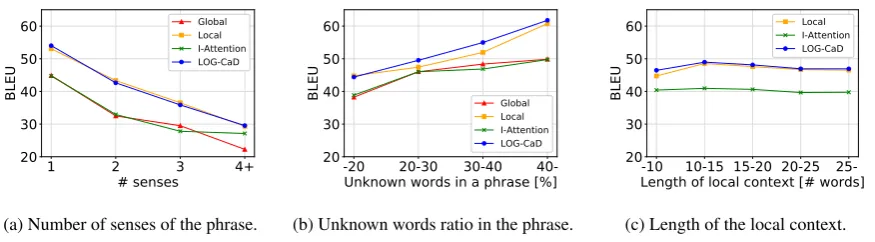
de-1 2 3 4+ # senses
20 30 40 50 60
B
LE
U
Global Local I-Attention LOG-CaD
(a) Number of senses of the phrase.
-20 20-30 30-40
40-Unknown words in a phrase [%] 20
30 40 50 60
B
LE
U
Global Local I-Attention LOG-CaD
(b) Unknown words ratio in the phrase.
-10 10-15 15-20 20-25 25- Length of local context [# words] 20
30 40 50 60
B
LE
U
Local I-Attention LOG-CaD
[image:8.595.82.520.66.187.2](c) Length of the local context.
Figure 3: Impact of various parameters of a phrase to be described onBLEUscores of the generated descriptions.
signed the I-Attention model to filter out unre-lated meanings in the global context given local context, they did not discuss the impact of the number of senses has on the performance of defi-nition generation. To understand the influence of the ambiguity of phrases to be defined on the gen-eration performance, we did an analysis on our Wikipedia dataset. Figure3(a) shows that the de-scription generation task becomes harder as the phrases to be described become more ambiguous. In particular, when a phrase has an extremely large number of senses, (i.e., #senses≥4), theGlobal
model drops its performance significantly. This re-sult indicates that the local context is necessary to disambiguate the meanings in global context.
As shown in Table 2, a large proportion of the phrases in our Wikipedia dataset includes un-known words (i.e., only 26.79%of words in the phrases have their pre-trained embeddings). This fact indicates that the global context in this dataset is not fully reliable. Then our next question is, how does the lack of information from global con-text affect the performance of phrase description? Figure3(b) shows the impact of unknown words in the phrases to be described on the performance. As we can see from the result, the advantage of
LOG-CaDandLocalmodels overGlobaland
I-Attentionmodels becomes larger as the unknown
words increases. This result suggests that we need to fully utilize local contexts especially in prac-tical applications where the phrases to be defined have many unknown words. Here, Figure3(b) also shows a counterintuitive phenomenon that BLEU scores increase as the ratio of unknown words in a phrase increase. This is mainly because unknown phrases tend to be person names such as writ-ers, actors, or movie directors. Since these enti-ties have fewer ambiguienti-ties in categories, they can be described in extremely short sentences that are
easy for all four models to decode (e.g., “finnish writer” or “american television producer”).
6.2 How do the models utilizeglobal
contexts?
As discussed earlier, local contexts are important to describe unknown expressions, but how about global contexts? Assuming a situation where we cannot obtain much information from local con-texts (e.g., infer the meaning of “boswellia” from a short local context “Here is a boswellia”), global contexts should be essential to understand the meaning. To confirm this hypothesis, we analyzed the impact of the length of local contexts onBLEU scores. Figure 3(c) shows that when the length of local context is extremely short (l ≤ 10), the
LOG-CaD model becomes much stronger than
the Local model. This result indicates that not
only local context but also global context help models describe the meanings of phrases.
7 Related Work
In this study, we address a task of describing a given phrase with its context. In what follows, we explain existing tasks that are related to our work. Our task is closely related to word sense dis-ambiguation (WSD) (Navigli, 2009), which iden-tifies a pre-defined sense for the target word with its context. Although we can use it to solve our task by retrieving the definition sentence for the sense identified by WSD, it requires a substantial amount of training data to handle a different set of meanings of each word, and cannot handle words (or senses) which are not registered in the dictio-nary. Although some studies have attempted to de-tect novel senses of words for given contexts (Erk,
phrases or words. It also allows us to flexibly tailor a fine-grained definition for the specific context.
Paraphrasing (Androutsopoulos and Malakasi-otis, 2010; Madnani and Dorr, 2010) (or text simplification (Siddharthan, 2014)) can be used to rephrase words with unknown senses. How-ever, the target of paraphrase acquisition are words/phrases with no specified context. Al-though a few studies (Connor and Roth, 2007;
Max, 2009; Max et al., 2012) consider sub-sentential (context-sensitive) paraphrases, they do not intend to obtain a definition-like description as a paraphrase of a word.
Recently, Noraset et al. (2017) introduced a task of generating a definition sentence of a word from its pre-trained embedding. Since their task does not take local contexts of words as inputs, their method cannot generate an appropriate def-inition for a polysemous word for a specific con-text. To cope with this problem, Gadetsky et al.
(2018) proposed a definition generation method that works with polysemous words in dictionar-ies. They presented a model that utilizes local context to filter out the unrelated meanings from a pre-trained word embedding in a specific con-text. While their method use local context for dis-ambiguating the meanings that are mixed up in word embeddings, the information from local con-texts cannot be utilized if the pre-trained embed-dings are unavailable or unreliable. On the other hand, our method can fully utilize the local con-text through an attentional mechanism, even if the reliable word embeddings are unavailable.
The most related work to this paper is Ni and Wang(2017). Focusing on non-standard English phrases, they proposed a model to generate the explanations solely from local context. They fol-lowed the strict assumption that the target phrase was newly emerged and there was only a single lo-cal context available, which made the task of gen-erating an accurate and coherent definition diffi-cult. Our proposed task and model are more gen-eral and practical thanNi and Wang(2017); where (1) we use Wikipedia, which includes expressions from various domains, and (2) our model takes ad-vantage of global contexts if available.
Our task of describing phrases with its context is a generalization of the three tasks (Noraset et al.,
2017;Ni and Wang,2017;Gadetsky et al.,2018), and the proposed method utilizes both local and global contexts of an expression in question.
8 Conclusions
This paper sets up a task of generating a natural language description for an unknown phrase with a specific context, aiming to help us acquire un-known word senses when reading text. We ap-proached this task by using a variant of encoder-decoder models that capture the given local con-text with the encoder and global concon-texts with the decoder initialized by the target phrase’s embed-ding induced from massive text. We performed ex-periments on three existing datasets and one newly built from Wikipedia and Wikidata. The experi-mental results confirmed that the local and global contexts complement one another and are both es-sential; global contexts are crucial when local con-texts are short and vague, while the local context is important when the target phrase is polysemous, rare, or unseen.
As future work, we plan to modify our model to use multiple contexts in text to im-prove the quality of descriptions, considering the “one sense per discourse” hypothesis (Gale et al., 1992). We will release the newly built Wikipedia dataset and the experimental codes for the academic and industrial
communi-ties athttps://github.com/shonosuke/
ishiwatari-naacl2019 to facilitate the
re-producibility of our results and their use in various application contexts.
Acknowledgements
The authors are grateful to Thanapon Noraset for sharing the details of his implementation of the previous work. We also thank the anony-mous reviewers for their careful reading of our paper and insightful comments, and the members of Kitsuregawa-Toyoda-Nemoto-Yoshinaga-Goda laboratory in the University of Tokyo for proof-reading the draft.
This work was partially supported by Grant-in-Aid for JSPS Fellows (Grant Number 17J06394) and Commissioned Research (201) of the Na-tional Institute of Information and Communica-tions Technology of Japan.
References
Dzmitry Bahdanau, Kyunghyun Cho, and Yoshua Ben-gio. 2015. Neural machine translation by jointly learning to align and translate. InProceedings of the Third International Conference on Learning Repre-sentations (ICLR).
Yuzhen Chen. 2012. Dictionary use and vocabulary learning in the context of reading. International Journal of Lexicography, 25(2):216–247.
Michael Connor and Dan Roth. 2007. Context sensi-tive paraphrasing with a global unsupervised clas-sifier. InProceedings of the 18th European Confer-ence on Machine Learning (ECML), pages 104–115.
Katrin Erk. 2006. Unknown word sense detection as outlier detection. InProceedings of the Human Lan-guage Technology Conference of the North Amer-ican Chapter of the Association of Computational Linguistics (NAACL), pages 128–135.
Carol A. Fraser. 1998. The role of consulting a dictio-nary in reading and vocabulary learning. Canadian Journal of Applied Linguistics, 2(1-2):73–89.
Artyom Gadetsky, Ilya Yakubovskiy, and Dmitry Vetrov. 2018. Conditional generators of words def-initions. In Proceedings of the 56th Annual Meet-ing of the Association for Computational LMeet-inguistics (ACL), Short Papers, pages 266–271.
William A. Gale, Kenneth W. Church, and David Yarowsky. 1992. One sense per discourse. In Pro-ceedings of the workshop on Speech and Natural Language, HLT, pages 233–237.
Felix A. Gers, J¨urgen Schmidhuber, and Fred Cum-mins. 1999. Learning to forget: Continual predic-tion with lstm. In Proceedings of the Ninth Inter-national Conference on Artificial Neural Networks (ICANN), pages 850–855.
Philipp Koehn. 2004. Statistical significance tests for machine translation evaluation. In Proceedings of the 2004 Conference on Empirical Methods in Natu-ral Language Processing (EMNLP), pages 388–395.
Jey Han Lau, Paul Cook, Diana McCarthy, Spandana Gella, and Timothy Baldwin. 2014. Learning word sense distributions, detecting unattested senses and identifying novel senses using topic models. In Pro-ceedings of the 52nd Annual Meeting of the Asso-ciation for Computational Linguistics (ACL), pages 259–270.
Minh-Thang Luong and Christopher D. Manning. 2016. Achieving open vocabulary neural machine translation with hybrid word-character models. In
Proceedings of the 54th Annual Meeting of the Asso-ciation for Computational Linguistics (ACL), pages 1054–1063.
Nitin Madnani and Bonnie J. Dorr. 2010. Generat-ing phrasal and sentential paraphrases: A survey of data-driven methods. Computational Linguistics, 36(3):341–387.
Aur´elien Max. 2009. Sub-sentencial paraphrasing by contextual pivot translation. InProceedings of the 2009 Workshop on Applied Textual Inference, pages 18–26.
Aur´elien Max, Houda Bouamor, and Anne Vilnat. 2012. Generalizing sub-sentential paraphrase acqui-sition across original signal type of text pairs. In
Proceedings of the 2012 Joint Conference on Empir-ical Methods in Natural Language Processing and Computational Natural Language Learning, pages 721–731.
George A Miller. 1995. Wordnet: a lexical database for english. Communications of the ACM, 38(11):39– 41.
Roberto Navigli. 2009. Word sense disambiguation: A survey. ACM COMPUTING SURVEYS, 41(2):1–69.
Ke Ni and William Yang Wang. 2017. Learning to ex-plain non-standard English words and phrases. In
Proceedings of the 8th International Joint Confer-ence on Natural Language Processing (IJCNLP), pages 413–417.
Thanapon Noraset, Chen Liang, Larry Birnbaum, and Doug Downey. 2017. Definition modeling: Learn-ing to define word embeddLearn-ings in natural language. InProceedings of the 31st AAAI Conference on Ar-tificial Intelligence (AAAI), pages 3259–3266.
Kishore Papineni, Salim Roukos, Todd Ward, and Wei-Jing Zhu. 2002. Bleu: a method for automatic eval-uation of machine translation. In Proceedings of 40th Annual Meeting of the Association for Compu-tational Linguistics (ACL), pages 311–318.