Preferential procurement in the public
sector: The case of Amathole
Peer reviewed and revised
Abstract
The end of the apartheid era in South Africa ushered in a new institutional environment through changes to legislative frameworks in government depart-ments. A key aspect of the transformation is the economic empowerment of the mainly historically disadvantaged groups in the country through procurement. The thrust of the issue is the assessment of the extent of compliance with Act No. 5 of 2000: Preferential Procurement Policy Framework Act (PPPFA), 2000 at government departments, with particular focus on the Amathole region of the Eastern Cape Province.
The assessment was undertaken in a qualitative and quantitative research study conducted among key construction industry stakeholders such as public-sector clients, architects, engineers, and quantity surveyors based within the Amathole region.
Selected findings include that there is a perceived low level of awareness of preferential procurement in the public sector as the majority of the institutions investigated have not completely implemented procurement responsibilities as a dedicated function within their organisations. Another significant finding arising from the study is that there are conflicting perceptions among consultants regarding procurement strategies for different types of project.
Keywords: Construction, consultants, procurement, public sector, South Africa
Abstrak
Die einde van die apartheidsera in Suid-Afrika het ‘n nuwe institusionele om-gewing deur veranderinge aan wetom-gewingsraamwerke in regerings-departemente ingelei. ‘n Sleutelaspek van die transformasie is die ekonomiese bemagtiging van die hoofsaaklik historiese agtergeblewene groepe in die land deur verkryging.
Die kruks van die saak is die assessering van die omvang van inwilliging met Wet No. 5 van 2000: Wet op Raamwerk vir Voorkeurverkrygingsbeleid deur regeringsdepartemente met spesifieke fokus op die Amathole streek van die Oos-Kaapprovinsie.
Die assessering is deur ‘n kwalitatiewe en kwantitatiewe navorsingstudie onder sleutelkonstruksie industrie-aandeelhouers soos openbare sektor kliënte, argitekte, ingenieurs, en bourekenaars binne die Amathole streek gedoen. Geselekteerde bevindings sluit in dat daar ‘n lae vlak van bewustheid oor voorkeurverkryging in die openbare sektor is omdat die meerderheid instansies wat ondersoek is nie volledig verkrygingsverantwoordelikhede as ‘n toegewyde funksie binne hul organisasies geïmplimenteer het nie. ‘n Ander noemenswaardige bevinding uit die studie is die botsende persepsies onder konsultante aangaande die strategieë vir verskillende projektipes.
Sleutelwoorde: Konstruksie, konsultante, verkryging, openbare sektor, Suid-Afrika
1.
Background
According to the Construction Industry Development Board (CIDB) (2004: 1), procurement was identified as a tool to achieve economic reform to regulate a bias in award of contracts in favour of historically disadvantaged individuals (HDIs) in South Africa. This type of procurement, termed preferential procurement, was formally initiated in 1998 in South Africa. At the beginning, an interim strategy for public sector procurement reform in South Africa, commonly known as the ten-point plan, was developed by the Department of Public Works. The ten-point plan paved the way for the promulgation of Act No. 5 of 2000: Preferential Procurement Policy Framework Act (PPPFA), 2000 (Republic of South Africa, 2000a: 1).
preferential procurement policy. The initial points are allocated to cost and the latter points to empowerment indicators. The PPPFA also prescribes that all government institutions must develop preferential procurement policies for awarding such contracts in a credible fashion. In particular, the PPPFA requires state institutions to determine their preferential procurement policy and to implement it within the framework through a preference point system, which dictates that (CIDB, 2004: 5):
for contracts with a Rand value above a prescribed amount, •
a maximum of 10 points may be allocated for specific goals provided that the lowest acceptable tender scores 90 points for price;
for contracts with a Rand value equal to or below a prescribed •
amount, a maximum of 20 points may be allocated for specific goals provided that the lowest acceptable tender scores 80 points for price;
any other acceptable tenders which are higher in price must •
score fewer points on a pro rata basis, calculated on their tender prices in relation to the lowest acceptable tender in accordance with a prescribed formula, and
the contract must be awarded to the tenderer who scores •
the highest points unless objective criteria in addition to that pertaining to specific goals justify the award to another tenderer.
Further, the framework provides examples of specific goals in that it states that specific goals may include contracting with HDIs, any specific goal for which a point may be awarded, and any goals contemplated must be measurable, quantifiable and monitored for compliance (CIDB, 2004: 5). To this end, the Department of Treasury is a custodian of Act No. 53 of 2003: Broad Based Black Economic Empowerment (BBBEE) Act, 2003. The BBBEE Act complements the PPPFA, and broadens the target areas for business sectors in order to address the six critical areas of empowerment (South Africa, 2003: 1):
increasing the number of black people that manage, own •
and control enterprise and productive assets;
facilitating ownership and management of enterprises and •
productive assets by communities, workers, cooperatives and other collective enterprises;
achieving equitable representation in all occupation •
categories and levels in the workforce; preferential procurement, and
•
investing in enterprises that are owned or managed by black •
people.
In essence, in addition to the BBBEE, public-sector clients have to comply with the prescripts of the PPPFA in relation to empowerment, which sets the framework within which organs of state must implement their empowerment policies (SAACE, 2006: 2). To be succinct, as construction is one of the sectors targeted by the BBBEE Act, built-environment consultants are thus relevant to the implementation of the reform. Hence, the focus of the study among built-environment consultants is justified, taking into account the role they play with respect to the facilitation and implementation of construction-related investment projects. An additional responsibility would then be to ensure the successful integration of empowerment or social goals with project development goals. Hence it is important that targeted procurement be rightfully implemented in appointing built-environment consultants.
In order to gain understanding of these issues, the study assesses the extent to which PPPFA directives are observed by the Public Sector using the Amathole region as a case study. The PPPFA directives were tested by measuring compliance with its prescripts through the lens of public-sector employees and selected consultants based within the Amathole region. The adequacy of management systems, including statutory decision-making processes, integration of procurement responsibilities, and the capacity of institutions to comply with the directives, were investigated.
2.
Literature review
The perceived reliance of the public sector on consultants (Bowen, Pearl, Cattell, Hunter & Kelly, 2007: 63) underscores the need to examine how their services are procured for construction project purposes. The extent of integrating project-development objectives with social objectives is related to how preferential procurement forms an inherent element of overall project goals (CIDB, 2007: 1). Hence, preferential procurement should be considered at the earliest possible stage of the project and should be carried through the subsequent stages in sequence.
training of HDIs should feature as early as the conceptual stage. In South Africa, there are six prescribed built-environment professions recognised by Act No. 43 of 2000: Council for Built Environment Act, 2000. These professions include the (South Africa, 2000b: 1):
Architectural profession; •
Project and Construction Management professions; •
Engineering profession; •
Landscape Architectural profession; •
Property Valuers profession, and •
Quantity Surveying profession. •
However, this study is limited to three professions, namely the archi-tectural profession, the engineering profession, and the quantity surveying profession. These professions have different roles to perform in different project environments. In particular, appointments of professional services by state institutions are essentially governed by a number of legislative frameworks. According to Table 1, legislative frameworks that directly affect procurement in South Africa total five in number (SAACE, 2006: 2). Of this number, two are directly related to equitable procurement systems.
Table 1: Procurement-related legislative frameworks in South Africa
Constitution of the Republic of South Africa (Act No. 108 of 1996) – Section 217 states that government procurement systems must be fair, equitable, transparent,
competitive, and cost-effective
Fair transparent competitive and cost-effective Equitable Public Finance
Management Act (Act No. 1
of 1999
Municipal Finance Management Act (Act No. 56
of 2003)
Construction Industry Development Board Act (Act No. 38 of 2000)
Preferential Procurement
Policy Framework Act
(Act No. 5 of 2000)
Broad Based Black Empowerment Act (Act No. 53
of 2004)
PFMA MFMA CIDB PPPFA BBBEE
Public-sector
clients Public-sector clients private-sector Public- and clients
Public-sector
clients private-sector Public- and clients Source: SAACE (2006: 2)
order to stimulate sustainable growth as well as reform and develop the industry in order to bring about improved performance of the industry (South Africa, 2000c: 1). Pursuant to its mandate therefore, the CIDB embarked on the publication of statutory regulations and guidelines such as the CIDB standard for uniformity in construction procurement (SFU), which refers to the CIDB best practice guidelines for construction procurement for procurement-related issues. Specifically, the CIDB best practice guideline number A7 addresses the procurement of professional services (CIDB, 2007: 9). The recommended procedures for the appointment of professional service providers according to the guideline took cognisance of the importance of quality and price. Where quality is deemed to be the most important criteria, the guidelines state that negotiated procedure, proposal procedure using the two-stage system, open procedure, qualified procedure, proposal procedure using two envelopes, and quotation envelopes, should be used for complex projects. Where price is deemed to be the most important criterion, the guideline recommends negotiated procedure, nominated procedure, open procedure, and quotation procedure for the appointment of consultants for routine projects.
However, the then South African Association of Consulting Engineers (SAACE), now known as Consulting Engineers South Africa (CESA), recommended that the selection procedure for the appointment of consultants should be ability-based or quality-based (SAACE, 2006: 4). In terms of ability selection, the appointment may be made by referral, panel or roster. It is notable that the roster system of selection has been popular in South Africa as it ensures that work is automatically rotated among firms on the roster, using a number of specific selection criteria, which include position on roster, size of firm, fields of competence, locality of offices, and empowerment criteria (SAACE, 2006). In addition, in terms of quality-based selection that comprises prequalification, submission of proposals, evaluation of proposals, and agreement, SAACE (2006: 5) recommends that firms may be selected based on skills and qualifications of personnel; technical competence; targeted selection criteria such as empowerment goals or local capacity; reputation; experience on similar projects; capacity to undertake the project; understanding and commitment to the client’s interests; impartiality; professional integrity; quality management system, and knowledge of local issues.
argue that preferential procurement policies remain a ‘contested’ concept from a conflict theory perspective. They contend that, despite the efforts and progress made by government since the inception of the PPPFA, access to work opportunities provided by preferential procurement is not always translated into sustainable empowerment. In particular, they observe that the reason why preferential procurement is so significant to the South African construction industry is the dual role of government as a major client of the sector and policymaker, as well as it being labour-intensive with low barriers to entry coupled with the structure of the construction industry. However, these have not overcome the challenges of meeting socio-economic objectives (Kajimo-Shakantu & Root, 2006: 303). They note that inadequate management systems and lack of capacity within the public sector, poor and inconsistent procurement practices by client bodies, fronting and the abuse of subcontractors, poor management and inadequate skills, lack of permanent relationships in structured joint ventures, lack of access to capital and finance, and high competition and unprofitable tender prices are challenges working against the realisation of the benefits of preferential procurement practices.
3.
The research
Given the extensive roles allocated to local government in terms of the implementation of municipal infrastructure projects, the perceptions of stakeholders in the public sector were deemed important to the findings of this particular study. As vividly amplified in the Department of Provincial and Local Government (DPLG), (2006) document entitled Municipal infrastructure: Roles and responsibilities, the contributions of the public sector to the provision of municipal infrastructure cannot be overemphasised.
City, Ngqushwa, Nkonkobe and Nxuba local municipalities, and the Amathole District Municipality (ADM).
According to a recently released report, ADM has the second largest economy in the province, contributing 33% to the provincial economy (ADM, 2011: 24). East London, Bhisho, Butterworth and King Williams Town are areas of significant economic activity in the district which is concentrated mainly within the Central Business Districts (CBD) of these major towns. These towns also function as centres of economic activity for neighbouring areas and smaller towns, with manufacturing, trade, finance and community services sectors dominating the district’s economy. The report further notes that the economy of the district is dominated by the community services sector. The dominance of this sector that includes the government sector is partly attributed to the location of the Provincial Government Head Offices in Bhisho. This sector is also a major employer as it accounted for 38% of all formal jobs in the ADM.
However, a growing modern economy linked to global production chains in East London is contrasted with an extremely poor rural economy in former homeland areas (ADM, 2011: 25). An unemployment rate of 30% was recorded in the area in 2009 and 50% of the population in the district were estimated to be living below the minimum living level threshold. High levels of poverty and inequality thus exist, especially in the eastern part of the district. Therefore, the ADM report contends that there is a major need for investment in social and economic infrastructure throughout the district, but especially in the rural areas (ADM, 2011: 25). This contention therefore amplifies the need to re-examine the dynamics related to procurement or rather preferential procurement in the public sector in the district.
A pilot study using the draft questionnaire at two public-sector institutions and two built-environment consultants yielded useful feedback. The feedback was incorporated in the final version of the questionnaires, which were administered to the respondents. Due to the busy schedule of the targeted managers and consultants, a copy of the questionnaire was e-mailed to each respondent for his/her personal attention. E-mailed questionnaires were also followed-up with telephonic reminders.
Findings from an extensive literature survey and the outcome of these interviews were used for the second quantitative data-production stage comprising the design, pre-test and administration of a structured questionnaire among selected public-sector institutions and practising professionals in the region. The structured questionnaire for procurement managers consisted of three sections. The first section (A) of the questionnaire addressed the demographic background of the respondent and section two (B) aspects of knowledge and background relating to the basis for operational effectiveness such as existence of policy and strategies used on procuring consultants. Section three (C) addressed institutional capacity, which included aspects such as training and development of personnel.
4.
Findings and discussion
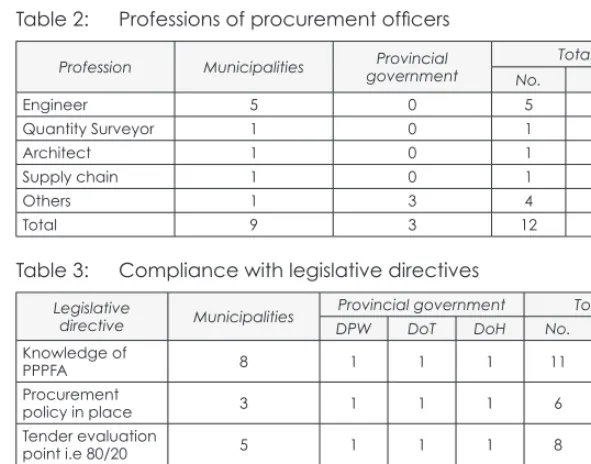
Table 2: Professions of procurement officers
Profession Municipalities governmentProvincial Total
No. %
Engineer 5 0 5 42.0
Quantity Surveyor 1 0 1 8.0
Architect 1 0 1 8.0
Supply chain 1 0 1 8.0
Others 1 3 4 33.0
Total 9 3 12 100.0
Table 3: Compliance with legislative directives
Legislative
directive Municipalities
Provincial government Total
DPW DoT DoH No. %
Knowledge of
PPPFA 8 1 1 1 11 92.0
Procurement
policy in place 3 1 1 1 6 50.0
Tender evaluation
point i.e 80/20 5 1 1 1 8 67.0
Functional tender
committee 8 1 1 1 11 92.0
[image:10.471.73.369.61.293.2]Table 4 indicates that the respondents are of the opinion that seven public-sector institutions have tender technical personnel (58%); twelve public-sector institutions have tender committees (100%), and five public-sector institutions have audit committees as part of PPPFA-related required management structures (42%). In particular, four municipalities have tender technical personnel, nine municipalities have tender committees, and three municipalities have audit committees in place. It is also notable that, with the exception of the DoT, all three provincial departments have the desired management structures in place.
Table 4: Institutional set-up for procurement function
Statutory
structures Municipalities
Provincial government Total
DPW DoT DoH No. %
Tender technical 4 1 1 1 7 58.0
Tender
committee 9 1 1 1 12 100.0
Audit committee 3 1 0 1 5 42.0
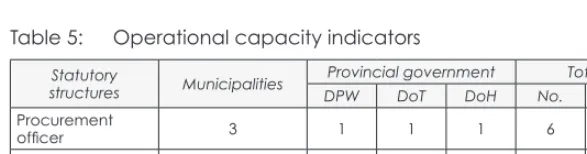
[image:10.471.71.370.425.494.2]municipalities and the provincial departments place statutory structures such as procurement officers, a procurement unit, and procurement employees in place. In effect, only 50% of the public sectors have operational capacities required for the implementation of PPPFA procurement directives. Therefore, within the surveyed institutions, the capacity of procurement units varies from one support employee to a multi-disciplinary team of personnel who account to the procurement officer.
Table 5: Operational capacity indicators
Statutory
structures Municipalities
Provincial government Total
DPW DoT DoH No. %
Procurement
officer 3 1 1 1 6 50.0
Procurement unit 3 1 1 1 6 50.0
Procurement staff 3 1 1 1 6 50.0
Hence, it can be assumed from the above analysis that institutions follow different processes in the procurement of consultants, since appointments are strongly dictated by institutional capacity arrangements or limitations. The analysis of the aforementioned findings ultimately led to the emergence of two distinct categories of institutions pertaining to the discourse. The categories include:
Category 1: Institutions with procurement units, and •
Category 2: Institutions without procurement units. •
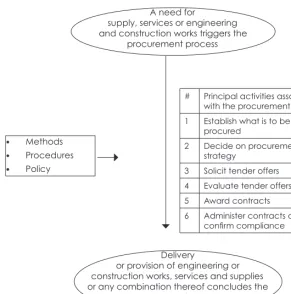
Figure 1: Components of a procurement system Source: Watermeyer 2004: 33
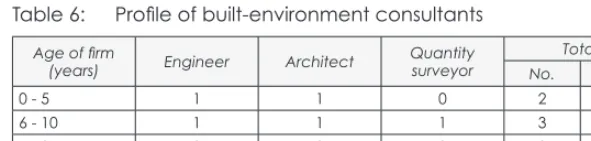
Having considered the issues that may influence the appointment of consultants by public-sector institutions based at Amathole, the views of built-environment consultants were sought in order to arrive at robust perspectives relative to PPPFA implementation. To this end, Table 6 indicates the professional group, as well as the age of the businesses that were surveyed. In particular, all respondents to the survey were directors of their respective businesses at the time of the research, possessing either an academic diploma or degree qualification. Out of the thirteen consulting practices surveyed, 61.5% have been in existence for over ten years, 23.1% have been in existence for over six years, but less than ten years, while 15.4% have been in existence for less than five years. Therefore, it can be assumed that the majority of the built-environment respondents are
A need for
supply, services or engineering and construction works triggers the
procurement process
Methods •
Procedures •
Policy •
Delivery
or provision of engineering or construction works, services and supplies or any combination thereof concludes the
procurement process
# Principal activities associated with the procurement
1 Establish what is to be procured
2 Decide on procurement strategy
3 Solicit tender offers 4 Evaluate tender offers 5 Award contracts 6 Administer contracts and
[image:12.471.76.368.68.362.2]sufficiently experienced in the industry to provide valid inputs relative to the subject under investigation.
Table 6: Profile of built-environment consultants
Age of firm
(years) Engineer Architect Quantity surveyor
Total
No. %
0 - 5 1 1 0 2 15.4
6 - 10 1 1 1 3 23.1
> 10 8 0 0 8 61.5
[image:13.471.59.355.100.170.2]Table 7 indicates the level of the consulting practices’ awareness of the PPPFA. The table suggests that 76.9% of the engineers that responded to the survey are aware of the PPPFA, while 7.7% of the architects and quantity surveyors surveyed affirmed their awareness of the Act. Perhaps, the high percentage of awareness reflected relative to engineers may be ascribed to the fact that engineering consultancies constitute the greater percentage of respondents. Table 7: Awareness of Act No. 5 of 2000: Preferential Procurement
Policy Framework Act, 2000
Profession Yes (%)
Engineer 76.9
Architect 7.7
Quantity surveyor 7.7
[image:13.471.60.357.257.329.2]Table 8 indicates the respondents’ perceptions relative to public-sector compliance with PPPFA requirements. The findings suggest that 61.5% of the respondents are of the opinion that they comply with the ‘developed equity plan’-related PPPFA directive; 76.9% with the ‘established equity targets’-related PPPFA directive; while 15.4% with the ‘established equity committee’-related PPPFA directive. However, it is notable that none comply with the ‘HDIs in equity committee’ directive.
Table 8: Observing preferential procurement policy requirements
PPPFA directive Engineer Architect Quantity surveyor Total
No. %
Developed equity plan 8 0 0 8 61.5
Established equity
committee 2 0 0 2 15.4
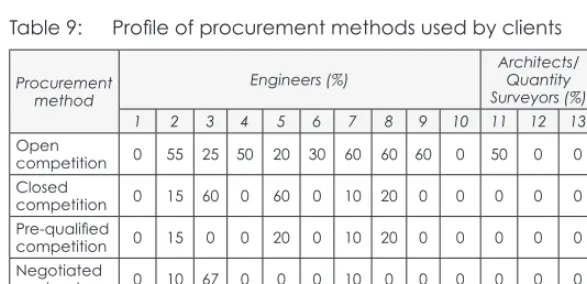
[image:13.471.60.352.436.522.2]Table 9 indicates the respondents’ perceptions of procurement methods used for engaging built-environment consultants after the promulgation of the PPPFA Act in 2000. Specifically, the respondents perceive that on average: 31.5% of appointments are based on open competition; 12.7% are based on closed competition, and 45.5% are based on selection/roster. However, given the 5.0% and 6.7% response percentages, the appointments based on pre-qualified competition and negotiated contracts can be deemed to be limited.
Table 9: Profile of procurement methods used by clients
Procurement method
Engineers (%) Architects/Quantity Surveyors (%) Mean (%)
1 2 3 4 5 6 7 8 9 10 11 12 13
Open
competition 0 55 25 50 20 30 60 60 60 0 50 0 0 31.5 Closed
competition 0 15 60 0 60 0 10 20 0 0 0 0 0 12.7 Pre-qualified
competition 0 15 0 0 20 0 10 20 0 0 0 0 0 5.0 Negotiated
contract 0 10 67 0 0 0 10 0 0 0 0 0 0 6.7 Selection/
Roster 0 5 67 50 0 70 10 0 40 100 50 100 100 45.5
5.
Conclusions and recommendations
In addition, synergy must be developed between provincial and local government procurement policies and structures for effective preferential procurement monitoring. This must be conducted under the supervision of a neutral procurement ombudsman to prevent social complexities as envisaged in the Ten-point plan. Perhaps the CIDB can perform the function of ombudsman. Policy must address, inter alia, the dynamic nature of services being procured, and the different types of project. Consultation with stakeholders such as consultants should be given priority when developing such policies so that common ground is achieved with procurement strategies. In this way, public-sector institutions would be obliged to take charge of their responsibility and can be monitored on a continuous basis with persistent support being provided in a structured manner. Integrating procurement as part of the performance management systems and developing a balance scorecard wherein preferential procurement inputs, processes and outputs are clearly stipulated and easy to monitor is deemed necessary.
References
ADM (Amathole District Municipality). 2011. 2011/2012 draft integrated development plan: Version 5 of IDP 2007-2012. East London: ADM.
Bowen, P., Pearl, R., Cattell, K., Hunter, K. & Kelly, J. 2007. The role of value management in achieving best value in public sector service delivery in South Africa: A research agenda. Acta Structilia, 14(2), pp. 58-75.
CIDB (Construction Industry Development Board). 2004. Best practice guideline B1: Formulating and implementing preferential procurement policies:1st edition of CIDB document 1007. Pretoria:
CIDB.
CIDB (Construction Industry Development Board). 2007. Best practice guideline A7: Procurement of professional services: 2nd edition of
CIDB document 1035. Pretoria: CIDB.
DPLG (Department of Provincial and Local Government). 2006. Municipal Infrastructure: Roles and responsibilities of National Sector Department, Provincial counterparts and Municipalities. Pretoria: DPLG.
Conference, University of Salford, 29 November-1 December 2006, pp. 298-309.
Leedy, P.D. & Ormrod, J.E. 2005. Practical research: Planning and design. 8th ed. New Jersey: Pearson Prentice Hall.
Republic of South Africa. 2000a. Act No. 5 of 2000: Preferential Procurement Policy Framework Act, 2000. Pretoria: Government Printer.
Republic of South Africa. 2000b. Act No. 43 of 2000: Council for the Built Environment Act, 2000. Pretoria: Government Printer.
Republic of South Africa. 2000c. Act No. 38 of 2000: Construction Industry Development Board Act, 2000. Pretoria: Government Printer.
Republic of South Africa. 2003. Act No. 53 of 2003: Broad Based Black Economic Empowerment Act, 2003. Pretoria: Government Printer. SAACE (South African Association of Consulting Engineers). 2006. Guideline: How to select and appoint a consulting engineer. Johannesburg: SAACE.