Proceedings of the 2nd Workshop on Deep Learning Approaches for Low-Resource NLP (DeepLo), pages 56–66 56
Cross-lingual Joint Entity and Word Embedding to Improve Entity
Linking and Parallel Sentence Mining
Xiaoman Pan∗, Thamme Gowda‡, Heng Ji∗†, Jonathan May‡, Scott Miller‡
∗Department of Computer Science†Department of Electrical and Computer Engineering
University of Illinois at Urbana-Champaign
{xiaoman6,hengji}@illinois.edu
‡Information Sciences Institute, University of Southern California
{tg,jonmay,smiller}@isi.edu
Abstract
Entities, which refer to distinct objects in the real world, can be viewed as language univer-sals and used as effective signals to generate less ambiguous semantic representations and align multiple languages. We propose a novel method,CLEW, to generate cross-lingual data that is a mix of entities and contextual words based on Wikipedia. We replace each an-chor link in the source language with its corre-sponding entity title in the target language if it exists, or in the source language otherwise. A cross-lingual joint entity and word embedding learned from this kind of data not only can dis-ambiguate linkable entities but can also effec-tively represent unlinkable entities. Because this multilingual common space directly re-lates the semantics of contextual words in the source language to that of entities in the tar-get language, we leverage it for unsupervised cross-lingual entity linking. Experimental re-sults show thatCLEW significantly advances the state-of-the-art: up to 3.1% absolute F-score gain for unsupervised cross-lingual en-tity linking. Moreover, it provides reliable alignment on both the word/entity level and the sentence level, and thus we use it to mine parallel sentences for all 3022 language pairs in Wikipedia.1
1 Introduction
The sheer amount of natural language data pro-vides a great opportunity to represent named en-tity mentions by their probability distributions, so that they can be exploited for many Natural Lan-guage Processing (NLP) applications. However, named entity mentions are fundamentally differ-ent from common words or phrases in three as-pects. First, the semantic meaning of a named
1We make all software and resources publicly
avail-able for research purpose athttp://panx27.github.io/ wikiann.
entity mention (e.g., a person name “Bill Gates”) is not a simple summation of the meanings of the words it contains (“Bill” + “Gates”). Second, en-tity mentions are often highly ambiguous in var-ious local contexts. For example, “Michael Jor-dan” may refer to the basketball player or the com-puter science professor. Third, representing entity mentions as mere phrases fails when names are rendered quite differently, especially when they appear across multiple languages. For example, “Ang Lee” in English is “Li An” in Chinese.
Fortunately, entities, the objects which men-tions refer to, are unique and equivalent across lan-guages. Many manually constructed entity-centric knowledge base resources such as Wikipedia2, DBPedia (Auer et al.,2007) and YAGO (Suchanek et al.,2007) are widely available. Even better, they are massively multilingual. For example, up to August 2018, Wikipedia contains 21 million inter-language links3between 302 languages. We pro-pose a novel cross-lingual joint entity and word (CLEW) embedding learning framework based on multilingual Wikipedia and evaluate its effective-ness on two practical NLP applications: Cross-lingual Entity Linking and Parallel Sentence Min-ing.
Wikipedia contains rich entity anchor links. As shown in Figure 2, many mentions (e.g., “小米” (Xiaomi)) in a source language are linked to the entities in the same language that they refer to (e.g., zh/小米科技 (Xiaomi Technology)), and some mentions are further linked to their corre-sponding English entities (e.g., Chinese mention “苹果” (Apple) is linked to entityen/Apple_Inc.
in English). We replace each mention (anchor link) in the source language with its corresponding entity title in the target language if it exists, or in
2
https://www.wikipedia.org
the source language otherwise. After this replace-ment, each entity mention is treated as a unique disambiguated entity, then we can learn joint en-tity and word embedding representations for the source language and target language respectively.
Furthermore, we leverage these shared target language entities as pivots to learn a rotation ma-trix and seamlessly align two embedding spaces into one by linear mapping. In this unified com-mon space, multiple mentions are reliably disam-biguated and grounded, which enables us to di-rectly compute the semantic similarity between a mention in a source language and an entity in a target language (e.g., English), and thus we can perform Cross-lingual Entity Linking in an unsu-pervised way, without using any training data. In addition, considering each pair of Wikipedia arti-cles connected by an inter-language link as parable documents, we use this multilingual com-mon space to represent sentences and extract many parallel sentence pairs.
The novel contributions of this paper are:
• We develop a novel approach based on rich anchor links in Wikipedia to learn cross-lingual joint entity and word embedding, so that entity mentions across multiple lan-guages are disambiguated and grounded into one unified common space.
• Using this joint entity and word embedding space, entity mentions in any language can be linked to an English knowledge base with-out any annotation cost. We achieve state-of-the-art performance on unsupervised cross-lingual entity linking.
• We construct a rich resource of parallel sen-tences for 3022 language pairs along with ac-curate entity alignment and word alignment.
2 Approach
2.1 Training Data Generation
Wikipedia contains rich entity anchor links. For example, in the following sentence from En-glish Wikipedia markup: “[[Apple Inc.|apple]]
is a technology company.”, where [[Apple Inc.|apple]]is an anchor link that links the anchor text“apple”to the entityen/Apple_Inc.4
4In this paper, we uselangcode/entity_titleto
rep-resent entities in Wikipedia in each individual language. For example,en/*refers to an entity in English Wikipedia en.wikipedia.org/wiki/*.
Traditional approaches to derive training data from Wikipedia usually replace each anchor link with its anchor text, for example, “appleis a tech-nology company.”. These methods have two lim-itations: (1)Information loss: For example, the anchor text“apple”itself does not convey infor-mation such as the entity is a company; (2) Ambi-guity(Faruqui et al.,2016): For example, the fruit sense and the company sense of“apple” mistak-enly share one surface form. Similar to previous work (Wang et al.,2014;Tsai and Roth,2016; Ya-mada et al., 2016), we replace each anchor link with its corresponding entity title, and thus treat each entity title as a unique word. For example, “en/Apple_Inc.is a technology company.”. Us-ing this kind of data mix of entity titles and con-textual words, we can learn joint embedding of en-tities and words.
en/Steve_Jobs en/Microsoft
en/Cashew en/Pear
pear
fruit cashewwine juice
apple
computer microsoft company
steve jobs ibm
macintosh
pear fruit juice
apple
computer microsoft
company jobs
en/Apple
en/Apple_Inc.
cashew
steve
[image:2.595.309.520.318.418.2]entity word word
Figure 1: Traditional word embedding (left), and joint entity and word embedding (right).
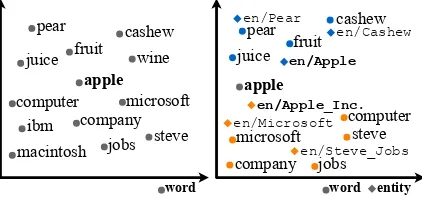
The results from traditional word embedding and joint entity and word embedding for “apple” are visualized through Principal Component Anal-ysis (PCA) in Figure 1. Using the joint embed-ding we can successfully separate those words referring to fruit and others referring to compa-nies in the vector space. Moreover, the similar-ity can be computed based on entsimilar-ity-level instead of word-level. For example, en/Apple_Inc and
en/Steve_Jobsare close in the vector space be-cause they share many context words and entities. Moreover, the above approach can be easily extended to the cross-lingual setting by using Wikipedia inter-language links. We replace each anchor link in a source language with its corre-sponding entity title in a target language if it exists, and otherwise replace each anchor link with its corresponding entity title in the source language. An example is illustrated in Figure2.
Fig-[[⼩⽶科技|⼩⽶]]被誉为中国的[[苹果公司|苹果]]。
en/Apple_Inc.
zh/苹果公司
zh/⼩⽶科技
link
langlink
zh/⼩⽶科技 被 誉为 中国的 en/Apple_Inc. 。
(Xiaomi) (is) (known as) (Chinese)
Example Chinese Wikipedia Sentence:
Generated Sentence:
link
langlink
[image:3.595.96.267.228.347.2]None
Figure 2: Using Wikipedia inter-language links to gen-erate sentences which contain words and entities in a source language (e.g.,Chinese) and entities in a target language (e.g.,English).
English entity Chinese entity Chinese word
(microsoft)
en/Apple
(pear)
(fruit) (tree)
(apple)
(computer) (phone)
(company)
en/Apple_Inc.
en/Microsoft zh/ (Xiaomi)
en/Pear zh/ (Arbor)
Figure 3: Embedding which includes entities in En-glish, and words and entities in Chinese (English words in brackets are human translations of Chinese words).
ure3.
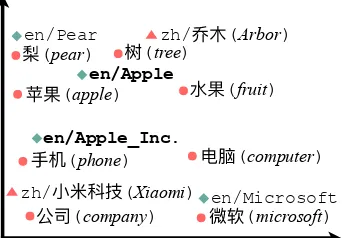
This joint representation has two advantages: (1) Disambiguation: For example, two entities
en/Apple_Inc.anden/Applecan be differenti-ated by their distinct neighbors “电脑” (computer) and “水果” (fruit) respectively. (2)Effective rep-resentation of unknown entities: For example, the new entityzh/小米科技(Xiaomi Technology), a Chinese mobile phone manufacturer, may not have an English Wikipedia page yet. But because it’s close to neighbors such asen/Microsoft, “手
机” (phone) and “公司” (company), we can infer it’s likely to be a technology company.
2.2 Linear Mapping across Languages
Word embedding spaces have similar geometric arrangements across languages (Mikolov et al.,
2013b). Given two sets of independently trained word embedding, the source language embedding
ZS and the target language embedding ZT, and
a set of pre-aligned word pairs, a linear mapping
Wis learned to transformZSinto a shared space
where the distance between the embedding of the source language word and the embedding of its
pre-aligned target language word is minimized. For example, given a set of pre-aligned word pairs, we use X andY to denote two aligned matrices which contain the embedding of the pre-aligned words from ZS and ZT respectively. A linear
mappingWcan be learned such that:
argmin W
||WX−Y||F
Previous work (Xing et al.,2015;Smith et al.,
2017) shows that enforcing an orthogonal con-straint W yields better performance. Conse-quently, the above equation can be transferred to Orthogonal Procrustes problem (Conneau et al.,
2017):
argmin W
||WX−Y||F=UV>
ThenWcan be obtained from the singular value decomposition (SVD) ofYX>such that:
UΣV>= SVD(YX>)
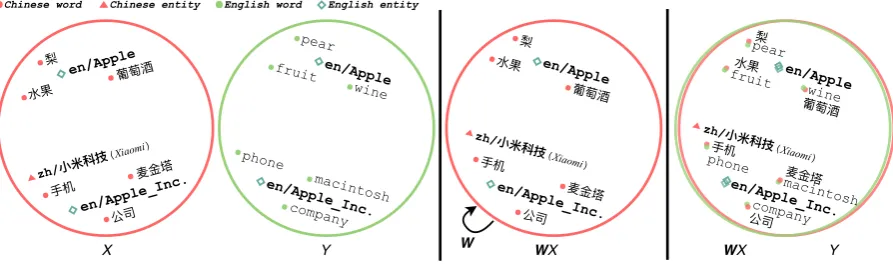
In this paper, we propose using entities instead of pre-aligned words as anchors to learn such a linear mappingW. The basic idea is illustrated in Figure4. We use ET andWT to denote the sets
of entities and words in the target language asso-ciated with the target entity and word embedding
ZT:
ZT ={zte
1, ..,z
t e|E
T|,z t w1, ..,z
t w|W
T| }
Similarly, we useESandWSto denote the sets of entities and words in the source language associ-ated with the source entity and word embedding
ZS:
ZS={zs e1, ..,z
s e|ES|,z
s w1, ..,z
s w|WS|}
and use E0T to denote the set of entities in the source language which are replaced with the cor-responding entities in the target language, where
E0T ∈ ET. ThenZScan be represented as
ZS ={zte0
1, ..,z
t0 e|E0T|,z
s e1, ..,z
s
e|ES|−|E0T|,
zsw1, ..,zsw|W S|
}
Note that ztei andzte0i are the embedding of ei in ZT andZSrespectively. Therefore, using entities
en/Apple_Inc. en/Apple
X
pear
fruit
wine
phone
macintosh
company en/Apple_Inc.
en/Apple
Y W WX Y
pear
wine
macintosh company en/Apple_Inc.
en/Apple fruit
phone English word
Chinese word
zh/
(Xiaomi) Chinese entity
en/Apple_Inc. en/Apple
WX zh/
(Xiaomi) zh/
(Xiaomi)
[image:4.595.76.523.64.196.2]English entity
Figure 4: Using the aligned entities as anchors to learn a linear mapping (rotation matrix) which maps a source language embedding space to a target language embedding space.
obtain the cross-lingual joint entity and word em-beddingZ.
We adopt the refinement procedure proposed by Conneau et al. (2017) to improve the quality ofW. A set of new high-quality anchors is gen-erated to refineWlearned fromE0
T. High-quality
anchors refer to entities that have high frequency (e.g.,top 5,000) and entities that are mutual near-est neighbors. We iteratively apply this procedure to optimize W. At each iteration, the new high-quality anchors are exploited to learn a new map-ping.
Conneau et al. (2017) also propose a novel comparison metric, Cross-domain Similarity Lo-cal SLo-caling (CSLS), to relieve the hubness phe-nomenon, where some vectors (hubs) are the near-est neighbors of many others. For example, entity
en/United_Statesis a hubin the vector space. By employing this metric, the similarity of iso-lated vectors is increased, while the similarity of vectors in dense areas is decreased. Specifically, given a mapped source embeddingWxand a tar-get embedding y, the mean cosine similarity of
Wx and y for their K nearest neighbors in the other language,rT(Wx)andrS(y)are computed
respectively. The comparison metric is defined as follows:
CSLS(Wx,y) = cos(Wx,y)−rT(Wx) −rS(y)
Conneau et al. (2017) show that the performance is essentially the same whenK = 5,10,50. Fol-lowing this work, we setK = 10.
3 Downstream Applications
We applyCLEWto enhance two important down-stream tasks: Cross-lingual Entity Linking and Parallel Sentence Mining.
3.1 Unsupervised Cross-lingual Entity Linking
Cross-lingual Entity Linking aims to link an entity mention in a source language text to its referent entity in a knowledge base (KB) in a target lan-guage (e.g.,English Wikipedia). A typical Cross-lingual Entity Linking framework includes three steps: mention translation, entity candidate gener-ation, and mention disambiguation. We use trans-lation dictionaries collected from Wikipedia (Ji et al.,2009) to translate each mention into English. If a mention has multiple translations, we merge the linking results of all translations at the end. We adopt a dictionary-based approach (Medelyan and Legg,2008) to generate entity candidates for each mention. Then we use CLEW to implement the following two widely used mention disambigua-tion features: Context Similarity and Coherence.
Context Similarity refers to the context simi-larity between a mention and a candidate entity. Given a mention m, we consider the entire sen-tence containing m as its local context. Using
CLEWembeddingZ, the vectors of context words are averaged to obtain the context vector represen-tation ofm:
vm= 1 |Wm|
X
w∈Wm
zw
whereWm is the set of context words ofm, and zw ∈ Z is the embedding of the context word
w. We measure context similarity between m and each of its entity candidates by using the co-sine similarity betweenvmand entity embedding ze∈ Z such that:
Ftxt(e) =cos(vm,ze) =
Feature Description
Fprior(e) Entity Prior: |Ae,∗|
|A∗,∗|, whereAe,∗is a set of anchor links that link to entityeandA∗,∗is
all anchor links in the KB
Fprob(e|m) Mention to Entity Probability: |Ae,m|
|A∗,m|, whereA∗,mis a set of anchor links with anchor
textmandAe,mis a subset that links to entitye. Ftype(e|m, t) Entity Type (Ling et al.,2015): Pp(e|m)
e7→tp(e|m), wheree7→tindicates thattis one ofe’s
[image:5.595.70.529.71.173.2]entity types. Conditional probabilityp(e|m)can be estimated byFprob(e|m).
Table 1: Mention disambiguation features.
Coherence is driven by the assumption that if multiple mentions appear together within a con-text window, their referent entities are more likely to be strongly connected to each other in the KB. Previous work (Cucerzan, 2007;Milne and Wit-ten,2008;Hoffart et al.,2011;Ratinov et al.,2011;
Cheng and Roth, 2013; Ceccarelli et al., 2013;
Ling et al., 2015) considers the KB as a knowl-edge graph and models coherence based on the overlapped neighbors of two entities in the knowl-edge graph. These approaches heavily rely on explicit connections among entities in the knowl-edge graph and thus cannot capture the coher-ence between two entities that are implicitly con-nected. For example, two entitiesen/Mosquito
and en/Cockroach only have very few over-lapped neighbors in the knowledge graph, but they usually appear together and have similar contexts in text. Using CLEW embedding Z, the coher-ence score can be estimated by cosine similarity between the embedding of two entities. This co-herence metric pays more attention to semantics.
We consider mentions that appear in the same sentence as coherent. Let m be a mention, and
Cebe the set of corresponding entity candidates of m’s coherent mentions. The coherence score for each ofm’s entity candidates is the average:
Fcoh(e) = 1 |Ce|
X
ce∈Ce
cos(ze,zce)
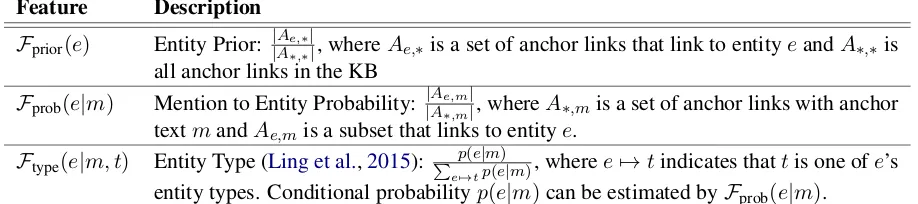
Finally, we linearly combine these two features with several other common mention disambigua-tion features as shown in Table1.
3.2 Parallel Sentence Mining
One major bottleneck of low-resource language machine translation is the lack of parallel sen-tences. This inspires us to mine parallel sentences from Wikipedia automatically using CLEW em-beddingZ.
Wikipedia contributors tend to translate some content from existing articles in other languages while editing an article. Therefore, if there exists an inter-language link between two Wikipedia ar-ticles in different languages, these two arar-ticles can be considered comparable and thus they are very likely to contain parallel sentences. We represent a Wikipedia sentence in any of the 302 languages by aggregating the embedding of entities and words it contains. In order to penalize high frequent words and entities, we apply a weighted metric:
IDF(t,S) = log
|S|
|{s∈ S :t∈s}|
wheretis a term (entity or word),S is an article containing|S| sentences, and|{s ∈ S : t ∈ s}|
is the total number of sentences containingt. The embedding of a sentencevscan be computed as:
vs= 1 |Ts|
X
t∈Ts
IDF(t,S)·zt
whereTsis the set of terms ofsandzt∈ Z is the
embedding oft.
4 Experiments
4.1 Training Data
We use an April 1, 2018 Wikipedia XML dump to generate data to train the joint entity and word em-bedding. We only select and analyze those main Wikipedia pages (nstag is 0) which are not redi-rected (redirecttag is None) using the approach described in Section 2.1. We use the Skip-gram model in Word2Vec (Mikolov et al., 2013a,c) to learn the unaligned embeddings. The number of dimensions of the embedding is set to 300, and the minimal number of occurrences, the size of the context window, and the learning rate are set to 5, 5, and 0.025 respectively.
4.2 Linear Mapping
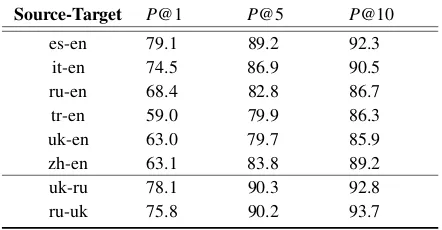
A large number of aligned entities can be obtained using the approach described in Section 2.1. For example, there are about 400,000 aligned entities between English and Spanish. However, the map-ping algorithm does not perform well if we try to align all anchors, because the embedding of rare entities is updated less often, and thus their con-texts are very different across languages. There-fore, we learn the global mapping using only high-quality anchors, and select high-frequency enti-ties only as anchors using the salience metric de-scribed in Table1. We use 5,000 anchors for train-ing and 1,500 anchors for testtrain-ing for each lan-guage pair. Our proposed method is applied to 9 language pairs in our experiments. Table2shows the statistics and the performance. We can see that mapping a language to its related language (e.g.,
Ukrainian to Russian) usually achieves better per-formance.
Source-Target P@1 P@5 P@10
es-en 79.1 89.2 92.3
it-en 74.5 86.9 90.5
ru-en 68.4 82.8 86.7
tr-en 59.0 79.9 86.3
uk-en 63.0 79.7 85.9
zh-en 63.1 83.8 89.2
uk-ru 78.1 90.3 92.8
ru-uk 75.8 90.2 93.7
Table 2: Linear entity mapping statistics and perfor-mance (Precision (%) atK) (en: English, es: Spanish, it: Italian, ru: Russian, so: Somali, tr: Turkish, uk: Ukrainian, zh: Chinese).
4.3 Cross-lingual Entity Linking
We use the training set and evaluation set (LDC2015E75 and LDC2015E103) in TAC Knowledge Base Population (TAC-KBP) 2015 Tri-lingual Entity Linking Track (Ji et al., 2015) for the cross-lingual entity linking experiments, because these data sets include the most recent and comprehensive gold-standard annotations on this task and we can compare our model with previ-ously reported state-of-the-art approaches on the same benchmark.
We first compare our unsupervised approach to the top TAC2015 unsupervised system reported by Ji et al. (2015). In order to have a fair com-parison with the state-of-the-art supervised meth-ods, we also combine the features as described in Section 3.1 in a point-wised learning to rank algorithm based on Gradient Boosted Regression Trees (Friedman,2000). The learning rate and the maximum depth of the decision trees are set to
0.01and4 respectively. The results are shown in Table3. We can see that our unsupervised and su-pervised approaches significantly outperform the best TAC15 systems.
Method ENG CMN SPA
Best TAC15 Unsupervised 67.1 78.1 71.5 Our Unsupervised 70.0 81.2 73.4
[image:6.595.306.526.406.544.2]w/o Context Similarity 66.9 79.0 70.6 w/o Coherence 68.5 78.6 71.4 Best TAC15 Supervised 73.7 83.1 80.4 (Tsai and Roth,2016) - 83.6 80.9 (Sil et al.,2017) - 84.4 82.3 Our Supervised 74.8 84.2 82.1 w/o Context Similarity 72.2 80.4 79.5 w/o Coherence 73.3 82.1 77.8
Table 3: F1 (%) of the evaluation set in TAC KBP 2015 Tri-lingual Entity Linking Track (Ji et al.,2015) (ENG: English, CMN: Chinese, SPA: Spanish).
We further observe that Context Similarity and Coherence features derived from Z play signif-icant roles. Without such features, the perfor-mance drops significantly, as shown in Table 3. For example, in the following sentence: “欧 盟委员会副主席雷雷雷丁丁丁就此表示... (Euro-pean Commission vice president Redding said that...)”, without Context Similarity feature, men-tion “雷雷雷丁丁丁(Redding)” is likely to be linked to the football club en/Reading_F.C. or the city
[image:6.595.71.292.577.692.2]席(president)”, we can successfully link this men-tion to the target entityen/Viviane_Reding.
4.4 Parallel Sentence Mining
The proposed parallel sentence mining approach can be applied to any two languages in Wikipedia. Therefore, we have mined parallel sentences from a total number of 3022
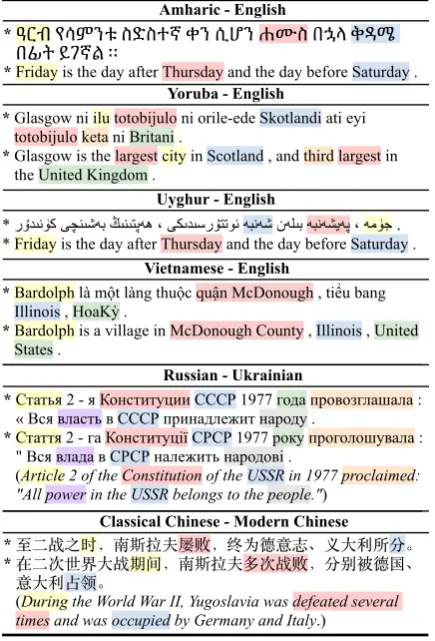
language pairs and made this data set publicly available for research pur-pose. Table4shows some examples of mined par-allel sentences from Wikipedia, with word and en-tity alignment highlighted.
*ዓርብየሳምንቱስድስተኛቀንሲሆንሐሙስበኋላቅዳሜ
በፊትይገኛል።
* Friday is the day after Thursday and the day before Saturday .
Amharic - English
Yoruba - English
* Glasgow ni ilu totobijulo ni orile-ede Skotlandi ati eyi totobijulo keta ni Britani .
* Glasgow is the largest city in Scotland , and third largest in the United Kingdom .
Uyghur - English
* رۇﺪ ﻧﯜﻛﻰﭽﻨ ﺷ ﺑﯔ ﻨ ﺘﭘ ھ،ﻰﻜ ﺪ ﺳرﯘﺘﺗﻮﺋ ﺒﻧ ﺷن ﻠ ﺑ ﺒﻧ ﺸﯾ ﭘ، ﻣﯜﺟ .
* Friday is the day after Thursday and the day before Saturday .
Russian - Ukrainian
* Статья 2 - я Конституции СССР 1977 года провозглашала : « Вся власть в СССР принадлежит народу .
* Стаття 2 - га Конституції СРСР 1977 року проголошувала : " Вся влада в СРСР належить народові .
(Article 2 of the Constitution of the USSR in 1977 proclaimed:
"All power in the USSR belongs to the people.")
*⾄⼆战之时,南斯拉夫屡败,终为德意志、义⼤利所分。
*在⼆次世界⼤战期间,南斯拉夫多次战败,分别被德国、
意⼤利占领。
(During the World War II, Yugoslavia was defeated several times and was occupied by Germany and Italy.)
Classical Chinese - Modern Chinese Vietnamese - English
* Bardolph là một làng thuộc quận McDonough , tiểu bang Illinois , HoaKỳ .
* Bardolph is a village in McDonough County , Illinois , United States .
Table 4: Examples of mined parallel sentences from Wikipedia. A portion of alignments are highlighted us-ing the same colors.
We randomly select 100 mined parallel sentence pairs for each of 3 language pairs, and ask linguis-tic experts to judge the quality of these sentence pairs (perfect, partial, or not parallel). The results are shown in Table 5. We can see that the qual-ity of mined parallel sentence is promising and the quality of word and entity alignment is decent.
Furthermore, we evaluate the quality of mined parallel sentences extrinsically using a neural ma-chine translation (NMT) model. We use the
Language Pairs Prefect Partial Word Entity
[image:7.595.73.291.248.569.2]Chinese-English 81% 10% 92.3% 95.5% Spanish-English 75% 13% 89.7% 91.1% Russian-Ukrainian 70% 16% 82.4% 90.3%
Table 5: Quality of the mined parallel sentences (Per-fect and Partial stand for the percentage of per(Per-fect and partial respectively; Word and Entity stand for the Ac-curacy of word and entity alignments respectively).
Transformer model (Vaswani et al., 2017) im-plemented by Tensor2Tensor5. Our Transformer model has 6 encoder and decoder layers, 8 at-tention heads, 512-dimension hidden states, 2048-dimension feed-forward layers, dropout of 0.1 and label smoothing of 0.1. The model is trained up to 128,000 optimizer steps.
Using the NMT model as a black box, we per-form two experiments using the following training and tuning settings:
• Baseline: 44,000 training and 1,000 tun-ing sentences randomly sampled from the WMT17 News Commentary v12 Russian-English Corpus (Bojar et al.,2016).
• Our approach: Adding 44,000 training and 1,000 tuning sentences mined from Wikipedia usingCLEW.
Using 1,000 randomly selected sentences from WMT 17 corpus for testing, the baseline achieves 19.0% BLEU score while our approach achieves 20.8% BLEU score.
5 Related Work
Cross-lingual Word Embedding Learning.
Mikolov et al. (2013b) first notice that word embedding spaces have similar geometric ar-rangements across languages. They use this property to learn a linear mapping between two spaces. After that, several methods attempt to improve the mapping (Faruqui and Dyer, 2014;
Xing et al., 2015;Lazaridou et al.,2015;Ammar et al., 2016; Artetxe et al., 2017; Smith et al.,
2017). The measures used to compute similarity between a foreign word and an English word often include distributed monolingual representations on character-level (Costa-jussà and Fonollosa,
2016; Luong and Manning, 2016), subword-level (Anwarus Salam et al., 2012; Rei et al.,
2016; Sennrich et al., 2016; Yang et al., 2017), and bi-lingual word embedding (Madhyastha and España-Bonet, 2017). Recent attempts have shown that it is possible to derive cross-lingual word embedding from unaligned corpora in an unsupervised fashion (Zhang et al., 2017;
Conneau et al.,2017;Artetxe et al.,2018).
Another strategy for cross-lingual word em-bedding learning is to combine monolingual and cross-lingual training objectives (Zou et al.,2013;
Klementiev et al.,2012;Luong et al.,2015; Am-mar et al.,2016;Vuli´c et al.,2017). Compared to our direct mapping approach, these methods gen-erally require large size of parallel data.
Our work is largely inspired from (Conneau et al.,2017). However, our work focuses on better representing entities, which are fundamentally dif-ferent from common words or phrases in many as-pects as described in Section1. Previous multilin-gual word embedding efforts including (Conneau et al.,2017) do not explicitly handle entity repre-sentations. Moreover, we perform comprehensive extrinsic evaluations based on down-stream NLP applications including cross-lingual entity linking and machine translation, while previous work on cross-lingual embedding only focused on intrinsic evaluations.
Cross-lingual Joint Entity and Word Embed-ding Learning. Previous work on cross-lingual joint entity and word embedding methods largely neglect unlinkable entities (Tsai and Roth,2016) and heavily rely on parallel or comparable sen-tences (Cao et al.,2018).Tsai and Roth(2016) ap-ply a similar approach to generate code-switched data from Wikipedia, but their framework does not keep entities in the source language. Using all aligned entities as a dictionary, they adopt canon-ical correlation analysis to project two embed-ding spaces into one. In contrast, we only choose salient entities as anchors to learn a linear map-ping. Cao et al.(2018) generate comparable data via distant supervision over multilingual knowl-edge bases, and use an entity regularizer and a sentence regularizer to align cross-lingual words and entities. Further, they design knowledge atten-tion and cross-lingual attenatten-tion to refine the align-ment. Essentially, they train cross-lingual embed-ding jointly, while we align two embedembed-ding spaces that trained independently. Moreover, compared to their approach that relies on comparable data, aligned entities are easier to acquire.
Parallel Sentence Mining. Automatic mining parallel sentences from comparable documents is an important and useful task to improve Statis-tical Machine Translation. Early efforts mainly exploited bilingual word dictionaries for boot-strapping (Fung and Cheung, 2004). Recent ap-proaches are mainly based on bilingual word em-beddings (Marie and Fujita, 2017) and sentence embeddings (Schwenk, 2018) to detect sentence pairs or continuous parallel segments (Hangya and Fraser,2019). To the best of our knowledge, this is the first work to incorporate joint entity and word embedding into parallel sentence mining. As a re-sult the sentence pairs we include reliable align-ment between entity align-mentions which are often out-of-vocabulary and ambiguous and thus receive poor alignment quality from previous methods.
6 Conclusions and Future Work
We developed a simple yet effective framework to learn cross-lingual joint entity and word embed-ding based on rich anchor links in Wikipedia. The learned embedding strongly enhances two down-stream applications: cross-lingual entity linking and parallel sentence mining. The results demon-strate that our proposed method advances the state-of-the-art for unsupervised cross-lingual en-tity linking task. We have also constructed a valu-able repository of parallel sentences for all lan-guage pairs in Wikipedia to share with the commu-nity. In the future, we will extend the framework to capture better representation of other types of knowledge elements such as relations and events.
Acknowledgments
References
Waleed Ammar, George Mulcaire, Yulia Tsvetkov, Guillaume Lample, Chris Dyer, and Noah A. Smith. 2016. Massively multilingual word embeddings. CoRR, abs/1602.01925.
Khan Md. Anwarus Salam, Setsuo Yamada, and Tet-suro Nishino. 2012. Sublexical translations for low-resource language. InProceedings of the Workshop on Machine Translation and Parsing in Indian Lan-guages, pages 39–52, Mumbai, India. The COLING 2012 Organizing Committee.
Mikel Artetxe, Gorka Labaka, and Eneko Agirre. 2017. Learning bilingual word embeddings with (almost) no bilingual data. InProceedings of the 55th Annual Meeting of the Association for Computational Lin-guistics (Volume 1: Long Papers), pages 451–462. Association for Computational Linguistics.
Mikel Artetxe, Gorka Labaka, and Eneko Agirre. 2018. A robust self-learning method for fully unsupervised cross-lingual mappings of word embeddings. In Proceedings of the 56th Annual Meeting of the As-sociation for Computational Linguistics (Volume 1: Long Papers), pages 789–798. Association for Com-putational Linguistics.
Sören Auer, Christian Bizer, Georgi Kobilarov, Jens Lehmann, Richard Cyganiak, and Zachary Ives. 2007. Dbpedia: A nucleus for a web of open data. In The Semantic Web, pages 722–735, Berlin, Hei-delberg. Springer Berlin HeiHei-delberg.
Ondrej Bojar, Rajen Chatterjee, Christian Federmann, Yvette Graham, Barry Haddow, Matthias Huck, An-tonio Jimeno Yepes, Philipp Koehn, Varvara Lo-gacheva, Christof Monz, et al. 2016. Findings of the 2016 conference on machine translation. In Pro-ceedings of the First Conference on Machine Trans-lation: Volume 2, Shared Task Papers, pages 131– 198. Association for Computational Linguistics.
Yixin Cao, Lei Hou, Juanzi Li, Zhiyuan Liu, Chengjiang Li, Xu Chen, and Tiansi Dong. 2018. Joint representation learning of cross-lingual words and entities via attentive distant supervision. In Pro-ceedings of the 2018 Conference on Empirical Meth-ods in Natural Language Processing, pages 227– 237. Association for Computational Linguistics.
Diego Ceccarelli, Claudio Lucchese, Salvatore Or-lando, Raffaele Perego, and Salvatore Trani. 2013. Learning relatedness measures for entity linking. In Proceedings of the 22Nd ACM International Con-ference on Information & Knowledge Management, CIKM ’13, pages 139–148, New York, NY, USA. ACM.
Xiao Cheng and Dan Roth. 2013.Relational inference for wikification. InProceedings of the 2013 Con-ference on Empirical Methods in Natural Language Processing, pages 1787–1796, Seattle, Washington, USA. Association for Computational Linguistics.
Alexis Conneau, Guillaume Lample, Marc’Aurelio Ranzato, Ludovic Denoyer, and Hervé Jégou. 2017. Word translation without parallel data. arXiv preprint arXiv:1710.04087.
Marta R. Costa-jussà and José A. R. Fonollosa. 2016. Character-based neural machine translation. In Pro-ceedings of the 54th Annual Meeting of the Associa-tion for ComputaAssocia-tional Linguistics (Volume 2: Short Papers), pages 357–361, Berlin, Germany. Associa-tion for ComputaAssocia-tional Linguistics.
Silviu Cucerzan. 2007. Large-scale named entity dis-ambiguation based on Wikipedia data. In Proceed-ings of the 2007 Joint Conference on Empirical Methods in Natural Language Processing and Com-putational Natural Language Learning (EMNLP-CoNLL), pages 708–716, Prague, Czech Republic. Association for Computational Linguistics.
Manaal Faruqui and Chris Dyer. 2014.Improving vec-tor space word representations using multilingual correlation. InProceedings of the 14th Conference of the European Chapter of the Association for Com-putational Linguistics, pages 462–471. Association for Computational Linguistics.
Manaal Faruqui, Yulia Tsvetkov, Pushpendre Rastogi, and Chris Dyer. 2016. Problems with evaluation of word embeddings using word similarity tasks. In Proceedings of the 1st Workshop on Evaluating Vector-Space Representations for NLP, pages 30– 35, Berlin, Germany. Association for Computational Linguistics.
Jerome H. Friedman. 2000. Greedy function approx-imation: A gradient boosting machine. Annals of Statistics, 29:1189–1232.
Pascale Fung and Percy Cheung. 2004. Mining very-non-parallel corpora: Parallel sentence and lexicon extraction via bootstrapping and e. In Proceed-ings of the 2004 Conference on Empirical Meth-ods in Natural Language Processing, pages 57–63, Barcelona, Spain. Association for Computational Linguistics.
Viktor Hangya and Alexander Fraser. 2019. Unsuper-vised parallel sentence extraction with parallel seg-ment detection helps machine translation. In Pro-ceedings of the 57th Annual Meeting of the Asso-ciation for Computational Linguistics, pages 1224– 1234, Florence, Italy. Association for Computa-tional Linguistics.
Heng Ji, Ralph Grishman, Dayne Freitag, Matthias Blume, John Wang, Shahram Khadivi, Richard Zens, and Hermann Ney. 2009. Name extraction and translation for distillation. Handbook of Natu-ral Language Processing and Machine Translation: DARPA Global Autonomous Language Exploitation.
Heng Ji, Joel Nothman, Ben Hachey, and Radu Flo-rian. 2015. Overview of tac-kbp2015 tri-lingual en-tity discovery and linking. In Proc. Text Analysis Conference (TAC2015).
Alexandre Klementiev, Ivan Titov, and Binod Bhat-tarai. 2012. Inducing crosslingual distributed rep-resentations of words. InProceedings of COLING 2012, pages 1459–1474. The COLING 2012 Orga-nizing Committee.
Angeliki Lazaridou, Georgiana Dinu, and Marco Ba-roni. 2015. Hubness and pollution: Delving into cross-space mapping for zero-shot learning. In Pro-ceedings of the 53rd Annual Meeting of the Associ-ation for ComputAssoci-ational Linguistics and the 7th In-ternational Joint Conference on Natural Language Processing (Volume 1: Long Papers), pages 270– 280. Association for Computational Linguistics.
Xiao Ling, Sameer Singh, and Daniel S. Weld. 2015. Design challenges for entity linking. Transactions of the Association for Computational Linguistics, 3:315–328.
Minh-Thang Luong and Christopher Manning. 2016. Achieving open vocabulary neural machine trans-lation with hybrid word-character models. In Pro-ceedings of ACL2016.
Thang Luong, Hieu Pham, and Christopher D. Man-ning. 2015. Bilingual word representations with monolingual quality in mind. InProceedings of the 1st Workshop on Vector Space Modeling for Natural Language Processing, pages 151–159. Association for Computational Linguistics.
Pranava Swaroop Madhyastha and Cristina España-Bonet. 2017. Learning bilingual projections of em-beddings for vocabulary expansion in machine trans-lation. InProceedings of the 2nd Workshop on Rep-resentation Learning for NLP, pages 139–145, Van-couver, Canada. Association for Computational Lin-guistics.
Benjamin Marie and Atsushi Fujita. 2017. Efficient extraction of pseudo-parallel sentences from raw monolingual data using word embeddings. In Pro-ceedings of the 55th Annual Meeting of the Associa-tion for ComputaAssocia-tional Linguistics (Volume 2: Short Papers), pages 392–398, Vancouver, Canada. Asso-ciation for Computational Linguistics.
O. Medelyan and C. Legg. 2008. Integrating cyc and wikipedia: Folksonomy meets rigorously defined common-sense. In Proc. AAAI 2008 Workshop on Wikipedia and Artificial Intelligence.
Tomas Mikolov, Kai Chen, Greg Corrado, and Jeffrey Dean. 2013a. Efficient estimation of word represen-tations in vector space.CoRR.
Tomas Mikolov, Quoc V. Le, and Ilya Sutskever. 2013b. Exploiting similarities among languages for machine translation. CoRR.
Tomas Mikolov, Ilya Sutskever, Kai Chen, Greg S Cor-rado, and Jeff Dean. 2013c. Distributed representa-tions of words and phrases and their compositional-ity. InAdvances in Neural Information Processing Systems 26.
D. Milne and I.H. Witten. 2008. Learning to link with wikipedia. InProc. ACM international conference on Information and knowledge management (CIKM 2008).
Lev Ratinov, Dan Roth, Doug Downey, and Mike An-derson. 2011. Local and global algorithms for dis-ambiguation to Wikipedia. InProceedings of the 49th Annual Meeting of the Association for Com-putational Linguistics: Human Language Technolo-gies, pages 1375–1384, Portland, Oregon, USA. As-sociation for Computational Linguistics.
Marek Rei, Gamal Crichton, and Sampo Pyysalo. 2016. Attending to characters in neural sequence label-ing models. In Proceedings of COLING 2016, the 26th International Conference on Computational Linguistics: Technical Papers, pages 309–318, Os-aka, Japan. The COLING 2016 Organizing Commit-tee.
Holger Schwenk. 2018. Filtering and mining parallel data in a joint multilingual space. InProceedings of the 56th Annual Meeting of the Association for Computational Linguistics.
Rico Sennrich, Barry Haddow, and Alexandra Birch. 2016. Neural machine translation of rare words with subword units. InProceedings of ACL2016.
Avirup Sil, Gourab Kundu, Radu Florian, and Wael Hamza. 2017. Neural cross-lingual entity linking. CoRR, abs/1712.01813.
Samuel L. Smith, David H. P. Turban, Steven Hamblin, and Nils Y. Hammerla. 2017. Offline bilingual word vectors, orthogonal transformations and the inverted softmax. CoRR, abs/1702.03859.
Fabian M. Suchanek, Gjergji Kasneci, and Gerhard Weikum. 2007. Yago: a core of semantic knowl-edge. InProceedings of the 16th international con-ference on World Wide Web, pages 697–706.
Ashish Vaswani, Noam Shazeer, Niki Parmar, Jakob Uszkoreit, Llion Jones, Aidan N Gomez, Łukasz Kaiser, and Illia Polosukhin. 2017. Attention is all you need. InAdvances in Neural Information Pro-cessing Systems, pages 5998–6008.
Ivan Vuli´c, Nikola Mrkši´c, and Anna Korhonen. 2017. Cross-lingual induction and transfer of verb classes based on word vector space specialisation. In Pro-ceedings of the 2017 Conference on Empirical Meth-ods in Natural Language Processing, pages 2546– 2558. Association for Computational Linguistics.
Zhen Wang, Jianwen Zhang, Jianlin Feng, and Zheng Chen. 2014. Knowledge graph and text jointly em-bedding. InProceedings of the 2014 Conference on Empirical Methods in Natural Language Processing (EMNLP), pages 1591–1601. Association for Com-putational Linguistics.
Chao Xing, Dong Wang, Chao Liu, and Yiye Lin. 2015. Normalized word embedding and orthogonal trans-form for bilingual word translation. In Proceed-ings of the 2015 Conference of the North Ameri-can Chapter of the Association for Computational Linguistics: Human Language Technologies, pages 1006–1011. Association for Computational Linguis-tics.
Ikuya Yamada, Hiroyuki Shindo, Hideaki Takeda, and Yoshiyasu Takefuji. 2016. Joint learning of the em-bedding of words and entities for named entity dis-ambiguation. InProceedings of The 20th SIGNLL Conference on Computational Natural Language Learning, pages 250–259, Berlin, Germany. Asso-ciation for Computational Linguistics.
Baosong Yang, Derek F. Wong, Tong Xiao, Lidia S. Chao, and Jingbo Zhu. 2017. Towards bidirectional hierarchical representations for attention-based neu-ral machine translation. InProceedings of the 2017 Conference on Empirical Methods in Natural Lan-guage Processing, pages 1432–1441, Copenhagen, Denmark. Association for Computational Linguis-tics.
Meng Zhang, Yang Liu, Huanbo Luan, and Maosong Sun. 2017. Adversarial training for unsupervised bilingual lexicon induction. In Proceedings of the 55th Annual Meeting of the Association for Compu-tational Linguistics (Volume 1: Long Papers), pages 1959–1970. Association for Computational Linguis-tics.