Proceedings of the 2018 EMNLP Workshop W-NUT: The 4th Workshop on Noisy User-generated Text, pages 1–6 1
Inducing a lexicon of sociolinguistic variables from code-mixed text
Philippa Shoemark∗ [email protected]
James Kirby† [email protected]
Sharon Goldwater∗ [email protected]
∗School of Informatics
University of Edinburgh
†Dept. of Linguistics and English Language
University of Edinburgh
Abstract
Sociolinguistics is often concerned with how variants of a linguistic item (e.g., nothingvs. nothin’) are used by different groups or in different situations. We introduce the task of inducing lexical variables from code-mixed text: that is, identifying equivalence pairs such as (football, fitba) along with their linguis-tic code (football→British, fitba→Scottish). We adapt a framework for identifying gender-biased word pairs to this new task, and present results on three different pairs of English di-alects, using tweets as the code-mixed text. Our system achieves precision of over 70% for two of these three datasets, and produces useful results even without extensive parame-ter tuning. Our success in adapting this frame-work from gender to language variety suggests that it could be used to discover other types of analogous pairs as well.
1 Introduction
Large social media corpora are increasingly used to study variation in informal written language (Schnoebelen,2012;Bamman et al.,2014;Nguyen et al.,2015;Huang et al.,2016). An outstanding methodological challenge in this area is the bottom-up discovery of sociolinguisticvariables: linguistic items with identifiable variants that are correlated with social or contextual traits such as class, regis-ter, or dialect. For example, the choice of the term rabbitversusbunnymight correlate with audience or style, whilefitbais a characteristically Scottish variant of the more general Britishfootball.
To date, most large-scale social media studies have studied the usage of individual variant forms (Eisenstein, 2015; Pavalanathan and Eisenstein,
2015). Studying how a variable alternates be-tween its variants controls better for ‘Topic Bias’ (Jørgensen et al., 2015), but identifying the rele-vant variables/variants may not be straightforward.
For example,Shoemark et al.(2017b) used a data-driven method to identify distinctively Scottish terms, and then manually paired them with Stan-dard English equivalents, a labour intensive process that requires good familiarity with both language varieties. Our aim is to facilitate the process of curating sociolinguistic variables by providing re-searchers with a ranked list of candidate variant pairs, which they only have to accept or reject.
This task, which we term lexical variable in-duction, can be viewed as a type of bilingual lexi-con induction (Haghighi et al.,2008;Zhang et al.,
2017). However, while most work in that area as-sumes that monolingual corpora are available and labeled according to which language they belong to, in our setting there is a single corpus contain-ing code-mixed text, and we must identify both translation equivalents (football, fitba) as well as linguistic code (football→British,fitba→Scottish). To illustrate, here are some excerpts of tweets from the Scottish dataset analysed byShoemark et al., with Standard English glosses in italics:1
1. need to come hame fae the football need to come home from the football 2. miss the fitba
miss the football
3. awwww man a wanty go tae the fitbaw awwww man I want to go to the football
The lexical variable induction task is challenging: we cannot simply classify documents containing fitbaas Scottish, since thefootballvariant may also occur in otherwise distinctively Scottish texts, as in (1). Moreover, if we start by knowing only a few variables, we would like a way to learn what other likely variables might be. Had we not known
1Note that it is hard to definitively say whether tweets
the (football, fitba) variable, we might not detect that (2) was distinctively Scottish. Our proposed system can make identifying variants quicker and also suggest variant pairs a researcher might not have otherwise considered, such as (football, fit-baw) which could be learned from tweets like (3).
Our task can also be viewed as the converse of the one addressed byDonoso and Sanchez(2017), who proposed a method to identify geographical regions associated with different linguistic codes, using pre-defined lexical variables. Also comple-mentary is the work ofKulkarni et al.(2016), who identified words which have the same form but dif-ferent semantics across difdif-ferent linguistic codes; here, we seek to identify words which have the same semantics but different forms.
We frame our task as a ranking problem, aim-ing to generate a list where the best-ranked pairs consist of words that belong to different linguistic codes, but are otherwise semantically and syntac-tically equivalent. Our approach is inspired by the work ofSchmidt(2015) andBolukbasi et al.
(2016), who sought to identify pairs of words that exhibit gender bias in their distributional statistics, but are otherwise semantically equivalent. Their methods differ in the details but use a similar frame-work: they start with one or more seed pairs such as{(he, she), (man, woman)}and use these to ex-tract a ‘gender’ component of the embedding space, which is then used to find and rank additional pairs. Here, we replace the gendered seed pairs with pairs of sociolinguistic variants corresponding to the same variable, such as{(from, fae), (football, fitba)}. In experiments on three different datasets of mixed English dialects, we demonstrate useful results over a range of hyperparameter settings, with precision@100 of over 70% in some cases using as few as five seed pairs. These results indi-cate that the embedding space contains structured information not only about gendered usage, but also about other social aspects of language, and that this information can potentially be used as part of a sociolinguistic researcher’s toolbox.
2 Methods
Our method consists of the following steps.2
Train word embeddings We used the Skip-gram algorithm with negative sampling (Mikolov et al.,2013) on a large corpus of code-mixed text
2Code is available at github.com/pjshoemark/
lexvarinduction.
to obtain a unit-length embeddingwfor each word in the input vocabularyV.3
Extract ‘linguistic code’ component Using seed pairs S = {(xi,yi), i = 1. . . n}, we com-pute a vectorcrepresenting the component of the embedding space that aligns with the linguistic code dimension. Both Schmidt and Bolukbasi et al. were able to identify gender-biased word pairs using only a single seed pair, defining the ‘gender’ component asc = wshe −whe.
How-ever, there is no clear prototypical pair for dialect relationships, so we average our pairs, defining c= n1P
ixi−n1Piyi.4We experiment with the number of required seed pairs in§5.
Threshold candidate pairs From the set of all word pairs in V ×V, we generate a set of can-didate output pairs. We follow Bolukbasi et al.
(2016) and consider only pairs whose embeddings meet a minimum cosine similarity thresholdδ. We setδautomatically using our seed pairs: for each seed pair(xi,yi)we computecos(xi,yi)and set
δequal to the lower quartile of the resulting set of cosine similarities.
Rank candidate pairs Next we usecto rank the remaining candidate pairs such that the top-ranked pairs are the most indicative of distinct linguis-tic codes, but are otherwise semanlinguis-tically equiva-lent. We followBolukbasi et al.(2016),5 setting score(wi,wj) = cos(c,wi−wj).
Filter top-ranked pairs High dimensional em-bedding spaces often contain ‘hub’ vectors, which are the nearest neighbours of a disproportionate number of other vectors (Radovanovi´c et al.,2010). In preliminary experiments we found that many of our top-ranked candidate pairs included such ‘hubs’, whose high cosine similarity with the word vectors they were paired with did not reflect gen-uine semantic similarity. We therefore discard all pairs containing words that appear in more thanm of the top-nranked pairs.6
3
In preliminary experiments we also tried CBOW and FastText, but obtained better output with Skip-gram.
4
Bolukbasi et al.(2016) introduced another method to
com-bine multiple seed pairs, using Principal Component Analysis. We compared it and a variant to our very simple difference of means method, and found little difference in their efficacy. Details can be found in the Supplement. All results reported in the main paper use the method defined above.
5
See Supplement for comparison with an alternative scor-ing method devised bySchmidt(2015).
6The choice ofm∈ {5,10,20}andn∈ {5k,10k,20k}
pa-3 Datasets
We test our methods on three pairs of language varieties: British English vs Scots/Scottish English; British English vs General American English; and General American English vs African American Vernacular English (AAVE). Within each data set, individual tweets may contain words from one or both codes of interest, and theonlywords with a known linguistic code (or which are known to have a corresponding word in the other code) are those in the seed pairs.
BrEng/Scottish For our first test case, we com-bined the two datasets collected byShoemark et al.
(2017a), consisting of complete tweet histories from Aug-Oct 2014 by users who had posted at least one tweet in the preceding year geotagged to a location in Scotland, or that contained a hashtag relating to the 2014 Scottish Independence referen-dum. The corpus contains 9.4M tweets.
For seeds, we used the 64 pairs curated by Shoe-mark et al.(2017b). Half are discourse markers or open-class words (dogs, dugs), (gives, gees) and half are closed-class words (have, hae), (one, yin). The full list is included in the Supplement.
BrEng/GenAm For our next test case we re-created the entire process of collecting data and seed variables from scratch. We extracted 8.3M tweets geotagged to locations in the USA from a three-year archive of the public 1% sample of Twitter (1 Jul 2013–30 Jun 2016). All tweets were classified as English by langid.py (Lui and Baldwin,
2012), none are retweets, none contain URLs or embedded media, and none are by users with more than 1000 friends or followers. We combined this data with a similarly constructed corpus of 1.7M tweets geotagged to the UK and posted between 1 Sep 2013 and 30 Sep 2014.
To create the seed pairs, we followedShoemark et al.(2017b) and used the Sparse Additive Genera-tive Model of Text (SAGE) (Eisenstein et al.,2011) to identify the terms that were most distinctive to UK or US tweets. However, most of these terms turned out to represent specific dialectswithineach country, rather than the standard BrEng or GenAm dialects (we discuss this issue further below). We therefore manually searched through the UK terms to identify those that are standard BrEng and
dif-rameters for each language pair: m = 20, n = 20k for BrEng/Scottish;m = 5,n = 5kfor GenAm/AAVE; and
m= 10,n= 5kfor BrEng/GenAm.
fer from GenAm by spelling only, and paired each one with its GenAm spelling variant, e.g. (color, colour), (apologize, apologise), (pajamas, pyja-mas). This process involved looking through thou-sands of words to identify only 27 pairs (listed in the Supplement), which is a strong motivator for our proposed method to more efficiently increase the number of pairs.
GenAm/AAVE While creating the previous dataset, we noticed that many of the terms identi-fied by SAGE as distinctively American were actu-ally from AAVE. To create our GenAm/AAVE seed pairs, we manually cross-referenced the most dis-tinctively ‘American’ terms with the AAVE phono-logical processes described by Rickford (1999). We then selected terms that reflected these pro-cesses, paired with their GenAm equivalents, e.g. (about, bou), (brother, brudda). The full list of 19 open-class and 20 closed-class seed pairs is in-cluded in the Supplement.
4 Evaluation Procedure
We evaluate our systems using Precision@K, the percentage of the top K ranked word pairs judged to be valid sociolinguistic variables. We discard any seed pairs from the output before computing precision. Since we have no gold standard transla-tion dictransla-tionaries for our domains of interest, each of the top-K pairs was manually classified as either valid or invalid by the first author.
For a pair to be judged as valid, (a) each member must be strongly associated with one or the other language variety, (b) they must be referentially, functionally, and syntactically equivalent, and (c) the two words must be ordered correctly accord-ing to their language varieties, e.g. if the seeds were (BrEng, GenAm) pairs, then the BrEng words should also come first in the top-K output pairs.
Evaluation judgements were based on the au-thor’s knowledge of the language varieties in ques-tion; for unfamiliar terms, tweets containing the terms were sampled and manually inspected, and cross-referenced with urbandictionary.com and/or existing sociolinguistic literature.
100 500 1000 0.0
0.2 0.4 0.6 0.8
Precision@100
Scottish/BrEng
100 500 1000
Dimensions 0.0
0.2 0.4 0.6
0.8 BrEng/GenAm
100 500 1000
0.0 0.2 0.4 0.6
0.8 AAVE/GenAm
Min. Freq. 50 100 500
[image:4.595.75.527.69.158.2]Window 2 10 15
Figure 1: Precision@100 for various Skip-gram hyperparameter settings.
works for the ‘people’ sense of folk, but not the adjectival sense: (folk music, *folks music). The BrEng/GenAm dataset also yielded many pairs of words that exhibit different frequencies of usage in the two countries, but where both words are part of both dialects, such as(massive, huge),(vile, dis-gusting), and(horrendous, awful). We generally marked these as incorrect, although the line be-tween these pairs and clear-cut lexical alternations is fuzzy. For some applications, it may be desirable to retrieve pairs like these, in which case the preci-sion scores we report here are very conservative.
5 Results and Discussion
We started by exploring how the output precision is affected by the hyperparameters of the word embedding model: the number of embedding di-mensions, size of the context window, and mini-mum frequency below which words are discarded. Results (Figure1) show that the context window size does not make much difference and that the best scores for each language use a minimum fre-quency threshold of 50-100. The main variability seems to be in the optimal number of dimensions, which is much higher for the BrEng/Scottish data set than for GenAm/AAVE. Although the preci-sion varies considerably, it is over 40% for most settings, which means a researcher would need to manually check only a bit over twice as many pairs as needed for a study, rather than sifting through a much larger list of individual words and trying to come up with the correct pairs by hand. Results for BrEng/GenAm are worse than for the other two datasets, for reasons which become clear when we look at the output.
Table 1 shows the top 10 generated pairs for each pair of language varieties, using the best hy-perparameters for each of the datasets. The top 100 are given in the Supplement. According to our strict evaluation criteria, many of the output pairs for the BrEng/GenAm dataset were scored as incorrect. However, most of them are actually
sen-0 100 200 300
K 0.0
0.2 0.4 0.6 0.8 1.0
Precision@K
[image:4.595.312.527.200.291.2]Scottish/ BrEng AAVE/ GenAm BrEng/ GenAm
Figure 2: Precision@K from K=1 to 300 for each language variety pair.
sible, and examples of the kinds of grey areas and cultural analogies (e.g., (amsterdam, vegas), (bbc, cnn)) that we discussed in§4. These types of pairs likely predominate because BrEng and GenAm are both standardized dialects with very little differ-ence at the lexical level, so cultural analogies and frequency effects are the most salient differences.
BrEng / Scottish now / noo what / whit
wasnt / wis
cant / canny would / wid doesnt / disny cant / cannae
going / gonny want / wanty
anyone / embdy
BrEng / GenAm mums / moms
dunno / idk yeh / yea shouting / yelling quid / dollars
learnt / learned favour / favor sofa / couch advert / commercial adverts / commercials
GenAm / AAVE the / tha with / wit getting / gettin just / jus
and / nd
making / makin
when / wen
[image:4.595.308.547.443.554.2]looking / lookin something / somethin going / goin
Table 1: Top 10 ranked variables for each language pair (invalid variables in italics).
To show how many pairs can be identified ef-fectively, Figure2 plots Precision@K as a func-tion of K ∈ {1. .300}. For BrEng/Scottish and GenAm/AAVE, more than 70% of the top-100 ranked word pairs are valid. Precision drops off fairly slowly, and is still at roughly 50% for these two datasets even when returning 300 pairs.
Baseline Our Method BrEng / Scottish 0.00 0.71
[image:5.595.73.273.61.116.2]BrEng / GenAm 0.04 0.32 GenAm / AAVE 0.08 0.74
Table 2: Precision@100 for our method and the baseline for each language pair.
to be very close to one another in the embedding space, it is worth checking whether they can be identified on that basis alone. The baseline ranks all unordered pairs of words in the vocabulary just by their cosine similarity,cos(wi,wj). Since this baseline gives us no indication of which word be-longs to which language variety, we evaluated it only on its ability to correctly identify translation equivalents (i.e. using criteria (a) and (b), see§4), and gave it a free pass on assigning the variants to the correct linguistic codes (criterion (c)). Results are in Table2. Despite its more lenient evaluation criteria, the baseline performs very poorly. Perhaps if we were starting with a pre-defined set of words from one language variety which were known to have equivalents in the other, then simply return-ing their nearest neighbours might be sufficient. However, in this more difficult setting where we lack prior knowledge about which words belong to our codes of interest, an additional signal clearly is needed.
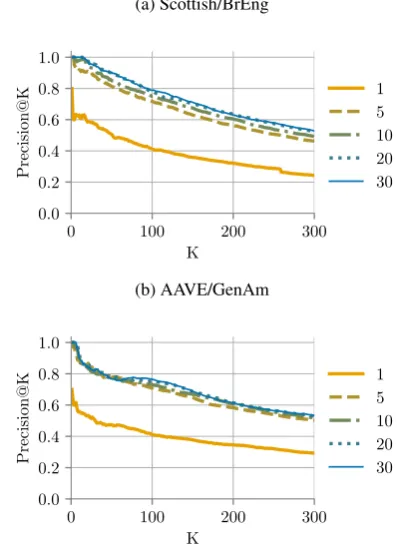
Finally, we examined how performance depends on the particular seed pairs we used and the num-ber of seed pairs. Using the BrEng/Scottish and GenAm/AAVE datasets, we subsampled between 1 and 30 seed pairs from our original sets. Over 10 random samples of each size, we found sim-ilar average performance using just 5 seed pairs as when using the full original sets (see Figure3). Performance increased slightly when using only open-class seed pairs: P@100 rose to 0.77 for Scot-tish/BrEng and 0.75 for GenAm/AAVE (cf. 0.71 and 0.74 using all the original seed pairs). These results indicate our method is robust to the number and quality of seed pairs.
6 Conclusion
Overall, our results demonstrate that sociolinguistic information is systematically encoded in the word embedding space of code-mixed text, and that this implicit structure can be exploited to identify so-ciolinguistic variables along with their linguistic code. Starting from just a few seed variables, a
(a) Scottish/BrEng
0 100 200 300
K 0.0
0.2 0.4 0.6 0.8 1.0
Precision@K
1 5 10 20 30
(b) AAVE/GenAm
0 100 200 300
K 0.0
0.2 0.4 0.6 0.8 1.0
Precision@K
1 5 10 20 30
Figure 3: Mean Precision@K curves for different sized samples from the original seed pair lists. Each curve is averaged across 10 random samples ofn seed pairs, forn∈ {1,5,10,20,30}.
simple heuristic method is sufficient to identify a large number of additional candidate pairs with precision of 70% or more. Results are somewhat sensitive to different hyperparameter settings but even non-optimal settings produce results that are likely to save time for sociolinguistic researchers. Although we have so far tested our system only on varieties of English7, we expect it to perform well with other pairs of language varieties which have a lot of vocabulary overlap or are frequently code-mixedwithinsentences or short documents, including code-mixed languages as well as dialects. This framework may also be useful for identifying variation across genres or registers.
Acknowledgments
This work was supported in part by the EPSRC Cen-tre for Doctoral Training in Data Science, funded by the UK Engineering and Physical Sciences Re-search Council (grant EP/L016427/1) and the Uni-versity of Edinburgh.
7The Scots language, while not a variety of Modern
[image:5.595.315.514.65.341.2]References
David Bamman, Jacob Eisenstein, and Tyler Schnoe-belen. 2014. Gender identity and lexical varia-tion in social media. Journal of Sociolinguistics, 18(2):135–160.
Tolga Bolukbasi, Kai-Wei Chang, James Zou, Venkatesh Saligrama, and Adam Kalai. 2016. Man is to computer programmer as woman is to homemaker? Debiasing word embeddings. In Pro-ceedings of the 30th International Conference on Neural Information Processing Systems, NIPS’16, pages 4356–4364. Curran Associates Inc.
Gonzalo Donoso and David Sanchez. 2017. Dialecto-metric analysis of language variation in Twitter. In Proceedings of the Fourth Workshop on NLP for Sim-ilar Languages, Varieties and Dialects, VarDial’17, pages 16–25. Association for Computational Lin-guistics.
Jacob Eisenstein. 2015. Systematic patterning in phonologically-motivated orthographic variation. Journal of Sociolinguistics, 19(2):161–188.
Jacob Eisenstein, Amr Ahmed, and Eric P. Xing. 2011. Sparse additive generative models of text. In Proceedings of the 28th International Conference on International Conference on Machine Learning, ICML’11, pages 1041–1048. Omnipress.
Aria Haghighi, Percy Liang, Taylor Berg-Kirkpatrick, and Dan Klein. 2008. Learning bilingual lexicons from monolingual corpora. In Proceedings of the 46th Annual Meeting of the Association for Compu-tational Linguistics on Human Language Technolo-gies, ACL’08: HLT, pages 771–779. Association for Computational Linguistics.
Yuan Huang, Diansheng Guo, Alice Kasakoff, and Jack Grieve. 2016. Understanding U.S. regional linguis-tic variation with Twitter data analysis. Computers, Environment and Urban Systems, 59:244 – 255.
Anna Jørgensen, Dirk Hovy, and Anders Søgaard. 2015. Challenges of studying and processing dialects in social media. In Proceedings of the Workshop on Noisy User-generated Text, W-NUT’15, pages 9–18. Association for Computational Linguistics.
Vivek Kulkarni, Bryan Perozzi, and Steven Skiena. 2016. Freshman or fresher? quantifying the geo-graphic variation of language in online social media. In Proceedings of the Tenth International Confer-ence on Web and Social Media, ICWSM’16, pages 615–618. AAAI Press.
Marco Lui and Timothy Baldwin. 2012. langid.py: An off-the-shelf language identification tool. In Pro-ceedings of the ACL 2012 system demonstrations, ACL’12, pages 25–30. Association for Computa-tional Linguistics.
Tomas Mikolov, Ilya Sutskever, Kai Chen, Greg Cor-rado, and Jeffrey Dean. 2013. Distributed represen-tations of words and phrases and their composition-ality. InProceedings of the 26th International Conference on Neural Information Processing Systems -Volume 2, NIPS’13, pages 3111–3119. Curran Asso-ciates Inc.
Dong Nguyen, Dolf Trieschnigg, and Leonie Cornips. 2015. Audience and the use of minority lan-guages on Twitter. InProceedings of the Ninth In-ternational Conference on Web and Social Media, ICWSM’15, pages 666–669. AAAI Press.
Umashanthi Pavalanathan and Jacob Eisenstein. 2015. Audience-modulated variation in online social me-dia. American Speech, 90(2):187–213.
Miloˇs Radovanovi´c, Alexandros Nanopoulos, and Mir-jana Ivanovi´c. 2010. Hubs in space: Popular nearest neighbors in high-dimensional data. Journal of Ma-chine Learning Research, 11(Sep):2487–2531.
John R Rickford. 1999. African American vernacular English: Features, evolution, educational implica-tions, chapter 1. Blackwell Malden, MA.
Ben Schmidt. 2015. Rejecting the gender
bi-nary: a vector-space operation. http:
//bookworm.benschmidt.org/posts/
2015-10-30-rejecting-the-gender-binary. html.
Tyler Schnoebelen. 2012. Do you smile with your nose? stylistic variation in Twitter emoticons. Uni-versity of Pennsylvania Working Papers in Linguis-tics, 18(2):14.
Philippa Shoemark, James Kirby, and Sharon Gold-water. 2017a. Topic and audience effects on dis-tinctively scottish vocabulary usage in Twitter data. In Proceedings of the Workshop on Stylistic Varia-tion, pages 59–68. Association for Computational Linguistics.
Philippa Shoemark, Debnil Sur, Luke Shrimpton, Iain Murray, and Sharon Goldwater. 2017b. Aye or naw, whit dae ye hink? Scottish independence and lin-guistic identity on social media. InProceedings of the 15th Conference of the European Chapter of the Association for Computational Linguistics: Volume 1, Long Papers, EACL’17, pages 1239–1248. Asso-ciation for Computational Linguistics.