Learning Hierarchical Translation Spans
Jingyi Zhang1,2, Masao Utiyama3, Eiichro Sumita3, Hai Zhao1,2
1Center for Brain-Like Computing and Machine Intelligence, Department of Computer Science and Engineering, Shanghai Jiao Tong Unviersity, Shanghai, 200240, China
2Key Laboratory of Shanghai Education Commission for Intelligent Interaction and Cognitive Engineering, Shanghai Jiao Tong Unviersity, Shanghai, 200240, China
3National Institute of Information and Communications Technology 3-5Hikaridai, Keihanna Science City, Kyoto, 619-0289, Japan
[email protected], mutiyama/[email protected], [email protected]
Abstract
We propose a simple and effective ap-proach to learn translation spans for the hierarchical phrase-based translation model. Our model evaluates if a source span should be covered by translation rules during decoding, which is integrated into the translation system as soft con-straints. Compared to syntactic con-straints, our model is directly acquired from an aligned parallel corpus and does not require parsers. Rich source side contextual features and advanced machine learning methods were utilized for this learning task. The proposed approach was evaluated on NTCIR-9 Chinese-English and Japanese-English translation tasks and showed significant improvement over the baseline system.
1 Introduction
The hierarchical phrase-based (HPB) translation model (Chiang, 2005) has been widely adopted in statistical machine translation (SMT) tasks. The HPB translation rules based on the synchronous context free grammar (SCFG) are simple and pow-erful.
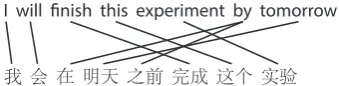
One drawback of the HPB model is the appli-cations of translation rules to the input sentence are highly ambiguous. For example, a rule whose English side is “X1 by X2” can be applied to any word sequence that has “by” in them. In Figure 1, this rule can be applied to the whole sentence as well as to “experiment by tomorrow”.
In order to tackle rule application ambiguities, a few previous works used syntax trees. Chi-ang (2005) utilized a syntactic feature in the HPB
I will finish this experiment by tomorrow
[image:1.595.331.501.261.304.2]我 会 在 明天 之前 完成 这个 实验
Figure 1: A translation example.
model, which represents if the source span cov-ered by a translation rule is a syntactic constituent. However, the experimental results showed this feature gave no significant improvement. Instead of using the undifferentiated constituency feature, (Marton and Resnik, 2008) defined different soft syntactic features for different constituent types and obtained substantial performance improve-ment. Later, (Mylonakis and Sima’an, 2011) in-troduced joint probability synchronous grammars to integrate flexible linguistic information. (Liu et al., 2011) proposed the soft syntactic constraint model based on discriminative classifiers for each constituent type and integrated all of them into the translation model. (Cui et al., 2010) focused on hierarchical rule selection using many features in-cluding syntax constituents.
These works have demonstrated the benefits of using syntactic features in the HPB model. How-ever, high quality syntax parsers are not always easily obtained for many languages. Without this problem, word alignment constraints can also be used to guide the application of the rules.
Suppose that we want to translate the English sentence into the Chinese sentence in Figure 1, a translation rule can be applied to the source span “finish this experiment by tomorrow”. Nonethe-less, if a rule is applied to “experiment by”, then the Chinese translation can not be correctly ob-tained, because the target span projected from
periment by” contains words projected from the source words outside “experiment by”.
In general, a translation rule projects one con-tinuous source word sequence (source span) into one continuous target word sequence. Meanwhile, the word alignment links between the source and target sentence define the source spans where translation rules are applicable. In this paper, we call a source span that can be covered by a trans-lation rule without violating word alignment links atranslation span.
Translation spans that have been correctly iden-tified can guide translation rules to function prop-erly, thus (Xiong et al., 2010) attempted to use extra machine learning approaches to determine boundaries of translation spans. They used two separate classifiers to learn the beginning and end-ing boundaries of translation spans, respectively. A source word is marked as beginning (ending) boundary if it is the first (last) word of a translation span. However, a source span whose first and last words are both boundaries is not always a transla-tion span. In Figure 1, “I” is a beginning boundary since it is the first word of translation span “I will” and “experiment” is an ending boundary since it is the last word of translation span “finish this exper-iment” , but “I will finish this experexper-iment” is not a translation span. This happens because the trans-lation spans are nested or hierarchical. Note that (He et al., 2010) also learned phrase boundaries to constrain decoding, but their approach identified boundaries only for monotone translation.
In this paper, taking fully into account that translation spans being nested, we propose an approach to learn hierarchical translation spans directly from an aligned parallel corpus that makes more accurate identification over transla-tion spans.
The rest of the paper is structured as follows: In Section 2, we briefly review the HPB transla-tion model. Sectransla-tion 3 describes our approach. We describe experiments in Section 4 and conclude in Section 5.
2 Hierarchical Phrase-based Translation
Chiang’s HPB model is based on a weighted SCFG. A translation rule is like: X → hγ, α,∼i, whereXis a nonterminal,γandαare source and target strings of terminals and nonterminals, and∼ is a one-to-one correspondence between
nontermi-nals inγ andα. The weight of each rule is:
w(X → hγ, α,∼i) =Y t
ht(X→ hγ, α,∼i)λt (1)
wherehtare the features defined on the rules.
Rewriting begins with a pair of linked start sym-bols and ends when there is no nonterminal left. LetDbe a derivation of the grammar,f(D) and e(D) be the source and target strings generated byD. Dconsists of a set of tripleshr, i, ji, each of which stands for applying a rule r on a span f(D)ji. The weight ofDis calculated as:
w(D) = Y hr,i,ji∈D
w(r)×Plm(e)λlm×exp (−λwp|e|)
(2) where w(r) is the weight of ruler, the last two terms represent the language model and word penalty, respectively.
3 Learning Translation Spans
We will describe how to learn translation spans in this section.
3.1 Our Model
We make a series of binary classifiers {C1, C2, C3, ...} to learn if a source span
f(D)ji should be covered by translation rules dur-ing translation. Ckis trained and tested on source
spans whose lengths arek, i.e.,k=j−i+ 1.1 Cklearns the probability
Pk(v|f(D), i, j) (3) wherev ∈ {0,1}, v = 1represents a rule is ap-plied onf(D)ji, otherwisev= 0.
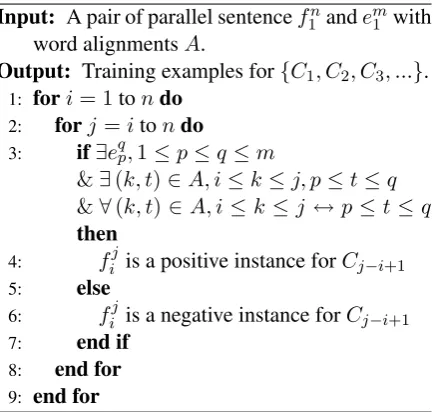
Training instances for these classifiers are ex-tracted from an aligned parallel corpus according to Algorithm 1. For example, “I will” and “will finish” are respectively extracted as positive and negative instances in Figure 1.
Note that our model in Equation 3 only uses the source sentencef(D) in the condition. This means that the probabilities can be calculated be-fore translation. Therebe-fore, the predicted prob-abilities can be integrated into the decoder con-veniently as soft constraints and no extra time is added during decoding. This enables us to use rich source contextual features and various ma-chine learning methods for this learning task.
1We indeed can utilize just one classifier for all source
3.2 Integration into the decoder
It is straightforward to integrate our model into Equation 2. It is extended as
w(D) = Y hr,i,ji∈D
w(r)×Plm(e)λlm×exp (−λwp|e|)
×Pk(v= 1|f(D), i, j)λk
(4)
whereλkis the weight forCk.
During decoding, the decoder looks up the probabilities Pk calculated and stored before
de-coding.
Algorithm 1Extract training instances.
Input: A pair of parallel sentencefn
1 andem1 with
word alignmentsA.
Output: Training examples for{C1, C2, C3, ...}. 1: fori= 1tondo
2: forj=itondo
3: if∃eqp,1≤p≤q≤m
&∃(k, t)∈A, i≤k≤j, p≤t≤q &∀(k, t)∈A, i ≤k≤j ↔ p≤t≤q
then
4: fijis a positive instance forCj−i+1
5: else
6: fijis a negative instance forCj−i+1
7: end if
8: end for
9: end for
3.3 Classifiers
We compare two machine learning methods for learning a series of binary classifiers.
For the first method, each Ck is individually
learned using the maximum entropy (ME) ap-proach (Berger et al., 1996):
Pk(v|f(D), i, j) = exp P
tµtht(v, f(D), i, j) P
v0exp Ptµtht(v0, f(D), i, j)
(5) where ht is a feature function and µt is weight
of ht. We use rich source contextual
fea-tures: unigram, bigram and trigram of the phrase [fi−3, ..., fj+3].
As the second method, these classification tasks are learned in the continuous space using feed-forward neural networks (NNs). Each Ck has
the similar structure with the NN language model (Vaswani et al., 2013). The inputs to the NN are indices of the words:[fi−3, ..., fj+3]. Each source
word is projected into an N dimensional vector.
The output layer has two output neurons, whose values correspond to Pk(v= 0|f(D), i, j) and
Pk(v= 1|f(D), i, j).
For both ME and NN approaches, words that occur only once or never occur in the training corpus are treated as a special word “UNK” (un-known) during classifier training and predicting, which can reduce training time and make the clas-sifier training more smooth.
4 Experiment
We evaluated the effectiveness of the proposed ap-proach for Chinese-to-English (CE) and Japanese-to-English (JE) translation tasks. The datasets of-ficially provided for the patent machine translation task at NTCIR-9 (Goto et al., 2011) were used in our experiments. The detailed training set statis-tics are given in Table 1. The development and test
SOURCE TARGET
CE #Sents#Words 37.2M 954k40.4M #Vocab 288k 504k JE #Sents#Words 118M 3.14M104M
[image:3.595.74.295.257.463.2]#Vocab 150k 273k
Table 1: Data sets.
sets were both provided for CE task while only the test set was provided for JE task. Therefore, we used the sentences from the NTCIR-8 JE test set as the development set. Word segmentation was done by BaseSeg (Zhao et al., 2006; Zhao and Kit, 2008; Zhao et al., 2010; Zhao and Kit, 2011; Zhao et al., 2013) for Chinese and Mecab2for Japanese. To learn the classifiers for each translation task, the training set and development set were put to-gether to obtain symmetric word alignment us-ing GIZA++ (Och and Ney, 2003) and the grow-diag-final-andheuristic (Koehn et al., 2003). The source span instances extracted from the aligned training and development sets were used as the training and validation data for the classifiers.
The toolkit Wapiti (Lavergne et al., 2010) was adopted to train ME classifiers using the classi-cal quasi-newton optimization algorithm with lim-ited memory. The NNs are trained by the toolkit NPLM (Vaswani et al., 2013). We chose “recti-fier” as the activation function and the logarithmic loss function for NNs. The number of epochs was set to 20. Other parameters were set to default
Span length
CE JE
Rate P MEN P NNN Rate P MEN P NNN
1 2.67 0.93 0.63 0.93 0.64 1.08 0.85 0.79 0.86 0.80 2 1.37 0.83 0.70 0.82 0.75 0.73 0.69 0.84 0.71 0.87 3 0.86 0.70 0.80 0.73 0.83 0.52 0.56 0.89 0.63 0.90 4 0.62 0.57 0.81 0.67 0.88 0.36 0.48 0.93 0.54 0.93 5 0.48 0.52 0.90 0.61 0.91 0.26 0.30 0.96 0.47 0.95 6 0.40 0.47 0.91 0.58 0.92 0.20 0.25 0.97 0.41 0.96 7 0.34 0.40 0.93 0.53 0.93 0.16 0.14 0.98 0.33 0.97
8 0.28 0.35 0.94 0.46 0.94 0.13 0 1 0.32 0.97
9 0.22 0.28 0.96 0.37 0.96 0.10 0 1 0.25 0.98
[image:4.595.138.466.60.194.2]10 0.15 0.21 0.97 0.28 0.97 0.08 0 1 0.23 0.99
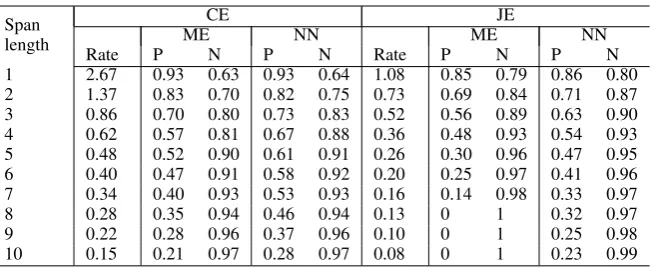
Table 2: Classification accuracies. The Rate column represents ratio of positive instances to negative instances; the P and N columns give classification accuracies for positive and negative instances.
values. The training time of one classifier on a 12-core 3.47GHz Xeon X5690 machine was 0.5h (2.5h) using ME (NN) approach for CE task; 1h (4h) using ME (NN) approach for JE task .
The classification results are shown in Table 2. Instead of the undifferentiated classification accu-racy, we present separate classification accuracies for positive and negative instances. The big differ-ence between classification accuracies for positive and negative instances was caused by the unbal-anced rate of positive and negative instances in the training corpus. For example, if there are more positive training instances, then the classifier will tend to classify new instances as positive and the classification accuracy for positive instances will be higher. In our classification tasks, there are less positive instances for longer span lengths.
Since the word order difference of JE task is much more significant than that of CE task, there are more negative Japanese translation span in-stances than Chinese. In JE tasks, the ME classi-fiersC8,C9andC10predicted all new instances to
be negative due to the heavily unbalanced instance distribution.
As shown in Table 2, NN outperformed ME ap-proach for our classification tasks. As the span length growing, the advantage of NN became more significant. Since the classification accura-cies deceased to be quite low for source spans with more than 10 words, only{C1, ..., C10}were
inte-grated into the HPB translation system.
For each translation task, the recent version of Moses HPB decoder (Koehn et al., 2007) with the training scripts was used as the base-line (Base). We used the default parameters for Moses, and a5-gram language model was trained on the target side of the training corpus by IRST
LM Toolkit3with improved Kneser-Ney smooth-ing. {C1, ..., C10}were integrated into the
base-line with different weights, which were tuned by MERT (Och, 2003) together with other feature weights (language model, word penalty,...) under the log-linear framework (Och and Ney, 2002).
BLEU-n n-gram precisions
Method TER 4 1 2 3 4
CE BaseBLM 49.39- -48.60 33.07- -33.93 69.9/40.7/25.8/16.970.0/41.4/26.6/17.6 ME 49.02- 33.63- 70.0/41.2/26.3/17.4 NN 48.09++ 34.35++ 70.1/41.9/27.0/18.0
[image:4.595.307.532.345.449.2]JE BaseBLM 57.39- -56.79 30.13- -30.81 67.1/38.3/23.0/14.067.7/38.9/23.6/14.5 ME 56.48 31.01 67.6/39.0/23.8/14.7 NN 55.96++ 31.77++ 67.8/39.7/24.6/15.4
Table 3: Translation results. The symbol ++ (- -) represents a significant difference at thep <0.01 level and - represents a significant difference at the p <0.05level against the BLM.
We compare our method with the baseline and the boundary learning method (BLM) (Xiong et al., 2010) based on Maximum Entropy Markov Models with Markov order 2. Table 3 reports BLEU (Papineni et al., 2002) and TER (Snover et al., 2006) scores. Significance tests are con-ducted using bootstrap sampling (Koehn, 2004). Our ME classifiers achieve comparable translation improvement with the BLM and NN classifiers en-hance translation system significantly compared to others. Table 3 also shows that the relative gain was higher for higher n-grams, which is reason-able since the higher n-grams have higher ambi-guities in the translation rule application.
It is true that because of multiple parallel sen-tences, a source span can be applied with
tion rules in one sentence pair but not in another sentence pair. So we used the probability score as a feature in the decoding. That is, we did not use classification results directly but use the prob-ability score for softly constraining the decoding process.
5 Conclusion
We have proposed a simple and effective transla-tion span learning model for HPB translatransla-tion. Our model is learned from aligned parallel corpora and predicts translation spans for source sentence be-fore translating, which is integrated into the trans-lation system conveniently as soft constraints. We compared ME and NN approaches for this learn-ing task. The results showed that NN classifiers on the continuous space model achieved both higher classification accuracies and better translation per-formance with acceptable training times.
Acknowledgments
Hai Zhao were partially supported by CSC fund (201304490199), the National Natural Science Foundation of China (Grant No.60903119, Grant No.61170114, and Grant No.61272248), the Na-tional Basic Research Program of China (Grant No.2013CB329401), the Science and Technol-ogy Commission of Shanghai Municipality (Grant No.13511500200), the European Union Seventh Framework Program (Grant No.247619), and the art and science interdiscipline funds of Shang-hai Jiao Tong University, a study on mobilization mechanism and alerting threshold setting for on-line community, and media image and psychology evaluation: a computational intelligence approach.
References
Adam Berger, Vincent Della Pietra, and Stephen Della Pietra. 1996. A maximum entropy approach to
nat-ural language processing. Computational
linguis-tics, 22(1):39–71.
David Chiang. 2005. A hierarchical phrase-based
model for statistical machine translation. In
Pro-ceedings of the 43rd Annual Meeting on Association
for Computational Linguistics, pages 263–270.
As-sociation for Computational Linguistics.
Lei Cui, Dongdong Zhang, Mu Li, Ming Zhou, and Tiejun Zhao. 2010. A joint rule selection model
for hierarchical phrase-based translation. In
Pro-ceedings of the ACL 2010 Conference Short Papers,
pages 6–11. Association for Computational Linguis-tics.
Isao Goto, Bin Lu, Ka Po Chow, Eiichiro Sumita, and Benjamin K Tsou. 2011. Overview of the patent machine translation task at the ntcir-9 workshop. In
Proceedings of NTCIR, volume 9, pages 559–578.
Zhongjun He, Yao Meng, and Hao Yu. 2010. Learn-ing phrase boundaries for hierarchical phrase-based translation. InProceedings of the 23rd International
Conference on Computational Linguistics: Posters,
pages 383–390. Association for Computational Lin-guistics.
Philipp Koehn, Franz Josef Och, and Daniel Marcu.
2003. Statistical phrase-based translation. In
Proceedings of the 2003 Conference of the North American Chapter of the Association for Computa-tional Linguistics on Human Language
Technology-Volume 1, pages 48–54. Association for
Computa-tional Linguistics.
Philipp Koehn, Hieu Hoang, Alexandra Birch, Chris Callison-Burch, Marcello Federico, Nicola Bertoldi, Brooke Cowan, Wade Shen, Christine Moran, Richard Zens, et al. 2007. Moses: Open source toolkit for statistical machine translation. In Pro-ceedings of the 45th Annual Meeting of the ACL
on Interactive Poster and Demonstration Sessions,
pages 177–180. Association for Computational Lin-guistics.
Philipp Koehn. 2004. Statistical significance tests for
machine translation evaluation. In EMNLP, pages
388–395.
Thomas Lavergne, Olivier Capp´e, and Franc¸ois Yvon.
2010. Practical very large scale crfs. In
Proceed-ings of the 48th Annual Meeting of the Association
for Computational Linguistics, pages 504–513,
Up-psala, Sweden, July. Association for Computational Linguistics.
Lemao Liu, Tiejun Zhao, Chao Wang, and Hailong Cao. 2011. A unified and discriminative soft syn-tactic constraint model for hierarchical phrase-based
translation. In the Thirteenth Machine Translation
Summit, pages 253–260. Asia-Pacific Association
for Machine Translation.
Yuval Marton and Philip Resnik. 2008. Soft syntac-tic constraints for hierarchical phrased-based trans-lation. InACL, pages 1003–1011.
Markos Mylonakis and Khalil Sima’an. 2011. Learn-ing hierarchical translation structure with lLearn-inguis-
linguis-tic annotations. InProceedings of the 49th Annual
Meeting of the Association for Computational
Lin-guistics: Human Language Technologies-Volume 1,
pages 642–652. Association for Computational Lin-guistics.
Franz Josef Och and Hermann Ney. 2002. Discrimina-tive training and maximum entropy models for sta-tistical machine translation. In Proceedings of the 40th Annual Meeting on Association for
Computa-tional Linguistics, pages 295–302. Association for
Franz Josef Och and Hermann Ney. 2003. A sys-tematic comparison of various statistical alignment models. Computational linguistics, 29(1):19–51. Franz Josef Och. 2003. Minimum error rate training
in statistical machine translation. InProceedings of the 41st Annual Meeting on Association for
Compu-tational Linguistics-Volume 1, pages 160–167.
As-sociation for Computational Linguistics.
Kishore Papineni, Salim Roukos, Todd Ward, and Wei-Jing Zhu. 2002. BLEU: a method for automatic evaluation of machine translation. InProceedings of the 40th annual meeting on association for
compu-tational linguistics, pages 311–318. Association for
Computational Linguistics.
Matthew Snover, Bonnie Dorr, Richard Schwartz, Lin-nea Micciulla, and John Makhoul. 2006. A study of translation edit rate with targeted human annotation.
In Proceedings of association for machine
transla-tion in the Americas, pages 223–231.
Ashish Vaswani, Yinggong Zhao, Victoria Fossum, and David Chiang. 2013. Decoding with large-scale neural language models improves translation.
In Proceedings of the 2013 Conference on
Em-pirical Methods in Natural Language Processing,
pages 1387–1392, Seattle, Washington, USA, Oc-tober. Association for Computational Linguistics. Deyi Xiong, Min Zhang, and Haizhou Li. 2010.
Learning translation boundaries for phrase-based
decoding. In Human Language Technologies: The
2010 Annual Conference of the North American Chapter of the Association for Computational
Lin-guistics, pages 136–144. Association for
Computa-tional Linguistics.
Hai Zhao and Chunyu Kit. 2008. Exploiting unla-beled text with different unsupervised segmentation criteria for chinese word segmentation. Research in
Computing Science, 33:93–104.
Hai Zhao and Chunyu Kit. 2011. Integrating unsu-pervised and suunsu-pervised word segmentation: The
role of goodness measures. Information Sciences,
181(1):163–183.
Hai Zhao, Chang-Ning Huang, and Mu Li. 2006. An improved chinese word segmentation system with conditional random field. InProceedings of the Fifth SIGHAN Workshop on Chinese Language Process-ing, pages 162–165. Sydney: July.
Hai Zhao, Chang-Ning Huang, Mu Li, and Bao-Liang Lu. 2010. A unified character-based tagging
frame-work for chinese word segmentation. ACM
Trans-actions on Asian Language Information Processing
(TALIP), 9(2):5.
Hai Zhao, Masao Utiyama, Eiichiro Sumita, and Bao-Liang Lu. 2013. An empirical study on word
seg-mentation for chinese machine translation. In