Cross-Lingual Part-of-Speech Tagging through Ambiguous Learning
Guillaume Wisniewski Nicolas Pécheux Souhir Gahbiche-Braham François Yvon Université Paris Sud
LIMSI-CNRS
91 403 ORSAY CEDEX, France
{wisniews,pecheux,souhir,yvon}@limsi.fr
Abstract
When Part-of-Speech annotated data is scarce, e.g. for under-resourced lan-guages, one can turn to cross-lingual trans-fer and crawled dictionaries to collect par-tially supervised data. We cast this prob-lem in the framework ofambiguous learn-ing and show how to learn an accurate history-based model. Experiments on ten languages show significant improvements over prior state of the art performance. 1 Introduction
In the past two decades, supervised Machine Learning techniques have established new perfor-mance standards for many NLP tasks. Their suc-cess however crucially depends on the availability of annotated in-domain data, a not so common sit-uation. This means that for many application do-mains and/or less-resourced languages, alternative ML techniques need to be designed to accommo-date unannotated or partially annotated data.
Several attempts have recently been made to mitigate the lack of annotated corpora using par-allel data pairing a (source) text in a resource-rich language with its counterpart in a less-resourced language. By transferring labels from the source to the target, it becomes possible to obtain noisy, yet useful, annotations that can be used to train a model for the target language in a weakly super-vised manner. This research trend was initiated by Yarowsky et al. (2001), who consider the trans-fer of POS and other syntactic information, and further developed in (Hwa et al., 2005; Ganchev et al., 2009) for syntactic dependencies, in (Padó and Lapata, 2009; Kozhevnikov and Titov, 2013; van der Plas et al., 2014) for semantic role la-beling and in (Kim et al., 2012) for named-entity recognition, to name a few.
Assuming that labels can actually be projected across languages, these techniques face the issue
of extending standard supervised techniques with partial and/or uncertain labels in the presence of alignment noise. In comparison to the early ap-proach of Yarowsky et al. (2001) in which POS are directly transferred, subject to heuristic fil-tering rules, recent works consider the integra-tion of softer constraints using expectaintegra-tion regu-larization techniques (Wang and Manning, 2014), the combination of alignment-based POS transfer with additional information sources such as dic-tionaries (Li et al., 2012; Täckström et al., 2013) (Section 2), or even the simultaneous use of both techniques (Ganchev and Das, 2013).
In this paper, we reproduce the weakly super-vised setting of Täckström et al. (2013). By re-casting this setting in the framework of ambiguous learning (Bordes et al., 2010; Cour et al., 2011) (Section 3), we propose an alternative learning methodology and show that it improves the state of the art performance on a large array of languages (Section 4). Our analysis of the remaining errors suggests that in cross-lingual settings, improve-ments of error rates can have multiple causes and should be looked at with great care (Section 4.2).
All tools and resources used in this study are available at http://perso.limsi.fr/ wisniews/ambiguous.
2 Projecting Labels across Aligned Corpora
Projecting POS information across languages re-lies on a rather strong assumption that morpho-syntactic categories in the source language can be directly related to the categories in the tar-get language, which might not always be war-ranted (Evans and Levinson, 2009; Broschart, 2009). The universal reduced POS tagset pro-posed by Petrov et al. (2012) defines an opera-tional, albeit rather empirical, ground to perform this mapping. It is made of the following 12 cat-egories: NOUN (nouns), VERB (verbs), ADJ
ar cs de el es fi fr id it sv % of test covered tokens (type) 83.2 93.2 95.6 97.4 96.7 83.0 98.3 90.5 95.8 95.3 % of test correctly covered token (type) 72.9 94.2 93.7 92.9 93.8 93.6 92.1 89.6 93.6 94.1 avg. number of labels per token (type) 2.1 1.3 1.3 1.3 1.3 1.4 1.3 1.2 1.3 1.3 avg. number of labels per token (type+token) 1.7 1.1 1.1 1.1 1.1 1.2 1.2 1.1 1.1 1.1 % of aligned tokens 53.0 77.8 66.7 69.3 74.0 73.1 64.7 81.6 72.2 79.9 % of token const. violating type const. 2.5 16.0 15.8 21.4 16.9 14.3 16.1 19.3 17.5 13.6 % informative token const. 79.7 27.5 15.7 29.8 21.3 36.0 25.5 16.2 28.2 26.4
Table 1: Interplay between token and type constraints on our training parallel corpora. ‘Informative’ token constraints correspond to tokens for which (a) a POS is actually transfered and (b) type constraints do not disambiguate the label, but type+token constraints do.
jectives), ADV(adverbs), PRON(pronouns), DET (determiners and articles), ADP(prepositions and postpositions), NUM(numerals), CONJ (conjunc-tions), PRT (particles), ‘.’ (punctuation marks) and X (a catch-all for other categories). These labels have been chosen for their stability across languages and for their usefulness in various mul-tilingual applications. In the rest of this work, all annotations are mapped to this universal tagset.
Transfer-based methods have shown to be very effective, even if projected labels only deliver a noisy supervision, due to tagging (of the source language) and other alignment errors (Yarowsky et al., 2001). While this uncertainty can be ad-dressed in several ways, recent works have pro-posed to combine projected labels with monolin-gual information in order to filter out invalid la-bel sequences (Das and Petrov, 2011; Täckström et al., 2013). In this work we follow Täckström et al. (2013) and use two families of constraints:
Token constraints rely on word alignments to
project labels of source words to target words through alignment links. Table 1 shows that, de-pendening on the language, only50−80%of the target tokens would benefit from label transfer.
Type constraints rely on a tag dictionary to
define the set of possible tags for each word type. Type constraints reduce the possible la-bels for a given word and help filtering out cross-lingual transfer errors (up to 20%, as shown in Ta-ble 1). As in (Täckström et al., 2013), we con-sider two different dictionaries. The first one is extracted automatically fromWiktionary,1 us-ing the method of (Li et al., 2012). The second tag dictionary is built by using for each word the two most frequently projected POS labels from the training data.2 In contrast to Täckström et al.
1http://www.wiktionary.org/
2This heuristic is similar to the way Täckström et al.
(2013) we use the intersection3 of the two type constraints instead of their union. Table 1 shows the precision and recall of the resulting constraints on the test data.
These two information sources are merged ac-cording to the rules of Täckström et al. (2013). These rules assume that type constraints are more reliable than token constraints and should take precedence: by default, a given word is associated to the set of possible tags licensed type constraints; additionally, when a POS tag can be projected through alignmentandalso satisfies the type con-straints, then it is actually projected, thereby pro-viding a full (yet noisy) supervision.
As shown in Table 1, token and type con-straints complement each other effectively and greatly reduce label ambiguity. However, the transfer method sketched above associates each target word with a set of possible labels, of which only one is true. This situation is less favorable than standard supervised learning in which one unique gold label is available for each occurrence. We describe in the following section how to learn from thisambiguous supervisioninformation.
3 Modeling Sequences under Ambiguous Supervision
We use a history-based model (Black et al., 1992) with a LaSO-like training method (Daumé and Marcu, 2005). History-based models reduce struc-tured prediction to a sequence of multi-class clas-sification problems. The prediction of a complex structure (here, a sequence of POS tags) is thus modeled as a sequential decision problem: at each (2013) filter the tag distribution with a threshold to build the projected type constraints.
position in the sequence, a multiclass classifier is used to make a decision, using features that describe both the input structure and the history of past decisions (i.e. the partially annotated se-quence).
Letx = (xi)ni=1 denote the observed sequence and Y be the set of possible labels (in our case the 12 universal POS tags). Inference consists in predicting labels one after the other using, for in-stance, a linear model:
yi∗ = arg max
y∈Y hw|φ(x, i, y, hi)i (1)
whereh·|·i is the standard dot product operation,
y∗
i the predicted label for positioni,wthe weight vector, hi = y∗1, ..., y∗i−1 the history of past
de-cisions andφ a joint feature map. Inference can therefore be seen as a greedy search in the space of the#{Y}n possible labelings of the input se-quence. Trading off the global optimality of in-ference for additional flexibility in the design of features and long range dependencies between la-bels has proved useful for many sequence labeling tasks in NLP (Tsuruoka et al., 2011).
The training procedure, sketched in Algo-rithm 1, consists in performing inference on each input sentence and correcting the weight vector each time a wrong decision is made. Impor-tantly (Ross and Bagnell, 2010), the history used during training has to be made of the previous pre-dicted labels so that the training samples reflect the fact that the history will be imperfectly known at test time.
This reduction of sequence labeling to multi-class multi-classification allows us to learn a sequence model in an ambiguous setting by building on the theoretical results of Bordes et al. (2010) and Cour et al. (2011). The decision about the correctness of a prediction and the weight updates can be adapted to the amount of supervision information that is available.
Full Supervision In a fully supervised setting,
the correct label is known for each word token: a decision is thus considered wrong when this gold label is not predicted. In this case, a standard per-ceptron update is performed:
wt+1 ←wt−φ(x, i, yi∗, hi)+φ(x, i,yˆi, hi) (2) wherey∗
i andyˆiare the predicted and the gold la-bel, respectively. This update is a stochastic gra-dient step that increases the score of the gold label while decreasing the score of the predicted label.
Ambiguous Supervision During training, each
observationiis now associated with a set of possi-ble labels, denoted byYˆi. In this case, a decision is considered wrong when the predicted label is not inYˆiand the weight vector is updated as follows:
wt+1 ←wt−φ(x, i, yi∗, hi)+
X
ˆ
yi∈Yˆi
φ(x, i,yˆi, hi)
(3) Compared to (2), this rule uniformly increases the scores of all the labels inYˆi.
It can be shown (Bordes et al., 2010; Cour et al., 2011), under mild assumptions (namely that two labels never systematically co-occur in the supervision information), that the update rule (3) enables to learn a classifier in an ambiguous set-ting, as if the gold labels were known. Intuitively, as long as two labels are not systematically co-occurring inYˆ, updates will reinforce the correct labels more often than the spurious ones; at the end of training, the highest scoring label should therefore be the correct one.
Algorithm 1Training algorithm. In the
ambigu-ous setting, Yˆi contains all possible labels; in the supervised setting, it only contains the gold label.
w0 ←0
fort∈J1, TKdo
Randomly pick examplex,yˆ
h←empty list
fori∈J1, nKdo y∗
i = arg maxy∈Yhwt|φ(x, i, y, hi)i
ify∗
i ∈/ Yˆithen
wt+1 ←update(wt,x, i,Yˆi, y∗i, hi)
end if
push(y∗
i,h)
end for end for
return 1
T
PT
t=1wt
4 Empirical Study
Datasets Our approach is evaluated on 10
lan-guages that present very different characteristics and cover several language families.4In all our ex-periments we use English as the source language. Parallel sentences5 are aligned with the standard 4Resources considered in the related works are not freely available, which prevents us from presenting a more complete comparison.
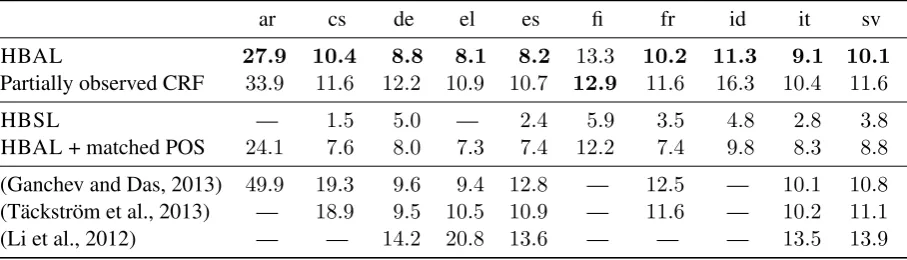
ar cs de el es fi fr id it sv HBAL 27.9 10.4 8.8 8.1 8.2 13.3 10.2 11.3 9.1 10.1 Partially observed CRF 33.9 11.6 12.2 10.9 10.7 12.9 11.6 16.3 10.4 11.6
HBSL — 1.5 5.0 — 2.4 5.9 3.5 4.8 2.8 3.8
[image:4.595.72.526.63.193.2]HBAL + matched POS 24.1 7.6 8.0 7.3 7.4 12.2 7.4 9.8 8.3 8.8 (Ganchev and Das, 2013) 49.9 19.3 9.6 9.4 12.8 — 12.5 — 10.1 10.8 (Täckström et al., 2013) — 18.9 9.5 10.5 10.9 — 11.6 — 10.2 11.1 (Li et al., 2012) — — 14.2 20.8 13.6 — — — 13.5 13.9
Table 2: Error rate (in %) achieved by the method described in Sec. 3 trained in an ambiguous (HBAL) or in a supervised setting (HBSL), a partially observed CRF and different state-of-the-art results.
MOSES pipeline, using the intersection heuristic that only retains the most reliable alignment links. The English side of the bitext is tagged using a standard linear CRF trained on the Penn Treebank. Tags are then transferred to the target language us-ing the procedure described in Section 2. For each language, we train a tagger using the method de-scribed in Section 3 withT = 100 000iterations6 using a feature set similar to the one of Li et al. (2012) and Täckström et al. (2013). The baseline system is our reimplementation of the partially observed CRF model of Täckström et al. (2013). Evaluation is carried out on the test sets of tree-banks for which manual gold tags are known. For Czech and Greek, we use the CoNLL’07 Shared Task on Dependency Parsing; for Arabic, the Ara-bic Treebank; and otherwise the data of the Uni-versal Dependency Treebank Project (McDonald et al., 2013). Tagging performance is evaluated with the standard error rate.
4.1 Results
Table 2 summarizes the performance achieved by our method trained in the ambiguous setting (HBAL) and by our re-implementation of the partially supervised CRF baseline. As an upper bound, we also report the score of our method when trained in a supervised (HBSL) settings considering the training part of the various tree-banks, when it is available.7 For the sake of com-parison, we also list the best scores of previous studies. Note, however, that a direct comparison with these results is not completely fair as these 6Preliminary experiments showed that increasing the number of iterations T in Algorithm 1 has no significant impact.
7In this setting, HBSL implements an averaged percep-tron, and achieves results that are similar to those obtained with standard linear CRF.
systems were not trained and evaluated with the same exact resources (corpora,8 type constraints, alignments, etc). Also note that the state-of-the-art scores have been achieved by different models, which have been selected based on their scores on the test set and not on a validation set.9
Experimental results show that HBAL signif-icantly outperforms, on all considered languages but one, the partially observed CRF that was trained and tested in the same setting.
4.2 Discussion
The performance of our new method still falls short of the performance of a fully supervised POS tagger: for instance, in Spanish, full supervision reduces the error rate by a factor of 4. A fine-grained error analysis shows that many errors of HBAL directly result from the fact that, contrary to the fully supervised learner HBSL, our am-biguous setting suffers from a train/test mismatch, which has two main consequences. First, the train and test sets do not follow exactly the same nor-malization and tokenization conventions, which is an obvious source of mistakes. Second, and more importantly, many errors are caused by systematic differences between the test tags and the super-vised tags (i.e. the English side of the bitext and Wiktionary). While some of these differences are linguistically well-justified and reflect funda-mental differences in the language structure and usage, others seem to be merely due to arbitrary annotation conventions.
For instance, in Greek, proper names are labeled 8The test sets are only the same for Czech, Greek and Swedish.
9The partially observed CRF is the best model in (Täck-ström et al., 2013) only for German (de), Greek (el) and Swedish (sv), and uses only type constraints extracted from
either as X (when they refer to a foreignerandare not transliterated) or as NOUN(in all other cases), while they are always labeled as NOUNin English. In French and in Greek, contractions of a prepo-sition and a determiner such as ‘στο’ (‘σε το’, meaning ‘to the’) or ‘aux’ (‘à les’ also meaning ‘to the’) are labeled as ADPin the Universal De-pendency Treebank but as DETinWiktionary and are usually aligned with a determiner in the parallel corpora. In the Penn Treebank, quanti-fiers like ‘few’ or ‘little’ are generally used in con-junction with a determiner (‘a few years’, ‘a little parable’, ...) and labeled as ADJ; the correspond-ing Spanish constructions lack an article (‘mucho tempio’, ‘pocos años’, ...) and the quantifiers are therefore labeled as DET. Capturing such subtle differences is hardly possible without prior knowl-edge and specifically tailored features.
This annotation mismatch problem is all the more important in settings like ours, that rely on several, independently designed, information sources, which follow contradictory annotation conventions and for which the mapping to the uni-versal tagset is actually error-prone (Zhang et al., 2012). To illustrate this point, we ran three ad-ditional experiments to assess the impact of the train/test mismatch.
We first designed a control experiment in which the type constraints were manually completed with the gold labels of the most frequent errors of HBAL. These errors generally concern function words and can be assumed to result from system-atic differences in the annotations rather than pre-diction errors. For instance, for French the type constraints for ‘du’, ‘des’, ‘au’ and ‘aux’ were cor-rected from DET to ADP. The resulting model, denoted ‘HBAL + matched POS’ in Table 2, sig-nificantly outperforms HBAL, stressing the diver-gence in the different annotation conventions.
Additionally, in order to approximate the am-biguous setting train/test mismatch, we learn two fully supervised Spanish taggers on the same train-ing data as HBAL, ustrain-ing two different strategies to obtain labeled data. We first use HBSL (which was trained on the treebank) to automatically la-bel the target side of the parallel corpus. In this setting, the POS tagger is trained with data from a different domain, but labeled with the same an-notation scheme as a the test set. Learning with this fully supervised data yields an error rate of 4.2%for Spanish, almost twice as much as HBSL,
bringing into light the impact of domain shift. We then use a generic tagger, FREELING,10 to label the training data, this time with possible addi-tional inconsistent annotations. The correspond-ing error rate for Spanish was 6.1%, to be com-pared with the8.2%achieved by HBAL. The last two control experiments show that many of the re-maining labeling errors seem to be due to domain and convention mismatches rather to the trans-fer/ambiguous setting, as supervised models also suffer from very similar conditions.
These observations show that the evaluation of transfer-based methods suffer from several biases. Their results must therefore be interpreted with great care.
5 Conclusion
In this paper, we have presented a novel learning methodology to learn from ambiguous supervision information, and used it to train several POS tag-gers. Using this method, we have been able to achieve performance that surpasses the best re-ported results, sometimes by a wide margin. Fur-ther work will attempt to better analyse these re-sults, which could be caused by several subtle differences between HBAL and the baseline sys-tem. Nonetheless, these experiments confirm that cross-lingual projection of annotations have the potential to help in building very efficient POS taggers with very little monolingual supervision data. Our analysis of these results also suggests that, for this task, additional gains might be more easily obtained by fixing systematic biases intro-duced by conflicting mappings between tags or by train/test domain mismatch than by designing more sophisticated weakly supervised learners.
Acknowledgments
We wish to thank Thomas Lavergne and Alexan-dre Allauzen for early feedback and for providing us with the partially observed CRF implementa-tion. We also thank the anonymous reviewers for their helpful comments.
References
Ezra Black, Fred Jelinek, John Lafferty, David M. Magerman, Robert Mercer, and Salim Roukos. 1992. Towards history-based grammars: Using
richer models for probabilistic parsing. In Proceed-ings of the Workshop on Speech and Natural Lan-guage, HLT ’91, pages 134–139, Stroudsburg, PA, USA. Association for Computational Linguistics.
Antoine Bordes, Nicolas Usunier, and Jason Weston. 2010. Label ranking under ambiguous supervision
for learning semantic correspondences. In ICML,
pages 103–110.
Jürgen Broschart. 2009. Why Tongan does it differ-ently: Categorial distinctions in a language without
nouns and verbs. Linguistic Typology, 1:123–166,
10.
Timothee Cour, Ben Sapp, and Ben Taskar. 2011.
Learning from partial labels. Journal of Machine
Learning Research, 12:1501–1536, July.
Dipanjan Das and Slav Petrov. 2011. Unsupervised part-of-speech tagging with bilingual graph-based
projections. In Proceedings of the 49th Annual
Meeting of the Association for Computational Lin-guistics: Human Language Technologies - Volume
1, HLT ’11, pages 600–609, Stroudsburg, PA, USA.
Association for Computational Linguistics.
Hal Daumé, III and Daniel Marcu. 2005. Learning as search optimization: Approximate large margin
methods for structured prediction. InProceedings
of the 22Nd International Conference on Machine Learning, ICML ’05, pages 169–176, New York, NY, USA. ACM.
Nicholas Evans and Stephen C. Levinson. 2009. The myth of language universals: Language diversity and its importance for cognitive science. Behavioral and Brain Sciences, 32:429–448, 10.
Kuzman Ganchev and Dipanjan Das. 2013. Cross-lingual discriminative learning of sequence models with posterior regularization. InProceedings of the 2013 Conference on Empirical Methods in Natu-ral Language Processing, pages 1996–2006, Seattle, Washington, USA, October. Association for Compu-tational Linguistics.
Kuzman Ganchev, Jennifer Gillenwater, and Ben Taskar. 2009. Dependency grammar induction via bitext projection constraints. InProceedings of the Joint Conference of the 47th Annual Meeting of the ACL and the 4th International Joint Conference on Natural Language Processing of the AFNLP: Volume 1 - Volume 1, ACL ’09, pages 369–377, Stroudsburg, PA, USA. Association for Computa-tional Linguistics.
Rebecca Hwa, Philip Resnik, Amy Weinberg, Clara Cabezas, and Okan Kolak. 2005. Bootstrapping parsers via syntactic projection across parallel texts.
Nat. Lang. Eng., 11(3):311–325, September.
Sungchul Kim, Kristina Toutanova, and Hwanjo Yu. 2012. Multilingual named entity recognition using
parallel data and metadata from wikipedia. In
Pro-ceedings of the 50th Annual Meeting of the Associ-ation for ComputAssoci-ational Linguistics: Long Papers - Volume 1, ACL ’12, pages 694–702, Stroudsburg, PA, USA. Association for Computational Linguis-tics.
Mikhail Kozhevnikov and Ivan Titov. 2013. Cross-lingual transfer of semantic role labeling models. In Proceedings of the 51st Annual Meeting of the Association for Computational Linguistics (Volume 1: Long Papers), pages 1190–1200, Sofia, Bulgaria, August. Association for Computational Linguistics.
Shen Li, João V. Graça, and Ben Taskar. 2012. Wiki-ly
supervised part-of-speech tagging. InProceedings
of the 2012 Joint Conference on Empirical Methods in Natural Language Processing and Computational Natural Language Learning, EMNLP-CoNLL ’12, pages 1389–1398, Stroudsburg, PA, USA. Associa-tion for ComputaAssocia-tional Linguistics.
Ryan McDonald, Joakim Nivre, Yvonne Quirmbach-Brundage, Yoav Goldberg, Dipanjan Das, Kuz-man Ganchev, Keith Hall, Slav Petrov, Hao Zhang, Oscar Täckström, Claudia Bedini, Núria Bertomeu Castelló, and Jungmee Lee. 2013. Uni-versal dependency annotation for multilingual
pars-ing. InProceedings of the 51st Annual Meeting of
the Association for Computational Linguistics (Vol-ume 2: Short Papers), pages 92–97, Sofia, Bulgaria, August. Association for Computational Linguistics.
Sebastian Padó and Mirella Lapata. 2009. Cross-lingual annotation projection of semantic roles. J. Artif. Int. Res., 36(1):307–340, September.
Slav Petrov, Dipanjan Das, and Ryan McDonald. 2012. A universal part-of-speech tagset. In Nicoletta Cal-zolari (Conference Chair), Khalid Choukri, Thierry Declerck, Mehmet U˘gur Do˘gan, Bente Maegaard, Joseph Mariani, Jan Odijk, and Stelios Piperidis,
ed-itors, Proceedings of the Eight International
Con-ference on Language Resources and Evaluation (LREC’12), Istanbul, Turkey, may. European Lan-guage Resources Association (ELRA).
Stéphane Ross and Drew Bagnell. 2010. Efficient re-ductions for imitation learning. InAISTATS, pages 661–668.
Yoshimasa Tsuruoka, Yusuke Miyao, and Jun’ichi Kazama. 2011. Learning with lookahead: Can history-based models rival globally optimized
mod-els? InProceedings of the Fifteenth Conference on
Computational Natural Language Learning, pages 238–246, Portland, Oregon, USA, June. Association for Computational Linguistics.
Oscar Täckström, Dipanjan Das, Slav Petrov, Ryan McDonald, and Joakim Nivre. 2013. Token and type constraints for cross-lingual part-of-speech
tag-ging. Transactions of the Association for
Lonneke van der Plas, Marianna Apidianaki, and Chen-hua Chen. 2014. Global methods for cross-lingual
semantic role and predicate labelling. In
Proceed-ings of COLING 2014, the 25th International Con-ference on Computational Linguistics: Technical Papers, pages 1279–1290, Dublin, Ireland, August. Dublin City University and Association for Compu-tational Linguistics.
Mengqiu Wang and Christopher D. Manning. 2014. Cross-lingual projected expectation regularization for weakly supervised learning. Transactions of the
ACL, 2:55–66, February.
David Yarowsky, Grace Ngai, and Richard Wicen-towski. 2001. Inducing multilingual text analy-sis tools via robust projection across aligned cor-pora. InProceedings of the First International Con-ference on Human Language Technology Research, HLT ’01, pages 1–8, Stroudsburg, PA, USA. Asso-ciation for Computational Linguistics.
Yuan Zhang, Roi Reichart, Regina Barzilay, and Amir Globerson. 2012. Learning to map into a
univer-sal pos tagset. In Proceedings of the 2012 Joint