StruAP: A Tool for Bundling Linguistic Trees through Structure-based
Abstract Pattern
Kohsuke Yanai, Misa Sato, Toshihiko Yanase, Kenzo Kurotsuchi, Yuta Koreeda, and Yoshiki Niwa
Research & Development Group, Hitachi, Ltd.
Abstract
We present a tool for developing tree struc-ture patterns that makes it easy to define the relations among textual phrases and create a search index for these newly de-fined relations. By using the proposed tool, users develop tree structure patterns through abstracting syntax trees. The tool features (1) intuitive pattern syntax, (2) unique functions such as recursive call of patterns and lexicon reference, and (3) whole workflow support for relation de-velopment and validation. We report the current implementation of the tool and its effectiveness.
1 Introduction
This paper describes a tool that helps users se-mantically bundle linguistic trees such as a con-stituency tree and a dependency tree. We refer to the tool as StruAP (Structure-based Absract Pattern). By using the proposed tool, the user can easily define relations that are specific to a given business use case and create a search index for the newly defined relations. The search index al-lows the user to retrieve sentences that include the defined relations. For instance, we can interpret the following sentence as including aspin-off rela-tion between Japanese electronics maker Hitachi andhome appliance and industrial equipment di-visions.
Japanese electronics maker Hitachi will spin off its home appliance and indus-trial equipment divisions by April to be-come quicker in decision-making to re-spond to market changes. 1
1⃝c 1994–2010 The Associated Press, 2001/9
If we define aspin-off relation and extract tex-tual phrases consisting of the relation from large amounts of documents, we can investigate which companies spin off a given business segment, such ashome appliance, by using standard information retrieval techniques.
By using the proposed tool StruAP, users develop tree structure patterns of the relations through abstracting syntax trees. We assume that in most practical use cases, newly defining rela-tions specific to the use case and developing the corresponding relation extraction modules, instead of use of a universal relation taxonomy and a gen-eral extraction algorithm, are required. For exam-ple, in a use case of investment decisions, more than ten relations, such as “acquire”, “sue”, and “penalize”, are important to investigate compa-nies. However, it is difficult to develop and main-tain a relation extraction module based on linguis-tic trees because implementation of the logics for traversing trees tends to be complicated. Thus, a tool to help develop and maintain structural pat-terns of relations would be useful.
The proposed tool is related to semantic role labelling. There are several tools available (Punyakanok et al., 2008; Collobert et al., 2011; Kshirsagar et al., 2015) . However, these tools im-plicitly assume a kind of general relation taxon-omy. When adding new relations in these tools, users need to prepare a certain amount of training data for each relation. The proposed tool aims to help the user to newly define relations for each use case and develop extraction modules within sev-eral hours.
The features of the proposed tool are as follows: 1. Intuitive pattern syntax, which is an ab-stracted representation of outputs of syntax parsers,
2. Unique functions such as recursive call of
patterns and lexicon reference for word level pattern matching,
3. Whole workflow support for relation devel-opment and validation.
This paper is structured as follows. We describe related work in Section 2 and the proposed tool in Section 3. We explain the implementation of the tool in Section 4. Section 5 discusses the effec-tiveness of the tool and Section 6 concludes this paper.
2 Related Work
Tgrep2 is a grep-like tool for tree expres-sions (Rohde, 2005). The tool allows users to search tree expressions with a given tree query. The expressivity of Tgrep2 has been expanded and a tree query tool Tregex has been developed (Levy and Andrew, 2006). Besides these tools, several tools for tree queries are already available, such as TIGERSearch (Brants et al., 2002), NiteQL (Heid et al., 2004), LPath+ (Lai and Bird, 2005), and a query language for threaded trees (Singh, 2012). However, all these tools are for grep-like purposes but do not support the whole workflow of the rela-tion development. Although Odin’s Runes (Valenzuela-Esc´arcega et al., 2016) provides an information extraction framework, it does not cover the whole workflow. In addition, their pattern languages are path-based and difficult to intuitively understand. For example, a Tregex tree query for the spin-off relation can be written as follows:
(VP<(VB<<#spin)<(PRT(RP<<#off))) $--MD>VP$--NP>S
Please refer to (Levy and Andrew, 2006) for the detailed pattern syntax of Tregex. The above pat-tern expression is different from that of the usual parser outputs. Our proposed tool allows users to easily create a structure-based pattern by directly editing a constituency tree or a dependency tree generated by syntax parsers.
3 Proposed Model
[image:2.595.308.527.64.196.2]Table 1 illustrates the concept of our pro-posed model. First, we get a syntax tree by using a parser, such as Stanford’s CoreNLP (Manning et al., 2014). The left column shows the syntax tree obtained by parsing the sample text shown in Section 1. We change the
Figure 1: Architecture
expression a little from the original output of Stanford’s CoreNLP by adding lemma=, POS=,
and so on. The bold face parts indicate important structures to represent thespin-off relation. Thus, we can obtain the generalized structure of the spin-off relation by removing non-essential sub-trees and lemma information. The right column shows an example of generalized structure. This paper refers to the generalized structure as a structure-based pattern, in contrast to a path-based pattern. Here, * means a repeat of any subtree, while #a[0-2] means target subtrees to be
ex-tracted as elements of the relation. Table 2 shows examples of extracted relations by applying the pattern shown in the right column of Table 1. From a computational point of view, the proposed tool bundles multiple tree instances based on ab-stract structure, and gives an index for retrieval of the tree instances. In the context of NLP (natural language processing), the main application is relation extraction.
3.1 Architecture and Workflow
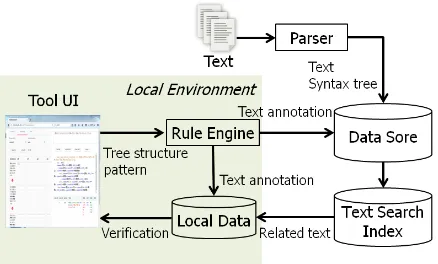
Figure 1 describes the architecture of the proposed tool. We parse texts that are utilized for a tar-get application and store the generated linguistic trees in a data store in advance. Then, we prepare a text search index for full text search, which is also used later to retrieve relations extracted by the tool. The data store and text search index are run-ning on the server side. If users want to, they can use the proposed tool in only a local environment without server side settings.
(.POS=ROOT&.lemma=will
(.POS=S&.lemma=will
(.POS=NP&.lemma=Hitachi (.POS=JJ&.lemma=japanese ) (.POS=NNS&.lemma=electronics ) (.POS=NN&.lemma=maker ) (.POS=NNP&.lemma=Hitachi ))
(.POS=VP&.lemma=will
(.POS=MD&.lemma=will )
(.POS=VP&.lemma=spin
(.POS=VB&.lemma=spin ) (.POS=PRT&.lemma=off
(.POS=RP&.lemma=off )) (.POS=NP&.lemma=division (.POS=PRP$&.lemma=its ) (.POS=NN&.lemma=home ) (.POS=NN&.lemma=appliance ) (.POS=CC&.lemma=and ) (.POS=JJ&.lemma=industrial ) (.POS=NN&.lemma=equipment ) (.POS=NNS&.lemma=division )) (.POS=PP&.lemma=by
...
(.POS=S *
(#a1.POS=NP *) (.POS=VP
(*.POS=MD _) *
(.POS=VP
(#a0.POS=VB&.lemma=spin _) (.POS=PRT
[image:3.595.111.491.62.253.2](.POS=RP&.lemma=off _)) (#a2.POS=NP *) *) *) *)
Table 1: Syntax tree (left) and structure-based pattern (right).
Figure 2: Snapshots of StruAP.
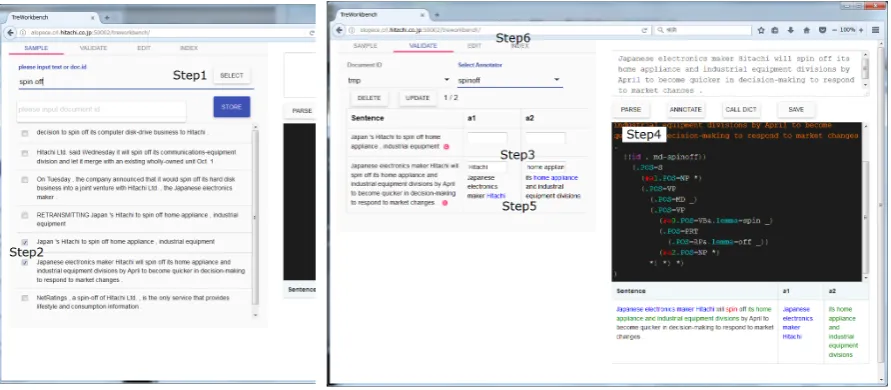
Step 1 In the SAMPLE tab, find several texts of a basis of a tree structure pattern by keyword search. The keyword “spin off” draws rele-vant sentences from the data store by using the text search index.
Step 2 Choose proper sentences and click the STORE button to save the sentences into the local data store.
Step 3 In the VALIDATE tab, prepare a validation dataset before developing a tree structure pat-tern. In Figure 2, we decodeHitachifor a1 as a subject phrase, and home appliancefor a2 as a object phrase. Fill out the a[1-2] text fields with the corresponding words.
Step 4 Click the “c” button to parse the sentence and generate its syntax tree in the text area
of the right pane. Change the syntax tree to a tree structure pattern through abstraction as shown in Table 1, and click the ANNOTATE button (or Ctrl-Shift-o) to confirm if the pat-tern works well. A user can see the respective phrases of a[1-2] in the table area below. Al-though no syntactic error correction is avail-able, frequent use of the shortcut key is help-ful to avoid syntactic errors.
[image:3.595.77.523.287.482.2]annotations. The differences are highlighted in red.
Step 6 Click the UPDATE button in the INDEX tab to write the annotations for all of the stored documents into the data store on the server side, and update the text search index for extracted relations.
By following the above steps, a text search in-dex for relations is ready for an external applica-tion. The CALL DICT button and EDIT tab are related to the lexicon reference explained in Sec-tion 3.2.
3.2 Detailed Pattern Specifications
Table 3 lists a sample of pattern expressions of the proposed model. Our model permits leaf node match (_), alternatives (|), subtree retrieval (#), negation (!), and quantification (*,?,+). In addi-tion, the user can use two unique functions: lexi-con reference and subpattern call.
Lexicon Reference The following pattern is a simple one representing a causal relation between subtree a1 and subtree a2.
(.POS=S * (#a1.POS=NP *)
(.POS=VP * (.lemma=increase|cause _) (#a2.POS=NP) *) *)
Here, the pattern(.lemma=increase|... would
be long because many words can be used as a lemma for the leaf node. In this case, users can use word lists described in separate files, instead of writing down all of the words in the pattern subtree. A pattern using lexicon reference is as follows:
(.POS=S * (#a1.POS=NP *)
(.POS=VP * (.lemma=\dic.affect _) (#a2.POS=NP) *) *)
The affectrepresents the name of a word list
containing the words increase and cause. Users can also define a list of words for a1 and a2. Subpattern Call It is useful to partially refer to pre-defined subpatterns because the same subpat-terns occur repeatedly in different tree structure patterns. The following is an example of a sub-pattern definition.
(
((ref . (leaf pos))) (.POS=VP *
(.POS=\arg.pos&.lemma=\dic.spinoff *) (#a2.POS=NP *) *)
)
Here, ref is a reserved word meaning
subpat-tern definition, leaf is the name of the
subpat-tern, pos is the name of the argument variable. \arg.posis expanded to a given argument. The
user can call the subpattern as follows:
(.POS=S * (#a1.POS=NP *) (.POS=VP *
(\ref.leaf VB|VBZ) *) *)
Here,\ref.leafmeans the call of the subpat-tern whose name isleaf. VB|VBZis the argument
of the subpattern and is substituted for\arg.pos
in the subpattern. When creating a pattern for a sentence with a complicated syntax structure, the recursive call of a subpattern is useful. An exam-ple of a recursive call is as follows:
(
((ref . (lib.vp_loop leaf_pattern pos))) (.POS=VP *
(\ref.vp_loop \arg.leaf_pattern VB) *) )
(
((ref . (lib.vp_loop leaf_pattern pos))) (\ref.\arg.leaf_pattern \arg.pos)
)
(.POS=S * (#a1.POS=NP *)
(\ref.vp_loop leaf VB|VBZ) *)
This pattern partially corresponds to the pattern syntaxA .+(VP) Bof Tregex.
4 Implementation
The proposed tool StruAP is implemented in Python. Syntax trees are expanded on python data structures and tree structure patterns are di-rectly applied on the data structure. This means we do not use translation from our model to ex-isting query lauguage, such as SQL. In the cur-rent implementation, we use Cassandra2as a data store and Solr3 as a text search index. We also use Hadoop4for parallel processing of the rule en-gine. While the tool comes with the web-based user interface shown in Figure 2, command line tools for the Linux environment are also available. Users can easily start up the web version of the tool by using a docker image5 with several con-figurations for the data store and the text search in-dex. For the command line version, users edit files for tree patterns and lexicon reference with their
a1 a2 text
Pepsi the restaurant unit Pepsi will spin off the restaurant unit by the end of the year . Mannesmann its Internet business The chairman also said Mannesmann might spin off its
In-ternet business . Rhone-Poulenc part of its chemicals
[image:5.595.84.512.63.133.2]ac-tivities As part of the plan Rhone-Poulenc would spin off part of itschemicals activities to focus on healthcare , in a bid to boost its share price and earnings .
Table 2: Examples of extracted relations.⃝c1994–2010 New York Times.
Pattern Subtree to be matched
(.POS=PRT *) Subtree whose POS is PRT.
(.POS=VB|VBD _) Leaf node whose POS is VB or VBD.
(.POS=VB&.lemma=spin _) Leaf node POS of which is VB, and the lemma of which isspin.
(#a0.POS=VB _) Leaf node whose POS is VB. Retrieve the matched node with the name of a0.
(.POS=NP&.type!=tmod *) Subtree POS of which is NP, the dependency type of which is nottmod.
* Zero or more occurrences of any subtree.
(*.POS!=NP|NN|NNS *) Zero or more occurrences of the subtree whose POS is not NP, NN, nor NNS.
(?.POS=MD|CC|VP *) Zero or one occurrences of the subtree whose POS is MD, CC or VP.
[image:5.595.308.527.309.449.2](+.POS=NN|NP *) One or more occurrences of the subtree whose POS is NN or NP. Table 3: Sample of pattern expressions.
Figure 3: brat view of generated annotations.
favorite editors and run the rule engine from the Linux command line. We implemented the tool for the English language and Japanese language. Stanford’s CoreNLP (Manning et al., 2014) and CaboCha (Kudo and Matsumoto, 2002) are used for the English language and Japanese language, respectively. For the English version, the user can use both constituent trees and dependency trees as the basis of the tree structure patterns. On the other hand, only dependency trees are available for the Japanese version because CaboCha does not out-put constituent trees.
We can easily integrate the annotation tool brat6 into the proposed tool via the data store. Fig-ure 3 visualizes the generated annotations in the data store with brat view.
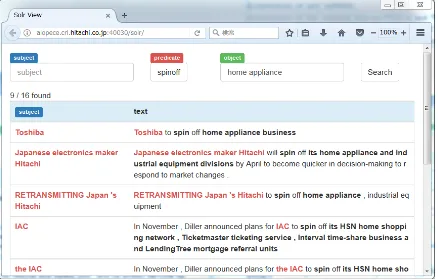
Figure 4 shows a simple example of an cation that uses extracted relations. This appli-cation uses the same text search index as that of the proposed tool. For example, we can retrieve sentences that include the spin-off relation with the object phrase of home appliance by entering home appliancein the object phrase text field. The highlighted text fragments correspond to the sub-ject phrases. By using the same search index,
6brat, http://brat.nlplab.org
Figure 4: Example of application using extracted relations.
the tool can be used to directly maintain and up-date the relation data for the application. Simi-larly, we can implement various applications us-ing case-specific relations through the index of the proposed tool.
5 Discussion
relation Developer A Developer B spin-off
# of patterns 8 12
# of words 3 2
sue
# of patterns 7 10
# of words 5 4
penalize
# of patterns 8 9
# of words 8 4
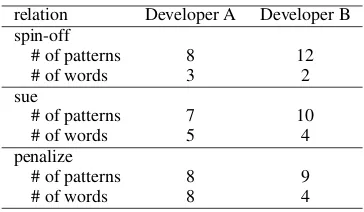
Table 4: Efficiency investigation. Developer A is translator, but not researcher; Developer B is soft-ware engineer, but not researcher.
syntax and whole workflow support. The use of a bracketed syntax to define patterns is arguable. However, we suppose users can develop lots of patterns faster by editting bracketed patterns in a text-based editor, than by use of a graphical tree editor.
On the other hand, there are not enough words for lexicon reference for an actual application. Al-though the function of the lexicon reference is use-ful, the current tool is not helpful to increase the variety of predicate words and clue words.
We have already used the tool in several cases. We have developed 657 patterns in total, and the number of words in the lexicons used for the pat-terns is 6406. Especially, our development of end-to-end argument generation system in debat-ing (Sato et al., 2015) relied on the proposed tool. We conclude that the proposed model is effective when it is necessary to newly define case-specific relations and non-researchers are involved in de-velopment of the relation extraction.
6 Conclusion
This paper describes a tool for developing tree structure patterns, which makes it easy to de-fine relations among textual phrases, and creates a search index for these newly defined relations. The tool assumes that in most practical use cases, newly defining relations specific to the use cases is required. In such cases, the proposed tool is ef-fective to identify essential tree structure patterns. Future work includes developing semi-automatic abstraction using frequent subtree mining and integrating techniques to collect clue words for lexicon reference. Another direction is to support collaboration between users. Similar subpattern search helps users to avoid duplicating a pattern created by another user.
References
Sabine Brants, Stefanie Dipper, Silvia Hansen, Wolf-gang Lezius, and George Smith. 2002. The TIGER treebank. InProceedings of the Workshop on Tree-banks and Linguistic Theories.
Ronan Collobert, Jason Weston, L´eon Bottou, Michael Karlen, Koray Kavukcuoglu, and Pavel Kuksa. 2011. Natural language processing (almost) from scratch. J. Mach. Learn. Res., 12:2493–2537. Ulrich Heid, Holger Voormann, Jan-Torsten Milde,
Ul-rike Gut, Katrin Erk, and Sebastian Pad´o. 2004. Querying both time-aligned and hierarchical corpora with NXT search. InProceedings of LREC-2004, pages 1455 – 1459.
Meghana Kshirsagar, Sam Thomson, Nathan Schnei-der, Jaime Carbonell, Noah A. Smith, and Chris Dyer. 2015. Frame-semantic role labeling with het-erogeneous annotations. In Proceedings of ACL-IJCNLP 2015 Short Papers, pages 218–224. Taku Kudo and Yuji Matsumoto. 2002. Japanese
de-pendency analysis using cascaded chunking. In Proceedings of CoNLL 2002 Post-Conference Work-shops, pages 63–69.
Catherine Lai and Steven Bird. 2005. Lpath+: A first-order complete language for linguistic tree query. In Proceedings of the 19st Pacific Asia Conference on Language, Information and Computation, PACLIC. R. Levy and G. Andrew. 2006. Tregex and tsurgeon:
tools for querying and manipulating tree data struc-tures. InProceedings of LREC-2006.
Christopher D. Manning, Mihai Surdeanu, John Bauer, Jenny Finkel, Steven J. Bethard, and David Mc-Closky. 2014. The Stanford CoreNLP natural lan-guage processing toolkit. InACL System Demon-strations, pages 55–60.
Vasin Punyakanok, Dan Roth, and Wen-tau Yih. 2008. The importance of syntactic parsing and infer-ence in semantic role labeling. Comput. Linguist., 34(2):257–287.
Douglas L. T. Rohde. 2005. Tgrep2 user manual ver-sion 1.15.
Misa Sato, Kohsuke Yanai, Toshinori Miyoshi, Toshi-hiko Yanase, Makoto Iwayama, Qinghua Sun, and Yoshiki Niwa. 2015. End-to-end argument gener-ation system in debating. In Proceedings of ACL-IJCNLP 2015 System Demonstrations.
Anil Kumar Singh. 2012. A concise query language with search and transform operations for corpora with multiple levels of annotation. InProceedings of LREC-2012.
[image:6.595.90.272.60.166.2]