AMR Parsing using Stack-LSTMs
Miguel Ballesteros Yaser Al-Onaizan
IBM T.J Watson Research Center,
1101 Kitchawan Road, Route 134 Yorktown Heights, NY 10598. U.S
[email protected], [email protected]
Abstract
We present a transition-based AMR parser that directly generates AMR parses from plain text. We use Stack-LSTMs to repre-sent our parser state and make decisions greedily. In our experiments, we show that our parser achieves very competitive scores on English using only AMR train-ing data. Addtrain-ing additional information, such as POS tags and dependency trees, improves the results further.
1 Introduction
Transition-based algorithms for natural language parsing (Yamada and Matsumoto, 2003; Nivre, 2003, 2004, 2008) are formulated as a series of decisions that read words from a buffer and incre-mentally combine them to form syntactic struc-tures in a stack. Apart from dependency pars-ing, these models, also known as shift-reduce al-gorithms, have been successfully applied to tasks like phrase-structure parsing (Zhang and Clark, 2011;Dyer et al.,2016), named entity recognition (Lample et al., 2016), CCG parsing (Misra and Artzi,2016) joint syntactic and semantic parsing (Henderson et al.,2013;Swayamdipta et al.,2016) and even abstract-meaning representation parsing (Wang et al.,2015b,a;Damonte et al.,2016).
AMR parsing requires solving several natural language processing tasks; mainly named entity recognition, word sense disambiguation and joint syntactic and semantic role labeling.1 Given the
difficulty of building an end-to-end system, most prior work is based on pipelines or heavily de-pendent on precalculated features (Flanigan et al., 2014; Zhou et al., 2016; Werling et al., 2015; Wang et al.,2015b, inter-alia).
1Check (Banarescu et al.,2013) for a complete
descrip-tion of AMR graphs.
Inspired by Wang et al. (2015b,a); Goodman et al.(2016);Damonte et al.(2016) andDyer et al. (2015), we present a shift-reduce algorithm that produces AMR graphs directly from plain text. Wang et al.(2015b,a);Zhou et al.(2016); Good-man et al.(2016) presented transition-based tree-to-graph transducers that traverse a dependency tree and transforms it to an AMR graph.Damonte et al.(2016)’s input is a sentence and it is therefore more similar (with a different parsing algorithm) to our approach, but their parser relies on external tools, such as dependency parsing, semantic role labeling or named entity recognition.
The input of our parser is plain text sentences and, through rich word representations, it predicts all actions (in a single algorithm) needed to gen-erate an AMR graph representation for an input sentence; it handles the detection and annotation of named entities, word sense disambiguation and it makes connections between the nodes detected towards building a predicate argument structure. Even though the system that runs with just words is very competitive, we further improve the results incorporating POS tags and dependency trees into our model.
Stack-LSTMs2have proven to be useful in tasks
related to syntactic and semantic parsing (Dyer et al.,2015,2016;Swayamdipta et al.,2016) and named entity recognition (Lample et al.,2016). In this paper, we demonstrate that they can be effec-tively used for AMR parsing as well.
2 Parsing Algorithm
Our parsing algorithm makes use of aSTACK(that stores AMR nodes and/or words) and a BUFFER that contains the words that have yet to be pro-cessed. The parsing algorithm is inspired from 2We use the dynamic framework ofNeubig et al.(2017)
to implement our parser.
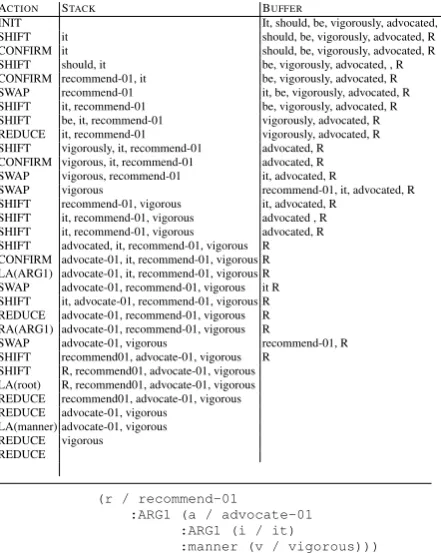
the semantic actions presented byHenderson et al. (2013), the transition-based NER algorithm by Lample et al. (2016) and the arc-standard algo-rithm (Nivre,2004). As in (Ballesteros and Nivre, 2013) the buffer starts with the root symbol at the end of the sequence. Figure2shows a running ex-ample. The transition inventory is the following:
• SHIFT: pops the front of the BUFFER and push it to theSTACK.
• CONFIRM: calls a subroutine that predicts the AMR node corresponding to the top of the STACK. It then pops the word from the STACK and pushes the AMR node to the STACK. An example is the prediction of a propbank sense: Fromoccuredtooccur-01.
• REDUCE: pops the top of the STACK. It oc-curs when the word/node at the top of the stack is complete (no more actions can be ap-plied to it). Note that it can also be apap-plied to words that do not appear in the final output graph, and thus they are directly discarded.
• MERGE: pops the two nodes at the top of the STACK and then it merges them, it then pushes the resulting node to the top of STACK. Note that this can be applied recur-sively. This action serves to get multiword named entities (e.g.New York City).
• ENTITY(label): labels the node at the top of the STACK with an entity label. This action serves to label named entities, such as New York City or Madrid and it is normally run after MERGEwhen it is a multi-word named entity, or after SHIFT if it is a single-word named entity.
• DEPENDENT(label,node): creates a new node in the AMR graph that is dependent on the node at the top of the STACK. An example is the introduction of a negativepolarityto a given node: From illegal to (legal, polarity -).
• LA(label) and RA(label): create a left/right arc with the top two nodes at the top of the STACK. They keep both the head and the dependent in the stack to allow reentrancies (multiple incoming edges). The head is now a composition of the head and the dependent. They are enriched with the AMR label.
• SWAP: pops the two top items at the top of the STACK, pushes the second node to the front of theBUFFER, and pushes the first one back into theSTACK. This action allows non-projective arcs as in (Nivre,2009) but it also helps to introduce reentrancies. At oracle time, SWAP is produced when the word at the top of the stack is blocking actions that may happen between the second element at the top of the stack and any of the words in the buffer.
Figure1shows the parser actions and the effect on the parser state (contents of the stack, buffer) and how the graph is changed after applying the actions.
We implemented an oracle that produces the se-quence of actions that leads to the gold (or close to gold) AMR graph. In order to map words in the sentences to nodes in the AMR graph we need to align them. We use the JAMR aligner provided byFlanigan et al.(2014).3 It is important to
men-tion that even though the aligner is quite accurate, it is not perfect, producing a F1 score of around 0.90. This means that most sentences have at least one alignment error which implies that our oracle is not capable of perfectly reproducing all AMR graphs. This has a direct impact on the accuracy of the parser described in the next section since it is trained on sequences of actions that are not per-fect. The oracle achieves 0.895 F1 Smatch score (Cai and Knight,2013) when it is run on the de-velopment set of the LDC2014T12.
The algorithm allows a set of different con-straints that varies from the basic ones (not al-lowing impossible actions such as SHIFT when the buffer is empty or not generating arcs when the words have not yet beenCONFIRMed and thus transformed to nodes) to more complicated ones based on the propbank candidates and number of arguments. We choose to constrain the parser to the basic ones and let it learn the more compli-cated ones.
3 Parsing Model
In this section, we revisit Stack-LSTMs, our pars-ing model and our word representations.
Stackt Buffert Action Stackt+1 Buffert+1 Graph
S u, B SHIFT u, S B —
u, S B CONFIRM n, S B —
u, S B REDUCE S B —
u, v, S B MERGE (u, v), S B —
u, S B ENTITY(l) (u:l), S B —
u, S B DEPENDENT(r, d) u, S B u→r d
u, v, S B RA(r) u, v, S B u→r v
u, v, S B LA(r) u, v, S B u←r v
[image:3.595.135.465.62.203.2]u, v, S B SWAP u, S v, B —
Figure 1: Parser transitions indicating the action applied to the stack and buffer and the resulting state.
ACTION STACK BUFFER
INIT It, should, be, vigorously, advocated, R SHIFT it should, be, vigorously, advocated, R CONFIRM it should, be, vigorously, advocated, R SHIFT should, it be, vigorously, advocated, , R CONFIRM recommend-01, it be, vigorously, advocated, R SWAP recommend-01 it, be, vigorously, advocated, R SHIFT it, recommend-01 be, vigorously, advocated, R SHIFT be, it, recommend-01 vigorously, advocated, R REDUCE it, recommend-01 vigorously, advocated, R SHIFT vigorously, it, recommend-01 advocated, R CONFIRM vigorous, it, recommend-01 advocated, R SWAP vigorous, recommend-01 it, advocated, R
SWAP vigorous recommend-01, it, advocated, R SHIFT recommend-01, vigorous it, advocated, R
SHIFT it, recommend-01, vigorous advocated , R SHIFT it, recommend-01, vigorous advocated, R SHIFT advocated, it, recommend-01, vigorous R CONFIRM advocate-01, it, recommend-01, vigorous R LA(ARG1) advocate-01, it, recommend-01, vigorous R SWAP advocate-01, recommend-01, vigorous it R SHIFT it, advocate-01, recommend-01, vigorous R REDUCE advocate-01, recommend-01, vigorous R RA(ARG1) advocate-01, recommend-01, vigorous R
SWAP advocate-01, vigorous recommend-01, R SHIFT recommend01, advocate-01, vigorous R
SHIFT R, recommend01, advocate-01, vigorous LA(root) R, recommend01, advocate-01, vigorous REDUCE recommend01, advocate-01, vigorous REDUCE advocate-01, vigorous
LA(manner) advocate-01, vigorous REDUCE vigorous REDUCE
(r / recommend-01
:ARG1 (a / advocate-01 :ARG1 (i / it)
:manner (v / vigorous)))
Figure 2: Transition sequence for the sentenceIt should be vigorously advocated. R represents the root symbol
3.1 Stack-LSTMs
The stack LSTM is an augmented LSTM (Hochreiter and Schmidhuber, 1997; Graves, 2013) that allows adding new inputs in the same way as LSTMs but it also provides a POP opera-tion that moves a pointer to the previous element. The output vector of the LSTM will consider the stack pointer instead of the rightmost position of the sequence.4
4We refer interested readers to (Dyer et al.,2015) for
fur-ther details.
3.2 Representing the State and Making Parsing Decisions
The state of the algorithm presented in Section2is represented by the contents of theSTACK,BUFFER and a list with the history of actions (which are encoded as Stack-LSTMs).5 All of this forms the
vectorst that represents the state which s calcu-lated as follows:
st= max{0,W[stt;bt;at] +d}, whereWis a learned parameter matrix,dis a bias term andstt, bt,atrepresent the output vector of the Stack-LSTMs at timet.
Predicting the Actions: Our model then uses the vector st for each timestep t to compute the probability of the next action as:
p(zt|st) = exp g
>
ztst+qzt
P
z0∈Aexp g>z0st+qz0 (1) wheregzis a column vector representing the (out-put) embedding of the action z, and qz is a bias term for action z. The set A represents the ac-tions listed in Section2. Note that due to parsing constraints the set of possible actions may vary. The total number of actions (in the LDC2014T12 dataset) is 478; note that they include all possible labels (in the case of LA and RA ) and the differ-ent dependdiffer-ent nodes for the DEPENDENTaction Predicting the Nodes: When the model selects the action CONFIRM, the model needs to decide the AMR node6 that corresponds to the word at
5Word representations, input and hidden representations
have 100 dimensions, action and label representations are of size 20.
6When the word at the top of stack is an out of
[image:3.595.74.295.243.520.2]the top of theSTACK, by usingst, as follows:
p(et|st) = exp g
>
etst+qet
P
e0∈N exp g>e0st+qe0 (2) whereN is the set of possible candidate nodes for the word at the top of the STACK. ge is a column vector representing the (output) embedding of the node e, and qe is a bias term for the node e. It is important to mention that this implies finding a propbank sense or a lemma. For that, we rely entirely on the AMR training set instead of using additional resources.
Given that the system runs two softmax opera-tions, one to predict the action to take and the sec-ond one to predict the correspsec-onding AMR node, and they both share LSTMs to make predictions, we include an additional layer with atanh nonlin-earity afterstfor each softmax.
3.3 Word Representations
We use character-based representations of words using bidirectional LSTMs (Ling et al., 2015b; Ballesteros et al., 2015). They learn represen-tations for words that are orthographically simi-lar. Note that they are updated with the updates to the model. Ballesteros et al. (2015) and Lam-ple et al. (2016) demonstrated that it is possible to achieve high results in syntactic parsing and named entity recognition by just using character-based word representations (not even POS tags, in fact, in some cases the results with just character-based representations outperform those that used explicit POS tags since they provide similar vec-tors for words with similar/same morphosyntac-tic tag (Ballesteros et al., 2015)); in this paper we show a similar result given that both syntactic parsing and named-entity recognition play a cen-tral role in AMR parsing.
These are concatenated with pretrained word embeddings. We use a variant of the skip n-gram model provided by Ling et al. (2015a) with the LDC English Gigaword corpus (version 5). These embeddings encode the syntactic behavior of the words (see (Ling et al.,2015a)).
More formally, to represent each input token, we concatenate two vectors: a learned character-based representation (w˜C); and a fixed vector
rep-resentation from a neural language model (w˜LM).
A linear map (V) is applied to the resulting vector and passed through a component-wise ReLU,
x= max{0,V[ ˜wC; ˜wLM] +b}.
whereVis a learned parameter matrix,bis a bias term and wC is the character-based learned
rep-resentation for each word, w˜LM is the pretrained
word representation.
3.4 POS Tagging and Dependency Parsing We may include preprocessed POS tags or depen-dency parses to incorporate more information into our model. For the POS tags we use the Stanford tagger (Toutanova et al., 2003) while we use the Dyer et al. (2015)’s Stack-LSTM parser trained on the English CoNLL 2009 dataset (Hajiˇc et al., 2009) to get the dependencies.
POS tags: The POS tags are preprocessed and a learned representationtagis concatenated with the word representations. This is the same setting as (Dyer et al.,2015).
Dependency Trees: We use them in the same way as POS tags by concatenating a learned rep-resentation dep of the dependency label to the parent with the word representation. Additionally, we enrich the state representationst, presented in Section 3.2. If the two words at the top of the STACKhave a dependency between them,stis en-riched with a learned representation that indicates that and the direction; otherwise st remains un-changed.stis calculated as follows:
st= max{0,W[stt;bt;at;dept] +d},
where dept is the learned vector that represents that there is an arc between the two top words at the top of the stack.
4 Experiments and Results
We use the LDC2014T12 dataset7 for our
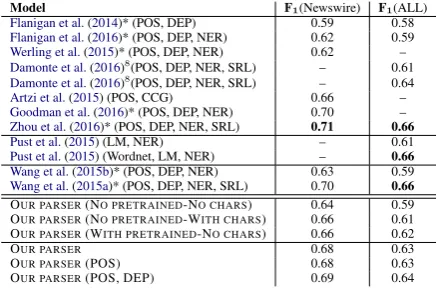
experi-ments. Table1shows results, including compari-son with prior work that are also evaluated on the same dataset.8
7This dataset is a standard for comparison and has been
used for evaluation in recent papers like (Wang et al.,2015a; Goodman et al.,2016;Zhou et al.,2016). We use the standard training/development/test split: 10,312 sentences for training, 1,368 sentences for development and 1,371 sentences held-out for testing.
8The first entry for Damonte et al. is calculated
Model F1(Newswire) F1(ALL)
Flanigan et al.(2014)* (POS, DEP) 0.59 0.58
Flanigan et al.(2016)* (POS, DEP, NER) 0.62 0.59
Werling et al.(2015)* (POS, DEP, NER) 0.62 –
Damonte et al.(2016)8(POS, DEP, NER, SRL) – 0.61
Damonte et al.(2016)8(POS, DEP, NER, SRL) – 0.64
Artzi et al.(2015) (POS, CCG) 0.66 –
Goodman et al.(2016)* (POS, DEP, NER) 0.70 –
Zhou et al.(2016)* (POS, DEP, NER, SRL) 0.71 0.66 Pust et al.(2015) (LM, NER) – 0.61
Pust et al.(2015) (Wordnet, LM, NER) – 0.66 Wang et al.(2015b)* (POS, DEP, NER) 0.63 0.59
Wang et al.(2015a)* (POS, DEP, NER, SRL) 0.70 0.66
OUR PARSER(NO PRETRAINED-NO CHARS) 0.64 0.59 OUR PARSER(NO PRETRAINED-WITH CHARS) 0.66 0.61 OUR PARSER(WITH PRETRAINED-NO CHARS) 0.66 0.62 OUR PARSER 0.68 0.63 OUR PARSER(POS) 0.68 0.63 OUR PARSER(POS, DEP) 0.69 0.64
Table 1: AMR results on the LDC2014T12 dataset; Newsire section (left) and full (right). Rows labeled with OUR-PARSER show our re-sults. POS indicates that the system uses prepro-cessed POS tags, DEP indicates that it uses pre-processed dependency trees, SRL indicates that it uses preprocessed semantic roles, NER indicates that it uses preprocessed named entitites. LM in-dicates that it uses a LM trained on AMR data and WordNet indicates that it uses WordNet to predict the concepts. Systems marked with * are pipeline systems that require a dependency parse as input. (WITH PRETRAINED-NO CHARS) shows the re-sults of our parser without character-based rep-resentations. (NO PRETRAINED-WITH CHARS) shows results without pretrained word embed-dings. (NO PRETRAINED-NO CHARS) shows re-sults without character-based representations and without pretrained word embeddings. The rest of our results include both pretrained embeddings and character-based representations.
Our model achieves 0.68 F1 in the newswire section of the test set just by using character-based representations of words and pretrained word em-beddings. All prior work uses lemmatizers, POS taggers, dependency parsers, named entity rec-ognizers and semantic role labelers that use ad-ditional training data while we achieve competi-tive scores without that. Pust et al.(2015) reports 0.66 F1 in the full test by using WordNet for con-cept identification, but their performance drops to 0.61 without WordNet. It is worth noting that we achieved 0.64 in the same test set without Word-Net.Wang et al.(2015b,a) without SRL (via Prop-bank) achieves only 0.63 in the newswire test set while we achieved 0.69 without SRL (and 0.68 without dependency trees).
In order to see whether pretrained word em-beddings and character-based emem-beddings are
use-ful we carried out an ablation study by show-ing the results of our parser with and with-out character-based representations (replaced by standard lookup table learned embeddings) and with and without pretrained word embeddings. By looking at the results of the parser without character-based embeddings but with pretrained word embeddings we observe that the character-based representation of words are useful since they help to achieve 2 points better in the Newswire dataset and 1 point more in the full test set. The parser with character-based embeddings but with-out pretrained word embeddings, the parser has more difficulty to learn and only achieves 0.61 in the full test set. Finally, the model that does not use neither character-based embeddings nor pre-trained word embeddings is the worst achieving only 0.59 in the full test set, note that this model has no explicity way of getting any syntactic infor-mation through the word embeddings nor a smart way to handle out of vocabulary words.
All the systems marked with * require that the input is a dependency tree, which means that they solve a transduction task between a dependency tree and an AMR graph. Even though our parser starts from plain text sentences when we incorpo-rate more information into our model, we achieve further improvements. POS tags provide small im-provements (0.6801 without POS tags vs 0.6822 for the model that runs with POS tags). Depen-dency trees help a bit more achieving 0.6920.
5 Conclusions and Future Work
We present a new transition-based algorithm for AMR parsing and we implement it using Stack-LSTMS and a greedy decoder. We present com-petitive results, without any additional resources and external tools. Just by looking at the words, we achieve 0.68 F1 (and 0.69 by preprocessing dependency trees) in the standard dataset used for evaluation.
Acknowledgments
[image:5.595.75.294.62.206.2]References
Yoav Artzi, Kenton Lee, and Luke Zettlemoyer. 2015. Broad-coverage ccg semantic parsing with amr. In
Proceedings of the 2015 Conference on Empirical Methods in Natural Language Processing, pages 1699–1710, Lisbon, Portugal. Association for Com-putational Linguistics.
Miguel Ballesteros, Chris Dyer, and Noah A. Smith. 2015. Improved transition-based parsing by model-ing characters instead of words with lstms. In Pro-ceedings of the 2015 Conference on Empirical Meth-ods in Natural Language Processing, pages 349– 359, Lisbon, Portugal. Association for Computa-tional Linguistics.
Miguel Ballesteros and Joakim Nivre. 2013. Going
to the roots of dependency parsing. Computational
Linguistics, 39(1).
Laura Banarescu, Claire Bonial, Shu Cai, Madalina Georgescu, Kira Griffitt, Ulf Hermjakob, Kevin Knight, Philipp Koehn, Martha Palmer, and Nathan Schneider. 2013. Abstract meaning representation
for sembanking. InProceedings of the 7th
Linguis-tic Annotation Workshop and Interoperability with Discourse.
Shu Cai and Kevin Knight. 2013. Smatch: an evalua-tion metric for semantic feature structures. InACL (2), pages 748–752.
Marco Damonte, Shay B. Cohen, and Giorgio Satta. 2016. An incremental parser for abstract meaning
representation. CoRR, abs/1608.06111.
Chris Dyer, Miguel Ballesteros, Wang Ling, Austin Matthews, and Noah A. Smith. 2015. Transition-based dependency parsing with stack long
short-term memory. InProc. of ACL.
Chris Dyer, Adhiguna Kuncoro, Miguel Ballesteros, and Noah Smith. 2016. Recurrent neural network
grammars. InProceedings of NAACL-HLT 2016.
Jeffrey Flanigan, Chris Dyer, Noah A Smith, and Jaime Carbonell. 2016. Cmu at semeval-2016 task 8: Graph-based amr parsing with infinite ramp loss.
Proceedings of SemEval, pages 1202–1206. Jeffrey Flanigan, Sam Thomson, Jaime Carbonell,
Chris Dyer, and Noah A. Smith. 2014. A discrim-inative graph-based parser for the abstract meaning
representation. InProceedings of the 52nd Annual
Meeting of the Association for Computational Lin-guistics, volume 1, pages 1426–1436. Association for Computational Linguistics.
James Goodman, Andreas Vlachos, and Jason
Narad-owsky. 2016. Noise reduction and targeted
explo-ration in imitation learning for abstract meaning rep-resentation parsing. In Proceedings of the 54th Annual Meeting of the Association for Computa-tional Linguistics (Volume 1: Long Papers), pages 1–11, Berlin, Germany. Association for Computa-tional Linguistics.
Alex Graves. 2013. Generating sequences with recur-rent neural networks. CoRR, abs/1308.0850. Jan Hajiˇc, Massimiliano Ciaramita, Richard
Johans-son, Daisuke Kawahara, Maria Ant`onia Mart´ı, Llu´ıs M`arquez, Adam Meyers, Joakim Nivre, Sebastian Pad´o, Jan ˇStˇep´anek, Pavel Straˇn´ak, Mihai Surdeanu,
Nianwen Xue, and Yi Zhang. 2009. The conll-2009
shared task: Syntactic and semantic dependencies in multiple languages. InProceedings of the Thir-teenth Conference on Computational Natural Lan-guage Learning: Shared Task, CoNLL ’09, pages 1–18, Stroudsburg, PA, USA. Association for Com-putational Linguistics.
James Henderson, Paola Merlo, Ivan Titov, and Gabriele Musillo. 2013. Multilingual joint pars-ing of syntactic and semantic dependencies with a
latent variable model. Computational Linguistics,
39(4):949–998.
Sepp Hochreiter and J¨urgen Schmidhuber. 1997.
Long short-term memory. Neural Computation,
9(8):1735–1780.
Guillaume Lample, Miguel Ballesteros, Kazuya Kawakami, Sandeep Subramanian, and Chris Dyer. 2016. Neural architectures for named entity
recog-nition. InProceedings of NAACL-HLT 2016.
Wang Ling, Chris Dyer, Alan Black, and Isabel Trancoso. 2015a. Two/too simple adaptations of
word2vec for syntax problems. In Proceedings of
the North American Chapter of the Association for Computational Linguistics (NAACL).
Wang Ling, Tiago Lu´ıs, Lu´ıs Marujo, Ram´on Fernan-dez Astudillo, Silvio Amir, Chris Dyer, Alan W Black, and Isabel Trancoso. 2015b. Finding func-tion in form: Composifunc-tional character models for
open vocabulary word representation. In
Proceed-ings of the Conference on Empirical Methods in Nat-ural Language Processing (EMNLP).
Dipendra Kumar Misra and Yoav Artzi. 2016. Neural
shift-reduce ccg semantic parsing. InProceedings of the 2016 Conference on Empirical Methods in Natu-ral Language Processing, pages 1775–1786, Austin, Texas. Association for Computational Linguistics. Graham Neubig, Chris Dyer, Yoav Goldberg, Austin
Matthews, Waleed Ammar, Antonios Anastasopou-los, Miguel Ballesteros, David Chiang, Daniel Clothiaux, Trevor Cohn, Kevin Duh, Manaal Faruqui, Cynthia Gan, Dan Garrette, Yangfeng Ji, Lingpeng Kong, Adhiguna Kuncoro, Gaurav Ku-mar, Chaitanya Malaviya, Paul Michel, Yusuke Oda, Matthew Richardson, Naomi Saphra, Swabha Swayamdipta, and Pengcheng Yin. 2017. Dynet:
The dynamic neural network toolkit. arXiv preprint
arXiv:1701.03980.
Joakim Nivre. 2003. An Efficient Algorithm for
Pro-jective Dependency Parsing. InProceedings of the
Joakim Nivre. 2004. Incrementality in deterministic
dependency parsing. In Proceedings of the
Work-shop on Incremental Parsing: Bringing Engineering and Cognition Together.
Joakim Nivre. 2008. Algorithms for deterministic
in-cremental dependency parsing. Computational
Lin-guistics, 34:4:513–553. MIT Press.
Joakim Nivre. 2009. Non-projective dependency
pars-ing in expected linear time. In Proceedings of the
Joint Conference of the 47th Annual Meeting of the ACL and the 4th International Joint Conference on Natural Language Processing of the AFNLP: Vol-ume 1-VolVol-ume 1, pages 351–359. Association for Computational Linguistics.
Michael Pust, Ulf Hermjakob, Kevin Knight, Daniel Marcu, and Jonathan May. 2015. Parsing english into abstract meaning representation using
syntax-based machine translation. In Proc. EMNLP,
Lis-bon, Portugal.
Swabha Swayamdipta, Miguel Ballesteros, Chris Dyer, and Noah A. Smith. 2016. Greedy, joint
syntactic-semantic parsing with stack lstms. InProceedings
of the 20th SIGNLL Conference on Computational Natural Language Learning, CoNLL 2016, Berlin, Germany, August 11-12, 2016, pages 187–197. Kristina Toutanova, Dan Klein, Christopher D.
Man-ning, and Yoram Singer. 2003. Feature-rich part-of-speech tagging with a cyclic dependency network. InProceedings NAACL.
Chuan Wang, Nianwen Xue, and Sameer Pradhan. 2015a. Boosting transition-based AMR parsing with refined actions and auxiliary analyzers. In
Proc. of , ACL 2015, pages 857–862.
Chuan Wang, Nianwen Xue, and Sameer Pradhan. 2015b. A transition-based algorithm for amr
pars-ing. In Proceedings of the 2015 Conference of
the North American Chapter of the Association for Computational Linguistics: Human Language Tech-nologies, pages 366–375, Denver, Colorado. Asso-ciation for Computational Linguistics.
Keenon Werling, Gabor Angeli, and Christopher D. Manning. 2015. Robust subgraph generation im-proves abstract meaning representation parsing. In
Proceedings of the 53rd Annual Meeting of the Association for Computational Linguistics and the 7th International Joint Conference on Natural Lan-guage Processing (Volume 1: Long Papers), pages 982–991, Beijing, China. Association for Computa-tional Linguistics.
Hiroyasu Yamada and Yuji Matsumoto. 2003. Statis-tical dependency analysis with support vector
ma-chines. In Proceedings of the 8th International
Workshop on Parsing Technologies (IWPT), pages 195–206.
Yue Zhang and Stephen Clark. 2011. Syntactic pro-cessing using the generalized perceptron and beam search. Computational Linguistics, 37(1):105–151.
Junsheng Zhou, Feiyu Xu, Hans Uszkoreit, Weiguang QU, Ran Li, and Yanhui Gu. 2016. Amr parsing
with an incremental joint model. InProceedings of