Combining Generative and Discriminative Approaches to Unsupervised
Dependency Parsing via Dual Decomposition
∗Yong Jiang, Wenjuan Han and Kewei Tu
{jiangyong,hanwj,tukw}@shanghaitech.edu.cn School of Information Science and Technology
ShanghaiTech University, Shanghai, China
Abstract
Unsupervised dependency parsing aims to learn a dependency parser from unanno-tated sentences. Existing work focus-es on either learning generative model-s umodel-sing the expectation-maximization al-gorithm and its variants, or learning dis-criminative models using the discrimina-tive clustering algorithm. In this paper, we propose a new learning strategy that learn-s a generative model and a dilearn-scriminative model jointly based on the dual decom-position method. Our method is simple and general, yet effective to capture the ad-vantages of both models and improve their learning results. We tested our method on the UD treebank and achieved a state-of-the-art performance on thirty languages.
1 Introduction
Dependency parsing is an important task in nat-ural language processing. It identifies dependen-cies between words in a sentence, which have been shown to benefit other tasks such as semantic role labeling (Lei et al.,2015) and sentence classifica-tion (Ma et al., 2015). Supervised learning of a dependency parser requires annotation of a train-ing corpus by ltrain-inguistic experts, which can be time and resource consuming. Unsupervised dependen-cy parsing eliminates the need for dependendependen-cy an-notation by directly learning from unparsed text.
Previous work on unsupervised dependency parsing mainly focuses on learning generative models, such as the dependency model with va-lence (DMV) (Klein and Manning, 2004) and combinatory categorial grammars (CCG) (Bisk and Hockenmaier,2012). Generative models have
∗This work was supported by the National Natural
Sci-ence Foundation of China (61503248).
many advantages. For example, the learning ob-jective function can be defined as the marginal likelihood of the training data, which is typical-ly easy to compute in a generative model. In addition, many types of inductive bias, such as those favoring short dependency arcs (Smith and Eisner, 2006), encouraging correlations between POS tags (Cohen et al., 2008;Cohen and Smith, 2009;Berg-Kirkpatrick et al., 2010; Jiang et al., 2016), and limiting center embedding (Noji et al., 2016), can be incorporated into generative models to achieve better parsing accuracy. However, due to the strong independence assumption in most generative models, it is difficult for these models to utilize context information that has been shown to benefit supervised parsing.
Recently, a feature-rich discriminative model for unsupervised parsing is proposed that captures the global context information of sentences (Grave and Elhadad, 2015). Inspired by discriminative clustering, learning of the model is formulated as convex optimization of both the model parameters and the parses of training sentences. By utilizing language-independent rules between pairs of POS tags to guide learning, the model achieves state-of-the-art performance on the UD treebank dataset.
In this paper we propose to jointly train two state-of-the-art models of unsupervised dependen-cy parsing: a generative model called LC-DMV (Noji et al., 2016) and a discriminative model called Convex-MST (Grave and Elhadad, 2015). We employ a learning algorithm based on the dual decomposition (Dantzig and Wolfe, 1960) infer-ence algorithm, which encourages the two models to influence each other during training.
We evaluated our method on thirty languages and found that the jointly trained models surpass their separately trained counterparts in parsing ac-curacy. Further analysis shows that the two models positively influence each other during joint
ing by implicitly sharing the inductive bias.
2 Preliminaries 2.1 DMV
The dependency model with valence (DMV) ( K-lein and Manning, 2004) is the first generative model that outperforms the left-branching base-line in unsupervised dependency parsing. In D-MV, a sentence is generated by recursively apply-ing three types of grammar rules to construct a parse tree from the top down. The probability of the generated sentence and parse tree is the prob-ability product of all the rules used in the genera-tion process. To learn the parameters (rule prob-abilities) of DMV, the expectation maximization algorithm is often used. Noji et al. (2016) ex-ploited two universal syntactic biases in learning DMV: restricting the center-embedding depth and encouraging short dependencies. They achieved a comparable performance with state-of-the-art ap-proaches.
2.2 Convex-MST
Convex-MST (Grave and Elhadad,2015) is a dis-criminative model for unsupervised dependency parsing based on the first-order maximum span-ning tree dependency parser (McDonald et al., 2005). Given a sentence, whether each possible dependency exists or not is predicted based on a set of handcrafted features and a valid parse tree closest to the prediction is identified by the mini-mum spanning tree algorithm.
For each sentence x, a first-order dependency graph is built over the words of the sentence. The weight of each edge is calculated bywTf(x, i, j),
where w is the parameters and f(x, i, j) is the handcrafted feature vector of the dependency from thei-th word to thej-th word in sentencex. For sentencexof lengthn, we can represent it as ma-trix X where each raw is a feature vector. The parse tree y is a spanning tree of the graph and can be represented as a binary vector with length n×nwhere each element is 1 if the corresponding arc is in the tree and 0 otherwise.
Learning is based on discriminative clustering with the following objective function:
1
N
N
X
α=1
1
2nα||yα−Xαw||
2
2−µvTyα
+λ2||w||22
whereXαis a matrix where each row is a feature
representationf(xα, i, j)of an edge in the
depen-dency graph of sentencexα,vrepresents whether
each dependency arc inyα satisfies a set of
pre-specified linguistic rules, andλandµ are hyper-parameters. The Frank-Wolfe algorithm is em-ployed to optimize the objective function.
2.3 Dual Decomposition
Dual decomposition (Dantzig and Wolfe,1960), a special case of Lagrangian relaxation, is an opti-mization method that decomposes a hard problem into several small sub-problems. It has been wide-ly used in machine learning (Komodakis et al., 2007) and natural language processing (Koo et al., 2010;Rush and Collins,2012).
Komodakis et al. (2007) proposed using dual decomposition to do MAP inference for Markov random fields. Koo et al. (2010) proposed a new dependency parser based on dual decomposition by combining a graph based dependency model and a non-projective head automata. In the work of Rush et al. (2010), they showed that dual de-composition can effectively integrate two lexical-ized parsing models or two correlated tasks.
2.4 Agreement based Learning
Liang et al. (2008) proposed agreement based learning that trains several tractable generative models jointly and encourages them to agree on certain latent variables. To effectively train the system, a product EM algorithm was used. They showed that the joint model can perform better than each independent model on the accuracy or convergence speed. They also showed that the ob-jective function of the work of Klein and Manning (2004) is a special case of the product EM algo-rithm for grammar induction. Our approach has a similar motivation to agreement based learning but has two important advantages. First, while their approach only combines generative models, our approach can make use of both generative and dis-criminative models. Second, while their approach requires the sub-models to share the same dynam-ic programming structure when performing decod-ing, our approach does not have such restriction.
3 Joint Training
dependency parsing: J(MF,MG)
=
N
X
α=1 min
yα∈Yα(F(xα,yα;MF) +G(xα,yα;MG))
whereN is the size of training data,MFandMG
are the parameters of the first and second model respectively, F and Gare their respective learn-ing objectives, and Yα is the set of valid
depen-dency parses of sentence xα. While in
princi-ple this objective can be used to combine many different types of models, here we consider two state-of-the-art models of unsupervised dependen-cy parsing, a generative model LC-DMV (Noji et al.,2016) and a discriminative model Convex-MST (Grave and Elhadad,2015). We denote the parameters of LC-DMV byΘand the parameters of Convex-MST byw. Their respective objective functions are,
F(xα,yα; Θ) =−log (PΘ(xα,yα)f(xα,yα))
G(xα,yα;w)
= 1
2nα||yα−Xαw||
2
2+ 2λN||w||22−µvTy
wherePΘ(xα,yα) is the joint probability of
sen-tencexαand parseyα,fis a constraint factor, and
the notations in the second objective function are explained in section2.2.
3.1 Learning
We use coordinate descent to optimize the param-eters of the two models. In each iteration, we first fix the parameters and find the best dependency parses of the training sentences (see section3.2); we then fix the parses and optimize the parameter-s. The detailed algorithm is shown in Algorithm 1.
Pretraining of the two models is done by run-ning their original learrun-ning algorithms separate-ly. When the parses of the training sentences are fixed, it is easy to show that the parameters of the two models can be optimized separately. Updat-ing the parametersΘof LC-DMV can be done by simply counting the number of times each rule is used in the parse trees and then normalizing the counts to get the maximum-likelihood probabili-ties. The parameters w of Convex-MST can be updated by stochastic gradient descent. After up-dating Θandw at each iteration, we additional-ly train each model separateadditional-ly for three iterations, which we find further improves learning.
Algorithm 1Parameter Learning
Input:Training sentencex1,x2, ...,xN
Pre-trainΘandw repeat
FixΘandwand solve the decoding problem to getyα, α= 1,2, . . . , N
Fix the parses and updateΘandw untilConvergence
Algorithm 2Decoding via Dual Decomposition Input:Sentencex, fixed parameterswandΘ
Initialize vectoruof sizen×nto0 repeat
ˆ
y= arg miny∈YF(x,y; Θ) +uTy
ˆ
z= arg minz∈YG(x,z;w)−uTz
ifyˆ= ˆzthen returnyˆ
else
u=u−τ(ˆy−ˆz)
end if
untilConvergence
3.2 Joint Decoding
Given a training sample xand parameters w,Θ, the goal of decoding is to find the best parse tree:
ˆ
y= arg min
y∈Y 1
2n||y−Xw||22−µvTy−logPΘ(x,y) We employ the dual decomposition algorithm to solve this problem (shown in Algorithm2), where τ represents the step size.
The most important part of the algorithm is solving the two separate decoding problems:
ˆ
y= arg min
y∈Y−log(PΘ(x,y)f(x,y)) +u Ty
ˆ
z= arg min
z∈Y 1
2n||z−Xw||22−µvTz−uTz
The first decoding problem can be solved by a modified CYK parsing algorithm that takes into account the information in vectoru. The second decoding problem can be solved using the same al-gorithm of Grave and Elhadad (2015) (we use the projective version in our approach).
4 Experiments 4.1 Setup
training sentences of length≤15 and selected the top thirty datasets, which is similar to the setup of Noji et al. (2016). For each dataset, we trained our method on the training data with length≤15 and tested our method on the testing data with length≤
40. We tuned the hyper-parameters of our method on the dataset of the English language and re-ported the results on the thirty datasets without any further parameter tuning. We compared our method with four baselines. The first two base-lines are Convex-MST and LC-DMV that are in-dependently trained. To construct the third base-line, we used the independently trained Convex-MST baseline to parse all the training sentences and then used the parses to initialize the training of LC-DMV. This can be seen as a simple method to combine two different approaches. On the other hand, we did not use the LC-DMV baseline to ini-tialize Convex-MST training because the objective function of Convex-MST is convex and therefore the initialization does not matter.
4.2 Results
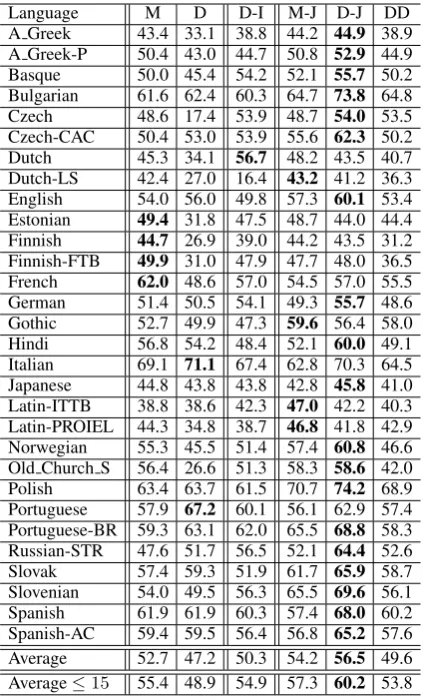
In Table1, we compare our jointly trained models with the four baselines. We can see that with joint training and independent decoding, LC-DMV and Convex-MST can achieve superior overall perfor-mance than when they are separately trained with or without mutual initialization. Joint decoding with our jointly trained models performs worse than independent decoding. We made the same observation when applying joint decoding to the separately trained models (not shown in the table). We believe this is because unsupervised parsers have relatively low accuracy and forcing them to reconcile would not lead to better parses. On the other hand, joint decoding during training helps propagate useful inductive biases between models and thus leads to better trained models.
4.3 Analysis of Parsing Results
We analyze the parsing results from the two mod-els to see how they benefit each other with join-t join-training. Nojoin-te join-thajoin-t LC-DMV limijoin-ts join-the depjoin-th of center embedding and encourages shorter de-pendency length, while Convex-MST encourages dependencies satisfying pre-specified linguistic rules. Therefore, we would like to see whether the jointly-trained LC-DMV produces more de-pendencies satisfying the linguistic priors than it-s it-separately-trained counterpart, and whether the jointly-trained Convex-MST produces parse trees
Language M D D-I M-J D-J DD
[image:4.595.311.523.61.411.2]A Greek 43.4 33.1 38.8 44.2 44.9 38.9 A Greek-P 50.4 43.0 44.7 50.8 52.9 44.9 Basque 50.0 45.4 54.2 52.1 55.7 50.2 Bulgarian 61.6 62.4 60.3 64.7 73.8 64.8 Czech 48.6 17.4 53.9 48.7 54.0 53.5 Czech-CAC 50.4 53.0 53.9 55.6 62.3 50.2 Dutch 45.3 34.1 56.7 48.2 43.5 40.7 Dutch-LS 42.4 27.0 16.4 43.2 41.2 36.3 English 54.0 56.0 49.8 57.3 60.1 53.4 Estonian 49.4 31.8 47.5 48.7 44.0 44.4 Finnish 44.7 26.9 39.0 44.2 43.5 31.2 Finnish-FTB 49.9 31.0 47.9 47.7 48.0 36.5 French 62.0 48.6 57.0 54.5 57.0 55.5 German 51.4 50.5 54.1 49.3 55.7 48.6 Gothic 52.7 49.9 47.3 59.6 56.4 58.0 Hindi 56.8 54.2 48.4 52.1 60.0 49.1 Italian 69.1 71.1 67.4 62.8 70.3 64.5 Japanese 44.8 43.8 43.8 42.8 45.8 41.0 Latin-ITTB 38.8 38.6 42.3 47.0 42.2 40.3 Latin-PROIEL 44.3 34.8 38.7 46.8 41.8 42.9 Norwegian 55.3 45.5 51.4 57.4 60.8 46.6 Old Church S 56.4 26.6 51.3 58.3 58.6 42.0 Polish 63.4 63.7 61.5 70.7 74.2 68.9 Portuguese 57.9 67.2 60.1 56.1 62.9 57.4 Portuguese-BR 59.3 63.1 62.0 65.5 68.8 58.3 Russian-STR 47.6 51.7 56.5 52.1 64.4 52.6 Slovak 57.4 59.3 51.9 61.7 65.9 58.7 Slovenian 54.0 49.5 56.3 65.5 69.6 56.1 Spanish 61.9 61.9 60.3 57.4 68.0 60.2 Spanish-AC 59.4 59.5 56.4 56.8 65.2 57.6 Average 52.7 47.2 50.3 54.2 56.5 49.6 Average≤15 55.4 48.9 54.9 57.3 60.2 53.8 Table 1: Directed dependency accuracy on thirty datasets with test sentences of length≤40. The last row indicates the average directed accuracy on sentences of length≤15. M (Convex-MST) and D (LC-DMV) are the independently trained baselines. D-I is the third baseline in which the LC-DMV training is initialized by the parses produced from the trained Convex-MST model. With our jointly trained models, M-J and D-J denote separate decoding and DD denotes joint decoding.
with less center embedding and shorter dependen-cies than its separately-trained counterpart.
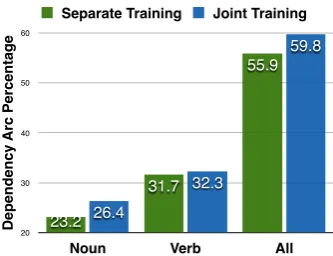
Figure1shows the percentages of dependencies satisfying linguistic rules when using the separate-ly and jointseparate-ly trained LC-DMV to parse the test sentences in the English dataset. As we can see, with joint training, LC-DMV is indeed influenced by Convex-MST and produces more dependencies satisfying linguistic rules.
D
e
p
e
n
d
e
n
c
y
A
rc
Pe
rc
e
n
ta
g
e
20 30 40 50 60
Noun Verb All
59.8
32.3
26.4
55.9
31.7
23.2
Separate Training Joint Training
Figure 1: Percentages of dependencies satisfying linguistic rules in the LC-DMV parses of the English test dataset. Noun and Verb denote dependencies headed by nouns and verbs.
Methods Average Dependency Length
Separate Training 1.673
[image:5.595.96.263.61.189.2]Joint Training 1.627
Table 2: Average dependency length in the Convex-MST parses of the English test dataset.
so the influence from the center embedding con-straint of LC-DMV during joint training is not ob-vious. We note that the influence on Convex-MST from LC-DMV during joint training is relatively small, which may contribute to the much small-er accuracy improvement (1.5%) of Convex-MST with joint training in comparison with the 9.3% improvement of LC-DMV. We conducted an ad-ditional experiment that scaled down the Convex-MST objective in joint training in order to in-crease the influence of LC-DMV. The results show that LC-DMV indeed influences Convex-MST to a greater degree, but the parsing accuracies of the two models decrease.
5 Conclusion
In this paper, we proposed a new learning strategy for unsupervised dependency parsing that learns a generative model and a discriminative model joint-ly based on dual decomposition. We show that with joint training, two state-of-the-art models can positively influence each other and achieve better performance than their separately trained counter-parts.
References
Taylor Berg-Kirkpatrick, Alexandre Bouchard-Cˆot´e, John DeNero, and Dan Klein. 2010. Painless un-supervised learning with features. In Human Lan-guage Technologies: The 2010 Annual Conference of the North American Chapter of the Association
for Computational Linguistics, pages 582–590. As-sociation for Computational Linguistics.
Yonatan Bisk and Julia Hockenmaier. 2012. Simple ro-bust grammar induction with combinatory categorial grammars.
Shay B Cohen, Kevin Gimpel, and Noah A Smith. 2008. Logistic normal priors for unsupervised prob-abilistic grammar induction. InAdvances in Neural Information Processing Systems, pages 321–328. Shay B Cohen and Noah A Smith. 2009. Shared
lo-gistic normal distributions for soft parameter tying in unsupervised grammar induction. In Proceed-ings of Human Language Technologies: The 2009 Annual Conference of the North American Chap-ter of the Association for Computational Linguistic-s, pages 74–82. Association for Computational Lin-guistics.
George B Dantzig and Philip Wolfe. 1960. Decom-position principle for linear programs. Operations research, 8(1):101–111.
Edouard Grave and No´emie Elhadad. 2015. A con-vex and feature-rich discriminative approach to de-pendency grammar induction. InProceedings of the 53rd Annual Meeting of the Association for Compu-tational Linguistics and the 7th International Joint Conference on Natural Language Processing (Vol-ume 1: Long Papers), pages 1375–1384, Beijing, China. Association for Computational Linguistics. Yong Jiang, Wenjuan Han, and Kewei Tu. 2016.
Un-supervised neural dependency parsing. In Proceed-ings of the 2016 Conference on Empirical Method-s in Natural Language ProceMethod-sMethod-sing, pages 763–771, Austin, Texas. Association for Computational Lin-guistics.
Dan Klein and Christopher D Manning. 2004. Corpus-based induction of syntactic structure: Models of de-pendency and constituency. In Proceedings of the 42nd Annual Meeting on Association for Computa-tional Linguistics, page 478. Association for Com-putational Linguistics.
Nikos Komodakis, Nikos Paragios, and Georgios Tzir-itas. 2007. Mrf optimization via dual decomposi-tion: Message-passing revisited. In Computer Vi-sion, 2007. ICCV 2007. IEEE 11th International Conference on, pages 1–8. IEEE.
Terry Koo, Alexander M Rush, Michael Collins, Tom-mi Jaakkola, and David Sontag. 2010. Dual de-composition for parsing with non-projective head automata. InProceedings of the 2010 Conference on Empirical Methods in Natural Language Pro-cessing, pages 1288–1298. Association for Compu-tational Linguistics.
American Chapter of the Association for Computa-tional Linguistics: Human Language Technologies, pages 1150–1160, Denver, Colorado. Association for Computational Linguistics.
Percy S Liang, Dan Klein, and Michael I. Jordan. 2008.
Agreement-based learning. In J. C. Platt, D. Koller, Y. Singer, and S. T. Roweis, editors, Advances in Neural Information Processing Systems 20, pages 913–920. Curran Associates, Inc.
Mingbo Ma, Liang Huang, Bing Xiang, and Bowen Zhou. 2015. Dependency-based convolutional neu-ral networks for sentence embedding. arXiv preprint arXiv:1507.01839.
Ryan McDonald, Koby Crammer, and Fernando Pereira. 2005. Online large-margin training of de-pendency parsers. In Proceedings of the 43rd an-nual meeting on association for computational lin-guistics, pages 91–98. Association for Computation-al Linguistics.
Hiroshi Noji, Yusuke Miyao, and Mark Johnson. 2016.
Using left-corner parsing to encode universal struc-tural constraints in grammar induction. In Proceed-ings of the 2016 Conference on Empirical Meth-ods in Natural Language Processing, pages 33–43, Austin, Texas. Association for Computational Lin-guistics.
Alexander M. Rush and Michael Collins. 2012.A tuto-rial on dual decomposition and lagrangian relaxation for inference in natural language processing. J. Ar-tif. Int. Res., 45(1):305–362.
Alexander M Rush, David Sontag, Michael Collins, and Tommi Jaakkola. 2010. On dual decomposition and linear programming relaxations for natural lan-guage processing. InProceedings of the 2010 Con-ference on Empirical Methods in Natural Language Processing, pages 1–11. Association for Computa-tional Linguistics.