A Sequential Model for Classifying Temporal Relations between
Intra-Sentence Events
Prafulla Kumar Choubey and Ruihong Huang Department of Computer Science and Engineering
Texas A&M University
(prafulla.choubey, huangrh)@tamu.edu
Abstract
We present a sequential model for tem-poral relation classification between intra-sentence events. The key observation is that the overall syntactic structure and compositional meanings of the multi-word context between events are important for distinguishing among fine-grained tempo-ral relations. Specifically, our approach first extracts a sequence of context words that indicates the temporal relation be-tween two events, which well align with the dependency path between two event mentions. The context word sequence, together with a parts-of-speech tag quence and a dependency relation se-quence that are generated corresponding to the word sequence, are then provided as input to bidirectional recurrent neural network (LSTM) models. The neural nets learn compositional syntactic and seman-tic representations of contexts surrounding the two events and predict the temporal relation between them. Evaluation of the proposed approach on TimeBank corpus shows that sequential modeling is capa-ble of accurately recognizing temporal re-lations between events, which outperforms a neural net model using various discrete features as input that imitates previous fea-ture based models.
1 Introduction
Identifying temporal relations between events is crucial to constructing events timeline. It has di-rect application in tasks such as question answer-ing, event timeline generation and document sum-marization.
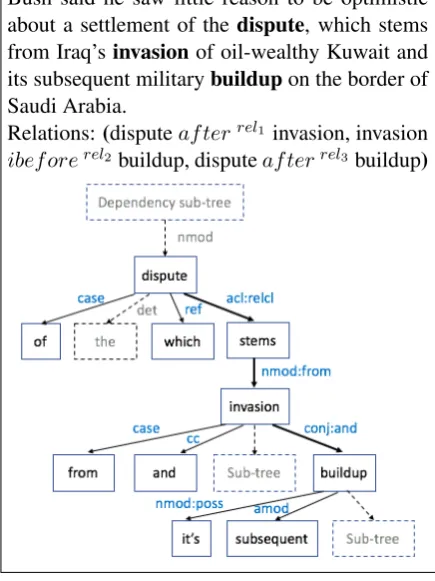
Bush said he saw little reason to be optimistic about a settlement of thedispute, which stems from Iraq’sinvasion of oil-wealthy Kuwait and its subsequent militarybuildupon the border of Saudi Arabia.
Relations: (disputeafterrel1 invasion, invasion
[image:1.595.307.525.236.527.2]ibeforerel2buildup, disputeafterrel3buildup)
Figure 1: Example sentence to illustrate the tem-poral context for event pairs.
Previous works studied this task as the classifi-cation problem based on discrete features defined over lexico-syntactic, semantic and discourse fea-tures. However, these features are often derived from local contexts of two events and are only ca-pable of capturing direct evidences indicating the temporal relation. Specifically, when two events are distantly located or are separated by other events in between, feature based approaches often fail to utilize compositional evidences, which are hard to encode using discrete features.
Consider the example sentence in Fig-ure 1. Here, the first two temporal
lations, dispute afterrel1 invasion and invation ibeforerel2 buildup, involve events that are close by and discrete features, such as dependency relations and bag-of-words extracted from local contexts of two events, might be sufficient to correctly detect their relations. However, for the temporal relation disputeafterrel3 buildup, the context between the two events is long, complex and involves another event (invasion) as well, which makes it challenging for any individual feature or feature combinations to capture the temporal relation.
We propose that the overall syntactic structure of in-between contexts including the linear order of words as well as the compositional semantics of multi-word contexts are critical for predicting the temporal relation between two events. Further-more, the most important syntactic and semantic structures are derived along dependency paths be-tween two event mentions1. This aligns well with the observation that semantic composition relates to grammatical dependency relations (Monroe and Wang,2014;Reddy et al.,2016).
Our approach defines rules on dependency parse trees to extract temporal relation indicating con-texts. First, we extract the dependency path be-tween two event mentions. Then we apply two heuristic rules to enrich extracted dependency paths and deal with complex syntactic structures such as punctuations. Empirically, we found that parts-of-speech tags (POS) and dependency se-quences generated following the dependency path provide evidences to predict the temporal relation as well.
We use neural net sequence models to cap-ture structural and semantic compositionality in describing temporal relations between events. Specifically, we generate three sequences for each dependency path, the word sequence, the POS tag sequence and the dependency relation sequence. Using the three types of sequences as input, we train bi-directional LSTM models that consume each of the three sequences and model compo-sitional structural information, both syntactically and semantically.
The evaluation shows that each type of se-quences is useful to temporal relation classifica-tion between events. Our complete neural net model taking all the three types of sequences
per-1In this paper, we restrict ourselves to study temporal
re-lation classification between event mentions that are within one sentence.
forms the best, which clearly outperforms feature based models.
2 Related Works
Most of the previous works on temporal relation classification are based on feature-based classi-fiers. Mani et al. (2006) built MaxEnt classifier on hand-tagged features in the corpus, including tense, aspect, modality, polarity and event class for classifying temporal relations. Later Chambers et al.(2007) used a two-stage classifier which first learned imperfect event attributes and then com-bined them with other linguistic features in the second stage to perform the classification.
The following works mostly expanded the fea-ture sets (Cheng et al., 2007; Bethard and Mar-tin, 2007; UzZaman et al., 2012;Bethard, 2013; Kolomiyets et al.,2012;Chambers,2013; Laokul-rat et al.,2013). Specifically, Chambers (2013) used direct dependency path between event pairs to capture syntactic context. Laokulrat et al. (2013) used 3-grams of paths between two event mentions in a dependency tree as features instead of full paths as those are too sparse. We found that modeling the entire path as one sequence provides greater compositional evidence on the temporal re-lation. In addition, modifiers attached to the words in a path with specific dependency relations like nmod:tmodare also informative.
Ng(2013) proposed a hybrid system for tempo-ral relation classification that combines the learned classifier with 437 hand-coded rules. Their sys-tem first applied high-accuracy rules and then used the learned classifier, trained on rich features in-cluding those high-accuracy rules as features, to classify the cases that were not handled by the rules. Ng et al. (2013) also showed the ef-fectiveness of different discourse analysis frame-works for this task. Later Mirza and Tonelli (2014) showed that a simpler approach based on lexico-syntactic features achieved results compa-rable to Ng (2013). They also reported that de-pendency order between events, either governor-dependent or governor-dependent-governor, was not useful in their experiments. However, we show that de-pendency relations, when modeled as a sequence, contribute significantly to this task.
3 Temporal Link Labeling
se-quence extraction model and the used recurrent neural net based classifier.
3.1 Task description
Early works on temporal relation classification Mani et al. (2006); Chambers et al. (2007) and the first two versions of TempEval (Verhagen et al., 2007,2010) simplified the task by consid-ering only six relation types. They combined the pair of relation types that are the inverse of each other and ignored the relations during and dur-ing inv. Then TempEval-3 (Uzzaman et al.,2013) extended the task to complete 14 class classifica-tion problem and all later works have considered all 14 relations. Our model performs 14-class clas-sification following the recent works, as this is ar-guably more challenging (Ng, 2013). Also, we consider gold annotated event pairs, mainly be-cause the corpus is small and distribution of re-lations is very skewed. All previous works focus-ing on the problem of classifyfocus-ing temporal relation types assumed gold annotation.
3.2 Dataset
Relations Train Validate Test
After 419 60 120
Before 337 48 97
Simultaneous 288 41 83
Identity 147 21 43
Includes 141 20 41
IS included 93 13 27
Ended by 66 9 19
During inv 26 4 8
Begun by 25 3 7
Begins 22 3 7
IBefore 16 2 5
IAfter 12 2 4
During 11 1 3
Ends 9 2 3
[image:3.595.100.266.399.564.2]Total 1612 229 467
Table 1: Distribution of temporal relations in TimeBank v1.2.
We have used TimeBank corpus v1.2 for train-ing and evaluattrain-ing our model. The corpus con-sists of 14 temporal relations between 2308 event pairs, which are within the same sentence. These relations (Saurı et al., 2006) are simultaneous, before, after, ibefore, iafter, begins, begun by, ends, ended by, includes, is included, during, dur-ing inv, identity. Six pairs among them are inverse of each other and other two types are commuta-tive (e1Re2 ≡e2Re1,R ∈ {identical, simultane-ous}). Our sequential model requires that relation
should always be betweene1ande2, wheree1 oc-curs beforee2 in the sentence. Therefore, before extracting the sequence, we inverted the relation types in cases where relation type was annotated in opposite order. Final distribution of dataset is given in Table1.
3.3 Extracting Context Word Sequence First, we extract words that are in the dependency path between two event mentions. However, event pairs can be very far in a sentence and are in-volved in complex syntactic structures. Therefore, we also apply two heuristic rules to deal with com-plex syntactic structures, e.g., two event mentions are in separate clauses and have a punctuation sign in their context. We describe our specific rules be-low. We used the Stanford parser (Chen and Man-ning, 2014) for generating dependency relations and parts-of-speech tags and all notations follow enhanced universal dependencies (De Marneffe and Manning,2008).
Rule 1 (punctuation): Comma directly influ-ences the meaning in text and omitting it may alter the meaning of phrase. Therefore, include comma if it precedes or followse1,e2or their modifiers.
Rule 2 (children):Modifiers likenow, then, will, yesterday, subsequent, when, was, etc. contains information on the temporal order of events and help in grounding events to the timeline. These modifiers are often related to event mentions with a specific class of dependency relations. Include all such children ofe1, e2 and other words in the path between them, which are connected with de-pendency relations nmod:tmod, mark, case, aux, conj, expl, cc, cop, amod, advmod, punct, ref. 3.4 Sequences and Classifier
We form three sequences on the extracted con-text words (withtwords), which are based on (i) parts-of-speech tags: PT = p1, p2, ..., pt (ii)
de-pendency relations:DT =d1, d2, ..., dn2and (iii)
word forms:WT =w1, w2, ..., wt.
We transform eachpi anddi to a one-hot
vec-tor and eachwito a pre-trained embedding vector
(Pennington et al.,2014). Then each sequence of vectors are encoded using their corresponding for-ward (LST Mf) and backward (LST Mb) LSTM
layers.
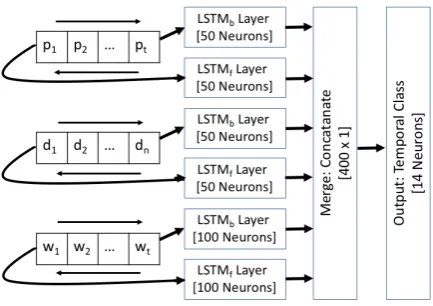
Classifier: Figure2shows an overview of our model. It consists of six LSTM (Hochreiter and
2we only consider dependency relations for words in path
Figure 2: Bi-directional LSTM based classifier used for temporal relations classification.
Schmidhuber,1997) layers, three of them encode feature sequences in forward order and remain-ing in reverse order. LSTM layers for POS tag and dependency relation have 50 neurons and have dropouts of 0.20. LSTM layers for word form have 100 neurons and have dropout of 0.25. All LSTM layers use ’tanh’ activation function. For-ward and backFor-ward embeddings of all sequences are concatenated and fed into another neural layer with 14 neurons corresponding to 14 fine-grained temporal relations. This neural layer uses soft-max activation function. We train model for 100 iterations using rmsprop optimizer on batch size of 100 and error defined by categorical cross-entropy (Chollet,2015) .
4 Evaluation
We evaluate our model using accuracy which has been used in previous research works for tempo-ral relation classification. We also compare model performance using per-class score and macro F-score. We briefly describe all the systems we have used for evaluation.
Majority Class: assigns “after” relation to all event pairs.
Unidirectional LSTMs: use single LSTM layer to encode each sequence (POS tags, dependency relation and word forms) individually for extracted phrase in forward order.
Bidirectional LSTMs: use two LSTM layers to encode each sequence individually, taken from POS tags, dependency and word forms sequences. The first layer encodes sequence in forward and second in reverse order.
2 Sequences: bi-directional LSTM based mod-els considering all combinations of two sequences taken from POS tags, dependency and word forms sequences.
Full model: our complete sequential model con-sidering POS, dependency and word forms se-quences.
Direct dependency path: the same as Full modelexcept that the two heuristic rules were not applied in extracting sequences.
Baseline I: a neural network classifier us-ing discrete features described in Mirza and Tonelli (2014); Ng (2013). The features used are: POS tag, dependency relation, token and lemma of e1(e2); dependency relations between e1(e2) and their children; binary features indicat-ing if e1 and e2 are related with the ’happens-before’ or the ’similar’ relation according to Ver-bOcean (Chklovski and Pantel, 2004), if e1 and e2have the same POS tag, or ife1(e2) is the root ande1 modifies (or governs) e2; the dependency relation betweene1ande2if they are directly con-nected in the dependency parse tree; prepositions that modify (or govern)e1(e2); signal words ( Der-czynski and Gaizauskas,2012) and entity distance between e1 and e2. These features are concate-nated and fed into an output neural layer with 14 neurons.
Baseline II: a neural network classifier using POS tags and word forms of words in thesurface pathas input. Thesurface pathconsists of words that lie in between two event mentions based on the original sentence. The classifier uses four LSTM layers to encode both POS tag and word sequences in forward and backward order. The output neural layer and parameters for all LSTM layers are kept the same as theFull model.
All baselines are trained using rmsprop opti-mizer on an objective function defined by cate-gorical cross entropy and their output layer uses softmax activation function.
4.1 Results and Discussion
Models Accuracy
Majority Class 25.69
Baseline I 41.97
Unidirectional LSTM: only POS 34.90 only Word 35.12 only Dependency 34.48 Bidirectional LSTMs: only POS 39.19 only Word 37.69 only Dependency 40.04 2 Sequences: POS + Word 44.54 Dependency + Word 45.18 Dependency + POS 47.75
Full Model 53.32
Direct dependency path 49.25
Baseline II 43.90
[image:5.595.75.287.150.317.2]Baseline III 44.75
Table 2: Temporal relation classification result on TimeBank corpus.
Relations OurSystem BaselineI
P R F P R F
After 0.62 0.68 0.65 0.56 0.48 0.45 Before 0.56 0.52 0.53 0.37 0.45 0.41 Simultan. 0.44 0.51 0.47 0.32 0.43 0.37 Identity 0.47 0.56 0.51 0.45 0.53 0.49 Includes 0.59 0.39 0.47 0.43 0.30 0.35 IS includ. 0.5 0.56 0.53 0.61 0.51 0.56
Ended by 0.48 0.63 0.55 0.41 0.47 0.44
During in. 0 0 0 0 0 0
Begun by 0.75 0.43 0.55 0 0 0
Begins 1.0 0.29 0.44 0 0 0
IBefore 0.4 0.4 0.4 0 0 0
IAfter 0.33 0.25 0.29 0 0 0
During 0 0 0 0 0 0
Ends 0 0 0 0 0 0
Macro Av. 0.44 0.37 0.40 0.23 0.22 0.22
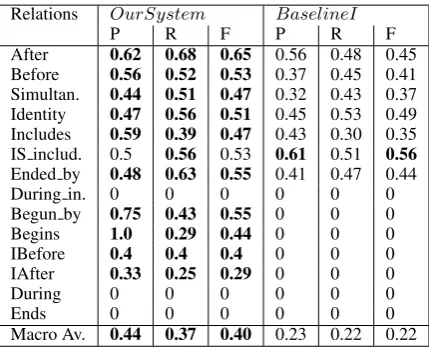
Table 3: Per-class results of our best system and the baseline I.
Table2 reports accuracy scores for all the sys-tems. We see that simple sequential models out-perform the strong feature based system, Base-line I, which used various discrete features. Note that dependency relation and POS tag sequences alone achieve reasonably high accuracies. This implies that an important aspect of temporal rela-tion is contained in the syntactic context of event mentions. Moreover, Mirza and Tonelli (2014) observed that discrete features based on depen-dency parse tree did not contribute to improving their classifier’s accuracy. On the contrary, using
the sequence of dependency relations yields a high accuracy in our setting which signifies the advan-tages of using sequential representations for this task. OurFull Modelachieves a performance gain of 11.35% overBaseline I.
We developed two more baselines (Baseline II and III) that do not require syntactic information as well as theDirect dependency pathmodel that used no rules. TheFull Modeloutperformed them by 9.42%, 8.57% and 4.07% respectively. This af-firms that the most useful syntactic and semantic structures are derived along dependency paths and additional context words, including prepositions, signal words and punctuations that are indirectly attached to event words, entail evidence on tem-poral relations as well.
Table 3 compares precision, recall and F1 scores of our Full Model with Baseline I. Our model performs reasonably well compared to the baseline system for most of the classes. In ad-dition, it is able to identify relations present in small proportion like begun by, ibefore, iafter etc., which the baseline system couldn’t iden-tify. A similar observation was also reported by Mirza and Tonelli (2014) that relation types be-gins, ibefore, endsandduringare difficult to iden-tify using feature based systems, which often gen-erate false positives forbeforeandafterrelations.
5 Conclusion and Future work
In this paper, we have focused on modeling syn-tactic structural information and compositional se-mantics of contexts in predicting temporal rela-tions between events in the same sentence. Our approach extracts lexical and syntactic sequences from contexts between two events and feed them to recurrent neural nets. The evaluation shows that our sequential models are promising in distin-guishing among fine-grained temporal relations.
In the future, we will extend our sequential models to predict temporal relations for event pairs spanning across multiple sentences, for in-stance by incorporating discourse relations be-tween sentences in a sequence.
Acknowledgments
[image:5.595.74.289.378.552.2]References
Steven Bethard. 2013. Cleartk-timeml: A minimalist approach to tempeval 2013. InSecond Joint Con-ference on Lexical and Computational Semantics (* SEM), volume 2, pages 10–14.
Steven Bethard and James H Martin. 2007. Cu-tmp: Temporal relation classification using syntactic and semantic features. InProceedings of the 4th
Inter-national Workshop on Semantic Evaluations, pages
129–132. Association for Computational Linguis-tics.
Nathanael Chambers. 2013. Navytime: Event and time ordering from raw text. Technical report, DTIC Document.
Nathanael Chambers, Shan Wang, and Dan Juraf-sky. 2007. Classifying temporal relations between events. InProceedings of the 45th Annual Meeting of the ACL on Interactive Poster and Demonstration
Sessions, pages 173–176. Association for
Computa-tional Linguistics.
Danqi Chen and Christopher D Manning. 2014. A fast and accurate dependency parser using neural net-works. InEMNLP, pages 740–750.
Yuchang Cheng, Masayuki Asahara, and Yuji Mat-sumoto. 2007. Naist. japan: Temporal relation iden-tification using dependency parsed tree. In Proceed-ings of the 4th International Workshop on Semantic
Evaluations, pages 245–248. Association for
Com-putational Linguistics.
Timothy Chklovski and Patrick Pantel. 2004. Verbo-cean: Mining the web for fine-grained semantic verb relations. InEMNLP, volume 4, pages 33–40. Franc¸ois Chollet. 2015. Keras. https://github.
com/fchollet/keras.
Marie-Catherine De Marneffe and Christopher D Man-ning. 2008. Stanford typed dependencies manual. Technical report, Technical report, Stanford Univer-sity.
Leon Derczynski and Robert Gaizauskas. 2012. Using signals to improve automatic classification of tem-poral relations.arXiv preprint arXiv:1203.5055. Sepp Hochreiter and J¨urgen Schmidhuber. 1997.
Long short-term memory. Neural computation, 9(8):1735–1780.
Eliyahu Kiperwasser and Yoav Goldberg. 2016. Sim-ple and accurate dependency parsing using bidirec-tional lstm feature representations. arXiv preprint
arXiv:1603.04351.
Oleksandr Kolomiyets, Steven Bethard, and Marie-Francine Moens. 2012. Extracting narrative time-lines as temporal dependency structures. In Pro-ceedings of the 50th Annual Meeting of the Associ-ation for ComputAssoci-ational Linguistics: Long
Papers-Volume 1, pages 88–97. Association for
Computa-tional Linguistics.
Natsuda Laokulrat, Makoto Miwa, Yoshimasa Tsu-ruoka, and Takashi Chikayama. 2013. Uttime: Tem-poral relation classification using deep syntactic fea-tures.
Inderjeet Mani, Marc Verhagen, Ben Wellner, Chong Min Lee, and James Pustejovsky. 2006. Ma-chine learning of temporal relations. InProceedings of the 21st International Conference on Compu-tational Linguistics and the 44th annual meeting
of the Association for Computational Linguistics,
pages 753–760. Association for Computational Linguistics.
Paramita Mirza and Sara Tonelli. 2014. Classifying temporal relations with simple features. InEACL, volume 14, pages 308–317.
Will Monroe and Yushi Wang. 2014. Dependency parsing features for semantic parsing.
Jun-Ping Ng, Min-Yen Kan, Ziheng Lin, Vanessa Wei Feng, Bin Chen, Jian Su, and Chew Lim Tan. 2013. Exploiting discourse analysis for article-wide tem-poral classification. InEMNLP, pages 12–23.
Vincent Ng. 2013. Classifying temporal relations with rich linguistic knowledge.
Jeffrey Pennington, Richard Socher, and Christopher D Manning. 2014. Glove: Global vectors for word representation. InEMNLP, volume 14, pages 1532– 1543.
Siva Reddy, Oscar T¨ackstr¨om, Michael Collins, Tom Kwiatkowski, Dipanjan Das, Mark Steedman, and Mirella Lapata. 2016. Transforming dependency structures to logical forms for semantic parsing.
Transactions of the Association for Computational Linguistics, 4:127–140.
Roser Saurı, Jessica Littman, Bob Knippen, Robert Gaizauskas, Andrea Setzer, and James Pustejovsky. 2006. Timeml annotation guidelines version 1.2. 1.
Naushad UzZaman, Hector Llorens, James Allen, Leon Derczynski, Marc Verhagen, and James Pustejovsky. 2012. Tempeval-3: Evaluating events, time ex-pressions, and temporal relations. arXiv preprint arXiv:1206.5333.
Naushad Uzzaman, Hector Llorens, Leon Derczyn-ski, Marc Verhagen, James Allen, and James Puste-jovsky. 2013. Semeval-2013 task 1: Tempeval-3: Evaluating time expressions, events, and temporal relations.
Marc Verhagen, Robert Gaizauskas, Frank Schilder, Mark Hepple, Graham Katz, and James Pustejovsky. 2007. Semeval-2007 task 15: Tempeval temporal relation identification. In Proceedings of the 4th
International Workshop on Semantic Evaluations,
Marc Verhagen, Roser Sauri, Tommaso Caselli, and James Pustejovsky. 2010. Semeval-2010 task 13: Tempeval-2. InProceedings of the 5th international
workshop on semantic evaluation, pages 57–62.