Accurate Semantic Class Classifier for Coreference Resolution
Zhiheng Huang1, Guangping Zeng1,2, Weiqun Xu3, and Asli Celikyilmaz1 1EECS Department, University of California at Berkeley,
CA 94720, USA
{zhiheng,gpzeng,asli}@eecs.berkeley.edu
2Computer Science Department, School of Information Engineering, University of Science and Technology Beijing, China
3ThinkIT, Institute of Acoustics, Chinese Academy of Sciences, Beijing, 100190, China
Abstract
There have been considerable attempts to incorporate semantic knowledge into coreference resolution systems: different knowledge sources such as WordNet and Wikipedia have been used to boost the per-formance. In this paper, we propose new ways to extract WordNet feature. This feature, along with other features such as named entity feature, can be used to build an accuratesemantic class(SC) classifier. In addition, we analyze the SC classifica-tion errors and propose to use relaxed SC agreement features. The proposed accu-rate SC classifier and the relaxation of SC agreement features on ACE2 coreference evaluation can boost our baseline system by 10.4% and 9.7% using MUC score and anaphor accuracy respectively.
1 Introduction
Coreference resolution is used to determine which noun phrases (including pronouns, proper names, and common nouns) refer to the same entities in documents. Much work on coreference resolution is based on (Soon et al., 2001), which built a de-cision tree classifier to label pairs of mentions as coreferent or not. Recent work aims to improve the performance from two aspects: new models and new features. The former cast the pair wise mention classifications into various forms such as the best path in a Bell tree (Luo et al., 2004), the best graph cut (Nicolae and Nicolae, 2006), in-teger linear programming (Denis and Baldridge, 2007) and graph partition based conditional model (McCallum and Wellner, 2004). The latter de-velop and investigate new linguistic features for the problem. For instance, WordNet (Poesio et al., 2004), Wikipedia (Ponzetto and Strube, 2006), se-mantic neighbor words (Ng, 2007a), and pattern based features (Yang and Su, 2007) have been ex-tensively studied.
Deeper linguistic knowledge is required to en-able the coreference resolution to reach a higher level of performance (Kehler et al., 2004). An im-portant type of semantic knowledge that has been employed in coreference resolution system is the semantic class (SC) of an NP, which can be used to filter out the coreference between semantically incompatible NPs. However, the difficulty is to accurately compute the semantic class features. In this paper, we show that the WordNet may not be efficiently employed in the traditional way such as (Soon et al., 2001; Ng, 2007a; Ponzetto and Strube, 2006) to compute the semantic class fea-tures. We introduce new ways to use the WordNet and the experiments show its effectiveness in de-termining the semantic classes for noun phrases. In addition, we analyze the classification errors of the SC classifier and propose to use relaxed SC agreement features. With these proposed features and other standard syntactic features (which are commonly employed in existing coreference sys-tems), our coreference resolution system can ob-tain an increase of 10.4% for MUC score and 9.7% for anaphor accuracy from the baseline in ACE2 evaluation.
2 Related Work
WordNet (Fellbaum, 1998) as an important knowl-edge source has been widely employed in previ-ous coreference resolution work. For example, Harabagiu et al. (2001) have used WordNet rela-tions such as synonym and is-a to mine the pat-terns of WordNet paths for pairs of antecedents and anaphors. Due to the nature of the rule based coreference system (in contrast to machine learn-ing based), the weights of relations may not be accurately estimated. Vieira and Poesio (2000) and Markert and Nissim (2005) have used Word-Net synonym and hyponym etc. to determine if an anaphor semantically relates to one previous NP. Ponzetto and Strube (2006) have used Word-Net semantic similarity and relatedness scores be-tween antecedents and candidate anaphors. Their
work is different to this work in the following: 1) Their work involves various relations such as hy-ponyms and meronyms while ours only makes use of hypernyms; and 2) Their work focuses on in-vestigating if two NPs have particular WordNet re-lations or not, while ours focuses on using Word-Net hypernyms for their SC classification and then testing their SC compatibility. In doing so, we can directly model the accuracy of semantic class clas-sification and test its impact on coreference reso-lution.
While the SC of a proper name is computed fairly accurately using a named entity (NE) recog-nizer, many coreference resolution systems sim-ply assign to a common noun the first (i.e., most frequent) WordNet synset as its SC (Soon et al., 2001; Markert and Nissim, 2005). This heuris-tics, apparently, did not lead to good performance. The best reported ACE2 coreference resolution system (Ng, 2007a; Ng, 2007b) has proposed an accurate SC classifier which used heterogeneous semantic knowledge sources. WordNet is just one of the several knowledge sources which have been utilized. However, the WordNet based fea-tures is not informative compared to other feafea-tures such as the semantic neighbor feature. Similarly, Ponzetto and Strube (2006) have discovered that the WordNet feature is no more informative than the community-generated Wikipedia feature. In this paper, we focus on the investigation of vari-ous usages of WordNet for the SC classification task. The work which is directly comparable to ours would be (Ng, 2007a; Ng, 2007b).
Other similar work includes themention detec-tion (MD) task (Florian et al., 2006) and joint probabilistic model of coreference (Daum´e III and Marcu, 2005). The MD task identifies the bound-ary of a mention, its mention type (e.g., pronoun, name), and its semantic type (e.g., person, orga-nization). Unlike them, we do not perform the boundary detection, as we make use of the noun phrases directly from the noun phrase chunker and NE recognizer. The joint probabilistic model mod-els the MD and coreference simultaneously, while our work focuses on them separately.
3 Semantic Class Classification
In this section, we describe how we compile the training corpus and extract features using Word-Net. We report our results on the ACE coreference corpus due to that it has been commonly used and it was annotated SCs of six types.1 As in (Ng,
1
Person, organization, gpe, location and facility are ex-plicitly annotated. The rest noun phrases are other type.
2007a), we first train a classifier to predict the SC of an NP. This SC information is used later in the coreference resolution stage. For example,the au-dience is classified as SC of person, and it thus should not be coreferent withthe security industry, which is usually classified asorganization. This task is by no means trivial. First, while the classi-fication ofTom Hanksbeing SC ofperson can be accurately achieved by an NE recognizer, the as-sociation ofaudienceandpersonrequires seman-tic language source such as WordNet. Second, the same noun phrase can be annotated with different SCs under different context. For example,the au-thorities is usually annotated as person, but it is sometimes asorganization. Even worse, the same noun phrases are sometimes annotated with one of the five explicitly annotated classes while some-times are not annotated at all (thus falling into the other SC). For example, people is annotated as personSC explicitly 20 times and is not annotated at all 21 times in the ACE2 testset. This inconsis-tent annotation adversely affects the performance of an SC classifier. And this in turn would cause errors during coreference stage. In section 4.3, we show how to relax the strict SC agreement feature to address this.
3.1 Training instance creation
Table 1: Distributions of SCs in ACE2 corpus.
Size PER ORG GPE FAC LOC OTH
Train 55629 20.29 7.30 8.42 0.61 0.55 62.80
Dev 6181 20.29 7.30 8.42 0.61 0.55 62.80
Test 15360 20.48 7.57 6.90 0.85 0.41 63.79
3.2 Lexical features
Each instance is represented as a bag of features and is fed into a classifier in training stage. We present four binary lexical feature sets as follows.
Word unigrams and bigrams: An N-gram is a sub-sequence of N words from a given noun phrase. Unigram forms the bag of words feature, and bigram forms the pairs of words feature, and so forth. We have considered word unigram and bigram features in our experiments.
First and last words: This feature extracts the first and last words of an NP. For example, the first wordtheand the last wordstoreare extracted from the NPthe main store. This feature does not only coarsely models the influence of the first word, for example,aorthe, but also models the head word, since the head word usually is the last word in the NP.
Head word: We use Collins style rules (Collins, 1999) to extract the head words for given NPs. These features should be most informative if the training corpus is large enough.2 For exam-ple, the head word company of the NP the com-panyimmediately determines its SC being organi-zation. However, due to the sparseness of training data, its potential importance is adversely affected.
3.3 Semantic features
NEfeature is extracted from Stanford named en-tity recognizer (NER) (Finkel et al., 2005). Three types of named entities: person, location and or-ganization can be recognized for a given NP. This feature is primarily useful for SC classification of proper nouns.
WordNet is a large English lexicon in which se-mantically related words are connected via cogni-tive synonyms (synsets). The WordNet is a use-ful tool for word semantics analysis and has been widely used in natural language processing appli-cations. In WordNet, synsets are organized into hi-erarchies with hypernym/hyponym relationships: Y is a hypernym of X if every X is a (kind of) Y (X is called a hyponym of Y in this case).
The WordNet is employed in (Ng, 2007a) as following to create the WN CLASSfeature. For each keywordwas shown in the right column of
2
It, however, is mostly useful for nominal noun phrase and not for the pronoun and proper noun phrases.
Table 2, if the head noun of a given NP is a hy-ponym of w in WordNet,3 then the word w be-comes a feature for such NP. It is explained that these keywords are correlated with the ACE SCs and they are obtained via experimentation with WordNet and the ACE SCs of the NPs in the ACE training data. However, it is likely that these hand-crafted keywords have poor coverage for general cases. As a result, it may not make full use of WordNet semantic knowledge. This will be shown in our individual feature contribution experiment in Section 3.5.
Table 2: List of keywords used in WordNet seman-tic feature in (Ng, 2007a).
ACE SC Keywords PER person ORG social group
FAC establishment, construction, building, facility, workplace
GPE country, province, government, town, city, administration, society, island, community LOC dry land, region, landmass, body of water
geographical area, geological formation
There are other ways of using WordNet for se-mantic feature extraction. For example, Ponzetto and Strube (2006) have employed WordNet sim-ilarity measure for coreference resolution. The difference is that they created the feature di-rectly at the coreference resolution stage, ie, us-ing the WordNet similarity between the antecedent and anaphor to determine if they are coreferent, while we focus on using this feature to classify an NP into a particular SC. For comparison, we implemented a WordNet similarity based feature (WN SIM) as follows: for a given NP head word and a key word as listed in Table 2, the WordNet similarity package (Seco et al., 2004) models the length of path traveling from the head word to the key word over the WordNet network. It then com-putes the semantic similarity based on the path. For example, the similarity betweencompanyand social groupis 0.77, while the similarity between companyandpersonis0.59. The key word which receives the highest similarity to the head word is marked as a feature.
The WN CLASS feature may suffer from the coverage problem and the WN SIM feature is heavily dependent on the definition of similarity metric which may turn out to be inappropriate for coreference resolution task. To make better use of WordNet knowledge, we attempt to directly intro-duce hypernyms for the NP head words (we denote
3
it as WN HYPfeature). The most similar work to ours is (Daum´e III and Marcu, 2005), in which two most common synsets from WordNet forall words in an NP and their hypernyms are extracted as features. We avoid augmenting the hypernyms for non-head words in the NP to prevent introduc-ing noisy information, which may potentially cor-rupt the hypernym feature space.
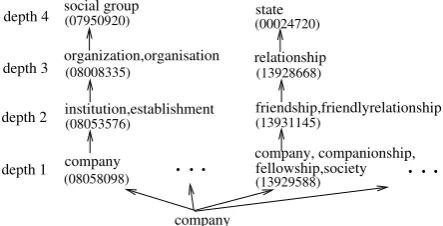
Considering a WordNet hypernym structure as shown in Fig. 1 for the word company, its first synset (an institution created to conduct business) has a unique id of 08058098 and can also be rep-resented by a set of description words (company
in this case). Its third synset (the state of being with someone) has an id of 13929588 and descrip-tion words ofcompany, companionship, fellow-ship, society. Each synset can be extended by its hypernym synsets. For example, the direct hyper-nym of the first synset is the synset of 08053576 which can be described asinstitution, establish-ment. The augmentation of hypernyms for NP head words can introduce useful information, but can also bring noise if the head word or the synset of head word are not correctly identified. For an optimal use of WordNet hypernyms, four ques-tions shall be addressed: 1) how many depths are required to tradeoff the generality (thus more in-formative) and the specificity (thus less noisy)? 2) which synset of the given word is needed to be augmented? 3) which representation (synset id or synset word) is better? and 4) is it helpful to en-code the hypernym depth into the hypernym fea-ture?4 These four questions provide the guideline to search the optimal use of WordNet. We will de-sign experiments in Section 3.5 to determine the optimal configuration of WN HYP feature.
state
(08008335)
(13931145) (13928668)
(08053576) (07950920)
company depth 2
depth 3 depth 4
depth 1
social group
institution,establishment organization,organisation
(00024720)
friendship,friendlyrelationship
fellowship,society
(13929588) (08058098)
company, companionship, company
[image:4.595.72.294.550.663.2]relationship
Figure 1: WordNet hypernym hierarchy for the wordcompany.
4
For example, we encode the synset 08053576 as 08053576-1, with the last digit 1 indicating the depth of hy-pernym with regard to the entry wordcompany.
3.4 Learning algorithm
Maximum entropy (ME) models (Berger et al., 1996; Manning and Klein, 2003), also known as log-linear and exponential learning models, has been adopted in the SC classification task. Max-imum entropy models can integrate features from many heterogeneous information sources for clas-sification. Each feature corresponds to a constraint on the model. Given a training set of (C, D), where C is a set of class labels and D is a set of feature represented data points, the maximum entropy model attempts to maximize the log like-lihood
logP(C|D, λ) = X
(c,d)∈(C,D)
log exp
P
iλifi(c, d)
P
c′exp P
jλjfi(c, d)
(1)
wherefi(c, d)are feature indicator functions and λiare the parameters to be estimated. We use ME models for both SC classification and mention pair classification.
3.5 SC classification evaluation
We design three experiments to test the accuracy of our classifiers. The first experiment evalu-ates the individual contribution of different fea-ture sets to SC classification accuracy. In par-ticular, a ME model is trained on the 55,629 training instances using the following feature sets separately: 1) unigram, 2) bigram, 3) first-last word, 4) head word (HW), 5) named entities (NE), 6) HW+WN CLASS, 7) HW+WN SIM, and 8) variants of HW+WN HYP. Note that HW+WN CLASS is the semantic feature used in (Ng, 2007a), HW+WN SIM is the semantic fea-ture using WordNet similarity measure (Seco et al., 2004), and variants of HW+WN HYP are the work proposed in this paper. We combine head word and the semantic features due to the fact that WordNet features are dependent on head words and they could be treated as units. In the second experiment, features are fed into the ME model incrementally until all features have been used.5 Finally, we perform the feature ablation experi-ments. That is, we remove one feature at a time from the entire feature set and test the accuracy loss. The SC classification performance is mea-sured by accuracy, i.e., the proportion of the cor-rectly classified instances among all test instances.
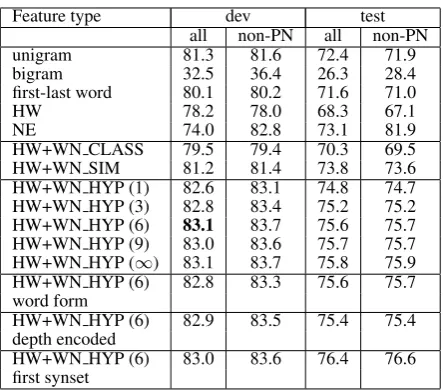
Individual feature contributionTable 3 shows the SC classification accuracy of all NPs (all) and non-pronoun NPs (non-PN) on the develop-ment and test datasets using individual feature
5
sets. Among all the lexical features, unigram
fea-Table 3: SC classification accuracy of ME using individual feature sets for development and test ACE2 datasets.
Feature type dev test all non-PN all non-PN unigram 81.3 81.6 72.4 71.9 bigram 32.5 36.4 26.3 28.4 first-last word 80.1 80.2 71.6 71.0 HW 78.2 78.0 68.3 67.1 NE 74.0 82.8 73.1 81.9 HW+WN CLASS 79.5 79.4 70.3 69.5 HW+WN SIM 81.2 81.4 73.8 73.6 HW+WN HYP (1) 82.6 83.1 74.8 74.7 HW+WN HYP (3) 82.8 83.4 75.2 75.2 HW+WN HYP (6) 83.1 83.7 75.6 75.7 HW+WN HYP (9) 83.0 83.6 75.7 75.7 HW+WN HYP (∞) 83.1 83.7 75.8 75.9 HW+WN HYP (6) 82.8 83.3 75.6 75.7 word form
HW+WN HYP (6) 82.9 83.5 75.4 75.4 depth encoded
HW+WN HYP (6) 83.0 83.6 76.4 76.6 first synset
ture performs the best (81.3%) for all NPs over the development dataset. The bigram feature performs poorly due to the sparsity problem: NPs usually consist of one to three words. The first-last word feature effectively models the prefix words (such asaandthe) and the head words and thus obtains a reasonably high accuracy of80.1%. As mentioned before, the head word feature may suffer from the sparsity and it results in the accuracy of 78.2%. We also list the accuracies for non-pronoun NP SC classification, which are slightly different com-pared to all NP SC classification except for bi-gram, in which the accuracy has increased 3.9%.
Although Stanford NER performs well on named entity recognition task, it results in ac-curacy of 74.0% for all NP SC classification, due to its inability to deal with pronouns such as he and common nouns such as the govern-ment. The removal of pronouns significantly boosts its accuracy to 82.8%. The introduc-tion of semantic feature HW+WN CLASS boosts the performance to 79.5% compared to the head word alone of 78.2%. This conforms to (Ng, 2007a) that only small gain can be achieved us-ing WN CLASS feature. The HW+WN SIM feature outperforms HW+WN CLASS and the accuracy reaches 81.2%. For the variants of HW+WN HYP, we first search the optimal depth. This is performed by using all synsets for NP head word, encoding the feature using synset id (rather than synset word), and no hypernym depth is en-coded in the features. We try various depths of
1, 3, 6, 9 and ∞, with ∞signifies that no depth constraint is imposed. The optimal depth of 6 is obtained with the accuracy of83.1%over the de-velopment dataset. We then fix the depth of 6 to try using synset word as features, using synset id with depth encoded as features, and using first synset only. The results show that the optimum is to en-code the features using hypernym synset id with-out hypernym depth information and all synsets are considered for hypernym extraction. This is slightly different from the previous finding (Soon et al., 2001; Lin, 1998b) that a coreference res-olution system employing only the first WordNet synset performs slightly better than that employ-ing more than one synset.6 The best result reaches the accuracy of83.1%. Although the best seman-tic feature only outperforms the best lexical fea-ture by1.8%on the development dataset, its gain in the test dataset is more significant (3.2%, from 72.4%to75.6%).
[image:5.595.72.294.141.336.2]Incremental feature contribution Once we use the training and development datasets to find the optimal configuration of HW+WN HYP se-mantic feature, we use all lexical features and the optimal HW+WN HYP feature incrementally to train an ME model over the combination of train-ing and development datasets. Table 4 shows the SC classification accuracy of all NPs (all) and non-pronoun NPs (non-PN) on the train-ing+development (we refer it as training hereafter) and test datasets.
Table 4: SC classification accuracy of ME using incremental feature sets for training and test ACE2 datasets.
Feature type train test all non-PN all non-PN HW 87.8 89.0 68.6 67.6 +WN HYP 87.8 89.0 75.7 75.8 +unigram 91.5 93.3 77.7 78.1 +bigram 93.1 95.2 78.7 79.2 +first-last word 93.2 95.3 78.8 79.3 +NE 93.4 95.6 83.1 84.4
Ng 2007a - 85.0 - 83.3
Note that the significant higher accuracies in training compared to test are due to the overfit-ting problem. The interesoverfit-ting evaluation thus re-mains on the test data. As can be seen, the in-clusion of more features results in higher perfor-mance. This is more obvious in the test dataset than in the training dataset. The inclusion of the
6
[image:5.595.313.522.518.607.2]optimized WN HYP feature (ie, using all synsets’ hypernyms up to 6 depth and with synset id encod-ing) results in 7.1% increase for all NP SC classifi-cation over test data. This shows the effectiveness of the WN HYP features to overcome the sparsity of head word feature. The unigram, bigram and first-last word features offer reasonable accuracy gain, and the final inclusion of NE boosts the over-all performance to 83.1% for over-all NP and 84.4% for non pronoun NPs over test data. This result can be directly compared to the SC classification ac-curacy as reported in (Ng, 2007a), in which the highest accuracy is 83.3% for non pronoun NPs.7 The large difference between the highest training accuracies is due to that our classifier is trained di-rectly on the ACE2 training dataset, while their SC classifier was trained on BBN Entity Type Corpus (Weischedel and Brunstein, 2005), which is five times larger than the ACE2 corpus used by us. In addition to WordNet, they have adopted multiple knowledge sources which include BBN’s Identi-Finder (this is equivalent to the Stanford NER in our work), BLLIP corpus and Reuters Corpus,8 and dependency based thesaurus (Lin, 1998a). It is remarkable that our SC classifier can achieve even higher accuracy only using WordNet hyper-nym and NE features. It is worth noting that the small accuracy gain is indeed hard to achieve con-sidering that the test data size is large (15360).
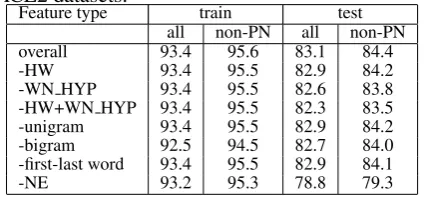
[image:6.595.75.289.581.680.2]Feature ablation experimentWe now perform the feature ablation experiments to further deter-mine the importance of individual features. We re-move one feature at a time from the entire feature set. Table 5 shows the SC classification accuracy of all NPs (all) and non-pronoun NPs (non-PN) on the training and test datasets respectively.
Table 5: SC classification accuracy of ME by re-moving one feature at a time for training and test ACE2 datasets.
Feature type train test all non-PN all non-PN overall 93.4 95.6 83.1 84.4 -HW 93.4 95.5 82.9 84.2 -WN HYP 93.4 95.5 82.6 83.8 -HW+WN HYP 93.4 95.5 82.3 83.5 -unigram 93.4 95.5 82.9 84.2 -bigram 92.5 94.5 82.7 84.0 -first-last word 93.4 95.5 82.9 84.1 -NE 93.2 95.3 78.8 79.3
Again, the significant higher accuracies in train-ing compared to test are due to overfitttrain-ing. The
re-7
All NP accuracy was not reported as they excluded the pronouns in creating their training and test data.
8
They use these corpus to extract patterns to induce SC of common nouns.
moval of NE feature results in the largest accuracy loss of 4.3% (from 83.1% to 78.8%) for all nouns on test data. It follows WN HYP (0.5% loss) and the bigram (0.4%). If we treat HW+WN HYP as one feature, the removal of it results in accuracy loss of 0.8% for all nouns on test data. The un-igram, first-last word and head word each results in the loss of 0.2%. The reason that the removal of NE results in a much significant loss is due to the fact that the NE feature is quite different from other features. Its strength is to distinguish SCs for proper names, while other features are more sim-ilar (their targets are common nouns). The pro-posed use of HW+WN HYP can bring 0.8% gain on top of other features, higher than other informa-tive lexical features including unigram and first-last word.
3.6 Error analysis
A closer look at the errors produced by our SC classifier reveals that the second probable label is very likely to be the actual labels if the first proba-ble one is wrong. In fact, if we allow the classifier to predict two most probable labels and the clas-sification is judged to be true if the actual label is one of the two predictions, then the classification accuracy increases from 83.1% to 96.4%. This is because that the same noun phrases are some-times annotated with one of the five explicitly an-notated classes while sometimes are not anan-notated at all (thus falling into the other SC). Again for the example of people. It is annotated as person SC 20 times and is not annotated at all 21 times. Given the same feature set for this instance, the best the classifier can do is to classify it to other semantic class. To address this annotation incon-sistency issue, we relax the SC agreement feature from the strict match in designing coreference res-olution features. For example, if the first probable SC of an NP matches the second probable SC of another NP, we still give some partial match credit.
4 Application to Coreference Resolution
We can now incorporate the NP SC classifier into our ME based coreference resolution system. This section examines how our WordNet hypernym fea-tures help improve the coreference resolution per-formance.
4.1 Experimental setup
POS-tagging and text chunking. The statistics of corpus and mention extraction are shown in Table 6, where g-mention is the automatically extracted mentions which contain the annotated (gold) men-tions. The recalls of gold mentions are 95.88% and 95.93% for training and test data respectively.
Table 6: Statistics for corpus and extracted men-tions.
text# mention# g-mention# gold# recall(%)
train 422 61810 22990 23977 95.88
test 97 15360 5561 5797 95.93
Our coreference system uses Maximum En-tropy model to determine whether two NPs are coreferent. As in (Soon et al., 2001; Ponzetto and Strube, 2006), we generate training instances as follows: a positive instance is created for each anaphoric NP, NPj, and its closest antecedent, NPi; and a negative instance is created for NPj
paired with each of the intervening NPs, NPi+1, NPi+2, ...,NPj−1. Each instance is represented by syntactic or semantic features described as fol-lows. All training data are used to train a maxi-mum entropy model. In the test stage,we select the closest preceding NP that is classified as corefer-ent withNPjas the antecedent ofNPj. If no such NP exists, no antecedent is selected forNPj.
Unlike other natural language processing tasks such as information extraction which have de facto evaluation metrics, it is an open question which evaluation is the most suitable one. The evalu-ation becomes more complicated when automat-ically extracted mentions (in contrast to the gold mentions) are used. To facilitate the comparison with previous work, we report performance us-ing two different scorus-ing metrics: the commonly-used MUC scorer (Vilain et al., 1995) and the ac-curacy of the anaphoric references (Ponzetto and Strube, 2006). An anaphoric reference is correctly resolved if it and its closest antecedent are in the same coreference chain in the resulting partition.
4.2 Baseline features
We briefly review the baseline features used in this paper as follows. More detailed information and implementations can be found at (Soon et al., 2001; Versley et al., 2008). For example, the ALIAS feature takes values of true or false. The value of true means that the antecedent and the anaphor refer to the same entity (date, person, or-ganization or location). The ALIAS feature de-tection works differently depending on the named entity type. For date, the day, month, and year
values are extracted and compared. For person, the last words of the noun phrases are compared. For organization names, the alias detection checks for acronym match such asIBMandInternational Business Machines Corp.
Lexical features STRING MATCH: true if NPiandNPjhave the same spelling after remov-ing article and demonstrative pronouns, false oth-erwise. ALIAS: true ifNPj is the alias ofNPi.
Grammatical features I PRONOUN: true if NPi is a pronoun; J PRONOUN: true if NPj
is pronoun; J REFL PRONOUN: true if NPj is reflexive pronoun; J PERS PRONOUN: true if NPj is personal pronoun; J POSS PRONOUN:
true if NPj is possessive pronoun; J PN: true if NPj is proper noun; J DEF: true if NPj starts with the; J DEM: true if NPj starts with this, that, these or those; J DEM NOMINAL: true if NPj is a demonstrative nominal noun; J DEM PRONOUN: true ifNPj is a demonstra-tive pronoun; PROPER NAME: true if bothNPi and NPj are proper names; NUMBER: true if NPi andNPj agree in number; GENDER: true ifNPi andNPj agree in gender; APPOSITIVE: true ifNPiandNPjare appositions.
Distance feature DISTANCE: how many sen-tencesNPiandNPj are apart.
Semantic featureSEMCLASS: This feature is implemented from (Soon et al., 2001). Its possible values are true, false, or unknown. First the fol-lowing semantic classes are defined:female,male, person,organization,location,date,time,money, percent, andobject. Each of these defined seman-tic classes is then mapped to a WordNet synset. Then the semantic class determination module de-termines the semantic class for every NP as the first synset of the head noun of the NP. If such synset is a hyponym of defined semantic class, then such semantic class is assigned to the NP. Otherwise,unknownclass is assigned. Finally, the agreement of semantic classes ofNPiandNPj is unknown if either assigned class isunknown; true if their assigned class are the same, false other-wise. Notice that the WordNet use in (Ng, 2007a) and this feature apply in the same principle except that 1) the former is used in SC classification while the latter is used directly for coreference resolu-tion, and 2) they have different semantic class cat-egories.
4.3 Proposed WordNet agreement features
la-bels to propose the SC agreement feature forNPi andNPj. In particular, SC STRICT is true if li andlj are the same and they are not of other type, false otherwise; SC COARSE is true if bothliand lj are not of other type; In addition, we propose
two other SC agreement features to cope with the SC classification errors. SC RELAX1 is true if the first probable ofNPi,li1, is not other type and is the same as the second probable ofNj,lj2, or vice visa. SC RELAX2 is true if the second probable ofNPi,li2, is not other type and is the same as the second probable label ofNPj,lj2. The purpose in using SC RELAX1 and SC RELAX2 features is to relax the strict SC agreement feature in the hope that partial SC match is useful for coreference res-olution.
4.4 Coreference results
Table 7 shows the MUC score for ACE2 corpus and its three partitions: bnews, npaper, and nwire using baseline and the proposed semantic features. It also shows the accuracy of resolving anaphors for all nouns in ACE2 corpus. SC STRICT is the configuration that uses the baseline features with the SEMCLASS (Soon et al., 2001) replaced by SC STRICT, and SC COARSE, SC RELAX1, and SC RELAX2 are incrementally included into the SC STRICT feature set.
As can be seen, the SC STRICT significantly boosts the performance: it improves the MUC F score and anaphor accuracy of baseline from 57.7% to 65.7% and 37.7% to 46.3% respectively. It is remarkable that the new use of WordNet can obtain such significant gain in both MUC score and anaphor accuracy. The large improvement of the precision from 58.1% to 73.3% for all NPs shows that the SC STRICT feature can ef-fectively filter out the semantic incompatible pairs of antecedents and anaphors. In accordance with our hypothesis, the relaxation of strict SC agree-ment by including SC COARSE, SC RELAX1 and SC RELAX2 help improve the performance further, which is reflected by both MUC score and anaphor accuracy. For example, compared to the baseline, the use of all proposed four SC agree-ment features results in the maximal accuracy gain of 9.7% (from 37.7% to 47.4%) and the use of SC STRICT, SC COARSE, and SC RELAX1 re-sults in the maximal MUC score gain of 10.4% (from 57.7% to 68.1%).
Our best MUC score is 68.1% which outper-forms the MUC score of 64.6% as reported in (Ng, 2007a) by 3.5%, while our best accuracy of anaphor is 47.4%, which is 4.1% less than
the accuracy of 51.5% in (Ng, 2007a). Note that, unlike (Ng, 2007a) which performed exten-sive experiments using different machine learn-ing algorithms, alternative use of features (either constraint or normal features), and heterogeneous knowledge sources, this paper simply uses one learning classifier (ME model) and only employs WordNet and Stanford NER semantic sources.
The different MUC and accuracy scores reflect the non-trivial cases of evaluating coreference sys-tems. While we leave out the discussion of which evaluation is more appropriate, we focus on show-ing that the proposed SC classifier can brshow-ing sig-nificant boost from the baseline using both MUC and accuracy metrics.
5 Conclusion
We have showed that the traditional use of Word-Net in coreference resolution may not effectively exploit the WordNet semantic knowledge. We pro-posed new ways to extract WordNet feature. This feature, along with other features such as named entity feature, can be used to build an accurate se-mantic class (SC) classifier. In addition, we ana-lyzed the classification errors of the SC classifier and relaxed SC agreement features to cope with part of the classification errors. The proposed ac-curate SC classifier and the relaxation of SC agree-ment features can boost our baseline coreference resolution system by 10.4% and 9.7% using MUC score and anaphor accuracy respectively.
Acknowledgments
We wish to thank Yannick Versley for his sup-port with BART coreference resolution system and the three anonymous reviewers for their invaluable comments. This research was supported by British Telecom grant CT1080028046 and BISC Program of UC Berkeley.
References
A. L. Berger, S. A. D. Pietra, and V. J. D. Pietra 1996. A maximum entropy approach to natural language
processing. Computational Linguistics, 22(1):39–
71.
M. Collins 1999. Head-driven statistical models for
natural language parsing. PhD thesis, University of
Pennsylvania.
H. Daum´e III and D. Marcu. 2005. A large-scale
exploration of effective global features for a joint
entity detection and tracking model. In Proc. of
Table 7: MUC score and accuracy of baseline and proposed SC agreement features for ACE2 dataset.
MUC score Accuracy
All bnews npaper nwire All
System R P F R P F R P F R P F
baseline 57.4 58.1 57.7 56.6 55.4 56.0 59.3 60.4 59.9 56.2 58.6 57.3 37.7 Ng 2007a 59.5 70.6 64.6 - - - 51.5
SC STRICT 59.6 73.3 65.7 61.6 72.8 66.7 60.3 74.9 66.8 56.8 72.1 63.5 46.3 + SC COARSE 59.2 76.7 66.8 61.0 76.7 67.9 59.8 77.2 67.4 56.6 76.2 64.9 45.9 + SC RELAX1 59.8 79.0 68.1 61.3 79.8 69.3 60.9 80.3 69.3 57.2 76.7 65.5 47.2 + SC RELAX2 60.2 77.7 67.8 61.5 78.2 68.9 61.4 78.9 69.1 57.5 75.7 65.4 47.4
P. Denis and J. Baldridge. 2007. Joint determination of anaphoricity and coreference resolution using
in-teger programming. InHLT-NAACL.
C. Fellbaum. 1998. An electronic lexical database.
The MIT press.
J. Finkel, T. Grenager, and C. Manning. 2005. In-corporating non-local information into information
extraction systems by Gibbs sampling. InProc. of
ACL, pages 363-370.
R. Florian, H. Jing, N. Kambhatla, and I. Zitouni. 2006. Factorizing complex models: a case study in
mention detection. InProc. of COLING/ACL, pages
473-480.
S. M. Harabagiu, R. C. Bunescu, and S. J. Maiorano. 2001. Text and knowledge mining for coreference
resolution. InProc. of NAACL, pages 55-62.
A. Kehler, D. Appelt, L. Taylor, and A. Simma. 2004. The (non)utility of predicate-argument frequencies
for pronoun interpretation. InProc. of HLT/NAACL,
pages 289-296.
D. Lin. 1998a. Automatic retrieval and clustering
of similar words. InProc. of COLING/ACL, pages
768-774.
D. Lin. 1998b. Using collocation statistics in
informa-tion extracinforma-tion. InProc. of MUC-7.
X. Luo, A. Ittycheriah, H. Jing, N. Kambhatla, and S. Roukos. 2004. A mention synchronous coreference
resolution algorithm based on the Bell tree. InProc.
of the ACL.
C. Manning and D. Klein. 2003. Optimization,
Maxent Models, and Conditional Estimation
with-out Magic. Tutorial at HLT-NAACL 2003 and ACL
2003.
K. Markert and M. Nissim. 2005. Comparing
knowl-edge sources for nominal anaphora resolution.
Com-putational Linguistics, 31(3):367-401.
A. McCallum and B. Wellner. 2004. Conditional mod-els of identity uncertainty with application to noun
coreference. InProc. of the NIPS.
V. Ng. 2007a. Semantic Class Induction and
Corefer-ence Resolution. InProc. of the ACL.
V. Ng. 2007b. Shallow Semantics for Coreference
Resolution. InProc. of the IJCAI.
C. Nicolae and G. Nicolae 2006. BESTCUT: A Graph
Algorithm for Coreference Resolution. In Proc. of
the EMNLP.
M. Poesio, R. Mehta, A. Maroudas, and J. Hitzeman. 2004. Learning to resolve bridging references. In
Proc. of the ACL.
S. P. Ponzetto and M. Strube. 2006. Exploiting se-mantic role labeling, WordNet and Wikipedia for
coreference resolution. InProc. of the HLT/NAACL,
pages 192-199.
N. Seco, T. Veale, and J. Hayes. 2004. An Intrinsic Information Content Metric for Semantic Similarity
in WordNet. Proc. of the European Conference of
Artificial Intelligence.
W. M. Soon, H. T. Ng, and D. C. Y. Lim. A machine learning approach to coreference resolution of noun
phrases.Computation Linguistics, 27(4):521-544.
Y. Versley, S. P. Ponzetto, M. Poesio, V. Eidelman, A. Jern, J. Smith, X. Yang, and A. Moschitti. 2008. BART: a modular toolkit for coreference resolution.
ACL 2008 System demo.
R. Vieira and M. Poesio. 2000. An empirically-based
system for processing definite descriptions.
Compu-tational Linguistics, 26(4):539-593.
M. Vilain, J. Burger, J. Aberdeen, D. Connolly, and L. Hirschman. 1995. A model-theoretic coreference
scoreing scheme. InProc. of MUC-6, pages 45-52.
R. Weischedel and A. Brunstein. 2005. BBN pronoun coreference and entity type corpus. Linguistic Data Consortium.
X. Yang and J. Su. 2007. Coreference resolution us-ing semantic relatedness information from