Jointly Combining Implicit Constraints Improves Temporal Ordering
Nathanael Chambers and Dan Jurafsky Department of Computer Science
Stanford University Stanford, CA 94305
{natec,jurafsky}@stanford.edu
Abstract
Previous work on ordering events in text has typically focused on local pairwise decisions, ignoring globally inconsistent labels. How-ever, temporal ordering is the type of domain in which global constraints should be rela-tively easy to represent and reason over. This paper presents a framework that informs lo-cal decisions with two types of implicit global constraints: transitivity (A before BandB be-fore CimpliesA before C) and time expression normalization (e.g. last monthis before yes-terday). We show how these constraints can be used to create a more densely-connected network of events, and how global consis-tency can be enforced by incorporating these constraints into an integer linear programming framework. We present results on two event ordering tasks, showing a 3.6% absolute in-crease in the accuracy ofbefore/after classifi-cation over a pairwise model.
1 Introduction
Being able to temporally order events is a neces-sary component for complete document understand-ing. Interest in machine learning approaches for this task has recently been encouraged through the cre-ation of the Timebank Corpus (Pustejovsky et al., 2003). However, most work on event-event order-ing has focused on improvorder-ing classifiers for pair-wise decisions, ignoring obvious contradictions in the global space of events when misclassifications occur. A global framework to repair these event or-dering mistakes has not yet been explored.
This paper addresses three main factors involved in a global framework: the global optimization al-gorithm, the constraints that are relevant to the task, and the level of connectedness across pairwise de-cisions. We employ Integer Linear Programming to address the first factor, drawing from related work in paragraph ordering (Bramsen et al., 2006). After finding minimal gain with the initial model, we ex-plore reasons for and solutions to the remaining two factors through temporal reasoning and transitivity rule expansion.
We analyze the connectivity of the Timebank Cor-pus and show how textual events can be indirectly connected through a time normalization algorithm that automatically creates new relations between time expressions. We show how this increased con-nectivity is essential for a global model to improve performance.
We present three progressive evaluations of our global model on the Timebank Corpus, showing a 3.6% gain in accuracy over its original set of re-lations, and an 81% increase in training data size from previous work. In addition, we present the first results on Timebank that include anunknown rela-tion, establishing a benchmark for performance on the full task of document ordering.
2 Previous Work
Recent work on classifying temporal relations within the Timebank Corpus built 6-way relation classifiers over 6 of the corpus’ 13 relations (Mani et al., 2006; Mani et al., 2007; Chambers et al., 2007). A wide range of features are used, ranging from sur-face indicators to semantic classes. Classifiers make
local pairwise decisions and do not consider global implications between the relations.
The TempEval-07 (Verhagen et al., 2007) contest recently used two relations, before and after, in a semi-complete textual classification task with a new third relation to distinguish relations that can be la-beled with high confidence from those that are un-certain, calledvague. The task was a simplified clas-sification task from Timebank in that only one verb, the main verb, of each sentence was used. Thus, the task can be viewed as ordering the main events in pairwise sentences rather than the entire document.
This paper uses the core relations of TempEval (before,after,vague) and applies them to a full docu-ment ordering task that includes every labeled event in Timebank. In addition, we extend the previous work by including a temporal reasoning component and embedding it within a global constraint model.
3 The Timebank Corpus
The Timebank Corpus (Pustejovsky et al., 2003) is a corpus of 186 newswire articles that are tagged for events, time expressions, and relations between the events and times. The individual events are fur-ther tagged for temporal information such as tense, modality and grammatical aspect. Time expressions use the TimeML (Ingria and Pustejovsky, 2002) markup language. There are 6 main relations and their inverses in Timebank:before,ibefore,includes, begins,endsandsimultaneous.
This paper describes work that classifies the re-lations between events, making use of rere-lations be-tween events and times, and bebe-tween the times themselves to help inform the decisions.
4 The Global Model
Our initial model has two components: (1) a pair-wise classifier between events, and (2) a global con-straint satisfaction layer that maximizes the confi-dence scores from the classifier. The first is based on previous work (Mani et al., 2006; Chambers et al., 2007) and the second is a novel contribution to event-event classification.
4.1 Pairwise Classification
Classifying the relation between two events is the basis of our model. A soft classification with
confi-dence scores is important for the global maximiza-tion step that is described in the next secmaximiza-tion. As in Chambers et al. (2007), we build support vec-tor machine (SVM) classifiers and use the probabili-ties from pairwise SVM decisions as our confidence scores. These scores are then used to choose an op-timal global ordering.
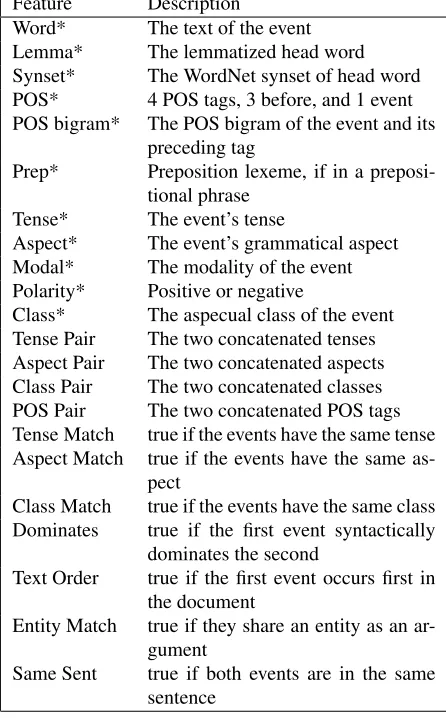
Following our previous work, we use the set of features summarized in figure 1. They vary from POS tags and lexical features surrounding the event, to syntactic dominance, to whether or not the events share the same tense, grammatical aspect, or aspec-tual class. These features are the highest performing set on the basic 6-way classification of Timebank.
Feature Description
Word* The text of the event Lemma* The lemmatized head word Synset* The WordNet synset of head word POS* 4 POS tags, 3 before, and 1 event POS bigram* The POS bigram of the event and its
preceding tag
Prep* Preposition lexeme, if in a preposi-tional phrase
Tense* The event’s tense
Aspect* The event’s grammatical aspect Modal* The modality of the event Polarity* Positive or negative
Class* The aspecual class of the event Tense Pair The two concatenated tenses Aspect Pair The two concatenated aspects Class Pair The two concatenated classes POS Pair The two concatenated POS tags Tense Match true if the events have the same tense Aspect Match true if the events have the same
as-pect
Class Match true if the events have the same class Dominates true if the first event syntactically
dominates the second
Text Order true if the first event occurs first in the document
Entity Match true if they share an entity as an ar-gument
[image:2.612.313.536.267.626.2]Same Sent true if both events are in the same sentence
Figure 1: The features to learn temporal relations be-tween two events. Asterisks (*) indicate features that are duplicated, one for each of the two events.
before after unknown
A r1 B .5 .3 .2
B r2 C .4 .3 .3
A r3 C .4 .5 .1
total 1.3 1.1 .6
A r1 B .5 .3 .2
B r2 C .4 .3 .3
A r3 C .2 .7 .1
[image:3.612.103.270.56.184.2]total 1.1 1.3 .6
Figure 2: Two sets of confidence scores. The first set choosesbeforefor all three labels, and the second chooses after. Other lower-scoring valid relation sets also exist, such asbefore,unknown, andbefore.
study of global constraints, described next.
4.2 Global Constraints
Pairwise classifiers can make contradictory classifi-cations due to their inability to consider other deci-sions. For instance, the following three decisions are in conflict:
A before B B before C A after C
Transitivity is not taken into account. In fact, there are several ways to resolve the conflict in this exam-ple. Given confidence scores (or probabilities) for each possible relation between the three pairs, we can compute an optimal label assignment. Differ-ent scores can lead to differDiffer-ent conflict resolutions. Figure 2 shows two resolutions given different sets of scores. The first choosesbeforefor all three rela-tions, while the second choosesafter.
Bramsen et al. (2006) presented a variety of ap-proaches to using transitivity constraints to help in-form pairwise decisions. They found that Integer Linear Programming (ILP) performed the best on a paragraph ordering task, consistent with its property of being able to find the optimal solution for a set of constraints. Other approaches are variations on agreedystrategy of adding pairs of events one at a time, ordered by their confidence. These can lead to suboptimal configurations, although they are guar-anteed to find a solution. Mani et al. (2007) sub-sequently proposed one of these greedy strategies as well, but published results are not available. We also
implemented a greedy best-first strategy, but found ILP outperformed it.
Our Integer Linear Programming framework uses the following objective function:
maxX
i X
j
pijxij (1)
with added constraints:
∀i∀j xij ∈ {0,1} (2)
∀i xi1+xi2+...+xim= 1 (3)
wherexij represents the ith pair of events classified as the jth relation of m relations. Thus, each pair of events generates m variables. Given n pairs of events, there aren∗mvariables. pij is the proba-bility of classifying pairiwith relationj. Equation 2 (the first constraint) simply says that each variable must be0or1. Equation 3 containsmvariables for a single pair of eventsirepresenting itsmpossible relations. It states that one relation must be set to1 and the rest to0. In other words, a pair of events cannot have two relations at the same time. Finally, a transitivity constraint is added for all connected pairsi, j, k, for each transitivity condition that infers relationcgivenaandb:
xia+xjb−xkc <= 1 (4)
We generated the set of constraints for each doc-ument and used lpsolve1to solve the ILP constraint problem.
The transitivity constraints are only effective if the available pairwise decisions constitute a con-nected graph. If pairs of events are disconcon-nected, then transitivity makes little to no contribution be-cause these constraints are only applicable to con-nected chains of events.
4.3 Transitive Closure
In order to connect the event graph, we draw on work from (Mani et al., 2006) and applytransitive closure to our documents. Transitive closure was first proposed not to address the problem of con-nected event graphs, but rather to expand the size of training data for relations such asbefore. Time-bank is a relatively small corpus with few examples
1
Total Event-Event Relations After Closure
before after
Timebank 592 656
[image:4.612.121.251.70.117.2]+ closure 3919 3405
Figure 3: The number of event-event relations after tran-sitive closure.
of each relation. One way of expand the training set is through transitive rules. A few rules are given here:
A simultaneous B∧A bef ore C→B bef ore C A includes B∧A ibef ore C→B bef ore C A bef ore B∧A ends C→B af ter C
While the original motivation was to expand the training size of tagged relations, this approach also creates new connections in the graph, replacing pre-viously unlabeled event pairs with their true rela-tions. We adopted this approach and closed the orig-inal set of 12 relations to help connect the global constraint model.
4.4 Initial Experiment
The first evaluation of our global temporal model is on the Timebank Corpus over the labeled rela-tionsbeforeandafter. We mergedibeforeandiafter into these two relations as well, ignoring all oth-ers. We use this task as a reduced evaluation to study the specific contribution of global constraints. We also chose this strict ordering task because it is well defined from a human understanding perspec-tive. Snow et al. (2008) shows that average inter-net users can makebefore/afterdecisions with very high confidence, although the distinction with an un-knownrelation is not as clear. An evaluation includ-ingunknown(orvagueas in TempEval) is presented later.
We expanded the corpus (prior to selecting the be-fore/after relations) using transitive closure over all 12 relations as described above. Figure 3 shows the increase in data size. The number ofbeforeandafter relations increase by a factor of six.
We trained and tested the system with 10-fold cross validation and micro-averaged accuracies. The folds were randomly generated to separate the 186 files into 10 folds (18 or 19 files per fold). The same 10-way split is used for all the evaluations. We used
Comparative Results
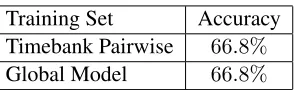
Training Set Accuracy Timebank Pairwise 66.8% Global Model 66.8%
Figure 4: Using the base Timebank annotated tags for testing, accuracy on before/after tags in the two models.
libsvm2to implement our SVM classifiers.
Figure 4 shows the results from our ILP model with transitivity constraints. The first row is the baseline pairwise classification trained and tested on the original Timebank relations. The second row gives performance with ILP. The model shows no improvement. The global ILP constraints did affect local decisions, changing 175 of them (out of 7324), but the changes cancelled out and had no affect on overall accuracy.
4.5 Loosely Connected Graph
Why didn’t a global model help? The problem lies in the graph structure of Timebank’s annotated rela-tions. The Timebank annotators were not required to annotate relations between any particular pair of events. Instead, they were instructed to annotate what seemed appropriate due to the almost insur-mountable task of annotating all pairs of events. A modest-sized document of 30 events, for example, would contain 302
= 435 possible pairs. Anno-tators thus marked relations where they deemed fit, most likely between obvious and critical relations to the understanding of the article. The vast majority of possible relations are untagged, thus leaving a large set of unlabeled (and disconnected) unknown rela-tions.
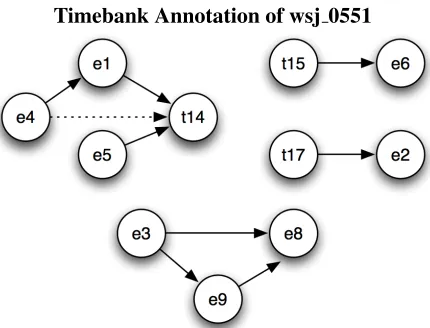
Figure 5 graphically shows all relations that are annotated between events and time expressions in one of the shorter Timebank documents. Nodes rep-resent events and times (event nodes start with the letter ’e’, times with ’t’), and edges represent tempo-ral relations. Solid lines indicate hand annotations, and dotted lines indicate new rules from transitive closure (only one, from event e4 to time t14). As can be seen, the graph is largely disconnected and a global model contributes little information since transitivity constraints cannot apply.
2
[image:4.612.355.502.73.118.2]Timebank Annotation of wsj 0551
Figure 5: Annotated relations in document wsj 0551.
The large amount of unlabeled relations in the corpus presents several problems. First, building a classifier for theseunknownrelations is easily over-whelmed by the huge training set. Second, many of the untagged pairs have non-unknownordering rela-tions between them, but were missed by the annota-tors. This point is critical because one cannot filter this noise when training anunknownclassifier. The noise problem will appear later and will be discussed in our final experiment. Finally, the space of an-notated events is very loosely connected and global constraints cannot assist local decisions if the graph is not connected. The results of this first experiment illustrate this latter problem.
Bethard et al. (2007) strengthen the claim that many of Timebank’s untagged relations should not be left unlabeled. They performed an independent annotation of 129 of Timebank’s 186 documents, tagging all events in verb-clause relationships. They found over 600 valid before/afterrelations that are untagged in Timebank, on average three per docu-ment. One must assume that if these nearby verb-clause event pairs were missed by the annotators, the much larger number of pairs that cross sentence boundaries were also missed.
The next model thus attempts to fill in some of the gaps and further connect the event graph by using two types of knowledge. The first is by integrating Bethard’s data, and the second is to perform tempo-ral reasoning over the document’s time expressions (e.g.yesterdayorjanuary 1999).
5 A Global Model With Time
Our initial model contained two components: (1) a pairwise classifier between events, and (2) a global constraint satisfaction layer. However, due to the sparseness in the event graph, we now introduce a third component addressing connectivity: (3) a temporal reasoning component to inter-connect the global graph and assist in training data expansion.
One important aspect of transitive closure in-cludes the event-time and time-time relations during closure, not just the event-event links. Starting with 5,947 different types of relations, transitive rules in-crease the dataset to approximately 12,000. How-ever, this increase wasn’t enough to be effective in global reasoning. To illustrate the sparsity that still remains, if each document was a fully connected graph of events, Timebank would contain close to 160,000 relations3, more than a 13-fold increase.
More data is needed to enrich the Timebank event graph. Two types of information can help: (1) more event-event relations, and (2) a separate type of in-formation to indirectly connect the events: event-X-event. We incorporate the new annotations from Bethard et al. (2007) to address (1) and introduce a new temporal reasoning procedure to address (2). The following section describes this novel approach to adding time expression information to further connect the graph.
5.1 Time-Time Information
As described above, we use event-time relations to produce the transitive closure, as well as annotated time-time relations. It is unclear if Mani et al. (2006) used these latter relations in their work.
However, we also add new time-time links that are deduced from the logical time intervals that they describe. Time expressions can be resolved to time intervals with some accuracy through simple rules. New time-time relations can then be added to our space of events through time stamp comparisons. Take this newswire example:
The Financial Times 100-share index shed 47.3 points to close at 2082.1, down 4.5% from theprevious Friday, and 6.8% fromOct. 13, when Wall Street’s plunge helped spark thecurrentweakness in London.
3
Sum over the # of eventsndin each documentd, n2d
The first two expressions (‘previous Friday’ and ‘Oct. 13’) are in a clear before relation-ship that Timebank annotators captured. The ‘current’ expression, is correctly tagged with the PRESENT REF attribute to refer to the document’s timestamp. Both ‘previous Friday’ and ‘Oct. 13’ should thus be tagged as being before this expres-sion. However, the annotators did not tag either of these twobeforerelations, and so our timestamp resolution procedure fills in these gaps. This is a common example of two expressions that were not tagged by the annotators, yet are in a clear temporal relationship.
We use Timebank’s gold standard TimeML an-notations to extract the dates and times from the time expressions. In addition, those marked as PRESENT REFare resolved to the document times-tamp. Time intervals that are strictly before or after each other are thus labeled and added to our space of events. We create newbeforerelations based on the following procedure:
if event1.year < event2.year return true
if event1.year == event2.year if event1.month < event2.month
return true
if event1.month == event2.month if event1.day < event2.day
return true end
end
return false
All other time-time orderings not including the beforerelation are ignored (i.e. includesis not cre-ated, although could be with minor changes).
This new time-time knowledge is used in two sep-arate stages of our model. The first is just prior to transitive closure, enabling a larger expansion of our tagged relations set and reduce the noise in the un-knownset. The second is in the constraint satisfac-tion stage where we add our automatically computed time-time relations (with the gold event-time rela-tions) to the global graph to help correct local event-event mistakes.
Total Event-Event Relations After Closure
before after
Timebank 3919 3405
[image:6.612.353.502.71.131.2]+ time-time 5604 5118 + time/bethard 7111 6170
Figure 6: The number of event-eventbeforeandafter re-lations after transitive closure on each dataset.
Comparative Results with Closure
Training Set Accuracy
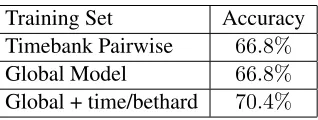
Timebank Pairwise 66.8%
Global Model 66.8%
Global + time/bethard 70.4%
Figure 7: Using the base Timebank annotated tags for testing, the increase in accuracy on before/after tags.
5.2 Temporal Reasoning Experiment
Our second evaluation continues the use of the two-way classification task withbefore andafterto ex-plore the contribution of closure, time normaliza-tion, and global constraints.
We augmented the corpus with the labeled rela-tions from Bethard et al. (2007) and added the au-tomatically created time-time relations as described in section 5.1. We then expanded the corpus using transitive closure. Figure 6 shows the progressive data size increase as we incrementally add each to the closure algorithm.
The time-time generation component automati-cally added 2459 newbeforeandaftertime-time re-lations into the 186 Timebank documents. This is in comparison to only 157 relations that the human annotators tagged, less than 1 per document on av-erage. The second row of figure 6 shows the dras-tic effect that these time-time relations have on the number of available event-event relations for train-ing and testtrain-ing. Addtrain-ing both Bethard’s data and the time-time data increases our training set by81% over closure without it.
[image:6.612.349.508.193.253.2]Figure 7 shows the results from the new model. The first row is the baseline pairwise classification trained and tested on the original relations only. Our model improves by 3.6% absolute. This improve-ment is statistically significant (p < 0.000001, Mc-Nemar’s test, 2-tailed).
5.3 Discussion
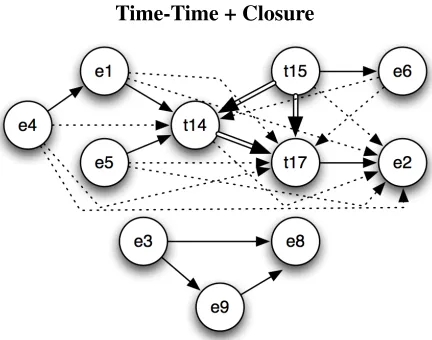
To further illustrate why our model now improves local decisions, we continue our previous graph ex-ample. The actual text for the graph in figure 5 is shown here:
docstamp: 10/30/89(t14)
Trustcorp Inc. will become(e1) Society Bank & Trust when its merger(e3)is completed(e4)with Society Corp. of Cleveland, the bank said(e5). Society Corp., which is also a bank, agreed(e6)in June(t15)to buy(e8)Trustcorp for 12.4 million shares of stock with a market value of about$450 million. The transaction(e9)is expected(e10)
to close(e2)around year end(t17).
The automatic time normalizer computes and adds three new time-time relations, two connecting t15 and t17 with the document timestamp, and one con-necting t15 and t17 together. These are not other-wise tagged in the corpus.
[image:7.612.78.294.422.592.2]Time-Time + Closure
Figure 8: Before and after time-time links with closure.
Figure 8 shows the augmented document. The double-line arrows indicate the three new time-time relations and the dotted edges are the new relations added by our transitive closure procedure. Most crit-ical to this paper, three of the new edges are event-event relations that help to expand our training data.
If this document was used in testing (rather than training), these new edges would help inform our transitive rules during classification.
Even with this added information, disconnected segments of the graph are still apparent. However, the3.6%performance gain encourages us to move to the final full task.
6 Final Experiment with Unknowns
Our final evaluation expands the set of relations to include unlabeled relations and tests on the entire dataset available to us. The following is now a clas-sification task between the three relations: before, after, andunknown.
We duplicated the previous evaluation by adding the labeled relations from Bethard et al. (2007) and our automatically created time-time relations. We then expanded this dataset using transitive closure. Unlike the previous evaluation, we also use this en-tire dataset for testing, not just for training. Thus, all event-event relations in Bethard as well as Timebank are used to expand the dataset with transitive closure and are used in training and testing. We wanted to fully evaluate document performance on every pos-sible event-event relation that logically follows from the data.
As before, we converted IBefore andIAfter into before and after respectively, while all other rela-tions are reduced tounknown. This relation set co-incides with TempEval-07’s core three relations (al-though they usevagueinstead ofunknown).
Rather than include all unlabeled pairs in our un-knownset, we only include the unlabeled pairs that span at most one sentence boundary. In other words, events in adjacent sentences are included in the un-knownset if they were not tagged by the Timebank annotators. The intuition is that annotators are more likely to label nearby events, and so events in adja-cent sentences are more likely to be actualunknown relations if they are unlabeled. It is more likely that distant events in the text were overlooked by con-venience, not because they truly constituted an un-knownrelationship.
evalu-Classification Accuracy
% unk base global global+time
0 72.0% 72.2% 74.0%
1 69.4% 69.5% 71.3%
3 65.5% 65.6% 67.1%
5 63.7% 63.8% 65.3%
7 61.2% 61.6% 62.8%
9 59.3% 59.5% 60.6%
11 58.1% 58.4% 59.4%
[image:8.612.320.537.55.196.2]13 57.1% 57.1% 58.1%
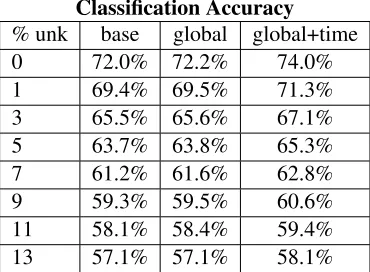
Figure 9: Overall accuracy when training with different percentages ofunknownrelations included. 13%of un-knownsis about equal to the number ofbefores.
ation. We used the same SVM approach with the features described in section 4.1.
6.1 Results
Results are presented in figure 9. The rows in the table are different training/testing runs on varying sizes of unknown training data. There are three columns with accuracy results of increasing com-plexity. The first, base, are results from pairwise classification decisions over Timebank and Bethard with no global model. The second, global, are re-sults from the Integer Linear Programming global constraints, using the pairwise confidence scores from thebaseevaluation. Finally, theglobal+time
column shows the ILP results when all event-time, time-time, and automatically induced time-time re-lations are included in the global graph.
The ILP approach does not alone improve perfor-mance on the event-event tagging task, but adding the time expression relations greatly increases the global constraint results. This is consistent with the results from out first two experiments. The evalua-tion with1%of theunknowntags shows an almost 2% improvement in accuracy. The gain becomes smaller as theunknownset increases in size (1.0% gain with 13% unknown). Unknown relations will tend to be chosen as more weight is given to un-knowns. When there is a constraint conflict in the global model,unknowntends to be chosen because it has no transitive implications. All improvements from base to global+time are statistically significant (p <0.000001, McNemar’s test, 2-tailed).
Base Pairwise Classification
precision recall f1-score
before 61.4 55.4 58.2
after 57.6 53.1 55.3
unk 53.0 62.8 57.5
Global+Time Classification
[image:8.612.93.278.58.194.2]precision recall f1-score before 63.7(+2.3) 57.1(+2.2) 60.2(+2.0) after 60.3(+2.7) 54.3(+2.9) 57.1(+1.8) unk 52.0(-1.0) 62.9(+0.1) 56.9(-0.6)
Figure 10: Precision and Recall for the base pairwise de-cisions and the global constraints with integrated time in-formation.
The first row of figure 9 corresponds to the re-sults in our second experiment in figure 7, but shows higher accuracy. The reason is due to our different test sets. This final experiment includes Bethard’s event-event relations in testing. The improved per-formance suggests that the clausal event-event rela-tions are easier to classify, agreeing with the higher accuracies originally found by Bethard et al. (2007). Figure 10 shows the precision, recall, and f-score for the evaluation with13%unknowns. This set was chosen for comparison because it has a similar num-ber ofunknown labels as before labels. We see an increase in precision in both thebeforeandafter de-cisions by up to 2.7%, an increase in recall up to 2.9%, and an fscore by as much as 2.0%. The un-knownrelation shows mixed results, possibly due to its noisy behavior as discussed throughout this pa-per.
6.2 Discussion
Our results on the two-way (before/after) task show that adding additional implicit temporal constraints and then performing global reasoning results in significant improvements in temporal ordering of events (3.6% absolute over simple pairwise deci-sions).
indepen-dent annotations directly point to missing relations, but the dramatic increase in the size of our closure data (81%) from adding a small amount of time-time relations suggests that the problem is widespread. This noise in the unknown relation may be damp-ening the gains that the two way task illustrates.
This work is also related to the task of event-time classification. While not directly addressed in this paper, the global methods described within clearly apply to pairwise models of event-time ordering as well.
Further progress in improving global constraints will require new methods to more accurately iden-tifyunknown events, as well as new approaches to create implicit constraints over the ordering. We ex-pect such an improved ordering classifier to be used to improve the performance of tasks such as summa-rization and question answering about the temporal nature of events.
Acknowledgments
This work is funded in part by DARPA through IBM and by the DTO Phase III Program for AQUAINT. We also thank our anonymous reviewers for many helpful suggestions.
References
Steven Bethard, James H. Martin, and Sara Klingenstein. 2007. Timelines from text: Identification of syntac-tic temporal relations. InInternational Conference on Semantic Computing.
Philip Bramsen, Pawan Deshpande, Yoong Keok Lee, and Regina Barzilay. 2006. Inducing temporal graphs. InProceedings of EMNLP-06.
Nathanael Chambers, Shan Wang, and Dan Jurafsky. 2007. Classifying temporal relations between events. InProceedings of ACL-07, Prague, Czech Republic. R Ingria and James Pustejovsky. 2002. TimeML
specifi-cation 1.0. Inhttp://www.time2002.org.
Inderjeet Mani, Marc Verhagen, Ben Wellner, Chong Min Lee, and James Pustejovsky. 2006. Machine learning of temporal relations. InProceedings of ACL-06, July. Inderjeet Mani, Ben Wellner, Marc Verhagen, and James Pustejovsky. 2007. Three approaches to learning tlinks in timeml. Technical Report CS-07-268, Bran-deis University.
James Pustejovsky, Patrick Hanks, Roser Sauri, Andrew See, David Day, Lisa Ferro, Robert Gaizauskas, Mar-cia Lazo, Andrea Setzer, and Beth Sundheim. 2003.
The timebank corpus.Corpus Linguistics, pages 647– 656.
Rion Snow, Brendan O’Connor, Dan Jurafsky, and An-drew Ng. 2008. Cheap and fast - but is it good? evaluating non-expert annotations for natural language tasks. InProceedings of EMNLP-08, Waikiki, Hawaii, USA.