University of Warwick institutional repository: http://go.warwick.ac.uk/wrap
A Thesis Submitted for the Degree of PhD at the University of Warwick
http://go.warwick.ac.uk/wrap/66746
This thesis is made available online and is protected by original copyright.
Please scroll down to view the document itself.
i
Managing Risk in Operations: A Multi-Level
Study
By
Ross Andrew Ritchie
A thesis submitted in partial fulfilment of the requirements for the
degree of
Doctor of Philosophy
University of Warwick, Warwick Business School
ii
Table of Contents
1. INTRODUCTION
... 1
1.1 Research Rationale ... 1
1.2 Theoretical Background ... 4
1.3 The Purpose of this Research ... 7
1.4 Contribution of the Research ... 8
1.5 Research Structure ... 10
2. FOUNDATIONAL LITERATURE
... 13
2.1 Ontology of Risk ... 15
2.1.1 Risk as Loss or Imprecision ... 18
2.1.2 Residual and Inherent Risk ... 19
2.1.3 Defining the Relations of Risks ... 21
2.2 Risk Management Standards ... 22
2.2.1 British Standard (BS ISO31000) ... 26
2.2.2 Committee of Sponsoring Organizations of the Treadway Commission (COSO) ... 29
2.2.3 AIRMIC (2002), A Risk Management Standard ... 31
2.2.4 Comparison of Risk Management Standards ... 32
2.3 Operational Risk ... 35
2.3.1 Basel Committee Definitions ... 37
2.3.2 Transferability of Operational Risk ... 40
2.3.3 Power (2005) Calculative Cultures: ... 42
2.3.4 Mikes (2009) ERM Ideal Types: ... 43
2.3.5 Summary of Operational Risk Literature ... 47
2.4 Risk in Operations... 48
2.4.1 Supply-Demand Coordination Risk ... 49
2.4.2 Disruption Risk ... 51
2.4.3 Summary of Risk in Operations Literature ... 56
2.5 Risk Treatment ... 56
2.5.1 Ignorance and Consciousness ... 58
2.5.2 Accept... 60
2.5.3 Transfer (Financial) ... 61
2.5.4 Risk Transfer (Outsource) ... 64
2.5.5 Avoid or Withdraw... 66
2.5.6 Mitigate ... 67
2.5.7 Defer (Options Approaches) ... 71
2.5.8 Summary of Risk Literature ... 72
2.6 Decisions under Uncertainty ... 75
2.6.1 Prospect Theory ... 75
2.6.2 Intuition and Reasoning... 78
iii
2.6.4 Decision Strategies ... 80
2.6.5 Time Pressure ... 81
2.6.6 Information Load ... 83
2.6.7 Rationality ... 83
2.6.8 Informational Attributes ... 84
2.6.9 Weighting ... 86
2.6.10 Aversion ... 87
2.6.11 Bias ... 88
2.6.12 Personal Contingencies ... 89
2.6.13 Principle Agent Theory (Eisenhardt, 1989) ... 91
2.6.14 Decisions Under Uncertainty Summary ... 92
2.7 Performance Management ... 94
2.8 Performance System Functions ... 98
2.8.1 Performance System as a Measurement System ... 100
2.8.2 The Communication Function ... 102
2.8.3 The Performance System as a Strategy Tool ... 103
2.8.4 Learning in the Performance System ... 105
2.8.5 Performance System Evolution and Organizational Influence ... 106
2.8.6 Performance System and Risk ... 107
2.8.7 Simons (1995) Levers of Control: ... 110
2.8.8 An Integrative Model of the Performance System ... 113
2.8.9 Summary of Performance System Literature ... 115
2.9 Synthesis of the Literature ... 116
3. RESEARCH STRATEGY
... 121
3.1 Research Strategy Overview ... 121
3.2 Philosophy ... 122
3.2 The Influence of Critical Realism... 123
3.3 Abductive Development: Systematic Combining ... 126
3.4 Research Approach and Methods ... 129
4. FIRM-LEVEL ANALYSIS
... 135
4.1 Case Study ... 135
4.1.1 Approach ... 138
4.1.2 Sample Frame ... 140
4.1.3 Case Organization: GRS ... 140
4.1.4 Case Organization: FCORP ... 141
4.1.5 Case Summary ... 142
4.1.6 Firm-Level Data Collection ... 143
4.2 Firm-Level Results and Analysis ... 146
4.2.1 Risk Types: Public Communication (RT1) ... 147
4.2.2 Risk Types: Investor Communication (RT2) ... 149
iv
4.2.4 Risk Governance (RG1): Risk Policy and Standards ... 153
4.2.5 Risk Governance (RG2): Risk Roles ... 156
4.2.6 Risk Governance (RG3): Risk Reporting... 157
4.2.7 Risk Strategy (RS1): Mapping of risk in strategy ... 161
4.7.8 Risk Strategy (RS2): Decision-Making ... 162
4.3 Firm-Level Discussion ... 163
5. FUNCTION-LEVEL ANALYSIS: ASSET AND SERVICE
... 170
5.1 Introduction to Function-Level Analysis ... 170
5.2 Method: Case Study ... 171
5.2.1 Sample Frame ... 173
5.2.2 Case Organization: ERS (GRS) ... 173
5.2.3 Case Organization: EGEN (GRS) ... 174
5.2.4 Case Organization: FRET (FCORP) ... 175
5.2.5 Case Organization: EAM (FCORP) ... 175
5.2.6 Function-Level Data Collection ... 176
5.3 Function-Level Results and Analysis... 178
5.3.1 Risk Systems (M1) ... 180
5.3.2 Risk Amnesties (M2) ... 182
5.3.3 Risk Valuation (M3) ... 183
5.3.4 Risk Treatments (M4) ... 186
5.3.6 Risk Grading (M5) ... 187
5.3.7 Learning in the System (P1) ... 190
5.3.8 Performance Systems (P2) ... 191
5.3.9 Options and Decisions (R1) ... 193
5.3.10 The Risk Manager’s Role (R2) ... 195
5.4 Function-Level Discussion ... 197
5.5 Integrative Discussion (Firm & Function) ... 200
6. GROUP-LEVEL ANALYSIS
... 206
6.1 Reconciling the Organizational and Managerial View of Risk ... 207
6.2 Method: Causal Mapping... 210
6.3 Research Method ... 213
6.3.1 Sample Frame ... 213
6.3.2 Data Collection ... 216
6.3.3 Data Analysis ... 223
6.3.4 Reflection on method ... 224
6.4 Group-Level Results and Analysis ... 226
6.4.2 Map Complexity (MC) and Map Density (MD) ... 233
6.4.3 Node Centrality (NC) ... 234
6.5 Group-Level Thematic Analysis ... 238
v
6.5.2 Barriers and Treatments (G2) ... 240
6.5.3 Subjective Influences (G3) ... 243
6.5.4 Environment Pressure (G4) ... 245
6.5.5 Decision Order (G5) ... 246
6.6 Discussion ... 249
6.6.1 Causal Maps: Intra-Sample Conflicts ... 249
6.6.2 Dominant Risk Types ... 250
6.6.3 Dominant Risk Treatments ... 251
6.6.5 Influences on Decision Process ... 253
6.6.6 Map Commonality ... 255
6.6.7 The S-suite Manager ... 257
6.6.8 The Service Manager ... 260
6.6.9 The Asset Manager ... 263
6.7 Integrative Discussion (Firm, Function & Group) ... 267
7. INDIVIDUAL-LEVEL ANALYSIS
... 270
7.1 Introduction to the Individual Level Analysis ... 270
7.2 Method: Survey ... 273
7.2.1 Design of the Risk Sensitivity Survey (RSS) ... 274
7.2.2 Design of Treatment Application Survey (TAS) ... 277
7.2.3 Pilot Survey ... 277
7.2.4 Sample Frame ... 278
7.3 Data Analysis ... 279
7.4 Results (1): Descriptive Statistics ... 281
7.5 Results (2): Exploratory Factor Analysis ... 282
7.6 Results (3): Risk Sensitivity ... 285
7.7 Results (4): Risk Treatments ... 288
7.7.1 Treatment Application Survey ... 288
7.7.2 Risk Treatments by Levels of Analysis ... 289
7.8 Results (5): Risk Treatment Usage ... 290
7.9 Summary of Individual-Level Results ... 291
7.10 Integration of Results (4 Levels) ... 292
8. DISCUSSION
... 295
8.1 Risk in Operations... 295
8.1.1 Risk in Operations as a Category of Risk ... 296
8.1.2 Risk Analysis and Valuation ... 298
8.1.3 The Influence of Corporate Function ... 299
8.2 Types of Risk ... 301
vi
8.2.2 A Framework for Risk Descriptions ... 302
8.2.3 Risk Hierarchies ... 307
8.3 Treatment Strategies for Risk in Operations ... 310
8.4 Four Levels of Analysis ... 315
8.4.1 Relationship between Levels of Analysis ... 316
8.5 Individual Decision Influences ... 320
8.5.1 Levers of Control ... 321
8.5.2 Contrast with Levers of Control (Simons, 1995) ... 323
8.6 Sponsor Statement ... 326
8.6.1 Influencing Risk Taking ... 327
8.6.2 Operational Risk in the Energy Sector ... 327
8.6.3 Finance Sector Envy ... 328
8.6.4 Summary... 328
9. CONCLUSION
... 330
9.1 Findings ... 333
9.2 Contributions to Theory ... 336
9.3 Contributions to Practice ... 340
9.4 Limitations and Extensions ... 343
10. REFERENCES
... 345
11. APPENDIX
... 367
Appendix A: Firm-Level interview protocol ... 367
Appendix B: Function-level Interview Protocol ... 368
Appendix C: Group-Level Interview Protocol ... 369
Appendix D: Risk Sensitivity Survey and Treatment Application Survey ... 371
Appendix E: Exploratory Factor Analysis Results ... 372
vii
List of Figures
Figure 1.1 Research Structure ... 11
Figure 2.1 Overview of Bodies of Literature ... 15
Figure 2.2 Relationship between Inherent and Residual Risk ... 20
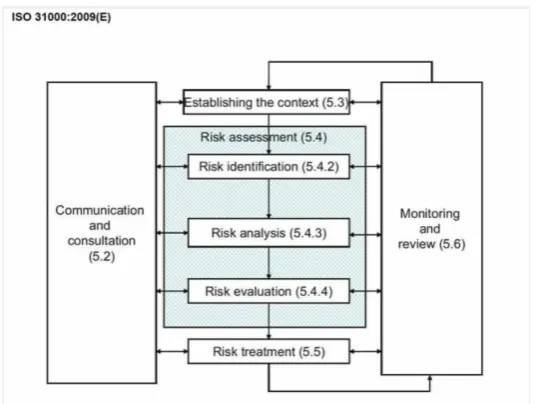
Figure 2.3 ISO 31000 Processes (adapted from BS ISO31000) ... 27
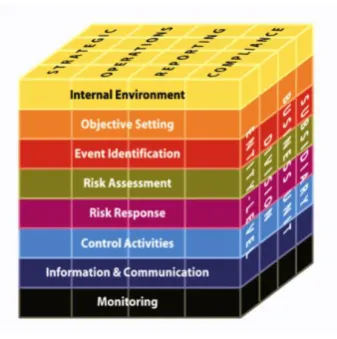
Figure 2.4 The COSO Cube for Risk Management (COSO, 2004) ... 30
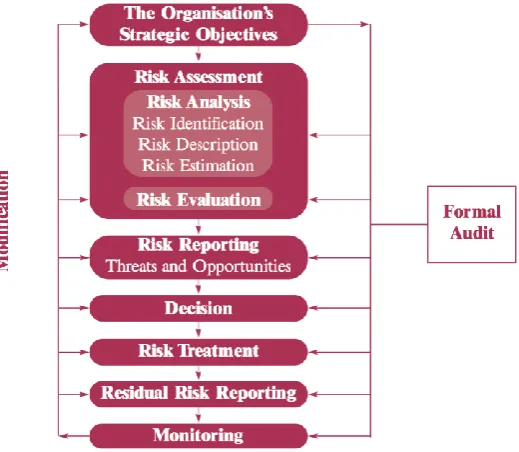
Figure 2.5 The Risk Management Process (AIRMIC, 2002:4) ... 32
Figure 2.6 Accepting Risk ... 61
Figure 2.7 Transfer Risk (Insurance) ... 64
Figure 2.8 Outsource Risk ... 66
Figure 2.9 Risk Avoidance ... 67
Figure 2.10 Probability Mitigation ... 69
Figure 2.11 Impact Mitigation ... 70
Figure 2.12 Combined Mitigation Strategies ... 70
Figure 2.13 Summary of Links in Risk Literature ... 74
Figure 2.14 Prospect Theory (Kahneman & Tversky, 1984) ... 76
Figure 2.15 Decisions Under Uncertainty Concept Links ... 77
Figure 2.16 Overview of Performance Systems ... 97
Figure 2.17 Integrated Performance Management System and Risk ... 115
Figure 2.18 Overview of Performance System Concepts ... 116
Figure 3.1 Path of Abductive Development ... 131
Figure 4.1 About Us Risk Types: Public Communication (adapted from Company Websites) ... 148
Figure 4.3 Hierarchy of risk (FCORP), developed from internal risk policy document (2009) ... 151
Figure 4.4 GRS Hierarchy of Risk, developed from internal risk management document (2010) ... 152
Figure 4.5 HSE (2011) Average Unit Costs for Injuries ... 152
Figure 4.6 Risk Reporting ... 159
viii
Figure 4.8 Firm-Level: Risk Management and Communication ... 160
Figure 5.1 ERS Risk Register ... 181
Figure 5.2 EAM Risk Register (embedded module) ... 182
Figure 5.3 Example Risk Matrix ... 188
Figure 6.1 Simplified Risk Management Decision Process ... 208
Figure 6.2 Operational Strategic Risks and Operational Failure Risks ... 209
Figure 6.3 Example Coding Matrix ... 218
Figure 6.4 Concept Saturation ... 222
Figure 6.5 Example Handwritten Causal Map ... 225
Figure 6.6 service M-suite Map ... 229
Figure 6.7 asset M-suite Map ... 230
Figure 6.8 service S-suite Map ... 231
Figure 6.9 asset S-suite Map ... 232
Figure 6.10 Nodes as Central Influence ... 234
Figure 6.11 Nodes as Central Outcome Affect ... 235
Figure 6.12 Decision Influences ... 247
Figure 6.13 Order of Decision Influences ... 248
Figure 6.14 Formative Influences ... 249
Figure 6.15 Shared Arcs between Groups ... 256
Figure 6.16 S-suite Core Model ... 257
Figure 6.17 Service Manager Belief Loop ... 261
Figure 6.18 Asset S-suite, Feedback Loop ... 264
Figure 6.19 M-suite Asset Manager, Feedback Loop... 265
Figure 6.20 Asset Manager Core Mental Model ... 266
Figure 7.1 Path of Research Development ... 270
Figure 7.2 Chapter 7 Research Pathway ... 272
Figure 8.1 Cause-Consequence in Basel Accord (2004) ... 305
Figure 8.2 Cause-Consequence in GRS asset ... 306
ix
Figure 8.4 Causal-Consequential Classification Reconciliation ... 308
Figure 8.5 Paths to Treatment ... 314
Figure 8.6 Changing Perspectives ... 317
Figure 8.7 Levels of Analysis Inter-Relations... 319
Figure 8.8 Performance Managing Risk ... 324
Figure 11.1 Raw Causal Map (Worked example) ... 374
Figure 11.2 Individual Map, Pre-aggregation (Worked example) ... 375
x
List of Tables
Table 2.1 Summary of Risk Management Standards ... 34
Table 2.2 Summary of Performance System Functions from Literature ... 99
Table 2.3 Summary of Risk Influences ... 119
Table 3.1 Abductive Phases of Research ... 130
Table 3.2 Levels of Analysis and Methods Employed ... 133
Table 4.1: Adopted approach to case study ... 139
Table 4.2 Summary of Case Organizations ... 143
Table 4.3 Firm-Level Data Collection ... 145
Table 4.4 Inductively Developed Thematic Categories at Firm Level ... 146
Table 4.5 Firm Level Risk Management Ideals ... 165
Table 4.6 Summary of Firm Level Analysis ... 167
Table 5.1 Summary of Case Organizations (Business Units) ... 173
Table 5.2 Function Level Data Collection: ... 177
Table 5.3 Inductively Developed Thematic Categories at Function Level ... 179
Table 5.5 Qualitative Impact Descriptors (ERS Risk Matrix, 2009) ... 189
Table 5.7 Qualitative Probability Descriptors (ERS Risk Matrix, 2009) ... 190
Table 5.8 Summary of Function-Level Analysis ... 199
Table 5.9 Function-level Calculative Cultures ... 201
Table 5.10: Summary of findings and questions from firm-level analysis... 203
Table 6.1 Group Level Analysis Respondents ... 216
Table 6.2 Node Descriptions ... 219
Table 6.3 Cognitive Map Summary Nodes and Arcs ... 228
Table 6.4 Map Complexity and Density Results ... 234
Table 6.5 Group Node Centrality Scores ... 235
Table 6.6 Group Node Summary ... 237
Table 6.7 Inductively Developed Thematic Categories (Group-Level) ... 238
Table 6.8 Treatment Authority, Cost and Permanence ... 242
xi
Table 6.10 Risk Treatments ... 252
Table 6.11 Summary of findings and questions from function-level ... 269
Table 7.1 Summary of Sensitivity Tests ... 276
Table 7.2 Respondents to Risk Sensitivity Survey ... 279
Table 7.3 Descriptive Statistics, Risk Sensitivity Survey ... 281
Table 7.4 Factors by Function ... 285
Table 7.5 Factors by Management Level ... 286
Table 7.6 Factors by Gender... 287
Table 7.7 Summary of Risk Sensitivities at four Frames of Reference ... 288
Table 7.8 Risk Treatments by 3-Levels of Analysis ... 289
Table 7.9 Summary of Treatment Usage by Levels of Analysis ... 289
Table 7.10 Summary of Risk Treatment Usage by Factor ... 291
Table 7.11 Node and Influence Summary... 293
Table 7.12 Paths to Treatment Summary ... 294
Table 8.1 Observed and desired influences at four levels of analysis ... 300
Table 8.2 Cause-Consequence Comparison ... 304
Table 8.3 Risk in Operations Treatments ... 312
Table 9.1 Thesis Contributions ... 337
Table 9.2 Contributions to practice ... 341
Table 11.2 Group-level Interview Prompts ... 370
xii
Acknowledgements
To,
Aileen Ritchie, who nurtured me, Sally Ritchie, who made me,
Lara and Toby Ritchie, who completed me, And not least, Geoff Ritchie, who I aspire to be.
Simple, yet heartfelt thanks to the many people that have brought me through this process.
My history of supervisors: Dr Jannis Angelis (who demonstrated belief in me during my
transition from industry), the late Professor Robert ‘Bob’ Johnston, Professor Nigel Slack
(who has always been an inspiration to my teaching), Dr Dawn Eubanks and not least Dr
Mark Johnson (a colleague and great friend, who has given more of his precious time than
was asked of him, and influenced me beyond my research and writing).
My colleagues at Warwick Business School, Operations Management group, who have
provided moral support, a friendly ear and advice (even when they did not know it): Emily
Jamieson, Dr Pietro Micheli, Dr Rhian Silvestro, Dr Nicola Burgess, Dr Nick Wake, Dr Mike
Shulver and Professor Duncan Shaw (who gave me valuable breathing space when needed).
Not forgetting those outside of the department, of whom Professor Neil Stewart was one.
My colleagues in industry, who offered their time, insight and introduction: Brian Tear,
Kieron Kennedy, Toby Edmonds and Phil Robinson.
Foremost my family, who in long suffering, have made this whole process accessible to me:
xiii
Declaration
This thesis is submitted to the University of Warwick in fulfilment of the requirements for
admission to the degree of Doctor of Philosophy. The work presented here is my own, and
xiv
Abstract
This research explores the management of risk in operations. It explores the different
structures influencing the treatment of risk and the influence on managerial risk taking
behaviours. There is limited understanding within the extant literature of the different
treatment strategies for risk in operations and what influences selection of treatment
strategy. This research employs an abductive approach iterating between the theoretical and
empirical. There are four levels of analysis: the firm, the function, the group and the
individual. The research was conducted in two European Energy companies. The research
found that there is a complex interaction between organizational structures and individual
perceptions in managing risk. Corporate risk structures have limited influence on the
selection of risk treatments. The specification of business function (service or asset focus)
informs the process of risk management and use of systems. Use of systems and valuation
techniques underpin the risk prioritization process and specifically the assessment of risk.
There is an order of decision influences that reflects the Levers of Control (Simons, 1995;
1998): Risk treatments are prohibited by boundary systems. Secondly, individual’s beliefs
influence positive selection of treatment, and third where a treatment has not been selected
through beliefs, the performance system is consulted. The performance system is most likely
to influence selection of risk acceptance or risk mitigation. It is found that classification of
risk has more than a semantic influence on perception and risk treatment; it can prohibit
uses of certain treatments and inform priority. Understanding of the decision process
matures and increases in complexity in senior managers. It is found that the performance
system has influences on manager’s beliefs and in the long term, reflecting vision and
xv
Abbreviations
BSC: Balanced Scorecard BSI: British Standards Institute CEO: Chief Executive Officer CFO: Chief Finance Officer
COSO: Committee of Sponsoring Organizations of the Treadway Commission CRO: Chief Risk Officer
DUU: Decisions Under Uncertainty EAM: Energy asset Management (FCORP) EFA: Exploratory Factor Analysis
EGEN: Energy Generation (GRS) ERM: Enterprise Risk Management ERS: Energy and Retail services (GRS) FCORP: French Corporation
FD: Finance Director
FRET: FCORP Retail (FCORP)
GRS: German Retail, asset and services ISO: International Standards Organization KPI: Key Performance Indicator
KRI: Key Risk Indicator
MCS: Management Control System MC: Map Centrality (see section 6.2.2)
MD: Map Density (see section 6.2.2)
NC: Node Centrality (see section 6.2.2)
PMS: Performance Management System PP: Performance Prism
1
Chapter 1
1. Introduction
This research is concerned with the management of risk in operations. Mikes identifies the
gap in understanding (2009:19) as:
What do risk managers do and what function and structural arrangements organize their activities? … How are control systems used by decision makers?
This research extends this understanding from an Operations Management standpoint.
1.1 Research Rationale
The idea for this research began as I worked as a general manager in an energy company. I
had operated across a number of functions, roles and variety of levels in management. As I
became more senior, and exposed to increasingly strategic considerations, it became
apparent that my management of resources in operations and through change was
underpinned by an overarching requirement to manage risk. For example, I was managing
my resources against a conflicting set of demands from different clients, trying to minimise
the potential for defaulting against well-established contracts, choosing a path that would
expose the operation to a minimal level of financial or reputational loss.
I found it difficult to reconcile the actions of my colleagues, who seemed to be taking risks,
where I felt constrained by the requirements on me from the firm. As I changed from retail
(sales and service), to asset (power generation) and finally to trading I sought reference
points to what was successful risk management. Understanding of this was poorly defined.
On seeking promising practice from practitioner and academic sources I found that risk
management was understood within the finance discipline, and less well defined in
operations management. Understanding from financial disciplines aligned to my role in
2 primary tool available to me in steering the operation was the company’s performance
management system.
The performance management system, and specifically the Balanced Scorecard, appeared as
a tool for aligning operational objectives with strategic requirements. But there was a gap in
understanding as to how a performance management system is used to manage risk, risk
taking or even the perception of risk. As my responsibility for employees increased from a
handful to a few hundred, and across multiple locations I became increasingly reliant on the
performance management system as a tool to direct the operation functions. The risks I was
managing were increasing in magnitude (i.e. value) and complexity (i.e. integration of risks).
With this increased responsibility, the aggregation of risks being reported and managed had
changed from transactional (cost-benefit) to complex priority and risk-bearing decisions.
My concerns were discussed with the company’s executive management team. It appeared
that I was not the only manager interested in developing an understanding on how to
manage risk through the organization with more precision. My enquiry led me to
understand a hidden process of risk management, driven by the corporate functions, laden
with reporting requirements and with limited operational engagement.
I returned to the executive team with a developed understanding of the process, but felt this
was still poorly understood. Risk management was becoming an increasingly important
discipline within the sector, and the complexity was increasing because of growing political
and public interest in the energy sector. The executive team felt that the practitioner
literature was limited and shallow in its understanding of risk management levers. That
understanding was based on a simplified and mechanistic process of data collection and
stakeholder management. They felt it missed the complexity of the energy sector’s
environment, where there are many different stakeholder demands and many different
types of risk being faced. The Chief Finance Officer (CFO) supported this concern, and
articulated the business imperative behind developing an improved understanding of
3
“I want to understand the mechanisms available to me to change our risk management process, whether we can operate like financial institutions in our assessment of risk, or whether we are fundamentally different. I wish to be able to desensitise certain aspects of our organisation and turn-on others.” CFO, UK Energy Company.
During early analysis, it was apparent that although trading activities existed as part of some
energy companies, the greatest complexities arose where organizations were reconciling the
different issues in pure risk (the risk of loss). There were issues in running parallel pure and
speculative risk (the potential for loss and gain) management processes. It was this
reconciliation that was not effective.
Looking beyond my company, it was apparent that energy companies showed an intent to
develop their risk management process, wishing to make this a function for competitive
advantage and not just a process ‘of hygiene’ (i.e. a task required of them by regulators and auditors). There was a common question, whether financial institutions should be a model
for risk management, and replicated in energy. This was a reflection on the Basel Accord
(2006; 2009), which defines banking supervision requirements through a set of voluntary
standards and risk classifications, therefore the question was asked:
“Should the energy sector adopt the classification defined by the Basel Accord as a suitable standard for their risk management process?” CFO, UK Energy Company.
Scanning the environment that was accessible to me, there seemed a large variety of
different performance systems in use; some were used to record performance and others to
direct activity and priority.
This is where the interest developed for developing a deeper understanding of the
performance management of risk in the energy sector. This research clearly has managerial
implications, but as the next section shows it has the potential to make a theoretical
4
1.2 Theoretical Background
Understanding of management of risk in operations is covered across several bodies of
work: Performance measurement (Bourne et al., 2000; Neely & Austin, 2002; Otley, 2008)
and performancemanagement (Franco-Santos et al., 2007 Neely, 2005; Otley, 1999), risk management (Chapman, 2006; Cohen & Kunreuther, 2007; Kleindorfer & Saad., 2005) and
behavioural science (Kahneman & Tversky, 1984; Pennington & Tuttle, 2007; Peterson & Beach, 1967; Tversky & Kahneman, 1992).
The performance measurement and management literature is well established. It has a long lineage both in Operations and Performance Management (e.g. Bourne et al., 2000;
Neely & Adams, 2002; Otley, 1999) and Management Accounting (Anthony, 1965; Mikes,
2011; Power, 2005; 2009). There is a difference in focus between the Operations
Management and Management Accounting communities. Management Accounting has been
developed with a financial focus (cf. Mikes, 2009). Operations Management has been more
holistic in its understanding, it has developed an interest in both the breadth of stakeholders
and the mapping of strategy into objectives (cf. Kaplan & Norton, 2008). Over the last
decade these two communities (i.e. performance management and measurement) have
converged on a discussion that is now harder to separate (cf. Otley, 1999).
The literature on control systems (Anthony, 1965), performance management systems
(Kaplan & Norton, 2008) and performance measurement systems (Bourne et al., 2000; Neely, 2005) overlaps (cf. Franco-Santos et al., 2007). It may appear to be a semantic issue
between the different terms management and measurement. However the literature does
clarify that the performance measurement system is a wholly encompassed aspect of the
performance management system (Otley, 2008). Reconciliation of these classifications is not
well defined with management control system literature, so leaves ambiguity in the
literature.
5 intertwined in a breadth of subjects. There are a number of approaches to describing this
body of work: community specific discussions of risk (i.e. the banking sector), discipline
based perspectives (e.g. supply chain, Cohen & Kunreuther, 2007), project management (Raz
& Michael, 2001), and theoretical discussions of risk (e.g. inherent and residual risks and the
meaning of probability, cf. Zwikael & Sadeh, 2007). There are research themes on different
aspects of the risk cycle (e.g. valuation techniques, Chapman, 2006). Finally, there are
defined risk management frameworks (e.g. Enterprise Risk Management) and risk
standards (e.g. Committee of Sponsoring Organizations of the Treadway Commission, 2004).
All of these bodies of work provide an understanding of risk and how it may be managed.
The literature on risk appears to be dominated by discussion of different classifications of
risk (cf. Power, 2005), and defining appropriate risk management cycles (COSO, 2004;
2004b). This again is more than a semantic issue (Power, 2005). Operational risk is a
description of risk from the Basel Accord (Basel Committee, 2005; 2006), and banking
sector explicitly. It is a risk originating from people, processes and systems (Basel
Committee, 2004). This is different to risk in operations (Lewis, 2003). Risk in operations is
broader in understanding; it includes a multiplicity of risk types (cf. Dey 2004), and a
description of risks occurring in the transformation process. However, understanding of
Operational risk is important in the body of risk literature. It is often confused as a term, and
used extensively by practitioners. It is well defined in its relationship with Credit and
Market risk and the associated valuation approaches. In practice there was confusion in the
term, as either a specific and technical classification or a more general catch-all term (Power, 2009).
Besides the sector-specific definitions of risk, there is a body of work discussing industrial
approaches to risk management. These are the risk standards or frameworks. Current
thinking is that risk management should be an iterative process (BSI, 2009; Chapman,
6 The best known of the risk management frameworks is ERM (Enterprise Risk Management).
ERM provides definitions, process and structure for managing risk (Beasley et al., 2010).
However it is understood that implementation is often imperfect. There are a number of
standards that pertain to an ERM approach; these have different focuses and definitions
embedded within each (e.g. COSO ERM).
Referring to practice, risk management effectiveness is viewed as a product of its decisions.
These decisions are discrete, with limited choices to be made, for example mitigation (cf.
Slack et al., 2010), risk transfer (Sharpe, 1997) and termination (Hopkin, 2012). This
simplicity is surprisingly limited in coverage as a complete discussion in extant literature.
There is empirical and theoretical discussion of risk treatments (i.e. outsource, Teng et al.,
1995), but this is conducted either as individual treatments or at an abstract level that has
limited insight into how these different choices are influenced.
The third body of work reviewed is from the behavioural sciences. This is a large body of
knowledge, which has many features and sub-topics. The sub-topic of interest is decisions under uncertainty. This literature (e.g. Kahneman & Tversky, 1984; Peterson & Beach, 1967; Pennington & Tuttle, 2007; Tversky & Kahneman, 1992) provides an explanation to many of
the human factors seen in risk management. Prospect Theory is highly cited and critically
reviewed, as a theory to understand the influence on risk decisions. Prospect theory
provides a link to many of the different concepts underpinning an understanding of
decisions (Kahneman & Tversky, 1984). They define the different decision-making
strategies that people use (Payne et al., 1988), how time pressure affects these decisions
(Pennington & Tuttle, 2007), and further how weighting (Wedell & Senter, 1997), bias (Hsee
& Hastie, 2006) and aversion (Wiseman & Gomez-Meija, 1998) can be of influence. This
knowledge provides an understanding that risk is a subjective phenomenon, which has
direct impact on the organization and the individual.
In bringing these different bodies of work together, four theoretical frameworks are
7
Levers of Control (Simons, 1994; 1995) and Principle Agent Theory (Eisenhardt, 1989). The rationale behind using these frameworks is explained in sections: 2.3.3, 2.3.4, 2.8.7 and
2.6.13.
So, although there are a few well-established frameworks and theories to understand the
management of risk, there is a gap in understanding as to how organizations and managers
control risk decisions. Risk treatments (e.g. mitigation), are the strategies organizations can
deploy (Hopkin, 2012). The influence of different controls, performance systems and
behaviour are not understood as to their effect on selecting these risk treatments. Is this a
matter of individual beliefs and frames of reference or is this a rational and consistent
process of treatment selection? Where there is an environment presenting a multiplicity of
risk types (e.g. safety and reputational risk), there is a lack of understanding as to the
different perspectives these risk types engender.
1.3 The Purpose of this Research
The purpose of this research is to understand the treatment strategies for risk in
operations and what influences selection of treatment strategy; therefore contributing to the knowledge of managing risk in operations. As this research is situated as a study in
operations, this research distinguishes between managing risk as the potential for risk and
reward, and risk as the management of loss, arising from operational activities (e.g. power
generation).
Inherent in these questions, the different levels of the firm need to be understood as to their
influence on risk management and evidence the inputs and outputs of the process. Each
level of the organization, starting at the firm (representing the central and corporate
perspective) provides an understanding of how the next level is being managed.
Performance system literature (e.g. Bourne et al., 2000) suggests that mature and integrated
approaches support an iterative development and check on strategy. The performance
system (or control system) can be understood as a mechanism to develop and communicate
8 energy sector) the use of performance systems are desired to be a framework that
disseminates these objectives and measures across a distributed (both technically and
geographically) organization. This research takes a top-down approach (in order of: firm,
function, managerial group and finally individual) to reflect one view of the performance
system.
The Business-Units (BU) report into the corporate functions, they are the next level of the
organization. These are semi-autonomous organizations delivering to a specific market,
often independent of other BUs. There are several cases available for comparison, but the
greatest polar examples are the retail functions (selling power and gas to the market) and
the generation functions (the production of Power).
It was observed during the design of the research that different management communities
existed within these functions, relating to levels of authority in the organization. These
communities have access to different types and degrees of resource (i.e. employees and
capital). There was a presumption that different management communities have different
levels of strategic and operational demands and therefore access to knowledge (cf. Yang et
al., 2009), this forms the third level of analysis: the group-level.
The most granular unit of analysis is the individual. The organization is made up of a
structured collection of individuals, each which bring with them different experience,
judgement and personal contingencies (e.g. risk aversion).
These four levels of analysis provide the structure of this research; each level informing the
next on how to operate and potentially how to manage risk. The research method also has to
reflect this evolution of the frame of reference; this is the use of the abductive approach.
1.4 Contribution of the Research
This research makes contribution to both theory and practice. The analysis found that
9 in the energy sector. Further, there were differences in the desired and observed influences,
for example ERM adoption was meant to influence the design of the risk management
process, whereas this influence was limited as it did not permeate into the BUs; where local
culture and market influences dominated. Academically there is ambiguity in the literature,
there is limited understanding of how different levels of the firm interplay.
It was found that the corporate functions focus on standards and communication. The
business units operate in specific disciplines, and define the system and micro-processes in
their organizations. In moving to a study of managerial groups, the focus becomes the
mental models existing within these communities. Finally, individuals reflect their own
beliefs, sensitivities to measures and personal experience in decision-making. This is clearly
a multi-level phenomenon.
The research extended understanding of Simons’ (1995) Levers of Control. It found the
levers have order of influence. Further, that managerial belief was affected by the
classification of risk. The research showed different decision models existed between senior
and middle managers. Fundamentally, the influence of function has great bearing on the risk
management process, risk perceptions and behaviours.
A framework identified for risk classification offers the practitioner a standardised
approach to integrate different risk types. Academically it exposes the challenges in
managing an environment which has a multiplicity of risk types.
For practice, this research responds to the question of what structures and influences are in
force to manage risk in operations, this is seen as a process of selecting risk treatments. This
research exposes the influences on the different paths to treatment selection; where each
treatment (or absence of) infers different levels of risk taking or aversion.
This research highlights a number of further research opportunities, which through
10 operations. From the results there are opportunities to extend this understanding into other
sectors that demonstrate similar multiplicity of risk types.
1.5 Research Structure
This research uses an abductive method. Abductive methods cycle between observations of
the environment and explanations. At each phase the research reviews the findings, leading
to a set of observations, which the next phase of research then seeks to develop. The
adoption of an abductive approach is an iterative approach to extend theory or offer new
theory. It is a cycle of theory matching, observation and suggestion (cf. Dubois & Gadde,
11
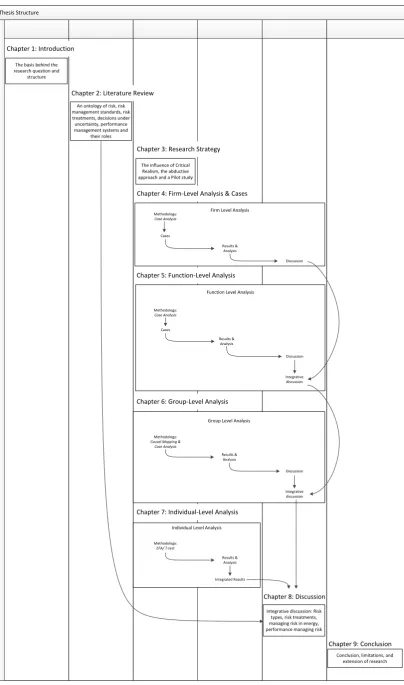
Figure 1.1 Research Structure
Chapter 8: Discussion
Thesis Structure
Introduction Literature Review Methodology/Method Results/ Analysis Discussion Conclusion
P
h
as
e
The basis behind the research question and
structure
An ontology of risk, risk management standards, risk treatments, decisions under uncertainty, performance management systems and
their roles
The influence of Critical Realism, the abductive approach and a Pilot study
Firm Level Analysis Methodology: Case Analysis Cases Results & Analysis Discussion
Function Level Analysis
Methodology: Case Analysis Cases Results & Analysis Discussion Integrative discussion
Group Level Analysis
Methodology:
Causal Mapping & Case Analysis Results & Analysis Discussion Integrative discussion
Individual Level Analysis
Methodology:
EFA/ T-test
Results & Analysis
Integrated Results
Integrative discussion: Risk types, risk treatments, managing risk in energy, performance managing risk
Conclusion, limitations, and extension of research
Chapter 1: Introduction
Chapter 2: Literature Review
Chapter 3: Research Strategy
Chapter 4: Firm-Level Analysis & Cases
Chapter 5: Function-Level Analysis
Chapter 6: Group-Level Analysis
Chapter 7: Individual-Level Analysis
12 Following the introduction, a literature review is presented (Chapter 2); this is broken into
three main sections: Risk, Decisions Under Uncertainty and Performance Systems.
Chapter 3 is the research strategy; it provides a structure and philosophical stance relevant
to the whole thesis.
Chapters 4 to 7 report the four levels of analysis. Each chapter contains a description and
justification of method. Next, results and analysis are presented, and finally a discussion
(first within the level, secondly between levels). The levels of analysis are as follows:
Chapter 4, Firm-level: Exploratory Case Study, thematically analysed;
Chapter 5, Function-level: Exploratory Case Study, thematically analysed;
Chapter 6, Group-level: Exploratory Case Study, thematically analysed and casually
mapped;
Chapter 7, Individual-level: Statistical Analysis of perceptions and risk treatment use.
Chapter 8 synthesises the different points of understanding and develops a new model of
cause-consequence, and extensions to the levers of control and treatment selection. It
concludes with a discussion of the impact to practice, and a sponsor summary (responding
to practitioner questions).
Chapter 9 is the conclusion, summarising the contributions to theory and practice,
13
Chapter 2
2. Foundational Literature
There are three main bodies of work reviewed in this chapter:
- Risk (including ontology of risk, risk management standards, risk in operations,
Operational risk and risk treatments);
- Decisions under Uncertainty; and
- Performance Systems.
The literature on risk spans many disciplines and its boundaries are imprecise. Risk is
discussed as a product of risk and reward in the finance community (Damodaran, 2002), as
a focus of control of imprecision in the accounting community (Zebda, 2011), as a source of
loss in Operations Management (Slack et al., 2010), Supply Chain (Kliendorfer et al., 2003)
and Project Management (Huchzermeier & Loch, 2001). In Performance Management
literature the focus is on risk as a strategic concern (Kaplan & Norton, 2008), as well as a
representation of the organization’s culture (Mikes, 2009; Power, 2005), it is seen as a
highly practical discipline with precise valuation methods (i.e. Value at Risk [VaR]) (Tang,
2006) but yet can be subjective in nature (Kapteyn & Teppa, 2002).
The management of risk is the main theme of this research. The first section covers the
academic perspective of risk: The Ontology of Risk (section 2.1). Next, practitioner risk management standards (section 2.2), and following, two main bodies of risk management
literature are reviewed:
a) The financial perspective of risk, this is a review of Operational risk (section 2.3).
Operational risk (Basel Committee, 2005; 2006) is the first point of reference both as a
14 b) Risk in operations and Supply chain risk (2.4), is reviewed as a rich body of risk
literature. Kleindorfer & Saad (2005) are a valuable point of reference in this domain.
The final risk section (section 2.5) covers risk treatments (e.g. Insurance). Each treatment is analysed in turn.
The second section (section 2.6) reviews a number of concepts from the psychology
literature and specifically Decisions Under Uncertainty. This is a broad field of work, it
begins with the understanding of Prospect Theory (Tversky & Kahneman, 1984). This
provides an entry point for discussion of a number of sub-themes in this literature: a)
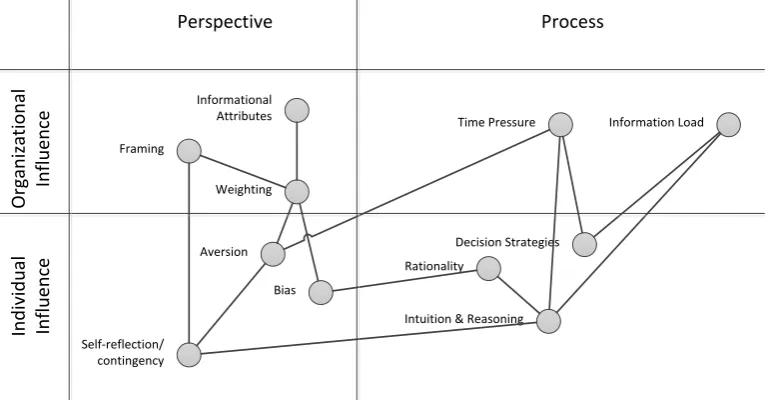
Intuition and reasoning, b) Framing, c) Decision strategies, d) Time pressure, e) Information
load, f) Rationality, g) Informational attributes, h) Weighting and i) Biases. These are chosen
in context of the relationship between the risk management and performance management
processes.
The third section (section 2.7), reviews the performance management literature. The
boundaries of the performance management and control system literature are better
defined than the risk literature. This is a field dominated by a number of clearly defined
approaches: The Balanced Scorecard (BSC) and the Performance Prism (i.e. “Contemporary
Performance Measurement Systems” Franco-Santos et al., 2012), and from the management
accounting literature, the discussion of Management Control Systems (MCS). To develop
beyond specific implementations (i.e. BSC), and in line with the philosophy adopted, the
performance system is deconstructed into a number of functions.
15
Figure 2.1 Overview of Bodies of Literature
2.1 Ontology of Risk
The term risk is derived from the classical Greek ρίζα, literally translated as root or more appropriately cliff or crag; originating as a nautical concept of ‘navigating among cliffs’. The meaning of risk is a potential for hazard or hazardous activity (Klein, 1967:1350). The normal or non-technical meaning in current usage infers possibility of loss (financial loss);
associated terms include “danger, gamble, chance, liability” (Simpson & Weiner, 1989:XIII 987). Association with terms chance,gamble and unfavourable contingency highlight the imprecise definition in common usage, and the conceptually mediated nature of the term.
When defining risk, the challenge is a comparison between competing paradigms (e.g. the
finance and operations communities). It is a search for a definition that overcomes
imprecision apparent in common usage (cf. Chapman & Cooper, 1983).
Ontology of Risk (De Finetti; 1970, Holton, 2004;
Knight, 1921)
Risk Management Standards (AIRMIC, 2002;
Basel, 2006; COSO, 2004)
Operational Risk (Basel, 2006)
Risk in Operations (Kleindorfer et al., 2005)
Risk Treatments
Ontology of Risk (De Finetti; 1970, Holton, 2004; Knight, 1921)
Risk Management Standards (AIRMIC, 2002; Basel, 2006; COSO, 2004)
Operational Risk (Basel, 2006) Risk in Operations (Kleindorfer et al., 2005) Risk Treatments
Performance Systems:
Balanced Scorecard (Kaplan & Norton, 2008)
Performance Prism (Neely & Adams, 2002)
Management Control Systems (Otley, 1999)
Performance Systems:
Balanced Scorecard (Kaplan & Norton, 2008) Performance Prism (Neely & Adams, 2002) Management Control Systems (Otley, 1999)
Decisions Under Uncertainty
Decision Strategies (Payne et al., 1988)
Biases, weighting & framing (Tversky &
Kahneman, 1981; Hsee & Hastie, 2006)
Prospect Theory (Kahneman & Tversky, 1981)
Decisions Under Uncertainty Decision Strategies (Payne et al., 1988) Biases, weighting & framing (Tversky & Kahneman, 1981; Hsee & Hastie, 2006) Prospect Theory (Kahneman & Tversky, 1981)
RISK
Performance
Management
Decisions Under
Uncertainty
Fischhoff (2009); Tversky & Kahneman (1981); Kahneman (2003); Slovic (1964)Mikes (2009); Power (2005); Simons (1995); Kaplan & Mikes (2012)
Chewning & Harrell (1990); Wedell & Senter
(1997)
Power (2009); Calandro & Lane (2006); Proctor et
16
When defining risk there are ontological disputes1, not apparent in common usage. The term
can be understood in either an objective or a subjective sense. The objective view exhibits a
positivist’s standpoint, as it assumes uniform access to knowledge and that quantitative
representation of risk is reality, regardless of individual context. The subjective view of risk
is aligned to a Realist or Constructivist philosophy, where risk is a socially mediated
construct, based on the perception of the individual.
Knight (1921:233) defines risk as “measureable uncertainty”. This differentiates the term from chance or luck. It is a definition cited in social sciences (e.g. Shane & Venkataraman,
2000), decision sciences (e.g. Slovic, 2000), and organisational behaviour (e.g. Teece et al.,
1994). Knight narrows his definition that uncertainty has two potential offspring:
measurable uncertainty and unmeasurable uncertainty. Measureable uncertainty is risk, the other uncertainty.
Risk defined as measureable uncertainty infers probability in the definition of risk, and whether measurability is considered as subjective or objective. Knight (1921) is able to
balance this dichotomy by viewing the two sources of measurability as a priori or statistical.
A priori is a calculation based on deductive reasoning, and statistical is based on past experience (to calculate the future). Although now dated, Knight’s view is still considered
“the principle source for our understanding of uncertainty” (Spender, 1998:240).
Knight (1921) suggests that an a priori approach is dominant in business almost to the point of exclusion of the statistical approach. It is a view disputed by financial and insurance
communities; because of their prolific use of statistical techniques, for example VaR (Allen &
Bali, 2007; Basu et al., 2011; Chavez-Demoulin et al., 2006; Jarrow & Yu, 2001; Palomba &
Riccetti, 2012; Santos et al., 2013; Tang, 2006). His concept may be best summarised
through his comment that “unmeasurability” is “unknowability”.
1The study of ontology is the study of what is being. Understanding whether objective probability exists is an issue in
17 Finite intelligence prevents absolute outcomes from being predicted (Knight, 1921). This
supports the subjective position, as intelligence is specific to the individual or group. Knight
therefore takes the view that measurability is subjective to the individual it concerns.
De Finetti (translation by Machi & Smith, 1970) emotively proposes a thesis that “Probability does not exist”; this is contradictory, that in calculating objective probability, an assumption of perfect knowledge forms the basis of facts from which to calculate risk. If knowledge were
perfect, it follows that there are no unknowns. Therefore there are no random events; every
action is to have a causal mechanism. It becomes our subjective understanding of them that
differs. Where all the nuances of events and triggers that affect outcome are understood,
objective probability becomes certainty, (e.g. a man jumping from a plane without a
parachute, Holton, 2004). Here, there is no risk, only certainty (of death). All the events and
triggers are understood to conclusion. To apply this across all potential situations requires
an extension of existing beliefs, and assumes that our understanding of the world and
society is complete. Knowledge of the world and society is incomplete, but “probabilities are subject to change as our information improves” (North, 1968:13). The value of De Finetti’s emotive proposition is an erosion of the term objective probability and moves to reinforce
subjective probability as the convincing interpretation. North (1968:13) supports this: “We must conclude that the probability assignment depends on our present state of knowledge”.
De Finetti’s and Knight’s perspectives are linked by Holton (2004). The definition of risk
requires exposure (Holton, 2004). Holton sees Knight’s separation of objective and subjective
probability less as a discussion of knowledge rather as the division between human beliefs
and whether probabilities can be real. Holton’s contribution is the consideration for
18 impact is owned. It seems difficult to reproduce a grammatically and logically valid
conversation that doesn’t establish exposure in risk. By the nature of language, risk is uncertainty of outcome to something or someone.
Risk is therefore comprised of uncertainty (Knight, 1921), subjective probability (Finetti,
1970) and ownership; what Holton (2004) describes as exposure. This provides a grounding
to review the specific and practitioner discussions of risk. In management science (e.g. Gan
et al., 2004) and psychology (e.g. Slovic, 2000) there is an assumption of these
considerations; although they are largely consistent with this understanding. The next
section changes perspective from a theoretical discussion of risk to practitioner descriptions
of risk, as loss or imprecision.
2.1.1 Risk as Loss or Imprecision
Having deconstructed the ontological description of risk, recent literature segments the
term risk, often within specific contexts. Different communities describe risks by different
terms, for example: financial loss (Basel Committee, 2006), reputational damage (Eccles et
al., 2007) and reward (Al-Binali, 1999). Although there is commonality between disciplines,
there is a difference between the financial definitions of risk as variability (the possibility and impact of inaccuracy or imprecision), and in operations as incident or accident (loss of
availability) (cf. Kaplan & Mikes, 2012). The difference between finance and operations
perspectives is discussed in section 2.3. Operation’s perspectives have greater focus on
negative outcomes (cf. Kaplan & Mikes, 2012), described as downside risk. But downside risk
is inseparable from opportunity for financial gain (Law, 2009:485). This infers that risk is
imperfection in output of an event. Thus both positive and negative outcome is included
within the term. Risk in finance, is more broadly situated as:
“The likelihood that we will receive a return on an investment that is different from the return we expected to make” (Damodaran, 2002:32)
19
“Variance from the mean” (March & Shapira, 1987)
The interpretation of risk as downside risk maps to Knight’s perspective of risk as probability of loss or unfavourable contingency. This is seen in examples from the
Operations Management and Supply Chain communities. For Harland et al. (2003:52), risk is
“a chance of danger, damage, loss, injury or any other undesired consequences.”, or as
“…probability of loss” (Gillet, 1997; Mitchell, 1995).
The difference between Knight’s unfavourable contingency and March and Shapira’s
variance from the mean, is the contention between distinct disciplines (i.e. the Financial and Strategic communities). Variance from the mean indicates the potential for impact as loss or
gain, and highlights probability.
These definitions support both upside and downside outcomes of risk. Banks (2004)
provides a language for these differences. Together upside and downside consequences are
termed speculative risk (Banks, 2004:4; Williams, 1966:577). Where only the negative
consequence (i.e. risk of loss) of an event is described, this is pure risk (Banks, 2004:4). Both of these definitions are largely undisputed. In an industrial context risk is considered more
of an issue of loss than of potential reward: “Risk today connotes less opportunity for gain and more possibility of loss. Risk is broadly thought of as involving a threat, hazard, danger or some form of harm” (Gephart et al., 2009:147).
Therefore risk may be a statement of imprecision resulting in loss (pure) or as loss or gain
(speculative). The next section reviews a description of the risk as pre-treatment (inherent)
or post-treatment (residual).
2.1.2 Residual and Inherent Risk
20 prior to treatment (Bettman, 1973). The relationship between the two terms is the
treatment being employed, and the reduction of perceived exposure to risk.
Inherent risk is described in a number of different communities but dominated by analysis
of auditor’s judgements, for example Bell et al. (2001) and Taylor (2000). Inherent risk is
not restricted to auditing and medical communities; it is used to understand activities such
as product and service design (Shariff & Leong, 2009). A definition of Inherent Risk is “the latent risk a product class holds for a consumer…” (Bettman, 1973:184). Removed from the context of marketing research, the definition of inherent risk may be better understood as:
The pre-treatment level of risk, (i.e. the latent risk that exists in an environment or process).
The valuation may be based on either qualitative or quantitative appraisal (Mikes, 2009;
2011).
Residual risk is the post-treatment level of risk, the relationship between inherent risk and
residual risk described as: “to reduce inherent risk to an acceptable level. In contrast business risk is by definition, a residual risk that, in principle, cannot be eliminated or reduced below a certain level.” (Bell et al., 2001:36). This definition assumes that treatment is effective and complete in its application. Figure 2.2 provides a visual representation of residual and
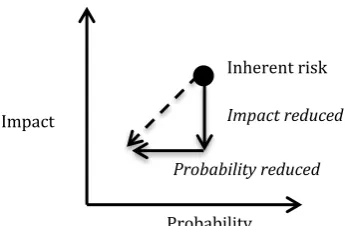
inherent risk as understood from these descriptions.
Figure 2.2 Relationship between Inherent and Residual Risk
Bettman’s (1973) and Bell et al.’s (2001) definitions of residual and inherent risks are
specific to an individual risk. They do not describe the relationship it has with the
Level of risk
InherentRisk (pre-treatment); risk
that exists in the system
ResidualRisk (post-treatment); risk
that cannot be eliminated Effect of risk treatment,
21 environment or the causal influence of the risk. A description of this relationship is
provided, as specific, systematic or systemic risk.
2.1.3 Defining the Relations of Risks
Specific, Systematic and Systemic are descriptions of the source of risk. It is unusual in the literature to see these different classifications discussed in parallel with the technical
classification. There is a focus on either the type of risk (e.g. financial risk) or a discussion of
the context (e.g. a systematic risk). These different relationships are irrespective of
speculative or pure definition. Instead they specify the inter-relationships of risks between organisational and industrial boundaries. Specific, systematic and systemic risk, are terms of process, organizational and market relationship.
Specific risk is a risk that affects an individual or individual company; its existence is
brought about though history, culture, and position. (cf. Kasperson et al. 1988:184).
Systematic risk is a risk that affects all players in the market; regardless of history,
culture, market position the risk exists in the marketplace itself (cf. Kaplan & Mikes,
2012; Pfohl et al., 2010).
Systemic risk (Ackermann et al., 2007; Kaplan et al., 2009), is “the risk or probability of
breakdown in an entire system” (Kaufman & Scott, 2003:371) a macroeconomic “chain-reaction or domino effect of sequential failures” (Bliss & Kaufman, 2006:59). These are large-scale breakdowns, caused by highly correlated exposures result in a domino effect
on the system (Elsinger et al., 2006). Systemic Operational Risk (Patrick, 2012) or
Operational risk as a cause of systemic risk (Andreas, 2010) is a more fundamental risk,
which may span multiple sectors and industries. Examples can be seen in the 2007/9
financial crisis, where banking failures led to realisation of risks within the insurance
sector. This ecology of risk, as a series of inter-related system failures is specifically
identified by the Basel accord (Basel Committee, 2006:s.49 xvi). Although with
hindsight, Basel’s omission to regulate against this risk category may attract significant
22 The definitions discussed in sections 2.1.2 and 2.1.3, show that beyond the description of
risk as variance from the mean, or in a practitioner focus the discussion of a cause or type (i.e. reputational risk), risk has a number of different relationships used to describe it:
Risk as a statement of untreated or treated state (inherent or residual);
Risk as a statement of relationship (specific, systematic or systemic).
These classifications are not mutually exclusive; therefore a risk in operations may be
described both in terms of its state (a residual risk) or the relationship it holds (a systematic
risk). These terms permeate into the language and expressions of risk within the
organizations and risk management standards; they have a specific meaning in their usage.
At a practitioner level, moving beyond the detailed classifications and descriptions of risk,
risk management standards are considered, providing a framework for risk management
and risk management activities. The risk management standards are a set of codified
approaches. Their development is driven by a desire to standardise approaches.
2.2 Risk Management Standards
This section of the literature review outlines what is meant by a risk management standard
and its purpose. It highlights that the standards are contextually benign and designed to be a
framework that may be applied across a variety of industries. There is a similarity of process
order advocated by the different standards; it provides a structure by which to understand
the risk management process.
A Risk Management Standard is understood to be a definition of the strategic process of risk management including setting of objectives, routines for identification, analysis and the
approach to treatment and control of risks (Federation of European Risk Management
Associations, 2013; Hopkin, 2004:57). Risk Management Standards provide consistency in
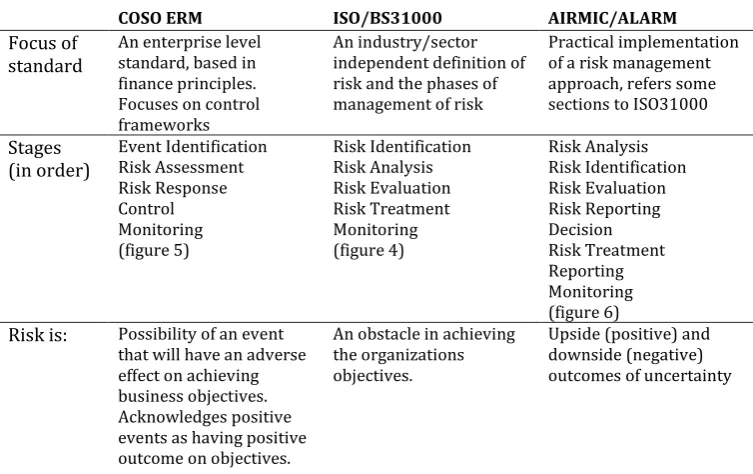
23 2002). There are six risk management standards occurring across sectors with regular
usage2:
a. A Risk Management Standard AIRMIC/ ALARM/ IRM (2002);
b. Australian/New Zealand Standard AS/NZS 4360 (2004);
c. Enterprise Risk Management Integrated Framework COSO (ERM COSO) (2004);
d. ISO31000 International Standard (2009);
e. BSI British Standard BS ISO31000 (2008, 2011);
f. Criteria of Control (CoCo), Canadian Institute of Chartered Accountants (1995).
There is an increasing number of sector specific standards being developed, e.g. NHSLA Risk
Management Standard (2013), this is the National Health services Litigation Authority Risk
Management Standards. There is no such standard identified in the Energy sector.
From the standards identified above, three are of importance in the context of this research:
1) BS31000 (British Standard 311000: 2011 as basis of analysis);
2) ERM Committee of Sponsoring Organisations of the Treadway Commission (COSO,
2004);
3) AIRMIC/ALARM/IRM, A Risk Management Standard (2002).
AIRMIC and BS310000 are standards known to be in use in the European Energy sector
(2009). Use of The Australian Standard (AS4360) could not be evidenced in the energy
sector (2009), probably because ISO31000 replaced AS4360 between 2003-2006. Prior to
this AS4360 was the most widely recognised approach to risk management (Hopkin,
2004:57). ISO31000 is an applied standard for certification of good practice, recognised by
the British government, and a trusted standard for specialist risk management practitioners
(Chapman, 2006).
2 Two pieces of legislation, not considered risk management standards, but understood to have an
24 COSO is supported by: the American Accounting Association (AAA), the American Institute
of Certified Public Accountants (AICPA), Institute of Management Accountants (IMA), the
Institute of Internal Auditors (IIA) and Financial Executives International (FEI).
Organizations in the energy sector, e.g. Électricité de France (2009) could be found that
explicitly used this standard.
The energy companies refer internally to their use of Enterprise Risk Management (ERM) as
a methodology for risk management, for example RWE (2009) and E.ON (2009). In their
definitions it was not clear whether ERM was an adoption of a prescribed standard or a
philosophy toward risk management. However, Chapman (2006) describes ERM as:
“a systematic process embedded in a company’s system of internal control
(spanning all business activity), to satisfy policies effected by its board of directors, aimed at fulfilling its business objectives and safeguarding both the shareholder’s investment and the company’s assets… this process is to manage and effectively control risk appropriately.” (Chapman, 2006:8).
It is found that ERM approaches are embedded within a number of different standards (e.g.
COSO). Instead of ERM specifying a precise process, it indicates an approach toward risk
management, a move from silo to integrated approach (Chapman, 2006). It is understood
that ERM is an overlapping term or even a risk management methodology; sometimes used
in conjunction with COSO (i.e. COSO ERM).
Chapman’s (2006) description is arguably a description aimed at the private sector
and with an Anglo-American influence (because shareholders, not stakeholders are
represented). However it is a description highlighting the integrated and strategic
nature of ERM. ERM adoption is driven by a desire to manage risk more holistically
(Liebenberg & Hoyt, 2003), and is associated with internal control and audit. Both
COSO and the British Standard refer to the practice of ERM:
25
directors, management and other personnel, applied in strategy setting and across the enterprise, designed to identify potential events that may affect the entity, and manage risk to be within its risk appetite, to provide reasonable assurance regarding the achievement of entity objectives.” (COSO, 2004b:2)
“Risk management is not a stand-alone activity that is separate from the main activities and processes of the organization. Risk management is part of the responsibilities of management and an integral part of all organizational processes, including strategic planning and all project and change management processes.” (British Standards Institution, 2009:4)
ERM is therefore an integrated risk management framework; it expands the focus of risk
management from traditional risk practices (i.e. financial) towards a breadth of risks
(O’Donnell, 2005). It is a standardised process, usually managed from a central team within
the organization. ERM adoption promises mistakes of the past will be mitigated (Power,
2009), and that all risks are owned (Nocco & Stulz, 2006). The appointment of Chief Risk
Officers (CRO) is closely associated to the development of an ERM approach (Kaplan et al.,
2009). A CRO is required to communicate the management of risks to external stakeholders
(Liebenberg & Hoyt, 2003). Appointment of a CRO is just one of a number of requirements of
an ERM implementation. This journey of implementation may be lengthy (Beasley et al.,
2010). Beasley et al. (2010) suggest that an organization’s adoption of ERM will be a
progressive journey, and that both a decision to implement and the implementation itself
are as much concerns for practice as the theoretical basis of holistic risk management, and
the classification of risk itself.
In direct contrast to the earlier ontological discussion, the review of risk management
standards reflects the practical nature of risk management: What is the terminology being
promoted? What components form the prescribed standard? What is the overall objective of
the standard? Three of these different standards (the three most commonly observed