warwick.ac.uk/lib-publications
Original citation:Allen, David G., Pelkotorpi, V. and Rubenstein, A. L.. (2016) When “embedded” means “stuck” : moderating effects of job embeddedness in adverse work environments. Journal of Applied Psychology, 101 (12). pp. 1670-1686.
Permanent WRAP URL:
http://wrap.warwick.ac.uk/80094 Copyright and reuse:
The Warwick Research Archive Portal (WRAP) makes this work by researchers of the University of Warwick available open access under the following conditions. Copyright © and all moral rights to the version of the paper presented here belong to the individual author(s) and/or other copyright owners. To the extent reasonable and practicable the material made available in WRAP has been checked for eligibility before being made available.
Copies of full items can be used for personal research or study, educational, or not-for-profit purposes without prior permission or charge. Provided that the authors, title and full
bibliographic details are credited, a hyperlink and/or URL is given for the original metadata page and the content is not changed in any way.
Publisher’s statement:
© 2017, American Psychological Association. This paper is not the copy of record and may not exactly replicate the final, authoritative version of the article. Please do not copy or cite without authors permission. The final article will be available, upon publication, via its DOI: http://dx.doi.org/10.1037/apl0000134
A note on versions:
The version presented here may differ from the published version or, version of record, if you wish to cite this item you are advised to consult the publisher’s version. Please see the ‘permanent WRAP URL’ above for details on accessing the published version and note that access may require a subscription.
When “Embedded” Means “Stuck”: Moderating Effects of Job Embeddedness in Adverse
Work Environments
MANUSCRIPT ACCEPTED FOR PUBLICATION AND IN PRESS AT JOURNAL OF APPLIED
PSYCHOLOGY; PLEASE DO NOT CITE, QUOTE, OR USE WITHOUT PERMISSION
David G. Allen*
School of Management & Labor Relations Rutgers University
&
Warwick Business School Piscataway, NJ 08854 [email protected]
848.445.1350
Vesa Peltokorpi* Saitama University Saitama Prefecture, Japan
Alex L. Rubenstein*
Fogelman College of Business & Economics University of Memphis
Memphis, TN 38152 [email protected]
Running Head: ADVERSE EFFECTS OF JOB EMBEDDEDNESS
When “Embedded” Means “Stuck”: Moderating Effects of Job Embeddedness in Adverse
Work Environments
MANUSCRIPT ACCEPTED FOR PUBLICATION AND IN PRESS AT JOURNAL OF APPLIED
Abstract
Job embeddedness is predominately assumed to benefit employees, work groups, and
organizations (e.g., higher performance, social cohesion, and lower voluntary turnover).
Challenging this assumption, we examined the potentially negative outcomes that may occur if
employees are embedded in an adverse work environment - feeling “stuck”, yet unable to exit a
negative situation. More specifically, we considered two factors representing adverse work
conditions: abusive supervision and job insecurity. Drawing from conservation-of-resources
theory, we hypothesized that job embeddedness would moderate the relationship between these
conditions and outcomes of voluntary turnover, physical health, emotional exhaustion, and sleep
quality/quantity, such that employees embedded in more adverse environments would be less
likely to quit, but would experience more negative personal outcomes. Results from two
independent samples, one in Japan (N=597) and one in the United States (N=283), provide
support for the hypothesized pattern of interaction effects, thereby highlighting a largely
neglected “dark side” of job embeddedness.
Keywords: Job embeddedness; abusive supervision; physical health symptoms; employee
When “Embedded” Means “Stuck”: Moderating Effects of Job Embeddedness in Adverse
Work Environments
“I ain’t gonna quit!”
Richard Gere as Ensign Mayo (An Officer and a Gentleman)
In a pivotal scene in the movie An Officer and a Gentleman (Paramount Pictures, 1982),
Ensign Zack Mayo is repeatedly abused by his supervisor, drill instructor Gunnery Sergeant Emil
Foley. Foley forces Mayo to perform excessive physical exercise, coupled with various forms of
verbal harassment (e.g., berating Mayo’s character; insulting Mayo’s father) and distress (e.g.,
push-ups face down into a mud puddle; calisthenics while being struck in the face by a stream
from a water hose), ultimately screaming at Mayo that he should give up and quit. However,
Mayo refuses to quit. He has made significant investments and built meaningful relationships
that would be sacrificed if he left, and believes he has little choice but to endure the abuse.
While an extreme example of abusive supervision, this scene illustrates a unique
perspective as to the joint nature of unfavorable work conditions along with being “stuck” or “embedded” in a particular context. We know that employees regularly experience work
conditions that, while not as extreme as those facing Ensign Mayo, include abusive supervision,
bullying, threats, harassment, job insecurity, and other forms of distress (e.g., Duffy, Ganster, &
Pagon, 2002; Martinko, Harvey, Brees, & Mackey, 2013). Although aversive work conditions
such as abusive supervision are related to outcomes such as withdrawal, many employees who
experience such difficulties choose to stay rather than leave their jobs. We suggest this is at least
partially attributable to employee job embeddedness, defined as “the combined forces that keep a
embeddedness has gained increased attention as a means to understand employee stay or leave
decisions (Lee, Burch, & Mitchell, 2014). A sizable body of research has accumulated, relating
embedding forces to numerous important individual, group, and organizational outcomes, most
notably generally favorable criteria such as lower voluntary turnover (Mitchell, Holtom, Lee,
Sablynski, & Erez, 2001), greater in- and extra-role performance (Lee, Mitchell, Sablynski,
Burton, & Holtom, 2004), and improved attitudes (Jiang, Liu, McKay, Lee, & Mitchell, 2012).
There is also evidence that being embedded can buffer the effects of negative workplace shocks
on task and citizenship behaviors (Burton, Holtom, Sablynski, Mitchell, & Lee, 2010) and job
search (Holtom, Burton, and Crossley, 2012).
At first blush, these empirical findings suggest that greater embeddedness is something
that organizations should strategically encourage (Hom, Tsui, Lee, Ping, Wu, & Zhang, 2009;
Mitchell et al., 2001), and perhaps even something employees would themselves seek to
cultivate. However, though being embedded may have buffering effects that prevent negative
workplace events from evolving into quitting behavior, being stuck in an unfavorable work
environment could also have potentially negative consequences for employees. Even though
unfavorable conditions such as abusive supervision may be associated with thoughts of leaving,
many employees who experience such negative conditions do not quit. One reason for this may
be, in contemporary turnover parlance, that some employees are so embedded that they will not
or cannot leave, despite adverse work experiences or treatment (Mitchell et al., 2001).
By definition, being embedded describes a certain degree of “stuckness” or “inertia” - a
sense of feeling enmeshed in “a net or a web” from which it is difficult for one to separate
(Mitchell et al., 2001, p. 1104). We think the “stuckness” aspect of embeddedness has been
toxic social environment, like Ensign Mayo? What if an employee’s skills are a perfect match to
the idiosyncratic practices of a company, but s/he experiences constant fear of being laid off?
What if an employee would like to leave for a better career opportunity, but certain sacrifices
s/he would give up (e.g., retirement benefits vesting, a convenient commute, interesting projects,
on-site job amenities) constrain such action? Notably, Lee et al. reflected in their review of a
decade of embeddedness research, there remains a “need to better understand the potentially bad
things stemming from job embeddedness” (2014, p. 209).
We extend theory by emphasizing the “dark side” of job embeddedness and its
potentially negative outcomes. Other scholars have begun to raise similar concerns. For example,
Holtom et al. (2012) mentioned a possible dark side whereby being disgruntled but stuck could
lead to reduced performance or increased deviance. Hom, Mitchell, Lee, and Griffeth (2012) also
considered the potentially dysfunctional ramifications for organizations of “reluctant stayers”
(i.e., individuals who desire to leave an organization but cannot). Ng and Feldman (2012) found
positive relationships between embeddedness and work-to-family and family-to-work conflict,
while Tepper (2000) showed that employees subject to abusive supervision but with few
perceived job alternatives (a separate but related concept to job embeddedness; Mitchell et al.,
[2001]) were more likely to experience depressive symptoms and were less satisfied. At the same
time, meta-analytic findings suggest employees exposed to hostile workplaces (e.g., unfair
treatment, high job insecurity) are more likely to experience deteriorated physical and mental
health, and even higher mortality rates (Goh, Pfeffer, & Zenios, 2016). We expect that these two
qualities in combination - high embeddedness, along with an adverse work environment -
interact to produce especially potent negative outcomes for employees, because they cannot
We explore this phenomenon in two studies. In Study 1, we use an employee sample
from Japan to test whether increased embeddedness reduces the likelihood that aversive work
conditions (in terms of abusive supervision) translate into voluntary turnover, while also
examining whether the interaction between a negative work environment and embeddedness
predicts negative physical health symptoms. In Study 2, we use an employee sample from the
United States to test how embeddedness interacts with a broader set of adverse work conditions
(abusive supervision, job insecurity) to affect other negative outcomes (emotional exhaustion,
sleep quantity/quality). With two independent samples, we seek to replicate an interaction pattern
by which embeddedness exacerbates relationships between aversive environments and individual
outcomes, and show that such effects operate in different cultural contexts.
We contribute to theory by challenging the predominant assumption that greater job
embeddedness is altogether advantageous. We hope to shift the current consensus by showing
when and how embeddedness can have a “dark side” if employees are faced with aversive work
conditions but feel stuck. We expand the nomological network of job embeddedness by
emphasizing its role as a moderator and testing under-explored consequences, such as physical
health symptoms, emotional exhaustion, and sleep quantity/quality. We also contribute to recent
theorizing extending the rationale for how and why embeddedness motivates and constrains
behavior by emphasizing resource conservation (Kiazad, Holtom, Hom, & Newman, 2015). That
is, embeddedness can help explain why employees remain in the face of abuse and other aversive
conditions, because they strive to retain and protect valued resources. We also contribute to
theory by demonstrating the role of embeddedness in Eastern as well as Western cultures, an
organizational attachment and how embeddedness operates across cultures (Jiang et al., 2012;
Peltokorpi, Allen, & Froese, 2015; Ramesh & Gelfand, 2010).
Job Embeddedness
Traditional turnover theories (e.g., March & Simon, 1958; Mobley, 1977) maintain that
voluntary turnover is more likely if employees are dissatisfied or otherwise unhappy in their
jobs, and believe they can obtain attractive alternatives elsewhere. These theories predominately
focus on affectively-charged reasons for quitting, such as low job satisfaction or organizational
commitment, and unfair treatment (Holtom, Mitchell, Lee, & Eberly, 2008). Disappointed by the
relatively low predictive power of such models, Mitchell et al. (2001) proposed a shift in
turnover theorizing away from why employees leave and toward better understanding why they
stay (Zhang, Fried, & Griffeth, 2012).
Since the introduction of the job embeddedness concept (Mitchell et al., 2001), scholars
have reconsidered the nature of voluntary turnover - the “voluntary cessation of membership in
an organization by an individual who receives monetary compensation for participation in that
organization” (Hom & Griffeth, 1995, p. 5), finding that the reasons why people stay at a job are
often wholly different than the reasons why people leave. That is, the reasons for leaving are not merely the opposite as those for staying, but involve a separate set of “push” or “pull” factors
(Lee & Mitchell, 1994; Mitchell & Lee, 2001). Many of these reasons have little to do with affect or attitudes, but reside in individuals’ idiosyncratic attachments to their surroundings. The
concept of job embeddedness is grounded in field theory (Lewin, 1951) and research on
embedded figures (Mitchell & Lee, 2001): embeddedness exists as a compilation of forces
enmeshing individuals into a psychological field or life space summarizing a variety of
constrain) decision-making. In a similar way, embedded figures are immersed in their
background, attached or linked in various ways with their surroundings.
Job embeddedness consists of three on- and off-the-job dimensions: links, fit, and
sacrifice, which operate as causal indicators of one’s aggregate level of embeddedness (Mitchell
et al., 2001). Links refer to one’s formal or informal ties to institutions or other people (e.g., coworkers on one’s work team; relatives or social groups in one’s community). Fit refers to
one’s perceived compatibility with their work and community (e.g., believing one’s values,
skills, and preferences match with what an organization requires or with what their community
offers). Sacrifice refers to the perceived psychological, social, or material costs of leaving one’s
organization and/or community (e.g., compensation, benefits, and other perks; positive
community qualities, such as neighborhood safety). To the degree one experiences greater levels
of any or all of these dimensions, the further s/he becomes embedded in an environmental field,
and subsequently, the stronger are the forces which restrain movement out (Mitchell et al., 2001).
We focus on on-the-job, or organizational embeddedness, rather than off-the-job, or
community embeddedness, because we are interested to understand what happens when an
employee is “stuck” in a negative work environment. Further, since research shows that
on-the-job embeddedness plays a larger role in on-the-job withdrawal attitudes and decisions than does
off-the-job embeddedness (Allen, 2006; Jiang et al., 2012), we believe that organizational embeddedness
better captures the effects of adverse work conditions (Zhang et al., 2012). Of course, it is
possible that community embeddedness could also restrain leaving in the face of abusive
supervision, a point we return to in the Discussion section. In line with previous research (e.g.,
“organizational embeddedness” synonymously in this paper, because most employees who are
embedded in their jobs are also embedded in their organizations (Ng & Feldman, 2010).
Our intention is to shift the consensus in the embeddedness literature away from its
positive pole towards its negative pole (Hollenbeck, 2008). We seek to accomplish this by
exploring conditions under which embeddedness has detrimental effects on employees. Since the
introduction of the job embeddedness concept, the theoretical deck has largely been stacked in
favor of its beneficial effects, focusing mainly on its relationship to decreased turnover, as well
as increased citizenship behaviors and in-role performance (Lee et al., 2004). However, while
ostensibly imbued with positive qualities (e.g., more links, higher fit), job embeddedness at its
core is substantively a non-affective construct – a contextual characteristic that carries no
inherent positive or negative valence (Mitchell et al., 2001; Johns, 2006). For example, Mitchell
et al.’s (2001) original job embeddedness measure focuses on links only in terms of quantity
(e.g., “How many coworkers are highly dependent on you?”), rather than quality (Zhang et al.,
2012). In a similar manner, Crossley, Bennett, Jex, and Burnfield’s (2007) global embeddedness
measure focuses on degree of attachment or ties to an organization, but makes no distinction as
to whether one is embedded in a desirable or undesirable environment. The essential point is that
being embedded is inherently neither good nor bad; however, the characteristics of one’s work
environment can make it so. Our focus is to examine what happens when employees are
embedded in an adverse work environment.
Our perspective is related to but distinct from at least two other research streams. One is a
growing literature considering possible downsides of being embedded or stuck. Holtom et al.
(2012) raised the possibility that embeddedness could have a dark side in that disgruntled but
behaviors. Hom et al. (2012), in turn, described reluctant stayers as individuals who prefer to
leave their organization but cannot, and trapped reluctant stayers as individuals whose mobility is
constrained by normative influences or sacrifices that would be lost upon exit. Hom et al. (2012)
offer a range of expected dysfunctional organizational outcomes associated with feeling trapped,
such as absence, lateness, deviance, and low performance. Individuals experiencing adverse
work conditions who are nevertheless embedded may be an interesting example of trapped
reluctant stayers, a group whom Hom et al. (2012) suggest have eluded scholarship to this point.
However, these perspectives on the dark side of being stuck focus on outcomes largely of direct
interest to organizations, whereas our focus is more directly on employee well-being.
The other related stream is commitment research, particularly the idea that continuance
and normative commitment can sometimes be dysfunctional, due to similar feelings of being
stuck. Mitchell et al. (2001) acknowledged that the sacrifice element of embeddedness is similar
to continuance commitment, while links sometimes connote normative obligations. However,
they take pains to differentiate embeddedness conceptually and empirically from commitment.
Perhaps more relevant to our arguments is research on commitment configurations or profiles.
This work suggests that configurations of affective, normative, and continuance commitment
create commitment profiles that predict outcomes (Meyer & Herscovitch, 2001). For example,
Sinclair, Tucker, Cullen, and Wright (2005) called employees with profiles of strong continuance and weak affective commitment “trapped”. Wasti (2005) found that a continuance commitment
dominant cluster (i.e., with average affective and normative, but high continuance commitment)
reported higher stress, while in another sample the continuance commitment dominant cluster as
well as a normative-continuance dominant cluster (with low affective, but average or higher
analogous in that we imagine an employee stuck in aversive work conditions may be likely to
experience lower affective commitment (because of the abuse), but higher continuance (because
of embedding sacrifices) and normative (because of links) commitment. However, Hom et al.
(2012) make a key distinction between these continuance commitment dominant profiles and
reluctant stayers: although both feel stuck, the former are theoretically agnostic about wanting to
leave, while the latter by definition prefer to leave. In our case, we focus on aversive conditions,
such as abusive supervision, that would presumably drive a desire to exit the situation.
Study 1
In Study 1, we focus on the role of abusive supervision as a negative work condition that
interacts with job embeddedness to predict voluntary turnover and physical health symptoms.
Abusive supervision is defined as “subordinates’ perceptions of the extent to which supervisors
engage in the sustained display of hostile verbal and nonverbal behaviors, excluding physical contact” (Tepper, 2000, p. 178). Behavioral descriptors consistent with this definition include
disparaging language, public ridicule, threats, intimidation tactics, breaking promises, employing
the “silent treatment”, and purposely withholding needed information (Tepper, 2000). Previous
research suggests that employees report supervisors as the most frequent source of negative
treatment at work (Mitchell & Ambrose, 2007). However, limited research has been devoted to
understanding leadership antecedents of subordinate voluntary turnover and physical health
(Kelloway & Barling, 2010; Rubenstein, Eberly, Lee, & Mitchell, 2015). This is unfortunate,
because immediate superiors are not only proximal environmental cues, but also have a large
impact on working conditions.
In line with Tepper (2000, 2007), we expect that abusive supervision can drive
cues for appropriate behavior (Tett & Burnett, 2003) - abusive treatment is a clear violation of
these rules (Bies & Moag, 1986). At the same time, we think job embeddedness theory may
explain why many employees nevertheless choose to remain in such toxic relationships:
embeddedness may temper positive abusive supervision-voluntary turnover relationships. This
can occur because the inertial forces of numerous links, strong fit, and/or large sacrifices exert
significant pressures to restrain leaving. That is, in contrast to abuse as a “push-to-leave” force,
embeddedness counteracts this as an opposing “pull-to-stay” force. Holtom et al. (2012) began to
address this phenomenon by showing that embeddedness makes job search less likely even in the
face of negative shocks (of which abusive supervision could be one example). To better elucidate
how embeddedness may restrain mobility even when exposed to adverse work conditions such as
abusive supervision, we invoke conservation of resources (COR; Hobfoll, 1989) theory.
The central tenet of COR theory is that individuals strive to retain, protect, and build
resources they value. A loss of resources, or a threat of such loss, produces stronger emotional
reactions than does resource gain – a principle termed the “primacy of resource loss” (Hobfoll,
1989). In an integrative review applying COR and job embeddedness theories, Kiazad et al.
(2015) argued that job embeddedness is negatively related to voluntary turnover because
embedded employees have more resources and that they are motivated to “retain resources that
hold intrinsic (sacrifices) or instrumental (fit and links) value, as resource loss is distressing” (p.
642). As such, when employees have valued resources - when they are more embedded - they are
motivated to protect those resources, which could include tolerating adverse work conditions.
For example, employees who have acquired particular skillsets for their organizations (i.e., high
fit) may bear with abusive treatment if they believe it will be difficult to find alternative jobs
investments accrued over time, as these increase, individuals will become increasingly protective
over them, because they were difficult to obtain (Hobfoll, 2002; Kiazad et al., 2015).
Thus, we hypothesize that abusive supervision leads to increased voluntary turnover
when employees are less embedded (i.e., when they have fewer potential resource losses), but
that increased embeddedness weakens the abusive treatment-voluntary turnover relationship, as
concerns about potential resource losses override interpersonal discomfort (Mitchell & Lee,
2001; Trevor & Nyberg, 2008; Burton et al., 2010; Kiazad et al., 2015).
Hypothesis 1: Job embeddedness moderates the positive relationship between abusive
supervision and subordinates’ voluntary turnover, such that the relationship will be weaker (i.e., less positive) when employees are more embedded.
Although more embedded employees are less likely to quit in the face of abusive
supervision, we expect they might be adversely affected by being stuck and enduring such
treatment. We focus here on impaired employee physical health. In previous research, abusive
supervision (Bowling & Michel, 2011) and supervisor undermining (Duffy et al., 2002) have
been linked to employee health symptoms. COR theory emphasizes that the threat of resource
loss can be accompanied by impaired psychological and physical well-being (Hobfoll, 2002).
However, research to date has not considered that employees’ embeddedness could exacerbate
such symptoms to the degree that subordinates have to submit to abusive supervisory treatment
rather than terminate the employment relationship.
When coupled with higher job embeddedness, we propose that abusive supervision may
have deleterious effects for subordinates. As theory suggests, at higher levels of embeddedness,
employees tend to possess greater work resources, and subsequently, they are more motivated to
retain those resources by staying (Kiazad et al., 2015; Mitchell et al., 2001). However, despite
abusive supervisor - threatens one’s well-being, health, and may lead to other negative personal
outcomes (Tepper, 2007). Whereas many individuals will, over time, distance themselves from
such abusive treatment to avoid future unpleasant exchanges (Hess, 2000; Tepper & Lockhart,
2005), high embeddedness renders this option less feasible. Here, employees wrestle with the
simultaneous forces of being abused and pushed to leave, yet being highly embedded, wanting to
preserve held resources, and thereby feeling pulled to stay. For abused subordinates, we expect
this position of being mistreated and having difficulty terminating the relationship to coincide
with feelings of helplessness and lack of control, which can be damaging to one’s health (Duffy
et al., 2002; Henry, 2005). Thus, we hypothesize that abusive supervision will be positively
related to subordinate physical health symptoms, and that this relationship will be exacerbated
for employees reporting higher levels of embeddedness.
Hypothesis 2: Job embeddedness moderates the positive relationship between abusive supervision and subordinates’ physical health symptoms, such that the relationship will be stronger (i.e., more positive) when employees are more embedded.
Study 1 Method
Sample and Procedure
Data were collected by a Japanese research company through online surveys in the
greater Tokyo region at three time points. We collected data through a research company
because they help to access a diverse sample of respondents and to prescreen potential
respondents on a variety of characteristics (Ng & Feldman, 2013). In Japan, collecting data and
accessing a diverse sample without a research company is challenging without personal contacts
(Takeuchi, Lepak, Wang, & Takeuchi, 2007). Another important advantage in this study is that,
unlike cases where researchers make entry through senior management, participants were made
Data were collected from full-time employees with three surveys over a 12-month period.
We used a three-wave design to mitigate concerns about common method variance (Podsakoff,
Mackenzie, Lee, & Podsakoff, 2003). Participants were not aware the three surveys were related.
Participation was voluntary and respondents received small incentives (on-line shopping points)
for participation. At Time 1, 799 employees participated. The research company informed us the
response rate was 91%. At Time 1, we measured independent and control variables. At Time 2,
three months later, another survey was sent to respondents who participated at Time 1. Among
those respondents, 719 completed the survey (90% response rate). At Time 2, we measured the
moderator. At Time 3, 12 months after Time 1, we invited the same respondents to participate in
another survey. We received 643 surveys, of which 597 were usable, representing a response rate
of 89% in the final sample. At Time 3, we measured dependent variables.
The average age of respondents was 41.85 years (SD = 9.42), 72% were male, and 52%
were married. Average tenure in the organization was 11.25 years (SD = 9.25). The average size
of organizations in which respondents worked was 600 employees (SD = 15720). Categorized in
line with Ono (2007), the respondents worked in the following industry areas: manufacturing
(36.8%), services (22.5%), transportation and communication (8.8 %), construction (7.7%),
finance, insurance, and real estate (6.5%), retail (6%), healthcare (0.7%), and other industries
(11.1%). We compared participants who participated in all three surveys with those who dropped
out during the 12-month period, but did not find significant differences.
Measures
Survey items were translated from English to Japanese using Brislin’s (1980) method of
the translated survey. Based on their suggestions, we used more polite kanji (logographic
characters) in three statements.
Abusive supervision. Abusive supervision was measured by a 15-item scale from Tepper
(2000). Respondents indicated the frequency with which their immediate supervisor engaged in
15 different abusive supervision behaviors using the response scale ranging from 1 = I cannot
remember him/her ever using this behavior with me to 5 = He/she uses this behavior very often
with me. A sample item is “Is rude to me.” Cronbach’s α was .97.
Organizational embeddedness. Organizational embeddedness was measured by a 7-item,
7-point Likert-type (1 = strongly disagree, 7 = strongly agree) global embeddedness measure
(Crossley et al., 2007). A sample item is “I feel tied to this organization.” Cronbach’s α was .84.
Voluntary turnover. In line with prior research (e.g., Lee, Gerhart, Weller, & Trevor,
2008; Peltokorpi et al., 2015), participants reported at Time 3 if they were still employed in the
same organization. If participants had left the organization, they reported whether their turnover
was voluntary or involuntary. Voluntary turnover was coded 0 for stayers and 1 for leavers.
Physical health symptoms. Physical health symptoms were measured by the 18-item
Physical Symptoms Inventory (PSI) from Spector and Jex (1998). The sum variable covers a
wide spectrum of symptoms (e.g., chest pain). Respondents were requested at Time 3 to answer
each item on the basis of their experiences over the previous 12 months, using the options for
each symptom item: “No, I didn’t have”; “Yes, but I didn’t see doctor”; and “Yes, and I saw
doctor”. The total score with a potential range from 0 to 18 was the sum of all symptoms that the
person reported having, whether seeing or not seeing a doctor.
We controlled for eight variables theorized or shown to affect our moderating and
dependent variables. First, we controlled for organizational tenure (in years), because employees
with longer tenure have a higher propensity for embeddedness and a lower propensity for
voluntary turnover (Ng & Feldman, 2009). Second, we controlled for number of previous jobs
because employees may possess internal impulses to migrate from one job to another (Ghiselli,
1974). Third, we controlled for age because younger employees tend to change jobs more
frequently (Griffeth, Hom, & Gaertner, 2000). Fourth, we controlled for gender because females
leave jobs more frequently (Cotton & Tuttle, 1986). Fifth, we controlled for education level
because more educated employees tend to change jobs more frequently (Benson, Finegold, &
Mohrman, 2004). Sixth, we controlled for average hours per week because overwork can have an
impact on physical health (Spurgeon, Harrington, & Cooper, 1997) and can motivate employees
to change jobs (Altonji & Paxson, 1988). Seventh, we controlled for marital status because it is
related to turnover behavior (Valcour & Tolbert, 2003). Eighth, we controlled for tenure under one’s supervisor (in months) because subordinates subject to supervisory abuse might have
dropped out earlier (Burton, Hoobler, & Scheuer, 2012).
Analysis and Results
Before hypothesis testing, we conducted confirmatory factor analyses (CFA) to test the
discriminant validity of the factors. The two-factor measurement model (abusive supervision and
embeddedness) fit the data well: (χ2
(139) = 281.98, p < .01, comparative fix index [CFI] = .99,
Tucker Lewis Index [TLI] = .98, root mean-square error of approximation [RMSEA] = .04) (Hu
& Bentler, 1999). All factor loadings were significant (p < .01) and sizeable (average factor
loading = .87). We then compared the two-factor model with a one-factor model. The one-factor
model fit the data worse than the two-factor model: (χ2
= .88, RMSEA = .10). Descriptive statistics and inter-correlations among the variables are
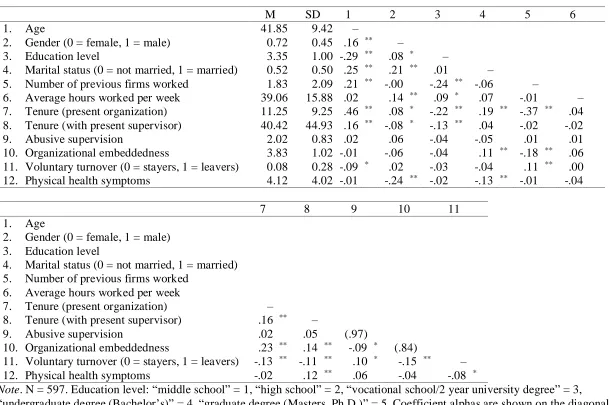
reported in Table 1. We used logistic regression with SPSS version 23 to test Hypothesis 1, and
the PROCESS regression macro (Hayes, 2013) to test Hypotheses 2.To reduce non-essential
multicollinearity concerns (Cohen, Cohen, West, & Aiken, 2003), independent variables were
mean-centered before computing product terms.
Hypothesis 1 stated that embeddedness moderates the relationship between abusive
supervision and voluntary turnover such that the positive relationship is weaker under higher
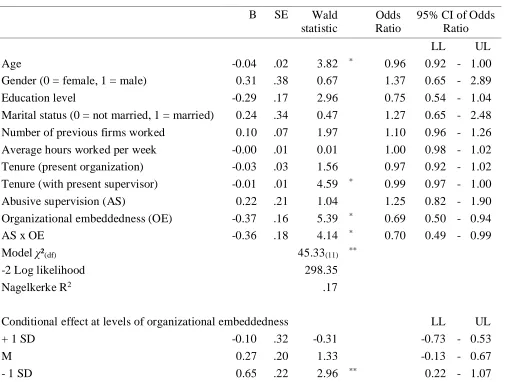
embeddedness. As shown in Table 2, after accounting for main effects, this interaction term was
significant (B = -0.36, Wald statistic = 4.14, Odds Ratio = 0.70, p < .05).Hypothesis 2 stated that
embeddedness moderates the relationship between abusive supervision and physical health
symptoms, such that the positive relationship is stronger under higher embeddedness. As shown
in Table 3, this interaction was significant (B = 0.43, t = 2.34, p < .05). We also tested
Hypothesis 2 only with stayers, finding a robust interaction (B = 0.46, t = 2.13, p < .05).
--- Insert Tables 1 and 2 about here ---
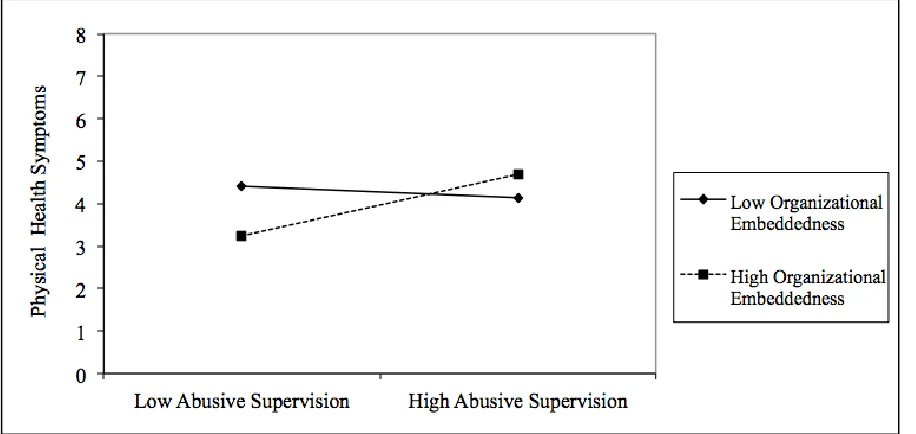
To facilitate interpretation of the interaction terms, we plotted conditional slopes at high
and low levels of the independent variable and moderator. Figure 1 shows that the relationship
between abusive supervision and turnover is positive only when embeddedness is low. Figure 2
shows that the relationship between abusive supervision and physical health symptoms is
positive only when embeddedness is high. Thus, Hypotheses 1 and 2 are supported.
--- Insert Figures 1 and 2 about here ---
Study 1 provides evidence to support our idea that more embedded employees are less
likely to quit, despite abusive supervision. However, such retention is not without negative
consequences. The relationship between abusive supervision and physical symptoms is only
positive for more embedded employees. Although Japan has the second highest life expectancy
in the world (World Health Statistics, 2014), the average physical symptoms reported here are
comparable to previous research using the PSI (e.g., Machin & Hoare, 2008, M = 4.22; Spector
& Jex, 1998, M = 5.4), and more embedded participants reporting high abusive supervision
exhibited 15.8% more negative physical symptoms than did less embedded participants reporting
abusive supervision. Interestingly, we found that employees reported the lowest levels of
physical health complaints under conditions of high job embeddedness and low abuse,
suggesting that embeddedness might be beneficial to employees so long as the circumstances
surrounding them are relatively favorable (e.g., “I fit quite well here and people treat me well”).
Abusive supervision does not encompass the complete domain of an adverse work
environment. Other negative circumstances can also be present that lead employees to consider
quitting, though embeddedness restricts such movement (Holtom, Mitchell, Lee, & Interriden,
2005). In Study 2, we considered a broader range of adverse work conditions that we expect to
interact with embeddedness to affect employee outcomes. Specifically, our purpose in Study 2 is
to attempt to replicate the interactional pattern of job embeddedness-by-adverse work conditions
by considering abusive supervision (a partial replication of Study 1) as well as job insecurity. We
also examine additional outcomes that could result from this negative experience: emotional
exhaustion and sleep impairment.
Study 2 assesses this pattern in a different national cultural context, namely in the U.S.A.
self is defined more interdependently and individuals feel a stronger duty to uphold social
obligations and to maintain relationships (Markus & Kitayama, 1991). Since the Japanese have
been found to hold strong reciprocal ties and have difficulty breaking them (Peltokorpi, 2013),
job embeddedness can be expected to play a particularly strong role in explaining reactions to
adverse work conditions. Thus, there is value in studying these relationships in a more
individualistic context, to see if the potentially negative effects of feeling embedded in adverse
conditions hold when individuals may feel less compunction about breaking such ties. At the
same time, Japan is a higher power distance country than is the U.S.A. (Carl, Gupta, & Javidan,
2004). In higher power distance countries, individuals tend to find unequally distributed power
more acceptable and are less likely to react negatively to supervisory wrongdoing than are those
in lower power distance contexts (Vogel, Mitchell, Tepper, Restubog, Hu, Hua, & Huang, 2015).
Thus, there is also value in studying these relationships in a lower power distance context, to see
if the potentially negative effects of feeling embedded in adverse work conditions operate when
individuals may react more strongly to abusive supervision.
Study 2
We sought to constructively replicate the pattern by which abusive supervision interacts
with job embeddedness to affect employee well-being. We consider two health-related outcomes
that may also be a function of the resource threat associated with being embedded in an abusive
supervisor-subordinate relationship: emotional exhaustion and sleep quantity/quality.
Emotional exhaustion refers to “feelings of being overextended and depleted of one’s
emotional and physical resources” (Maslach & Leiter, 2008, p. 498). In previous research, COR
theory has been used to link abusive supervision to emotional exhaustion (e.g., Aryee, Chen,
one’s emotional resources and can lead to emotional exhaustion. Emotional exhaustion is a state
of impoverished personal resources, which constrains further investment in resources, and leads
to further resource loss. We think this resource depletion can be exacerbated by perceptions of
being more highly embedded. Greater embeddedness is likely to constrain behavioral responses
to the abusive supervision, such as leaving the situation, leading victims to endure the abuse and
associated resource depletion, resulting in emotional exhaustion.
In a similar manner, we expect abusive supervision to be associated with worsened sleep
quantity/quality, and for this relationship to be exacerbated under conditions of greater
embeddedness. On average, individuals spend more time sleeping than they do working (Barnes,
Wagner, & Ghumman, 2012): “…sleep constitutes a large portion of people’s day-to-day lives that ought to be considered by organizational researchers” (p. 790). Sleep is also a primary
mediator between work events and employee health, attitudes, and behavior (Melamed et al.,
2006; Knudsen, Ducharme, & Roman, 2007), restoring personal resources needed for effective
functioning (Barnes, 2012; Barnes & Hollenbeck, 2009; Pilcher & Huffcutt, 1996). As a
confrontational, provocative behavior, abusive treatment has been linked to negative reactions
such as fear, irritation, and anger, as well as to resistance behaviors and turnover intentions
(Martinko et al., 2013; Tepper, 2007). When abusive treatment occurs, we expect that
employee’s sleep will also be impaired. The heightened emotional arousal evoked by abuse
coincides with increased cognitive activity (Harvey, Tang, & Browning, 2005), which is
antithetical to the required relaxation and reduced responsiveness that sleep onset demands
(Thomsen et al., 2003). Further, we propose that abusive supervision is more likely to disrupt
sleep when employees are more embedded. Whereas abusive treatment pushes employees away
comply with requests, as other employees may be dependent on the embedded individual (i.e.,
high links), and any act of withdrawal could lead to resource loss (Kiazad et al., 2015). Thus, we
expect sleep to be an additional indicator of difficulty coping with feeling stuck in an abusive
environment, as employees endure the effects of abuse, yet are hesitant to take action to escape
their negative circumstances.
Hypothesis 3: Job embeddedness moderates the positive relationship between abusive supervision and emotional exhaustion, such that the relationship will be stronger (i.e., more positive) when employees are more embedded.
Hypothesis 4: Job embeddedness moderates the negative relationship between abusive supervision and sleep quantity/quality, such that the relationship will be stronger (i.e., more negative) when employees are more embedded.
Up to this point, we have focused on being embedded in the face of abusive supervision.
We believe our underlying ideas apply to other aversive conditions, and extend our theorizing to
job insecurity, defined as the “perceived powerlessness to maintain desired continuity in a threatened job situation” (Greenhalgh & Rosenblatt, 1984, p. 438). This definition suggests that
job insecurity connotes a feeling of fear, powerlessness, and lack of control, that individuals are
unable to be protected from losing their job, and that they hold unclear expectancies about what
actions would be necessary for them to keep the job. Research shows that job insecurity is linked
to impaired physical and mental health (Sverke, Hellgren, & Näswall, 2002) and sleep (Ashford,
Lee, & Bobko, 1989). Even though the definition suggests a desire to stay, job insecurity often
produces a withdrawal response, as threatened employees may seek alternatives as a means of
rationally securing control over their situation and trying to eliminate the stressor (Ashford et al.,
1989; Sverke et al., 2002). Increased embeddedness, however, impedes this withdrawal response
reinforce employees’ stuckness, leaving them in a precarious position of simultaneously having
difficulty leaving, while still being threatened with the possibility that they may be forced out.
Hypothesis 5: Job embeddedness moderates the positive relationship between job insecurity perceptions and emotional exhaustion, such that the relationship will be stronger (i.e., more positive) when employees are more embedded.
Hypothesis 6: Job embeddedness moderates the negative relationship between job insecurity and sleep quantity/quality, such that the relationship will be stronger (i.e., more negative) when employees are more embedded.
Study 2 Method
Sample and Procedure
We used a Qualtrics Panel service to collect data through online surveys in the U.S.A.
Qualtrics is a third-party research company that administers online surveys through a participant
pool in which researchers can “pay per respondent”. The service has increasingly been used to
collect data in the management discipline (e.g., Long, Bendersky, & Morrill, 2011). In return for participation, panels are compensated with “survey cash”, which they are able to exchange for
actual compensation in online marketplaces (participants were paid roughly US$7 per survey).
Data were collected from full-time employees with two surveys at two points in time over
a three-month period. To obtain sufficient power to detect interaction effects (Cohen, 1992), we
aimed for a final sample of approximately 300 employees. At Time 1, we sought a sample of 600
employees with the expectation of 50% attrition at Time 2. We obtained 600 responses at Time
1, from an initial solicitation of 1,125 individuals (53% response rate). Qualtrics informed us that
this response rate is partially a function of some survey solicitations being deleted due to spam
blockers or other communication impediments. At Time 1, we measured independent,
matched sample of 305 individuals who responded to Time 1 and Time 2 surveys. However,
some responses to key variables were left blank, leaving a final usable sample of 283.
The average age of respondents was 47 (SD=10.42); 59% were female; and 84% were
Caucasian. Average tenure in the organization was 10.20 years (SD=8.49); and their average education was 4.33 out of 7, indicating roughly between an associate’s and bachelor’s degree.
Respondents represented a broad range of occupations, including government work, tourism, law
enforcement, and information technology, among others. As with Study 1, we compared
participants who participated in both surveys to those who only completed survey 1. We found
no significant differences on substantive variables of interest (i.e., independent variables or
moderators), though there were slightly more males who did both surveys (0.15 difference in
gender means), and those who did both surveys were slightly older (about 2 years).
Measures
Abusive Supervision. Similar to Study 1, abusive supervision was measured by the
15-item scale from Tepper (2000). Cronbach’s α was .96.
Organizational Embeddedness. Organizational embeddedness was measured with a
5-point Likert-type (1 = strongly disagree, 5 = strongly agree) abbreviated scale from Mitchell et
al. (2001). Given our focus on on-the-job embeddedness, we relied on the nine items capturing
this facet, with three items for each dimension of links, fit, and sacrifice. Sample items are “I work closely with my coworkers” (links), “My job utilizes my skills and talents well” (fit), and
“I would sacrifice a lot if I left this job” (sacrifice). As a formative or causal indicator index, the
original measure is theorized to independently aggregate to overall embeddedness (Mitchell et
α was an acceptable .89. Notably, using this scale enables replication of our interaction pattern
with the two most common measures of embeddedness.
Job Insecurity. Job insecurity was measured with a 10 item, 6-point Likert-type (1 =
never, 6 = all the time) scale from Huang, Niu, Lee, and Ashford (2012). We opted for an affective insecurity measure to capture respondents’ feelings about their future with their job. A
sample item is “I am worried that this company will fire me any time”. Cronbach’s α was .90.
Emotional exhaustion. Emotional exhaustion was measured with a 9-item, 5-point
Likert-type (1 = strongly disagree, 5 = strongly agree) scale from Maslach and Jackson (1981). A
sample item is “I feel emotionally drained”. Cronbach’s α was .91.
Employee Sleep Index. This measure consists of two items reflecting sleep quantity and
quality (Buysse, Reynolds, Monk, Berman, & Kupfer, 1988). The sleep quantity item asked
participants to estimate (in minutes) the average amount of time they had actually spent sleeping
per night over the past month. Consistent with previous research (Barnes, Schaubroeck, Huth, &
Ghumman, 2011; Barnes et al., 2012), participants were cautioned that this number might have
been different from the total time spent in bed. The sleep quality item asked “During the past month, how would you rate your sleep quality overall?” and rated on a 7-point Likert-type scale
(1=horrible, 7=terrific). Given the separate item ranges, we first standardized both and then
computed a single mean “employee sleep index” score. Cronbach’s α was .66.
Control Variables
The demographic controls from Study 1 were included for prior relationships with
turnover, but were largely uncorrelated with our health-related outcomes (and their inclusion did
not change results). For robustness, in Study 2 we controlled for age, gender, education level,
exhaustion (Swider & Zimmerman, 2010), we also controlled for trait neuroticism, measured by
an 8-item, Likert-type (1=strongly disagree, 5=strongly agree) scale (Saucier, 1994).
Respondents were asked on how much they agreed with how adjectives such as “moody” or “temperamental” described them in general. Cronbach’s α was .86.
Analyses and Results
In line with Study 1, we performed a CFA. However, it should be noted that the Mitchell
et al. (2001) embeddedness scale is a causal indicator model, and thus CFA is generally not
appropriate. Still, the distinct-factor measurement model had a good fit to the data (χ2 (396) =
849.03, p < .01, CFI = .91, TLI = .90, RMSEA = .08), and had significantly better fit than a
one-factor model (χ2
(819) = 5,075.27, p < .01, CFI = .35, TLI = .31, RMSEA = .23). All factor
loadings were significant (p < .01) and sizable (average factor loading = .79). Descriptive
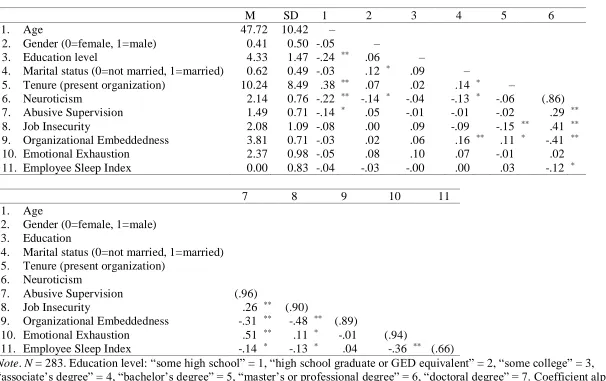
statistics and inter-correlations among variables are reported in Table 4.
Consistent with Study 1, independent variables were mean-centered before computing
interaction terms (Cohen et al., 2003) and interaction tests were conducted using the PROCESS
macro in SPSS (Hayes, 2013). Hypothesis 3 stated that embeddedness would moderate the
positive relationship between abusive supervision and emotional exhaustion, such that the
relationship is stronger when employees are more embedded. As shown in Table 5, this
interaction was significant (B = 0.20, t = 2.13, p < .05). Hypothesis 4, stating that embeddedness
moderates the positive relationship between abusive supervision and sleep, was not supported (B
= .07, t = 0.61, p > .05). Hypotheses 5 and 6, respectively, stated that embeddedness moderates
the positive relationship between job insecurity and emotional exhaustion, and the negative
employees are more embedded. As shown in Table 6, Hypothesis 5 was not supported (B = 0.03,
t = 0.45, p > .05); yet, the Hypothesis 6 interaction was significant (B = -0.15, t = -2.33, p < .05).
We plotted conditional slopes at high and low levels of the independent and moderator
variables (see Figures 3 and 4). Figure 3 shows that the relationship between abusive supervision
and emotional exhaustion is stronger when embeddedness is high. Figure 4 shows that the
relationship of job insecurity with sleep is more negative when embeddedness is high. Thus,
Hypothesis 3 and 6 are supported.
--- Insert Tables 4 - 6 and Figures 3 and 4 about here ---
Study 2: Discussion
Study 2 partially replicates and builds on the results of Study 1 by highlighting the
harmful outcomes that can be associated with being embedded in adverse work environments.
We constructively replicated the interactive influence of an abusive work environment on
employee well-being, finding that abusive supervision was more positively associated with
emotional exhaustion for those higher in job embeddedness, while demonstrating this effect with
an alternative measure of embeddedness, in a distinct national cultural context, and with a
personality control variable. The results also reveal that embeddedness interacts with a second
factor representing a negative work environment. We found those who report higher levels of
insecurity under high embeddedness were also likely to suffer. Thus, feelings of stuckness may
permeate throughout organizational life. The results of Study 2 also expose a broader spectrum
of consequences that can result for employees who feel stuck in an adverse workplace. Notably,
we found a significant interaction for sleep quantity/quality, which studies have shown may
of sleep vary across individuals, it is generally recommended that healthy adults obtain roughly
7-8 hours per night (Mayo Clinic, 2013). Yet, those in the most negative condition (i.e., high
embeddedness, high adverse work environment) reported receiving almost a full hour less sleep
than average each night - and worse-quality sleep - indicating potentially serious deprivation
(Bonnet & Arand, 1995).
General Discussion
To date, the primary assessment of job embeddedness has been of its merits (Mitchell et
al., 2001; Jiang et al., 2012). Researchers present embeddedness as a desirable quality, and most
practical implications encourage finding ways to increase employee embeddedness so as to
reduce turnover and increase social cohesion. The present studies were an attempt to shed light
on a less examined negative aspect of embeddedness - employees who feel stuck in a negative
employment context (Hom et al., 2012). Previous research has shown that being embedded can
encourage employees to behave in ways that benefit the organization, even in the face of
negative workplace events (e.g., refraining from job search or counterproductive behaviors,
maintaining contributions). In Study 1, we demonstrated this effect by showing that being
embedded mitigates the likelihood that employees will quit in the face of abusive supervision.
However, what about the effects of remaining in aversive conditions on the individual? We
found that under adverse conditions, increased embeddedness can harm rather than help
employees, revealing a boundary condition of embeddedness’ favorable influence (Jiang et al.,
2012). Thus, while embeddedness itself is value neutral, the environment in which one is
embedded must also be considered. In shifting attention to a “dark side” of embeddedness, we contribute to theoretical discussions encouraging researchers to challenge “established facts” in
Theoretical Implications and Future Research Directions
In some ways, our findings reinforce the foundations of job embeddedness theorizing, as
embeddedness is certainly important to retention. Consistent with previous research (Jiang et al.,
2012), we found that higher embeddedness did predict lower turnover likelihood, while also
answering calls for research on embeddedness’ applicability in non-Western contexts (Holtom et
al., 2008; Peltokorpi et al., 2015; Ramesh & Gelfand, 2010). Going beyond previous research,
we find that embeddedness deters quitting even in hostile workplaces, providing perhaps
unsettling testament to its influence in constraining employee decision-making. However, we did
not replicate the buffering effect of embeddedness between abusive supervision and turnover in
Study 2; future research should aim to replicate this finding in other contexts.
Though embedded employees were less likely to quit in adverse work environments,
being stuck in these conditions was associated with serious negative consequences. To date,
theory and research have mainly concentrated on how job embeddedness retains employees, without attending to the concern of retained employees’ welfare. These findings are particularly
relevant to theory on the buffering effects of embeddedness. For example, turnover theorists
have integrated the unfolding model with embeddedness theory to describe how embeddedness
can buffer or mitigate the effects of negative shocks on turnover and performance (Mitchell &
Lee, 2001). Our findings do support this perspective, but also point to a key additional
consideration: while mitigating the effect of negative shocks (such as abusive supervision) on
quitting, embeddedness may, at the same time, exacerbate the effect of negative shocks on
individual well-being – precisely because embeddedness constrains leaving and removing
Our results provide indirect corroboration as well for research on commitment profiles.
This research stream suggests that employees high in continuance or normative commitment, in
the absence of strong affective commitment, tend to report greater stress and other negative
outcomes (Sinclair et al., 2005). We demonstrate additional negative health outcomes associated
with feeling stuck.
Relatedly, our results have implications for nascent theorizing on Hom et al.’s (2012)
expanded criterion model. They suggest reluctant stayers, particularly those who feel trapped,
will exhibit dysfunctional behaviors such as reduced contributions and increased deviance.
However, this is at odds with embeddedness research showing that embeddedness buffers the
effects of negative shocks on contributions and deviance (Burton et al., 2010; Holtom et al.,
2012). Our results suggest a key temporal element to this theorizing that future research will
need to address. Namely, embeddedness may constrain performance decrements and deviance in
the face of negative shocks, treatment, and conditions in the short run; however, our results
showing the exacerbating effects of embeddedness on employee well-being suggest that, in the
long run, performance decrements and deviance may be more likely (perhaps even inevitable).
Alternatively, another possibility is that rather than through overt reactions, stuck employees
may resort to insidious ways to act out frustration (e.g., social undermining; sabotage).
On the other side, though, being embedded in a favorable work environment can be an
ideal situation. Though our focus was to explore the dark side of embeddedness, in testing our
interaction effects, we uncovered equally novel results for the bright side. In examining the
visual interaction plots, we see that those who are embedded in positive work environments (i.e.,
low abusive supervision, low job insecurity) had the fewest physical health problems, lowest
embeddedness was generally zero (across conditions). Thus, moderating effects suggest higher
embeddedness is best considered a double-edged sword, providing a comforting safety net for
those who are favorably embedded, but a vicious entanglement for those unfavorably embedded.
With Study 1, we also extend embeddedness and abusive supervision research to a
Western, developed country context. To date, the bulk of abusive supervision research in
non-Western settings has been conducted in less-developed East Asian countries, such as China and
the Philippines (Martinko et al., 2013), yet limited research has examined embeddedness and
voluntary turnover in non-Western contexts (Holtom et al., 2008). In line with previous research,
our findings suggest that abusive supervision predicts subordinates’ voluntary turnover (Tepper,
2000) and physical symptoms (Bowling & Michel, 2011) in Japan. Further, our findings suggest
that the global job embeddedness (Crossey et al., 2007) and abusive supervision (Tepper, 2000)
measures are valid constructs in Japan. Taken together, the findings support the cross-cultural
applicability of abusive supervision and job embeddedness relationships.
Though the overall pattern of moderation results provided support for the “dark side” of
embeddedness, some predictions were contrary to expectations. Embeddedness failed to
moderate job insecurity effects on emotional exhaustion. This is surprising because our
theorizing suggested the lack of control and feelings of helplessness associated with high job
insecurity would be troubling to many employees. It may be that abusive supervision produces a
qualitatively different negative feeling compared to insecurity. The visceral and direct experience
of abuse may have more pronounced effects on resource threat than more vague and distal
feeling of insecurity. Items for emotional exhaustion entail feeling burned out and emotionally
drained from one’s work. While higher insecurity can still allow “the show to go on” - at least on
Our theorizing hints at but does not directly address potential mediating mechanisms that
would provide additional explanation of how or when job embeddedness and aversive work
conditions interact. For example, when abusive treatment occurs, individuals exert effort to
process and make sense of this negative deviation from expected behavior (Bies & Moag, 1986;
Nolen-Hoeksema, McBride, & Larson, 1997). We think this is especially likely to be the case for
highly embedded employees, who are likely to dwell on the abusive treatment, their feelings in
response to the treatment, and how they might respond, while being frustrated that they cannot
easily quit the job. These negative emotional reactions coincide with increased cognitive arousal
and worry (i.e., unwanted intrusive thoughts; Harvey et al., 2005), which could be associated
with emotional exhaustion and are antithetical to the required relaxation and reduced
responsiveness sleep onset demands (Thomsen et al., 2003). Thus, future research that considers
cognitive processes such as rumination, thereby providing additional perspectives on how
individuals respond to being stuck in adverse work conditions, would be valuable.
Theoretically, we adopted a COR perspective, suggesting that the motivation to preserve
resources would constrain embedded employees from leaving even in the face of aversive work
conditions and negative health outcomes. Our findings provide an initial empirical test bridging
embeddedness theorizing with COR theory (e.g., Kiazad et al., 2015), and also suggest future
research on the inevitable tension created by embeddedness coupled with an adverse work
environment. More specifically, COR theory states that individuals are motivated to retain,
protect, and build resources they value. Yet, the abusive supervision, job insecurity, and turnover
literatures highlight that negative work environments create salient pressures to make people
want to leave. Two interesting research questions, then, are: what factors determine individual
to quitting; and, when embedded employees are faced with aversive work conditions, to where
do they turn for additional resources to combat abuse or to cope with difficult conditions?
Practical Implications
The moderating effects of embeddedness have practical implications. On the one hand,
despite abusive supervision, the findings do show that organizations can retain employees by
increasing their job embeddedness. Thus, for the purely retention-oriented manager, finding
ways to increase employee embeddedness is likely to reduce voluntary turnover. However, the
results also reveal that this solution might not be sustainable, at least in adverse work
environments. Being embedded in such a workplace may be detrimental to employee well-being,
in terms of physical health, emotional exhaustion, and sleep loss. Although previous research
suggests that feeling embedded in negative work conditions does not reduce contributions or
increase deviance, our results showing detrimental effects on employee health suggest that over
longer time periods performance decrements and increased deviance might be more likely. When
considered together, we recommend that organizational stakeholders first attend to work
environment characteristics before seeking to increase embeddedness. This is consistent with
suggestions from commitment profile research suggesting it makes little sense to focus only on
fostering continuance commitment (Sinclair et al., 2005; Wasti, 2005); instead, efforts to tie
individuals to organizations must be coupled with efforts to create a healthy environment. For
example, this could involve reassuring employees of their job security or identifying abusive
treatment at its source and making clear efforts to curb such behavior.
Counter-intuitively, organizations may need to provide additional support and resources
for those most tied to the organization. Our findings suggest retaining employees in adverse
or feel their job is insecure, organizations may provide counseling services or access to employee
assistance programs (EAPs) to mitigate the negative effects we have described above. In finding
that sleep impairment can be linked to embeddedness, counseling and EAPs may be particularly
beneficial, lest employees seek mere palliative solutions such as sleeping pills, alcohol, or other
hypnotics, which in the long term, can generate their own problems (Kripke, 2000).
Limitations
In both studies, we used a research company to recruit respondents and collect data.
While enabling access to a diverse sample of respondents, one potential concern in using online
surveys with incentives is whether respondents are mainly motivated by extrinsic rewards. In line
with Ng and Feldman (2013), though, we checked for unusual response patterns, such as
answering all questions identically. We also inserted attention checks, page breaks,
reverse-coded items, and reminders to answer honestly, while reinforcing how responses were
anonymous. If extrinsic rewards primarily drove participation, we might have seen a pattern of
unusually high correlations among measures that should not correlate especially highly.
However, we found no such cases (and a realistic average time period for survey completions) in
either study, suggesting participants deliberated in responding and did not “fly through” surveys.
The measures in our studies were collected through self-reports. To partially mitigate
common method concerns, we collected data at several points in time over a number of months,
minimizing the effects of potential transitory biases at the time of the survey. Because
subordinates are most knowledgeable about how they perceive the treatment of others and
experience emotional exhaustion, self-reports are appropriate in our studies (Chan, 2009).
Further, the results derived through CFA suggested that common method variance did not
importantly, the interaction effects cannot be artifacts of common method variance, and in fact
are likely to be deflated and more difficult to detect (Siemsen, Roth, Oliveira, 2010).
The amount of variance explained was modest for some variables, such as the sleep
index. A wide variety of variables an influence sleep; for example, past studies (e.g. Barnes et al., 2012) have found that incorporating how one’s time is spent on the job can improve
prediction of sleep outcomes. With this in mind, future research would do well to explore how
things like workload or social interdependence operate alongside embeddedness and abusive
supervision to predict sleep. There may also be a temporal element to the prediction of sleep
difficulty. We assessed average evaluations of sleep over a one-month period, assuming that
feeling stuck is an on-going concern. However, particularly harsh episodes of abusive supervision might be expected to influence sleep that night, especially for those who can’t
escape. Future research able to more finely track the timing of abuse and sleep difficulty would
be valuable.
We focused on on-the-job embeddedness believing it to be most relevant to feeling stuck
in aversive work conditions. However, it is certainly the case that off-the-job or community
embeddedness could matter in some circumstances (Lee et al., 2004): for example, being deeply
embedded in a community could also lead to feeling stuck with negative work conditions
(although Allen [2006] emphasized that this is most likely when changing jobs would require
relocating out of the community). In Study 2, we did have data on community embeddedness.
We therefore tried to replicate the Study 2 analyses using only community embeddedness, but
found no significant main or interaction effects. We also tried replicating Study 2 analyses with
community embeddedness as a covariate to on-the-job embeddedness, but again the pattern of