warwick.ac.uk/lib-publications
Original citation:Francis, Leslie J., Astley, Jeff and Parker, S.. (2016) Who studies religion at advanced level : why and to what effect? Journal of Beliefs and Values, 37 (3). pp. 334-346.
Permanent WRAP URL:
http://wrap.warwick.ac.uk/83329
Copyright and reuse:
The Warwick Research Archive Portal (WRAP) makes this work by researchers of the University of Warwick available open access under the following conditions. Copyright © and all moral rights to the version of the paper presented here belong to the individual author(s) and/or other copyright owners. To the extent reasonable and practicable the material made available in WRAP has been checked for eligibility before being made available.
Copies of full items can be used for personal research or study, educational, or not-for profit purposes without prior permission or charge. Provided that the authors, title and full bibliographic details are credited, a hyperlink and/or URL is given for the original metadata page and the content is not changed in any way.
Publisher’s statement:
This is an Accepted Manuscript of an article published by Taylor & Francis in Journal of Beliefs and Values on 17 Oct 2016 available online:
http://www.tandfonline.com/10.1080/13617672.2016.1236325
A note on versions:
The version presented here may differ from the published version or, version of record, if you wish to cite this item you are advised to consult the publisher’s version. Please see the ‘permanent WRAP url’ above for details on accessing the published version and note that access may require a subscription.
C:\Users\lyslbp\Downloads\0673558-ces-021116-who_studies_religion_at_a_level.docx 03/11/2016
Who studies religion at Advanced level: Why and to what effect?
Leslie J Francis*
University of Warwick
Jeff Astley
Glyndŵr University
Stephen Parker
University of Worcester
Author note:
*Corresponding author: Leslie J Francis
Warwick Religions & Education Research Unit Centre for Education Studies
The University of Warwick
Coventry CV4 7AL United Kingdom Tel: +44 (0)24 7652 2539
Fax: +44 (0)24 7657 2638
Abstract
This study was established to profile students currently studying religion at Advanced level
(A level) in terms of their demography, motivation, experience and attitudes. Eight specific
areas were identified for examination: their personal motivation to study religion at A level,
the personal challenges posed by the subject, their personal experience of studying the
subject, their growth in understanding stimulated by the subject, the impact of their study on
respecting religious diversity, the impact on their personal development, the impact on
spiritual and religious development, and the connection between studying religion at A level
and their personal faith. Data were provided by 462 students at the end of the first year of A-
level study. Key findings demonstrated that 78% of students opted for the subject because
they enjoyed their earlier experiences of religious studies in school, that 80% of students have
become more tolerant of religious diversity, and that only 7% of students feel that studying
religion at A level has undermined their personal religious faith while three times that number
feel that it has affirmed their religious faith.
Introduction
Current trends in religion at A level
Advanced level (A level) examinations in England and Wales have a long history
embedded within the history of sixth-form education itself (Reid & Filby, 1982). A-level
examinations began in the 1950s as an extension to the Ordinary level qualification, replacing
the Higher School Certificate at a time when the school leaving age had been raised (Reid &
Filby, 1982, p. 131). A-level examinations have long been seen as the pinnacle qualification
of the school system, offering subject specialisation and preparing students to access
university courses. This perception was preserved beyond the reform of A levels which
occurred in 2000, and which created a two-tier, two-year, examination process of Advanced
Subsidiary (AS) and Advanced 2 (A2) level. The best available evidence shows that the
religious studies qualification at A level (especially at AS) has become increasingly popular,
the number almost doubling since the 1990s. The subject is particularly favoured as a choice
among girls (Field, 2010). A variety of options are available in A-level religious studies
(including, for example, courses in any of the major world religions, biblical studies, the
history of Christianity, and aspects of contemporary religion), but modules in the philosophy
of religion and ethics have become the most often selected. Typical of the language used to
describe the aim of the A-level religious studies curricula, which is determined by a variety of
examination boards, is that of developing an inquiring, critical and reflective approach to the
study of religion. Learning in the subject is focused on its potential to contribute to the
intellectual development of young people.
Sixth-form religion
In the late 1960s Edwin Cox’s (now classic) study, Sixth Form Religion (Cox, 1967)
drew attention to the potential for quantitative research in this field. Cox’s book on data
Cox, 1967a, 1967b) and by a replication study conducted in 1970 (Wright & Cox, 1971a,
1971b). Cox’s book also inspired Greer’s study of sixth-form religion in Northern Ireland
conducted in 1968 (Greer, 1972). Greer then replicated his study at ten-yearly intervals, in
1978 and 1988 (Greer, 1980, 1989). Greer’s work was further replicated a decade or so later
and reported in a series of studies by Francis, Robbins, Barnes, and Lewis (2006a, 2006b),
Francis, ap Siôn, Lewis, Robbins, and Barnes (2006), Francis, Robbins, ap Siôn, Lewis, and
Barnes (2007), Francis, Robbins, Lewis, Barnes, and ap Siôn (2007), and Francis, Robbins,
Lewis, and Barnes (2008).
Another approach to studying aspects of sixth-form religion was fostered by Astley
and colleagues at the North of England Institute for Christian Education, concentrating
particularly on students engaged in A-level religious studies. An annual study day for these
students was held in Durham University for 25 years, covering topics relevant to their AS/A2
level syllabuses. Up to 770 students and staff attended in some years, choosing from a menu
of around 40 lectures given by teachers from the universities and institutions of theological
education of the north east region. Over this period, students were also invited to complete a
variety of questionnaires during the course of the study day. These were designed to explore a
range of topics, including religion, gender issues, well-being and personality (Francis &
Wilcox, 1995, 1996, 1999; Francis, Jones, & Wilcox, 1997; Wilcox & Francis, 1997a, 1997b,
1997c; Francis & Fearn, 1999; Francis, Wilcox, & Jones, 1999); attitudes toward science and
religion (Astley & Francis, 2010) and attitude toward Christianity (Francis, Astley, Fearn, &
Wilcox, 1999; Fearn, Francis, & Wilcox, 2001); and their understanding of Christianity and
images of Jesus (Francis, Astley, & Wilcox, 1992; Astley & Francis, 1996; Francis & Astley,
1997).
In what they describe as a preliminary investigation, Francis, Fearn, Astley, and
Wilcox (1999) explored the motivation to study religion at A level of a sample of 304 A-level
religious studies students attending 56 schools in the north east of England (7 Roman
Catholic maintained schools, 3 Church of England maintained schools, 30
state-maintained schools without a religious character, and 16 independent schools). Their sample
comprised 63 males and 241 females; 217 were aged sixteen or seventeen, 77 were aged
eighteen or nineteen, and 10 were aged twenty or over. In terms of religious affiliation, the
majority (221) claimed affiliation to a Christian denomination, 8 claimed affiliation to
another world faith, and 75 claimed affiliation to no religious group. In this study, Francis,
Fearn, Astley, and Wilcox identified five motivational factors relevant to A-level religious
studies students which they characterised as follows: the religious studies approach, the
faith-based approach, the influence of school, the pragmatic approach, and future educational
intentions.
The data from this study demonstrated that nearly two-thirds of the students (64%)
were attracted to study religion at A level by the religious studies approach, affirming that
they wanted to understand more about other people’s religious beliefs. Slightly fewer than
one third of the students (29%) were attracted to study religion at A level by the faith-based
approach, affirming that they believed it would be spiritually beneficial for them.
Previous positive experience of studying religion at school was of key importance in
attracting students to study religion at A level, with 89% affirming that they enjoyed the
subject and 60% affirming that they like the religious studies staff at their school. By way of
contrast, only a small minority of students, one in twenty, had taken the pragmatic approach,
with 5% saying that they had been attracted to studying religion at A level because they
Future educational intentions had played a part in the decision to study religion at A
level among one in five of the students, with 195 saying that they had made the choice
because they wanted to go on to study religion at university.
Research question
In the conclusion to their preliminary investigation of the motivation of students to
study religion at A level, Francis, Fearn, Astley, and Wilcox (1999) commend the benefit of
building on this preliminary investigation among a larger sample of students and employing a
more sophisticated instrument across a wider range of schools. This new study responds to
that challenge by posing more precise research questions about both the motivation and the
experience of students studying religion at A level. These research questions explore the
following themes:
the personal religious profile of the students studying religion at A level;
their personal motivations to study religion at A level;
the personal challenges posed by studying religion at A level;
their personal experience of studying religion at A level;
the growth in understanding stimulated by studying religion at A level;
the impact on respecting religious diversity from studying religion at A level;
the impact on personal development from studying religion at A level;
the impact on spiritual and religious development from studying religion at A level;
how studying religion at A level connects with personal religious faith.
Method
Procedure
As part of a wider study concerned with the experiences and attitudes of 16- to
18-year-old students engaged with the study of religion at A level, a snowball sample of 25
questionnaire survey. The survey was conducted during regular class time and students were
assured of anonymity and confidentiality. Students who did not wish their data to be included
in the analysis were given the option of not submitting their completed questionnaires.
Toward the end of the first year of A-level study the schools were invited to administer a
second questionnaire, and 18 of the original 25 schools did so. The present analysis is based
on responses to this second questionnaire provided by 462 students.
Participants
The 462 participants comprised 129 males, 329 females and 4 individuals who did not
disclose their sex; in terms of age, 86 were sixteen, 351 were seventeen, 22 were eighteen and
three did not disclose their age.
Instrument
The motivation and experience of students studying religion at A level were assessed
by a battery of focused items rated on a five-point Likert scale: agree strongly, agree, not
certain, disagree, and disagree strongly. The items were designed to reflect eight themes
styled: personal motivation, personal challenges, personal experience, growth in
understanding, respecting religious diversity, personal development, spiritual and religious
development, and connecting with personal faith.
The personal religious profile of students was assessed by four questions:
self-assigned religious affiliation was assessed by the question ‘What is your religion?’ followed
by a check list of ten faith groups, preceded by ‘none’ and concluded by ‘other (please
specify)’. Those who checked the category ‘Christian’ were invited also to select between
four denominational groups: Roman Catholic, Anglican, Free Church, and Other (please
specify). Worship attendance was assessed by a five-point measure of frequency, from never
from never to nearly every day. Religious experience was assessed on a four-point scale: no,
perhaps but not really sure, probably but not certain, and yes definitely.
Analysis
In the following tables the agree strongly and the agree responses have been
combined to form the category ‘yes’; the disagree strongly and disagree responses have been
combined to form the category ‘no’.
Results
Personal religious profile
In response to the question on self-assigned religious affiliation, 249 students
identified themselves as Christian (54%), and 35 as Muslim (8%), with small numbers of
Hindus (7), Buddhists (3), Jews (2), Jains (2) and one Sikh. A further 11 students marked the
category ‘other’ and 10 failed to answer the question. The remaining 142 marked the
category ‘none’ (31%). Among the 249 Christian students, the two largest denominational
categories were Roman Catholic (116) and Anglican (17).
The question on frequency of worship attendance demonstrated that one quarter of the
students attended at least once a month (25%), another quarter never attended (26%) and the
remaining half attended either at least six times a year (7%) or less frequently than that
(42%).
The question on frequency of personal prayer demonstrated that two-fifths of the
students never prayed (40%), while 16% prayed daily, 9% at least weekly, 5% at least
monthly and 30% occasionally.
The question on religious experience demonstrated that 10% of the students were
convinced that they had experienced something they would describe as a religious or spiritual
experience, another 10% thought that they had probably had such an experience but were not
sure. This left 58% of the students who were clear that they had never experienced something
of that nature.
Personal motivation
- insert table 1 about here -
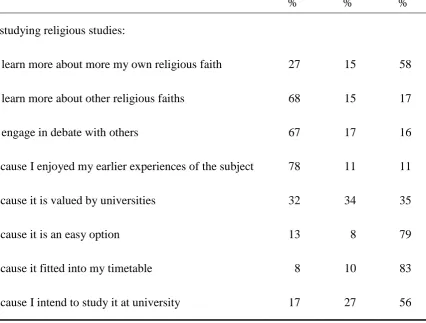
The first issue explored by the survey concerned the students’ motivation in pursuing
religious studies at A level. The data presented in table 1 demonstrate that a major factor in
motivating students to study religion at A level is their positive experience of studying the
subject in school at an earlier stage. Over three-quarters of the students (78%) claimed that
they were taking religious studies at A level because they had enjoyed their earlier experience
of the subject. In other words, good religious education delivered lower down the school
seems to provide core recruitment into the A-level religious studies class. It is probably this
good experience of religious education lower down the school that helps to shape the
response to the next two questions. Two-thirds of the students claimed that they were taking
religious studies at A level to learn more about other religious faiths (68%) and to engage in
debate with others (67%). The data also demonstrated that intrinsic motivation was much
more important than extrinsic motivation. While two-thirds of the students were studying the
subject because they wanted to learn about other religious faiths (68%), the proportion fell to
one-third who were studying the subject because it was valued by universities (32%), and
may consequently help them to gain a university place at the end of the course.
By way of comparison, just one in four students were motivated to take religious
studies at A level to learn more about their own religious faith (27%), while even fewer
(17%) were motivated to take religious studies at A level because they intended to study the
A small minority of students found themselves studying religion at A level under the
impression that it is an easy option (13%) or simply because it fitted into their timetable
(18%).
Personal challenges
- insert table 2 about here -
The second issue explored by the survey concerned the personal challenges faced by
the students in pursuing religious studies at A level. The data presented in table 2 demonstrate
that over three-quarters of the students had felt challenged by studying religion at A level to
think differently about religion. Thus 83% said that doing religious studies challenged them
to think differently about religion in society; 82% said that doing religious studies challenged
them to think differently about religious people; and 77% said that doing religious studies
challenged them to think differently about the relationship between religion and science.
Although the levels of endorsement dropped when the focus changed from the more
intellectual to the more personal, between two-fifths and half of the students recognised the
challenges posed by studying religion at A level to their religious faith. Thus, 52% said that
doing religious studies challenged them to re-think their ideas about God; and 40% said that
doing religious studies challenged them to think differently about their religious faith.
Personal experience
- insert table 3 about here -
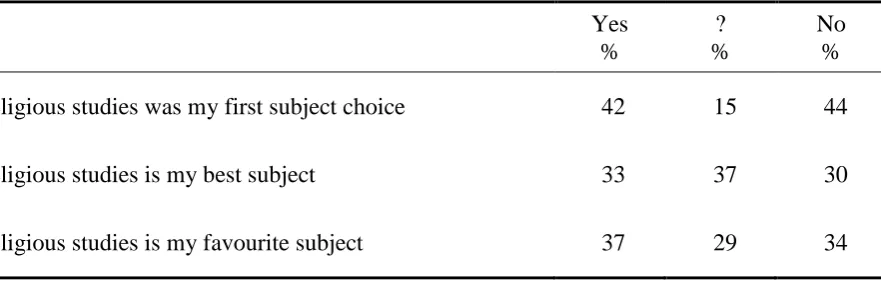
The third issue explored by the survey concerned the personal experience of the
students in following their choice to pursue religious studies at A level. The data presented in
table 3 demonstrate that between one-third and two-fifths of the students were personally
highly engaged with the subject. Thus, for 42% of the students religious studies had been
their first subject choice; for 37% of the students religious studies was their favourite subject;
Growth in understanding
- insert table 4 about here -
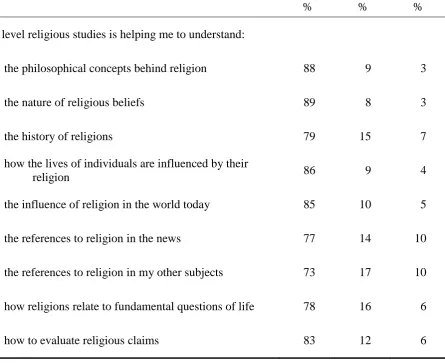
The fourth issue explored by the survey concerned the perceptions of the students
regarding how studying religion at A level had impacted their understanding. The data
presented in table 4 demonstrate a very high endorsement of the contribution made by
studying religion at A level to the students’ understanding of religion. Thus, at least four-
fifths of the students endorsed the views that A level religious studies was helping them to
understand the nature of religious beliefs (89%), the philosophical concepts behind religion
(88%), how the lives of individuals are influenced by their religion (86%), the influence of
religion in the world today (85%), and how to evaluate religious claims (83%).
For some of the other areas examined, endorsement dropped below the level of four-
fifths, but only marginally so. Thus, nearly four-fifths of the students endorsed the views that
A-level religious studies was helping them to understand the history of religions (79%), how
religions relate to fundamental questions of life (78%), the references to religion in the news
(77%), and the references to religion in their other subjects (73%).
Respecting religious diversity
- insert table 5 about here -
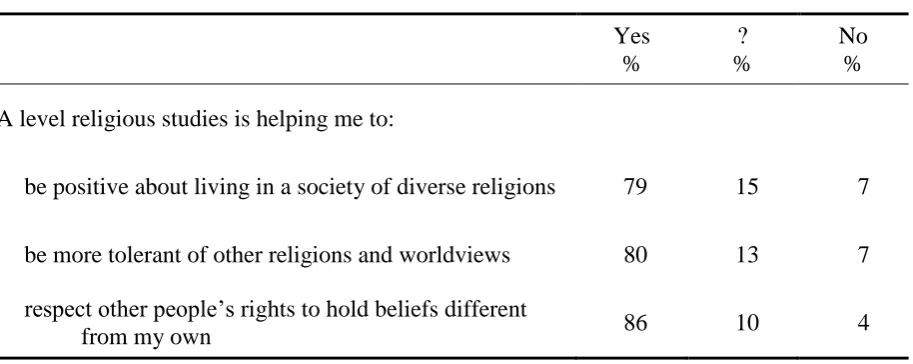
The fifth issue explored by the survey concerned the perceptions of the students
regarding how studying religion at A level had impacted the way in which they reflected on
religious diversity. The data presented in table 5 demonstrate that A-level religious studies
may be making a helpful contribution to promoting community cohesion in the sense of
enhancing respect for religious diversity. Thus, around four-fifths of the students affirmed
that A-level religious studies was helping them to respect other people’s rights to hold beliefs
different from their own (86%), to be more tolerant of other religions and worldviews (80%),
Personal development
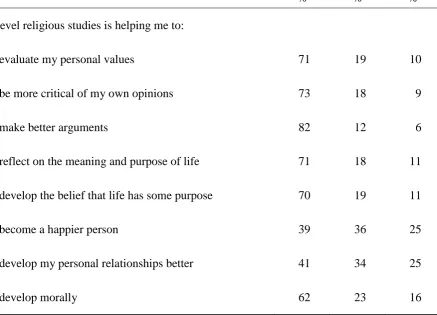
- insert table 6 about here -
The sixth issue explored by the survey concerned the perceptions of the students
regarding how studying religion at A level had impacted their personal development. The
data presented in table 6 demonstrate that studying religion at A level is making a helpful
contribution to the students’ personal development. Thus, over two-thirds of the students
affirmed that A-level religious studies was helping them to make better arguments (82%), to
be more critical of their own opinions (73%), to evaluate their personal values (71%), to
reflect on the meaning and purpose of life (71%), and to develop the belief that life has some
purpose (70%).
Somewhat lower levels of endorsement are attracted by the less academic and more
personal objectives supplied by the survey. Thus, 62% of the students affirmed that A-level
religious studies was helping them to develop morally; 41% of the students affirmed that
A-level religious studies was helping them to develop their personal relationships better; and
39% of the students affirmed that A-level religious studies was helping them to become
happier people.
Spiritual and religious development
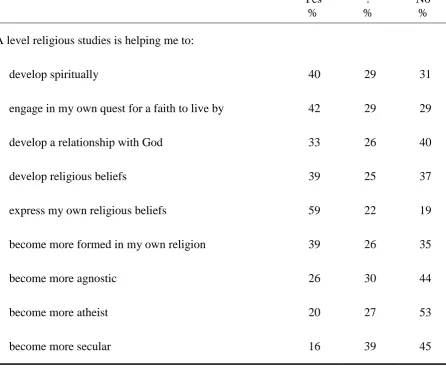
- insert table 7 about here -
The seventh issue explored by the survey concerned the perceptions of the students
regarding how studying religion at A level had impacted their spiritual and religious
development. The data presented in table 7 demonstrate that the students perceive A-level
religious studies as having much lower impact on their spiritual and religious development
than on their personal development. The largest impact on spiritual and religious
development is reflected in the way that three-fifths of the students affirmed that A-level
The proportions fell to around two-fifths of the students who affirmed that A-level
religious studies was helping them to engage in their own quest for a faith to live by (42%),
to develop spiritually (40%), to develop religious beliefs (39%), or to become more formed in
their own religion (39%). The proportion fell further in respect of those who affirmed that
A-level religious studies was helping them to develop a relationship with God (33%), but
further still in respect of those who affirmed that A level religious studies was helping them
to become more agnostic (26%), more atheist (20%), or more secular (16%).
Connecting with personal religious faith
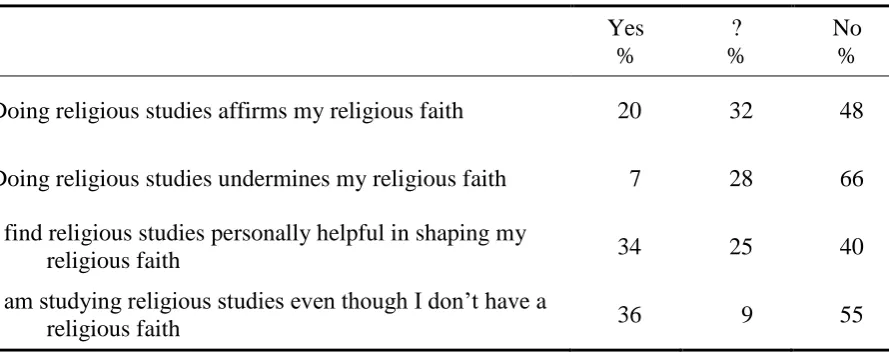
- insert table 8 about here -
The eighth issue explored by the survey concerned the perceptions of the students
regarding the connection between studying religion at A level and their personal religious
faith. The data presented in table 8 demonstrate that for the majority of students, studying
religion at A level does not connect directly with their personal religious faith. Indeed over
one-third of the students are clear that they are taking religious studies even though they do
not have a religious faith (36%). A similar proportion (34%), on the other hand, are finding
religious studies personally helpful in shaping their religious faith.
Only a small proportion of students (7%) have found that doing religious studies has
undermined their religious faith. Three times that number (20%) have found that doing
religious studies has affirmed their religious faith.
Discussion and conclusion
This study set out to address nine research questions. The original data gathered from
462 students who were coming to the end of the first year of studying religion at A level
offered the following responses to these nine research questions.
The first research question concerned the personal and religious profile of the 462
attracts both students who are closely aligned with religious identity and religious practice,
and students who have little current contact with a religious tradition. Thus, there are
significant numbers of students studying religion at A level who identify with a faith
tradition, and who engage with frequent public practice (worship attendance) and frequent
personal practice (prayer). There are also significant numbers of students who say that they
belong to no religious group, never pray and never engage with public worship attendance. It
is important for A-level religious studies provision to acknowledge the presence in the
classroom of students of religious faith alongside students who do not have religious faith.
The second research question concerned identifying the personal motivation of these
students to study religion at A level. The key finding is that the most important motivational
factor is the students’ experience of the subject (religious studies or religious education)
lower down in the school. Schools that wish to build strong religious studies A-level groups
need to invest well in the subject during the earlier formative years from year seven to year
eleven. This may involve giving proper attention to the curriculum and to the staffing.
The third research question concerned identifying the ways in which the students
perceived the educational challenges offered by studying religion at A level. The key finding
is that A-level religious studies offers effective challenges for students to reconceptualise
their understanding of the social, personal and intellectual dimensions of religion. In this
sense, A-level religious studies is offering a crucial foundation for the intelligent and
informed evaluation of the public and social significance of religion.
The fourth research question concerned identifying the levels of personal engagement
of the students with studying religion at A level. The key finding is that over one-third of the
students rated A-level religious studies as their first subject choice, as their best subject or as
good proportion of intrinsically motivated students who could (and should) become
ambassadors for the subject within the school.
The fifth research question concerned identifying the levels of perceived growth in
understanding encouraged by studying religion at A level. The key finding is that the
majority of students affirm that studying religion at A level genuinely promotes their
understanding of many aspects of religion and helps them to evaluate religious claims. Such
enhanced understanding should equip these students to make valuable and important
contributions within a wide range of professions and enhance their employability in many
sectors. In turn such information should enhance the professional self-confidence of the
subject itself and its position within the school curriculum.
The sixth research question concerned identifying the levels of perceived growth in
respect for religious diversity arising from studying religion at A level. The key finding is
that the majority of students affirm that studying religion at A level genuinely promotes their
respect for and positive attitude toward religious diversity. Such enhanced informed
awareness of religious differences offer an important contribution to fostering community
cohesion and to equipping citizens for managing the challenges and opportunities offered by
religiously diverse societies. It may be increasingly important that this public benefit deriving
from A-level religious studies should be better publicised.
The seventh research question concerned identifying the levels of perceived impact of
studying religion at A level on personal development. The key finding is that the majority of
students affirm that studying religion at A level has helped them to make better arguments,
and to evaluate their personal values. The contribution of the sixth-form curriculum to
personal development may be attractive to post-sixteen students grappling with adolescent
issues of identity, development and self-awareness. It may be wise to emphasise this
The eighth research question concerned identifying the levels of perceived impact of
studying religion at A level on spiritual and religious development. The key finding is that
this is not overall a high priority for the students. The majority have not joined the A-level
religious studies class either to critique or to deepen their religious beliefs. For a significant
minority, however, between one-third and two-fifths, A-level religious studies has helped
them to develop their relationship with God, to become more formed in their own religion,
and to develop spiritually. The A-level religious studies classroom needs to be fully aware of
and capable of relating to the expectations and needs of this significant minority of students.
The ninth research question concerned identifying how studying religion at A level
connects with personal religious faith. The key finding is that a very small minority of
students (7%) have found that studying religion at A level undermines their personal religious
faith while three times that number feel that it has affirmed their religious faith. There should
be little reason for churches to warn their young members against studying religion at A
level, but much stronger reasons for churches to encourage their young members to allow
References
Astley J., & Francis, L. J., (1996). A Level Gospel study and adolescents’ images of Jesus. In
L. J. Francis, W. K. Kay, & W. S. Campbell (Eds.), Research in religious education
(pp. 239-247). Leominster: Gracewing Fowler Wright; Macon, GA: Smyth & Helwys.
Astley, J., & Francis, L. J. (2010). Promoting positive attitudes towards science and religion
among sixth form pupils: Dealing with scientism and creationism. British Journal of
Religious Education, 32, 189-200. doi.org/10.1080/01416200.2010.498604
Cox, E. (1967). Sixth-form religion. London: SCM
Fearn, M., Francis, L. J., & Wilcox, C. (2001). Attitude toward Christianity and
psychological type: A survey among Religious Studies students. Pastoral Psychology,
49, 341-348. doi.org/10.1023/A:1010314610799
Field, C. D. (2010). A levels in religious studies
(http://www.brin.ac.uk/2010/a-levels-in-religious-studies/).
Francis, L. J., ap Siôn, T., Lewis, C. A., Robbins, M., & Barnes, L. P. (2006). Attitude toward
Christianity and religious experience: Replication among 16- to 18-year-old
adolescents in Northern Ireland. Research in Education, 76, 56-61.
doi.org/10.7227/RIE.76.5
Francis, L. J., & Astley, J. (1997). The quest for the psychological Jesus: Influences of
personality on images of Jesus. Journal of Psychology and Christianity, 16, 247-259.
Francis, L. J., Astley, J., Fearn, M., & Wilcox, C. (1999). Do social scientists hold a less
positive attitude toward Christianity? A study among female A-level students in
England. Journal of Christian Education, 42, 35-41.
Francis, L. J., Astley, J., & Wilcox, C. (1992). What is a Christian? Investigating the
understanding of 16- to 19-year-olds. In J. Astley & D. Day (Eds), The contours of
Christian education (pp. 325-339). Great Wakering: McCrimmons.
Francis, L. J., & Fearn, M. (1999). Religion and personality: A study among A-level students.
Transpersonal Psychology Review, 3, 26-30.
Francis, L. J., Fearn, M., Astley, J., & Wilcox, C. (1999). The relationship between Christian
commitment and motivation to study religion at A-level: A preliminary investigation,
Journal of Education and Christian Belief, 3, 115-122.
doi.org/10.1177/205699719900300206
Francis, L. J., Jones, S. H., & Wilcox, C. (1997). Religiosity and dimensions of psychological
well-being among 16-19 year olds. Journal of Christian Education, 40, 15-20.
doi.org/10.1177/002196579704000104
Francis, L. J., Robbins M., ap Siôn T, Lewis C. A., & Barnes, L. P. (2007). Psychological
health and attitude toward Christianity among Protestant and Catholic sixth-form
pupils in Northern Ireland. Pastoral Psychology, 56, 157-164.
doi.org/10.1007/s11089-007-0092-z
Francis, L. J., Robbins, M., Barnes L. P., & Lewis, C. A. (2006a). Sixth-form religion in
Northern Ireland: The Protestant profile 1968-1998. British Journal of Religious
Education, 28, 3-18. doi.org/10.1080/01416200500273596
Francis, L. J., Robbins, M., Barnes, L. P., & Lewis, C. A. (2006b). Religiously affiliated
schools in Northern Ireland: The persistence of denominational differences in pupils’
religious and moral values. Journal of Empirical Theology, 19, 182-202.
doi.org/10.1163/157092506778884508
Francis, L. J., Robbins, M., Lewis, C. A., Barnes L. P., & ap Siôn, T. (2007). Attitude toward
denominational differences. Educational Research, 49, 431-436.
doi.org/10.1080/00131880701717297
Francis, L. J., Robbins, M., Lewis, C. A. & Barnes, L.P. (2008). Prayer and psychological
health: A study among sixth-form pupils attending Catholic and Protestant schools in
Northern Ireland. Mental Health, Religion and Culture, 11, 85-92.
doi.org/10.1080/13674670701709055
Francis, L. J., & Wilcox, C. (1995). Personality, prayer and church attendance among
16- to 18-year-old girls in England. Journal of Social Psychology, 134,
243-246. doi.org/10.1080/00224545.1994.9711388
Francis, L. J., & Wilcox, C. (1996). Prayer, church attendance and personality
revisited: A study among 16- to 19-year-old girls. Psychological Reports, 79,
1265-1266. doi.org/10.2466/pr0.1996.79.3f.1265
Francis, L. J., & Wilcox, C. (1999). Personality and sex role orientation among 17-19
year old females in England. The Irish Journal of Psychology, 20, 172-178.
doi.org/10.1080/03033910.1999.10558233
Francis, L. J., Wilcox, C., & Jones, S. H. (1999). Is Bradburn’s Measure of
Psychological Well-Being fair to introverts? A study among 16- to 18-year-old
students. Psychological Reports, 85, 689-696.
doi.org/10.2466/pr0.85.6.689-696
Greer, J. E. (1972). A questioning generation. Belfast: Church of Ireland Board of
Education.
Greer, J. E. (1980). The persistence of religion: A study of adolescents in Northern
Ireland. Character Potential, 9, 139-149.
Greer, J. E. (1989). The persistence of religion in Northern Ireland: A study of sixth
fiche 20, G9.
Reid, W., & Filby, J. (1982). The sixth: An essay in education and democracy. Sussex:
Falmouth Press.
Wilcox, C., & Francis, L. J. (1997a). Beyond gender stereotyping: Examining the validity of
the Bem Sex Role Inventory among 16- to 19-year-old females in England.
Personality and Individual Differences, 23, 9-13.
doi.org/10.1016/S0191-8869(97)00026-3
Wilcox, C., & Francis, L. J. (1997b). Personality and religion among A-level Religious
Studies students. International Journal of Children’s Spirituality, 1, 48-56.
doi.org/10.1080/1364436970010207
Wilcox, C., & Francis, L. J. (1997c). The relationship between neuroticism and the perceived
social desirability of feminine characteristics among 16-19 year old females. Social
Behaviour and Personality, 25, 291-294. doi.org/10.2224/sbp.1997.25.3.291
Wright, D., & Cox, E. (1967a). Religious belief and co-education in a sample of sixth
form boys and girls. British Journal of Social and Clinical Psychology, 6,
23-31. doi.org/10.1111/j.2044-8260.1967.tb00495.x
Wright, D., & Cox, E. (1967b). A study of the relationship between moral judgement
and religious belief in a sample of English adolescents. Journal of Social
Psychology, 72, 135-44. doi.org/10.1080/00224545.1967.9922309
Wright, D., & Cox, E. (1971a). Changes in attitudes towards religious education and the bible
among sixth form boys and girls. British Journal of Educational Psychology, 41,
328-331. doi.org/10.1111/j.2044-8279.1971.tb00681.x
Wright, D., & Cox, E. (1971b). Changes in moral belief among sixth form boys and girls over
Journal of Social and Clinical Psychology, 10, 332-341.
Table 1
Personal motivation
Yes %
? %
No %
I am studying religious studies:
to learn more about more my own religious faith 27 15 58
to learn more about other religious faiths 68 15 17
to engage in debate with others 67 17 16
because I enjoyed my earlier experiences of the subject 78 11 11
because it is valued by universities 32 34 35
because it is an easy option 13 8 79
because it fitted into my timetable 8 10 83
Table 2
Personal challenges
Yes %
? %
No %
Doing religious studies challenges me:
to think differently about religious people 82 9 9
to think differently about religion in society 83 10 6
to think differently about the relationships between
religion and science 77 14 9
to re-think my ideas about God 52 19 29
Table 3
Personal experience
Yes %
? %
No %
Religious studies was my first subject choice 42 15 44
Religious studies is my best subject 33 37 30
Table 4
Growth in understanding
Yes %
? %
No %
A level religious studies is helping me to understand:
the philosophical concepts behind religion 88 9 3
the nature of religious beliefs 89 8 3
the history of religions 79 15 7
how the lives of individuals are influenced by their
religion 86 9 4
the influence of religion in the world today 85 10 5
the references to religion in the news 77 14 10
the references to religion in my other subjects 73 17 10
how religions relate to fundamental questions of life 78 16 6
Table 5
Respecting religious diversity
Yes %
? %
No %
A level religious studies is helping me to:
be positive about living in a society of diverse religions 79 15 7
be more tolerant of other religions and worldviews 80 13 7
respect other people’s rights to hold beliefs different
Table 6
Personal development
Yes %
? %
No %
A level religious studies is helping me to:
evaluate my personal values 71 19 10
be more critical of my own opinions 73 18 9
make better arguments 82 12 6
reflect on the meaning and purpose of life 71 18 11
develop the belief that life has some purpose 70 19 11
become a happier person 39 36 25
develop my personal relationships better 41 34 25
Table 7
Spiritual and religious development
Yes %
? %
No %
A level religious studies is helping me to:
develop spiritually 40 29 31
engage in my own quest for a faith to live by 42 29 29
develop a relationship with God 33 26 40
develop religious beliefs 39 25 37
express my own religious beliefs 59 22 19
become more formed in my own religion 39 26 35
become more agnostic 26 30 44
become more atheist 20 27 53
Table 8
Connecting with personal religious faith
Yes %
? %
No %
Doing religious studies affirms my religious faith 20 32 48
Doing religious studies undermines my religious faith 7 28 66
I find religious studies personally helpful in shaping my
religious faith 34 25 40
I am studying religious studies even though I don’t have a