Original citation:
Vigier, Mary and Spencer-Oatey, Helen. (2017) Code-switching in newly formed
multinational project teams : challenges, strategies and effects. International Journal of Cross Cultural Management, 17 (1). pp. 23-37.
Permanent WRAP URL:
http://wrap.warwick.ac.uk/87719
Copyright and reuse:
The Warwick Research Archive Portal (WRAP) makes this work by researchers of the University of Warwick available open access under the following conditions. Copyright © and all moral rights to the version of the paper presented here belong to the individual author(s) and/or other copyright owners. To the extent reasonable and practicable the material made available in WRAP has been checked for eligibility before being made available.
Copies of full items can be used for personal research or study, educational, or not-for-profit purposes without prior permission or charge. Provided that the authors, title and full
bibliographic details are credited, a hyperlink and/or URL is given for the original metadata page and the content is not changed in any way.
This is an Accepted Manuscript of an article published by Sage Publications Ltd in the International Journal of Cross Cultural Management
A note on versions:
The version presented here may differ from the published version or, version of record, if you wish to cite this item you are advised to consult the publisher’s version. Please see the ‘permanent WRAP URL’ above for details on accessing the published version and note that access may require a subscription.
Code-switching in newly-formed multinational project teams: Challenges,
strategies and effects
Mary Vigier
ESC Clermont School of Management, France
Email: [email protected]
Helen Spencer-Oatey
Centre for Applied Linguistics, University of Warwick, UK
Email: [email protected]
Theme: Cross-cultural team dynamics and intergroup processes
Abstract: Based on an ethnographic-like case study comprising observations and interviews with members of three newly-formed multinational project teams, our study explores the micro-processes of interactional
teamwork and captures how the three teams develop strategies for managing the challenges of code-switching in their interactions. Findings from our study suggest that teams interpret the impact of code-switching challenges differently in spite of the fact that they are performing similar activities, suggesting that adopting (clearly-defined) rules for managing interactions may not be as effective as the presence of other factors within the teams. Our findings extend theory on the use of a common working language in multinational teams and go beyond this by illustrating how individual teams establish practices for handling the challenges of code-switching, and the effects of these on team interactions.
Keywords: multinational company, multinational teams, common working language, code-switching challenges, team dynamics and processes, teamwork strategies, ethnographic-like case study
Introduction
Although previous studies in international management have addressed issues regarding
language and interactional processes in multinational teams (MNTs) (e.g. Brannen and Salk,
2000; Brett and Crotty, 2011; Canney Davison, 1994, 1996, with Ward, 1999; Gassmann,
2001; Govindarajan and Gupta, 2001; Janssens and Brett, 1997; Lagerström and Andersson, 2003; Price, 1996; Shachaf, 2008; Teagarden et al., 2005), these are often ‘stumbled’ upon but
are not necessarily the main research questions (Tietze, 2014). Thus, to our knowledge, only a small number investigate the theme of ‘language and communication in international teams’
in its own right. This body of research includes Del Carmen Mendez Garcia and Perez
However, these four studies obtained their data primarily from interviews, and only one
conducted observations of authentic interactions (Hinds et al., 2014), so they tend to focus on
retrospective perceptions about the challenges and opportunities generated by language use in
teams. Yet, as Tietze (2014) points out, empirical cross-disciplinary work that tracks
language activity across multinational companies (MNCs) would contribute valuable insights
to the field.
The present study aims to contribute to this goal by focusing on multinational project teams
and by using an empirical approach based on direct observation of their interactional
processes. Researchers frequently attribute difficulties in multicultural situations to national
culture (e.g., Hall, 1959; Hofstede, 1980; Trompenaars and Hampden-Turner, 1997).
However, findings from the current study indicate that the challenges of working in groups
with people from different cultural backgrounds involve a more complex range of factors
(Brannen and Salk, 2000; Milliken and Martins, 1996; Rogerson-Revell, 2007; Salk and
Brannen, 2000; Sarangi, 1994; Stahl et al., 2010; Thompson et al., 1996).
In the rest of this paper, we first briefly review the literature connected with code-switching in
newly-formed multinational project teams, drawing on international management
frameworks. After explaining our ethnographic-like case-study methodology, we address our
research questions by drawing out insights from across our three case study teams with regard
to the challenges of code-switching, the strategies the teams used to handle them, and the
effectiveness of these strategies. We then discuss our findings, acknowledge some
limitations, explore practical implications and make some recommendations for future
research.
Literature review: Theory and research questions
Dual impact of the challenges of code-switching
Code-switching in the workplace has been defined as changing from the common working
language of the international company (Harzing and Feely, 2008; Neeley et al., 2012), or
international team (Hinds et al., 2014; Tenzer et al., 2014), to the use of another language that
research has acknowledged a dual impact of this practice when doing business globally. On
the one hand, code-switching has been considered to be a helpful strategy when working in
international business contexts, since the use of other languages in addition to English is seen
as a valuable means of accomplishing the tasks at hand (Brannen and Salk, 2000; Cogo, 2010;
Feely and Harzing, 2003; Klimpfinger, 2009) and of building common ground and solidarity
among participants (Brannen and Salk, 2000; Chew, 2005; Ehrenreich, 2010; Feely and
Harzing, 2003; Janssens and Brett, 1997; Kankaanranta and Planken, 2010;
Louhiala-Salminen et al., 2005; Poncini, 2003; Tenzer et al., 2014; Virkkula-Räisänen, 2010). On the
other hand, in spite of these advantages, researchers have also reported that code-switching,
even for pragmatic purposes, is often not met with appreciation. Instead, it may be considered
as annoying, rude and disrespectful, triggering feelings of frustration, exclusion or mistrust,
regardless of the intentions behind this behaviour (Harzing and Feely, 2008; Hinds et al.,
2014; Neeley et al., 2012; Tenzer et al., 2014).
Unfortunately, it is only very recently that the international management literature has
addressed the issue of code-switching in MNTs. Hinds et al. (2014) used ethnographic
interviews and observations to report on both positive and negative reactions to
code-switching, and the strategies used to cope with such switches. Their article focused on
subgroup dynamics and power struggles through language-related decisions and behaviour.
On the basis of 90 interviews in 15 MNTs in three German automotive companies, Tenzer et al.’s (2014) work investigates how different types of language barriers – including
code-switching – impede trust formation in MNTs. Nevertheless, while both of these studies
investigate the impact of code-switching processes in MNTs, their findings pertaining to
code-switches are reported in the aggregate across the teams rather than on a team-by-team
basis. Work to date therefore remains largely incomplete as to how the dynamics and
processes actually occur within specific teams. Our research addresses this gap and sheds
light on the dual impact of code-switching practices in MNTs at the micro level and shows
how processes unfold in three separate teams. With this context in mind, we will address our
first research question: What challenges related to the impact of code-switching do
newly-formed, short-term multinational project teams experience in their interactions in the
Strategies to manage language-switching challenges
Another gap in the extant research involves a more in-depth understanding of the strategies
adopted by teams to handle the language switches. To our knowledge, only two recent studies
in the international management literature appear to address this area of research in global
teams. Hinds et al. (2014) report that strategies used by non-German speakers to handle the
code-switches of their German-speaking teammates include asking for translations or
explanations, asking that English be spoken, not taking the code-switching personally,
empathising with their German colleagues or declaring the code-switching to be rude.
Canney Davison and Ward (1999: 77) argue that, in order to compensate for any inequalities
in linguistic ability, and to ensure a level-playing field for all members, international teams
need to establish and follow a set of rules for effective language use, such as ‘giving time out
to talk in mother tongues so that people can explore and define what they want to say and paraphrase it back into the working language’. Therefore, this is another theoretical strand
that our paper will address in a second research question: How do teams manage their
code-switching challenges and to what extent do they learn to do so effectively?
We build on this theoretical foundation to illustrate how teams devise a set of strategies –
either formally or informally – to allow the optimising of task achievement and team
dynamics by managing code switching. In fact, from a general standpoint, the rules a team
adopts serve as crucial guidelines (Argyle et al., 1981) to govern team interactions and
behavioural dynamics (Earley and Gardner, 2005; Klimoski and Mohammed, 1994). Yet,
tightly structured ‘ground rules’ do not imply being rigid, but rather creating an ‘agreed field to play in’ (Canney Davison and Ward, 1999: 104). This flexibility of rules has been
underscored in the management literature (Larson, 1992; Ouchi, 1979; Shapiro, 1987).
Overall, to reduce the creation of anxiety in MNTs, activities need to be sufficiently organised
to enable task performance, but not so structured that they hinder individual responsiveness
(Hanges et al., 2005) or prevent processes from flowing naturally (Smith and Berg, 1997).
The current research will offer insights into a more in-depth understanding of what may
happen when rules to manage code-switching in MNTs are missing or are too rigid. This is
yet another area in the literature that needs to be more systematically investigated.
A second point related to rules also deserves further attention. In fact, rules and norms
defined (Davis, 1973; Larson, 1992). When explicit mechanisms, such as a written ‘social contract’ (Peterson, 2001), are not employed, informal agreements about what constitutes
appropriate behaviour remain implicit. These more subtle, less visible, forms of control work
quite effectively, thanks to a sense of community, cooperative action and commitment among
group members (Ouchi, 1979). Such internalised patterns of social behaviour, involving an
embedded degree of trust, therefore develop to govern personal relations and structures
(Doney et al., 1998; Granovetter, 1985; Peterson, 2001). In fact, trusting relationships
constitute a model of group control that emphasise the soft aspects of social processes
whereby trust, mutual respect and strong interpersonal relations are essential for the project’s
successful implementation (Easterby-Smith and Malina, 1999).
Effects of code-switching challenges and strategies on team dynamics and processes
This link between team performance and the soft aspects of teamwork underlines the
importance of informal and interpersonal processes, which are thought to be more resilient
than formal procedures (Edelman, 1990; Granovetter, 1985; Larson, 1992; Leana and Van
Buren III, 1999; Shapiro, 1987; Sitkin and Roth, 1993). As a matter of fact, positive
interpersonal relationships and social communication foster trust building, enable the
development of a more cohesive team, optimise working conditions (Teagarden et al., 2005),
and lead to goal achievement (Liang et al., 2015). Yet, other than the two recent studies by
Hinds et al. (2014) and Tenzer et al. (2014), the link between code-switching and
interpersonal team relations in MNTs remains largely unexplored in the management
literature, a focus that we will address in our third research question: What effects do
code-switching challenges and the strategies devised to cope with them have on team dynamics and
processes?
What differentiates our study is that we examine the micro-processes within three
project-teams carrying out their interactions using English as a lingua franca in a MNC in France, to
capture how the three MNTs respond to code-switching during their four problem-solving
tasks. Our research therefore fills a gap that is ‘long-overdue’ (Tenzer et al., 2014) by
examining the effects of language on MNTs. More precisely, our investigation sheds light on
the impact of code-switching challenges, the (in)effectiveness of strategies devised by each
Method
Research site
We conducted our research in a multinational company located in France, and obtained data
involving three newly-formed multicultural teams carrying out four problem-solving tasks
within a management integration programme.1 For reasons of confidentiality, we use the pseudonym Global Player in all references to the company and aliases have replaced the
names of people, functions and events. In this programme, and among other activities,
participants were put into problem-solving teams, using English as a common language,2 to find solutions to four corporate issues. To complete their tasks, the teams needed to establish
team-working practices to help them handle their interactive processes.
Each project-team workshop we observed took place in four distinct periods:
1) Presentation to the entire cohort3 of the task to solve by a corporate expert
2) Problem-solving and decision-making interactions in project teams4 – teams were given approximately one and a half hours to solve their problems; each team was
coached by a moniteur
3) Presentations to the entire cohort by two or three teams chosen at random
4) Debriefing sessions in each project team with the team’s moniteur
Research design
Our ethnographic-like case-study research design (Creswell, 2009; Eisenhardt, 1989, 1991;
Heigham and Sakui, 2009; Hood, 2009; Stake, 2005; Thomas, 2011; Yin, 2009) enabled us to
investigate how teams of people from diverse cultural and linguistic backgrounds try to make
sense of their context and develop strategies for working together. Observation records,
combined with interview comments, provide examples of how the programme participants
1 This paper is part of a larger study involving the interactive processes of multicultural project-team meetings (Vigier, 2015).
2
Some teams were designated as French-speaking although the majority were designated as English–speaking teams.
3 We were invited to attend the problem-solving workshops for three different cohorts. 4
(felt they) dealt with, and attempted to overcome, the challenges of code-switching while
working in these multinational project teams using English as a lingua franca.
To address the research questions, we examined interaction in multicultural project-team
workshops and obtained three types of data: observations of team interactions, observations
of follow-up team debriefing sessions, and interviews with the project-team participants. Our
complete data-set includes 37.5 hours of observations of project-team workshops and over 49
hours of interviews. We used the computer software programme for qualitative research
methods, NVivo (Bazeley, 2009), to store, organise and code these data. We analysed and
coded the data in the original language in which they were collected: English for the
observational data (interactions and debriefs) and English and/or French for the interview
data.
Participants
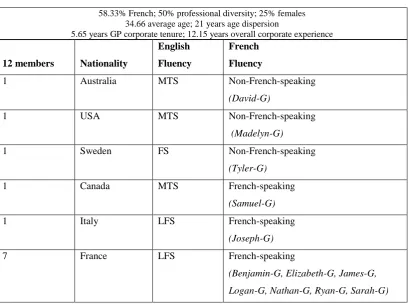
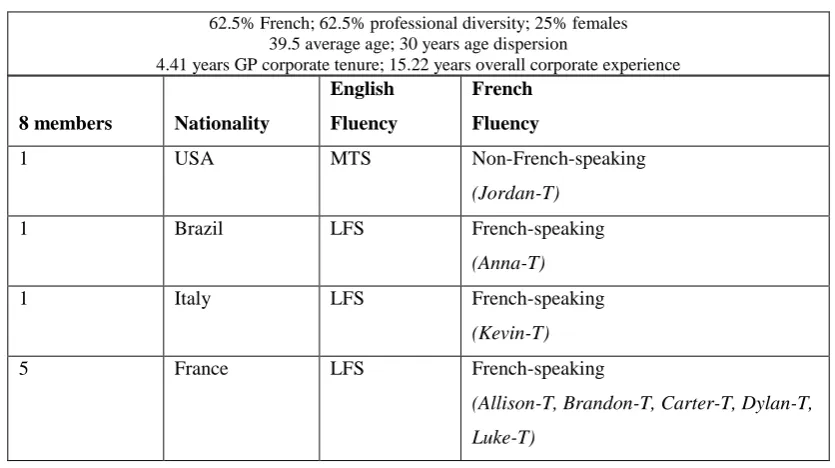
In this section, we present the three teams observed.5 The tables below provide the nationalities and language fluency for the thirteen members6 of Team K (Table 1), the twelve members of Team G (Table 2), and the eight members of Team T (Table 3). English fluency
includes mother tongue speakers (MTSs) and second-language speakers (SLSs) who were
either fluent speakers (FSs) or less-fluent speakers (LFSs). Fluent speakers refer to SLSs who
had had previous international experience (Canney Davison and Ward, 1999).7 French fluency indicates whether the participants were French-speaking or non-French speaking.
The tables also include the components of cultural diversity per team: percentage of French
members (representing a majority within the teams), percentage of different professional
sectors, percentage of females, average age, age dispersion between the youngest and the
eldest members, average number of years of Global Player (GP) corporate tenure, and average
number of years of overall corporate experience.
5
These are subsequently referred to as Teams K, G and T for reasons of anonymity. 6 There were thirteen members in Tasks 1 and 2; twelve members in Tasks 3 and 4.
Table 1. Team K’s members.
69.23% French; 53.85% professional diversity; 23.08% females; 36.39 average age; 27 years age dispersion;
3.05 years GP corporate tenure; 13.16 years overall corporate experience
13 members Nationality
English
Fluency
French
Fluency
1 India MTS Non-French-speaking
(Audrey-K)
1 USA MTS Non-French-speaking
(Emma-K)
1 Netherlands FS Non-French-speaking
(Zachary-K)
1 Romania LFS French-speaking
(Parker-K)
1 France FS French-speaking
(Olivia-K)
8 France LFS French-speaking
(Ethan-K, Jacob-K, [James-K – left the
team after Task 2], Leo-K, Lucas-K,
Mark-K, Michael-Mark-K, Wyatt-K)
Table 2. Team G’s members.
58.33% French; 50% professional diversity; 25% females 34.66 average age; 21 years age dispersion
5.65 years GP corporate tenure; 12.15 years overall corporate experience
12 members Nationality
English
Fluency
French
Fluency
1 Australia MTS Non-French-speaking
(David-G)
1 USA MTS Non-French-speaking
(Madelyn-G)
1 Sweden FS Non-French-speaking
(Tyler-G)
1 Canada MTS French-speaking
(Samuel-G)
1 Italy LFS French-speaking
(Joseph-G)
7 France LFS French-speaking
(Benjamin-G, Elizabeth-G, James-G,
[image:9.595.81.490.453.758.2]Table 3. Team T’s members.
62.5% French; 62.5% professional diversity; 25% females 39.5 average age; 30 years age dispersion
4.41 years GP corporate tenure; 15.22 years overall corporate experience
8 members Nationality
English
Fluency
French
Fluency
1 USA MTS Non-French-speaking
(Jordan-T)
1 Brazil LFS French-speaking
(Anna-T)
1 Italy LFS French-speaking
(Kevin-T)
5 France LFS French-speaking
(Allison-T, Brandon-T, Carter-T, Dylan-T,
Luke-T)
Case study findings
In each case study we report the challenges pertaining to the impact of code-switching, i.e. the
use of asides in French, the practices and strategies the teams used to manage these switches,
and the effects and effectiveness of these.
Case study 1: Team K
In Task 1 French was spoken in asides throughout the assignment (lines 12; 25-26; 61-62;
84-85 of observation notes).8 Moreover, the team experienced a number of other difficulties relating to communicative processes. The second task was even more troublesome so
between the second and third tasks the team decided to establish rules to help manage their
interactions. One interviewee commented on the team’s written rules, which included
guidelines concerning the use of asides in French:
The non-French speakers said…“respect us, speak English”…so that was the rule
(Jacob-K–interview).9
Overall, the assessment of the ‘speak-English’ rule appeared to be fairly positive (Vigier,
2015). However, a code-switching episode occurred in Task 4. Despite the rule stipulating
the use of English at all times, in one particular speech event Olivia-K made a very brief statement in French. When others in the group shouted ‘in English’, she apologised (lines
187-190). Two interviewees gave their accounts of this language-switching incident. Firstly,
Audrey-K claimed that:
Zachary-K lost...what they were saying...and then...I think he got personally offended
of it...because he was really, really that frustrated (Audrey-K-interview).10
Olivia-K commented on the particular ‘speak-English’ rule at length:
In a specific incident, in the last task, while being extremely aware of this rule, I
wanted to make...an aside to someone in particular; ... I summed it up...in three words,
in French, to tell him what I wanted to say…and at that particular moment, I don’t
know how many…who...said “...in English, in English!”...[The rules are good but
not]...such rigidness (Olivia-K-interview).11
For Olivia-K what appeared to matter most were positive intentions, not necessarily
respecting the rules to the letter:
I think that what works well...in relations, it’s when we are convinced of the positive
intentions...of others. ...It’s true, we are different, we don’t operate the same way, we
don’t have...the same country, the same profession...but as long as...we have the
conviction of positive intentions, we will make it (Olivia-K-interview).
9 Jacob-K-interview: Original in French; interviewed after Task 4. 10
These intentions apparently seemed lacking since Audrey-K believed this language-switching
example clearly illustrated the lack of trust within the team that prevented them from reaching the ‘performing’12
stage of their four-phase development:
There were people who could not trust simply some of the other people. ...We could
not really reach the performances...at the last stage (Audrey-K-interview).
Case study 2: Team G
In Team G’s first task, owing to the frequent use of French (14:40; 14:45; 14:50; 14:58-14:59;
15:05; 15:11; 15:13-15:14; 15:17; 15:31; 15:40),13 Madelyn-G advised the group to speak English to respect the non-French speakers (14:58).
In Task 2, although five asides in French appeared to have occurred (14:46; 14:54; 15:08;
15:10; 15:20), Ryan-G expressed the need for such switches:
When there are twelve of us…the advantage of having a small sub-discussion rapidly
[in French]…is that…if we have a question…we can at least ask our neighbour
(Ryan-G-interview).14
In the third task, French appeared to be used only five times, either to the whole group or in
side dialogues (9:35; 9:49). When this occurred, Elizabeth-G (9:35) and Madelyn-G (9:49)
reminded the team to speak in English and, overall, people seemed to have shown respect for
the non-French speakers by avoiding the use of French as much as possible.
In Task 4, French was used (14:37; 14:40; 14:50; 15:10; 15:16; 15:45), or English and French
were mixed, to ask for clarification, to find the right expression in English or to suggest
additional ideas to include in the slides.
Basically, during Team G’s four problem-solving workshops, asides in French appeared to
help the group move forward:
12 Tuckman, 1965, with Jensen, 1977.
13 See footnote at the beginning of Case study 1 with regard to the chronological reporting of the observation notes for Teams G and T. The project teams had approximately 1½ hours to solve each task.
The aside of…10-15 seconds…allowed us…to catch onto the argumentation…more
rapidly… Sometimes I judged [asides in French] useful…because when they responded to each other…(laughs)…it was like a ping-pong ball…and it was difficult
to stop them (James-G-interview).15
People…for whom…English was a hindrance…sometimes…spoke up saying: “OK, I’m making a small aside in my mother tongue…(laughs) because it will be faster”. …We were successful…using…these asides in French (Logan-G-interview).16
Unlike the situation in Team K in which a code-switching incident revealed a lack of trust and
a frustrating working climate even during the team’s final task, members of Team G seemed
to abide by an unwritten rule in which asides in French were apparently handled effectively
thanks to humour and a cheerful atmosphere within the team. For example:
I was happy to work with this group because…we were fairly close-knit, we got on
very, very well, we managed to be serious when it was necessary and then to have
funnier moments (James-G-interview).
Case study 3: Team T
In Task 1, like in both Teams K and G, French was sometimes used in asides (14:26; 14:30;
14:38; 14:39; 15:00; 15:15).17 Yet, even in Task 1, Jordan-T, the only non-French speaker in Team T, was tolerant and understood it was natural for the French to make asides in their own
language:
The French…naturally will migrate to that. …However, the ones that are more culturally aware…all of a sudden they will realise what’s happening because it’s just natural for them to...speak in…their language…and they will say: “Oh, wait a second. I see…Jordan-T’s listening, so we need to speak in English” (Jordan-T-interview).18
15
James-G-interview: Original in French; interviewed after Task 4. 16 Logan-G-interview: Original in French; interviewed after Task 4.
17 See footnotes at the beginning of Case studies 1 and 2 with regard to the chronological reporting of the observation notes for the interactions of Teams G and T.
In Task 2, French was again used for different reasons. Allison-T spoke in French to
encourage Dylan-T to contribute an idea (9:21). During the role-assignment process
(8:52-8:54), both Brandon-T and Dylan-T lightened the atmosphere by deliberately mixing English
and French and by not taking themselves too seriously.
In Task 3, a fairly long aside in French involving most of the participants was set off by
Dylan-T’s comment that he had not understood something (14:52-14:54). Yet, Jordan-T, the
only non-French speaker, did not complain about this use of French, but remained tolerant
(14:54).
Finally, in Task 4, owing to the strong convictions, triggered by the nature of the particular
problem-solving task, there was a greater involvement on behalf of all team members, and
simultaneously an increased use of French (8:34; 9:12; 9:20; 9:25-26; 9:34; 9:38-40; 9:41). In
three such speech episodes, to show respect to Jordan-T, the only non-French-speaker in the
team, Anna-T requested ‘in English’ (8:34), Kevin-T apologised (9:42) and Allison-T
translated:
…Once I was…near Jordan-T and somebody [said], “Well, I’m speaking French because I have a problem” and I did translate to him, but he didn’t ask me to do it
(Allison-T-interview).19
Basically, throughout the four tasks, the team appeared to have abided by an unwritten code
of conduct, like the unwritten rule that Team G eventually developed. Brandon-T described his feelings about the team’s effective handling of code-switching thanks to people’s values:
A lot of respect;…each person gave others time to speak…to interact;…it’s a friendly
atmosphere…as long as you stick to these values…of openness, respect…and of trying
to understand what the others are saying (Brandon-T-interview).20
19
Discussion
In this section we draw out insights from the case studies on the challenges related to the
impact of code-switching that the teams experienced, the relative (in)effectiveness of the
strategies they used to address them, and the effects of these.
The impact of code-switching challenges
As we have seen, all teams resorted to code-switching, i.e. the use of asides in French, the
language of the majority of the members in each team (see Tables 1, 2, 3), in spite of the fact
that using English as a common language constituted one of the main features of the project
teams investigated. More particularly, people used French to choose a role (T2),21 aid with understanding (K4, G4, T2, T3), check with their neighbours before speaking (G2, T2),
collaborate to find the right words (G4, T2), encourage fellow teammates to contribute an idea
(T2) or express strong convictions (T4). The challenge for them was to make sure French was
used as little as possible so as not to exclude the non-French speakers.
Although all teams strove to maintain smooth communication by reducing both the frequency
and the length of their switches to French, the impact of the code-switching challenges was
dual. Members of Team G felt that brief and occasional asides were helpful (Brannen and
Salk, 2000; Chew, 2005; Cogo, 2010; Ehrenreich, 2010; Feely and Harzing, 2003; Janssens
and Brett, 1997; Kankaanranta and Planken, 2010; Klimpfinger, 2009; Louhiala-Salminen et
al., 2005; Poncini, 2003; Tenzer et al., 2014; Virkkula-Räisänen, 2010) when the fluent speakers spoke back and forth to each other ‘like a ping-pong ball’ and that these asides were
‘successful’, ‘useful’ and ‘faster’ (G4) since they enabled the group to move forward. Even
so, the team still seemed to show respect by using French as little as possible (G3). Likewise,
people in Team T used French with humour (T2) and Jordan-T, the team’s only non-French
speaker, tolerated the need for fellow teammates to resort to French to clarify certain points (T3). In fact, he understood it was ‘natural’ for the other members of his team to ‘migrate’ to
French (T1), so when this happened he did not complain or make an issue of the situation (T1,
T3). However, the respectful and tolerant behaviour with regard to the use of asides in French
as a resource to facilitate teamwork in both Teams G and T contrasted sharply with the
reaction to the use of French in Team K, in which non-French speakers became ‘offended’
and ‘frustrated’ when French was spoken in a brief aside, after which several team members
shouted ‘in English, in English’ since they felt it was a violation of their ‘speak-English’ rule
(K4). Such incidents demonstrated that the use of asides in French appeared to have offended
the non-French speakers who did not appreciate being left out of the conversations; thus,
code-switching as a tool to aid SLSs in Team K apparently was considered as impolite
(Harzing and Feely, 2008; Hinds et al., 2014; Neeley et al., 2012; Tenzer et al., 2014) and generated a reverse effect on this team’s interactions compared to the use of French in the
other two teams. In response to the first research question, using French in asides was either
considered a help (Teams G and T) or a hindrance (Team K).
The (in)effectiveness of strategies to manage code-switching
In response to the second research question, our investigation has revealed that (1) it was
necessary for the teams to devise procedures for managing the critical challenge of
code-switching and (2) that these strategies differed across teams. More precisely, in order to
ensure respect for the non-French speakers and to optimise the work, Team K devised a
formal, written ‘speak-English’ rule. Conversely, after short dialogues in French, the ‘more
culturally aware’ in Teams G and T would – orally – remind people to revert to English (G1,
G3, T1, T4), some would apologise (T4) and others would translate (T4). Key findings that
have emerged from our research are therefore that establishing rules – through a formal
(Team K) or informal (Teams G and T) process (Davis, 1973; Larson, 1992; Ouchi, 1979;
Peterson, 2001) – was beneficial for handling the challenges of code-switching.
Nevertheless, as we have seen in the case studies, although all teams had their own
rule-setting processes and structures (explicit for Team K, implicit for Teams G and T), people in
both Teams G and T were tolerant of any deviation from their code-switching rules, whereas Team K’s rule-breaking incident involving an aside in French offended and annoyed team
members (K4).
Several procedural features might account for these differences. Basically, Team K’s rules appeared to be ‘rigid’, ‘unnatural’ and ‘extreme’ (Vigier, 2015) so were apparently not
flexible enough (Larson, 1992; Ouchi, 1979; Shapiro, 1987; Smith and Berg, 1997) to allow
enabling a restoration of the trust that seemed to have disappeared when the interactive processes ‘got out of control’ (Vigier, 2015) and led to the establishment of rules in the first
place. In contrast, in Teams G and T, both rule-setting and rule-implementing processes
seemed to be based on trust, mutual respect and strong interpersonal ties (Doney et al., 1998;
Easterby-Smith and Malina, 1999; Granovetter, 1985; Peterson, 2001; Sitkin and Roth, 1993),
so were apparently more lenient and flexible. This in turn had a positive impact on the
functioning of Teams G and T thanks to a pleasant environment and a climate of confidence as opposed to the frustration and distrust that prevailed in Team K. Thus, although Team K’s
formal rules were devised to improve dysfunctional team operations, they actually aggravated
processes by being too rigid to allow for any individual responsiveness (Hanges et al., 2005)
or for the natural flow of processes (Smith and Berg, 1997). Overall, the more subtle rules
and practices in Teams G and T appeared to be more resilient than the formal procedures
(Edelman, 1990; Granovetter, 1985; Larson, 1992; Leana and Van Buren III, 1999; Shapiro,
1987; Sitkin and Roth, 1993) created in Team K.
The effects of code-switching challenges and strategies on team dynamics and processes
Finally, regarding the third research question, the feelings of respect and trust as well as the
positive atmosphere and humour in Teams G (G1, G3, G4) and T (T2, T3, T4) contrasted with
the frustration within Team K (K1, K4) and, as we have seen, these interpersonal team
relations clearly influenced team operations and performance. Therefore, in addition to
managing their asides in French with rules (Argyle et al., 1981; Canney Davison and Ward,
1999; Earley and Gardner, 2005; Klimoski and Mohammed, 1994), either formally (Team K)
or informally (Teams G and T) (Davis, 1973; Larson, 1992; Ouchi, 1979; Peterson, 2001),
other vital factors must have impacted significantly on team functioning and contributed to
the effectiveness of the strategies adopted to cope with the code-switching challenges. Our
data suggest that diversity in age, experience and corporate tenure had a significant effect on
the team interactions (Vigier, 2015). This was apparently due to the fact that the senior members in Teams G and T tended to help or be more ‘courteous’ to the junior members
(Liang et al., 2015) in these two teams, whereas many of the members of Team K were close
in age, were at similar stages of their careers, had limited corporate tenure and may have had
limited shared corporate culture, all of which tended to create a more competitive rather than
cooperative atmosphere (Liang et al., 2015). This is in line with other research which has
ground (Brannen and Salk, 2000; Chew, 2005; Ehrenreich, 2010; Feely and Harzing, 2003;
Janssens and Brett, 1997; Kankaanranta and Planken, 2010; Louhiala-Salminen et al., 2005;
Poncini, 2003; Tenzer et al., 2014; Virkkula-Räisänen, 2010), developing informal and
interpersonal processes (Edelman, 1990; Granovetter, 1985; Larson, 1992; Leana and Van
Buren III, 1999; Shapiro, 1987; Sitkin and Roth, 1993) and fostering the creation of a
cohesive team (Teagarden et al., 2005).
In fact, in our investigation, the quality of the soft aspects of social processes appeared to
have had a strong impact on team interactions by influencing how the challenges of
code-switching were interpreted within each team. On the one hand, the positive interpersonal
relations in Teams G and T helped these two teams deal with the challenges of language
switches and develop appropriate strategies. On the other hand, although Team K was
operating similarly to the other two teams, because the level of trust was apparently lacking
and the relations did not seem as positive, this had a counter effect on the way the members of
Team K reacted to language-switching challenges and strategies. Indeed, code-switching
appeared to be inappropriate for people in Team K, highlighting the fact that the starting point
for the interactional aspects seemed to be the quality of the soft processes and interpersonal
team relations, regardless of the types of rules devised and the efforts made to apply them.
Previous studies on MNTs (e.g., Canney Davison and Ward, 1999; Earley and Gardner 2005;
Hinds et al., 2014; Klimoski and Mohammed, 1994) have highlighted the importance of
establishing rules and procedures to enable the achievement of task objectives and
simultaneously to help create strong interpersonal relations and build mutual trust and respect – and our findings support this. However, they go beyond this by showing how processes are
put into practice and the difficulties that can arise in doing so. Our study shows that all teams
experienced similar code-switching challenges, but that they each developed their own unique
strategies for handling these and that the impact of both the challenges and the strategies
affected the teams in different ways. It was our in-depth case study methodology that enabled
Acknowledgement of limitations
The present study has been subject to a number of limitations. Firstly, we were not looking at
the code-switching processes of on-going teams but at short-term teams in the formative
stages. Therefore, the particular teams examined had different ways of managing their
processes than established teams would have had. So care should be taken not to
overgeneralize the findings. A second limitation concerns the fact that the teams we studied
were somewhat artificial in that they were created for an internal corporate programme. In
particular, this study examined team assignments within a management integration
programme rather than authentic interactions of real project teams, because there were
confidentiality issues with the latter. Nevertheless, the teams we investigated were
participating in a real integration programme, with real career goals for staff working for a
real company. A third limitation relates to the fact that the participants were evaluated and
coached by a moniteur. Consequently, their behaviour may have differed from that of
members of authentic teams since many of the people in our teams were worried about how to
behave in front of the moniteur. A fourth type of limitation involves our methodology, and
more particularly, the corporate constraints to which we were subject. For example, Global
Player selected the particular project-team meetings for us to observe, and did not allow us to
audio- or video-record the team interactions.
Managerial implications and suggestions for future research
Despite the limitations, we believe some useful practical implications for managers have
emerged from our case study.
Firstly, managers and corporate trainers need to draw attention to the crucial importance of
being prepared to be confronted with a wide range of levels of fluency. Indeed, members of
MNTs need to learn to be tolerant of language differences by accommodating others and staying attuned to everyone’s linguistic needs. One way of accommodating LFSs might be to
allow for code-switching to help them get their points across. Secondly, managers and
corporate trainers should focus on the necessity of implementing a set of rules and practices to
respect, trust and positive intentions so as to enhance team functioning and prevent any
discomfort, dissatisfaction or frustration.
Further research on MNTs could help extend the insights obtained and the practical
implications associated with them. Firstly, more qualitative studies on code-switching in
real-life MNT interaction would enable growth in the body of research on ‘language in international business’ (Brannen et al., 2014). Secondly, longitudinal studies of authentic
multinational project teams would enable investigation of the effects of time and tenure on
code-switching. Researchers could also carry out studies focusing on specific process
variables, such as the effects of diverse types of rules and/or of trust on code-switching
patterns within established multinational project teams. Moreover, it would be valuable for
future research to pay more attention to the impact of diversity in age, experience and
corporate tenure (Vigier, 2015) on team dynamics and processes. Finally, other studies could
investigate the impact on team processes of specific linguistic or cultural components, such as
the role of monolingualism or differing leadership styles (e.g. Tenzer and Pudelko, 2015).
The overall findings from any of the research studies suggested above would lead to practical
recommendations and guidelines for managers and professionals in international business.
References
Argyle M, Furnham A, Graham JA (1981) Social Situations. Cambridge: Cambridge University Press.
Bazeley P (2009) Qualitative Data Analysis with NVivo. Thousand Oaks, CA: Sage Publications, Inc.
Brannen MY, Piekkari R, Tietze S (2014) The multifaceted role of language in international business: unpacking the forms, functions, and features of a critical challenge to MNC theory and performance. Journal of International Business Studies 45(5): 495-507. Brannen MY, Salk JE (2000) Partnering across borders: negotiating organizational culture in
a German-Japanese joint venture. Human Relations 53(4): 451-487.
Brett JM, Crotty S (2011) Fusing creativity in multicultural teams. Multicultural Teams:
Where Do We Go From Here? Virtual Webinar Series, 12 October 2011.
Canney Davison S (1994) Creating a high performance international team. Journal of
Management Development 13(2): 81-90.
Canney Davison S (1996) Leading and facilitating international teams. In: Berger M (ed)
Cross-Cultural Team Building: Guidelines for More Effective Communication and Negotiation. Maidenhead, UK: McGraw-Hill, pp. 158-179.
Canney Davison S, Ward K (1999) Leading International Teams. Maidenhead, UK: McGraw-Hill.
Chew K-S (2005) An investigation of the English language skills used by new entrants in banks in Hong Kong. English for Specific Purposes 24: 423-435.
Creswell JW (2009) Research Design: Qualtitative, Quantitative, and Mixed Methods Approaches.Thousand Oaks, CA: Sage Publications.
Davis JH (1973) Group decision and social interaction: a theory of social decision schemes.
Psychological Review 80(2): 97-125.
Del Carmen Mendez Garcia M, Perez Canado ML (2005) Language and power: raising awareness of the role of language in multicultural teams. Language and Intercultural Communication 5(1): 86-104.
Doney PM, Cannon JP, Mullen MR (1998) Understanding the influence of national culture on the development of trust. Academy of Management Review 23(3): 601-620.
Earley PC, Gardner HK (2005) Internal dynamics and cultural intelligence in multinational teams. In: Shapiro DL, Von Glinow MA, Cheng JLC (eds) Managing Multinational Teams: Global Perspectives. Oxford: Elsevier Ltd, pp. 3-31.
Easterby-Smith M, Malina D (1999) Cross-cultural collaborative research: toward reflexivity.
Academy of Management Journal 42(1): 76-86.
Edelman LB (1990) Legal environments and organizational governance: the expansion of due process in the American workplace. American Journal of Sociology 95(6): 1401-1440. Ehrenreich S (2010) English as a business lingua franca in a German multinational
corporation. Journal of Business Communication 47(4): 408-431.
Eisenhardt KM (1989) Building theories from case study research. Academy of Management Review 14(4): 532-550.
Eisenhardt KM (1991) Better stories and better constructs: the case for rigor and comparative logic. Academy of Management Review 16(3): 620-627.
Feely A, Harzing A-W (2003) Language management in multinational companies. Cross-Cultural Management: An International Journal 10(2): 37-52.
Gassmann O (2001) Multicultural teams: increasing creativity and innovation by diversity.
Creativity and Innovation Management 10(2): 88-95.
Govindarajan V, Gupta AK (2001) Building an effective global business team. MIT Sloan
Management Review 42(4): 63-71.
Granovetter M (1985) Economic action and social structure: the problem of embeddedness.
American Journal of Sociology 91(3): 481-510. Hall ET (1959) The Silent Language.New York: Doubleday.
Hanges PJ, Lyon JS, Dorfman PW (2005) Managing a multinational team: lessons from project GLOBE. In: Shapiro DL, Von Glinow MA, Cheng JLC (eds) Managing Multinational Teams: Global Perspectives. Oxford: Elsevier Ltd, pp. 337-360. Harzing A-W, Feely AJ (2008) The language barrier and its implications for HQ-subsidiary
relationships. Cross-Cultural Management: An International Journal 15(1): 49-61. Heigham J, Sakui K (2009) Ethnography. In: Heigham J, Croker RA (eds) Qualitative
Research in Applied Linguistics: A Practical Introduction. Basingstoke: Palgrave Macmillan, pp. 91-111.
Hinds PJ, Neeley TB, Cramton CD (2014) Language as a lightning rod: power contests, emotion regulation, and subgroup dynamics in global teams. Journal of International Business Studies 45(5): 536-561.
Hofstede G (1980) Culture's Consequences: International Differences in Work-Related Values.Newbury Park, CA: Sage.
Hood M (2009) Case study. In: Heigham J, Croker RA (eds) Qualitative Research in Applied Linguistics: A Practical Introduction. Basingstoke: Palgrave Macmillan, pp. 66-90. Janssens M, Brett JM (1997) Meaningful participation in transnational teams. European
Kankaanranta A, Planken B (2010) BELF competence as business knowledge of
internationally operating business professionals. Journal of Business Communication
47(4): 380-407.
Kassis Henderson J (2005) Language diversity in international management teams.
International Studies of Management and Organization 35(1): 66-82.
Klimoski R, Mohammed S (1994) Team mental model: construct or metaphor? Journal of Management 20(2): 403-437.
Klimpfinger T (2009) "She's mixing the two languages together" -- forms and functions of code-switching in English as a lingua franca. In: Mauranen A, Ranta E (eds) English as a Lingua Franca: Studies and Findings. Newcastle upon Tyne: Cambridge Scholars Publishing, pp. 348-371.
Lagerström K, Andersson M (2003) Creating and sharing knowledge within a transnational team: the development of a global business system. Journal of World Business 38: 84-95.
Larson A (1992) Network dyads in entrepreneurial settings: a study of the governance of exchange relationships. Administrative Science Quarterly 37(1): 76-104.
Leana CR, Van Buren III HJ (1999) Organizational social capital and employment practices.
The Academy of Management Review 24(3): 538-555.
Liang H-Y, Shih H-A, Chiang Y-H (2015) Team diversity and team helping behavior: the mediating roles of team cooperation and team cohesion. European Management Journal 33(1): 48-59.
Louhiala-Salminen L, Charles M, Kankaanranta A (2005) English as a lingua franca in Nordic corporate mergers: two case companies. English for Specific Purposes 24: 401-421. Milliken FJ, Martins LL (1996) Searching for common threads: understanding the multiple
effects of diversity in organizational groups. The Academy of Management Review
21(2): 402-433.
Neeley TB, Hinds PJ, Cramton CD (2012) The (un)hidden turmoil of language in global collaboration. Organizational Dynamics 41(3): 236-244.
Ouchi WG (1979) A conceptual framework for the design of organizational control mechanisms. Management Science 25(9): 833-848.
Peterson M (2001) International collaboration in organizational behavior research. Journal of Organizational Behavior 22(1): 59-81.
Poncini G (2003) Multicultural business meetings and the role of languages other than English. Journal of Intercultural Studies 24(1): 17-32.
Price H (1996) Team building in Asia. In: Berger M (ed) Cross-Cultural Team Building: Guidelines for More Effective Communication and Negotiation. Maidenhead, UK: McGraw-Hill, pp. 116-130.
Rogerson-Revell P (2007) Humour in business: a double-edged sword: a study of humour and style shifting in intercultural business meetings. Journal of Pragmatics 39(1): 4-28. Salk JE, Brannen MY (2000) National culture, networks, and individual influence in a
multinational management team. Academy of Management Journal 43(2): 191-202. Sarangi S (1994) Intercultural or not? Beyond celebration of cultural differences in
miscommunication analysis. Pragmatics 4(3): 409-427.
Shachaf P (2008) Cultural diversity and information and communication technology impacts on global virtual teams: an exploratory study. Information and Management 45(2): 131-142.
Shapiro SP (1987) The social control of impersonal trust. American Journal of Sociology
93(3): 623-658.
Smith K, Berg D (1997) Cross-cultural groups at work. European Management Journal
15(1): 8-15.
Stahl GK, Maznevski ML, Voigt A, et al. (2010) Unraveling the effects of cultural diversity in teams: a meta-analysis of research on multicultural work groups. Journal of
International Business Studies 41: 690-709.
Stake RE (2005) Qualitative case studies. In: Denzin NK, Lincoln YS (eds) The Sage Handbook of Qualitative Research. 3rd ed. Thousand Oaks, CA: Sage Publications, Inc., pp. 443-466.
Teagarden MB, Drost EA, Von Glinow MA (2005) The life cycle of academic international research teams: just when you thought "virtual" teams were all the rage...Here come the AIRTS! In: Shapiro DL, Von Glinow MA, Cheng JLC (eds) Managing
Multinational Teams: Global Perspectives. Oxford: Elsevier Ltd, pp. 303-336. Tenzer H, Pudelko M, Harzing A-W (2014) The impact of language barriers on trust
formation in multinational teams. Journal of International Business Studies 45(5): 508-535.
Tenzer H, Pudelko M (2015) Leading across language barriers: managing language-induced emotions in multinational teams. Leadership Quarterly 26(4): 606–625.
Thomas G (2011) How to Do Your Case Study: A Guide for Students and Researchers. London: Sage Publications Ltd.
Thompson N, Stradling S, Murphy M, et al. (1996) Stress and organizational culture. British Journal of Social Workers 26: 647-665.
Tietze S (2014) Keynote speech: exploring company performance from a language
perspective: evidence from research and future research directions. 8th International GEM&L Conference. Toulouse Business School, France.
Trompenaars F, Hampden-Turner C (1997) Riding the Waves of Culture: Understanding Cultural Diversity in Business.London: Nicholas Brealey.
Tuckman BW (1965) Developmental sequence in small groups. Psychological Bulletin 63(6): 384-399.
Tuckman BW, Jensen MAC (1977) Stages of small-group development revisited. Group and
Organization Management 2(419-427).
Vigier M (2015) Interaction in multicultural project-team meetings: managing the formative stages. PhD Thesis, Coventry: University of Warwick, UK.
Virkkula-Räisänen T (2010) Linguistic repertoires and semiotic resources in interaction: a Finnish manager as a mediator in a multilingual meeting. Journal of Business Communication 47(4): 505-531.