University of Warwick institutional repository: http://go.warwick.ac.uk/wrap
A Thesis Submitted for the Degree of PhD at the University of Warwick
http://go.warwick.ac.uk/wrap/57065
This thesis is made available online and is protected by original copyright. Please scroll down to view the document itself.
Essays on Market Structure and Competition.
Thesis
Submitted to the University of Warwick
for the degree of
Doctor of Philosophy
Department of Economics
Michalis Zaouras
University of Warwick
Contents
Contents i
List of Figures vi
List of Tables viii
Acknowledgements ix
Declarations x
Abstract xi
Introduction xiii
Topic I: David vs. Goliath 1
1 David vs. Goliath: Introduction and Literature Review 3
1.1 Introduction . . . 4
1.2 Literature . . . 8
1.3 Conclusion . . . 12
2 Theoretical Model 14
2.1 Theory . . . 15
3 Data and Market Definition 33
3.1 Data . . . 34
3.1.1 Market Structure . . . 36
3.1.2 Tube Stations Data . . . 41
3.1.3 Benchmark Variables . . . 45
3.1.4 Data to Construct a Proxy for Fixed Costs . . . 46
3.2 Market Definition . . . 50
3.3 Conclusion . . . 57
4 Empirical Investigation and Counterfactual Analysis 59 4.1 Empirical Investigation . . . 61
4.2 Identifying the Increased Propensity to Consume . . . 75
4.3 Counterfactual Analysis . . . 80
4.3.1 Maximum Cap on Entry . . . 81
4.3.2 Targeted Maximum Cap on Entry . . . 84
4.4 Conclusion . . . 86
5 Conclusion and Appendix 87 5.1 Conclusion . . . 87
5.A Appendix . . . 90
5.A.1 Firms to Area Figure . . . 91
5.A.2 Data sources and Issues . . . 92
5.A.3 Summary Statistics . . . 92
5.A.4 Timing . . . 93
5.A.5 Theoretical Model . . . 93
5.A.6 Definition of Variables . . . 101
References I 105
Topic II: Buyers Reporting a Cartel 110
6 Introduction and Literature Review 112
6.1 Introduction . . . 113
6.2 Literature Review . . . 116
6.3 Conclusion . . . 119
7 Basic Model and Social Welfare Implications 121 7.1 Model . . . 122
7.1.1 Buyers and Antitrust Authority . . . 124
7.1.2 Cartel . . . 130
7.2 Social Welfare Implications . . . 141
7.2.1 Social Welfare . . . 142
7.3 Conclusion . . . 143
8 Cartel Mechanisms on Controlling Reporting and Optimal Antitrust Policy145 8.1 Introduction . . . 146
8.2 Threat of Exclusion, foreclosure . . . 147
8.2.1 Excluded Buyers . . . 148
8.2.2 Equilibrium Cartel Behavior . . . 150
8.2.3 Threat of Exclusion . . . 151
8.3 Heterogenous cost of reporting . . . 159
8.4 A Comparison with Treble Damages . . . 162
8.5 Conclusion . . . 173
9.2 Mathematical Appendix . . . 177
9.2.1 Signalling Game. . . 177
9.2.2 Proofs for Lemma 2.1.2 and 2.1.4 . . . 179
9.2.3 Proposition 7.1.3 . . . 181
9.2.4 Proposition 7.1.5 . . . 183
9.2.5 Proposition 7.1.6 . . . 183
9.2.6 Bertrand Competition . . . 188
9.2.7 Proposition 7.2.1 . . . 189
9.2.8 Proposition 8.4.1 . . . 191
References II 193
List of Figures
2.1 Timing: David vs Goliath . . . 15
2.2 Entry Decisions . . . 18
3.1 Number of Coffee Shops and Subgroups Market Shares . . . 38
3.2 Total Entries and Exits . . . 39
3.3 Entries and Exits by Subgroups Market Shares . . . 39
3.4 Total Firms and Subgroups to Totaltube . . . 41
3.5 Uniform Approach . . . 52
3.6 2nd Approach . . . . 55
3.7 3rd approach . . . . 56
4.1 Identifying the Increased Propensity to Consume . . . 76
4.2 Average Number of Independents per tube station . . . 82
4.3 Average Number of Independents per tube station Scenario 2 . . . 85
5.1 Map of London and Central London. . . 90
5.2 Coffee Shops Density in Central London. . . 91
5.3 Total Number of Firms to Log Area. . . 91
5.4 Timing David vs. Goliath . . . 94
7.1 Timeline, Ch.7 . . . 122
7.3 Profits and Quantity as a function of v . . . 134
8.1 Collusive Price and Excluded Buyers . . . 149
8.2 Minimum Discount Factor . . . 156
8.3 Timeline Extended, Ch. 8 . . . 163
8.4 Cartel Incentives . . . 170
9.1 Signalling . . . 177
List of Tables
2.1 Entry Game . . . 20
2.2 Exit Game . . . 27
3.1 Tube Station Variables Summary Statistics . . . 45
3.2 Fixcosttime vs. Fixcost Example . . . 50
4.1 Estimation Results . . . 64
4.2 Estimation Results, Identifying Increased Propensity to Consume . . . 77
5.1 Summary Statistics . . . 93
5.2 Shifts of Demand Effects on Estimation . . . 104
7.1 Reporting Dilemma . . . 129
Acknowledgements
Foremost, I would like to thank my supervisors Professors Norman Ireland and Michael Wa-terson for their guidance and support. Pr. Michael WaWa-terson’s guidance has been outstanding and has provided me with the tools and intuition to appropriately tackle my research ques-tions. It has been a great honour working with him and Pr. Norman Ireland. I feel that Pr. Norman Ireland’s incredible insight and guidance was inspiring and highly motivating. I owe to both of them my development as an academic. It has been a privilege working with both of them.
Finally, I would like to thank the Department of Economics at the University of Warwick.
Declarations
I Declare:
Abstract
My thesis consists of two relatively independent topics. In the first topic I empirically inves-tigate the factors that determine the presence of the independent coffee shops in the market of Central London. In the second topic I present a theory of cartel detection. The common feature of these topics is that I investigate the demand side effects on market structure and its impact on competition.
To be more specific, in the first topic I build a simple theoretical model of product differentiation in adjacent markets, based on Mazzeo (2002). For the empirical estimation I have constructed a unique dataset of coffee shops in Central London. I further manage to identify differences on demand characteristics across markets by utilizing data on people’s mo-bility from the tube stations and provide evidence for the existence of product differentiation. It is found that residential areas with high employment, areas with small business density and leisure areas increase the profitability of the independent coffee shops. A counterfactual analysis is also presented.
In the second topic I investigate the cartel’s strategies and likelihood of collusion when the buyers of the cartel are able to report its existence to the anti-trust authority. I char-acterize the cartel’s optimal behavior when the buyers are actively monitoring the cartel’s members and are able to report a cartel to an anti-trust authority1. I present a simple static
model and I show that the likelihood of collusion increases as the willingness of the buyers to report increases (cost of reporting decreases). Furthermore, it is shown that it is optimal for an anti-trust authority to decrease the cost of reporting (a trade-off between price reductions in existing cartels and increased likelihood of cartel formation is identified). Finally, alterna-tive cartel strategies are also explored in this topic. As for the last point, I show that the threat of exclusion (foreclosure) and price discrimination are robust strategies that prevent
1This is an element of market structure since the buyers are exogenously informed or assumed that they
Introduction
My thesis is divided into two topics. The first topic includes six chapters and investigates the factors that determine the exit decision of the independent coffee shops in Central London. The first chapter of this topic includes an introduction and the literature review. The second chapter presents the theoretical model. In the third chapter the data is presented and the relative market is defined. In the fourth chapter the empirical investigation is provided. The fifth chapter is a concluding chapter but also includes the appendix of the topic. In the last chapter the bibliography is reported.
Topic I: David vs. Goliath; Product
Differentiation and Chain Stores’
effects on Independents
In the first topic I present an empirical investigation of the coffee shops market in Central
London. I utilize a unique dataset of coffee shops in Central London to explore the
impor-tance of chain stores’ behavior towards the presence of independents in the market. A simple
theoretical model that links exit with entry of firms and introduces product differentiation
in concentrated markets is constructed. The model predicts that product differentiation and
market specific demand characteristics are key factors to ensure the survival of the
indepen-dent firms. The high quality dataset addresses common problems in investigating
metropoli-tan areas. The most innovative part of this topic is the use of tube stations’ data to estimate
the importance of demand characteristics to the likelihood of an independent coffee shop to
exit. An additional important finding of the empirical estimation is that within group
(inde-pendents) competition is more important than between groups (chain stores vs. inde(inde-pendents)
competition. The intuition for this finding is the existence of product differentiation which
safeguards the independents from the chain stores’ effects. Furthermore, the importance of
product differentiation for the buyers is estimated and, in contrast to most of the literature,
shop is quantified. A counterfactual analysis of city planning policies and their impact on
market concentration is presented.
There are six chapters in this topic. In the first one I discuss my motivation and my
research questions. I also present the most important findings and the framework used. I
then discuss the relevant literature. In the second chapter I present the theoretical model
and in the third chapter I present the data and discuss how I define the relevant market. In
the fourth chapter I present the empirical results and the counterfactual analysis. In the fifth
chapter I conclude the topic and include the relevant appendix. In the last chapter I present
Chapter 1
David vs. Goliath: Introduction and
Literature Review
In the first chapter I discuss the motivation of this research project. I also present my
research questions and the framework used. In addition I briefly present the data sources
used to identify market specific demand effects and the significance of product differentiation.
The most important findings are also being discussed. Finally, in the last section I present
1.1
Introduction
In the UK there has been a long discussion1 about the “clone towns” effect2 and whether the
chain stores expansion should be restricted. As lobbyists against chain stores expansion argue,
the cities are being homogenized, the local identity is lost3 and highly concentrated markets
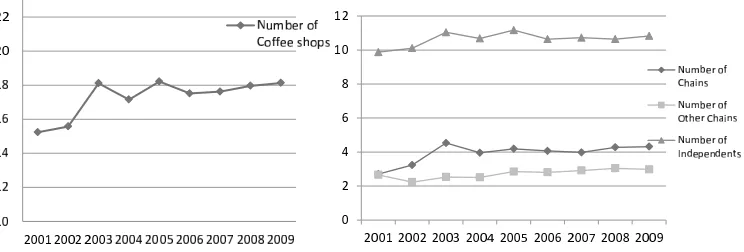
are generated. In the case of coffee shops within Central London sub-markets I observe the
independent firms (independents) enjoying a large market share, on average corresponding
to approximately 60%, which remains constant across time. However, a “clone town” effect
is also present, since in some cases the chain stores dominate with shares larger than 70%4.
Hence, the coffee shops’ industry in Central London is an ideal market to examine the factors
that facilitate the presence of independents in markets and highlight the effects of chain stores’
(hereafter denoted as C-Ss) behavior in the market5.
In chapter 2 I present a simple theoretical model extending Mazzeo’s (2002) model by
introducing an exit stage, as with Bresnahan and Reiss (1994), and introducing neighbourhood
effects, as with Seim (2006). The entry and exit multiplicity issue is tackled by assuming that
the entrants need to bid for their right to enter the market, through an English Auction
setting6. The unique equilibrium defines both the number and the identity of the entrants,
predicting that the most profitable enter. At the exit stage the incentives of the entrants
1See the following websites for illustrationhttp://news.bbc.co.uk/1/hi/magazine/4602953.stm,
http://www.guardian.co.uk/business/2012/oct/28/totnes−costa−cof f ee−high−street?IN T CM P = SRCH and
http : //www.independent.co.uk/news/uk/this−britain/cambridge−beats−exeter−f or−title−as−
uks−ultimate−clone−town−2079476.html.
2Where “clone towns” refers to the dominance of chain stores across city centres’ in UK towns and the
displacement of independents.
3See for example, New Economics Foundation (NEF) website (http :
//www.neweconomics.org/publications/reimagining−the−high−street).
4A map is provided in the appendix with the market shares of subgroups across submarkets in Central
London.
5Investigating if the “clone towns” effect exists in the market of coffee shops.
6This assumption was motivated by the fact that available retail space in Central London are scarce and
to replace7 an unprofitable incumbent combined with the assumption that entrants need to
bid for their right to enter, guarantee a unique equilibrium as well. Moreover, the model
provides a link between entrants and incumbents. To be more specific, the model predicts
that displacement and replacement, which rationalize entry in satiated markets, can be an
equilibrium behavior.
Most importantly, this model predicts that product differentiation and market specific
effects will safeguard the independents since it increases their profitability and offsets any cost
advantages that the C-Ss may enjoy. I further identify a non-strategic fringe, independent
incumbents, for which the market structure is given when taking exit decisions. In addition,
the C-Ss behavior does not depend on an individual independent’s probability of exit but
rather on the market structure8. As a consequence, a simple estimation procedure can be
used in order to examine the independent’s likelihood of exit9. Furthermore, the model
developed here can also be applied to other industries characterized by variation on both
entry and exit and a satiated market, where the total number of firms remains unchanged.
Industries where the assumption that entrants need to compete for the right to enter include
the airlines, the shipping and the retail industries in metropolitan areas.
In the empirical estimation the predictions of the theoretical model are tested and in
contrast to most of the existing literature10, with exception to Mazzeo (2002) and Smith
and Gorman (2008), demand factors that influence the market’s profitability are investigated.
A unique panel data-set of 1900 coffee shops covering the period between 2000 to 2009 is
employed including entries and exits of both independents and C-Ss in the coffee shops’ market
7This is also a consequence of the location scarcity assumption.
8In my view, the C-Ss decisions should not be influenced by the behavior of a particular independent but
rather from the overall market structure.
9Notice that an independent entrant is behaving strategically but conditional on entry an independent
incumbent is a non-strategic player. Therefore, a simple exit rule is constructed and estimated through a random-effects probit model.
10The literature has mainly focused on supply side effects such as sunk and fixed costs, suppliers’ strategic
of Central London. Most importantly, product differentiation is present in the data-set11 as
well as a large variation on the independents’ market shares across Central London subareas.
Data on commuting are included, i.e. on people’s traveling through tube stations, to estimate
the demand characteristics. The latter has been an unexplored source which tackles the
issue of demand effects’ estimation in metropolitan areas. The tube stations’ data reveal the
demand characteristics of each area12. In this topic people’s entry in the morning rush hours
is utilized to estimate the effect of residential employment on the independent’s profitability.
Another variable is constructed to estimate the effect of high business density by using counts
of the number of people that exit a tube station during the morning rush hours13. The third
variable is the number of people that visit a tube station during the weekend. This variable
should capture the demand for product differentiation14. The last variable constructed from
the tube station data is the total number of people that commute through a particular tube
station (both entries and exits). This variable captures the total demand for coffee, while the
previous three variables estimate demand characteristics. Furthermore, if the tube station
data is used properly it can be a source to investigate a wider range of questions (such as
city planning to decrease market concentration15) and a number of other industries within
metropolitan areas.
A random-effects probit model is applied in order to estimate the determinants of the
independent incumbents’ likelihood of exit. Even though the theoretical model is richer
11The independents’ group can be categorized into four different subgroups; coffee shops, delicatessens,
patisseries and sandwich bars. Furthermore, coffee is differentiated as a product as well. Some examples are: Cappuccino, Latte, Americano, Macchiato, Espresso and filter coffee.
12The demand in Metropolitan areas is mainly defined by the number of people that visit a subarea and
not its local population. As a result benchmark data sources like the local demographics will fail to estimate the importance of demand.
13Exit from a tube station is someone’s destination and I believe that during these hours the destination of
people is most likely to be their work place.
14It is more likely for people’s destination during the weekend to be leisure areas and I assume that at
leisure areas people are more likely to consume a differentiated coffee product.
15Other uses for the data-set are to investigate the determinants of real estates values in Metropolitan areas,
in structure, I do not investigate C-Ss entry - exit decisions or the entry decision of the
independents since it is not in the scope of this topic to examine market evolution16. The most
important finding of the empirical investigation is that within groups competition is found to
be more important than between groups suggesting the existence of product differentiation.
It is further shown that in the coffee shops’ market of Central London there is no effect on the
independents’ profitability resulting from the C-Ss’ presence or expansion. It is found that the
independents’ exit depends mainly on the number of independent incumbents and entrants.
Furthermore, the significance of product differentiation on the independents’ profitability is
estimated and specific market demand effects are identified. An additional finding is that an
independent coffee shop located in a leisure area, an area with a small density of businesses
and a residential area with high employment, will be more profitable. The last result suggests
that preferences in different areas determine the structure of the industry.
Finally, a counterfactual analysis, incorporating two scenarios, presents an example of
investigating city planning policies in Metropolitan areas and their effect on market structure
and concentration. In the first scenario we place a uniform (the same across subgroups) cap
on the number of entrants. This scenario was motivated by a planning regulation that took
place in 1996 in the UKs groceries market. We show that under this scenario the number of
independent incumbents will decrease and that the independents will be influenced the most.
In the second scenario we restrict the number of C-Ss entrants to zero if their market shares
are larger than a threshold point. This approach, liquidation of assets or growth constraints,
is usually taken by anti-trust authorities when they trace presence and abuse of market power
in an industry. The second scenario successfully increases the number of independents and
decreases the C-Ss market share.
16The construction of an entry - exit model, a more general model, was necessary since it defines how
1.2
Literature
The theoretical part of this topic builds on Mazzeo (2002). Mazzeo uses the framework
proposed by Bresnahan and Reiss (1991) and Berry (1992). The latter authors provide a
framework to investigate the effect of entry and strategic behavior on market concentration.
Furthermore, Bresnahan and Reiss (1991), estimate threshold points required for an additional
competitor to enter. Additionally, Bresnahan and Reiss (1994) investigate the importance of
sunk and fixed costs in their effort to estimate their effects on the intensity of competition.
Their estimation is based on the observation that when entering firms endure sunk costs and
when exiting they face a scrap cost. The approach taken was to compare the exit and entry
thresholds in order to estimate the fixed costs of an industry. In chapter 2 I extend Mazzeo’s
(2002) paper to allow for an exit stage as with Bresnahan and Reiss (1994). In contrast
to both papers, I formally shown that entry and exit is feasible in satiated markets. I also
suggest a new assumption, auction game prior entry (the entrants need to bid for the right
to enter the market), which solves the multiplicity issue.
Mazzeo (2002) is the first researcher that endogenizes the choice of the entrants to locate
themselves in the product space, introducing product differentiation. In a similar paper S.
Greenstein and M. Mazzeo (2006) test the role of product differentiation in entry decisions,
in the telecommunications industry. However, in this model the types of the groups,
Chain-Stores (denoted by C-S) and independents (denoted by y), are predetermined and they may
choose whether to enter heterogeneous markets. Hence, in the chapters of this topic the
type of the entrant is not endogenized but the choice to enter depends on their type in the
product space17. My approach also allows for the investigation of between and within groups
competition effects on the independents’ profitability, as with Mazzeo (2002). Furthermore,
the task to investigate a metropolitan area, Central London, introduces spatial correlation
that needs to be tackled, something that is not considered by Mazzeo. In addition and with
respect to product differentiation, Smith and O’Gorman (2008) also consider the importance
of product differentiation when estimating lower and upper bounds of the Radio Industry
fixed costs but they do not aim to identify specific demand market effects and demand taste
parameters18.
Seim’s (2006) work is the first paper which endogenizes entry in adjacent markets.
Adjacent markets are present in this data, markets within Central London, and as a result
Seim’s work will be relevant to the chapters of this topic. Seim’s technique is employed as
a control for spatial correlation in the empirical estimation. However, her theoretical model
generates a nested algorithm which defines the entry rule in adjacent markets is not extended,
since I believe that this should be a straightforward extension of Seim’s model and for the exit
decisions the adjacent markets are not a strategic element19. Notice, though, that the main
difference of the theoretical model chapter of this topic with Seim’s work is the introduction
of both product differentiation and exit stage.
The fact that both entry and exit is investigated, generates a model of market evolution.
There are a number of other papers that also examine market evolution. B. Jovanovic’s (1982)
seminal paper proposes a theory of selection where the most efficient grow and survive. A
similar paper that examines the firms’ life cycle is S. Klepper (1996)20 who presents a model
where product innovation determines the life cycle of the industry. Klepper (2002) empirically
tests this hypothesis. He shows that pre and post experience matters through R&D for firms’
survival, in four distinct industries. Klebber’s model is built on a series of papers that examine
the product innovation hypothesis. See for example, J. M. Utterback and W. J. Abernathy
(1975) and B. Jovanovic and G. M. MacDonald (1994). However, in the coffee shops’ industry
18I show in the empirical estimation chapter that there is a morning hours effect on the profitability of the
independent coffee shops. This suggests the presence of a strong preference to consume coffee in the morning.
19The independent’s do not choose to exit from adjacent market A or B since by definition they are 1 store
firms.
and for the time period examined (2000-2009), product innovation is not relevant and as a
result it is not anticipated that it can explain the industry’s evolution. My model differs from
this literature since I examine product differentiation21as a factor that determines the market
evolution22.
The theoretical chapter of this topic examines replacement and displacement of the
incumbents, which links entry with exit and explains why we observe this behavior in a
satiated market. Displacement, as far as I know, has only been examined in an empirical
study by D. Shapiro and R.S. Khemani (1987) who found evidence that the entrants displace
the incumbents.
In a similar strand of literature, R. Ericson and A. Pakes (1995) examine the dynamics
of industry evolution. The firms are assumed to choose between entry, investment and exit.
These choices are influenced by expectations on the evolution of competition. A number of
papers have enriched this framework. V. Aguirregabiria and P. Mira (2007) propose a
frame-work that allows for multiple equilibria in dynamic discreet games. A. Pakes, M. Ostrovsky
and S. Berry (2007) present an approach to estimate the sunk costs. J. H. Abbring and J.
R. Cambell (2010) extend Bresnahan and Reiss (1990) model by assuming last in, first out
behavior that guarantees a unique Markov perfect equilibrium in order to estimate the sunk
costs. N. Yang (2011) applies a dynamic framework that uses refinements of Markov
per-fect equilibria to overcome multiplicity issues. My theoretical chapter considers both entry
and exit but in contrast to the above papers I abstract from endogeneity and dynamic
con-cerns23. This is mainly because I focus on providing a simple model that introduces product
differentiation and market specific effects, in such a setting (with both entry and exit), in
order to investigate whether demand effects can explain the persistence of independents in
21The availability of differentiated products is defined by the taste parameters of the consumers. In other
words, the demand of differentiated products will allow for the suppliers (firms) to become product differen-tiated.
22The framework used is also different.
the markets.24. I manage to do that by identifying a non-strategic fringe where endogeneity
(influencing the market structure as well as being influenced by the market structure of the
industry) and dynamic concerns are not an issue.
In the entry in concentrated markets literature there are a number of papers that
exam-ine the effects of C-Ss behavior (entry and strategic behavior) on the market structure of an
industry. This part of the literature is the most relevant to this topic. To be more specific,
O. Toivanen and M. Waterson (2005) are the first, to my knowledge, that present an analysis
of C-Ss strategic behavior. They find support on market learning effects, a result that I wish
to investigate further. They focus entirely on competition within C-Ss rather than between
C-Ss and independents. J. Holmes (2011) and P. Jia (2008) also examine C-Ss. The former
identifies economies of scopes which can explain the growth of a C-S. The latter investigates
the impact of the C-Ss entrance on the independents (this is also the closest paper with
re-spect to the research question examined25) in a model in which firms choose to enter and exit.
However, her model lacks differentiation and abstracts from metropolitan areas.
With respect to the coffee shops’ industry, as far as I know there are only two other
papers that investigate this market; McManus (2007) and D. Durevall (2007). More
particu-larly, McManus examines non-linear pricing and finds evidence that distortions decrease, in
the coffee market, as the willingness of buyers to pay increases. Hence, even though McManus
investigates the market of coffee shops, he uses a different context and investigates a different
research question from the one presented in this topic. Durevall examines the coffee industry
in a different context as well. He investigates whether market power is present in the coffee
shops market in Sweden and whether downstream prices are high.
Finally, the entry and exit literature has mainly abstracted from metropolitan areas.
24Extending the empirical approach to incorporate dynamics will definitely be an improvement, but this is
left for future research.
25She investigates what happens to the independents when a C-S enters while I examine both the C-Ss
The main reasons for that are either the lack of micro level data of the population or the
nature of demand in these areas. To be more specific, for some industries (retail) the main
bulk of revenues is generated from the population that visits an area (footfall) rather than
the residents of that area. The only exception to this literature is the paper by Bresnahan
and Reiss (1994) who investigate the market of dentists. However, the feasibility of this study
was based on the local attribute of this industry (it is less likely for people to travel a great
distance to visit a dentist, except on rare cases where specialized work is required and in the
case of a “star” dentist). Hence, there was no need to estimate the demand charateristics of
the industry based on footfall variables.
1.3
Conclusion
This chapter has presented the motivation, the research questions, the framework, the data
sources and the literature of the first topic. The motivation comes from a long discussion in UK
about the “clone cities” effect. The research question is why do we observe in some markets
within Central London the C-Ss displacing the independent coffee shops and in some other
markets the fail to do so. Furthermore, I am interested to investigate what determines the exit
decision of the independent coffee shops in Central London. I first, construct a theoretical
model that specifies the exit decision of the independents. The data sources used are the
Yellow and White pages, the tube station data and neighborhood statistics from the Office
of National Statistics. The empirically investigation suggest that product differentiation and
market specific effects are important factors to the independent coffee shops exit decision. A
counterfactual analysis is also presented in this topic.
My research on this topic is relevant to the entry in concentrated markets literature.
To be more specific, I built my theoretical model based on Bresnahan and Reiss (1994) and
Chapter 2
Theoretical Model
In this chapter a simple model is presented, which introduces replacement and displacement of
the incumbents when product differentiation is present. The model actually extends Mazzeo
(2002) to allow for an exit stage, as with Bresnahan and Reiss (1994), and controls for adjacent
market effects as with Seim (2006). To be more specific, I utilize Bresnahan and Reiss’ (1994)
approach to define a structure on the profit functions for entry and exit. The Bresnahan and
Reiss paper provides an empirical and theoretical framework which allows the estimating of
the fixed costs of an industry. I show that entrants might replace or displace an incumbent.
I also assume location competition prior entry which solves for multiple equilibria. Finally,
Figure 2.1: Timing: David vs Goliath
2.1
Theory
I assume a game of two stages. In the first stage the potential entrants receive their fixed cost
draw, this will be repeated at each time period for the entrants but not for the incumbents.
The entrants then decide where (within a market) and whether to enter. Then the entrants
decide how to enter; either by displacing or replacing an incumbent. In the last case I will
assume that the entrants will need to buy their right to enter the market (this under some
conditions will generate displacement) or buyout the incumbent (replacement). In either
case this will be accomplished through an English auction setting (if there is more than one
potential entrant). In the second stage the incumbent observes the changes on the market;
the number and the identities of the new entrants as well as their highest bid. The incumbent
will then decide whether to accept a bid from the entrants and exit, or exit in any case (even if
the incumbent has not received a bid) or stay in the market. The first two cases will generate
the scrap value for the incumbents which will be denoted as hi1. The timeline is given in
figure 2.1.
For a more formal definition of the timing please see the appendix. Let me now define the
profit function for the three different states that a firm may encounter. The profit functions
following Bresnahan and Reiss (1994) are:
Entrant: Πi,j,t =d(Z)αi,j,tS(Y)−fi,j,t−Fi,j,t (2.1)
1The scrap value can be positive or negative, since it includes the bid of the entrants (if the incumbent is
Incumbent: Πi,j,t =d(Z)αi,j,tS(Y)−fi,j,t (2.2)
Exit: Πi,j,t =hi,j,t (2.3)
Where subscript i refers to an individual coffee shop, j to the market and t to time.
Where d(Z) is population demographics and αi,j,t is the residual demand parameter, a
pa-rameter that will capture product differentiation by decomposing the market structure into
different subgroups. This is the approach that Mazzeo (2002) uses in the entrants’ profit
function. Furthermore, S(Y) is for the size of the market, fi,j,t is the fixed cost, Fi,j,t is
for the sunk cost and hi,j,t is the scrap value of the incumbent that exits. Notice that the
main difference between the profit function of the entrant and that of the incumbent is the
existence of the sunk cost (Fi,j,t), a cost that an entrant needs to sunk. Additionally, I have
normalized the marginal cost and set it equal to zero. This assumption was mainly motivated
from B. McManus (2007) finding that the marginal cost of a cup of coffee is approximately
$0.04-$0.06, a negligible amount.
Let me assume two kinds of entrants, a C-S and the independents. The entrants differ
on fixed costs fk, where k ǫ {c−s, y} and y is the notation for the independents. I will
assume that there is only one type of C-Ss in the market2 while there are N
I potential
independents. Additionally, it is assumed that the fixed cost of a C-S entrant is generated by
an i.i.d. distribution Φ(f) with support [0,¯fc−s]. On the other hand, it is assumed that the
pool of independent entrants draw each time period a type for their fixed cost from an i.i.d.
distribution Φ(f) with minimum support ¯fc−s and maximum ¯fy. As a result, the fixed cost
2I am going to show that this assumption will not influence the results. Moreover, I do not separate
of the C-S is always going to be smaller than the independents, fc−s < fy. In this way, it is
allowed for the C-S to enjoy a cost advantage. To be more specific, P r(fy < fc−s) = 0 where
P r is the notation for probability. Whether this is a result of economies of scope or higher
productivity will not be examined. Notice that Abbring and Cambell (2010) have assumed
that the firms of the industry have only drawn their types at the birth of the industry (no
re-drawing of types) and they solve the equilibrium multiplicity issue at the exit stage and
entry stage by assuming a first in, last out strategy followed by all the firms. However, if
entrants redraw their types then the above strategy cannot hold, as it is not necessarily a first
in, last out result. Furthermore and with respect to the coffee shops data, this assumption
cannot be utilized since I observe both replacement and displacement of incumbents, while
entrants remain in the market3. In addition in the coffee shops market of Central London
it is possible for the fixed costs (which are of immense importance for this industry) of the
entrants to be smaller than the incumbents (thus indicating a redraw of fixed cost type).
In order to capture the demand for differentiated products I am going to assume that
the two types of entrants are faced with a different stream of revenues within a market. To
be more specific, I assume that the C-S will be able to capture a portion of the population
of the market, αc−s∗S, while the independents will capture αy∗S, where S is for the total
number of buyers (size of the market). The two demand parameters need to sum up to one,
αy +αc−s = 14. Notice that αy ∗ S is the aggregate demand share for the independents.
Therefore, that parameter can be decomposed to αi,j,t, as used in equations (2.1) and (2.2),
to capture the residual demand for an independent coffee shop. In other words, the residual
demand, parameter ai,j,t as defined by equation (2.1) and (2.2) belongs to the demand share
of a subgroup (PI
i=1ai,j,t =ay,j,t). Notice that in contrast to Mazzeo (2002) the product
dif-3The first one that should have exited according to Abbring and Cambell (2010) framework.
4Notice that I decompose the incumbents as with P. Jia (2008) and M. Slade (1992). The latter paper, is
Figure 2.2: Entry Decisions
ferentiation is not endogenously decided by the entrants (the entrants cannot decide between
becoming independent or C-S). Therefore, in this model I allow for product differentiation
to exogenously determine the behavior of firms5. However, the entry decision is not
endoge-nized since I assume that the entrants choose the market they enter. To be more specific, in
this model the firms do not choose locations but rather choose markets, given their product
range, which generate the higher stream of revenues. This approach is equivalent to choosing
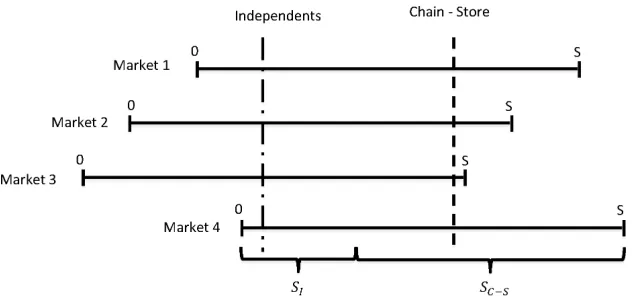
a market from a finite set of different markets (adjacent markets) given that a firm needs to
locate either left or right in the linear city model. The idea is presented in graph 2.2.
I have fixed the location of independents and C-S and drawn a vertical line across four
different markets. The markets differ with respect to buyers’ preferences6. For example, in
the fourth market there is little demand for the independents but this is not the case in the
third market. Actually an independent will find it more profitable to enter in the third market
than in any other, assuming that fixed costs are unchanged across adjacent markets. At the
same time a C-S might find it more profitable to enter the fourth market. This gives rise to
the first corollary of this chapter.
5Notice that the particular decomposition that I used is motivated by Hotteling’s (1929) seminal paper. 6This can be rationalized as a large set of preferences (from 0-1) where in some markets there are no
Corollary 2.1.1 In some cases the most profitable firm is not necessarily the most cost
effi-cient.
As a result, it is not necessary any more for the most cost efficient entrant to enter but
rather the most profitable (higher demand might compensate for the high fixed costs of an
independent). The proof is straightforward. The demand for differentiation states that in
some casesay,j,t > ac−s,j,twhich means that it is possible that Πy,j,t>Πc−s,j,teven though the
C-Ss are more efficient, fy,j,t > fc−s,j,t. Hence, the assumption of product differentiation and
market specific characteristics (markets are different as well) allow for an inefficient, higher
cost, but favoured by demand for differentiation independent to enter the market. To be more
specific, even though the C-Ss have a cost advantage they might be faced at the same time
with relatively lower demand (αc−s< αy) and in some cases the lower demand might induce
the less efficient to outbid (the English auction stage will formally be described later on) the
C-S and enter the market. Hence, I am not constrained by a first in, last out equilibria (where
the most efficient firm enters first as with Abbring and Cambell (2010)) since a less efficient
but more profitable entrant is more likely to enter and survive, in some cases, in the market.
It also follows, in this case, that the most efficient incumbent (C-S) might exit earlier than a
less efficient incumbent (independent), given some demand shocks.
Thus, given their product type, the entrants will rank the markets based on profitability
(decide where to enter) and then will bid for the right to enter the market (decide whether
to enter). A common problem with the entry game (given the choice of the market) is the
issue of multiple equilibria. In order to illustrate the issue, I provide a game similar to the
one presented by Bresnahan and Reiss (1990).
In the above game (see table2.1) there are two potential entrants, player 1 and 2, with
a > b >0. If both enter the market they become unprofitable, while if only one enters then
Player 2
Enter Stay Out Player 1 Enter −a,−b a,0
Stay Out 0, b 0,0
Table 2.1: Entry Game
an empirical estimation issue. The literature has overcome this issue by identifying in the
data a first mover and as a result redefining the game with a Subgame notion that generates
a unique N.E. and a unique prediction on the identity of the entrant7. However, the data
available cover a time period where the market has been relatively stable (satiated), with
small entry and exit of the C-Ss, and as a result it was not possible to identify a first mover.
On the other hand, it was observed that the retail space in Central London, and generally in
metropolitan areas, is scarce.
Scarcity of retail space can be seen in the second map provided in the appendix. In
the map it can be seen that in the area between Holborn, Covent Garden and Temple tube
stations there are approximately 200 coffee shops. Notice that the walking distance between
Holborn and Covent Garden is between 10-15 minutes. Furthermore, other retail units are
present within this area such as restaurants, pubs and textile retailers. Therefore, I believe
that the scarcity of retail space is a reasonable assumption. As a result of the scarcity issue,
I will assume that the entrants will need to bid (compete) for the right to enter the market
(acquire retail space for their shop). The entrants compete by participating in an English
Auction. Notice that the method of competition (type of auction) is not important but rather
the competition assumption. In other words, by the efficiency result of the auction theory,
the prediction of the identity of the winner (in this case the entrants identity) is unique, i.e.
the most profitable wins the auction.
In order to present the effect of an English Auction to the entry game some further
simplifying assumptions will be taken and abstract, for the time being, from product
differ-entiation effects. Assume the following rank of fixed costs for the incumbents (denoted as
In) and the entrants (denoted as En): fIn
1,j < f2In,j < ... < fN,jIn and f1En,j < f2En,j < ... < fm,jEn
where n is the number of incumbents, m the number of potential entrants and the numbers
1 to j correspond to markets (ranked from the ones with the smallest value of fixed cost).
As a result the following rank of profitabilities is observed: ΠIn
1,j > ΠIn2,j > ... > ΠInn,j and
ΠEn
1,j >ΠEn2,j > ... >ΠEnm,j. Notice, that product differentiation will only re-order firms within
the particular ranking. As a result there will be no adverse effect from introducing product
differentiation.
Let me define ¯BIn the outside option for an incumbent, the minimum value that makes
the incumbent willing to exit, and ¯BEn the outside option for the entrant, an option to locate
in the market without buying out (replacing) the incumbent. Intuitively, the last assumption
allows for the entrants to enter the market without always having to replace an incumbent.
The outside option of the entrants is equivalent to entrants acquiring an empty retail space
or acquiring a retail firm which is not specialized in the coffee industry. Similarly the outside
option of the incumbent might be an offer from an interested entrant of another industry
(restaurant or grocery) to acquire the incumbent’s retail space. Assume also that there are
only two profitable entrants with a fixed cost draw smaller than the one of the least profitable
incumbent:
Assumption 1:
ΠInn−1,j,t(n+ 1, f In
n−1)>Π
En
1,j,t(n+ 1, f En
1 )>Π
En
2,j,t(n+ 1, f En
2 )>Π
In n,j,t(n, f
In
n )>0 (2.4)
0>ΠEn1,j,t(n+ 2, f En
1 )>Π
En
2,j,t(n+ 2, f En
The first condition (2.4) states that the two entrants are more profitable than the least
profitable incumbent but less profitable than the next in order incumbent. The second
condi-tion (2.5) states that it is not possible for the entrants to enter the market without displacing
or replacing the incumbent8. The next result presents the equilibrium behavior.
Lemma 2.1.2 Given assumption 1, the most profitable entrant will enter replacing the
in-cumbent with a bid equal to the profit of the second most profitable entrant if the inin-cumbent’s
outside option is low enough.
For the proof please see the appendix. In the above specific case, two entrants are
profitable if only one of them enters the market by replacing an incumbent. The lemma
2.1.2 states that there is a unique equilibrium with the most profitable entrant replacing
the incumbent and the less profitable entrant not entering the market. In this case the
assumption of an English auction assumption solves the multiplicity issues with respect to
the identity of the entrant. Notice that the assumption of an English auction is not essential
for the equilibrium characterization since any auction setting will generate the same prediction
(efficiency result of auction theory), that the most profitable enters.
An issue with the competition prior entry is that it is not feasible to empirically estimate
either the entrant’s sunk costs or the incumbents’ scrap value. This is due to unobservable
issues that cannot be resolved. To be more specific, an econometrician observes the number
of successful entrants but does not observe the last most profitable entrant that failed to
enter which determines the level of sunk cost. This unobservable characteristic is of immense
importance since it defines the sunk cost (highest bid) of the entrant and in some cases
(replacement) the scrap value of the incumbent9. This will be further explained later on.
The purpose of lemma2.1.2 was to introduce in a simple case the solution for the
equi-8This is a simplifying assumption.
9For given market structure and demand characteristics the sunk cost is not unique since it depends on
librium multiplicity problem and to present an example on how exit can be linked with entry.
However, let me now be more formal on how this assumption solves the entry multiplicity
problem.
Proposition 2.1.3 If the entrants compete for the right to enter the market then there is a
unique prediction on the entry game; the most profitable enter.
Proof: Assume M the number of potential entrants andL the number of market
oppor-tunities (number of new entrants that can be sustained in the market). Assume that M > L.
Notice that for other casesM < LandM =Lthe prediction is unique; everyone enters. Rank
the entrants according to their profitability ΠEn
1,j > ... >ΠEnL−1,j >ΠL,jEn >ΠEnL+1,j > ... >ΠEnM,j.
Then examine the L+ 1 andL entrant, by definition ΠEn
L,j >ΠEnL+1,j which means that theL
entrant will outbid the L+ 1 and the L+ 1 will be outbidden by any entrant ranked from 1
toL. Therefore, the L+ 1 entrant will not enter the market. The same holds for all entrants
ranked fromL+ 1 to M. Therefore, a unique prediction is that only the most profitable enter
(ranked from 1 to L).
QED
This result is very useful, in this context, since it solves the equilibrium multiplicity issues
as presented by Bresnahan and Reiss (1990). To be more specific, under the assumption of
competition prior entry this will generate a unique NE with the most profitable (but not
necessarily the most efficient, see 2.1.1) entering the market. Furthermore, the assumption of
an English auction can be used in industries like the airlines as well. In the airlines’ industry
the firms need to bid for the right to locate themselves in a hub or operate on a route.
Additionally, this assumption might be relevant to the telecommunications’ industry where a
network will be made available to the highest bidder. Most importantly, the scarcity of retail
of locations will enforce the potential entrants to bid for the right to enter the market which
will create an extra sunk cost. Alternatively, this can be thought of as the need of an entrant
to acquire a firm in a metropolitan area in order to enter the market.
D. Levin and J. L. Smith’s (1994) paper investigates entry in auctions. However, they
introduce entry decisions (endogenizing auction participation decisions) to an auction setting
while I introduce auction (competition) prior to the entry game. They show that the efficiency
of the auction is preserved. Hence, the entrant with the highest valuation of the market is
going to win the auction.
The proposition2.1.3, has presented a new modelling approach to solve the equilibrium
multiplicity issue at the entry game. Additionally, the proposition 2.1.3 suggests that the
entry decision of an individual firm is conditional to the entry decisions of the competitors
(endogeneity of individual entry decision). Furthermore, I have also presented how it is
possible for an incumbent to be replaced.
Let me now be more specific as to the choice of an entrant to replace or displace an
incumbent. Assume that the fixed cost draws are such that there is only one potential entrant
and that the incumbent’s profit becomes negative if the potential entrant enters. Assume as
well that the following conditions hold:
Assumption 2:
ΠEn1,j,t(n, f En
1 )>Π
In n,j,t(n, f
In
n )>0 (2.6)
ΠIn
n−1,j,t(n+ 1, fnIn−1)>ΠEn1,j,t(n+ 1, f1En)>0>ΠInn,j,t(n+ 1, fnIn) (2.7)
The first condition states that the most profitable entrant (from all the potential
unchanged. The second condition introduces the second least profitable of the incumbents
(superscript n−1) and states that the entrant will be profitable even if the least profitable
incumbent (indexed asn) stays in the market. However, this is not the case for the incumbent;
if the entrant enters and the market structure increases by one firm then the least profitable
incumbent will have negative profit.
Lemma 2.1.4 Given assumption 2: If ¯BIn >B¯En then the incumbent will be displaced. If
¯ BIn
≤ B¯En then the incumbent will be replaced.
The lemma 2.1.4 explains why we observe in some instances entry and exit in satiated
markets (where the total number of firms remains unchanged across time). To be more
specific, it is possible for the market demand to be stable across time but at the same time
we might observe entry with replacement or displacement (keeping the number of suppliers
constant as well) if the entrants enjoy a better cost draw (or if there is a change on demand
within a market10). These two properties of this model, replacement and displacement, give
rise to a link between entry and exit. To be more specific, the number of the entrants
(through changes to the number of existing firms in the market) and their types (whether the
incumbents will be replaced) influence the decisions of the incumbents to exit. All benchmark
models that investigate entry and exit, predict that entry will generate exit by increasing the
competition and decreasing the profits of the incumbents (through an increase on the number
of competitors, n parameter in the model). While in this case it is predicted that exit can be
generated even if an incumbent is still profitable and this is possible through the replacement
effects.
Furthermore, it is possible that the entrants will neither replace nor displace the
incum-bents. This is the case if the demand increases and can sustain more firms than the current
number of incumbents; when even the least profitable incumbent has positive profit11. The
last effect suggests, as expected, that demand (market) increase will decrease the likelihood
of exit of the incumbents. In addition, an incumbent might choose to exit if, for example, the
market shrinks even with a lack of new entrants.
In the case where there are more potential entrants than incumbents to exit then the
English auction will define the identity of the entrants (most profitable) and as a result the
incumbents’ scrap value in the case where they are replaced. The intuition is the following: if
there are a number of possible entrants but only one of them can enter the market, otherwise it
is unprofitable, then by the English auction argument the most profitable entrant will bid up
to the point where the second most profitable entrant will not find it profitable to bid higher.
Thus, B1
En,j,t = Π2En,j,t, where superscript 1 is an identifier for the most profitable entrant
and Π2
En,j,t is the profit of the second most profitable entrant. Notice that BEn,j,tM = f, the
bid will determine the sunk cost (f) and as a result it is specified by the entrants’ behavior,
hence endogenous. Similarly this argument can be used for more entrants and more than 2
incumbents to exit. In all cases the prediction is unique; the most profitable enter or remain
(in the case of replacement, this will be explained later on) in the market.
Let me now proceed to the final stage, the exit decision. First of all, notice that if
replacement is present then there is a unique prediction of the identity of the incumbent
to exit. The main reason for this is the fact that the least profitable incumbent will be
replaced; the entrants have no incentive (in this model at least12) to replace a more profitable
incumbent. However, if there is displacement or if the market demand is declining then there
is a similar equilibrium multiplicity issue, with respect to the identity of the incumbent to
exit, with the entry game. In order to visualize this issue assume the game reported in table
2.2.
In the above game (table 2.2) there are two incumbents that become unprofitable if
to the maximum bid offered by the entrant to replace the incumbent, which in this case is rejected by the entrant since it chooses to enter through the outside option.
Player 2
Exit Stay In Player 1 Exit 0,0 0, b
Stay In a,0 −b,−a
Table 2.2: Exit Game
both stay in the market but they remain profitable if one of them leaves the market. It
is also assumed that one of them is relatively more profitable in any state of the world
(a > b > 0). Therefore, there are two pure strategies N.E. with only one of the incumbents
exiting. However, I will assume that the incumbents use a strategy which specifies that the
least profitable incumbent exits13. This assumption guarantees that the exit decisions are not
influenced by other players’ exit decisions but rather on incumbents’ rank of profitability. In
other words, independently of the decision of the least profitable incumbent the second in
order has a dominant strategy which is always to stay in the market, if only one incumbent
needs to be displaced. At the equilibrium, and by a rational expectations argument, the least
profitable incumbent exits14. This assumption is similar, in concept, to the one taken by J. H.
Abbring and J. R. Cambell (2010)15. Notice that it might not be a necessary assumption in
this case, since the scarcity assumption might guarantee that even if a coffee shop incumbent
is not replaced by a coffee shop entrant it might be replaced by another retailer (i.e. textile
retailer), if we assume that retail space in Central London is never left unoccupied. Therefore,
guaranteeing that the least profitable exit the market. Both of these assumptions (least
profitable exit and scarcity effect on the exit stage) have a common prediction that the least
profitable incumbent exits. This guarantees a unique equilibrium, on the identity of the exit
firm, even if I allow for product differentiation (unique N.E. between groups as well). In other
words, the determinant of the exit decision is the rank of profitability and the type of an
13This is one of the N.E. presented.
14An incumbent’s exit decision will have been influenced by other incumbents’ exit decisions if the players
were employing mixed strategies.
incumbent, independent or C-S, does not generate multiplicity issues. To conclude, the least
profitable will be replaced or will exit and a unique N.E. will be observed in the markets.
Having a unique solution to both the entry and exit stage guarantees a unique SPNE.
However, the above structure of the game assumes that the incumbents cannot influence
entry. This is indeed the case for the independents, since by assumption they cannot expand
and enter with more stores in the market, but this is not the case with the C-Ss. I am
not formally seeking to establish the C-Ss’ ability to influence both entry and exit but a
simple numerical example of strategic manipulation of exit is provided in the appendix, for
the interested reader.
In this model entry deterrence is possible by the entrants themselves, the entrants deter
other entry instead of incumbents deterring entry (as has usually been investigated by the
lit-erature). The case of entry deterrence, in this model, is a special case of the entry behavior. To
be more specific, assume ΠEn
1,j,t(n, f1En)>ΠnIn−1,j,t(n, fnIn−1)>ΠEn2,j,t(n, f2En)>ΠInn,j,t(n, fnIn)>0
and 0 > ΠEn
1,j,t(n + 1, f1En). In this case the unique N.E. predicts that the least profitable
incumbent is replaced (by the second condition) by the most profitable entrant, assuming
low enough outside scrap value. Hence, this is an efficient result at the same time, since the
most profitable of both entrants and incumbents occupy the market. For more details and a
formal proof please see the appendix. This is a slightly different approach to Sutton’s series of
papers16 and the literature that examines endogenous sunk cost. The main difference is that
the entrant firms are the ones that sunk a cost in order to prevent a less profitable entrant
to enter. Hence, the endogenous cost arises because of competition between entrants rather
than the incumbents’ effort to deter entry.
To sum up, the above model presents a theory where exit depends on entry but not
vice versa for the independents (non-strategic fringe). The entry depends on the type of
the incumbents, the size and the characteristics of the market and whether the entrants can
generate exit. Entry might also be influenced by incumbents’ deterring effects; an incumbent
by expanding, through opening new stores, can in principle deter entry. However and in the
case of the independents, they are not able in principle to follow this strategy either because of
credit or managerial constraints. Consequently, the independent incumbents cannot influence
entry17. Entry, on the other hand, will influence the independents’ exit decisions since the
entrants are able to acquire (replace) or displace (if they are more profitable) an incumbent.
Notice, as well, that for the entrants that are more profitable than the incumbents it is a
dominating strategy to enter, irrespective of the behavior of the independent incumbents
(exit)18.
I will now focus on the non-strategic fringe of the firms, the independent incumbents.
Their profit functions can be defined as:
Πy,j,t=dj,t(Z)αy,j,t(ownc−s,j,t−1, Entc−s,j,t, owny,j,t−1, Enty,j,t)S(Y)j,t−fy−fy,j (2.8)
Notice that I have introduced the effect of market structure into an independent’s
in-cumbent profit function. This was achieved by assuming that the residual demand, αy,j,t,
depends on the market structure of the industry. To be more specific, ownc−s,j,t−1 refers to
the number of C-Ss incumbents andEntc−s,j,trefers to the number of C-Ss entrants. A similar
notation has been introduced for the independents’ market structure variables,owny,j,t−1 and
Enty,j,t. The market structure elements have been also decomposed to entrants and
incum-bents in order to introduce learning (entrants having a larger impact on the profitability than
17A further justification for the assumption that independents are not able to influence entry is the fact
that in the data set, and for the time period examined, I do not observe independents’ expansion (I do not observe independents becoming small C-Ss).
18In the case of displacement it is straightforward that the entrant will enter the market. In the case of
incumbents), as proposed by Toivanen and Waterson (2005).
Finally, an incumbent will exit if its outside option is greater than its profit. Hence,
exit will be observed if:
By,j,t ≥dj,t(Z)αy,j,t(ownc−s,j,t−1, Entc−s,j,t−1, owny,j,t−1, Enty,j,t−1)S(Y)j,t−fy −fy,j
+ρky+σuy,t (2.9)
Where By,j,t is the outside option (scrap value) of the independents. Notice that the
scrap value depends on time and on the incumbents’ identity, since more profitable incumbents
will require a higher scrap value to exit and by the fact that the entrants’ types are redrawn
every period and the scrap value which depends on the maximum replacement bid changes
on time as a result. The uy,t and the ky is an iid error term normally distributed with mean
zero.
However, since I examine a metropolitan area I need to take into consideration spillover
effects from neighbouring markets. To be more specific, the requirement that entrants will
bid for their right to enter a market guarantees that the most profitable entrant will enter in
the most profitable market. As a result, the entry decision will be influenced by neighbouring
areas. Entry will be influenced by the strength of demand and market structure, as with Seim
(2006)19, but also through the fixed costs draw of the entrant and the local incumbents. Exit
on the other hand depends on local entry, since entrants might displace or replace incumbents,
local demand changes and does not depend on entry - exit, demand and the market structure
of neighbouring (adjacent) markets. For example, an exit of an incumbent in a neighbouring
market will have no impact in a local market. There will be no changes to the intensity of
19Entry decisions should be made in the same manner as with Seim (2006) and as a result this is not further
the competition (with respect to the number of incumbents) in the current market.
I assume that entry in a neighbouring market will not decrease the demand in the local
market. I feel confident that people are choosing places to visit, rather than coffee shops,
and then choose a coffee shop to enjoy their coffee. However, demand or market structure
shocks in one market might influence the adjacent market and for that reason I incorporate
these in the empirical analysis. To be more specific, the existence of a more profitable market
might generate entry in one market by the most profitable entrants. As a result, this will
decrease the entry in the less profitable market and become less likely for an incumbent to
be displaced. Hence, exit should not be directly influenced by the neighbouring markets but
the entry is influenced and is correlated between markets.
In order to control for adjacent markets I will assume that they influence the profit
function, equation (2.9), in a linear manner. Hence, the independent incumbent’s profit
function, the no-strategic fringe, is:
dj,t(Z)αy,j,t(ownc−s,j,t−1, Entc−s,j,t, owny,j,t−1, Enty,j,t)S(Y)j,t−fy −fy,j −By,j,t
+ρky,t+σuy,j,t+f(own−c−s,t−1, Ent−c−s,t, own−y,t−1, Ent−y,t)<0 (2.10)
Where f(.) is the function that incorporates the neighbourhood effects. Hence if
equa-tion (2.10) is smaller than zero an independent incumbent will exit while if it is greater than
zero then the independent Incumbent will stay in the market.
Admittedly the approach presented in this chapter can be enriched by introducing
dy-namics20. For example, it is possible for an incumbent to prefer to stay in the market, even
if its profitability becomes negative, in order to be replaced by entrants with a better draw
of fixed costs in the future (or if there is demand changes within the markets21). In the
ap-pendix I present a simple dynamic aspect of the model. It is shown that the expected growth
of demand is the most decisive factor that might postpone a coffee shop’s exit.
2.2
Conclusion
To conclude, in this chapter a simple entry - exit game has been presented. Entry with exit
has been linked through the choice of displacement and replacement. The multiple equilibria
on both exit and entry were tackled by assuming that entrants compete at the entry stage.
It has been shown that for an individual independent incumbent, a non-strategic fringe,
the likelihood of exit will be influenced by the market structure variables (entrants and the
number of incumbents). The market structure variables of other groups, such as the C-Ss,
should influence the independent’s profitability differently from its own variables. This is
mainly because of product differentiation and the shifts through the αy,j,t term. Admittedly
the theoretical model is richer in structure and will allow for empirically investigating the
determinants of market structure in general, investigating both the C-Ss’ entry-exit decision
and the independents’ entry decision. However, this is not in the scope of this topic and is
left for future research. In the empirical estimation I will investigate the determinants of the
presence of independents in the markets through their exit decisions. In the chapter that
follows I present the data set and define the relevant market.
Chapter 3
Data and Market Definition
In this chapter I present the data gathered for the estimation. I use three main sources: the
White and Yellow pages to identify the coffee shops, counts of people that enter and exit
a tube station to generate variables that capture demand characteristics and finally from
the office of National Statistics (neighbourhood Statistics) to construct local demographic
variables. I also define the relevant market, describe issues and the approach used to resolve