1
P
rimary school teachers’
development of
differentiation skills: Comparing skills,
teachers
’ mastery of skills
, and factors
influencing the development of skills
Master Thesis
Researcher: Ilen Safar
[email protected] s1881604
Supervisors: Dr. M van Geel
[email protected] Dr. T Keuning
2
Table of contents
Table of contents ... 2
Acknowledgements ... 4
Abstract ... 5
Problem statement... 6
Theoretical framework ... 8
Required differentiation skills ... 8
Preparing a lesson period ... 10
Preparing a lesson ... 11
Enacting a lesson ... 11
Evaluating a lesson ... 12
Teachers across the world mastering differentiation skills... 12
Dutch teachers’ differentiation skills ... 13
Teachers’ differentiation skills in other countries ... 13
Comparisons based on teachers’ characteristics ... 14
Factors that promote the development of differentiation skills ... 15
Factors that hinder the development of differentiation skills ... 16
Research question ... 18
Method ... 19
Research design ... 19
Instrumentation ... 19
Participants ... 20
Procedure ... 21
Results ... 22
Results of the interviews ... 22
Five phases of differentiation ... 22
Promoting factors ... 23
Hindering factors ... 24
Results of the survey ... 26
Reliability of the items, scales, and DSAQ instrument ... 26
Characteristics of the respondents ... 27
Scores and categorisation of each differentiation skill per scale ... 28
Examining differences between groups of teachers ... 34
Defining promoting factors according to teachers ... 38
3
Also important promoting factors ... 39
Less important promoting factors ... 40
Defining hindering factors according to teachers ... 41
Most important hindering factors ... 41
Also important hindering factors... 42
Less important hindering factors ... 43
Conclusion and Discussion ... 44
Conclusions and discussions ... 44
Primary school teachers’ differentiation skills ... 44
Differences between teachers ... 44
Promoting and hindering factors ... 45
Limitations and future research ... 47
Scientific and practical relevance ... 48
References ... 50
Appendices ... 54
Appendix A: Questions interview ... 54
Appendix B: Example of the survey ... 57
Appendix C: Overview promoting factors ... 60
4
Acknowledgements
5
Abstract
Differentiation is an approach that requires teachers to adjust their teaching to students’ needs. In previous research (Van Geel et al., 2018) it was identified which differentiation skills teachers need to master. However, many teachers still cannot adjust their teaching to students’ needs, even though education requires teachers to differentiate (Inspectie van het Onderwijs, 2014). To help teachers adapt their teaching to students, insights into the development of teachers’ differentiation skills were needed. Therefore, to gain more insight into how teachers develop differentiation skills and which factors promote and this development, this research was conducted. To examine what teachers do to differentiate per phase of a lesson and lesson period, which skills they think are easy and hard to master, and what they think supported and obstructed them in developing the
differentiation skills, seven teachers were interviewed. The results led to an extension of the second instrument. To investigate how teachers develop the differentiation skills, the Differentiation Self-Assessment Questionnaire (DSAQ) was used and new items and questions related to influencing factors were added. A total of 288 Dutch primary school teachers filled out the online survey.
To determine the reliability of the DSAQ including the new items, Cronbach’s alpha was calculated and the reliability turned out good. It is concluded that, on average, teachers think they master the required differentiation skills well. The skills to conduct diagnostic conversations, set goals with students, and support high-achieving students are mastered to a lower extent by teachers and considered as more difficult skills to master. To examine differences in the mastery of
differentiation skills between the beginning and more experienced teachers, between teachers teaching different grades, and between part-time and full-time teachers, analyses were done. Teachers with less than three years of teaching experience think they master differentiation skills to a lower extent than teachers with more than three years of teaching experience. Upper grade teachers think they master differentiation skills to a higher extent compared to other teachers. There is no difference between the mastery of differentiation skills by full-time and part-time teachers. Factors influencing teachers’ development of differentiation skills were also described. The most promoting factors are teachers’ experiences, their positive attitude and beliefs, and support from Teacher Education. Hindering factors are the lack of time to differentiate, lack of information from Teacher Education, and teachers’ lack of knowledge and experience. The insights are valuable for the specification of previous findings on teachers’ development and can be used to improve activities for teachers’ development of differentiation skills and to increase the effectiveness of differentiation.
6
Problem statement
Teachers are alleged to provide all students opportunities to grow in their learning (Smets, 2017). Moreover, the focus in education lies on meeting the different educational needs of all students (Deunk, Doolaard, Smale-Jacobse, & Bosker, 2015) to provide all students opportunities to develop their individual talents (Eysink, Hulsbeek, & Gijler, 2017). Differentiation is described as a method to improve students’ learning by providing them activities that are differentiated in content, process,
and product and based on the learners’ background, environment, interests, intelligence, readiness,
pace, and more (Heacox, 2014). Differentiation is a bigger priority than ever due to an increasing degree of students’ diversity in many European countries (Gaitas & Martins, 2017; Tomlinson et al., 2003). Nevertheless, many teachers do not know how to adapt their teaching to students (Smets, 2017). In addition, the skills to differentiate are considered as complex skills (Gaitas & Martins, 2017; Smets, 2017; Van Geel et al., 2018). Also in studies in other European countries such as Lower Saxony (Van de Grift, 2013) and Portugal (Gaitas & Martins, 2017), results indicated that many teachers consider the skills to differentiate as difficult skills.
Every year, the Dutch Inspectorate of Education reports which and how many Dutch teachers differentiate in their lessons, how many times teachers differentiate, and when they differentiate during lessons. In half of the lessons observed by the Dutch Inspectorate of Education, primary school teachers did not differentiate sufficiently. Beginning teachers experience challenges in their first teaching years on a daily basis regarding the transfer of differentiation theory into practice. A reason is that they lacked information about differentiation during Teacher Education, as Teacher Education focusses more on knowledge about subjects. Consequently, beginning teachers master the differentiation skills less than more experienced teachers. Nonetheless, even teachers with ten years of teaching experience still struggle with differentiating and do not master all differentiation skills. (Inspectie van het Onderwijs, 2014; Inspectie van het Onderwijs, 2015) Striking is that teachers with approximately three years of teaching experience do not show a huge difference compared to the more experienced teachers regarding mastering differentiation skills. It was also concluded that part-time teachers master differentiation skills less than full-part-time teachers. Moreover, teachers teaching in lower and upper grades master the differentiation skills less than teachers teaching in the middle grade of primary school. (Inspectie van het onderwijs, 2014)
7 soon as they get a job? Additionally, not enough teachers differentiate in their classrooms, even after teaching for several years. So, what do teachers do to gain experience in differentiating in the
8
Theoretical framework
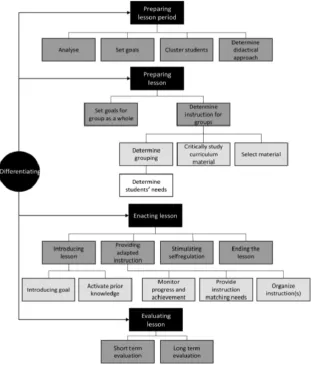
Differentiation refers to teachers reacting to students’ specific needs, readiness to learn, interests, language, prior knowledge, and learning preferences by changing, for instance, the instruction, pace, goals, level, and tasks (e.g., Heacox, 2014; Hall, Strangman, & Meyer, 2003). Dutch primary school teachers differentiate more than in previous years, but they still struggle with providing feedback to their students and adapting lessons to students’ differences (Inspectie van het Onderwijs, 2014). So, do teachers really master the skills to differentiate? Which skills are actually required to differentiate effectively? What or who do teachers consult when they want to learn how to differentiate or improve their differentiation skills? Moreover, what challenges could teachers face when developing the required differentiation skills? Researchers such as Keuning et al. (2017), Prast, Van de Weijer-Bergsma, Kroesbergen, and Van Luit (2015), and Van Geel et al. (2018) developed or used
instruments to categorise and present important skills to differentiate effectively in a model, and to measure the teachers’ levels of mastering differentiation skills. In the literature, also promoting and hindering factors for the development of differentiation skills are listed. Theory on differentiation is mainly focused on mathematics and language lessons.
Required differentiation skills
9 Figure 1. Differentiation skill hierarchy. Adapted from ‘’Capturing the complexity of differentiated instruction,’’ by M. van
Geel, T. Keuning, J. Frèrejean, D. Dolmans, J. van Merriënboer, and A. J. Visscher, 2018, School Effectiveness and School Improvement, p. 10. Copyright 2018 by Informa UK Limited, trading as Taylor & Francis Group.
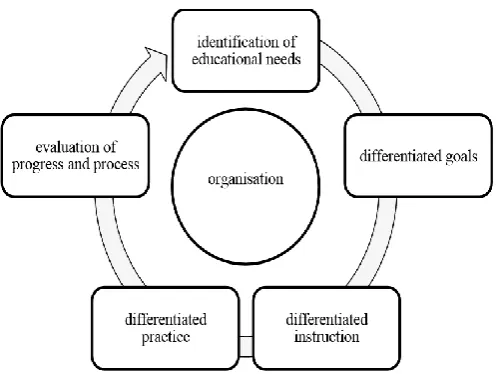
While Van Geel et al. (2018) made an overview of required differentiation skills, Prast et al. (2015) developed a Differentiation Self-Assessment Questionnaire (DSAQ) with strategies to differentiate that are divided over five phases instead of four. The reason for having five phases is that Prast et al. (2015) divided the phase of enacting a lesson into two phases, namely differentiating in instruction and differentiating in practice. The phases are presented and placed as a cycle, as seen in Figure 2, because the steps can be repeated throughout a school year. The term organisation is placed in the middle, as structure and good classroom management are requirements for a
10 Figure 2. Cycle of differentiation. Adapted from ‘’Readiness-based differentiation in primary school mathematics: expert recommendations and teacher self-assessment,’’ by E. J., Prast, E. van de Weijer-Bergsma, E. H. Kroesbergen, and J. E. H. van Luit, 2015, Frontline Learning Research, p. 98. Copyright 2015 by Emilie Johanna Prast.
Preparing a lesson period
Differentiation requires teachers to analyse students’ data and accordingly set flexible, specific, challenging, and realistic goals (Anthonissen et al., 2015; Eysink et al., 2017; Hall et al., 2003; Keuning et al., 2017; Prast et al., 2015; Smit & Humpert, 2012; Van Geel et al., 2018). Analysing students’ data will help teachers to identify students’ need to make goals more personal. Data of tests, observation of students, students’ work, and diagnostic conversations can be used to identify students’ educational needs (Prast et al., 2015). Teachers could thereby not only take data
concerning students’ cognitive background and learning needs into account, but could also focus on other data to respond to students’ interests, cultural background, readiness to learn, learning
preferences, and motivation (Dixon, Yssel, McConnell, & Hardin, 2014; Rock, Gregg, Ellis, & Gable, 2008; Tomlinson et al., 2003; Van Geel et al., 2018). Additionally, differentiation requires teachers to set various goals, such as long-term goals for a period or year, short-term goals for lessons, goals aimed at the majority of the group, and goals suited for individual students with specific needs (Prast et al., 2015). Knowing and using the opportunities for differentiation, which are stated in curriculum materials, would help teachers set minimum and challenging goals for low- and high-achieving students (Prast et al., 2015).
11 instance, using alternately homogeneous and heterogeneous groups is an effective solution (Heylen, 2009). The groups could also each time be based on different characteristics of students (Tomlinson et al., 2003), such as learning preference and motivation. A well-known form of differentiating is grouping students based on their level (Heylen, 2009). However, it is also recommended that teachers create groups based on, for example, students’ interests to avoid low expectations from individual students (Lawrence-Brown, 2004).
Preparing a lesson
Differentiation requires teachers to set lesson goals and thereby look critically at the goals from curriculum materials (Heacox, 2014; Keuning et al., 2017; Van Casteren et al., 2017). Working with curriculum materials does not imply that teachers have to or even can follow the stated suggestions of differentiation, as these suggestions are not always accurate and appropriate for all students (Heylen, 2009). Most teachers complement curriculum materials with materials available in the school and online. Teachers can decide on the instruction for the different groups based on their overview and prediction of students’ prior knowledge, misconceptions, capabilities, needs, and
direction of learning (Heacox, 2014; Keuning et al., 2017; Van Casteren et al., 2017). Moreover, it is suggested that teachers select meaningful materials and learning tasks, with variation in the level of problems, which suit students’ specific capabilities, needs, and backgrounds (Heacox, 2014;
Tomlinson et al., 2003; Van Casteren et al., 2017), support them to achieve their goals (Keuning et al., 2017; Van Geel et al., 2018), and push them to their limits (Heylen, 2009; Heacox, 2014; Smit & Humpert, 2012; Tomlinson et al., 2003).
Enacting a lesson
12 instruction can also be adapted to students’ needs. It is advised to use achievable tasks for the low-achieving students, compact practices for high-low-achieving students, and challenge the high-low-achieving students with enrichment tasks (Prast et al., 2015). Moreover, teachers can use websites and computer programmes to let students practise the skills they did not achieve yet and challenge high-achieving students (Prast et al., 2015).
To enable students to acquire and develop knowledge and skills, differentiation requires teachers to create a rich and safe learning environment to support students’ learning, collaboration (Van de Grift, 2013), confidence, and independence (Heylen, 2009; Van Casteren et al., 2017).
Stimulating students to take ownership of their learning can be done by giving students opportunities to become responsible (Heacox, 2014; Keuning et al., 2017; Tomlinson et al., 2003). Examples of responsibilities are: 1) deciding if they need instruction and practices, 2) what, how, when, how long, and where to learn, 3) how to present the learning gain, and 4) deciding to work alone or in groups (Heacox, 2014; Smit & Humpert, 2012). Furthermore, teachers could let the students work on their own pace (Heacox, 2014; Joseph, 2013; Tomlinson et al., 2003), but give responsibility for the deadlines they give to students (Joseph, 2013).
Evaluating a lesson
The evaluation of lessons refers to teachers evaluating the process, product, and goals to control students’ understanding and the effectiveness of the used approaches in order to make decisions for new lessons (Keuning et al., 2017; Van de Grift, 2013; Prast et al., 2015). Evaluating whether the goals are met by the students can be done by analysing test results, students’ work, and observations of students, and conducting diagnostic conversations (Prast et al., 2015). Effective reflection with students and colleagues, and assessment contribute to differentiated instruction in a way that the shared data show the impact of the instruction on students’ learning and achievements and give an indication of the quality of teachers’ teaching (Rock et al., 2008). Furthermore, differentiating teachers are advised to design and use other assessments such as pre-assessments and formative assessments to monitor the learning progress, to provide their students with effective feedback, and to make instructional adjustments during lessons (Rock et al., 2008; Smit & Humpert, 2012; Van Casteren et al., 2017; Van de Grift, 2013).
Teachers across the world mastering differentiation skills
13
Dutch teachers
’ differentiation skills
Teachers nowadays differentiate more than they did five years ago. Although it will always be a challenge to adapt instructions to students’ educational needs, 60% of the Dutch teachers are able to adapt their instructions. Also, 78% of the teachers can adapt the practices to students’ educational needs, which is 8% more than a few years ago (70%). In addition, teachers use suggestions from curriculum materials to differentiate, compact, and provide enrichment tasks more often. (Inspectie van het Onderwijs, 2018) Five years ago 50% of the schools in the Netherlands showed that in 75% of the lessons teachers master some differentiation skills. Whereas 38% of the schools showed in 75% or more of the lessons that teachers master all differentiation skills (Inspectie van het Onderwijs, 2014). Nevertheless, only 11% of the schools in the Netherlands are judged by the Dutch
Inspectorate of Education as schools in which the general didactical skills and differentiation skills are above average quality. The Dutch Inspectorate of Education noticed that the analysis of the needs of individual students, with different needs than the majority of the group, and their guidance stay limited. Moreover, the guidance students receive is most of the time only an additional instruction. Furthermore, teachers test more often but rarely use the information they get from the results. (Inspectie van het Onderwijs, 2018)
T
eachers’ differentiation skills
in other countries
Studies in other countries were conducted to compare teachers’ adaptation of their teaching to students’ diverse educational needs. For instance, in the study of Van de Grift (2013), the quality of the learning climate, classroom management, instruction, teaching of learning strategies, and adaptation of teaching in mathematics lessons were examined in various countries. The results showed that the average score on adapting the teaching to students’ various needs was significantly higher of Dutch teachers than teachers in Flanders, Lower Saxony, and the Slovak Republic. The average score of Slovakian teachers was higher than the teachers in Flanders and Lower Saxony. Relationships between the adaptation of teaching and the characteristics of the teachers and schools were also examined. Results showed that Flemish teachers especially adapted their teaching when they found that students in a group with many different ages were lagging behind and ‘’when the
Flemish teachers had to work with poor arithmetic curricula’’ (Van de Grift, 2013, p. 10). Moreover, a relationship was found between the adaptation of teaching, the quality of the curriculum, and student characteristics, only in Flanders. In Lower Saxony, there was a relationship between teachers adapting their teaching and students with another mother-language and the time teachers weekly spent with the students on arithmetic. (Van de Grift, 2013)
14 teachers considered activities and materials for differentiation, associated with adapting curricular elements (e.g., changing the content students have to learn) to students’ characteristics, such as learning preferences and interests, as the most difficult skills (Gaitas & Martins, 2017). Other difficult skills according to those Portuguese teachers were planning and preparing for differentiation, management, and the evaluation of differentiation processes and outcomes (Gaitas & Martins, 2017). In a country outside Europe, Indonesia, teachers’ implementation of differentiation were examined (Suprayogi, Valcke, & Godwin, 2017). Suprayogi et al. (2017) reported a high level of the implementation of differentiated instruction by primary school students.
Comparisons based on teachers’ characteristics
The inspectorate of the Netherlands (2014) compared different teachers based on a few
characteristics. It was concluded that teachers with less than one year of teaching experience or more than twenty years of teaching experience master the differentiation skills less than teachers with more than one but less than twenty years of teaching experience. Many school leaders claimed that they give combinations of groups to beginning teachers, while such groups require more differentiation skills than beginning teachers master. (Inspectie van het Onderwijs, 2014)
Additionally, on the one hand, 91% of the just-graduated teachers claimed they are able to react to students’ needs. On the other hand, just-graduated teachers did also admit that they rarely respond to students who are ahead or lagging behind in mathematics and Dutch language (Inspectie van het Onderwijs, 2015a). Teachers with one to three, three to ten, and ten to twenty years of teaching experience did not show a huge difference in mastering differentiation skills. In Indonesia, teachers with less than five years of teaching experience showed less adaption of differentiated instruction than teachers with more than five years of teaching experience (Suprayogi et al., 2017).
The Dutch Inspectorate of Education (2014) also found that part-time teachers master differentiation skills less than full-time teachers. The reason might be that full-time teachers have more time and space to practise for differentiation. Besides, teachers who teach in the third group (middle grade) master the differentiation skills better than teachers from the upper grade and teachers from the lower grade. One of the reasons is that curriculum materials for the third group provide a lot of support for differentiation. Differences between middle and lower grade teachers may be due to the combination of two groups in the lower grade or that mainly teachers who teach more than twenty years teach the youngest students. (Inspectie van het Onderwijs, 2014)
15 (Inspectie van het Onderwijs, 2015b). Besides, there was almost no difference in mastering
differentiation skills between Dutch teachers with big classes, average classes, and small classes (Inspectie van het Onderwijs, 2014). However, it was more common that on schools with more students the differentiation skills of teachers were marked as sufficient compared to teachers in smaller schools (Inspectie van het Onderwijs, 2014). Furthermore, in Indonesia it was found that the bigger a group is, the more the teachers feel the need to differentiate (Suprayogi et al., 2017).
Factors that promote the development of differentiation skills
The process of developing differentiation skills depends on several factors. The categories of promoting factors which repeatedly appeared in previous studies are: teachers’ attitude, the
presence of particular formal and informal professional development activities, and support from the teachers’ environment. First of all, teachers need to be willing to create a clear understanding of differentiation and its importance (Hall et al., 2003; Van Casteren et al., 2017), believe that
differentiation will enhance students’ learning (Nicolae, 2014), willing to change, and willing to invest time and effort in differentiation (Van Casteren et al., 2017). Changing the attitude towards
differentiation also requires teachers to have a growth mindset so they can change and improve their teaching. It was found that the higher a teacher’s self-efficacy was, the more positive beliefs a
teacher had to implement differentiation (Suprayogi et al., 2017). In addition, teachers need to accept that every student is different (Stavrou & Koutselini, 2016), be convinced that every student has a growth mindset, and that (s)he can learn anything if (s)he is willing to work hard and if (s)he gets support in the learning process on his or her own level (Tomlinson & Imbeau, 2010).
Secondly, professional development activities with certain features can have a positive effect on the development of differentiation. According to Little (1987), teachers’ professional
development is ‘’any activity that is intended partly or primarily to prepare paid staff members for improved performance in present or future roles in the school districts’’ (p. 491). Professional development can occur in a formal and informal way. The formal way of professional development includes activities that are mainly intentional and arranged, while the informal way refers to less structured development activities, which are most of the time intentional or involving an external person (OECD, 2009).
16 active learning refers to providing teachers opportunities to be active during professional
development training (Desimone, Porter, Garet, Yoon, & Birman, 2002). Thirdly, coherence refers to how much teacher training is in line with teachers’ beliefs and attitudes (Desimone, 2009), and how it is integrated into their daily school life (Garet, Porter, Desimone, Birman, & Yoon, 2001). Fourthly, duration refers to activities during the training that are spread over a long time, enough for teachers to acquire knowledge and practise skills. Dixon et al. (2014) concluded that the more hours during professional development training is invested in the differentiation of instruction, knowledge, and practicing skills, the more self-efficacy teachers create to differentiate in their classrooms. Lastly, it is crucial for teachers to collaborate with their colleagues during professional development training to improve teacher learning (Desimone, 2009).
Informal professional development activities refer to activities such as teachers individually reading literature about differentiation, engaging in an informal conversation with other teachers to improve teaching, or incidental observing a colleague when walking by the classroom (Jones & Dexter, 2014; OECD, 2009). One of the findings of Sprott (2019) was that teachers appreciated reflecting with colleagues and professionals by building a relationship, and sharing ideas, familiar difficulties, and questions in a structured conversation to solve certain problems. In addition, having informal and formal conversations with students seemed to help teachers build a relationship with students. This resulted in responding more effectively to students’ educational and social needs (Sprott, 2019). Informal activities are not measurable in days (OECD, 2009), mostly because such activities occur incidentally.
Finally, school team support focused on differentiation skills is a promoting factor for the practice of differentiated instruction, teachers’ professional development, and student achievement (Desimone, 2009; Smit & Humpert, 2012). According to Stavrou and Koutselini (2016), cooperation with leaders and colleagues plays a major role in teachers’ conceptual change and their effort to adjust their lessons to students’ needs. School leaders and colleagues should be dedicated to help
teachers change their perceptions on how students learn, on what and how they should be taught, and on the teacher’s role during differentiation (Tomlinson et al., 2003). In addition, the
implementation of differentiation is supported when principals and administrators give teachers educative resources focused on differentiation, such as digital tools (Van Casteren et al., 2017; Van Geel et al., 2018). Even parents can contribute to differentiation in the classroom, for instance by volunteering to lead a small group or by providing hands-on materials (Hall et al., 2003).
Factors that hinder the development of differentiation skills
17 classroom occurs in different ways is already a complex process (Dixon et al., 2014). Unfortunately, many teachers’ beliefs lead to teachers being resistant to adjust their teaching (Aldossari, 2018;
Heacox, 2014; Joseph, 2013; Nicolae, 2014) and way of thinking regarding students’ learning (Hall et al., 2003). Differentiated instruction is in contrast with most traditional educational perspectives and practices, which requires teachers to change their way of teaching, materials, approaches, and ways of thinking regarding students’ learning (Hall et al., 2003). Not all teachers think differentiation is needed. They think it is only necessary to differentiate if they have students with different ethnic and cultural backgrounds. Another teachers’ misconception is that differentiation is only based on the level of students’ disabilities (e.g., dyslexia), which leads to wrong learning expectations regarding low- and high-achieving students. A third misconception is that teachers think differentiating is time consuming, because they think students need to receive extra exercises. (Anthonissen et al., 2015) Many teachers also complained that they already have an overload of other responsibilities and therefore do not have enough time to put more effort into the preparation of differentiated lesson instead of a ‘regular lesson’ (Nicolae, 2014; Van Casteren et al., 2017).
A second hindering factor is that some teachers have a low self-efficacy regarding their capabilities to differentiate, mostly due to a lack of experience with differentiated instruction (Aldossari, 2018; Dixon et al., 2014). ‘’This lack of teacher efficacy may be a reason that some teachers attend professional development focused on differentiation of instruction and then return to business as usual without implementing what they have learned to address student variability in the classroom’’ (Dixon et al., 2014, p. 116). A cause of the lack of experience may be due to a lack of explanation during Teacher Education on how to transfer the theory on differentiation to actual practice (Dixon et al., 2014; Inspectie van het Onderwijs, 2015a). This resulted in teachers’ lack of ability to analyse data using assessments and to respond to students’ interests, readiness, and learning preferences (Dixon et al., 2014; Nicolae, 2014). Teachers who do not recognise ways to differentiate or feel incapable of instructing different groups at the same time will struggle with providing differentiated instruction (Dixon et al., 2014).
18 and in conflict with the beliefs of teachers (Sprott, 2019). A certain way of working in a school can demotivate teachers to embed differentiation in their lessons.
Research question
The goal of this study is to gain more insight into the development of primary school teachers’ differentiation skills. Previous studies (Keuning et al., 2017; Prast et al., 2015; Van Geel et al., 2018) were focused on differentiation for the subject mathematics, because the skills to differentiate can vary across subject areas, and focussing on one subject is more specific and gives teachers more guidance (Prast et al., 2015). Therefore, this study is focused on the subject mathematics. New insights will lead to rich knowledge to help teachers improve their development and mastery of differentiation skills. This leads to the following research question: How do primary school teachers develop the required differentiation skills?
In previous research (e.g., Inspectie van het Onderwijs, 2014), teachers’ mastery of differentiation skills were examined, but not all differentiation skills were observed. Also the perception of teachers regarding differentiation skills was barely examined. There were found differences between teachers, such as that teachers with more than one year of teaching experience master differentiation skills more than beginning teachers. In addition, it was reported that teachers teaching in the third group master differentiation skills better than teachers who only teach in a lower and/or upper grade group. Moreover, full-time teachers master the differentiation skills to a higher extent than part-time teachers (Inspectie van het Onderwijs, 2014). Furthermore, in previous studies factors which promote and factors which hinder the development of the differentiation skills were frequently mentioned, such as teachers’ attitude and beliefs, active training, support from the team (e.g., Desimone, 2009; Van Casteren et al., 2017), lack of information from Teacher Education, lack of support, lack of materials, and lack of time (e.g., Aldossari, 2018). However, the descriptions of the factors were not detailed enough. Therefore, the following sub-questions are formulated: 1. To what extent do primary school teachers think they master the required differentiation skills? 2a. Which differentiation skills do teachers consider as easy skills to develop and master?
2b. Which differentiation skills do teachers consider as difficult skills to develop and master? 3. Is there a difference in mastering differentiation skills between teachers with various years of teaching experience?
4. Is there a difference in mastering differentiation skills between teachers teaching different grades? 5. Is there a difference in mastering differentiation skills between part-time and full-time teachers? 6. Which factors promote the development of the required differentiation skills?
19
Method
In this chapter, the method, participants of the study, the process of data collection, and the data analysis are described.
Research design
The current study consisted of two main goals. The first goal was to gain a broader and deeper insight into the details of the development of the required differentiation skills of primary school teachers. This insight included discovering more about the content of the differentiation skills, about the promoting factors, and about the hindering factors teachers face when developing the required differentiation skills. Secondly, it was aimed to discover to what extent the primary school teachers think they master the differentiation skills and which promoting and hindering factors (and their features) are most important and effective according to the teachers.
A mixed-method study was done to reach the two goals. To reach the first goal and thus complement already existing theory, teachers were interviewed. In order to reach the second goal, a survey was conducted. It was a cross-sectional study, as the survey was conducted at a specific, single point in time to compare teachers with different years of work experience.
Instrumentation
Interview. The interview was semi-structured. The interview started with questions about teachers’ demographic characteristics. The interview was divided into five parts with questions regarding differentiation: 1) identification of educational needs, 2) differentiation in goals, 3) differentiation in instruction, 4) differentiation in practice, and 5) evaluation of progress and learning process. Each part of the survey consisted of two subparts. The first subpart consisted of the statements on the differentiation skills teachers had to score. These statements were derived from the Differentiation self-assessment questionnaire of Prast et al. (2015). This questionnaire that functions as a teacher self-assessment was used, as it suited the goal of investigating to what extent the teachers think they master the differentiation skills defined by Keuning et al. (2017) and Van Geel et al. (2018). The other subpart consisted of questions regarding the time to master differentiation skills, factors which positively influence(d) the development of the required differentiation skills, and challenges that teachers experience(d) during that development. These questions were based on the literature. All questions are presented in Appendix A.
Survey. The survey had the same structure as the interview. The results of the interview were used to supplement questions for the survey. Firstly, three items which almost all teachers
20 (2015) to cover more elements of the differentiation skill hierarchy. The added items are discussed in the results section of the interviews. For each item, respondents rated to what extent an item applies to them, ranging from does not apply at all to me (1) to fully applies to me (5). From the interviews it became clear that not all teachers use curriculum materials, while some items in the survey refer to the use of curriculum materials. Therefore, the option was added to check a box if a teacher does not use curriculum materials. As it appeared from interviews that it was too hard for teachers to tell how long it took to master the skills, this question was not included in the survey. However, teachers were able to indicate which skills were easy and difficult to master. Therefore, in the survey teachers were asked to decide for each part which skills were easy to master and which skills were more difficult and took more time to develop and master. Half of the survey was also focused on which factors positively and negatively influence(d) the development of the differentiation skills. The promoting and hindering factors mentioned in previous research were put as answer possibilities and complemented with factors mentioned by the interviewed teachers. An example of the first part of the survey is presented in Appendix B to give an impression of how the questions for each part were presented to the teachers.
Participants
For the interviews, several primary schools in the region Hengelo were approached. The researcher selected the teachers who were interviewed. The aim was to interview ten teachers. As contacting schools in one region did not lead to ten participants, other ways were used to obtain participants. The snowball effect method was used by asking the teachers if they knew other teachers who were willing to participate. Teachers from other regions were also approached.
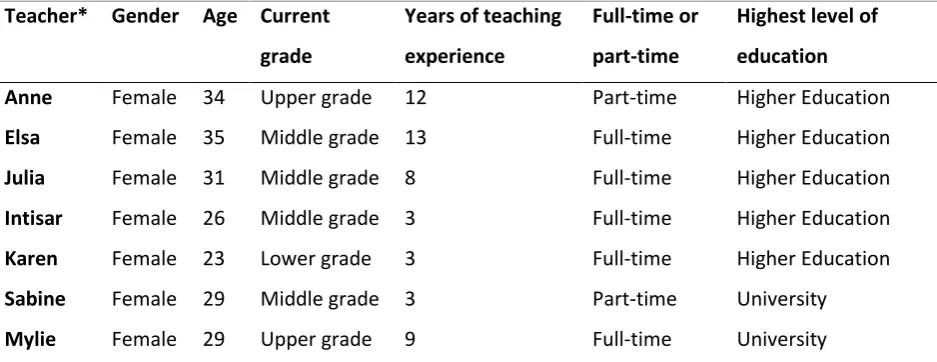
Eventually, seven teachers were willing to participate in the first part of the study. The characteristics of the participants who were interviewed are shown in Table 1.
21 Table 1
Characteristics of the Teachers
Teacher* Gender Age Current grade
Years of teaching experience
Full-time or part-time
Highest level of education
Anne Female 34 Upper grade 12 Part-time Higher Education
Elsa Female 35 Middle grade 13 Full-time Higher Education Julia Female 31 Middle grade 8 Full-time Higher Education Intisar Female 26 Middle grade 3 Full-time Higher Education
Karen Female 23 Lower grade 3 Full-time Higher Education
Sabine Female 29 Middle grade 3 Part-time University
Mylie Female 29 Upper grade 9 Full-time University
Note. *The teachers have fictional names to ensure anonymisation.
Procedure
Before the data was collected, permission was received from the BMS Ethics Committee of the University of Twente to conduct the study. The participants who were approached for an interview were informed about the objectives and consequences of the study by e-mail and verbal. For the interviews, the researcher made appointments with the teachers to visit and interview them.
Permission was asked through e-mail and verbally to record audio for the interview. In the e-mail and during the visit, the researcher informed the teachers about the possibility to withdraw from the interview. Each interview took approximately thirty minutes. The interviews took place in April 2019.
The survey was shared in May and June 2019 on social media. The platforms which were used were as followed: Facebook, teacher forums, WhatsApp, Instagram, and LinkedIn. Other ways that were used to reach teachers were e-mailing educational institutions, using the snowball effect, and asking personal contacts and contacts of the supervisors. The survey could be completed from May the 1st till June the 20th. In the online messages and e-mails, the teachers were informed about the goal of the survey and received the link to the survey. In the description of the survey, the
22
Results
In this chapter, the results of the interviews and survey are presented.
Results of the interviews
Five phases of differentiation
Interviews were held with seven primary school teachers to gain insight into the development of the differentiation skills. The interviews were also held to examine factors that promote and hinder the development of differentiation skills in order to design a survey. The data that led to additional information for the completion of the survey are discussed per phase, followed by the results of important factors that promote and hinder the teachers’ development of differentiation skills.
Identification of educational needs. Most teachers indicated they identify students’ needs based on observations, tasks, and tests, and thereby mainly pay attention to scores that are lower or higher than expected. Not all teachers conduct diagnostic conversations to identify students’ needs,
as conducting diagnostic conversations sometimes is the task of a remedial teacher. The teachers indicated that most skills are easy for them to master. The teachers also indicated that conducting diagnostic conversations is the most difficult skill to develop and master.
Differentiation in goals. Teachers claim they set minimum goals for low-achieving students but barely set challenging goals for high-achieving students. Some teachers work with differentiated goals as an approach. Other teachers use and adjust the goals stated in curriculum materials. In addition, some teachers set personal goals together with students to fit their level of understanding. Most teachers find it easier to set goals for low-achieving students than for high-achieving students, especially in their first years of teaching. Teachers experienced that following curriculum materials is easy, but does not always fit the goals and way of teaching.
Differentiation in instruction. Teachers indicated they adjust the levels, modality, and pace of instructions based on students’ needs. They also use hands-on materials and digital tools for instructions. The teachers ask open-ended questions and questions of different difficulty levels during instructions if the questions contribute to the goals. Half of the teachers do not give extended instruction or instruction to high-achieving students, as an assistant sometimes gives such
instructions. Other teachers give extended instruction if some students do not understand the instruction. The teachers said they do not find it difficult to differentiate in instruction.
23 used for low-achieving students to practise the goals they did not achieve yet. Nevertheless, teachers barely use computers to challenge high-achieving students. Teachers experienced that it is harder to find materials for high-achieving students than for low-achieving students. Teacher Intisar indicated that most curriculum materials only provide materials for practice for low-achieving students.
Evaluation of progress and process. Finally, teachers evaluate goals by observing students, checking their tasks, looking at test scores, and analysing answers. Most teachers evaluate the effectiveness of instructions and practices by asking students what they have learned, which struggles they had, and what was (in)effective about the lesson. A few teachers briefly discuss lessons with colleagues. Teachers Sabine mainly evaluates students’ products. Contrariwise, teacher Karen focusses on the learning process, because she experienced that the way students solve problems reveals the reason behind their results.
Based on the information received from the teachers, it was decided to add three items to the survey. The first addition was the question whether teachers dare to deviate from curriculum materials, as teachers experienced that curriculum materials do not always correspond with the goals or with their way of teaching. The second question relates to setting goals together with students, as teachers said they also set personal goals with students to adapt to students’ needs. Thirdly, teachers do not only focus on products, but also on students’ learning processes. Therefore, it was added whether teachers evaluate students’ learning processes. Moreover, support from a remedial teacher was added as an answer possibility for the questions about influencing factors.
Promoting factors
24 Besides, support from an academic coach plays a big role in developing all differentiation skills. The academic coach makes together with teachers a plan with goals for individual students with special needs, observes the teachers and students during instructions and individual working time, and evaluates periods to decide on the next steps and goals for teachers and students. In addition, teachers receive workshops from the academic coach. The workshops are mainly focused on the skills to identify students’ needs, differentiate in goals, and evaluate the progress and process. The workshops have four characteristics: 1) theory about differentiation, 2) practices with hands-on tasks, 3) time to practise in the group, and 4) reflections with colleagues. For instance, teacher Mylie and her colleagues of the same grade received four workshops, divided over a year. In one of the workshops, they received theory about differentiation, looked at students’ results, and estimated students’ levels and needs. After practising, they received additional information. The teachers made a plan based on the analyses. The teachers received time to carry out and adjust their plans. During the following workshops, teachers shared their experiences and gave feedback to each other. Another example was from teacher Karen. The teachers received three workshops with instruction about analysing mathematics goals, achieving goals, and analysing students’ results. They carried out their tasks, while the academic coach visited the teachers a few times to observe and give feedback.
Moreover, training from other experts were mentioned by teachers as promoting factors. However, a training covers certain differentiation skills and not all skills. For instance, the teachers Anne and Elsa followed a course of a year about setting goals and how to reach the goals, which was most effective to improve the differentiation in goals. Four teachers were enthusiastic about the course Sprongen Vooruit, offered by an institute. The course lasted for six months and teachers had to show up six times in total. Teachers received information about the goals of mathematics,
underlying ideas, and strategies. The focus lied more on the practical part of the course, consisting of trying out meaningful tasks and games to imagine how students can achieve the goals. Teachers tried out the activities in their groups. Afterwards, they shared their experiences and received feedback.
Furthermore, teachers experienced team meetings as promoting factors. During most
meetings, teachers discuss a struggle regarding a specific differentiation skill or phase. Teachers Anne and Elsa sometimes have meetings with colleagues from the same grade to analyse curriculum materials, compare goals of curriculum materials with the goals of SLO, and decide which goals they will work on, in which order, and how.
Hindering factors
25 search for or design materials for a differentiated practice, and evaluate students’ learning
continuously. Teachers are afraid they cannot give every student enough guidance on their level. Another struggle is a lack of suggestions for differentiation from curriculum materials and lack of materials in the school (e.g., hands-on materials) or ineffective materials (e.g., digital programs). For example, teachers experienced they sometimes lack suggestions from curriculum materials that fit their way of teaching. An example of less effective materials is that teacher Mylie does not use the adaptive program Snappet anymore, because Snappet also judges students’ answers based on their grammar and spelling, which are not the initial goals when solving mathematical problems.
Teachers said they lack support from colleagues and are insecure about their position in the team. However, this struggle was not mentioned as a struggle during the development in every phase of differentiation. Some teachers sometimes feel insecure asking colleagues for help when identifying educational needs or evaluating due to a lack of trust and because it takes time. An example was from teacher Julia, who is struggling with the standards she has when evaluating the goals of the lessons, as the standards are not the same throughout the school.
Moreover, the teachers consider self-confidence as a prerequisite to identify educational needs, to differentiate during instruction, and to select effective materials. Some teachers said it will take more time to increase the self-efficacy as a substitute teacher, because substitute teachers do not know the students well and work on various schools with different visions and curriculum
materials, which might slow down the process of creating a preference. In addition, they do not have to analyse test results, set differentiated goals or decide on the practice. They also think the flexibility to adjust lessons as a substitute teacher depends on the availability of time, space, and materials.
26
Results of the survey
Reliability of the items, scales, and DSAQ instrument
A survey was designed to determine how primary school teachers develop the required
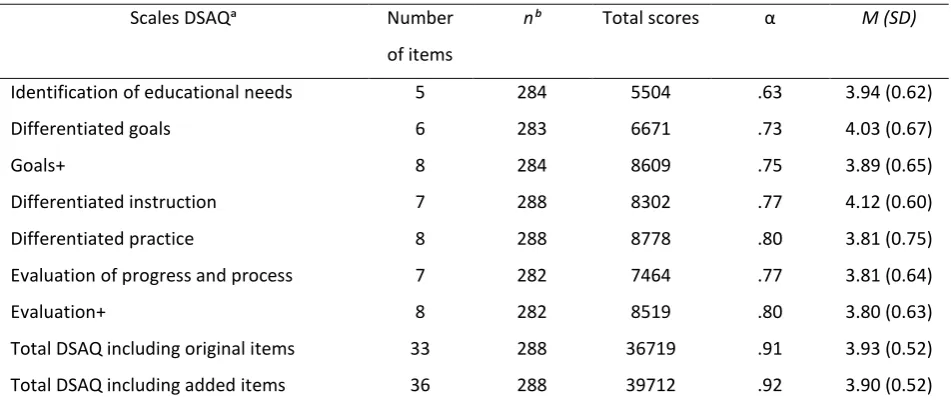
[image:26.595.71.547.474.677.2]differentiation skills. The survey was active from the 1st of May till the 20th of June. The survey consisted of five parts with questions about teachers’ development of differentiation skills. In order to examine how well teachers think they master the required differentiation skills, scales with items were included in the survey. The scales were used from the DSAQ instrument of Prast et al. (2015). Two items were added to the scale Differentiated Goals (Goals+) and one item was added to the scale Evaluation of Progress and Process (Evaluation+) based on the interviews with teachers. To check whether the new items contributed to the scales, Cronbach’s alpha was calculated. As shown in Table 3, the Cronbach’s alphas of the new scales Goals+ (α = .75) and Evaluation+ (α = .80) were larger than .70 and even slightly larger than the Cronbach’s alphas of the scales Differentiated goals (α = .73) and Evaluation of progress and process (α = .77) of Prast et al. (2015). This meant that the reliability of the new scales Goals+ and Evaluation+ were acceptable and good (Taber, 2017). The reliability of the new instrument (DSAQ+) was found to be high (α = .92). The results indicated that the added items are a strong addition, fit the instrument well, and can be included in the analyses.
Table 2
Descriptive Statistics of the Scales
Scales DSAQᵃ Number
of items
nᵇ Total scores α M (SD)
Identification of educational needs 5 284 5504 .63 3.94 (0.62)
Differentiated goals 6 283 6671 .73 4.03 (0.67)
Goals+ 8 284 8609 .75 3.89 (0.65)
Differentiated instruction 7 288 8302 .77 4.12 (0.60)
Differentiated practice 8 288 8778 .80 3.81 (0.75)
Evaluation of progress and process 7 282 7464 .77 3.81 (0.64)
Evaluation+ 8 282 8519 .80 3.80 (0.63)
Total DSAQ including original items 33 288 36719 .91 3.93 (0.52)
Total DSAQ including added items 36 288 39712 .92 3.90 (0.52)
Note. ᵃEach item of the scales had a scale from 1 to 5 with 1 = does not apply to me at all, and 5 = fully applies to me
27
Characteristics of the respondents
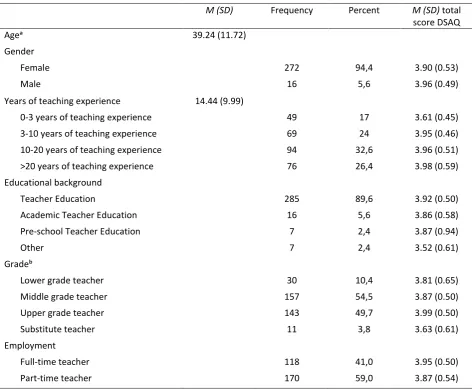
[image:27.595.72.545.333.722.2]In total, 1156 Dutch primary school teachers started with the survey and 25% of the teachers (288) completed the survey. Only fully completed questionnaires were used for analyses. In Table 3, characteristics of the respondents are presented. As seen in Table 3, the average age of the respondents are 39 years, varying from 21 years to 65 years. In the current study, 12,5% of the teachers are 55 years and older and 10% are younger than 25 years. According to Traag (2018), teachers who are 55 years or older together form 20% of the Dutch primary school teachers, while teachers between 15 and 25 years old form approximately 5% of the teachers. Data in this study are different compared to the data of Traag (2018). Nevertheless, the oldest teachers still form a bigger group than the youngest teacher. Teachers between 25 and 55 years old form the biggest group.
Table 3
Characteristics of the Respondents
M (SD) Frequency Percent M (SD) total
score DSAQ
Ageᵃ 39.24 (11.72)
Gender
Female 272 94,4 3.90 (0.53)
Male 16 5,6 3.96 (0.49)
Years of teaching experience 14.44 (9.99)
0-3 years of teaching experience 49 17 3.61 (0.45)
3-10 years of teaching experience 69 24 3.95 (0.46)
10-20 years of teaching experience 94 32,6 3.96 (0.51)
>20 years of teaching experience 76 26,4 3.98 (0.59)
Educational background
Teacher Education 285 89,6 3.92 (0.50)
Academic Teacher Education 16 5,6 3.86 (0.58)
Pre-school Teacher Education 7 2,4 3.87 (0.94)
Other 7 2,4 3.52 (0.61)
Gradeᵇ
Lower grade teacher 30 10,4 3.81 (0.65)
Middle grade teacher 157 54,5 3.87 (0.50)
Upper grade teacher 143 49,7 3.99 (0.50)
Substitute teacher 11 3,8 3.63 (0.61)
Employment
Full-time teacher 118 41,0 3.95 (0.50)
Part-time teacher 170 59,0 3.87 (0.54)
Note. ᵃSix birthdates were missing due to incomplete dates.
28 The majority of the respondents are female (94,4%). This is in line with statistics showing the
majority of Dutch teachers are female (Traag, 2018). The majority of the respondents have finished Teacher Education (89,6%). On average, the respondents have 14 years of teaching experience, varying from 0 to 43 years of teaching experience. The smallest group has teachers with zero to three years of experience (17%) and the largest group consists of teachers with ten to twenty years of teaching experience. 10,4% of the respondents teach at least in the lower grade, which refers to the first and second year of primary school in the Netherlands. Slightly more than half of the respondents (54,5%) teach at least in a middle grade group (group 3, 4, and/or 5). The other half of the
respondents (49,7%) teach in the upper grade (group 6, 7, and/or 8). In the current study, 3,8% of the respondents are substitute teachers. Lastly, 41% of the teachers work full-time, while the other 59% of teachers work part-time. In the past 15 years, there was a huge decrease of Dutch teachers working full-time, due to an increase of Dutch female teachers with part-time contracts (Traag, 2018). In the current study, also 61% out of the 272 female teachers work part-time, while 39% of the female teachers work full-time. Thus, more female teachers have a part-time contract.
Scores and categorisation of each differentiation skill per scale
This study aimed to investigate to what extent teachers think they master the required
differentiation skills and which skills they consider as easy skills to master and which skills they consider as difficult skills to master. The scales in Table 2 consisted of items, differentiation skills, for which teachers could give points on a scale from 1 to 5 to tell how much each skill applies to them. Per scale, it is reported to what extent teachers thought they master each skill and which skills they think are easy or difficult to develop and master.
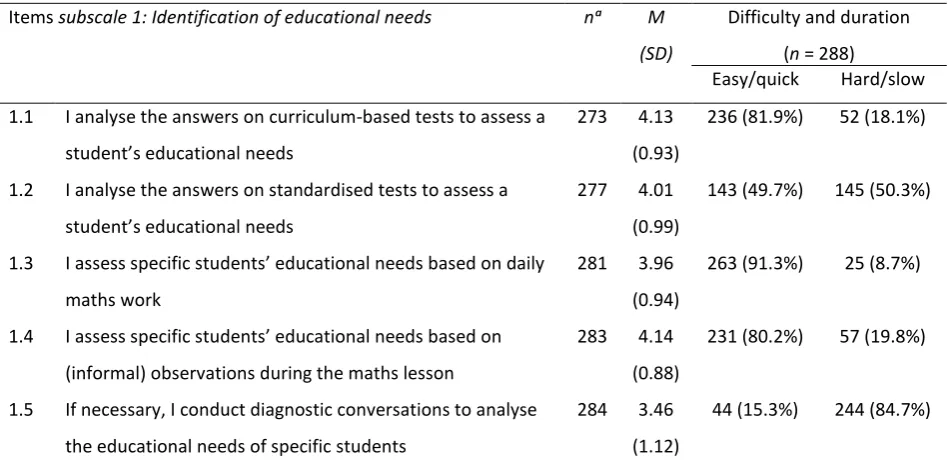
Identification of educational needs. In Table 4, an overview of the scores per item for the scale Identification of Educational Needs is presented. The items had an average score between 3.46 and 4.14. Teachers scored high on the skills to analyse curriculum-based tests (M = 4.13) and to identify specific students’ educational needs based on observations during maths lessons (M = 4.14). These skills were also indicated by the teachers as easy skills that were or could be mastered quickly. Although the skill to identify specific students’ educational needs based on their maths work did not have one of the highest average scores, almost all teachers (91,3%) consider it as an easy skill to master. Conducting diagnostic conversations has the lowest average score (M = 3.46). Most of the teachers (84,7%) indicated that it is a skill that is more difficult to develop and will take a
29 Table 4
Descriptive Statistics of the items in the Scale Identification of Educational Needs (range 1 – 5)
Items subscale 1: Identification of educational needs nᵃ M
(SD)
Difficulty and duration
(n = 288)
Easy/quick Hard/slow
1.1 I analyse the answers on curriculum-based tests to assess a
student’s educational needs
273 4.13
(0.93)
236 (81.9%) 52 (18.1%)
1.2 I analyse the answers on standardised tests to assess a
student’s educational needs
277 4.01
(0.99)
143 (49.7%) 145 (50.3%)
1.3 I assess specific students’ educational needs based on daily maths work
281 3.96
(0.94)
263 (91.3%) 25 (8.7%)
1.4 I assess specific students’ educational needs based on (informal) observations during the maths lesson
283 4.14
(0.88)
231 (80.2%) 57 (19.8%)
1.5 If necessary, I conduct diagnostic conversations to analyse
the educational needs of specific students
284 3.46
(1.12)
44 (15.3%) 244 (84.7%)
Note. ᵃSome respondents had not given a score on each item, because they do not use curriculum materials.
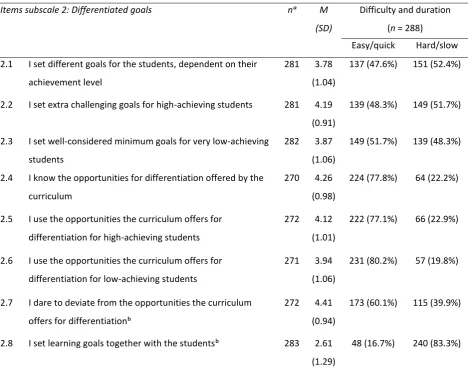
Differentiation in goals. In Table 5, an overview of the skills of the scale Differentiated Goals is shown. Teachers scored high on the skills of knowing and using the opportunities curriculum
30 Table 5
Descriptive Statistics of the items in the Scale Differentiated Goals (range 1 – 5)
Note. ᵃSome respondents had not given a score on each item, because they do not use curriculum materials. ᵇThe item was added in the current study by the researcher.
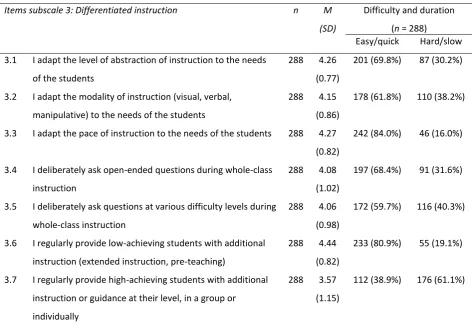
Differentiation in instruction. An overview of the skills of the scale Differentiated Instruction is presented in Table 6. The teachers had the highest average score for the skill to give low-achieving students additional instruction (M = 4.44), and most teachers (80,9%) said it is an easy skill to master. The teachers also scored high on the skills to adapt the level of abstraction and pace of instruction students’ needs. These skills are considered as easy skills to master. The teachers also adapt the modality of the instruction, ask open-ended questions, and ask questions of various difficulty levels during whole-class instructions. However, the opinions are more divided whether these skills are easy or hard skills to master, because only somewhat over 50% of the teachers indicated that these skills are easy skills to master. The skill to regularly provide additional instruction or guidance to high-achieving students at their level got the lowest score (M = 3.57). Moreover, 61,1% of the teachers
Items subscale 2: Differentiated goals nᵃ M
(SD)
Difficulty and duration
(n = 288)
Easy/quick Hard/slow
2.1 I set different goals for the students, dependent on their
achievement level
281 3.78
(1.04)
137 (47.6%) 151 (52.4%)
2.2 I set extra challenging goals for high-achieving students 281 4.19
(0.91)
139 (48.3%) 149 (51.7%)
2.3 I set well-considered minimum goals for very low-achieving
students
282 3.87
(1.06)
149 (51.7%) 139 (48.3%)
2.4 I know the opportunities for differentiation offered by the
curriculum
270 4.26
(0.98)
224 (77.8%) 64 (22.2%)
2.5 I use the opportunities the curriculum offers for
differentiation for high-achieving students
272 4.12
(1.01)
222 (77.1%) 66 (22.9%)
2.6 I use the opportunities the curriculum offers for
differentiation for low-achieving students
271 3.94
(1.06)
231 (80.2%) 57 (19.8%)
2.7 I dare to deviate from the opportunities the curriculum
offers for differentiationᵇ
272 4.41
(0.94)
173 (60.1%) 115 (39.9%)
2.8 I set learning goals together with the studentsᵇ 283 2.61 (1.29)
31 indicated that the skill to provide instruction to high-achieving students is a difficult skill that will take more time to master.
Table 6
Descriptive Statistics of the items in the Scale Differentiated Instruction (range 1 – 5)
Items subscale 3: Differentiated instruction n M
(SD)
Difficulty and duration
(n = 288)
Easy/quick Hard/slow
3.1 I adapt the level of abstraction of instruction to the needs
of the students
288 4.26
(0.77)
201 (69.8%) 87 (30.2%)
3.2 I adapt the modality of instruction (visual, verbal,
manipulative) to the needs of the students
288 4.15
(0.86)
178 (61.8%) 110 (38.2%)
3.3 I adapt the pace of instruction to the needs of the students 288 4.27
(0.82)
242 (84.0%) 46 (16.0%)
3.4 I deliberately ask open-ended questions during whole-class
instruction
288 4.08
(1.02)
197 (68.4%) 91 (31.6%)
3.5 I deliberately ask questions at various difficulty levels during
whole-class instruction
288 4.06
(0.98)
172 (59.7%) 116 (40.3%)
3.6 I regularly provide low-achieving students with additional
instruction (extended instruction, pre-teaching)
288 4.44
(0.82)
233 (80.9%) 55 (19.1%)
3.7 I regularly provide high-achieving students with additional
instruction or guidance at their level, in a group or
individually
288 3.57
(1.15)
112 (38.9%) 176 (61.1%)
32 maths websites more often for students to practise skills they do not master yet (M = 3.59) than for specific students to challenge them (M = 3.42). Additionally, somewhat more than half of the teachers indicated that it is easier to master the skill to use computer programs and websites for extra practice (69,8%) than to use computer programs and websites to challenge students (60,1%).
Table 7
Descriptive Statistics of the items in the Scale Differentiated Practice (range 1 – 5)
Items subscale 4: Differentiated practice n M
(SD)
Difficulty and duration
(n = 288) Easy/quick Hard/slow
4.1 I vary different types of practice during the maths lesson
(e.g. individual or group work, solution spoken, written or
drawn)
288 3.77
(1.03)
162 (56.3%) 126 (43.8%)
4.2 I adjust different types of practice to the needs of the
students in the classroom (e.g. having a specific child
complete exercises on the computer because this child
learns more in this way)
288 3.49
(1.13)
144 (50.0%) 144 (50.0%)
4.3 I select the most important tasks for very low-achieving
students
288 3.99
(1.03)
205 (71.2%) 83 (28.8%)
4.4 I use curriculum compacting for high-achieving students 288 3.93
(1.22)
183 (63.5%) 105 (36.5%)
4.5 I provide high-achieving students with enrichment tasks 288 4.33
(0.98)
169 (58.7%) 119 (41.3%)
4.6 I also use computer programmes or maths websites in my
maths lessons
288 3.95
(1.18)
208 (72.2%) 80 (27.8%)
4.7 I use computer programmes and/or maths websites to offer
students focused practice in a skill that they do not
sufficiently master
288 3.59
(1.31)
201 (69.8%) 87 (30.2%)
4.8 I use computer programmes and/or maths websites to offer
specific students additional challenge in the maths lesson
288 3.42
(1.36)
173 (60.1%) 115 (39.9%)
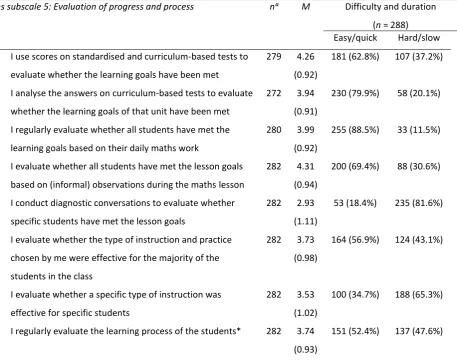
33 based on test scores. Moreover, the majority of the teachers (79,9%) finds it easy to master the skill to analyse test answers. According to most teachers (88,5%), a skill that is easy to master is the skill to evaluate whether the students have achieved the learning goals based on their maths work. The skill to evaluate whether students have met the lesson goals by conducting diagnostic conversations had the lowest average score (M = 2.92) and was considered by the majority of the teachers (81,6%) as a difficult skill to master. Moreover, two-thirds of the teachers (65,3%) indicated it is hard and it takes time to master the skill to evaluate whether a specific type of instruction was effective for specific students.
Table 8
Descriptive Statistics of the items in the Scale Evaluation of Progress and Process (range 1 – 5)
Items subscale 5: Evaluation of progress and process nᵃ M Difficulty and duration
(n = 288) Easy/quick Hard/slow
5.1 I use scores on standardised and curriculum-based tests to
evaluate whether the learning goals have been met
279 4.26
(0.92)
181 (62.8%) 107 (37.2%)
5.2 I analyse the answers on curriculum-based tests to evaluate
whether the learning goals of that unit have been met
272 3.94
(0.91)
230 (79.9%) 58 (20.1%)
5.3 I regularly evaluate whether all students have met the
learning goals based on their daily maths work
280 3.99
(0.92)
255 (88.5%) 33 (11.5%)
5.4 I evaluate whether all students have met the lesson goals
based on (informal) observations during the maths lesson
282 4.31
(0.94)
200 (69.4%) 88 (30.6%)
5.5 I conduct diagnostic conversations to evaluate whether
specific students have met the lesson goals
282 2.93
(1.11)
53 (18.4%) 235 (81.6%)
5.6 I evaluate whether the type of instruction and practice
chosen by me were effective for the majority of the
students in the class
282 3.73
(0.98)
164 (56.9%) 124 (43.1%)
5.7 I evaluate whether a specific type of instruction was
effective for specific students
282 3.53
(1.02)
100 (34.7%) 188 (65.3%)
5.8 I regularly evaluate the learning process of the students* 282 3.74
(0.93)
151 (52.4%) 137 (47.6%)
34
Examining differences
between groups of teachers
In order to determine whether there was a significant difference between teachers with various years of teaching experience, a one-way ANOVA was conducted. The total scores on the DSAQ+ of teachers with ‘0 to 3’, ‘3 to 10’, ’10 to 20’, and ‘more than 20’ years of teaching experience were compared. There was a significant difference between the groups (F(3,284) = 6.54, p = 0.000). A Tukey post hoc test revealed that the total score on the DSAQ+ of teachers with 0 to 3 years of teaching experience was significantly lower (3.61 ± 0.45 points) compared to the total scores of teachers with 3 to 10 years of teaching experience (3.95 ± 0.46 points, p = 0.002), teachers with 10 to 20 years of teaching experience (3.96 ± 0.51 points, p = 0.001), and teachers with more than 20 years of teaching experience (3.98 ± 0.59 points, p = 0.001). In Figure 3 is shown that the average score (M = 3.61) on the DSAQ+ of teachers with 0 to 3 years of teaching experience was lower than other teachers. In Figure 4 the mean scores are presented per scale and the results indicate that teachers with 0 to 3 years of teaching experience scored lower on all scales compared to other teachers. There were no significant differences between teachers with ‘3 to 10’ and ’10 to 20’ years of teaching experience (p = 0.999), between teachers with ‘3 to 10’ and ‘more than 20’ years of teaching
[image:34.595.77.377.501.734.2]experience (p = 0.988), and between teachers with ’10 to 20’ and ‘more than 20’ years of teaching experience (p = .997). However, in Figure 3 is shown that the scores on the DSAQ+ of teachers with 10 to 20 years of teaching experience individually were more spread out in the group, varying from an average score of 2.60 to 5. In Figure 4 is shown that the mean score of teachers with 3 to 10 years of teaching experience was slightly higher regarding skills to differentiate in practice. Moreover, all teachers seemed to think they master the skills to differentiate in instruction better than other skills.
35 Figure 4. Mean scores of teachers with various years of teaching experience per scale.
Besides determining differences between teachers with various years of experience, the current study focused on whether there were significant differences in the total score on the DSAQ+ between teachers in different grades, namely the lower, middle, and upper grade. Normally a one-way ANOVA would be conducted to compare three groups. However, some teachers teach in more than one grade. Therefore, the decision was made to compare two groups per grade, for instance, the group of teachers who teaches in the lower grade versus the group of teachers who do not teach in the lower grade. This comparison resulted in three independent sample t-tests.
36 Figure 5. Mean total score DSAQ+ of upper grade teachers.
37 Figure 6. Mean scores of upper grade teachers versus other grade teachers per scale.
Another aim of the study was to examine possible differences between teachers with different employment contract types. Therefore, another independent samples t-test was conducted to compare the scores in full-time and part-time conditions. There was no significant difference in the total score of teachers who work full-time and teachers who work part-time; t (286) = 1.31, p = 0.191. Also in Figure 7 is shown that there were no significant differences in the mean scores of the full-time and part-time teachers per scale and for the whole DSAQ+.