Original citation:
Mayo, M., van Knippenberg, D., Guillen, L. and Firfiray, Shainaz. (2016) Team diversity and categorization salience : capturing diversity-blind, intergroup biased, and multicultural perceptions. Organizational Research Methods, 19 (3). pp. 433-474. ISSN 1094-4281
Permanent WRAP URL:
http://wrap.warwick.ac.uk/77137 Copyright and reuse:
The Warwick Research Archive Portal (WRAP) makes this work by researchers of the University of Warwick available open access under the following conditions. Copyright © and all moral rights to the version of the paper presented here belong to the individual author(s) and/or other copyright owners. To the extent reasonable and practicable the material made available in WRAP has been checked for eligibility before being made available.
Copies of full items can be used for personal research or study, educational, or not-for profit purposes without prior permission or charge. Provided that the authors, title and full bibliographic details are credited, a hyperlink and/or URL is given for the original metadata page and the content is not changed in any way.
Publisher’s statement:
http://dx.doi.org/10.1177/1094428116639130 A note on versions:
The version presented here may differ from the published version or, version of record, if you wish to cite this item you are advised to consult the publisher’s version. Please see the ‘permanent WRAP URL’ above for details on accessing the published version and note that access may require a subscription.
TEAM DIVERSITY AND CATEGORIZATION SALIENCE: CAPTURING
DIVERSITY-BLIND, INTERGROUP BIASED, AND
MULTICULTURAL PERCEPTIONS
ABSTRACT
It is increasingly recognized that team diversity with respect to various social categories (e.g.,
gender, race) does not automatically result in the cognitive activation of these categories (i.e., categorization salience), and that factors influencing this relationship are important for the
effects of diversity. Thus, it is a methodological problem that no measurement technique is available to measure categorization salience in a way that efficiently applies to multiple
dimensions of diversity in multiple combinations. Based on insights from artificial intelligence research, we propose a technique to capture the salience of different social categorizations in teams that does not prime the salience of these categories. We illustrate the importance of such
measurement by showing how it may be used to distinguish among diversity-blind responses (low categorization salience), multicultural responses (positive responses to categorization
Diversity has become a fact of life for many organizations. The changing nature of the workforce and the popularity of work teams are bringing more people to work with others who
differ in their demographic backgrounds (Jackson, Joshi, & Erhard, 2003; Joshi & Roh, 2010). This increased diversity is one of the main challenges of today’s organizations (Harrison, Price,
Gavin, & Florey, 2002). Demographic diversity can be a positive influence when associated differences in perspectives stimulate a more in-depth understanding of the issues at hand, and
better quality and more innovative solutions to problems and decisions (van Knippenberg, De Dreu, & Homan, 2004; cf. diversity as variety; Harrison & Klein, 2007). At the same time, demographic diversity may invite interpersonal tensions and factional thinking within a team that
inhibit the stimulating influence of diversity and are detrimental to team performance (van Knippenberg et al., 2004; cf. diversity as separation; Harrison & Klein, 2007). An important
challenge thus is to understand the factors that prevent the negative effects of team diversity and stimulate its positive effects—a challenge that puts a premium on an understanding of the contingencies of diversity effects (van Knippenberg & Schippers, 2007).
The potential of demographic diversity to have negative performance effects has traditionally been viewed through the lens of the social categorization perspective (van
Knippenberg & Schippers, 2007; Williams & O’Reilly, 1998). This perspective has gone through
a development that we aim to take one important step further in the present study—a
development that requires a new measurement technique to adequately and efficiently capture the salience (i.e., cognitive activation) of categorizations (i.e., “us versus them” perceptions)
result in intergroup biases—negative responses to demographically different others who are seen as not part of one’s in-group—that disrupt team process and performance (Williams & O’Reilly,
1998). This perspective, however, would imply a negative main effect of demographic diversity
that is not supported by the evidence (van Dijk, van Engen, & van Knippenberg, 2012). An important step in the development of the social categorization perspective has been the emphasis
on categorization salience—the extent to which a social categorization is cognitively activated
and is used by group members as a basis for distinguishing in-groups and out-groups (Turner,
Hogg, Oakes, Reicher, & Wetherell, 1987; van Knippenberg et al., 2004). This salience perspective recognizes that demographic differences do not necessarily invite social
categorization and that contextual factors that foster or hinder the diversity-salience relationship
need to be taken into account in understanding diversity effects.
Thus, understanding which social categories are more important in a specific group is a
critical research question for diversity scholars. However, we know very little about how the context makes some social identities more psychologically prominent in the minds of team members than others. Categorization salience is more often evoked than actually measured.
Moreover, diversity scholars interested in testing categorization salience models face problems when it comes to measuring the salience of multiple dimensions of diversity in combination. The
purpose of our article is to introduce a measure of categorization salience that addresses problems with earlier measures and allows researchers to test more complete models of how contextual factors influence the effects of diversity paving the way for better diversity
However, it is increasingly recognized that salient categorizations may also invite positive responses (Ely & Thomas, 2001; van Knippenberg, van Ginkel, & Homan, 2013b). An important methodological implication of these insights is that diversity research cannot suffice with
measuring potential precursors to categorization salience like diversity on single attributes and their combination (i.e., where negative effects of diversity are assumed to reflect salient
categorizations, and the absence of negative effects signal low categorization salience). Rather, diversity research needs to directly assess categorization salience in diverse teams to distinguish
what we call diversity-blind responses (low categorization salience), multicultural responses (positive responses to salient categorization), and intergroup biased responses (negative
responses to salient categorization). Existing measures are not suitable for effectively assessing
the salience of multiple alternative categorizations (e.g., Earley & Mosakowski, 2000; Randel, 2002). Thus, the key contribution of the current study is that we develop a measure of
categorization salience based on insights from artificial intelligence (ID3, Quinlan, 1986) that addresses these problems with earlier measurement.
We also illustrate the importance of measuring categorization salience directly by showing
how gender and race diversity and their combination in gender by race faultlines can invite diversity-blind, multicultural, and intergroup biased responses. This illustration does not only
help establish the usefulness of our proposed measure, but constitutes a secondary contribution of our study as being the first to explicitly distinguish diversity-blind, multicultural, and
intergroup biased responses empirically. The current study provides the methodological tools as
THEORETICAL BACKGROUND
Team diversity and categorization salience
Team diversity refers to the degree to which team members differ on any given attribute (van Knippenberg & Schippers, 2007) and thus in principle could concern any attribute on which people may differ—demographic attributes, functional/educational background, or psychological
traits or states. In practice, diversity research concerns itself primarily with a more limited set of demographic and functional/educational attributes and diversity management in practice tends to by and large concern the “Big Two” of diversity management – gender and
race/ethnicity/cultural background (cf. van Knippenberg, Homan, & van Ginkel, 2013a). Most of the issues with negative effects associated with diversity—stereotyping, discrimination, and
disrupted performance—are also associated with these “Big Two” of gender and race (van Dijk et al., 2012). A focus on gender diversity and race diversity thus seems particularly relevant in
speaking to the performance effects of diversity. This focus is also supported by research on social categorization, which showed that individuals spontaneously categorize others using a superordinate category that represented sex and race simultaneously because it increases “informativeness” (Stangor et al., 1992).
In understanding the team performance effects of gender and race diversity, the primary
conceptual basis in diversity research was and still is the social categorization perspective. Earlier readings of this perspective seemed to imply more or less that gender or race differences between team members would inevitably invite social categorization in terms of own group and other
group (categorization salience), and such categorization would equally inevitably invite intergroup biases that would disrupt performance by reducing the willingness to collaborate with
this perspective that is reflected in the categorization-elaboration model (CEM) of team diversity and performance (van Knippenberg et al., 2004), however, recognizes that neither the path from diversity to categorization salience nor the path from categorization salience to intergroup bias
inevitably occurs but rather is contingent on other factors. This is an important observation because it points to diversity management opportunities either in preventing diversity from
inviting categorization salience or in preventing categorization salience from resulting intergroup biases.
The important implication of this analysis is that from a social categorization perspective it is meaningful to distinguish between three types of responses to gender and race diversity. The first is what can be called a diversity-blind response (cf. Plaut, Thomas, & Goren, 2009); gender
or race differences, or their combination gender-by-race, do not invite the cognitive activation of gender or race categories. The second is an intergroup biased response; gender and/or race
differences invite salient categorization resulting in intergroup biases. The third is a multicultural
response (cf. Plaut et al., 2009); gender and/or race differences invite salient categorization, which is embraced as a positive characteristic of the team (See Figure 1).
Insert Figure 1 about here
The distinction between diversity-blind, intergroup biased, and multicultural responses is
important because it implies different team performance outcomes. The CEM posits that diversity does not only have the potential to invite intergroup biases that disrupt performance, but also represents a source of diverse insights, information, and perspectives that can benefit
biases disrupt performance and thus also stand in the way of benefiting from diversity as an informational resource. Preventing intergroup bias should not be equated with stimulating the use of diversity as an informational resource, however; the use of diversity as an informational
resource requires motivated, proactive engagement with diversity and not merely the absence of intergroup bias (Kearney, Gebert, & Voelpel, 2009; Nederveen Pieterse, van Knippenberg, &
van Dierendonck, 2013; cf. van Ginkel & van Knippenberg, 2008). Whereas intergroup biased responses to diversity thus are clearly the least preferred outcome in that they should result in
negative performance effects of diversity, diversity-blind and multicultural responses to diversity should have other effects (cf. Plaut et al., 2009). Diversity-blind responses preempt intergroup bias by suppressing social categorization, but by the same token they discourage
proactive engagement with diversity as an informational resource. Such responses should thus be associated with the absence of diversity effects on performance rather than with positive
effects. Multicultural responses in contrast are associated with a positive recognition of different social categories and should thus be most likely associated with positive diversity effects on performance.
In reference to categorization salience, it is important to note that we conceptualize and operationalize salience as a team level construct – team salience. Past research in categorization
has treated salience as an individual level construct for understanding individual perceptions (e.g., Randel, 2002). For the team level analysis of the diversity-performance relationship, however, we suggest that members of a group categorize themselves and others on the basis of
patterns of differences on certain attributes. Team members tend to agree on the nature of those differences; yet how they experience those differences and their consequences vary across team
Organizational Behavior department. At the team-level, members of this team seem to clearly form subgroups on the basis of gender differences. During lunch, men sit together with other men and women with other women; on the weekends men get together for golf and women meet
to play tennis. All men and women would agree that gender matters when describing and
thinking about their work team. Regardless of how important gender is in their personal identity,
at the team level, gender explains in part the social dynamics within their team. Thus, team salience is a complex function that provides a better understanding of team member
arrangements on the basis of the salience of certain demographic categories.
A given social category (e.g., sex) is collectively salient or psychologically important in the minds of team members only when it is widely used by group members to categorize
themselves into in-groups and out-groups. The approach we propose deals with team salience based on in-group vs. out-group categorizations among all possible dyadic relationships within
the team. When people in the team form subgroups, it is rather clear to other team members who is part of the in-group and the out-group and which dimensions they follow to divide the team. For example, imagine that we are observing a Sales and Marketing group comprising of five
members formed by three women and two men, all of them with a management background, and we want to predict the extent to which gender might help to explain who might sit together for
lunch on a daily basis. If we asked them to make in-group vs. out-group categorizations with every other member of the team, it would reveal that the three women rate other women as in-group and men as out-in-group. Likewise, the two men perceive themselves as belonging to the
same subgroup but see women as the out-group. In this case, it is clear that the attribute of sex serves to explain the in- vs. out-group social categorizations within the team and it is highly
comprising also of three women and two men. Two of the women and one man have an
engineering background whereas one woman and one man have a management background. When we asked them to make in- vs. out-group judgments, the three engineers give in-group
ratings to one another and see their two management colleagues as out-group. In this case, the attribute of educational background, not sex, is the basis for their in-group/out-group
categorizations.
The need for a categorization salience measure
While in earlier understandings of social categorization processes in diverse teams negative
effects of diversity were seen as the inevitable effect of salient categorizations, the observation that diversity had a negative effect could be presumed to imply categorization salience, whereas the absence of a negative effect would imply low salience (cf. van Knippenberg et al., 2004).
Thus, to further develop diversity theory and provide stronger tests of theoretical perspectives, assessment of categorization salience is necessary.
In this respect, diversity research encounters a methodological challenge. There have been
relatively few attempts to measure categorization salience, and the measures that have been used are less suitable to research on multiple dimensions of diversity. Both Earley and Mosakowski
(2000) and Randel (2002) assessed categorization salience through a questionnaire measuring self-reported cognitive activation of a given category (nationality, sex). For example, Randel
(2002, p. 750) defines salience as “an individual-level measure of how prominently a
demographic category is used to describe one´s work group members (for example, “I think of
my work group in terms of women and men”). Individual members needed to complete a
of gender composition (e.g. two women and three men).” Yet, one of the weaknesses of Randel´s
(2002) salience measure is that it may prime group members to consider the salience of gender even if they were not thinking of this social category in the first place. We would not argue with the use of such a measure for the research purposes of Earley and Mosakowski (2000) or Randel (2002), which were both studies zooming in on a single diversity attribute. As soon as one is interested in multiple diversity attributes, however, and especially when one is also interested in their combination, measures like those employed by Earley and Mosakowski (2000) and Randel (2002) become problematic, because they require that the categorization of interest be explicitly identified.
Importantly, research on diversity faultlines suggests that assessing the salience of multiple
categorizations is exactly what should be on the agenda for diversity research. Lau and Murnighan (1998, p. 328) propose the concept of faultline, which refers to “hypothetical dividing lines that may split a group into subgroups based on one or more attributes.” They argue that diversity in
work teams is very complex and does not comprise of single attributes, but rather of multiple demographic attributes that subdivide groups. Groups that have identical dispersion of
demographic attributes can still have different dynamics if those characteristics are aligned among the individuals in the group so that when the group is divided on the basis of one attribute (e.g.,
sex), then these subgroups are very similar with respect to another attribute (e.g., race). For
example, in a group of five, all three females are white and all two males are black. When multiple demographic characteristics correlate with one another, divisions in groups occur on the basis of
faultlines (Lau and Murnighan, 1998). Existing research on social categorization shows that people use more than one attribute to categorize others and, thus single demographic attributes
2003). When multiple demographic characteristics correlate with one another, divisions in groups will occur on the basis of faultlines. Faultline measures are “raw data” determinants of
psychological salience, but not salience itself. It is therefore important to distinguish between faultlines and categorization salience, or between “faultlines and the earthquakes the faultlines may cause” (Shaw, 2004, p. 69). Thus, the existence of a faultline in the group does not
necessarily mean the faultline erupts in the minds of the people to produce real earthquakes that disrupt team performance. Accordingly, a measurement of social categorization salience is needed to account for multiple diversity attributes and their faultlines.
This implies that to assess the salience of, for instance race and gender categorizations as well as a categorization based on their combination (e.g., black women), one would need to administer a questionnaire similar to Randel’s three times – for sex, for race, and for their
combination. Once one is interested in more than one dimension and their faultlines, things get exponentially more difficult. Studying for instance sex, race, and functional background diversity
and their faultlines would require administering the same questionnaire seven times – three times to capture the salience of categorizations based on each diversity attribute by itself, three times to
capture the salience of categorizations based on the combination of two of the attributes, and once to capture the salience of the categorization based on all three attributes in combination (cf. van Knippenberg et al., 2011). A first problem here is that the repeated use of the same scale
becomes unwieldy in terms of survey length and respondent annoyance.
This in and of itself is enough to argue for a salience measure that does not assess
salience for each categorization separately in a survey. There are two additional considerations to be considered. First, for the salience of faultlines, items in a survey format become very
women arguably asks for items that refer either to all these combinations or refer to the race-sex coupling in a more abstracted sense. For faultlines involving more than two diversity attributes, such items might be beyond comprehension for a number of respondents. Second, for faultlines
and single-attribute diversity asking directly about salience could actually prime respondents to make categorizations more salient even if they were not thinking of these categories previously –
the measurement itself may influence responses1. In sum, the state of the science in diversity research puts a premium on a new way of measuring categorization salience.
MEASURING CATEGORIZATION SALIENCE
To address the shortcomings of current survey measures of social categorization salience in diverse teams, we propose an artificial intelligence framework to operationalize the salience of social categories. For the sake of simplicity, we will limit the presentation here to the “Big Two”
diversity categories of sex and race and the faultline formed by sex-by-race combinations, but our proposed approach can easily be extended to include more diversity attributes and faultlines.
More specifically, we use the leading machine learning system named the Interactive
Dichotomizer 3 (ID3; Quinlan, 1983) because of its structural and functional similarities to human categorization processes. The ID3 not only classifies the dependent variables as does for
example discriminant analysis, but also creates an entire classification structure represented in a rule decision tree in which each attribute is associated with a number representing the amount of information that that particular attribute provides to the entire system. The ID3 learning system
provides a useful model for understanding social categorization for several reasons. First, the ID3 has a functional similarity to social categorization. As individuals classify people into categories
on the basis of their relative similarity, the ID3 is particularly designed to deal with
classification problems. Second, the ID3 parallels social categorization in that both use
categories to represent knowledge. As the ID3 organizes the acquired knowledge of the system around attributes or nodes of a decision tree, individuals also organize their social knowledge in
the form of social attributes. Third, the implicit rule used by individuals to rank these social attributes from the most salient to the least salient is an information rule. The most informative
attribute to categorize other team members into in-group and out-group is the one most salient in our mind (Fiske & Taylor, 1991). Similarly, the ID3 uses an information-based rule to rank
attributes, placing the most informative attribute at the top of the decision tree. Fourth, social categorization and ID3 are comparable with respect to the underlying learning strategy. Both knowledge structures are acquired through an inductive learning strategy. The ID3 parallels the
process by which social categories are formed in that the formation of these social categories is the result of an inductive process by which, over the years, people extract knowledge from
specific examples that guide the development of the category (Fiske & Taylor, 1991).
THE PROCESS OF MEASURING CATEGORY SALIENCE
In applying the ID3 algorithm, four phases need to be followed. In Phase 1, a social categorization variable (in-group vs. out-group) has to be computed. In Phase 2, the diversity
variables need to be selected. Phase 3 requires the creation of dummy diversity variables at the dyadic level (relational diversity). Finally, Phase 4 requires running the ID3 algorithm to assess how salient the diversity attributes and their combinations are within a group. Let us consider a
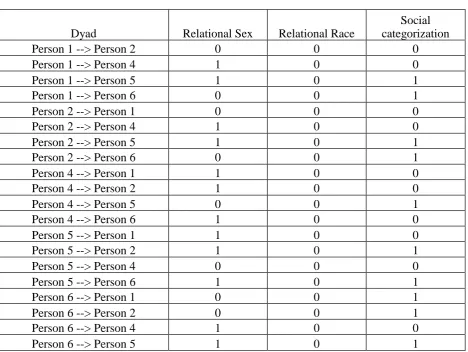
Black male, Person 4 = White female, Person 5 = White female, and Person 6 = White male (see Table 1)
Insert Table 1 about here
Phase 1: Computing the social categorization variable
Literature on social categorization processes suggests that categorization takes a
dichotomous form as people naturally divide others by a process of in-group vs. out-group classifications (cf. Crocker, Fiske, & Taylor, 1984; Rosch, 1975; Shaw, 2004; Turner, 1987). According to Turner (1987), “category formation is relative to the frame of reference (the pool of
psychologically relevant stimuli) and hence the available contrasts provided by the salient stimulus field, and depends not just on ‘similarities’ between stimuli, as is usually assumed, but
on relative similarities, on more similarity (or less difference) between certain stimuli than between those and others” (p. 47).
To apply the measure of categorization salience that we are proposing, participants
should therefore be given in a survey the names of all members of their team and asked to categorize them as belonging to in-groups vs. out-groups. Tajfel and colleagues (e.g., Billig &
Tajfel, 1973) noted that the variable of social categorization always coincides with the variable of similarity. It does not matter how the subjects divided themselves into sub-groups, the important point is that the subjects always perceived similarity between their fellow in-group
members and themselves, and dissimilarity between themselves and the members of the out-group. Thus, it is reasonable to assume that similarity ratings can be used as a proxy of social
as a dichotomous social categorization variable with two values (see Table 1 column social categorization): in-group (1; perceived similarity scores greater than or equal to 5), and out-group (0; perceived similarity scores less than 5)2. Regardless of whether researchers use direct
categorization measures (i.e., asking group members to make in- vs. out-group judgments), or similarity ratings, what is important is that the ID3 explores categorization as a categorical
variable.
Phase 2: Selection of diversity attributes
To be able to complete the data set for each team, we needed to decide on the diversity attributes that might impact their in-group vs. out-group categorizations, like, for example, demographic attributes (e.g., sex, age, race), personality (e.g., extroversion, neuroticism) and/or
values (e.g., individualism, collectivism). It was, however, beyond the scope of this paper to attempt to provide a comprehensive list of attributes to study diversity in groups. Since we were interested in illustrating the development of a salience measure for each diversity attribute
chosen, the exact nature of the attributes involved was a theoretical issue, and, for the sake of simplicity, we limited the presentation here to the “Big Two” diversity categories of sex and race
and the faultline formed by sex-by-race combinations.
Phase 3: Creation of dummy relational diversity variables (dyadic level)
The next step is to code the diversity variables in an interval scale and code relational scores (See Table 1 columns Relational Sex and Relational Race). Decision tree algorithms, (such as the ID3) tend to perform better when dealing with discrete, categorical features (Kotsiantis, 2007). Drawing from the diversity literature, there are variables that can thus be
2 The dichotomization of variables may reduce their observed correlations with other related constructs and thus
straightforwardly used with the ID3 approach, which include, among others, race, sex,
occupational level, organizational role, education, career level, legal marital status, and children. Although the ID3 algorithm does not directly deal with continuous predictors, we discuss this
point further in the conclusion. For this study, we coded our two demographic variables as follows: gender (two levels coded: male = 0, female = 1) and race (four levels coded: White = 1;
Black = 2; Hispanic = 3; Asian = 4). Then, we created the relational variables based on dyadic comparisons among all members of the team with a value of “0” indicating that two group
members share the attributes (e.g., same sex, or same race), and a value of “1” indicating that
they do not share the attribute.
Phase 4: Running the ID3 algorithm
The last step is to run the ID3 algorithm for each of the groups in the data set to obtain the relative salience of each diversity attribute (e.g., sex and race) and their faultlines (e.g.,
sex-by-race faultline) in each work group. The ID3 algorithm determines the extent to which the selected diversity attributes and their combinations predict social categorization. As mentioned earlier, a given diversity attribute (e.g., sex or race) is supposed to be salient in the minds of the team
members when they use it as the basis for social categorization judgments into similar (in-group members) or different (out-group members) from oneself. Following the recommendations of Thompson and Thompson (1986), we show how the ID3 algorithm determines the amount of
members. Thus, participants are not primed by the question to consider the salience of particular social categories, even if they were not thinking of these categories previously.
A ONE-TEAM ILLUSTRATION
We illustrate the procedure of the ID3 algorithm (Quinlan, 1986) to measure salience of two social categories (sex and race) within a team. We show how the ID3 algorithm determines the amount of information contained in each attribute when classifying group members into
in-group and out-in-group considering our previous example of Work Team 1 in Table 1.
We first create a data set for the team that includes 30 dyadic cases, 12 of which are in-group and 18 out-in-group categorizations. The social categorization column refers to the in-group
and out-group variable and it is calculated based on group members’ ratings of each other as similar to oneself (in-group) or different from oneself (out-group). The relational sex and
relational race columns refer to relational demography on these attributes for all dyads within
the team. These relational demography variables can have two values—same or different—and are used to predict the classification of these 30 cases into in-groups and out-groups.
Because some attributes give more information about how to classify a group member into an in-group or out-group than other attributes do, it is possible to calculate the amount of information gained by considering each attribute separately. The ID3 algorithm uses the notion
of entropy as defined in information theory (Pierce, 1980). The concept of entropy applied to social categorization refers to the uncertainty of the classification of an individual into an
groups). The purpose of the ID3 is to determine the gain in information provided by each
attribute (sex and race) when deciding whether the social categorization is in-group or out-group. The attribute that provides the highest gain is used as the root node in the decision tree and we
take it as the most salient attribute in the mind of team members. Mathematically, if an individual can be classified into N different classes, c1,
.... c
N, and the probability of an individual being inclass i is p(ci), then the entropy of classification, H ( C ), is as follows:
Equation 1:
N
H ( C ) = - p (ci) log2p(ci) i = 1
N
H ( C ) = - p (ci) log2 p(ci) i=1
where p(ci ) is the proportion of individuals who belong to each class of the social categorization
variable and the log base 2 represents the number of bits needed to represent that many different individuals.3
Applying the above equation to the example set in Table 1 gives us a measure of
uncertainty (or entropy) about social categorization being in-group or out-group. Because there are two possible values for social categorization (in-group and out-group), the probability of
having an in-group value is 12 out of a total sample set of 30. The probability of out-group is 18/30. Thus, the entropy of classification for the total data set is
H ( C ) = - p(in-group) log2 p(in-group) - p(out-group) log2 p(out-group)
-(12/30) log2 (12/30)
–
(18/30) log2 (18/30) = 0.97 bitsThis value is the total degree of entropy in the data set. The second step is to determine the amount of information contained in each social category (sex and race). To calculate the entropy of classification after deciding on a particular category, represented by H(C/A), the ID3
3 That the log2 (8) = 3 means that 3 bits of information are needed to represent 8 objects. That is, these 8 objects can
algorithm splits the example set into subsets where each case has the same value of the partitioning category (i.e. same sex or different sex).
Salience of Sex Identity. We calculate information gained by considering the sex
category. After splitting by sex, the same sex branch gives a total of 14 cases including 7 in-group cases and 7 out-in-group cases, and the different sex branch gives a total of 16 cases
including 5 in-group cases and 11 out-group cases. Let us calculate the entropy for each sex branch.
Entropy for “same” sex branch = - (7/14) log2 (7/14) – (7/14) log2 (7/14) = 1 bit
Entropy for “different” sex branch = - (5/16) log2 (5/16) – (11/16) log2 (11/16) = 0.90
bits
To calculate the entropy of the entire data set split on “sex,” represented as H(C/sex), the
ID3 method computes the weighted average of the entropy of each subset (14 same sex and 16 different sex). In the present example, this yields the following:
Entropy (System, sex) = (14/30) (1) + (16/30) (.90) = 0.94 bits
The information gained by considering sex is the total degree of entropy in the data set minus the
entropy of the system when we consider sex. We take this value as indication of the degree of salience of the sex category. Thus, the salience of sex identity in this team is:
Entropy (S) – Entropy (S, sex) = 0.97 - 0.94 = 0.03 bits
Salience of Race Identity. We repeat the same procedure to calculate the information gained by considering the race category. After splitting by race, the same race branch gives a total of 20 cases including 10 in-group cases and 10 out-group cases, and the different race
Entropy for “same” race branch = - (10/20) log2 (10/20) – (10/20) log2 (10/20) = 1
bit
Entropy for “different” race branch = - (2/10) log2 (2/10) – (8/10) log2 (8/10) =
0.72 bits
Entropy (S, race) = (20/30) (1) + (10/30) (0.72) = 0.91 bits Information gained by testing race is:
Entropy (S) – Entropy (S, race) = 0.97 - 0.91 = 0.06 bits
Race has the highest gain; therefore, the race category is most salient in the mind of team members because it provides the highest amount of information when categorizing others into
in-group and out-in-group (salience of race = 0.06, and salience of sex = 0.03). The amount of information associated with each social category is taken as an indication of the degree of
collective salience of each social category within the team. Since the entropy of the classification into in-groups and out-groups after partitioning by race gives the smallest entropy or, equivalent, the highest information, the category “race,” is chosen to serve as the root node of the decision tree. When “race” is the starting point of the tree, the tree takes the form shown in Figure 2. This
Figure also shows a further split based on the category “sex” and the value of the social
categorization into in-groups and out-groups.
Insert Figure 2 about here
---Salience of sex-by-race faultline. So far, the analysis is only concerned with salience of dimensions of diversity in isolation (i.e., sex salience and race salience). However, it is also possible to compute the interaction between different dimensions (i.e., sex-by-race) to assess the
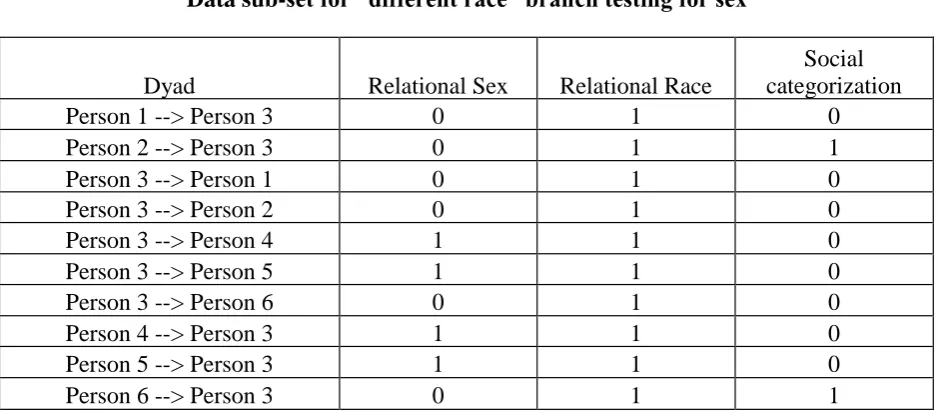
combination. Using “race” as the root node, we once again applied the ID3 algorithm to each of the two branches considering the two levels of the sex dimension. Step 1 describes the procedure for the “same race” branch and Step 2 describes the procedure for the “different race” branch.
Step 1. When we consider the “same race” branch, there still remains maximum entropy (1 bit) because half of the cases are in-group and half are out-group (See Table 2a). Then, we
applied the algorithm for the two values of the sex dimension (i.e., same or different) to assess the amount of information gained when also considering sex. After further splitting by sex, the
same sex branch (of the same race) gives a total of eight cases including five in-groups and three out-groups and the different sex branch (of the same race) gives a total of twelve cases including five in-groups and seven out-groups. Let us calculate the entropy for each sex branch
given same race.
--- Insert Table 2a about here ---
Step 1: Entropy of “same race” branch before considering for sex = - (10/20) log2 (10/20) –
(10/20) log2 (10/20) = 1 bit
Entropy for same sex branch = - (5/8) log2 (5/8) – (3/8) log2 (3/8) = 0.95 bits
Entropy for different sex branch = - (5/12) log2 (5/12) – (7/12) log2 (7/12) = 0.98 bits
Entropy (S same race, sex) = (8/20) (0.95) + (12/20) (0.98) = 0.97 bits
Step 2. Next when we consider the “different race” branch (see Table 2b), there still remains entropy of 0.72 bits. Then, we applied the algorithm for the two categories of the sex dimension (i.e., same or different) to assess the amount of information gained when testing for sex. After further splitting by sex, the same sex branch (of the different race) gives a total of six cases
gives a total of four cases including all out-groups. Let us calculate the entropy for each sex branch given different race.
--- Insert Table 2b about here ---
Step 2: Entropy of “different race” branch before considering for sex = - (2/10) log2 (2/10) –
(8/10) log2 (8/10) = 0.72 bits
Entropy for same sex branch = -(2/6) log2 (2/6) – (4/6) log2 (4/6) = 0.92 bits
Entropy for different sex branch = 0 (all out-group cases)
Entropy (S different race, sex) = (6/10) (.92) + (4/10) (0) = 0.55 bits
To calculate the entropy of the entire data set considering race and sex in combination, we next compute the weighted average of the entropy of each subset of race testing for sex (twenty cases of same race and ten cases of different race).
Entropy (S, race * sex) = (20/30) (0.97) + (10/30) (0.55) = 0.83 bits Information gained by considering sex * race is:
Entropy (S) – Entropy (S, sex * race) = 0.97 – 0.83 = 0.14 bits
Salience of sex * race would take the value of 0.14, meaning that in combination the sex and race categories are used by team members to divide themselves into in-groups and out-
groups to a greater extent than the sex or the race category in isolation (0.04 and 0.06 levels of salience, respectively).
step- by-step way. Readers interested in applying the ID3 algorithm can find an EXCEL macro in the link provided as a footnote4.
Insert Table 3 about here
AN EMPIRICAL ILLUSTRATION: DIVERSITY AND LEADERSHIP
We further illustrate the use of our proposed technique as well as its usefulness in diversity research in a survey of work teams. Again, we focus on the “Big Two” sex and race diversity
attributes and the sex-by-race faultline. Because the evidence in diversity research
overwhelmingly suggests that diversity attributes may have positive, negative, or null effects contingent on moderators (van Dijk et al., 2012; van Knippenberg & Schippers, 2007), we also
include a focus on moderation in this illustration. In particular, we focus on
charismatic-transformational leadership because it is the only moderating influence that has been studied both for the effects of single-attribute diversity (Greer, Homan, De Hoogh, & Den Hartog, 2012;
Kearney & Gebert, 2009; Shin, Kim, Lee, & Bian, 2012; Shin & Zhou, 2007) and diversity faultlines (Kunze & Bruch, 2010), with diversity effects and faultline effects more positive/less negative in the presence of higher, rather than lower, charismatic-transformational leadership. A focus on the moderating role of charismatic-transformational leadership (for short: charismatic
leadership) is thus well-suited, because it speaks to the only common denominator in research on the moderators of the effects of diversity and diversity faultlines. Even so, the focus on
charismatic leadership comes with an important caveat. As van Knippenberg and Sitkin (2013) outline, the concept of charismatic leadership is problematic both in its poor conceptualization and in terms of its poor measurement—the most plausible reading of the evidence is that survey
measures of charismatic leadership reflect the subjective perception of effective leadership. We would therefore not argue for any conceptual contribution flowing from its study. For the present purposes, however—the illustration of our approach to the measurement of categorization
salience—the focus on charismatic leadership is useful to illustrate what better measurement of categorization salience can bring to the diversity field.
The social categorization analysis suggests that both sex diversity and race diversity and sex-by-race faultlines can render social categorizations based on these attributes’ salience.
Neither diversity nor diversity faultlines deterministically lead to the salience of the associated categorization—team members can be diversity-blind—and categorization salience cannot be equated with negative effects—responses can be intergroup biased but also multicultural. It is
therefore important to assess both the relationship between diversity and salience, and the mediating role of salience in the relationship between diversity and relevant outcomes. For our
illustration, it is thus important to assess the relationship between sex diversity and sex
categorization salience, between race diversity and race categorization salience, and between the sex by race faultline and the salience of the categorization capturing both sex and race. Thus, we
focus on the mediating role salience plays in the relationship between diversity and team performance (self-reported performance by team members in this case).
Following the same social categorization analysis as illustrated in our prior example, we assess the moderating role of charismatic leadership, as charismatic leadership might invite diversity-blind responses, multicultural responses, or reduce intergroup biased responses. Thus,
we test the following three alternative responses.
Diversity-blind response
positive/less negative effects of diversity is that the effective leadership of which measures of charismatic leadership are presumably indicative (cf. van Knippenberg & Sitkin, 2013) invites diversity-blind responses: when charismatic leadership is low, diversity leads to categorization
salience, whereas with high charismatic leadership, diversity does not predict category salience. Effective leadership blinds team members so that they do not “see” these differences because of
personal identification with the leader. Diversity-blind responses would thus be evidenced in an interaction effect of diversity/faultlines and charisma predicting categorization salience.
Diversity-blind hypothesis. Diversity is positively associated with categorization salience and this effect is weaker when group members perceive the leader as high, rather than low, on charisma.
Intergroup biased response
Alternatively, charismatic leadership may reduce intergroup biased responses to salient categorizations. In this case, diversity leads to salient categorizations, and under conditions of
low charismatic leadership, salient categorizations invite intergroup bias. Under conditions of high charismatic leadership, however, these intergroup biases are attenuated or eliminated because group members begin to transcend their own short-term self-interest for the sake of their
workgroup. Thus, from an intergroup biased response perspective, we would expect that diversity has a main effect on categorization salience, and that categorization salience and charisma
predicting group performance have an interaction effect.
Intergroup-Biased hypothesis. Categorization salience will be negatively related to
evaluations of team performance and this relationship will be weaker when group members perceive their leader as high, rather than low, on charisma.
Multicultural response
Alternatively, when differences are perceived they can also be embraced because of their
Such a multicultural response perspective would imply that charismatic leadership invites positive responses to salient categorizations, because team members pay attention to the informational value associated with their differences. Like intergroup biased responses, this
implies effects of diversity on categorization salience and of salience-by-charismatic leadership interaction on performance. Importantly, we expect here positive effects of salience, rather than
absence of negative effects, on group performance when the leader is high in charisma.
Multicultural hypothesis. Categorization salience will be positively related to evaluations of team performance, and these relationships will be stronger when group members perceive their leader as high, rather than low, on charisma.
Sample and Procedure
The sample for this illustration was drawn from employees working at a large international manufacturing company located in upstate New York (Plant A headquarters) and New Jersey
(Plant B). The company was a leader in the development of products and systems that sense, transmit, record, store, and retrieve data, ranging from the wave forms of the human brain or heart to seismic activities. Meetings were organized to inform employees about the general
purpose of the study and to ensure that their participation was voluntary and confidential. Following Kozlowski and Bell (2003), we define work teams as groups that “(a) are composed
of two or more individuals, (b) who exist to perform organizationally relevant tasks, (c) share
one or more common goals, (d) interact socially, (e) exhibit task interdependencies (i.e., workflow, goals, outcomes), (f) maintain and manage boundaries, and (g) are embedded in an organizational context that sets boundaries, and constrains the team, and influences exchanges with other units in the broader entity” (p. 6). We determined work unit memberships from
organizational layouts. We verified this information in interviews with supervisors from each department. We met with each superior to set a group appointment to explain the nature of the study and distribute the survey. Our sample included such work groups as network development,
corporate communication management, corporate information systems, industrial sales and marketing, product development, quality control management, and top management.
Participants completed the survey in a meeting room next to the work setting during regular working hours and returned the surveys directly to the lead researcher. Demographic data for
each individual participant was recorded from internal archival data. A total of 239 individuals in 38 work teams completed the survey. The demographic description of the sample was as follows: 41% was male, 91% white, 6% black, 1% Hispanic, and 2% Asian, their average age was 51.7
years, and their average tenure in the company was 10.39 years.
Measures
Salience of social categorizations was measured using the ID3 algorithm as described in the earlier example.
Team diversity. Blau´s (1977) index was used to calculate team diversity with respect to
sex and race. This index measures the degree to which there are a number of categories in a distribution and the dispersion of the team members within these categories. This index can be
expressed as 1 - P i2 where P is the proportion of group members in a category and i is the
number of different categories represented on a team. We decided to use the Blau´s index to operationalize our measure of sex and race diversity because it is consistent with the categorical
scale of our demographic variables. We argue that differences in sex and race can be used as the basis for social categorization but also can be a source of valuable information for the team. This
Knippenberg et al., 2004), which holds that “all dimensions of diversity may have positive as well as negative effects” (van Knippenberg et al., 2004: 1008). According to Harrison and
Klein’s (2007) typology, this rationale implies that we conceptualize sex and race as both
separation and variety.
Sex/race faultline. We used Shaw´s (2004) index based on a Chi-squared statistic to measure the two-dimensional faultline of sex and race. In the case of two attributes, this is
equivalent to a cross-table correlation coefficient that captures the correlation between positions on two dimensions of diversity. It captures both within-subgroup similarities and between-group differences. Higher correlations indicate stronger faultlines. For example, let us take the case of
sex-by-race faultline in two teams of five people. The three female members of Team 1 are Hispanic, the two male members of Team 1 are white, and therefore the alignment between the
two variables (faultline) is 1. In contrast, in Team 2, there is variation in race within gender. The 2 female members of Team 2 are Hispanic, but the third is white, the faultine is weaker (r = .40).
Perceived task performance. Measures of team task performance were obtained by having all team members complete the Van der Ven and Ferry’s (1980) work group performance
scale, including seven factors: quantity and quality of performance, number of innovations, reputation for work excellence, goal attainment, efficiency, and morale. All items were
evaluated on a five-point scale, ranging from 1 = far below average to 5 = far above average. Items were combined into a scale by computing the mean on raw scores. The reliability index was .82. Scores were aggregated at the team level.
of our group.” Scores were aggregated at the team level.
Controls. We included team size as a control because it is often argued that team size can impact how team members perform and interact (Curral, et al., 2001). We also added a team plant
dummy as a control to our analyses as the work climate within a plant may impact team processes.
Team tenure or the average amount of time team members have spent with the team has long been considered to have an influence on group development (Pfeffer, 1983; Weick, 1969) and has been
shown to affect team outcomes (Finkelstein & Hambrick, 1990; Hirst, 2009). As a result, we believe it warrants inclusion as a control variable in our analyses. Finally, task interdependence is the degree to which accomplishing the goal of the team requires completion of interconnected or
interdependent subtasks. More interdependent tasks require higher levels of collaboration and information sharing among team members (Bell & Kozlowski, 2002). In teams with less
interdependent tasks, there is less of a need for collaboration and information sharing; hence the
level of interdependence within a team may impact team outcomes. Task interdependence was measured using a four-item survey developed by Van de Ven, Delbeck, and Koenig (1976). The task interdependence scale indicates what percentage of the total work within their unit flows in
each of the ways as shown by each of the figures (See Appendix A): (1) independent work flow, (2) sequential work flow, (3) reciprocal work flow, and (4) team work flow. These different work flow cases were assigned values of 0, 3, 6, and 9 respectively. Then, the scaled value
corresponding to the most predominant work flow in each group was used as the measurement of task interdependence. The average was 52.59 and standard deviation was 18.28, suggesting that indeed most groups were moderate to high interdependence but that there was enough variance on
this variable among the groups (see Appendix A).
Measurement model. Both charismatic leadership and team performance were subjective ratings by team members, and therefore we ran a confirmatory factor analysis to test whether a two factor charismatic leadership—team performance solution had a good fit and a better fit than
the one-factor alternative model. The two factor model had good fit, χ2 (20) = 60.49, CFI = .96, SRMR = .08, that was superior to that of the one factor model, χ2 (20) = 715.14, CFI = .43,
SRMR = .20, according to a χ2 difference test. All factor loadings were statistically significant
and ranged from .42 to .82 for team performance items and .53 to .94 for charismatic leadership
items.
Data aggregation. In order to assess the suitability of aggregating individual scores of team performance and team leader’s charisma to the organizational level, we examined
intra-class correlations, i.e., ICC(1) and ICC(2), as well as within group agreement, i.e., rWG(j) (Le
Breton & Senter, 2007) Although these scales already referred to the team level, we checked
empirically the appropriateness of aggregating the responses of individual team members to the team level. For team performance, ICC(1) was .05 and ICC(2) was .23; and for team leader’s charisma, ICC(1) was .21 and ICC(2) was .62. Team performance had a median rWG(j) = .85 and
leader charisma had a median rWG(j) =.75. Taken together, these results suggested very strong
agreement and consistency in responses among group members when evaluating the
performance of their team and the charismatic qualities of their leader.
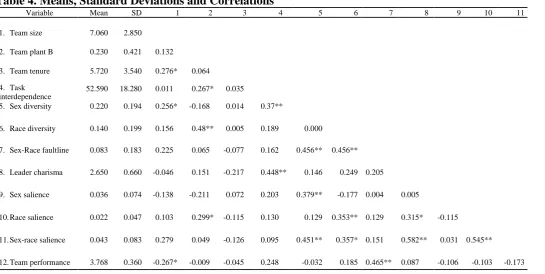
Descriptive statistics. Table 4 shows correlations, means, and standard deviations for the study variables. The means showed that on average the faultine categorization that captured sex
and race simultaneously (mean = .043) was more salient than the sex categorization (mean = .036) and the race categorization (mean = .022). Plant B was more ethnically diverse (r = .48, p < .01)
< .01).
The zero-order correlations offered preliminary support for the notion that demographic diversity in the team increases the salience of these categorizations. Sex diversity in the team was
positively related to the salience of the sex categorization (r = .38, p < .01). Similarly, race diversity in the team was positively related to the salience of race categorization (r = .35, p <
.01). Furthermore, the sex-by-race faultline was positively related to the salience of the categorization capturing the combination of sex and race (r = .58, p < .01).
--- Insert Table 4 about here ---
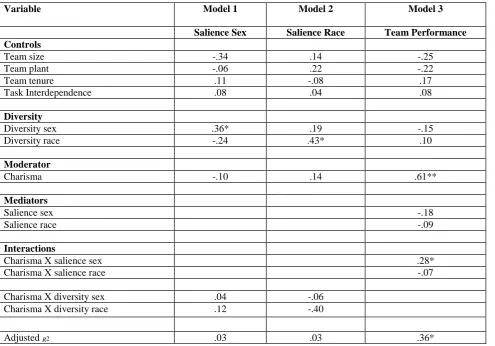
Regression analysis: Salience. First, we tested the notion that the salience of social categorizations is influenced by team diversity and diversity faultlines. We conducted
hierarchical regression analyses with sex categorization salience regressed on sex diversity and race categorization salience regressed on race diversity, controlling for the size and tenure of the
group, plant, task interdependence, and charismatic leadership. The results of the regression analyses are presented in Table 5. Model 1 showed that the coefficient for sex diversity was significant and positive predicting sex categorization salience, f3 = .36, p < .05. Table 5, Model 2 shows that the coefficient for race diversity was significant and positive predicting race categorization salience, f3 = .43, p < .05. Table 6, Model 1, shows that there was a positive and significant effect of the sex*race faultline on the salience of the sex*race categorization, f3 = .61, p < .01.
--- Insert Tables 5 and 6 about here ---
sex categorization salience and race categorization salience respectively, and that these
relationships were not moderated by charisma, we can thus rule out diversity-blind responses for sex diversity and race diversity either as a main effect or as an effect moderated by charisma.
The question that remained to be addressed below was whether there was a case of multicultural or intergroup biased responses.
Model 1 of Table 6 shows that the interaction of charisma and sex-by-race faultline
predicted salience of the sex*race categorization, β = -.39, p < .05. Figure 2 shows this interaction.
The positive relationship between the sex*race faultline and the salience of the sex*race
categorization was weaker with higher charismatic leadership, suggesting that charisma inspired diversity-blindness to some extent. Even so, given that both slopes are positive, these findings also
left open the possibility of intergroup biased or multicultural responses.
--- Insert Figure 2 about here ---
Regression analysis: Team performance. The notion of multicultural responses would suggest a positive relationship between categorization salience and team performance, whereas the notion of intergroup biased responses would suggest a negative relationship between salience
and performance. Table 5, Model 3, shows that there is no case for a main effect of either sex diversity or race diversity on performance, and Table 6, Model 2, shows that there is no case for
a sex*race faultline main effect on team performance. By implication, there is no case to further explore mediation of these main effects.
Moderated intergroup biased responses would suggest a negative effect of salience on
Accordingly, we tested salience by charisma interactions, as reported in Table 5, Model 3 for the diversity variables and in Table 6, Model 2, for the diversity faultline.
The interaction of sex salience and charismatic leadership predicting team performance was positive and significant, β = .28, p < .05. Figure 3 displays this interaction. The relationship
between the salience of the sex categorization and team performance was negative when the
leader was perceived as low on charisma, but was positive when the leader was perceived as high on charisma. Thus, with low charisma, responses to sex diversity appeared to be intergroup
biased, but with high charisma responses appeared to be multicultural. The interactions with charisma for race categorization salience and sex*race categorization salience were not significant.
--- Insert Figure 3 about here ---
Bootstrapping: The mediating role of salience. To test the moderated mediation model for
sex diversity implied by our findings, we used a bootstrap procedure to test the indirect effect of sex diversity on performance through the salience of the sex categorization at -1 SD for
charismatic leadership and at +1 SD for charismatic leadership. Mediation is indicated when the
indirect effect differs significantly from zero (Shrout & Bolger, 2002). We drew 1,000 random samples with replacement from the full sample and constructed bias-corrected confidence
intervals, using the PROCESS macro (Hayes, 2012). This method for evaluating the indirect effect has relatively high statistical power, particularly in the case of small samples (MacKinnon,
Lockwood, & Williams, 2004). As shown in Table 7a, for low charisma the indirect effect of sex
diversity on team performance mediated by sex salience was -.23, and the 95 percent confidence interval for this effect excluded zero (-.66, -.01), indicating a significant indirect effect. For high
.54), indicating a non-significant indirect effect. Because the indirect effect was not significant for high-perceived charismatic leadership, we cannot conclude that the response was
multicultural. These results supported the conclusion that responses to sex diversity are
intergroup biased with low perceived charismatic leadership but not with high perceived charismatic leadership.
The sex*race faultline interacted with charisma to predict salience, and we therefore also tested whether salience subsequently mediated an effect on performance. As shown in Table 7b,
for low charisma the indirect effect of sex*race faultline on team performance mediated by sex*race salience was -.22, and the 95 percent confidence interval included zero (-2.63, .33), indicating a non-significant indirect effect. Similarly, for high charisma the indirect effect of
sex*race faultline on team performance mediated by sex*race salience was .02 and the 95 percent confidence interval included zero (-1.26, 1.53). Because the indirect effects were not
significant, we can conclude that responses to sex*race faultlines with charisma were limited to diversity blindness with no subsequent effect on performance.
--- Insert Table 7a and Table 7b about here ---
DISCUSSION
Summary of Results
Our findings illustrate the importance of assessing salience to differentiate
demographic sex and race diversity and sex*race diversity faultline were significantly related to the salience of sex, race, and sex*race categorization within the team, suggesting that salience of
social categories is influenced by objective team diversity and faultlines. Furthermore, we found diversity-blind responses to the sex*race diversity faultline that was moderated by charisma. Sex*race categorization salience was lower the more members of the team rated their leaders as charismatic – a pattern of diversity-blind responses as a function of leadership (Figure 1a).
Second, for the diversity faultline, we found evidence for neither intergroup biased nor
multicultural responses (Figure 1b and 1c). Our results show that the indirect effect on team performance mediated by sex-race salience was non-significant, both on its own and also when accounting for the moderating influence of charisma on these relationships. This implies that
although charismatic leadership preempts intergroup bias by suppressing to some extent social categorization of sex and race (e.g., diversity-blind response), it may not bring about tangible improvements to team performance because it may discourage proactive engagement with diversity as an informational resource.
Third, as moderated effects, we found a buffer to intergroup biased responses to sex diversity as a function of leadership (but the influence did not take the form of multicultural
responses that would inspire performance benefits). With low charismatic leadership ratings, the salience of sex categorization in the team is associated with reduced performance. However, with
high charisma ratings, this intergroup biased response to sex categorization is significantly reduced. Without explicitly assessing salience this effect could not have been distinguished from a diversity-blind response inspired by leadership (i.e., intergroup biased responses with low
charisma, diversity-blind responses with high charisma).
salience measurement can be applied in diversity research to assess part of the process through which team diversity may affect team performance; it also advances understanding on how doing so can yield important insights that allow more sophisticated testing of theory regarding diversity
processes. First, our results urge us to consider categorization salience as a mediator between team diversity and team outcomes. Second, our research is one of the first empirical attempts to explore
moderators that may influence the relationship between team diversity and team outcomes. Thus, our moderated mediation approach to diversity is particularly suited to explore the different
potential responses to diversity that are at the heart of the categorization-elaboration model
proposed by van Knippenberg and his colleagues (van Knippenberg et al., 2004).
Methodological and Theoretical Contribution of ID3 Salience Measurement
Measuring categorization salience is important to capture one of the most fundamental processes proposed to underlie team diversity effects (cf. van Knippenberg et al., 2004). The ID3 approach to measuring salience we propose here is an important advance over previous self-reports of salience, because it can be applied in concise form (questionnaire length is determined
only by number of team members) to multiple dimensions of diversity and diversity faultlines formed by these measures. The inclusion of a salience measure of multiple attributes of diversity might help researchers in four ways. First, although salience of categorizations is often evoked
theoretically as a key mechanism that mediates demographic diversity and its consequences, measurement techniques of categorization salience are still missing. Harrison et al. (2002), for example, note that “diversity effects rely on perceptions... Yet, these perceptions have rarely been
studied in diversity research” (p. 1032). And when studied, perceptual measures are used as
assessed. As such, a key purpose of our research was a conceptual and methodological presentation on the use of the ID3 algorithm to operationalize categorization salience. This measure can assist in determining the extent to which a set of attributes is psychologically
relevant to team members.
Second, our results show that the inclusion of categorization salience measures might help to capture three different responses to diversity among team members in the presence of a
moderator - diversity-blind, intergroup biased, and multicultural perceptions. Our findings provide support for researchers who have argued that moderating factors which influence the
relationship between team diversity and team outcomes need to be brought to the fore to gain fine-grained understanding of diversity effects (e.g., Horwitz, Sujin, & Horwitz, 2007; van Knippenberg & Schippers, 2007). The most important implication for future research is that our
approach makes it possible to differentiate between the three responses to diversity as proposed by the categorization-elaboration model (van Knippenberg et al., 2004), thus providing a
much-needed tool to conceptualize and test more comprehensive theoretical models. By tracing connections between group composition, categorization salience and group performance, our paper helps to gain a more nuanced view of diversity at work.
Third, an additional advantage of the ID3 approach is that it requires interpersonal in- vs. out-group or similarity judgments and not self-reports of the use of a social categorization. The
latter arguably is more prone to social desirability in responding, because respondents may be more wary of reporting that they rely on demographic characteristics in thinking about their team members. The categorization or similarity judgments are not necessarily free of such concerns –
compared with the existing survey measurement, the concern should at least be weaker. Finally, our research advances the social categorization and diversity literatures drawing from cognitive process modelling based on machine learning algorithms (e.g., Quinlan, 1986).
Scholars showed long ago how computer programs that perform sequences of simple information processing steps could be construed to understand cognitive processes (e.g., Baylor & Simon,
1966). The ID3 represents the structure of the knowledge acquired by the system in the form of a decision tree, similar to the super-ordinate framework of social categorizations. Schrodt (1991: 379) concludes that the ID3 is “the most commonly used machine-learning technique for solving
classification problems, it is simple to implement, well understood, robust, and as such has become the artificial intelligence equivalent of stepwise multiple regression as a general-purpose empirical technique.” Our analysis suggests that the ID3 machine-learning technique has the
potential to provide a much-needed methodological tool to better understand social
categorization and its implications for work team diversity. As suggested by Schrodt (1987: 1), “unlike existing statistical techniques, the knowledge representation of structures inductively
constructed by [ID3] are plausible models of human inductive theorizing since they fit within the known cognitive constraints of the brain.” The ID3 thus does not only have the advantages of
being easy to implement and of measurement efficiency, but also of being well-aligned with the
cognitive processes it is targeted to measure.
Limitations and Future Research