http://wrap.warwick.ac.uk
Original citation:
Cotton-Barratt, Conrad, Murawski, Andrzej S. and Ong, C.-H. Luke (2015) Weak and
nested class memory automata. In: Dediu, Adrian-Horia and Formenti, Enrico and
Martín-Vide, Carlos and Truthe, Bianca, (eds.) Language and Automata Theory and
Applications : 9th International Conference, LATA 2015, Nice, France, March 2-6, 2015,
Proceedings. Lecture Notes in Computer Science, Volume 8977 . Springer International
Publishing, pp. 188-199. ISBN 9783319155784
Permanent WRAP url:
http://wrap.warwick.ac.uk/69971
Copyright and reuse:
The Warwick Research Archive Portal (WRAP) makes this work by researchers of the
University of Warwick available open access under the following conditions. Copyright ©
and all moral rights to the version of the paper presented here belong to the individual
author(s) and/or other copyright owners. To the extent reasonable and practicable the
material made available in WRAP has been checked for eligibility before being made
available.
Copies of full items can be used for personal research or study, educational, or not-for
profit purposes without prior permission or charge. Provided that the authors, title and
full bibliographic details are credited, a hyperlink and/or URL is given for the original
metadata page and the content is not changed in any way.
Publisher’s statement:
"The final publication is available at Springer via
http://dx.doi.org/10.1007/978-3-319-15579-1_14 "
A note on versions:
The version presented here may differ from the published version or, version of record, if
you wish to cite this item you are advised to consult the publisher’s version. Please see
the ‘permanent WRAP url’ above for details on accessing the published version and note
that access may require a subscription.
Conrad Cotton-Barratt1,?, Andrzej S. Murawski2,??, and C.-H. Luke Ong1,? ? ?
1 Department of Computer Science, University of Oxford, UK
{conrad.cotton-barratt,luke.ong}@cs.ox.ac.uk
2
Department of Computer Science, University of Warwick, UK
Abstract. Automata over infinite alphabets have recently come to be studied extensively as potentially useful tools for solving problems in verification and database theory. One popular model of automata studied is the Class Memory Automata (CMA), for which the emptiness problem is equivalent to Petri Net Reachability. We identify a restriction – which we call weakness – of CMA, and show that they are equivalent to three existing forms of automata over data languages. Further, we show that in the deterministic case they are closed under all Boolean operations, and hence have anExpSpace-complete equivalence problem. We also extend CMA to operate over multiple levels of nested data values, and show that while these have undecidable emptiness in general, adding the weakness constraint recovers decidability of emptiness, via reduction to coverability in well-structured transition systems. We also examine connections with existing automata over nested data.
Keywords: Automata, Data Languages, Nested Data
1
Introduction
A data word is a word over a finite alphabet in which every position in the word also has an associateddata value, from an infinite domain. Data languages provide a useful formalism both for problems in database theory and verification [13, 16, 3]. For example, data words can be used to model a system of a potentially unbounded number of concurrent processes: the data values are used as identifiers for the processes, and the data word then gives an interleaving of the actions of the processes. Having expressive, decidable logics and automata over data languages then allows properties of the modelled system to be checked.
Class memory automata (CMA) [3] are a natural form of automata over data languages. CMA can be thought of as finite state machines extended with the ability, on reading a data value, to remember what state the automaton was in when it last saw that data value. A run of a CMA is accepting if the following two conditions hold: (i) the run ends in aglobally accepting state; and (ii) each
?
Supported by an EPSRC Doctoral Training Grant
?? Supported by EPSRC (EP/J019577/1) ? ? ?
data value read in the run was last seen in a locally accepting state. If using data values to distinguish semi-autonomous parts of a system, while the first condition can check the system as a whole has behaved correctly, the second of these conditions can be used to check that each part of the system independently behaved correctly. The emptiness problem for CMA is equivalent to Petri net reachability, and while closed under intersection, union, and concatenation, they are not closed under complementation, and do not have a decidable equivalence problem.
We earlier described how data words can be used to model concurrent systems: each process can be identified by a data value, and CMA can then verify properties of the system. What happens when these processes can spawn subprocesses, which themselves can spawn subprocesses, and so on? In these situations the parent-child relationship between processes becomes important, and a single layer of data values cannot capture this; instead we want a notion ofnested data values, which themselves contain the parent-child relationship. In fact, such nested data values have applications beyond just in concurrent systems: they are prime candidates for modelling many computational situations in which names are used hierarchically. This includes higher-order computation where intermediate functional values are being created and named, and later used by referring to these names. More generally, this feature is characteristic of numerous encodings into theπ-calculus [14].
This paper is concerned with finding useful automata models which are expressive enough to decide properties we may wish to verify, as well as having good closure and decidability properties, which make them easy to abstract our queries to. We study a restriction of class memory automata, which we find leads to improved complexity and closure results, at the expense of expressivity. We then extend class memory automata to a nested data setting, and find a decidable class of automata in this setting.
Contributions.In Section 3 we identify a natural restriction of Class Memory Automata, which we call weak Class Memory Automata, in which the local-acceptance condition of CMA is dropped. We show that these weak CMA are equivalent to: (i) Class Counting Automata, which were introduced in [12]; (ii) non-reset History Register Automata, introduced in [18]; and (iii) locally
prefix-closed Data Automata, introduced in [5].
These automata have anExpSpace-complete emptiness problem. The primary advantage of having this equivalent model as a kind of Class Memory Automaton is that there is a natural notion of determinism, and we show that Deterministic Weak CMA are closed under all Boolean operations (and hence have decidable containment and equivalence problems).
but reintroducing the Weakness constraint recovers decidability. We show how these Nested Data CMA recognise the same string languages as Higher-Order Multicounter Automata, introduced in [2], and also how the weakness constraint corresponds to a natural weakness constraint on these Higher-Order Multicounter Automata. Finally, we show these automata to be equivalent to the Nested Data Automata introduced in [5].
Related Work. Class memory automata are equivalent to data automata (introduced in [4]), though unlike data automata, they admit a notion of
deter-minism. Data automata (and hence class memory automata) were shown in [4] to be equiexpressive with the two-variable fragment of existential monadic second order logic over data words. Temporal logics have also been studied over data words [6], and the introduction of locally prefix-closed data automata and of nested data automata in [5] is motivated by extensions to BD-LTL, a form of LTL over multiple data values introduced in [10].
Fresh register automata [17] are a precursor to the History Register automata [18] which we examine a restriction of in this paper. Class counting automata, which we show to be equivalent to weak CMA, have been extended to be as expressive as CMA by adding resets and counter acceptance conditions [12, 11]. We note that our restriction of class memory automata, which we call weak class memory automata, sound similar to the weak data automata introduced in [9]. However, these are two quite different restrictions, with emptiness problems of different complexities, and the two automata models should not be confused. In the second part of this paper we examine automata over nested data values. First-order logic over nested data values has been studied in [3], where it was shown that the<predicate quickly led to undecidability, but that only having the +1 predicate preserved decidability. They also examined the link between nested data and shuffle expressions. In [5] Decker et al. introduced ND-LTL, extending BD-LTL to nested data values. To show decidability of certain fragments of ND-LTL they extended data automata to run over nested data values, giving the nested data automata we examine in this paper.
Further Work.We would like to understand better whether there is a natural fragment of theπ-calculus that corresponds to the new classes of automata. On the logical side, an interesting outstanding question is to characterize languages accepted by our classes of automata with suitable logics.
2
Preliminaries
Let Σbe a finite alphabet, andDan infinite set of data values. Adata alphabet,
D, is of the formΣ× D. The set of finite data words overDis denotedD∗. Class Memory Automata and Data Automata. Given a setS, we write
S⊥to meanS∪ {⊥}, where⊥is a distinguished symbol (representing a fresh data value). AClass Memory Automaton [3] is a tuple hQ, Σ, qI, δ, FL, FGi where
Q is a finite set of states, Σ is a finite alphabet, qI ∈ Q is the initial state,
FG⊆FL⊆Qare sets of globally- and locally-accepting sets (respectively), and
if each set in the image of the transition function is a singleton. Aclass memory function is a map f :D →Q⊥ such thatf(d)6=⊥for only finitely manyd∈ D. We viewf as a record of the history of computation: it holds the state of the automaton after the data valuedwas last read, wheref(d) =⊥means thatdis fresh. A configuration of the automaton is a pair (q, f) whereq∈Qandf is a class memory function. The initial configuration is (q0, f0) wheref0(d) =⊥for
everyd∈ D. Suppose (a, d)∈Σ× D is the input. The automaton can transition from configuration (q, f) to configuration (q0, f0) just if q0 ∈ δ(q, a, f(d)) and
f0=f[d7→q0]. A data wordwisaccepted by the automaton just if the automaton can make a sequence of transitions from the initial configuration to a configuration (q, f) whereq∈FG andf(d)∈FL∪ {⊥}for every data valued.
A Data Automaton [4] is a pair (A,B) whereA is a letter-to-letter string transducer with output alphabetΓ, called the Base Automaton, andB is a NFA with input alphabetΓ, called the Class Automaton. A data wordw=w1. . . wn∈
D∗ is accepted by the automaton if there is a run ofAon the string-projection
of w (to Σ) with output b1. . . bn such that for each maximal set of positions {x1, . . . , xk} ⊆ {1, . . . , n} such thatwx1, . . . , wxk share the same data value, the
wordbx1. . . bxk is accepted byB.
CMA and DA are expressively equivalent, withPTimetranslation [3]. The emptiness problem for these automata is decidable, and equivalent to Petri Net Reachability [4]. The class of languages recognised by CMA is closed under intersection, union, and concatenation. It is not closed under complementation or Kleene star. Of the above, the class of languages recognised by deterministic CMA is closed only under intersection.
Locally Prefix-Closed Data Automata.A Data AutomatonD= (A,B) is locally prefix-closed (pDA) [5] if all states inBare final. The emptiness problem for pDA is ExpSpace-complete [5].
Class Counting Automata.A bag overD is a function h:D →N such thath(d) = 0 for all but finitely manyd∈ D. LetC={=,6=, <, >} ×N, which we call the set of constraints. If c= (op, e)∈C and n∈Nwe write n c iff
nope. AClass Counting Automaton (CCA) [12] is a tuplehQ, Σ, ∆, q0, Fiwhere
Qis a finite set of states,Σ is a finite alphabet,q0is the initial state,F ⊆Qis
the set of accepting states, and ∆, the transition relation, is a finite subset of
Q×Σ×C× {↑+,↓} ×
N×Q. A configuration of a CCA,C=hQ, Σ, ∆, q0, Fi,
is a pair (q, h) whereq∈Qandhis a bag. The initial configuration is (q0, h0)
whereh0 is the zero function. Given a data wordw= (a1, d1)(a2, d2). . .(an, dn)
a run of wonC is a sequence of configurations (q0, h0)(q1, h1). . .(qn, hn) such
that for all 0≤i < nthere is a transition (q, a, c, π, m, q0) whereq=qi,q0 =qi+1,
a = ai+1, hi(di+1) c, and hi+1 = hi[di+1 7→ hi(di+1) +m] if π =↑+ or
hi+1 =hi[di+1 7→m] if π =↓ The run is accepting ifqn ∈F. The emptiness
problem for Class Counting Automata was shown to beExpSpace-complete in [12].
Non-Reset History Register Automata.For a positive integer k write [k] for the set{1,2. . . , k}. Fixing a positive integerm, define the set of labels
with initially empty assignment is a tupleA=hQ, Σ, δ, q0, Fiwhereq0∈Qis
the initial state,F ⊆Qis the set of final states, andδ⊆Q×Σ×Lab×Q. A configuration of Ais a pair (q, H) where q ∈QandH : [m] → Pfn(D) where Pfn(D) is the set of finite subsets ofD. We callH anassignment, and ford∈ Dwe
writeH−1(d) for the set{i∈[m] :d∈H(i)}. The initial configuration is (q0, H0),
whereH0 assigns every integer in [m] to the empty set. When the automaton is
in configuration (q, H), on reading input (a, d) it can transition to configuration (q0, H0) providing there existsX ⊆[m] such that (q, a,(H−1(d), X), d)∈δand
H0 is obtained by removingdfromH(i) for each ithen addingdto eachH(i) such thati∈X. A run is defined in the usual way, and a run is accepting if it ends in a configuration (q, H) whereq∈F.
Higher-Order Multicounter Automata. A multiset over a set A is a function m :A → N. A level-1 multiset over A is a finite multiset over A. A
level-(k+ 1) multiset overAis a finite multiset of level-kmultisets over A. We can visualise this with nested set notation: e.g. {{a, a},{},{}} represents the level-2 multiset containing one level-1 multiset containing two copies ofa, and two empty level-1 multisets. A multiset ishereditarily empty if, written in nested set notation, it contains no symbols fromA.
Higher-Order Multicounter Automata (HOMCA) were introduced in [2], and their emptiness problem was shown to be Turing-complete at level-2 and above. A level-k multicounter automaton is a tuple hQ, Σ, A, ∆, q0, Fi whereQ is a
finite set of states, Σ is the input alphabet, A is the multiset alphabet,q0 is
the initial state, and F is the set of final states. A configuration is a tuple (q, m1, m2, . . . , mk) whereq∈Qand eachmi is either undefined (⊥) or a level-i
multiset overA. The initial configuration is (q0,⊥, . . . ,⊥). ∆is the transition
relation, and is a subset of Q×Σ×ops×Qwhere ops is the set of possible counter operations. These operations, and meanings, are as follows: (i) newi
(i≤k) turns mi from⊥into the empty level-imultiset; (ii)inca (a∈A) addsa
tom1; (iii)deca (a∈A) removesafromm1; (iv)storei(i < k) addsmitomi+1
and sets mi to⊥; (v) loadi (i < k) non-deterministically removes an m from
mi+1 and turnsmi from⊥tom. This can happen only whenm1. . . mi are all ⊥. The automaton reads the input word from left to right, updatingm1. . . mk
as determined by the transitions. A word is accepted by the automaton just if there is a run of the word such that the automaton ends up in configuration (q, m1, . . . , mk) whereq∈F and eachmiis hereditarily empty.
3
Weak Class Memory Automata
In this section we introduce a restriction of class memory automata,weak class memory automata (WCMA), that have improved closure and complexity proper-ties. We show that WCMA correspond to a natural restriction of data automata, locally-prefix closed data automata, as well as two other independent automata models, class counting automata and non-reset history register automata.
When defining a weak CMA (WCMA) we may omit the set of locally accepting states, and just give one set of final states,F.
The emptiness problem for class memory automata is reducible (in fact, equiva-lent) to emptiness of multicounter automata (MCA) [4, 3]. This reduction works by using counters to store the number of data values last seen in each state. The local-acceptance condition is checked by the zero-test of each counter at the end of a run of an MCA. In the weak CMA case, this check is not necessary, and so emptiness is reducible to emptiness of weak MCA. Just as MCA emptiness is equivalent to Petri net reachability, weak MCA emptiness is equivalent to Petri net coverability.
p1 p2
t2
t1
p1 p2
t2
t1
Fig. 1.An example Petri net with ini-tial and target markings
Example 2. We give an example showing how a very simple Petri net reachability query can be reduced to an emptiness of CMA problem, and the small change re-quired to reduce coverability queries to emptiness of WCMA. The idea is to en-code tokens in the Petri net using data values: the location of the token is stored by the class memory function’s memory
for the data value. Transitions in the Petri net will be simulated by sequences of transitions in the automaton, which change class memory function appropriately. Consider the Petri net shown in Figure 1, with initial marking above and target marking below.
s0
start
s1 s2
s4 s5
[image:7.595.294.461.410.545.2]s3 s6 s7 ⊥ s1 s3 ⊥ ⊥ s5 s5
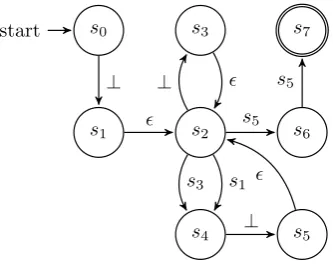
Fig. 2.A class memory automaton simulating the Petri net query shown in Figure 1
We give the automaton which models this reachability query in Figure 2. The first transitions from the initial state just set up the initial marking. As there is only one token in the initial marking, this just involves reading one fresh data value: this is the transition from s0 to s1 below. Once the
initial marking has been set up (reaching s2 below), the
automa-ton can simulate the transitions firing any number of times. Each loop froms2 back to itself
repre-sents one transition in the Petri
net firing: the loop above representst1firing, and the loop below representst2
firing. Fort1 to fire, no preconditions must be met, and a new data value can be
read in states3, thus data values last seen in either of statess1 ands3 represent
tokens inp1. For t2 to fire, a token must be removed from p1, since tokens in
p1are represented by tokens in eithers1 ors3, the first transition in this loop –
tos4 – involves reading a data value last seen in one of these states. Thus data
new token is placed in p2 by reading a fresh data value ins5. Once back ins2
these loops can be taken more, or the fact that a marking covering the target marking has been reached can be checked by reading two data values last seen in
s5 to reach a final state. The only globally accepting state iss7, and all states
except those which are used to represent tokens – i.e. all excepts1,s3, ands5 –
are locally accepting. The local acceptance condition thus checks that no other tokens remain in the simulated Petri net.
If we were interested in a coverability query, the same automaton, but without the local acceptance condition, would obviously suffice. Thus emptiness of WCMA is equivalent to Petri net coverability, which isExpSpace-complete.
We now give the main observation of this section: that weak CMA are equivalent to three independent existing automata models.
Theorem 3. Weak CMA, locally prefix-closed DA, class counting automata, and non-reset history register automata are all PTime-equivalent.
Proof. That Weak CMA and pDA are equivalent is a simple alteration of the proof of equivalence of CMA and DA provided in [3].
Recall that CCA use a “bag”, which essentially gives a counter for each data value. Weak CMA can easily be simulated by CCA by identifying each state with a natural number; then the bag can easily simulate the class memory function, by setting the data value’s counter to the appropriate number when it is read. To simulate a CCA with a WCMA, we first observe that for any CCA, since counter values can only be incremented or reset, there is a natural number,N, above which different counter values are indistinguishable to the automaton. Thus we need only worry about a finite set of values. This means the value for the counter of each data value can be stored in the automaton state, and thereby the class memory function.
In [18] the authors already show that nrHRA can be simulated by CMA. Their construction does not make use of the local-acceptance condition, so the fact that nrHRA can be simulated by WCMA is immediate. In order to simulate a given WCMA with state set [m], one can take a nrHRA of typem, with place
istoring the data values last seen in statei.
Data automata, and hence pDA, unlike CMA and WCMA, do not have a natural notion of determinism, nor a natural restriction corresponding to deterministic CMA or WCMA. What about for CCA? We define CCA to be deterministic if for each stateqand input lettera, the transitions (q, a, c, . . .)∈∆ are such that the c’s partition N. The same translations given in Theorem 3 also show that
deterministic WCMA and deterministic CCA are equivalent. We can ask the same question of non-reset HRA. We find that the natural notion of determinism here is: for eachq∈Q, a∈Σ, andX ⊆[m] there is precisely one Y ⊆[m] and
q0 ∈Qsuch that (q, a,(X, Y), q0)∈δ. Similarly, the translations discussed above show deterministic WCMA to be equivalent to deterministic nrHRA.
determinism). In fact, Deterministic Weak CMA have even nicer closure properties: the language recognised can be complemented using the same method as for DFA: complementing the final states.
Proposition 4. Deterministic Weak CMA are closed under all Boolean opera-tions.
Corollary 5. The containment and equivalence problems for Deterministic Weak CMA are ExpSpace-complete.
4
Nested Data Class Memory Automata
In Section 1 we discussed how data values fail to provide a good model for modelling computations in which names are used hierarchically, such as a system of concurrent processes which can spawn subprocesses. Motivated by these applications, in this section we introduce a notion of nested data values in which the data set has a forest-structure. This is a stylistically different presentation to earlier work on nested data in that [3, 5] require that each position in the words considered have a data value in each of a fixed number of levels. By giving the data set a forest-structure, we can explicitly handle variable levels of nesting within a word. However, we note that there is a natural translation between the two presentations.
Definition 6. A rooted tree (henceforth, just tree) is a simple directed graph
hD,predi, where pred:D * D is the predecessor map defined on every node of
the tree except the root, such that every node has a unique path to the root. A noden of a tree has levell just if predl−1(n)is the root (thus the root has level 1). A tree has bounded leveljust if there exists a least l≥1such that every node has level no more thanl; we say that such a tree has levell.
We define a nested dataseth D,predi to be a forest of infinitely many trees of level l which is fullin the sense that for each data valued of level less thanl, dhas infinitely many children (i.e. there are infinitely many data valuesd0 s.t.
pred(d0) =d).
We now extend CMA to nested data by allowing the nested data class memory automaton (NDCMA), on reading a data value d, to access the class memory function’s memory of not only d, but each ancestor of d in the nested data set. Once a transition has been made, the class memory function updates the remembered state not only ofd, but also of each of its ancestors. Formally:
Definition 7. Fix a nested data set of levell. ANested Data CMA of levell is a tuplehQ, Σ, δ, q0, FL, FGiwhereQis a finite set of states,q0∈Qis the initial state, FG ⊆FL⊆Qare sets of globally and locally accepting states respectively, and δis the transition map. δis given by a union δ=S
1≤i≤lδi where eachδi is a function:
The automaton is deterministic if each set in the image of δ is a singleton; and is weak if FL = Q. A configuration is a pair (q, f) where q ∈ Q, and
f : D → Q⊥ is a class memory function (i.e. f(d) = ⊥ for all but finitely
manyd∈ D). The initial configuration is(q0, f0)where f0 is the class memory
function mapping every data value to ⊥. A configuration (q, f) is final if q ∈
FG and f(d) ∈ FL∪ {⊥} for all d ∈ D. The automaton can transition from
configuration(q, f)to configuration(q0, f0)on reading input(a, d)just if dis a
level-i data value,q0 ∈δ(q, a,(i, f(predi−1(d)), . . . , f(pred(d)), f(d))), and f0=
f[d 7→q, pred(d)7→ q, . . . , predi−1(d)7→q]. A run (q
0, f0),(q1, f1), . . . ,(qn, fn) is accepting if the configuration(qn, fn)is final.w∈L(A)if there is an accepting run of Aonw.
It is clear that level-1 NDCMA are equivalent to normal CMA. We know that emptiness of class memory automata is equivalent to reachability in Petri nets; it is natural to ask whether there is any analogous correspondence – to some kind of high-level Petri net – once nested data is used.
Example 8. In Example 2, we showed how CMA (resp. WCMA) can encode Petri net reachability (resp. coverability). A similar technique allows reachability (resp. coverability) of Petri nets with reset arcs to be reduced to emptiness of NDCMA (resp. weak NDCMA). The key idea is to have, for each place in the net, a level-1 data value – essentially as a “bag” holding the tokens for that place. Nested under the level-1 data value, level-2 data values are used to represent tokens just as before. When a reset arc is fired, the corresponding level-1 data value is moved to a “dead” state – from where it and the data values nested under it are not moved again – and a fresh level-1 data value is then used to hold subsequently added tokens to that place.
Theorem 9. The emptiness problem for NDCMA is undecidable. Emptiness of Weak NDCMA is decidable, but Ackermann-hard.
Proof. This result follows from Theorem 12 together with results in [5], though we also provide a direct proof.
We show decidability by reduction to a well-structured transition system [8] constructed as follows: a class memory function on a nested data set can be viewed as a labelling of the data set by labels from the set of states. Since we only care about the shape of the class memory function (i.e. up to automorphisms of the nested data set), we can remove the nodes labelled by ⊥, and view a class memory function as a finite set of labelled trees. The set of finite forests of finite trees of bounded depth with the order given by F ≤F0 iff there is a forest homomorphism fromF toF0 (where a forest is the natural extension of tree homomorphisms to forests) is a well-quasi-order [7], which provides the basis for the well-structured transition system.
Weak Nested Data CMA have similar closure properties to Weak CMA (and this can be shown using the same techniques as for DFA).
Proposition 10. (i) Weak NDCMA are closed under intersection and union. (ii) Deterministic Weak NDCMA are closed under all Boolean operations.
Hence, as for weak CMA, the containment and equivalence problems for Deter-ministic Weak NDCMA are decidable.
4.1 Link with Nested Data Automata
In [5] Decker et al. also examined “Nested Data Automata” (NDA), and showed the locally prefix-closed NDA (pNDA) to have decidable emptiness (via reduction to well-structured transition systems). In fact, these NDA precisely correspond to NDCMA, and again being locally prefix-closed corresponds to weakness. In this section we briefly outline this connection.
Nested Data Automata.([5]) Ak-nested data automaton (k-NDA) is a tuple (A,B1, . . . ,Bk) where (A,Bi) is a data automaton for eachi. Such automata
run on words over the alphabet Σ× Dk, whereDis a (normal, unstructured)
dataset. As for normal data automata, the transducer, A, runs on the string projection of the word, giving outputw. Then for each ithe class automatonBi
runs on each subsequence ofwcorresponding to the positions which agree on the firstidata values. The NDA is locally prefix-closed if each (A,Bi) is.
Since these NDA are defined on a slightly different presentation of nested data, we provide the following presentation of NDCMA over multiple levels of data.
Definition 11. A Nested Data CMA of levelk over the alphabetΣ× Dk is a tuplehQ, Σ, δ, q0, FL, FGiwhereQis a finite set of states,q0∈Q,FG ⊆FL⊆Q, andδ:Q×Σ×(Q⊥)k → P(Q)is the transition map.
A configuration is a tuple(q, f1, f2, . . . , fk), where eachfi:Di→Q⊥maps an
i-tuple of data values to a state in the automaton (or⊥). The initial configuration is(q0, f10, . . . , fk0)wherefi0 maps every tuple in the domain to⊥. A configuration
(q, f1, . . . , fk)is final if eachfimaps intoFL∪{⊥}. The automaton can transition from configuration(q, f1, . . . , fk)to configuration(q0, f10, . . . , fk0)on reading input
(a, d1, . . . , dk)just if q0 ∈δ(q, a,(f1(d1), f2(d1, d2), . . . , fk(d1, . . . , dk))), and each
fi0=fi[(d1, . . . , di)7→q0].
Using ideas from the proof of equivalence between CMA and DA in [3], we can show the following result:
Theorem 12. NDCMA (resp. weak NDCMA) and NDA (resp. pNDA) are expressively equivalent, with effective translations.
4.2 Link with Higher-Order Multicounter Automata
(HOMCA). While not explicitly over nested data values, they are closely related to the ideas involved, and we show that, just as multicounter automata and CMA are equivalent, there is a natural translation between HOMCA and the NDCMA we have introduced. Further, just as the equivalence between MCA and CMA descends to one between weak multicounter automata and weak CMA, we find an equivalence between weak NDCMA and “weak” HOMCA in which the corresponding acceptance condition – hereditary emptiness – is dropped. To show this, we introduce HOMCA’, which add restrictions to thestoreiand
newi counter operations analogous to the restriction for the loadi operation.
[image:12.595.332.474.246.331.2]HOMCA weak HOMCA o o HOMCA’ O O weak HOMCA’ o o O O NDCMA O O weak NDCMA o o O O
Fig. 3.Translations between HOMCA, HOMCA’, NDCMA, and their weak counterparts
We show that these HOMCA’ are equiv-alent to HOMCA, and that HOMCA’ are equivalent to NDCMA, with both of these equivalences descending to the weak ver-sions. These equivalences are summarised in Figure 3.
Definition 13. We defineweakHOMCA to be just as HOMCA, but without the hereditary-emptiness condition on accep-tance, i.e. a run is accepting just if it ends in a final state.
Definition 14. We define HOMCA’ to be the same as HOMCA, except for the
fol-lowing changes to the counter operations: (i) storei operations are only enabled
when m1 =m2 =· · · =mi−1 =⊥; and (ii)newi operations are only enabled
whenmk 6=⊥, mk−16=⊥, . . . , mi+16=⊥andmi−1=mi−2=· · ·=m1=⊥. As for HOMCA, we define weak HOMCA’ to be HOMCA’ without the hereditary-emptiness condition.
This means that each reachable configuration (q, m1, . . . , mk) is such that there
is a unique 0≤i≤ksuch that for allj≤i,mj=⊥and eachl > i,ml6=⊥.
Theorem 15. HOMCA (respectively weak HOMCA) and HOMCA’ (resp. weak HOMCA’) are expressively equivalent, with effective translations between them.
Proof. This requires simulating the HOMCA operations storei and newi in
HOMCA’: which can be difficult if, for instance, the HOMCA is carrying out a
storeioperation when it has a current level-(i−1) multiset in memory. The trick is
to move the level-(i−1) multiset across to be nested under a new level-imultiset, and this can be done one element at a time in a “folding-and-unfolding” method. The hereditary emptiness condition checks that the each of these movements was completed, i.e. no element was left unmoved. In the weak case some elements not being moved could not change an accepting run to a non-accepting run, so the fallibility of the moving method does not matter.
Theorem 16. For every (weak) level-k NDCMA, A, there is a (weak) level-k HOMCA’, A0, such that L(A0) is equal to the Σ-projection of L(A), and
Proof. This proof rests on the strong similarity between the nesting of data values, and the nesting of level-imultisets in level-(i+ 1) multisets. For a NDCMA to simulate a HOMCA’, we use level-k data values to represent instances of the multiset letters, level-(k−1) data values to represent level-1 multisets, and so on, up to level-1 data values representing level-(k−1) multisets. Since each run of a HOMCA’ can have at most one level-k multiset, this does not need to be encoded in data values. Conversely, when simulating a NDCMA with a HOMCA’, a level-k data value is represented by an instance of an appropriate multiset letter. The letter contains the information on which state the data value was last seen in. Level-(k−1) data values are represented by level-1 multisets, which also include a multiset letter storing the state that data value was last seen in.
References
1. Araki, T., Kasami, T.: Some decision problems related to the reachability problem for Petri nets. Theor. Comput. Sci. 3(1), 85–104 (1976)
2. Bj¨orklund, H., Bojanczyk, M.: Shuffle expressions and words with nested data. In: Proceedings of MFCS. LNCS, vol. 4708, pp. 750–761 (2007)
3. Bj¨orklund, H., Schwentick, T.: On notions of regularity for data languages. Theor. Comput. Sci. 411(4-5), 702–715 (2010)
4. Bojanczyk, M., Muscholl, A., Schwentick, T., Segoufin, L., David, C.: Two-variable logic on words with data. In: LICS. pp. 7–16. IEEE Computer Society (2006) 5. Decker, N., Habermehl, P., Leucker, M., Thoma, D.: Ordered navigation on
multi-attributed data words. In: CONCUR 2014. pp. 497–511. Springer (2014)
6. Demri, S., Lazic, R.: LTL with the freeze quantifier and register automata. ACM Trans. Comput. Log. 10(3) (2009)
7. Ding, G.: Subgraphs and well-quasi-ordering. J. Graph Theory 16, 489–502 (1992) 8. Finkel, A., Schnoebelen, P.: Well-structured transition systems everywhere! Theor.
Comput. Sci. 256(1-2), 63–92 (2001)
9. Kara, A., Schwentick, T., T.: Feasible automata for two-variable logic with successor on data words. In: LATA. LNCS, vol. 7183, pp. 351–362. Springer (2012)
10. Kara, A., Schwentick, T., Zeume, T.: Temporal logics on words with multiple data values. In: FSTTCS. LIPIcs, vol. 8, pp. 481–492. Schloss Dagstuhl (2010)
11. Manuel, A.: Counter automata and classical logics for data words. Ph.D. thesis, Institute of Mathematical Sciences, Chennai (2011)
12. Manuel, A., Ramanujam, R.: Counting multiplicity over infinite alphabets. In: RP. LNCS, vol. 5797, pp. 141–153. Springer (2009)
13. Neven, F., Schwentick, T., Vianu, V.: Finite state machines for strings over infinite alphabets. ACM Trans. Comput. Log. 5(3), 403–435 (2004)
14. Sangiorgi, D.: Expressing Mobility in Process Algebras: First-Order and Higher-Order Paradigms. Ph.D. thesis, University of Edinburgh (1992)
15. Schnoebelen, P.: Verifying lossy channel systems has nonprimitive recursive com-plexity. Inf. Process. Lett. 83(5), 251–261 (2002)
16. Segoufin, L.: Automata and logics for words and trees over an infinite alphabet. In: CSL. LNCS, vol. 4207, pp. 41–57. Springer (2006)
17. Tzevelekos, N.: Fresh-register automata. In: POPL 2011. pp. 295–306. ACM (2011) 18. Tzevelekos, N., Grigore, R.: History-register automata. In: FoSSaCS. Lecture Notes