
Original citation:
Gajarsky, Jakub, Hlineny, Petr , Lokshtanov, Daniel , Obdrálek, Jan, Ordyniak, Sebastian, Ramanujan, Maadapuzhi Sridharan and Saurabh, Saket (2015) FO model checking on posets of bounded width. In: IEEE 56th Annual Symposium on Foundations of Computer Science, FOCS 2015, Berkeley, CA, USA, 17-20 October, 2015, Berkeley, CA, USA, 17-20 Oct 2015. Published in: 2015 IEEE 56th Annual Symposium on Foundations of Computer Science (FOCS) pp. 963-974.
Permanent WRAP URL:
http://wrap.warwick.ac.uk/97713
Copyright and reuse:
The Warwick Research Archive Portal (WRAP) makes this work by researchers of the University of Warwick available open access under the following conditions. Copyright © and all moral rights to the version of the paper presented here belong to the individual author(s) and/or other copyright owners. To the extent reasonable and practicable the material made available in WRAP has been checked for eligibility before being made available.
Copies of full items can be used for personal research or study, educational, or not-for profit purposes without prior permission or charge. Provided that the authors, title and full bibliographic details are credited, a hyperlink and/or URL is given for the original metadata page and the content is not changed in any way.
Publisher’s statement:
“© 2015 IEEE. Personal use of this material is permitted. Permission from IEEE must be obtained for all other uses, in any current or future media, including reprinting
/republishing this material for advertising or promotional purposes, creating new collective works, for resale or redistribution to servers or lists, or reuse of any copyrighted component of this work in other works.”
A note on versions:
The version presented here may differ from the published version or, version of record, if you wish to cite this item you are advised to consult the publisher’s version. Please see the ‘permanent WRAP URL’ above for details on accessing the published version and note that access may require a subscription.
arXiv:1504.04115v2 [cs.LO] 29 May 2015
FO Model Checking on Posets of Bounded Width
Jakub Gajarsk´y3 Petr Hlinˇen´y3 Daniel Lokshtanov1 Jan Obdrˇz´alek3
Sebastian Ordyniak3 M. S. Ramanujan1
Saket Saurabh1,2
1University of Bergen, Bergen, Norway,
{daniello,Ramanujan.Sridharan}@ii.uib.no
2The Institute of Mathematical Sciences, Chennai, India,
3Faculty of Informatics, Masaryk University, Brno, Czech Republic.
{gajarsky,hlineny,obdrzalek,ordyniak}@fi.muni.cz
Abstract
Over the past two decades the main focus of research into first-order (FO) model checking algorithms have been sparse relational structures—culminating in the FPT-algorithm by Grohe, Kreutzer and Siebertz for FO model checking of nowhere dense classes of graphs [STOC’14], with dense structures starting to attract attention only recently. Bova, Ganian and Szeider [LICS’14] initiated the study of the complexity of FO model checking on partially ordered sets (posets). Bova, Ganian and Szeider showed that model checkingexistentialFO logic is fixed-parameter tractable (FPT) on posets of bounded width, where the width of a poset is the size of the largest antichain in the poset. The existence of an FPT algorithm for general FO model checking on posets of bounded width, however, remained open. We resolve this question in the positive by giving an algorithm that takes as its input an n -element posetP of widthwand an FO logic formulaϕ, and determines whetherϕholds on
P in timef(ϕ, w)·n2.
1
Introduction
Algorithmic meta-theorems are general algorithmic results applying to a whole range of prob-lems, rather than just to a single problem alone. Such results are some of the most sought-after in algorithmic research. Many prominent algorithmic meta-theorems are aboutmodel checking; such theorems state that for certain kinds of logicL, and all classesC that have a certain struc-ture, there is an algorithm that takes as an input a formulaϕ∈ L and a structure S ∈ C and efficiently determines whetherS |=ϕ. Here S|=ϕ is read as “S models ϕ” or “ϕholds on S”. Examples of theorems of this kind include the classic theorem of Courcelle [3], as well as a large body of work on model checking first-order (FO) logic [1, 4, 6, 9, 11, 13, 12, 15, 21].
Most of the research on algorithms for FO model checking has focused on graphs. On general graphs there is a naive brute-force algorithm that takes as an input ann-vertex graphGand a formulaϕand determines whetherG|=ϕin timenO(|ϕ|)by enumerating all the possible ways to
instantiate the variables ofϕ. On the other hand, the problem is PSPACE-complete (see e.g. [7]) and encodes theCliqueproblem, thus it admits no algorithm with running timef(ϕ)no(|ϕ|)for
model checking remains PSPACE-complete on any fixed graph containing at least two vertices (again, see [7]). Hence, it is futile to look for restricted classes of graphs in which FO model checking can be done in polynomial time without restrictingϕ. Therefore, research has focused on obtaining algorithms with running time f(ϕ)nO(1) on restricted classes of graphs and other
structures. Algorithms with such a running time are said to befixed parameter tractable(FPT) parameterized byϕ. Even though FPT algorithms are not polynomial time algorithms, due to unlimited f, they significantly outperform brute-force.
The parameterized complexity of FO model checking on sparse graph classes is now well understood. In 1994 Seese [21] showed an FPT algorithm for FO model checking on graphs of bounded degree. Seese’s algorithm was followed by a long line of work [11, 9, 4, 6] giving FPT algorithms for progressively larger classes of sparse graphs, culminating in the FPT algorithm of Grohe, Kreutzer and Siebertz [15] on any nowhere dense graph classes. To complement this, Kreutzer [17] and Dvoˇr´ak et al. [6] proved that if a class C closed under taking subgraphs is not nowhere dense, then deciding first-order properties of graphs in C is not fixed-parameter tractable unless FPT=W[1] (a complexity-theoretic collapse which is considered to be unlikely). Hence, this means that the result of Grohe, Kreutzer and Siebertz [15] captures all subgraph-closed sparse graph classes on which FO model checking is fixed parameter tractable.
However, for other types of structures, such as dense graphs or algebraic structures, the parameterized complexity of FO model checking is largely uncharted territory. Grohe [14] notes that “it would also be very interesting to study the complexity of model-checking problems on finite algebraic structures such as groups, rings, fields, lattices, et cetera”. From this perspective it is particularly interesting to investigate model checking problems on partially ordered sets
(posets), since posets can be seen both as dense graphs and as algebraic structures. Motivated by Grohe’s survey [14], Bova, Ganian and Szeider [1, 2] initiated the study of FO model checking on posets. As a preliminary result, they show that FO model checking on posets parameterized byϕ is not fixed parameter tractable unless FPT = W[1], motivating the study of FO model checking on restricted classes of posets. Bova, Ganian and Szeider [1] identified posets of bounded width as a particularly interesting class to investigate. Their main technical contribution has been an FPT algorithm for model checking existential FO logic on posets of bounded width, and they left the existence of an FPT algorithm for model checking FO logic on posets of bounded width as an open problem. In subsequent work Gajarsk´y et al. [12] gave a simpler and faster algorithm for model checking existential FO logic on posets of bounded width. Nevertheless, the existence of an FPT algorithm for model checking full FO logic remained open.
Our contribution. In this paper we resolve the open problem of Bova, Ganian and Szeider by designing a new algorithm for model checking FO logic on posets. The running time of our algorithm on an n-element poset of width w is f(ϕ, w)·n2. Thus our algorithm is not only
FPT when parameterized by ϕ on posets of bounded width, it is also FPT by the compound
parameterϕ+w. We demonstrate the generality and applicability of our main result by showing that a simple FO-interpretation can be used to obtain an FPT-algorithm for another natural dense graph class, namely k-fold proper interval graphs. This generalizes and simplifies the main result of Ganian et al. [13].
Our algorithm is based on a new locality lemma for posets. More concretely, we show that for every poset P and formula ϕ one can efficiently iteratively construct a directed graph D such that (a) the vertex set of D are the elements of P, (b) every element of P has bounded out-degree inD, and (c) it is possible to determine whetherP |=ϕby checking whetherϕholds on sub-posets ofP induced by constant-radius balls in D.
width posets typically contain the entire poset. Thus a naive application of Gaifman’s theorem would reduce the problem of deciding whetherP is a model ofϕto itself. The crucial difficulty we have to overcome is that we have to make the digraphD “dense enough” so that (c) holds, while keeping it “sparse enough” so that the vertices inD still have bounded out-degree. The latter is necessary to ensure that constant radius balls inDhave constant size, making it feasible to use the naive model checking algorithm for determining whether ϕholds on sub-posets ofP
induced by constant-radius balls in D. The construction of the graph D and the proof that it indeed has the desired properties relies on a delicate inductive argument thoroughly exploiting properties of posets of bounded width.
Organization of the paper. In Section 2 we set up the definitions and the necessary notation. In Section 3 we define the digraph D used in our poset locality lemma, and prove some useful structural properties ofD. In Section 4 we prove the locality lemma for posets and give the FPT algorithm for FO logic model checking. We then proceed to show in Section 5 how our algorithm can be used to give an FPT algorithm for model checking FO logic on k-fold proper interval graphs. Finally, in Section 6 we conclude with a discussion of further research directions.
2
Preliminaries
2.1 Graphs and Posets
We deal with directed graphs (shortly digraphs) whose vertices and arcs bear auxiliary labels, and which may contain parallel arcs. For a directed graphD, a vertexv∈V(D), and an integer r, we denote byRD
r(v), the set of vertices ofDthat are reachable fromv via a directed path of
length at mostr. Slightly abusing the notation, we extend the functionRD
r to multiple vertices
as follows;RD
r(v1, . . . , vk) =Ski=1RrD(vi). Moreover, for v, v′ ∈V(D) we denote by distD(v, v′)
the length of a shortest directed path fromv to v′ inD.
A poset P is a pair (P,≤P) where P is a finite set and ≤P is a reflexive, anti-symmetric,
and transitive binary relation over P. The size of a posetP = (P,≤P) is kPk:= |P|. We say that p andp′ are incomparable (inP), denoted pkPp′, if neither p≤Pp′ nor p′ ≤Pp hold. We say that p′ isabove p (andp isbelowp′) ifp≤Pp′ and p6=p′. A chain C of P is a subset of P
such that x ≤Py or y ≤Px for every x, y ∈C. A chain partition of P is a tuple (C1, . . . , Ck)
such that {C1, . . . , Ck} is a partition of P and for every iwith 1≤i≤k the poset induced by
Ci is a chain of P. An anti-chain A of P is a subset of P such that for all x, y ∈P it is true
that xkPy. The width of a poset P, denoted by width(P) is the maximum cardinality of any anti-chain of P.
Proposition 2.1 ([8, Theorem 1.]). Let P be a poset. Then in time O(width(P)· kPk2), it is
possible to compute both width(P) =w and a corresponding chain partition (C1, . . . , Cw) of P.
2.2 Parameterized Complexity
Here we introduce the most basic concepts of parameterized complexity theory. For more details, we refer to the many existing text books on the topic [5, 10, 19]. An instance of a parameterized problem is a pair hx, ki where x is the input and k a parameter. A parameterized problem
P is fixed-parameter tractable (FPT) if, for every instance hx, ki, it can be decided whether
hx, ki ∈ P in timef(k)· |x|c, wheref is a computable function, andc is a constant.
2.3 First-order Logic
and quantifiers (∃,∀). Asentence is a formula with no free variables. We restrict ourselves to formulas that are in negation normal form; a first-order formula is in negation normal form if all negation symbols occur only in front of the atoms. Obviously, any first-order formula can be, in a linear time, converted into an equivalent one in negation normal form.
The problem we are interested in is a model checking problem for FO formulas on posets, which is formally defined as follows:
Poset FO Model Checking Parameter: width(P), |ϕ| Input: A first-order sentenceϕand a poset P = (P,≤P).
Question: Is it true P |=ϕ, i.e., isP a model of ϕ?
All first-order formulas in this paper are evaluated over posets as follows. The vocabulary consists of the one binary relation ≤P and a finite set of arbitrary unary relations (“colors”
of poset elements). Atoms of these FO formulas can be equalities between variables (x =y), applications of the predicate ≤P (with the natural meaning of x ≤P y in the poset P), or applications of one of the unary predicates c(x) (with the meaning thatx is of color c). For a more detailed treatment of the employed setting, we refer the reader to [1].
While for any fixed sentence ϕ one can easily decide whether P |= ϕ in polynomial time, by a brute-force expansion of all the quantifiers, such a solution is not FPT since the expo-nent depends on ϕ. Our aim is to provide an FPT solution in the case when we additionally parameterize the input by the width of P.
It is well known that the model checking problem for almost any logic can be formulated as finding a winning strategy in an appropriate model checking game, often called Hintikka game
(see e.g. [7]). In our case the gameG(P, ϕ) for a posetP and an FO formulaϕ=ϕ(x1, . . . , xk)
in negation normal form (wherex1, . . . , xk are the free variables ofϕ) is defined as follows:
The game is played by two players, the existential player (Player ∃, Verifier), who tries to prove thatP |=ϕ, and the universal player (Player∀, Falsifier), who tries to disprove that claim. The positions of this game G(P, ϕ) are pairs (ψ, β), where ψ ≡ ψ(x1, . . . , xℓ) is a subformula
of ϕ, and β :{x1, . . . , xℓ} → P assigns free variables of ψ elements of the poset P. We write
ψ(p1, . . . , pℓ) for a position (ψ, β), where β(xi) =pi for the free variables xi of ψ. The initial
position of the game is (ϕ, β0), where β0 is the initial assignment (ifϕhas free variables, orβ0
is empty).
The game is played as follows: the existential player (Verifier) moves from positions asso-ciated with disjunctions and formulas starting with the existential quantifier. From a position ψ1∨ψ2 he moves to either ψ1 or ψ2. From a position ψ(p1, . . . , pi) ≡ ∃y. ψ′(p1, . . . , pi, y) he
moves to any position ψ′(p1, . . . , pi, p), wherep∈P. The universal player plays similarly from
conjunctions and universally quantified formulas. At atoms which, in our case, are the positions σ(p1) of the formc(p1), or σ(p1, p2) of the form p1 =p2,¬(p1 =p2), p1 ≤Pp2 or ¬(p1 ≤Pp2),
the existential player wins if P |= σ(p1, p2), and otherwise the universal player wins. The
equivalence of these games to the standard semantic of FO is given by the following claim:
Proposition 2.2. The existential player has a winning strategy in the Hintikka game G(P, ϕ)
for a poset P and a first-order sentence ϕ if, and only if, P |=ϕ.
3
Poset Structure and Types
For the rest of the paper we fix a poset P = (P,≤P) of width w, a mapping λ:P → Λ where Λ is a (fixed) finite set ofcolors, and a chain partition (C1, . . . , Cw) ofP. To emphasize thatP
is associated with an auxiliary coloringλ, we sometimes call P acolored poset. Forp∈Cj with
p p
‘min’ ‘max’
‘up’
[image:6.595.149.453.69.209.2]‘down’
Figure 1: The picture, on the left, shows an upward-directed Hasse diagram of a bicolored poset
P (where P is the reflexive and transitive closure of it). On the right, the picture shows the arcs ofD0 starting from a selected element p∈P, as by Definition 3.1.
of the posetP structure suitable for applying “locality tools” of finite model theory. This turns out to be a delicate job requiring a careful inductive definition.
For an integer s ≥ 0, we set rs := 3·4s−1 and inductively define a) a labeling function
τs : P → N, and b) a vertex-labeled and arc-labeled directed graph Ds on the vertex set
V(Ds) :=P as follows:
Definition 3.1. For an integer s≥0 and an elementp∈P, we shortly denote byPs(p) the set
RDs
rs (p) (i.e., the set of vertices reachable inDsfrompat distance≤rs). We letτ0(p) :=hλ(p), ji,
where j is the index s.t. Cj =C(p). Inductively for every integer s ≥ 0, we define Ds as the
digraph with the vertex set P and vertex labels given by τs, containing the following arcs:
• for every p∈P and every j ∈ {1, . . . , w},Ds contains an arc from p with label‘max’ to
the topmost element ofCj;
• for every p ∈P and every j ∈ {1, . . . , w}, Ds contains an arc from p with label‘min’ to
the bottommost element ofCj;
• for every p ∈ P, every j ∈ {1, . . . , w}, and every t ∈ {τs(q) | q ∈ Cj}, Ds contains an
arc fromp to p′ with label ‘up’, wherep′ 6=p is the bottommost element of Cj such that
τs(p′) =tand p≤Pp′ (if such an elementp′ exists);
• for every p ∈ P, every j ∈ {1, . . . , w}, and every t ∈ {τs(q) | q ∈ Cj}, Ds contains an
arc from p to p′ with label ‘down’, where p′ 6= p is the topmost element of Cj such that
τs(p′) =tand p′ ≤Pp (if such an elementp′ exists).
Then, having definedDs as above, we set for every elementp∈P
• τs+1(p) to be the isomorphism type of a relational structureAPs(p), whereAPs(p) is formed
by the vertex- and arc-labeled induced subdigraphDs[Ps(p)] rooted at p with the
addi-tional binary relation ≤P restricted toPs(p).
The values τs(p), p∈P, will also be called thetypes of ranks(of elements ofP), where the
rank will often be implicit from the context. It is useful to notice that the considered coloringλ of the posetP elements is fully determined by their types of rank 0 inD0 (and so also by their
types of any higher rank). Therefore, we may skip an explicit reference to λin the rest of this section.
The definition of D0 is illustrated in Figure 1. Informally, the type of an element p ∈ P
each appearing type. Moreover, there are shortcut arcs, labeled‘min’ and ‘max’, from pto the extreme elements of each chain ofP. It is important that, since we use a fixed finite number of colors in P and since P is of bounded width, the outdegrees inDs are inductively bounded for
every fixed sindependently of the size ofP.
For start we need the following basic properties of the digraph Ds and the labeling function
τs, which are easy to prove. The first two of these simple claims establish that the sequence
of labeled digraphs D0, D1, D2, . . . indeed presents an increasingly finer resolution of a “local
structure” of the posetP. For all the claims, letP = (P,≤P) be a poset andP
s, Ds,APs andτs
be as in Definition 3.1.
Lemma 3.2. For every p, p′ ∈P and s≥0, if τ
s(p)6=τs(p′), then also τs+1(p)6=τs+1(p′).
Proof. Since τs(p) 6= τs(p′), it follows that p and and p′ have different vertex labels in Ds.
Hence, the isomorphism types ofAPs(p) andAPs(p′) are not the same either and henceτs+1(p)6=
τs+1(p′).
Lemma 3.3. For every s≥0, if Ds contains an arc from some vertex p∈P to some p′ ∈P, thenDs+1also contains an arc fromptop′ with the same label. In other words,Dsis a spanning subdigraph of Ds+1 (neglecting the vertex-labels).
Proof. Letp, p′ ∈P and assume there is an arcafromptop′ inD
s. We need to show that there
is also an arc fromp to p′ inD
s+1 that has the same label asa. Depending on the arc-label of
ainDs we distinguish the following cases:
1. Assume that the label ofais‘up’. Then,p′is the bottommost element of typeτ
s(p′) on the
chainC(p′) such thatpPp′. Hence, for any elementp′′∈C(p′) such thatpPp′′Pp′, it holds that τs(p′′) 6= τs(p′). By Lemma 3.2, we obtain that also τs+1(p′′) 6= τs+1(p′).
Consequently,p′ is also the bottommost element of typeτ
s+1(p′) on the chain C(p′) with
pPp′. This shows that Ds+1 contains an arc from pto p′ with label ‘up’, as required.
2. The argument for the case of label ‘down’ is similar to the previous case.
3. The claim trivially holds for the labels‘min’and ‘max’.
Another simple property of Definition 3.1 is that pairs of arcs of the same vertex- and arc-labels in the digraph Ds never “cross one another”, which is formalized as follows:
Lemma 3.4. Let P = (P,≤P) be a poset and Ps, Ds and τs be as in Definition 3.1. Assume that p, p′, q, q′ ∈P are such thatτs(p) =τs(p′) andτs(q) =τs(q′), and that both(p, q)and(p′, q′) are arcs of the same label inDs. Ifp≤Pp′ then q≤Pq′.
Proof. Note thatp′∈C(p) andq′∈C(q), and so the pairs are comparable. If the label of (p, q)
is ‘min’ or ‘max’, then q =q′ and the claim holds. Assume that the label of (p, q) is ‘up’ and thatq′ Pq. Thenp≤Pp′ ≤Pq′ and so, by Definition 3.1, the arc (p, q) should point frompto q′ inD
s, a contradiction. Therefore,q≤Pq′ as required. The case of label‘down’is similar.
The subsequent claims are more involved and technical. Informally, they together show that for any p1, . . . , pk ∈ P, a property or relation of other element(s) of P to p1, . . . , pk can also
be observed in a given bounded neighborhood ofp1, . . . , pk inDs. Importantly, the richer local
property is observed, the higher indexsinDsis used. The easy base case ofs= 0 is covered by
≤2ℓ+ 1
Ps(p)
Ps(p′)
ι
p p′ =ι(p)
a a′
b ℓ
[image:8.595.195.403.72.232.2]ι(b) ℓ
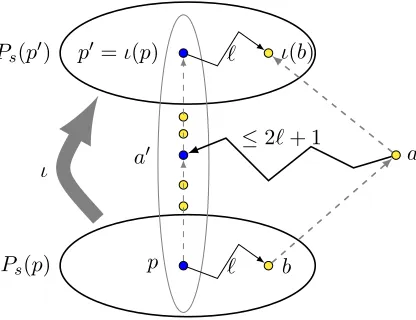
Figure 2: An illustration of the statement of Lemma 3.6: the dashed arcs depict the poset relation ≤P while the solid arcs represent directed paths in the digraphD
s.
Lemma 3.5. Let P = (P,≤P) be a poset and D0 the digraph defined in Definition 3.1. For
any k≥1and p, p1, . . . , pk∈P, there exists an elementp′∈RD20(p1, . . . , pk) such thatτ0(p′) =
τ0(p), andp′, pare in the same relation with respect to all ofp1, . . . , pk inP: formally, for every
i∈ {1, . . . , k}, it holds that p′ ≤Ppi if and only if p≤Ppi, andpi≤Pp′ if and only if pi ≤Pp.
Proof. Choosep′ to be the topmost element of the chainC(p) such thatτ
0(p′) =τ0(p) and, for
every element q ∈ C(p) with p Pq ≤P p′, it holds that q /∈ RD0
1 (p1, . . . , pk). Then, clearly,
p ≤Pp′ (while it might happen p =p′) and p′ ∈ RD0
2 (p1, . . . , pk) by the definition. It remains
to show that p′ is in the same relation with respect to p
1, . . . , pk in P as p. Assume for a
contradiction that this is not the case. Then there is an index i ∈ {1, . . . , k} such that p and p′ are in a different relation towardspi. Because p ≤Pp′, we have that either (I) p≤Ppi but
p′ 6≤Pp
i, or (II) pi ≤Pp′ butpi 6≤Pp.
In the case (I), either pi ∈ C(p) and hence pi is in between p and p′ on the chain C(p)
contradicting our choice of p′, or p
i ∈/ C(p) but D0 contains an arc with label ‘down’ from pi
to some element on the chain C(p) between p and p′, which again contradicts our choice of
p′. In the case (II), either pi ∈ C(p) and hence pi is in between p and p′ on the chain C(p)
contradicting our choice of p′, or pi ∈/ C(p) but D0 contains an arc with label ‘up’ from pi to
some element on the chainC(p) between pand p′, which again contradicts our choice ofp′.
We use the following shorthand notation. For p, p′, q ∈P we say that q discerns p from p′,
with respect to ≤P, if (at least) one of the following four conditions holds true; p ≤P q and
p′ 6≤Pq, p 6≤Pq and p′ ≤Pq, q ≤Pp and q 6≤Pp′, or q 6≤Pp and q ≤Pp′. For example, the conclusion of Lemma 3.5 is equivalent to saying “neither ofp1, . . . , pk discernspfromp′”. Since
the posetP is fixed for this section, we will often skip an explicit reference to≤P.
Lemma 3.6. Let P = (P,≤P) be a poset, s≥0 an integer, D
s and τs be as in Definition 3.1, and p, p′ ∈P. Assume that p≤Pp′ and τs+1(p) =τs+1(p′), where the latter is witnessed by an
isomorphism ι : Ps(p) → Ps(p′) of the structures APs(p) and APs(p′). If a ∈ P and b ∈ Ps(p) are such that a discernsb from ι(b) (with respect to ≤P), then there exists a directed path from
a to some element a′ ∈C(p) of type τs+1(p) withp≤Pa′ ≤Pp′, in Ds of length at most 2ℓ+ 1 where ℓ=distDs(p, b).
such that a′ lies between p and p′ on C(p). Lemma 3.6 then largely extends this simple obser-vation to the setting of Definition 3.1 and for discerned elements in neighborhoods ofp and p′.
The statement is illustrated in Figure 2.
Proof of Lemma 3.6. Notice that the assumption τs+1(p) = τs+1(p′) immediately implies p′ ∈
C(p). Let F = (b0 = p, b1, . . . , bℓ =b) be a shortest directed path from p to b in Ds. Then,
ι(F) = ι(b0) =p′, ι(b1), . . . , ι(bℓ) =ι(b)
is a directed path inDs that has the same arc-labels
and vertex-labels as F. Observe that since a discerns b from ι(b), it holds that b 6= ι(b) and hence also bi 6=ι(bi) for every i ∈ {0, . . . , ℓ}. Moreover, p ≤Pp′ =ι(p) implies b ≤Pι(b) by a
simple inductive argument using Lemma 3.4 along the path F.
We will show the existence of a′ ∈ C(p) and of the required path from a to a′ in D
s by
proving the following slightly stronger statement:
• For every i∈ {0, . . . , ℓ}, there is an element ai ∈C(bi) of type τs+1(bi) such that bi ≤P
ai ≤Pι(bi) andDs contains a directed path fromato ai of length at most 2(ℓ−i) + 1.
We prove the statement via induction on (ℓ−i) starting from i=ℓ.
For i= ℓ, we obtain aℓ as follows. If a ∈ C(b), then b ≤Pa≤Pι(b) because a discerns b
from ι(b), and letaℓ∈C(b) be the topmost element of typeτs+1(b) such thataℓ ≤Pa. Clearly,
b≤Paℓ ≤Pι(b) and Ds contains an arc with label ‘down’ from ato aℓ, as required. So assume
that a /∈C(b). Then, again, b≤Pι(b) anda discernsb from ι(b), and so at least one of b≤Pa or a≤Pι(b) holds true.
In the former case, let aℓ ∈C(b) be the topmost element of typeτs+1(b) such thataℓ≤Pa.
Since b ≤Pa but ι(b) 6≤Pa, it follows that b ≤Paℓ ≤Pι(b). Furthermore, Ds contains an arc
with label ‘down’ from ato aℓ, as required. In the later case, let aℓ∈C(b) be the bottommost
element of type τs+1(b) such that a ≤Paℓ. Since a ≤Pι(b) but a6≤Pb, it again follows that
b≤Paℓ ≤Pι(b). Furthermore, Ds contains an arc with label ‘up’from ato aℓ, as required.
Now, consideri∈ {0, . . . , ℓ−1} and that we have already shown the claim fori+ 1. Hence, by the induction hypothesis, we can assume that there exists ai+1∈C(bi+1) of type τs+1(bi+1)
withbi+1≤Pai+1≤Pι(bi+1) such that Ds contains a directed path fromato ai+1 of length at
most 2(ℓ−i−1) + 1.
We need to show that there is ai ∈ C(bi) of type τs+1(bi) with bi ≤Pai ≤Pι(bi) such that
Ds contains a directed path of length at most 2 fromai+1 to ai. We distinguish the following
cases, depending on the arc-label of the arc (bi, bi+1) in Ds.
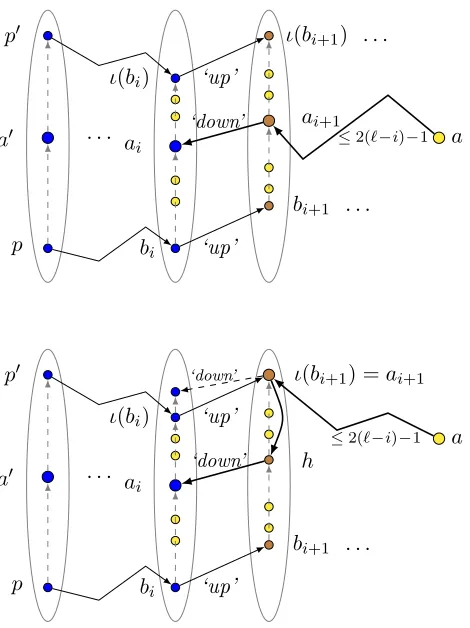
1. Assume that the label of (bi, bi+1) is ‘up’. See Figure 3.
Ifι(bi)6≤Pai+1, then let ai∈C(bi) be the topmost element inC(bi) of typeτs+1(bi) such
thatai≤Pai+1. Then,Ds contains an arc with label‘down’fromai+1 to ai (or, possibly,
ai = ai+1). Since ι(bi) ≤Pai would contradict ι(bi) 6≤Pai+1, we have ai ≤Pι(bi). Since
bi ≤Pbi+1 ≤Pai+1 and ai is the topmost one of its kind in C(bi), it holds that bi ≤Pai,
as required.
Otherwise,ι(bi) ≤Pai+1 and because the label of the arc (ι(bi), ι(bi+1)) in Ds is ‘up’, we
have ai+1 = ι(bi+1). Let h be the topmost element in C(bi+1) of type τs+1(bi+1) with
h P ai+1. Then, Ds contains an arc with label ‘down’ from ai+1 to h and bi+1 ≤P h
(recall bi+1 6= ι(bi+1)). Because of (the existence of) the arc (ι(bi), ι(bi+1)) in Ds, we
obtain that ι(bi) 6≤Ph. Let ai ∈ C(bi) be the topmost element in C(bi) of type τs+1(bi)
such that ai ≤Ph. Then,Ds contains an arc with label ‘down’ from h to ai and hence a
directed path fromai+1 to ai of length 2 (or, possibly,ai =h). Clearly,ai ≤Pι(bi). Since
bi ≤Pbi+1 ≤Ph and ai is the topmost one of this kind in C(bi), it holds that bi ≤Pai, as
p p′
a
≤2(ℓ−i)−1
a′ . . .
bi ‘up’
ι(bi) ‘up’
ai
bi+1 . . .
ι(bi+1) . . .
ai+1 ‘down’
p p′
a
≤2(ℓ−i)−1
a′ . . .
bi ‘up’
ι(bi) ‘up’
ai
bi+1 . . .
‘down’ ι(bi+1) =ai+1
h
[image:10.595.183.418.85.399.2]‘down’
Figure 3: An illustration of the proof of Lemma 3.6: top – the inductive step in the case of ι(bi)6≤Pai+1; bottom – the inductive step in the case of ι(bi)≤Pai+1.
2. Assume that the label of (bi, bi+1) is‘down’. The situation is completely symmetric to the
previous case, and the same arguments prove the conclusion (just exchanging ≤P with
≥P and ‘down’with‘up’).
3. Assume that the label of (bi, bi+1) is ‘max’ or ‘min’. That would imply bi+1 =ι(bi+1), a
contradiction. This case cannot happen.
The way we shall use Lemma 3.6 in Section 4 can be informally summarized as follows. If p and p′ are elements of the same type which are next to each other on their chain in P, then theirDs-neighborhoods appear “the same” with respect to ≤P to all poset elements which are
sufficiently far away fromp as measured by Ds+1. The precise formulation is next.
Corollary 3.7. Let P = (P,≤P) be a poset, s ≥ 0 an integer, the digraphs D
s and Ds+1 be
as in Definition 3.1, p 6= p′ ∈ P be such that τs+1(p) = τs+1(p′), and the isomorphism map
ι : Ps(p) → Ps(p′) be as in Lemma 3.6. Assume, moreover, that Ds+1 contains an arc (p′, p)
with label ‘down’. For any given p1, . . . , pk ∈ P, k ≥ 1, denote by S := RDrss(p1, . . . , pk) and
define a mapping f :S∪Ps(p)→ S∪Ps(p′) such that f(e) = ι(e) for e∈Ps(p) and f(e) =e otherwise. If p 6∈ RDs+1
rs+1−rs(p1, . . . , pk), then f is a color-preserving isomorphism between the
induced subposets P[S∪Ps(p)] and P[S∪Ps(p′)].
Ps(p)
Ps(p′)
f ι
p p′
· · · ·
[image:11.595.174.427.79.189.2]p1 pk S
Figure 4: An illustration of the statement of Corollary 3.7: f is a color-preserving isomorphism between the induced subposets P[S∪Ps(p)] andP[S∪Ps(p′)].
Proof. For the sake of contradiction assume that p6∈RDs+1
rs+1−rs(p1, . . . , pk) and f is not a poset
isomorphism. Then either f is not a bijection or there are two elements a, b∈S∪Ps(p) such
thataand b are in a different relation with respect to≤P thanf(a) andf(b).
Observe that in the latter case, since aand b are in a different relation with respect to≤P
thanf(a) andf(b), and by the definition off we clearly see that, up to symmetry,a∈S\Ps(p)
and b∈Ps(p). Hence, the latter case means thata=f(a) discerns bfrom f(b) =ι(b).
In the former case consider the function f′ defined analogously to the function f but from
the “perspective of p′”, i.e.,f′ :S∪P
s(p′)→S∪Ps(p) is defined by setting f′(e) =ι−1(e) for
everye∈Ps(p′) andf′(e) =eotherwise. Thenf is a bijection if and only if f′ is. Moreover, f
is a bijection if and only if both f and f′ are injective. If f is not injective, then there exists a b ∈Ps(p) such thata= f(b) = ι(b) ∈S\Ps(p). Since a6=b, the element a discerns b from
ι(b) = a. On the other hand, if f′ is not injective, then there exists a b′ ∈ Ps(p′) such that
a′ = f′(b′) = ι−1(b′) ∈ S \Ps(p′). Since a′ 6= b′, the element a′ discerns a′ from b′. Setting
a:=a′ and b:=a′, we again see that adiscernsb=a′ from ι(b) =b′.
In either of the three subcases above, the elements a and b satisfy the conditions of Lemma 3.6. Hence there exists a directed path fromato an element a′ ∈C(p) of type τs+1(p)
withp≤Pa′ ≤Pp′ inD
s of length at most 2rs+ 1. Because of Lemma 3.3 this path exists also
in Ds+1. Furthermore, since (p′, p) is an arc with label ‘down’ inDs+1, there are no elements
of type τs+1(p) on C(p) “between” p and p′, and so either a′ =p or a′ =p′. Hence, there is a
directed path from ato pinDs+1 of length at most 2rs+ 1 + 1.
Finally, since a ∈ S, there is a directed path from some of the elements p1, . . . , pk to a of
length at mostrs. In a summary, there exists a directed path inDs+1 from one of p1, . . . , pk to
p of length at most (recallrs= 3·4s−1)
2rs+ 2 +rs= (4rs+ 3)−rs−1 =rs+1−rs−1
which contradicts the assumption p6∈RDs+1
rs+1−rs(p1, . . . , pk).
Color-preservation by f immediately follows from the same property of ι.
4
The Model Checking Algorithm
We would like to use the Hintikka game to solve the poset FO model checking problemP |=ϕ, by Proposition 2.2. Though, the number of possible distinct plays in the game G(P, ϕ) grows roughly asO(kPk|ϕ|) which is not FPT. To resolve this problem, we are going to show that in fact
LetP = (P,≤P) be a poset, with an implicitly associated coloringλ:P →Λ as in Section 3, and ϕ an FO formula. The r-local Hintikka game Gr(P, ϕ) (where “r” refers to the sequence
rs = 3·4s−1, cf. Definition 3.1) is played on the same set of positions by the same rules as the
ordinary Hintikka gameG(P, ϕ), with the following additional restriction: for eachQ∈ {∃,∀}, and for any position of the form ψ(p1, . . . , pi)≡Qy. ψ′(p1, . . . , pi, y) where i≥1, Player Qhas
to move to a position ψ′(p1, . . . , pi, p) such that p ∈ RrDqq−rq−1(p1, . . . , pi), where q ≥ 1 is the
quantifier rank ofψ′. If q= 0, i.e., for quantifier-free ψ′, the restriction is p∈RD0
r0 (p1, . . . , pi).
Lemma 4.1. Let P be a poset, p1, . . . , pj ∈P, and ϕbe an FO formula of quantifier rank q. In the r-local Hintikka game Gr(P, ϕ) with an initial position ϕ(p1, . . . , pj), j ≥1, every reachable game position ψ(p1, . . . , pk), k > j, is such that
pj+1, . . . , pk∈RDrqq−−11(p1, . . . , pj).
Proof. We proceed by induction on (k−j), starting with the trivial degenerate case k=j and proving a stronger statement
pj+1, . . . , pk ∈R Dq−1
rq−1−rq+j−k−1(p1, . . . , pj).
Let the claim hold for a positionψ(p1, . . . , pk−1) and consider a next positionψ′(p1, . . . , pk−1, pk),
where the quantifier rank of ψ′ isq′ =q−(k−j). Then, by the definition, p
k is at distance at
mostrq′−rq′−1inDq′ from one of the elementsp1, . . . , pk−1, and the same holds also in Dq−1 by
Lemma 3.3 asq′ ≤q−1. Since each ofp1, . . . , pk−1 is at distance at mostrq−1−rq+j−(k−1)−1=
rq−1−rq′ from one ofp1, . . . , pj (and this holds also fork−1 =j), we get thatpkis at distance
at most rq−1 −rq′ +rq′ −rq′−1 = rq−1 −rq′−1 = rq−1 −rq+j−k−1 from one of p1, . . . , pj in
Dq−1.
Now we get to the crucial technical claim of this paper. For Q ∈ {∃,∀}, and with a ne-glectable abuse of terminology, we say that Player Q wins the (ordinary or r-local) Hintikka game from a position ψ(p1, . . . , pi) if Player Q has a winning strategy in the game G(P, ψ) (or
inGr(P, ψ), respectively) with the initial position ψ(p1, . . . , pi). Otherwise, Player Q loses the
game.
Lemma 4.2. Let P = (P,≤P) be a colored poset and ϕ be an FO formula in negation normal form. For Q∈ {∃,∀} andi≥0, consider a position ψ(p1, . . . , pi)in the Hintikka game G(P, ϕ). If Player Qwins the game G(P, ϕ) from the position ψ(p1, . . . , pi), then PlayerQ wins also the
r-local Hintikka game Gr(P, ψ) from an initial position ψ(p1, . . . , pi).
Proof. Let ¯Q denote the other player, that is, {Q,Q¯} ={∃,∀}. For the sake of contradiction, assume that we have got a counterexample with P,ϕ, andψ(p1, . . . , pi) of quantifier rankq+
1; meaning that Player Q wins G(P, ϕ) from ψ(p1, . . . , pi) but Q loses Gr(P, ψ) from initial
ψ(p1, . . . , pi). Assume, moreover, thatQ∈ {∃,∀} and the counterexample are chosen such that
the pair hq,|ψ|i is lexicographically minimal.
Since a game move associated with a conjunction or disjunction of formulas, and a (possible) initial move fori= 0, are not in any way restricted in ther-local Hintikka game, our minimality setup guarantees that ψ starts with a quantifier, and so q+ 1 ≥ 1 and i ≥ 1. If this leading quantifier ofψwas ¯Q, then we would again get a contradiction to the minimality ofq. Therefore,
(1) ψ(p1, . . . , pi)≡Qxi+1. ψ′(p1, . . . , pi, xi+1).
this is a contradiction to Player Q losing Gr(P, ψ) from ψ(p1, . . . , pi), we may further assume
thatq ≥1.
Letp∈P be such that PlayerQwins the gameG(P, ϕ) from (1)ψ(p1, . . . , pi) by moving to
the positionψ′(p1, . . . , pi, p), and assume thatpis chosen maximal with respect to≤P with this
property. By our minimal choice ofq, the statement of Lemma 4.2 holds for the game G(P, ϕ) from the positionψ′(p1, . . . , pi, p), and so
(2) PlayerQwins the r-local gameGr(P, ψ′) from the initial
positionψ′(p1, . . . , pi, p).
Consequently,
(3) p6∈RDq
rq−rq−1(p1, . . . , pi)
since, otherwise, Player Qwould win also ther-local gameGr(P, ψ) fromψ(p1, . . . , pi) which is
not the case by our assumption.
Let p′ ∈ C(p) be the bottommost element such that p P p′ and τ
q(p′) = τq(p). Observe
that such p′ does exist since, otherwise, Dq would contain an arc from the topmost element of
C(p) top with label ‘down’, and hencep∈RDq
2 (p1) contradicting (3). By our maximal choice
ofpwith respect to≤P, PlayerQloses the gameG(P, ϕ) fromψ(p
1, . . . , pi) after moving to the
position ψ′(p
1, . . . , pi, p′). In other words, Player ¯Q wins the game G(P, ϕ) from the position
ψ′(p1, . . . , pi, p′) and, by our choice of a counterexample with minimumq;
(4) Player ¯Qwins the r-local gameGr(P, ψ′) from the initial
positionψ′(p1, . . . , pi, p′).
Now, we employ Corollary 3.7 for s= q−1, k =i and S = RDq−1
rq−1 (p1, . . . , pi). By (3), we
hence get that there exists a color-preserving isomorphism map f between the induced colored subposetsP[S∪Pq−1(p)] andP[S∪Pq−1(p′)]. By Lemma 4.1, all the elements eplayed in any
play of an r-local Hintikka game Gr(P, ψ′) from an initial position ψ′(p1, . . . , pi, p′) belong to
the set RDq−1
rq−1 (p1, . . . , pi, p
′) =S∪P
q−1(p′).
The latter finding implies that every play of the r-local Hintikka game Gr(P, ψ′)
from ψ′(p
1, . . . , pi, p′) can be duplicated, with the same outcome, in the same game from
ψ′(p1, . . . , pi, p) via the isomorphism map f−1. Therefore, by (4), Player ¯Q wins the r-local
gameGr(P, ψ′) from the initial positionψ′(p1, . . . , pi, p), too. However, this contradicts (2), and
so there cannot be a counterexample to the statement of the lemma.
Remark 4.3. Notice that it is actually not necessary to explicitly use Lemma 3.5 in the proof of Lemma 4.2 —with a slightly modified setting this base case comes out “for free”. Though, we think that the current proof with Lemma 3.5 is easier to read and to understand.
We can now easily formulate and prove the main result:
Theorem 4.4. Let P = (P,≤P) be a poset, associated with λ:P →Λ where Λ is a finite set of colors, and let ϕ be an FO sentence in negation normal form. The existential player has a winning strategy in the r-local Hintikka game Gr(P, ϕ) if, and only if, P |=ϕ.
Proof. By Proposition 2.2, it is enough to prove the following:
The “only if” direction follows from Lemma 4.2 fori= 0, and so we deal with the “if” direction. Assume that we have a counterexample minimizing the quantifier rank ofϕ, i.e., that PlayerQ winsGr(P, ϕ) but does not winG(P, ϕ).
If the only quantifiers in ϕareQ, then ther-local winning strategy of Player Qcan be used “as is” in the game G(P, ϕ). Hence, denoting by ¯Q the opposite quantifier to Q, the sentence ϕ contains a subformula ψ ≡Qy. ψ¯ ′(y), such that all occurrences of the quantifier ¯Q inϕ are contained within ψ. Letψ(p1, . . . , pi) be a position reached by any winning strategy of Player
Q in the r-local game Gr(P, ϕ). Since Player Q loses G(P, ϕ) in general, Player ¯Q wins the
ordinary game G(P, ϕ) from the position ψ(p1, . . . , pi).
By Lemma 4.2 again, Player ¯Qhence wins ther-local gameGr(P, ψ) from the initial position
ψ(p1, . . . , pi). However, this contradicts the assumption that the strategy of PlayerQinGr(P, ϕ)
containing the position ψ(p1, . . . , pi) is winning for Player Q.
The following is then a straightforward observation.
Corollary 4.5. For a poset P let Ti(P) denote the set of types τi of rank ioccurring in P, i.e.
Ti(P) :={τi(p) :p∈P}, whereτi is as in Definition 3.1. AssumeP1,P2 are colored posets and
ϕ an FO sentence of quantifier rank q in negation normal form. If Tq−1(P1) =Tq−1(P2), then
it holds; P1|=ϕif and only if P2 |=ϕ.
Proof. Let the types of elements of P1 and P2 be denoted byτi1 and τi2, respectively, and the associated digraphs byD1
i and Di2.
From Theorem 4.4, it is enough to prove that the existential player wins the r-local game
Gr(P1, ϕ) if, and only if, he wins Gr(P2, ϕ). For that we have to analyze the game up to the
first quantifier move, and since the starting conjunction or disjunction moves are irrelevant for this analysis, we may without loss of generality assume that ϕ≡Qy. ψ(y) whereQ∈ {∃,∀}.
If the claim (that the existential player winsGr(P1, ϕ) iff he winsGr(P2, ϕ) ) is not true, then
PlayerQwins precisely one of the two considered games, say, ther-local gameGr(P1, ϕ). Let a
winning move of PlayerQinGr(P1, ϕ) be the positionψ(p1) wherep1 ∈P1. By the assumption Tq−1(P1) =Tq−1(P2), there hence exists p2 ∈P2 such thatτq1−1(p1) =τq2−1(p2). Let the latter
be witnessed by an isomorphismι:Pq1−2(p1) →Pq2−2(p2) between the structures AP 1
q−2(p1) and APq−22(p2) which is, in particular, a poset isomorphism between the induced colored subposets P1[Pq1−2(p1)] andP2[Pq2−2(p2)].
By Lemma 4.1, for the formula ψ of quantifier rank q −1 and for j = 1, every reachable position in the r-local game Gr(P1, ϕ) belongs to Pq1−2(p1). Consequently, Player Qcould win
also ther-local gameGr(P2, ϕ), by copying his winning strategy under the isomorphism mapι.
This contradiction finishes the proof.
Theorem 4.6. Let P = (P,≤P) be a poset of width w, with elements colored by λ : P → Λ
where Λ is a finite set, and let ϕ be an FO sentence in negation normal form. There is an algorithm which decides whether P |=ϕin FPT time f(w, ϕ)· kPk2.
Proof. According to Corollary 4.5, it is enough to know the set Tq−1(P) in order to decide
whether P |=ϕ. We thus proceed the algorithm in two steps:
1. We compute the setTq−1(P) (of rank-(q−1) types).
2. We decide whetherP |=ϕusing the set from Step 1.
Di+1, the outdegree is bounded from above by a function of w and the number of all possible
types of rank i+ 1, which is finite by the inductive assumption forDi.
Therefore, Step 2 is a finite problem and we may decide whether P |= ϕ by a brute-force evaluation of ϕon each member of Tq−1(P). This takes time f′(w, ϕ). As for Step 1, we start
with computing a chain partition of width w, in timeg(w)· kPk2 by Proposition 2.1. We then
proceed exactly along the iterations of constructive Definition 3.1. Since the number of possible types is finite, this computation takes time at most f′′(w, ϕ) · kPk2; by traversing, in every iterationDi fori= 0,1, . . . , q−2, for each p∈P every chain of P and finding the appropriate
out-neighbors.
5
Application to Interval Graphs
Besides the very successful story of FPT FO model checking on sparse graph classes, culminating with the ultimate and outstanding result of Grohe, Kreutzer, and Siebertz [15], only a few such results have been published for dense graph classes (especially, for graph classes which cannot be easily interpreted in nowhere dense classes). One of such notable papers is [13], dealing with FO model checking on interval graphs.
It has been shown [13] that FO model checking of interval graphs is FPT when the intervals are restricted to have lengths from a fixed finite set of reals (Corollary 5.2), while the problem is W-hard whenever the intervals are allowed to have lengths from any dense subset of a positive-length interval of reals. We will demonstrate the strength and usefulness of our main result by giving a rather short and straightforward derivation of the FPT result of [13] from our Theorem 4.6.
A graph G is aninterval graph if there exists a setI of intervals on the real line such that V(G) = I and E(G) is formed by the intersecting pairs of intervals. For a set L of reals, a set I of intervals is called an L-interval representation if every interval from I has its length inL. This notion generalizes well-studiedunit interval graphs (where all interval lengths are 1), which are also known under the name of proper interval graphs. A set I of intervals is called a
proper interval representation if there is no pair of intervals J1, J2 ∈ I such that J1 is strictly
contained in J2 (J1 ( J2). We call I a k-fold proper interval representation if there exists a
partitionI =I1∪ · · · ∪ Ik such that eachIj is a proper interval representation forj= 1, . . . , k.
Theorem 5.1. Let ϕ be a graph FO sentence. Assume G is an interval graph given along with its k-fold proper interval representation I. Then the FO model checking problem G|=ϕ, parameterized by k and ϕ, is FPT.
Proof. First of all, we prove that we can, without loss of generality, assume that no two ends of intervals fromIcoincide. This can be achieved by a tiny perturbation of the intervals, as follows. Let the given interval representation of G be I = {[ai, bi] : i = 1, . . . , n}, where n = |V(G)|.
Let D=Sn
i=1{ai, bi} be the set of all interval ends. Choose ε > 0 such that the least positive
difference in the set Dis greater than 2ε, and define
I′ :={[ai+ε
i
n, bi+ε(1 + i
n)] :i= 1, . . . , n}.
Then, clearly, the intersection graph ofI′is isomorphic toG, no two interval ends inI′coincide, and two intervals of I′ are in a proper inclusion only if the same is true already inI.
LetI =I1∪ · · · ∪ Ik be such that eachIj is a proper interval representation forj= 1, . . . , k.
LetP :=D∪ I. We define a posetP = (P,≤P) as follows:
• forj ∈ {1, . . . , k} and intervals J1, J2 ∈ Ij, it is J1 ≤PJ2 iff J1 is not to the right of J2,
and
• for every interval J = [a, b] ∈ I and every d∈ D, it is J ≤Pd iff d ≥b, and d≤PJ iff
d≤a.
The set P can be partitioned into k+ 1 chains; D and I1, . . . ,Ik. Hence the width of P is at
mostk+ 1.
Finally, we show how the posetP can be used to decide whetherG|=ϕ, applying a so called FO interpretation ofGinP. Specifically, we construct a poset FO sentence ψ, depending only on ϕ, such that P |=ψ if and only if G|=ϕ. The rest then follows from Theorem 4.6.
LetD(x) be a unary predicate (a color) onP identifying the elements ofD⊆P. Then, the proposition¬D(x) simply identifies the domain (vertex set) ofGwithinP in our interpretation. The crucial part of our construction ofψis to express by an FO formulaβ(J1, J2) that arbitrary
intervals J1, J2 ∈ I intersect each other (i.e., form an edge of G). Note that if intervals J1, J2
do not intersect, then J2 is to the right of the right end of J1 or vice versa. Then, by our
definition of P,J2 is to the right of the right end of J1 if, and only if, there existsd∈Dsuch
that J1 ≤Pd≤PJ2 (dlies “between” J1 and J2). Hence we can express the edge relation of G
as
β(x, y) ≡ ∀d
D(d)→ (¬x≤Pd∨ ¬d≤Py)∧(¬y≤Pd∨ ¬d≤Px)
,
meaning that there exists nod∈Dsuch that dlies “between” the intervalsx and y (or, yand x) of I.
The construction ofψthen proceeds by structural induction on the structure ofϕas follows. Each occurrence of atomic edge(x, y) is replaced with β(x, y). Other atomic propositions and logic connectives are simply copied from ϕ to ψ. Each quantifier ∃x σ(x) is replaced with
∃x(¬D(x)∧σ(x)), and ∀x σ(x) with ∀x(¬D(x) → σ(x)). All this construction is achieved in
polynomial time. Based on previous arguments, it is routine to verify that P |= ψ ⇐⇒
G|=ϕ.
We can now match the main result of [13], except the precise runtime:
Corollary 5.2 (Ganian et al. [13]). For every finite set L of reals, the FO model checking problem of L-interval graphs (given alongside with an L-interval representation) is FPT when parameterized by the FO sentence ϕand |L|.
Proof. LetIbe a givenL-interval representation, and setk:=|L|. We partitionI =I1∪· · ·∪Ik
such that eachIicontains intervals of the same length (fromL), and then apply Theorem 5.1.
Although, the formulation of Theorem 5.1 is more general than [13]. We can, for instance, in the same way derive fixed-parameter tractability also for FO model checking of well-studied k-proper interval graphs, introduced in [20] as those having an interval representation such that no interval is properly contained in more thank other intervals.
6
Conclusions
The result may also be used directly towards establishing fixed-parameter tractability for FO model checking of other graph classes. Given the ease with which it implies the otherwise non-trivial result on interval graphs [13], it is a natural to ask which other (dense) graph classes can be interpreted in posets of bounded width.
References
[1] S. Bova, R. Ganian, and S. Szeider. Model checking existential logic on partially ordered sets. In CSL-LICS’14. ACM, 2014. Article No. 21.
[2] S. Bova, R. Ganian, and S. Szeider. Quantified conjunctive queries on partially ordered sets. In IPEC’14, volume 8894 ofLNCS, pages 122–134. Springer, 2014.
[3] B. Courcelle. The monadic second-order logic of graphs I: Recognizable sets of finite graphs.Inform. and Comput., 85:12–75, 1990.
[4] A. Dawar, M. Grohe, and S. Kreutzer. Locally excluding a minor. InLICS’07, pages 270–279. IEEE Computer Society, 2007.
[5] R. Downey and M. Fellows. Parameterized complexity. Monographs in Computer Science. Springer, 1999.
[6] Z. Dvoˇr´ak, D. Kr´al’, and R. Thomas. Deciding first-order properties for sparse graphs. InFOCS’10, pages 133–142. IEEE Computer Society, 2010.
[7] E. Gr¨adel et al. Finite Model Theory and Its Applications (Texts in Theoretical Computer Science. An EATCS Series). Springer, 2005.
[8] S. Felsner, V. Raghavan, and J. Spinrad. Recognition algorithms for orders of small width and graphs of small dilworth number. Order, 20(4):351–364, 2003.
[9] J. Flum and M. Grohe. Fixed-parameter tractability, definability, and model-checking. SIAM J. Comput., 31(1):113–145, 2001.
[10] J. Flum and M. Grohe. Parameterized Complexity Theory. Springer, 2006.
[11] M. Frick and M. Grohe. Deciding first-order properties of locally tree-decomposable structures. J. ACM, 48(6):1184–1206, 2001.
[12] J. Gajarsk´y, P. Hlinˇen´y, J. Obdrˇz´alek, and S. Ordyniak. Faster existential FO model checking on posets. InISAAC’14, volume 8889 ofLNCS, pages 441–451. Springer, 2014.
[13] R. Ganian, P. Hlinˇen´y, D. Kr´al’, J. Obdrˇz´alek, J. Schwartz, and J. Teska. FO model checking of interval graphs. InICALP 2013, Part II, volume 7966 ofLNCS, pages 250–262. Springer, 2013. [14] M. Grohe. Logic, graphs, and algorithms. Electronic Colloquium on Computational Complexity
(ECCC), 14(091), 2007.
[15] M. Grohe, S. Kreutzer, and S. Siebertz. Deciding first-order properties of nowhere dense graphs. In STOC’14, pages 89–98. ACM, 2014.
[16] R. Impagliazzo, R. Paturi, and F. Zane. Which problems have strongly exponential complexity? J. Comput. Syst. Sci., 63(4):512–530, 2001.
[17] S. Kreutzer. Algorithmic meta-theorems. In Finite and Algorithmic Model Theory, volume 379 of London Math. Soc. Lecture Note Ser., chapter 5, pages 177–270. Oxford University Press, 2011.
[18] D. Lokshtanov, D. Marx, and S. Saurabh. Lower bounds based on the exponential time hypothesis. Bulletin of the EATCS, 105:41–72, 2011.
[19] R. Niedermeier. Invitation to Fixed-Parameter Algorithms, volume 31 ofOxford Lecture Ser. Math. Appl. OUP, 2006.
[20] A. Proskurowski and J. A. Telle. Classes of graphs with restricted interval models. Discrete Math. Theor. Comput. Sci., 3(4):167–176, 1999.

![Figure 4: An illustration of the statement of Corollary 3.7: fbetween the induced subposets is a color-preserving isomorphism P[S ∪ Ps(p)] and P[S ∪ Ps(p′)].](https://thumb-us.123doks.com/thumbv2/123dok_us/9516432.457087/11.595.174.427.79.189/figure-illustration-statement-corollary-fbetween-subposets-preserving-isomorphism.webp)
