A Thesis Submitted for the Degree of PhD at the University of Warwick
http://go.warwick.ac.uk/wrap/71180
This thesis is made available online and is protected by original copyright.
Please scroll down to view the document itself.
A Pedagogical Framework for Enhancing Skills of
References and Citations
by
Saba Khalil Toor
A thesis submitted in partial fulfillment of
the requirements for the degree of
Doctor of Philosophy
in Computer Science
Department of Computer Science
II
List of Tables---
VIList of Figures---
VIIAcknowledgement---
IXDeclaration---
XAbstract---
XI1
Introduction --- 1
1.1 Research Background and Motivation 1 1.2. Statement of Problem and Research Questions --- 3
1.3 Scope and Limitations --- 6
1.4 Research Approach--- --- 7
1.4.1. Investigation Phase--- 1.4.2. Solution Phase--- 1.4.3. Evaluation Phase--- 17 19 20 1.5 Outline of Thesis --- 20
1.6 Summary --- 22
2
References and Citations: Past and Present--- 23
2.1 Introduction --- 23
2.2 Historical Background --- 24
2.2.1. Practice and Perception about Referencing in the Ancient and Classical Eras--- 2.2.2. Progress of Scientific Culture During Classical Era--- 26 30 2.3 Facilities for Researchers in the Modern Era --- 33 2.3.1. Modern Citation Indices--- 2.3.2. Digital Library Catalogs--- 2.3.3. Digital Libraries--- 2.3.4. Reference Citation Formats---
III
2.5.1. Instructions, Guides, Manuals and Tutorials--- 2.5.2. Reference Management Software (RMS)---
40 42
2.6 Research Done to Highlight the Problem in Citing References--- 46
2.6.1. Citation Practices Amongst Trainee Teachers as Reflected in Their Project Papers--- 2.6.2. Accuracy of references cited in articles published in Indian Journal of Dermatology, Venereology and Leprology: A pilot study--- 2.6.3. Accuracy of references in Burns journals--- 2.6.4. Characteristics of doctoral students who commit citation errors--- 2.6.5. Tackling Student Referencing Errors Through an Online Tutorial--- 2.6.6. Discussion about the Above Cases--- 46 48 48 49 50 52 2.7 Conclusion-- --- 53
3
Investigative Study about Erroneous References and
Bibliographies in Academia---
553.1 Introduction --- 55
3.2 Research Methods for Investigative Study --- 56
3.2.1. Tool Used For Quantitative Research--- 3.2.2. Tools Used For Qualitative Research Method--- 57 59 3.3 Analysis --- 60
3.3.1. Analysis of Quantitative Data--- 3.3.2. Analysis of Qualitative Data--- 60 93 3.4 Discussion on Analysis --- --- 117
3.5 Conclusion --- 122
4
Framework to Enhance Skills of Referencing (FESR)--- 123
4.1 Introduction --- 123
4.2 Pedagogy and Pedagogical Approaches--- 123
IV
4.4 Development of FESR --- 130
4.4.1. Objective of the Framework (FESR)0 --- 4.4.2. Description of the Framework (FESR)--- 130 131 4.5 Operational Model for FESR --- 148
4.6 Discussion --- 158
4.6.1. Benefits of FESR--- 161
4.7 Conclusion --- 162
5
Software Solution for FESR--- 163
5.1 Introduction--- 163
5.2 Software for Operational Model of FESR--- 163
5.3 Prototype: Reference Skill Enhancement Software Solution (RSESS)--- 165
5.3.1. Methodology--- 5.3.2. Requirements for the Software--- 5.3.3. Analysis of the Requirements--- 5.3.4. Architectural Design--- 5.3.5. Implementations of RSESS--- 166 166 169 174 178 5.4 Summary--- 197
6
Evaluation of FESR--- 198
6.1 Introduction--- 198
6.2 Framework Evaluation Methodology--- 199
6.2.1. Tutored Experiments--- 6.2.2. Un-tutored Experiments--- 201 204 6.3 Analysis--- 205
V
6.4.2. Save Staff Members’/Tutors’ Time--- 6.4.3. Timely and Detailed Feedback for Students--- 6.4.4. Improves Students’ Skill in Referencing--- 6.4.5. Training Sessions---
252 253 254 254
6.5 Conclusion--- 256
7
Conclusion--- 257
7.1 Introduction--- 257
7.2 Discussion and Inference--- 257
7.3 Research Contribution--- 260
7.4 Future Work--- 262
Reference List---
266Appendix A---
278Appendix B---
291Appendix C---
295Appendix D---
310Appendix E---
329VI
2.1 Top Five Authors Cited (Small, 2010)--- 29
2.2 Citation Index--- 31
2.3 Reference Style--- 37
2.4 Errors Highlighted in Referencing and Citations--- 39
2.5 Examples for Handbooks and Tutorials--- 41
2.6 Analysis on Accuracy of Citation Styles--- 47
2.7 Citation Errors--- 47
2.8 Format Analysis. First Stage--- 50
2.9 Format Analysis. Second Stage--- 51
2.10 Format Analysis. Third Stage--- 52
3.1 Students’ Understanding of the Referencing Task--- 65
3.2 Importance of References and Citations --- 67
3.3 Feedback and Grading --- 70
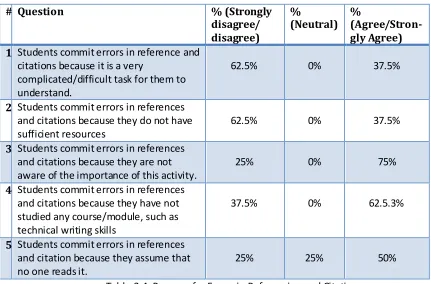
3.4 Reasons for Errors in Referencing and Citations --- 78
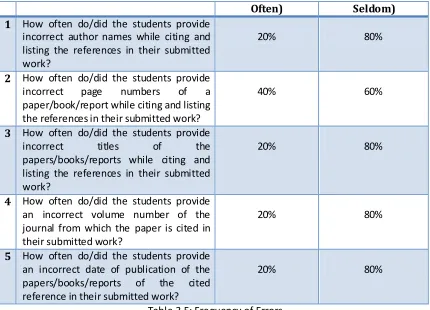
3.5 Frequency of Errors--- 80
6.1 Experience: of Referencing--- 207
6.2 Attitude--- 209
6.3 Importance--- 209
6.4 Risk--- 210
6.5 Advantages--- 211
6.6 Importance--- 216
6.7 Reference Style--- 217
6.8 Commitment to the Experiment--- 219
6.9 Evaluation of the Proposed Framework--- 220
6.10 Group 1--- 242
6.11 Group 2--- 246
VII
1.1 Philosophical Approach of the Current Research --- 10
1.2 Design Science Research Process (Offermann et al., 2009)--- 12
1.3 Convergent Parallel Mixed Methodology--- 13
1.4 Explanatory Mixed Methodology--- 14
1.5 Research Methodology--- 15
1.6 Research Phases--- 16
3.1 Age Distribution of Students--- 62
3.2 Subject Distribution--- 63
3.3 Subjects Taught by Teachers--- 74
3.4 Teaching Experience--- 75
3.5 Reference Sources --- 85
3.6 Favourite Online Sources --- 86
3.7 Favourite Reference Sources--- 87
3.8 Students Interview--- 105
3.9 Interview with Teachers--- 116
4.1 Space of Erroneous Referencing--- 126
4.2 Space for Erroneous References in Higher Education --- 127
4.3 Framework for Teaching the Skill of Referencing --- 131
4.4 Scope of Utilization of the Framework --- 133
4.5 Categories of Motivation (Huitt, 2011) --- 134
4.6 Operational Model of FESR--- 149
4.7 Operational Model for Tutored/Class Based FESR--- 155
4.8 Operational Model for Un-tutored/Student Based FESR--- 157
5.1 Software Components of the Operational Model--- 164
5.2 Tutor/Class Base Use Case --- 171
5.3 Un-Tutored Use Case--- 173
5.4 Architectural Design of RSESS--- --- 176
5.5 Interface for Un-tutored Scenario --- 181
VIII
5.9 Compare Students Reference Data with the Data Received from Digital
Libraries--- 189
5.10 Search in Online Library--- 189
5.11 Compare Students’ Reference with Digital Library Matching Reference List and Save the Result--- 190
5.12 Find the Nearest Match--- 191
5.13 Compare Student Reference with a Reference from the Digital Catalog--- 192
5.14 Generate Report--- 194
6.1 Tutored Experiment--- 203
6.2 Un-tutored Experiment--- 205
6.3 Group Performance (Group 1)--- 244
6.4 Individual Performance (Group 1)--- 245
6.5 Individual Performance (Group 2)--- 247
6.6 Group Performance (Group 3)--- 249
6.7 Individual Performance (Group 3)--- 249
F.1 Upload Assignment Information--- 336
IX
First of all I would like to thank God Almighty for providing me everything during this journey of life and for letting me pursue my goal.
I am most grateful to my supervisor, Dr. Mike Joy for his unyielding support and guidance. His inspiring and encouraging supervision has led to the compl etion of this thesis. I am also grateful to Dr. Jane Sinclair, my advisor, for her feedback and advice. My special thanks to Prof. Erkki Sutinen for agreeing to be my external examiner.
I would also like to express my gratitude to the staff members of Warwick University library, especially Stuart Hunt (Data Services Manager) and to Sian Prosser (Manager, Academic Services Development), for their guidance, help and support during the time I was trying to access digital libraries and next generation catalogs.
X
This thesis is presented in accordance with the regulations for the degree of Doctor of Philosophy. It has been composed by myself and has not been submitted in any previous
application for any degree. The work described in this thesis has been undertaken by me except
XI
References and citations form a basis for scientific research and creation/discovery of knowledge. However literature reviews had indicated that many errors are present in scholarly papers published in journals and conferences as well as in books and articles. Furthermore, course works of students studying in higher education institutions contain mistakes in references lists and in-text citations. Problems that stem from these inaccuracies are multifarious and range from the act of plagiarism, not acknowledging the source, problems in information access and retrieval as well as causing inaccuracies in ranking articles and journals, thus hindering the growth of knowledge. Based on the importance of this global issue this research was initiated. The first objective of our research was to determine root causes for the presence of mistakes and inadequacies in references and citations within the academic arena. We chose the academic arena because they are the training grounds for education and scientific research. Furthermore, through this research we sought a unique practical solution for this issue.
In order to conduct a thorough and comprehensive investigation into the above mentioned problems, and to achieve the aim of proposing a suitable solution, we divided our research work into three main phases. First phase was the investigative phase. During this phase a thorough literature review was conducted. As a result of this review, research questions were formed. Both quantitative and qualitative methods were adopted to investigate the causes of erroneous references and citations. Triangulation research methodology was used to get reliable and comprehensive information. Data received through these methods were analyzed and core issues such as inadequate feedback and training in referencing task were highlighted
In the second phase, termed as solution phase, a pedagogical framework was proposed to resolve issues that were reported during the investigative phase. A conceptual framework was built on the principles of Learning theories and spaced repetition theory. To evaluate this framework experiments were conducted. This was done in the third and final phase of the research which was termed as evaluation phase. Two types of experiments were conducted, first type was in a traditional classroom environment and the second type of experiment was with students who chose to work independently (without tutors). Data were collected and analyzed from these experiments using both quantitative methods and qualitative methods and were analyzed.
1
Chapter 1
Introduction
1.1.
Research Background
and
Motivation
Sir Isaac Newton said “If I have seen further it is by standing on the shoulders of giants.” (Newton, 1676). This is the essence of scientific research. Scholars and researchers build
knowledge on existing work. Researchers desire to get information from the best articles published in recognized journals. The question that arises is “how do scholars know which
articles and journals are the best source of information for their subject of interest? ”. Which articles will provide them with solid knowledge and ground to stand on? With the advent of
fields such as library sciences and information systems, researchers were introduced to bibliometric methods. These methods allow researchers to determine the influence of an article
(or articles) in a journal for any given subject. Articles and journals with a higher level of influence have a higher ranking, and the information within the article can therefore be trusted,
allowing researchers to build on the knowledge of other researchers (Ingwersen, 2012). An interesting exercise based on the data from SCI (Science Citation Index) conducted in 1967
predicted the names of two scientists who received Noble prize in 1969 (Garfield, 1970) .
The above mentioned information shows the impact and benefit of using methods of bibliometrics. The most commonly known methods of bibliometrics are citation analysis and publication counts. These methods have been utilized to gauge the influence of academic
documents within the sphere of science and social sciences (Di odato and Gellatly, 2013). The advent of information technology and the introduction of citation databases and indexes has
2
These new “citation tools” include Citation Maps, Citation Reports, Citation Trackers and h-index. These tools show the relationship between citations as well as the tracking and reporting of them (Kear and Danielle, 2011). Furthermore, for the ranking and influence of knowledge, tools and methods are incorporated within these databases, these journal tools include: Article
Influence Score, Eigenfactor Score, Impact Factor, SNIP (Source Normalized Impact per Paper). These tools allow users to view higher ranking journals and articles based on their influence and
usage in research. All these tools use the number of citations of the articles and journals over a given period of time, and use various statistical measures to numerically identify the rank of a
journal (Kear and Danielle, 2011).
These methods and tools depend on the number of times articles and journals have
been cited (Moed, 2006). Thus citations and references form a basic and important aspect in determining the ranks of journals, thereby paving the path for the correct direction of research
and creation of new knowledge. It can therefore be stated that correct references and citations lay foundation blocks for future research. Errors in citing and developing erroneous references and bibliographies lead to unreliable and inaccurate rankings, which in turn may be considered
as a serious hindrance to the quest for scientific research and knowledge.
However, the reviews of the current and the past literature have indicated that despite
the importance of correct references and citations, numerous errors exist ( Harinarayana, Chikkamanju and Vasantha, 2011; Lee et al., 2007; Harzing, 2002). The existence of erroneous
references and bibliographies has been present in the past, as well as in the current work of scholars and researchers (See Chapter 2). It has been found that articles published in high ranking (high impact factor) peer reviewed journals have errors in their reference lists (Al-Benna
3
author name the original discoverer of the diarrhea virus remained unknown for 32 years. Furthermore errors in references and citations are not specific to a certain domain of knowledge or the geographical location of researchers. This has been identified through our literature
review as being a global issue.
1.2.
Statement of Problem and Research Questions
A scientific paper does not stand alone; it is embedded in the “literature” of the subject
(Ziman, 1968). References and citations allow scientific research to be connected to the work documented in the literature. A problem arises when this link is broken due to errors and
omissions in the references. Omissions in references lead to plagiarism, while errors in referencing cause issues in the tracking and retrieval of data. As stated above, this issue in turn
leads to incorrect rankings of articles and journals, in addition to the failure to acknowledge the
source from which inspiration and support are taken.
The advent of software and hardware technologies has provided many tools to minimize such errors – for instance through the introduction of reference management systems and citation databases. However, erroneous references and bibliographies still exist – not only in journal articles but in books and other academic documents. Such errors are also fo und in the
final thesis submissions by PhD and Masters level student projects (details are available in chapter 2). This fact directed our research towards academic institutions. The purpose of
academic institutions (e.g., schools, colleges and universities) is to produce skilled individuals, who should be equipped with all the necessary knowledge and practice to face challenges in
4
higher education institutes – and looked at the reasons for erroneous references and citations within students’ coursework such as assignments, final reports, dissertations and theses. The aim of this research was to determine the reasons for the persistence of errors in references lists and bibliographies within the coursework of students at higher education institutes,
especially students studying the subject of Computer Science, and to try to find practical solutions for such issues. The reason for focusing more on students of Computer Science than
on others is to avoid generalization of the problem; however, during our research we have collected and analyzed data from students of other domains such as sciences, management
sciences and social sciences. To initiate this research two major research questions were formalized. Each research question was further categorized into sub-questions. The first and
foremost question was:
RQ1: Why do errors creep into citations and bibliographies/reference lists of higher
education students' coursework, especially in the coursework of computer science students?
This is the fundamental question. Since teachers and students are the two major stake- holders involved in this activity, we directed our inquiry and research toward them. We wanted to know about the perception of the students regarding the task of referencing and citation, how this knowledge is imparted to the students and how they practice it. Furthermore we were
interested in obtaining teachers’ view point about teaching this skill and their perceptions regarding students understanding and behavior toward referencing. Since software tools and
5
whenever the word “staff” or “teacher” or “tutor” is mentioned, it implies a staff/teacher/tutor
in a higher education institute.
The following sub questions were devised, and responses to these sub-questions provided a comprehensive answer to our first major research question. The sub-questions are as
follows.
RQ1.1: How do students perceive and practice the referencing and citation activity?
RQ1.2: What are tutors’ perceptions about students’ citing and reference exercises?
RQ1.3: Is technology – such as automated solutions – available to facilitate tutors to
provide education to students about referencing and citation tasks?
These questions aimed to find out why there are errors in references. Next we wanted to find a solution to the problem. Thus, the second major research question was the following.
RQ2: How can errors in references and citations be minimized within the educational
arena?
To gain a comprehensive answer to this research question three sub-questions were
asked.
RQ2.1: Can a change in the pedagogy of teaching references and citations reduce errors
in references and citations?
RQ2.2: Will the introduction of an automated solution for providing education to
6
RQ2.3: Can the introduction of an automated solution for educating students about
references and citations assist tutors?
These research questions formed the basis and center-point for this thesis. The following chapters explain how these research questions were resolved to produce a viable
solution for the problem stated at the beginning of this section. During this thesis, we will be
referring to these research questions as RQ1, RQ2 and so on.
1.3.
Scope and Limitations
The problem of references and citation is global and widespread (Section 1.1). Errors in references affect professional scholars, students, and publishers of books and journals, and may raise questions about the ethics of scientific research. Issues of errors in references that are cited are not related to one subject or geographical location, and are beyond geographical and
domain of knowledge boundaries. The fields of scientometrics and bibliometrics depend on correct references being made both by the authors of academic documents as well as by citation
databases and digital library catalogs. This provides a very wide field for referencing related research.
For the purposes of this research, the scope is limited to the educational arena. The reason for focusing on this area is that educational institutes are the training ground for
students. Once trained for various disciplines, students enter into their professional life and practice all that they were trained for and learned. To reach the core of the issue, it was decided
to start our research from the establishments that teach students to perform and practice norms of scientific research in various disciplines, such as Computer Science, and to seek to
7
Within higher educational establishments, the scope of research was broadened to encompass all levels of education. By levels of education we mean undergraduate level and postgraduate level. Hence our research has endeavored to explore and investigate reasons for erroneous references and citations among students from these levels of education and to
propose viable solutions to the problem.
The scope of the research was further extended to include the two main stakeholders of
educational institutions. As indicated in a study conducted by Mainardes (Mainardes, Alves and Raposo, 2010), the two main stakeholders in a university are students and teachers. A
stakeholder may be defined as an individual or group of individuals who are either impacted upon or are able to impact on the achievement of objectives (Freeman, 1994). Hence for a
viable and comprehensive study and investigation it was imperative to take these stakeholders
into consideration.
1.4.
Research Approach
To conduct scientific research, it is imperative to know the methods that will be employed, methodologies that govern these methods, the theoretical perspectives on which the methodology is based and finally the epistemology grounded in our theoretical perspectives
(Crotty, 1998). These are briefly explained as follows:
Methods in research imply the tools, techniques and procedure to collect and analyze
data that are gathered to answer our research question. Examples of research methods include
8
Methodologies mean the plans of action taken or strategies followed to use the
methods in order to achieve research outcomes. Examples of methodologies include
experimental research, quantitative research, qualitative research and design science research.
Theoretical perspectives provide philosophical grounds on which methodologies are
based; examples include positivism/post positivism, Interpretivism and pragmatism.
Epistemology is the theory of knowledge embedded in a theoretical perspective, for
example objectivism, subjectivism and constructionism.
In the literature, various approaches and paradigms are highlighted. Creswell (2014)
defines his approach as a “World View”, Crotty (1998) calls these approaches “Epistemologies and Ontologies”, Neuman (2014) refers to them as “broadly conceived research methodologies”
and Cohen (2007) has termed them as paradigms. According to Cohen (2007) several
approaches or paradigms have evolved to highlight and investigate social realities and for conducting scientific research, these include: scientific research and positivist, naturalistic and
Interpretive, critical theory and feminist educational research. Creswell (2014) identified his world views as positivism, constructivism, transformative and pragmatism. Simon (1996) on the
other hand introduced the design science approach to cater for engineering and the science of artificial. Offermann et al. (2009) provided a scheme to extend the design science approach to the realm of information systems. It is worth noting that the science of artificial and social realities are interlinked (Gregor and Baskervile, 2012), and their fusion provides a better
9
Based on the research scheme by Offermann et al. (2009), Cresswell (2014) and Crotty (1998) and by considering the definitions of objective and subjective approaches we designed
our research activity.
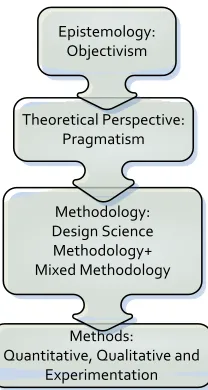
The current research was based on the philosophy of realism, and thus the
epistemology embedded in this research work is that of objectivism (Cohen, Morian and Morrison, 2007). The theoretical perspective for our research work, adopted from the work of
Cresswell, is pragmatism. The Pragmatism approach is problem-centered and real world practice oriented. This theoretical perspective provides the freedom to use various research
methodologies for conducting research. Since answers to our research questions aimed to create frameworks and artifacts such as software solutions to serve human purposes (Peffers et
al., 2007), the research methodology adopted for this research was mainly the design science
research methodology. Furthermore, a mixed methodology was also adopted to gather and
analyze data. The advantage of using a mixed methodology was that triangulation may be
performed to get a better understanding and verification of the data gathered.
Tools used to conduct research were questionnaires, interviews and analyses of documents. These tools were utilized to acquire data from surveys and experimentations (Chapter 3 and Chapter 6). The research approach undertaken for this research is presented in
10
Methods:
Quantitative, Qualitative and Experimentation
Methodology: Design Science Methodology+ Mixed Methodology Theoretical Perspective:
Pragmatism Epistemology:
Objectivism
Figure 1.1 Philosophical Approach of the Current Research
Figure 1.1 illustrates the philosophical standing of this research work. Design science research in information technology has been placed in the theoretical perspective of pragmatism, as discussed by Goldkuhi (2012), Moreover a mixed methodology has also been highlighted as an approach for pragmatism (Creswell, 2014). We will now briefly discus the
design science research process proposed by Offermann et al. (2009) and the mixed methodology approach, because these two methodologies are the foundation blocks for the
research methodology adopted in this research.
Design Science Research Methodology
This methodology is extended to be utilized, not only in the domain of engineering but also in the field of information systems. Offermann et al. (2009) presented a research process
[image:22.612.292.396.94.289.2]11
and between phases. Dashed line arrows indicate that researchers may revisit earlier process or
phases in case of ambiguities.
The problem Identification phase identifies the problem at hand, and ensures that the problems and the resulting solutions are of a practical nature. During this phase the literature is
reviewed, problem(s) are identified and their relevance to the contribution in resolving practical
issues are determined.
The solution design phase designs and develop artefacts in the light of second literature
research. During this stage, problems identified during the Problem Identification Phase may be
revisited to help in the understanding.
The Evaluation phase is the final phase in design science research. Case study/action
research, laboratory experiments and expert feedback in the form of surveys are conducted for
12 Literature Research:
Part 1
Identify Problem
Expert Interviews
Pre-evaluate Relevance
Literature Research:
Part 2 Design Artefact
Refine Hypothesis
Expert Survey
Laboratory Experiment
Case study/Action Research
Summaries Results
Problem Identification
Solution Design
Evaluation
Figure 1.2 Design Science Research Process (Offermann et al., 2009)
Since current research is embedded in the realm of information technology, design
science methodology was chosen. Not all the components in Figure 1.2 are mandatory, and are modified based on our research needs.
Mixed Methodology
Mixed methodology encompasses quantitative and qualitative research approaches. A benefit of using mixed methodology is to gain an in depth understanding of reality. Furthermore
13
done through this approach. This methodology is adopted as a secondary methodology. It is
applied in the first and the last phase of the design science research process.
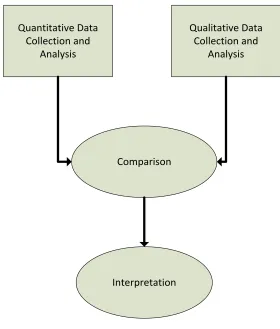
Various approaches to mixed methodology are provided in the literature (Creswell, 2014). These include Convergent Parallel Design, Embedded Design, Sequential designs such as
explanatory design and exploratory design. Convergent parallel design is illustrated in the Figure
1.3.
Quantitative Data Collection and
Analysis
Qualitative Data Collection and
Analysis
Comparison
[image:25.612.200.480.253.582.2]Interpretation
Figure 1.3: Convergent Parallel Mixed Methodology
The advantages of using convergent parallel mixed methodology are: better
understanding of reality as data is collected from two sets of sources, corroboration of results
14
Another category of mixed methodology is that of an explanatory approach. This methodology uses qualitative data to explain quantitative data. Figure 1.4 explains the process
for this methodology.
Quantitative Data Collection and
Analysis
Qualitative Data Collection and
Analysis
Interpretation Followed up with
Figure 1.4: Explanatory Mixed Methodology
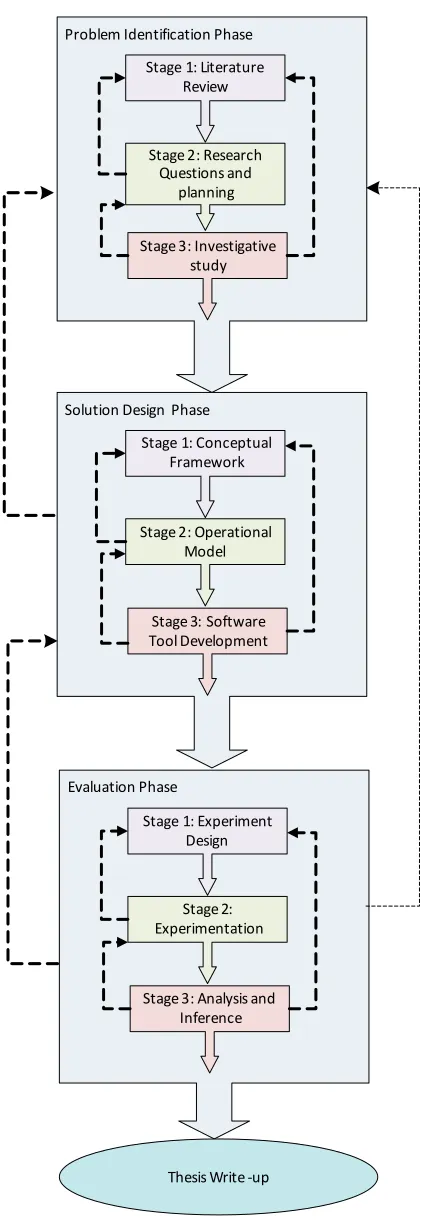
Thus, keeping in line with the design science research process and mixed methodology
approaches, this research was divided into three main phases. Each phase achieved a milestone and helped in answering one of the two research questions (RQ1–RQ2). However care was
taken to revisit previous phases if required. The first phase was the problem identification phase, the second phase was termed as the solution design phase and the third phase was the
evaluation phase in accordance with the design science process indicated in Figure 1.2. Figure
15 Literature Research:
Part 1
Identify Problem
Information from stake holders using Mixed Methodology(Convergent)
Pre-evaluate Relevance
Literature Research:
Part 2 Design Artefact
Experiment:
Results of experiment collected using Mixed
Methodology(Explanatory)
Summaries Results
Problem Identification
Solution Design
Evaluation
Figure 1.5: Research Methodology
A comparison of Figure 1.2 and Figure 1.5 indicates that the research methodology
adopted for the current research has embedded mixed methodology approaches during the first phase and the third phase of research. In the first phase, data were collected from the two
stakeholders, i.e. students and teachers, this data was then verified using triangulation. In the third phase a comprehensive experiment was conducted to determine the effect of intervention
designed in phase 2. During this experiment, an explanatory approach of mixed methodology was adopted to explain further the results of quantitative data obtained at pre and post tests as
16 Problem Identification Phase
Stage 1: Literature Review
Stage 2: Research Questions and
planning
Stage 3: Investigative study
Solution Design Phase Stage 1: Conceptual
Framework
Stage 2: Operational Model
Stage 3: Software Tool Development
Evaluation Phase
Stage 1: Experiment Design
Stage 2: Experimentation
Stage 3: Analysis and Inference
[image:28.612.237.451.74.689.2]Thesis Write -up
17
Figure 1.6 further illustrates the three phases (as mentioned in Figure 1.2. and Figure 1.5.) and divides them into stages within each phase. The dotted arrow lines in this figure (Figure 1.6) highlights the fact that each phase and stage is revisited to remove ambiguities, if
found, before proceeding to the next stage or phase.
We will discuss each of these phases and their stages in the following sections.
1.4.1.
Problem Identification Phase
This phase was divided into three stages, the literature review stage, the research
questions planning stage and the investigative stage. Each stage is described as follows.
In the first stage, the existing literature was reviewed. As stated by Boote and Beile “A substantive, thorough, sophisticated literature review is a pre-condition for doing substantive,
thorough, sophisticated research.” (Boote and Beile, 2005). The purpose for this review of the literature was to become acquainted with the domain of bibliometrics and with the practices of
referencing around the world – i.e., a broad context of study (Boote and Beile, 2005). Through this process, problems related to this topic were identified. Several papers have previously been
written that emphasize the existence of errors in references and citations within academic documents, thereby highlighting the issue (Al-Benna, et al. 2009; Shanmugam, 2009; Singh, 2009; Schiess, 2002). Hence the review of the literature formed the basis of our investigative study. It provided us with the directions to form our research questions, and thus led to the next
stage.
In the second stage, the research questions were formulated, as indicated in section 1.2 (Figure 1.5). The formulation of research questions is a fundamental step in theory
18
Sandberg, 2013). Once the research questions were identified and formulated, a plan for conducting research to acquire the answers to research questions was developed (Figure 1.5 and Figure 1.6). It was during this stage that three phases in the development of the thesis were decided upon. The decision for the planning of stages was based on the research methodology
chosen and the processes highlighted in the design science approach.
In the third stage, the primary sources (data from students and teachers at higher
education) were used to determine the root causes of errors in references and citations. The primary sources (as identified above) were the main stakeholders of the university. Methods
used to get information from these primary sources included both quantitative methods as well as qualitative methods. The convergent approach of mixed methodology was adopted here
(Figure 1.3 and Figure 1.5.). This information was then used to find solutions and to inform further research. As shown in Figure 1.6 previous stages were revisited to clarify and to remove
ambiguities.
For the quantitative research, questionnaire and document analysis was used as the appropriate tool. All the standard norms and practices – including ethical requirements – were adopted whilst developing the questionnaire, as well as during the acquisition and analysis of the documents. Devising and pilot testing were conducted at Warwick University before
questionnaires were distributed to the stakeholders. Furthermore, document analysis was also conducted – this is discussed in detail in chapter 3. Qualitative research tools, such as
interviews, were used with both types of stakeholder. Semi-structured interviews were designed and conducted. All the standard procedures for conducting interviews were followed, including
19
After the completion of quantitative and qualitative data collection processes, each set of data was analyzed. Statistical tests were applied to the quantitative data to determine if the relevant hypothesis was accepted or rejected (Chapter 3). Reference lists from the documents were extracted and analyzed by counting the frequency of references and the frequency of
errors in referencing. Interviews were scripted and coded to identify categories of data as per the practices of analyzing scripts. During this phase the practical relevancy of resolving this issue
of errors in referencing and citations for the educational and the professional scenario was identified as per the process in the first phase (Figure 1.5).
1.4.2.
Solution Design Phase
Data collected and analyzed during the problem identification phase highlighted some common problems and issues encountered by students while practicing the skills of references
and citation. Based on these findings a conceptual framework was developed (See Chapter 4) and the relationship between these components was established and justified. Prior to the development of the framework relevant literature was reviewed, and it was found that a framework to resolve this issue does not exist. Once the design of the conceptual framework
was completed, its operational model was developed. The conceptual framework was a very important stage of the research, since this was the solution proposed for the problems that
were highlighted in the problem identification phase of the research.
To implement the operational model, a software prototype was developed. While
developing the software prototype the software development methodology Rapid Application Development methodology was adopted. Care was taken to include all necessary functionalities
20
required, we revisited previous phases for the development of framework, operational model
and the software prototype to ensure accuracy of the research.
1.4.3.
Evaluation Phase
The evaluation phase was designed to evaluate the proposed framework (Chapter 4) (Figure 1.5 and Figure 1.6). As there were two stakeholders, two similar experiments were
designed and conducted. In each of the experiments, a pre-test and a post-test were conducted to determine the effect of the intervention. Furthermore, data such as academic documents
(including assignments) and corresponding reports were collected for analysis.
Data collected through these experiments were analyzed. Pre-tests and post-tests were conducted using quantitative as well as qualitative methods. Questionnaires were put to the
students involved in the experiments. The questionnaires were designed and delivered according to the standard procedures for this activity. Furthermore, interviews w ere conducted
with both tutors and students following the standard practices for interviews i.e. explanatory approach for mixed methodology was used here. Assignments and academic documents were
analyzed to determine the effect of the interventions on the way that references and citations
are practiced by students. Finally, conclusions were drawn and are presented in chapter 7.
1.5.
Outline of Thesis
The methodology described in section 1.4 was designed to address the research questions mentioned in section 1.2. The entire thesis is built around these research questions
21
Chapter 2 presents a historical background of references and citations, such as why and how they were started and how they evolved to the current state. This chapter further indicates some of the major efforts and facilities that are provided to researchers using the new technologies of software and cyberspace for the research and development of references. At
the end of this chapter, a few research studies are discussed to indicate the gravity of the
problem of erroneous references.
Chapter 3 explains the investigative study conducted during the first phase of this research. The details of the process of data gathering – through questionnaires, interviews and
document analysis – are presented. A discussion on the results of this analysis is also given in this chapter.
Chapter 4 presents a conceptual framework to overcome the problems stated in the
problem statements. This framework utilizes three important features of education. One of these features (‘spaced repetition’) has never been used in this manner. The relationship
between these components and the importance of each component in the framework is also highlighted. Furthermore, an operational model for the conceptual framework is introduced. This model incorporates all components of the framework. The chapter also describes how the
framework can be implemented through an automated solution.
Chapter 5 further discusses this automated software solution and indicates the modules of the operational model that require an automated software solution. It further indicates the
software development methodology adopted to build the required software. Requirements for the development of the software are extracted from the operational model proposed in this
22
Chapter 6 provides a description of and conclusions from the third and last phase of this research study. It indicates how the experiments were conducted to evaluate our proposed framework. This further provides analysis of the data received from these experiments. The chapter also presents a discussion and the conclusions reached in from the evaluation of the
framework.
The final chapter (chapter 7) concludes the thesis. It indicates how each of our research
questions was answered and the results of the evaluation process. The contributions of the
research are highlighted in this chapter and some directions for future work are described.
1.6.
Summary
This chapter has introduced the reader to the thesis. It has provided a map of the
research work and indicated the research questions. The scope of the research was identified, indicating that this research will focus on the academic arena. Within the academic arena, the
focus will be on university education especially for the domain of computer science. Hence, both, undergraduate and postgraduate levels of university education will be encompassed. In this chapter the overall methodology for conducting this research work was presented. All three phases of the research study were shown and discussed. These three phases of study
collectively answer our research questions (RQ1 –RQ2). Finally an outline of the thesis was
23
Chapter 2
References and Citations: Past and
Present
2.1.
Introduction
According to Peter Ingwersen (2012) “References (and thus citations) can be seen as footprints of information interaction, because of the behavioral conventions built in to the
scientific communication and publication process. They are manifestations of degrees of utility of methods, results and ideas made earlier on by other scientists”. This definition encompasses
the entire philosophy of references and citations and emphasizes its importance for scientific endeavours. It is therefore imperative to cite references in scholarly documents such as journal
papers, books and articles. References provide a sound base for research work and increase its credibility. At the same time references acknowledge the authors for their contribution to the
existing realm of knowledge (Moed, 2006). The importance of references has increased many fold during current electronic and cyberspace era due to the capability of electronically linking
text to the reference. Hence if references are not cited properly, they are not linked and
accessed by the readers of current document (Meyer, 2008).
However, several studies have indicated that while developing references, authors tend to make a number of errors (Davids, et al., 2010; Eichorn and Yankauer, 1987; Garfield, 1990).
This chapter aims to provide insight into the practices of references and citations adopted by scientists and researchers both past and present. Here we discuss briefly how and why libraries
24
Present day technologies that assist researchers are presented, including digital libraries and next generation catalogs. Reference management software is discussed, and some views about it are presented. An overview of the types of tutorials used to aid students in referencing is also included here. Finally some examples of errors present in books and academic papers are
highlighted, and research on understanding these errors is surveyed.
2.2.
Historical Background
To understand the root cause of a problem, it is recommended to trace its history. Since this research work aims to find reasons for erroneous referencing practices and for proposing
mechanism for improving this, it is vital to understand how these practices began and what their current state is. In this section we describe some evolutionary phases through which we have
reached the current state of referencing. This section also highlights efforts made to facilitate
researchers and bring them together to serve the cause of scientific research.
To understand how and when the concept of consulting the work done by others
started, we first look at the inception of libraries. Libraries are the mode of storage of information and allow its retrieval when required,. The importance of libraries or similar storage
mechanisms for preserving and accessing knowledge was understood millennia ago. Initially, factual documents and administrative information were stored. The purpose of storing this
information was that it could be referenced later (Casson, 2002). Slowly, creative material such as books and creative writing were added to these storage areas or archive rooms. Excavations near southern Mesopotamia have revealed a group of tablets from third millennium BCE. These tablets have lists of geographical locations, lists of gods, hymns, etc., and it appears that they
25
archeologists found a large scale collection of clay tablets at the city of Elba (Syria). This collection was located in a large archive room of the palace dating back to 2250 BCE (Wellisch, 1981), and nearly 2000 books and administrative documents were found inscribed on clay tablets. Several historic libraries in Europe and elsewhere have existed (Casson, 2002) including
the great library of Alexandria in Egypt (3rd Century BCE), the Library of Ugarit in Syria (1200 BCE), the Library of Ashurbanipal near Iraq (668 BCE), and the Library of Pergamum in Turkey
(3rd Century BCE) (Philips, 2010). The existence of these and many other magnificent libraries of the past indicates that the need to refer to and to learn from others’ work has always been
significant.
The magnitude and scale of the libraries mentioned above also indicates the desire to
add and build knowledge. Books and other data material are read and referred to by the scholars of the past, just as those of today. The evolution of the process of referencing can be
seen from historical documents. As elaborated by Small (2010), a rough form of refe rencing can already be seen in the ancient documents. Although there was no reference list at the end or footnotes, authors were referred to within the text by their name, but the location of knowledge was rarely mentioned. Thus the “who” and “what” was me ntioned as reference, but
not the “where” part of referencing (Small, 2010). A study was conducted by Allen et al. (1994) in which the evolution of referencing was traced for papers in the scientific journal, named
“Philosophical Transactions of the Royal Society”. Sample papers published from 1665 to 1990 were chosen and reference styles within these papers were analyzed. It was found that prior to
the 19th century references were embedded in the text. During the mid 19th century, these began to evolve as foot notes and finally in the 20th century they started to appear at the end as
26
2.2.1.
Practice and Perception about Referencing in the Ancient and
Classical Eras
It is of great interest to scholars and researchers to understand how scientists and
scholars of the ancient and classical eras practiced and perceived the activity of referencing. The
following is a short discussion on the practices followed by eminent scholars in the past.
Aristotle
Aristotle, born 385 BCE, is considered by many as the father of modern science as he
introduced scientific methods, and has had a great influence on how we perceive science even in this century (Sarton, 1952). Therefore, it is worth knowing what his perspective was about
referencing and how he practiced it. He wrote about 40 books containing in total more than 2000 pages. He referenced generously, and on average had 0.5 references per page. The
interesting thing seen in his references is that there is a large amount of self-referencing, i.e. he referred to his own work, either within the document or elsewhere. As Small (2010) states, “it is
interesting to speculate whether the impetus to cite oneself is not somehow the origin and prototype of all citations”. The references were made within the text, and contained mostly the name of the author and what he said, however there have been some examples of referencing in his documents where he mentions the “where” part of the reference e.g. ‘Plato in the
Timaeus says that matter and space are the same; for the “participant” and space are identical’
(Barnes, 1985), thus laying the foundation for current reference styles.
Newton
27
motion and gravity. Furthermore he wrote many papers and articles on other subjects including optics. His papers can be seen in the early journals of Philosophical Transactions (Small, 2010). By viewing three of his books on Mathematical Principles of Natural Philosophy (the Principia) it may be seen that on average, he had 0.4 references per page (Small, 2010). This indicates that
he has been referencing abundantly. Similar to Aristotle, while referencing, Newton mentioned the names of the authors and their work within the text of the document, but rarely mentioned
the location of the reference. However, while referencing the ancient writers such as Euclid, Apollonius, Archimedes, Aristotle, and Hipparchus, he mentioned the locations as well. It is
interesting to note that amount of self-citing by Newton has been quite small.
Darwin
Charles Darwin (born 1809 CE) was another prominent scientist. His theory of evolution had a great impact on the realm of natural sciences. By the time Darwin started publishing his work, the practices of referencing had become more advanced. Now, not just the name of the author was mentioned but the place of the cited author’s work was also mentioned. References
were being placed in the footnotes. However when viewing the first book by Darwin named The Origin of Species published in 1859, not a single footnote was present (Darwin, 1950). The
reason provided by Darwin for the omission of footnotes was that a Mr. Wallace sent him a memoir on the same topic, which “arrived at almost exactly the same general conclusions” (ibid:
1), therefore he had to publish his work in haste as he wanted to get the credit for his research wok. This issue of getting the credit for his work has also been seen with Isaac Newton, who had
unpleasant experiences in this regard and at one time, left the Royal Society of London due to
28
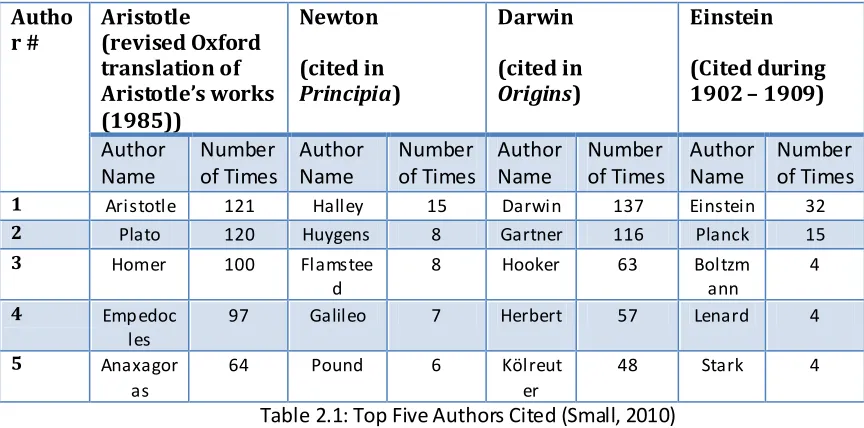
importance. As in the case of Aristotle, Darwin had self-cited many times. This factor is shown in
Table 2.1.
Einstein
Another eminent and celebrated scientist is Albert Einstein (born 1879 CE). His theory of
relativity has changed the way physics and astronomy are perceived. His theory was, however not easily accepted by the community of scientists, as it altered many know laws and explained
certain physical phenomena. This was one reason for delayed acceptance of his theory. The other reason maybe that he was not very generous in referencing, at least not at the start of
career as a scientist. His first book, named Theory of Relativity (1905), published in the Annalen der Physik, had no references at all. Although as stated by Small (2010,) there were quite a few
places where he could have mentioned the author, such as “references to Lorentz’s 1904 paper on what became known as the Lorentz contraction; the Michelson–Morley paper establishing the constancy of the speed of light with respect to the ether”. After two years, Einstein wrote another paper on the theory of relativity and gave references very generously. Einstein was an
independent thinker and apparently, did not rely too much on the work of his predecessors (Holton, 1973). Therefore, the numbers of references found in his work are less than expected.
He had several self-citations though as scientist before him did.
Discussion
Thus we can see from the references and citations practices by the scientists of the world who changed the course of thought by their ingenuity and intelligence, that references
29
work by Euclid, Archimedes, Aristotle as well as counterparts from same period, thus
highlighting the path taken by certain theories and philosophies to reach a logical conclusion.
Autho
r # Aristotle (revised Oxford translation of Aristotle’s works (1985)) Newton (cited in Principia) Darwin (cited in Origins) Einstein (Cited during 1902 – 1909)
Author Name Number of Times Author Name Number of Times Author Name Number of Times Author Name Number of Times
1 Aristotle 121 Halley 15 Darwin 137 Einstein 32
2 Plato 120 Huygens 8 Gartner 116 Planck 15
3 Homer 100 Flamstee
d
8 Hooker 63 Boltzm
ann
4
4 Empedoc
les
97 Galileo 7 Herbert 57 Lenard 4
5 Anaxagor
as
64 Pound 6 Kölreut
er
[image:41.612.108.540.153.367.2]48 Stark 4
Table 2.1: Top Five Authors Cited (Small, 2010)
Table 2.1 provides interesting information about citation trends and practices by the
scientists. This table provides information about the top five authors cited by the four scientists. It also highlights the number of times these authors are cited by the scientists in their books,
scientific journal papers and articles. Interesting trend seen by these scientists is that the amount of self-citing has been the largest for the majority of them, i.e. three scientists out of
the four cited their own work more than the other authors. Newton is the only scientist who did not excessively cite himself. The issue of ownership is prevalent for Newton, Darwin and
Einstein, and probably more glaringly for Darwin and Einstein, since both did not cite any reference in their first books. However Darwin was aware of the importance of referencing (Darwin, 1950) and later, cited abundantly. Einstein on the other hand was not very well acquainted with the works of others and hence did not often mention their names (Holton,
30
documentation. Aristotle, a student of Plato, on the other hand, was less concerned about it and cited the maximum number of references as shown in table 2.1. He was quite generous about referencing, perhaps the teaching of Plato played a role in it since his quotes such as “A house
that has a library in it has a soul”, indicate his love of knowledge and libraries.
2.2.2. Progress of Scientific Culture during Classical Era
The 17th century has often been described as the era of scientific revolution in Europe. The advent of this century saw enormous progress in the domain of science, and many science
journals and societies were formed. A first scholarly journal published in Europe was called
Journal des Scavans. It was published on 5th January 1665 in France by French writer Jean-Denis
de Sallo (1626-1669) (Boyer, 1894). It was followed closely by the scientific journal Philosophical Transactions of the Royal Society which was published on 6th March 1665 by The Royal Society of
London, which is the longest running scientific journal to date (Philosophical Transactions, 2010). Several scientists of that era published their papers in these scientific journals to let others know about their discoveries and inventions. Formation of several scientific societies and journals gave an enormous boost to the creation of new knowledge and inventions. At the same
time there was the race for the priority and ownership of inventions.
This scientific knowledge experienced exponential growth both in volume and quality.
Scientists and researchers had to study and synthesize greater quantity of text to establish their point. It was realized as early as 18th century that scholars face enormous problems while trying
to research as it was difficult to know about all the relevant journal s and articles for their area of research. This led to the development of citation indices (Parrott, 2001), several of which have
been developed by different societies and organization. This was a manual process hence very
31
Early Citation Indices and Catalogs
A citation index or reference index is a document that indexes published journals
(Garfield, 1955). These documents contain references to the journals, as well as the articles that
are published in these journals. Citation indices provide very good data about the journals in a given domain as well as the list of articles for each of them. The main advantage of such documents is that the researchers can easily find the articles of their interest and can pursue them in the given journal (Garfield, 1955). As stated above the earliest reference indices were
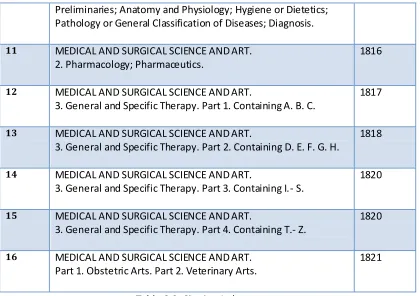
generated as early as 1800 by Jeremias David Reuss, and 16 volumes of these indices were
published, as shown in Table 2.2 below (Parrott, 2001).
Volume
# Contents Date Published
1 Natural History, General and Zoology. 1801
2 Botany and Mineralogy. 1802
3 Chemistry and Metallurgy. 1803
4 Physics. 1805
5 Astronomy. 1804
6 Economics (including agriculture). 1806
7 Mathematics; Mechanics; Hydrostatics; Hydraulics; Hydrotechnology; Aerostatics, Pneumatics; Technology; Civil Architecture; Naval Science; Military Science.
1808
8 History; Historical Aids; (Geography; Chronology; Monuments of Ancient Peoples; Inscriptions; Coins and Numismatology; Diplomatic Arts; Heraldry); Universal History; History of the Human Way; History of Mythology; Special history; Asia; Africa; America; Europe; Ecclesiastical History; Literary History.
1810
9 Philology; Languages; Greek Writing; Latin Writing; Fine Writing; Poetry; Rhetoric; Ancient Art; Painting; Music.
1810
32
Preliminaries; Anatomy and Physiology; Hygiene or Dietetics; Pathology or General Classification of Diseases; Diagnosis.
11 MEDICAL AND SURGICAL SCIENCE AND ART. 2. Pharmacology; Pharmaceutics.
1816
12 MEDICAL AND SURGICAL SCIENCE AND ART.
3. General and Specific Therapy. Part 1. Containing A. B. C.
1817
13 MEDICAL AND SURGICAL SCIENCE AND ART.
3. General and Specific Therapy. Part 2. Containing D. E. F. G. H.
1818
14 MEDICAL AND SURGICAL SCIENCE AND ART.
3. General and Specific Therapy. Part 3. Containing I.- S.
1820
15 MEDICAL AND SURGICAL SCIENCE AND ART.
3. General and Specific Therapy. Part 4. Containing T.- Z.
1820
16 MEDICAL AND SURGICAL SCIENCE AND ART.
Part 1. Obstetric Arts. Part 2. Veterinary Arts.
[image:44.612.108.528.74.370.2]1821
Table 2.2: Citation Index
As seen in the above table, all the domains in the realm of science have been covered and their catalogues or indices are generated. The process of generating these catalogues was
halted due to Reuss’ death.
The Royal Society of London started working on the indexing of scientific journals in the middle of the 19th century (Beaver, 1972), however Beaver claims that this idea was originated
by a young Lieutenant in the United States Army Corps of Engineers, Edward Bissell Hunt. These
indices were called the Catalogue of Scientific Papers, 19 volumes were published, and the work was completed in 1925. Another index of citations was developed by the Royal Society of London in collaboration with several other societies and was called the International Catalogue
of Scientific Papers. This was a much more complex venture, and indexing of journals from 1901
33
London, many other societies also developed domain specific indices (Parrott, 2001). In 1898 the Institution of Electrical Engineers (IEE) and the Physical Society of London started publishing
a citation index called Science Abstracts. During 1907 American Chemical Society (ACS) started
Chemical Abstracts. In 1927, the Union of American Biological Societies started Biological Abstracts, and in 1940 Mathematical Reviews was started by a collaboration of the American Mathematical Society (AMS), the Mathematical Association of America (MAA), the Academia
Nacional de Ciencias Exactas Físicas y Naturales in Lima, the Koninklijk Wiskundig Genootschap
in Amsterdam, and the London Mathematical Society (LMS).
2.3.
Facilities for Researchers in the Modern Era
The advent of computers and digitization of data have revolutionized the way research
is conducted now. Principles and scientific methods are primarily the same; however the mode of acquiring knowledge has changed. Scholars as well as students now are exposed to huge amount of information. The access method for getting this information has become easy, and the time taken to find information on a required subject and topic has reduced phenomenally,
thus increasing the speed of creation and dissemination of new knowledge. The following
subsections highlight some of the work that has been done in this regard.
2.3.1. Modern Citation Indices
As mentioned above, indices or catalogues have historically been developed and assembled manually. An enormous amount of work was performed by various societies to consolidate the work done by researchers and to facilitate them. However since this work was
done manually many errors were introduced, furthermore this process was very slow and time
34
cumbersome (Garfield, 1955). After World War 2 the government of the USA released funds for research and thus research activity in America increased manifold making it increasingly difficult
to manage and publish journals and citation indices (Thomson Reuter, 2010).
During the 1950s, when computers were coming into the picture, it was felt that
automation would be the solution for massive amounts of data storage and retrieval, and Eugene Garfield started working on the projects to develop citation indices and to store them on
computer. Thus it can be said that he is the pioneer in electronic citation indices (Thomson
Reuter, 2010).
The first automated citation index was the Science Citation Index (SCI), developed by
Garfield at the Institute of Scientific Information (ISI) in 1960. After the generation of this index, another index called the Social Science Citation Index (SSCI) was developed in the 1970s
followed by the Arts and Humanities Citation Index (AHCI). ISI was later taken over by Thomas
Reuter (Yancey, 2005; Gupta, Jha and Mishra, 2004).
These indices are the prime source of knowledge acquisition (Gupta, Jha and Mishra, 2004) and as stated by Garfield this was an attempt to materialize H.G. Wells’ vision of a “World
Brain” i.e. World information center (Garfield, 1964). SCI has data on about 3700 published journals covering about 100 disciplines of science (Gupta, Jha and Mishra, 2004). SSCI, which was built upon SCI, covers about 1700 journals covering 50 disciplines (Gupta, Jha, Mishra, 2004). AHCI contains data on about 135 journals pertaining to the knowledge of Arts and
Humanities. These indices are available on line through Web of sciences and Web of knowledge