http://wrap.warwick.ac.uk/
Original citation:
Petrou, Stavros, Rivero-Arias, Oliver, Dakin, Helen, Longworth, Louise, Oppe, Mark,
Froud, Robert J. and Gray, Alastair, 1953-. (2015) Preferred reporting items for studies
mapping onto preference-based outcome measures : the MAPS statement. Medical
Decision Making, 35 (6). NP1-NP8. ISSN 0272-989X
Permanent WRAP url:
http://wrap.warwick.ac.uk/71037
Copyright and reuse:
The Warwick Research Archive Portal (WRAP) makes this work by researchers of the
University of Warwick available open access under the following conditions.
This article is distributed under the terms of the Creative Commons Attribution 4.0
License (
http://creativecommons.org/licenses/by/4.0/
) which permits any use,
reproduction and distribution of the work without further permission provided the original
work is attributed.
A note on versions:
The version presented in WRAP is the published version, or, version of record, and may
be cited as it appears here.
Preferred Reporting Items for Studies
Mapping onto Preference-Based Outcome
Measures: The MAPS Statement
Stavros Petrou, PhD, Oliver Rivero-Arias, DPhil, Helen Dakin, DPhil,
Louise Longworth, PhD, Mark Oppe, PhD, Robert Froud, PhD, Alastair Gray, PhD
Background. ‘‘Mapping’’ onto generic preference-based outcome measures is increasingly being used as a means of generating health utilities for use within health eco-nomic evaluations. Despite the publication of technical guides for the conduct of mapping research, guidance for the reporting of mapping studies is currently lacking. The MAPS (MApping onto Preference-based measures reporting Standards) statement is a new checklist that aims to pro-mote complete and transparent reporting of mapping stud-ies. Methods. In the absence of previously published reporting checklists or reporting guidance documents, a de novo list of reporting items was created by a working group comprised of 6 health economists and 1 Delphi meth-odologist. A 2-round, modified Delphi survey with represen-tatives from academia, consultancy, health technology assessment agencies, and the biomedical journal editorial community was used to identify a list of essential reporting
items from this larger list.Results.From the initial de novo
list of 29 candidate items, a set of 23 essential reporting items was developed. The items are presented numerically and categorized within 6 sections, namely: (i) title and abstract; (ii) introduction; (iii) methods; (iv) results; (v) dis-cussion; and (vi) other. The MAPS statement is best applied in conjunction with the accompanying MAPS explanation
and elaboration document. Conclusions. It is anticipated
that the MAPS statement will improve the clarity, transpar-ency, and completeness of reporting of mapping studies. To facilitate dissemination and uptake, the MAPS statement is being co-published by 7 health economics and quality-of-life journals, and broader endorsement is encouraged. The MAPS working group plans to assess the need for an update
of the reporting checklist in 5 years.Key words:mapping;
outcome measures; preferences; reporting. (Med Decis
Making 2015;35:NP1–NP8)
INTRODUCTION
The process of ‘‘mapping’’ onto generic preference-based outcome measures is increasingly being used as a means of generating health utilities for application within health economic evaluations.1 Mapping involves the development and use of an algorithm (or algorithms) to predict the primary outputs of generic preference-based outcome measures (i.e., health utility values), using data on other indicators or measures of health. The source predictive measure may be a non-preference-based indicator or measure of health outcome or, more exceptionally, a preference-based outcome measure that is not preferred by the local health technology assessment agency. The
algorithm(s) can subsequently be applied to data from clinical trials, observational studies, or economic models containing the source predictive measure(s) to predict health utility values in contexts in which the target generic preference-based measure is absent. The predicted health utility values can then be analyzed using standard methods for individual-level data (e.g., within a trial-based eco-nomic evaluation) or summarized for each health state within a decision-analytic model.
Throughout recent years, there has been a rapid increase in the publication of studies that use map-ping techniques to predict health utility values, and databases of published studies in this field are begin-ning to emerge.2 Some authors3 and agencies4 con-cerned with technology appraisals have issued technical guides for the conduct of mapping research. However, guidance for thereportingof mapping stud-ies is currently lacking. In keeping with health-related research more broadly,5 mapping studies should be reported fully and transparently to allow
ÓThe Author(s) 2015 Reprints and permission:
http://creativecommons.org/licenses/by/4.0/ DOI: 10.1177/0272989X15598332
MEDICAL DECISION MAKING/AUGUST 2015 NP1
readers to assess the relative merits of the investiga-tion.6Moreover, there may be significant opportunity costs associated with regulatory and reimbursement decisions for new technologies informed by mislead-ing findmislead-ings from mappmislead-ing studies. This has led to the development of the MAPS (MApping onto Prefer-ence-based measures reporting Standards) reporting statement, which we summarize in this article.
The aim of the MAPS reporting statement is to pro-vide recommendations, in the form of a checklist of essential items, which authors should consider when reporting a mapping study. It is anticipated that the checklist will promote complete and trans-parent reporting by researchers. The focus, therefore, is on promoting the quality of reporting of mapping studies, rather than the quality of their conduct, although it is possible that the reporting statement will also indirectly enhance the methodological rigor of the research.7 The MAPS reporting statement is primarily targeted at researchers developing map-ping algorithms, the funders of the research, and peer reviewers and editors involved in the manu-script review process for mapping studies.5,6 In developing the reporting statement, the term map-ping is used to cover all approaches that predict the outputs of generic preference-based outcome measures using data on other indicators or measures of health, and it encompasses related forms of nomen-clature used by some researchers, such as ‘‘cross-walking’’ or ‘‘transfer to utility.’’1,8 Similarly, the term algorithm is used in its broadest sense to
encompass statistical associations and more complex series of operations.
THE DEVELOPMENT OF THE MAPS STATEMENT
The development of the MAPS reporting statement was informed by recently published guidance for health research reporting guidelines5 and broadly modeled other recent reporting guideline develop-ments.9–14 A working group comprised of 6 health economists (SP, ORA, HD, LL, MO, and AG) and 1 Delphi methodologist (RF) was formed following a request from an academic journal to develop a reporting statement for mapping studies. One of the working group members (HD) had previously conducted a systematic review of studies mapping from clinical or health-related quality-of-life meas-ures onto the EQ-5D.2 Using the search terms from this systematic review, as well as other relevant articles and reports already in our possession, a broad search for reporting guidelines for mapping studies was conducted. This confirmed that no previous reporting guidance had been published. The working group members therefore developed a preliminaryde novo list of 29 reporting items and accompanying explanations. Following further review by the work-ing group members, this was subsequently distilled into a list of 25 reporting items and accompanying explanations.
Members of the working group identified 62 possi-ble candidates for a Delphi panel from a pool of active researchers and stakeholders in this field. The candi-dates included individuals from academic and con-sultancy settings with considerable experience in mapping research, representatives from health tech-nology assessment agencies that routinely appraise evidence informed by mapping studies, and biomed-ical journal editors. Health economists from the MAPS working group were included in the Delphi panel. A total of 48 of the 62 (77.4%) individuals agreed to participate in a Delphi survey aimed at developing a minimum set of standard reporting requirements for mapping studies with an accompa-nying reporting checklist.
The Delphi panelists were sent a personalized link to a Web-based survey, which had been piloted by members of the working group. Nonresponders were sent up to 2 reminders after 14 and 21 days. The panelists were anonymous to each other through-out the study, and their identities were known only to 1 member of the working group. The panelists were invited to rate the importance of each of the 25
Received 7 July 2015 from the Warwick Clinical Trials Unit, Warwick Medical School, University of Warwick, Coventry, UK (SP, RF); National Perinatal Epidemiology Unit, Nuffield Department of Population Health, University of Oxford, Oxford, UK (ORA); Health Economics Research Centre, Nuffield Department of Population Health, University of Oxford, Oxford, UK (HD, AG); Health Economics Research Group, Brunel Uni-versity London, Uxbridge, UK (LL); EuroQol Research Foundation, Rot-terdam, The Netherlands (MO); and Norges Helsehøyskole, Campus Kristiania, Oslo, Norway (RF). Funding: No external funding was received for this study. All members of the working group acted on a vol-untary basis. Conflicts of interest: RF is a shareholder and a director of a company (Clinvivo Limited) that provides services for Delphi studies. However, these services were not used in this study, and thus notwith-standing the connection RF declares that he has no conflicts of interest. The remaining authors (SP, ORA, HD, LL, MO, AG) have no conflicts of interest to declare. All authors contributed to the study design and conduct, interpretation of results, and report writing. SP acts as the guarantor.
Address correspondence to Professor Stavros Petrou, Warwick Medi-cal School, University of Warwick, Coventry CV4 7AL, UK; phone: 02476 151124; fax: 02476 151586; e-mail: [email protected].
PETROU AND OTHERS
candidate reporting items identified by the working group on a 9-point rating scale (from 1,not important, to 9,extremely important), describe their confidence in their ratings (not confident, somewhat confident, orvery confident), comment on the candidate items and their explanations, suggest additional items for consideration by the panelists in subsequent rounds, and provide any other general comments. The candi-date reporting items were ordered within 6 sections: (i) title and abstract, (ii) introduction, (iii) methods, (iv) results, (v) discussion, and (vi) other. The panel-ists also provided information about their geographi-cal area of work, gender, and primary and additional work environments. The data were imported into Stata (version 13; Stata Corp., College Station, TX) for analysis.
A modified version of the Research and Develop-ment (RAND)/University of California, Los Angeles (UCLA) appropriateness method was used to analyze the round 1 responses.15This involved calculating the median score, the interpercentile range (IPR; 30th and 70th), and the interpercentile range adjusted for sym-metry (IPRAS) for each item (i) being rated. The IPRAS
includes a correction factor for asymmetric ratings, and panel disagreement was judged to be present in cases if IPRi.IPRASi.15 We modified the RAND/
UCLA approach by asking panelists about ‘‘impor-tance’’ rather than ‘‘appropriateness’’ per se. Assess-ment of importance followed the classic RAND/ UCLA definitions, categorized simply as whether the median rating fell between 1 and 3 (unimportant), 4 and 6 (neither unimportant nor important), or 7 and 9 (important).15
The results of round 1 of the Delphi survey were reviewed at a face-to-face meeting of the working group. A total of 46 of the 48 (95.8%) individuals who agreed to participate completed round 1 of the survey. Of the 25 items, 24 were rated as important, with one item (source of funding) rated as neither unimportant nor important. There was no evidence of disagreement on ratings of any items according to the RAND/UCLA method. These findings did not change when the responses of the MAPS working group were excluded. Based on the qualitative feed-back received in round 1, items describing ‘‘Model-ling Approaches’’ and ‘‘Repeated Measurements’’ were merged, as were items describing ‘‘Model Diag-nostics’’ and ‘‘Model Plausibility.’’ In addition, amendments to the wording of several recommenda-tions and their explanarecommenda-tions were made in the light of qualitative feedback from the panelists.
Panelists participating in round 1 were invited to participate in a second round of the Delphi survey.
A summary of revisions made following round 1 was provided. This included a document in which revisions to each of the recommendations and explanations were displayed in the form of track changes. Panelists participating in round 2 were pro-vided with group outputs (mean scores and their standard deviations, median scores and their IPRs, histograms, and RAND/UCLA labels of importance and agreement level) summarizing the round 1 results (and disaggregated outputs for the merged items). They were also able to view their own round 1 scores for each item (and disaggregated scores for the merged items). Panelists participating in round 2 were offered the opportunity to revise their rating of the importance of each of the items and informed that their rating from round 1 would otherwise hold. For the merged items, new ratings were soli-cited. Panelists participating in round 2 were also offered the opportunity to provide any further com-ments on each item or any further information that might be helpful to the group. Nonresponders to the second round of the Delphi survey were sent up to 2 reminders after 14 and 21 days. The analytical meth-ods for the round 2 data mirrored those for the first round.
The results of the second round of the Delphi sur-vey were reviewed at a face-to-face meeting of the working group. A total of 39 of the 46 (84.8%) panel-ists participating in round 1 completed round 2 of the survey. All 23 items included in the second round were rated as important with no evidence of disagree-ment on ratings of any items according to the RAND/ UCLA method. Qualitative feedback from the panelists participating in round 2 led to minor modifications to the wording of a small number of recommendations and their explanations. This was fed back to the round 2 respondents, who were given a final oppor-tunity to comment on the readability of the final set of recommendations and explanations. Based on these methods, a final consensus list of 23 reporting items was developed.
THE MAPS STATEMENT
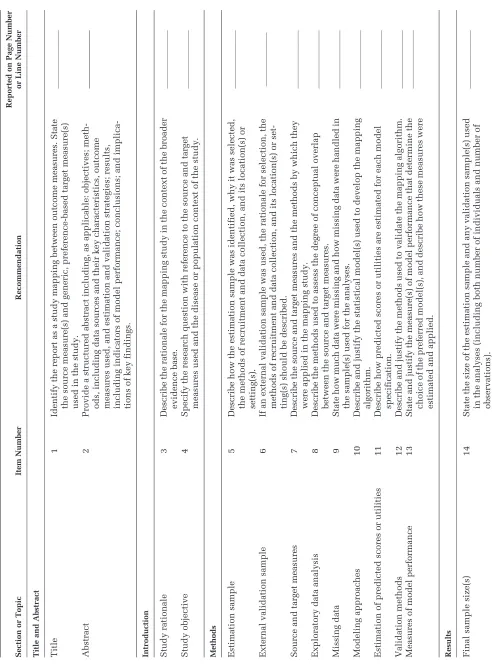
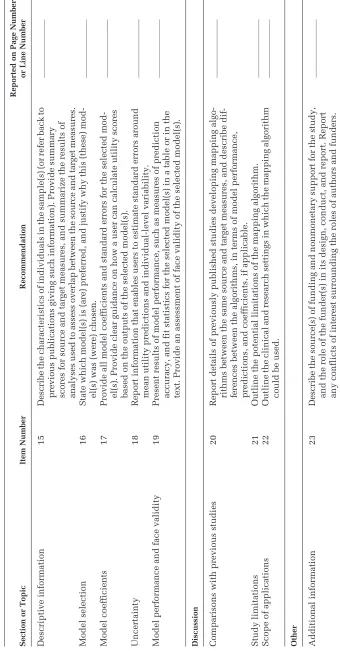
The MAPS statement is a 23-item checklist of rec-ommendations (Table 1) that we consider essential for complete and transparent reporting of studies that map onto generic preference-based outcome measures. The 23 reporting items are presented numerically and categorized within 6 sections: (i) title and abstract (2 items), (ii) introduction (2 items), (iii) methods (9 items), (iv) results (6 items), (v)
THE MAPS REPORTING STATEMENT
discussion (3 items), and (vi) other (1 item). The reporting of each item does not necessarily have to follow the order within the MAPS statement. Rather, what is important is that each recommendation is addressed in either the main body of the report or its appendices. Several biomedical journals have endorsed the MAPS statement, including Applied Health Economics and Health Policy, Health and Quality of Life Outcomes, International Journal of Technology Assessment in Health Care, Journal of Medical Economics, Medical Decision Making, Phar-macoEconomics, and Quality of Life Research. We encourage other journals and research interest groups to endorse the MAPS statement and authors to adhere to its principles.
THE MAPS EXPLANATION AND ELABORATION PAPER
In addition to the MAPS reporting statement, we have produced a supporting Explanation and Elabo-ration paper16modeled on those developed for other reporting guidelines.9–14 The reporting items con-tained within the MAPS statement are best under-stood by referring to the information contained within this accompanying document. The Explana-tion and ElaboraExplana-tion paper provides exemplars of good reporting practice identified from the published literature for each reporting item. In addition, it provides a detailed explanation to accompany each recommendation, supported by a rationale and rele-vant evidence when available. The development of the Explanation and Elaboration paper was com-pleted following several iterations produced by mem-bers of the working group, after which the examples and explanations were shared with the Delphi panel-ists for final revisions to improve readability and their approval. The Explanation and Elaboration paper also summarizes the characteristics of the Del-phi panelists and provides detailed statistics for item ratings at each Delphi round.
DISCUSSION
Throughout recent years, there has been a rapid increase in the publication of studies that use mapping techniques to predict health utility values. One recent review article identified 90 studies pub-lished up to the year 2013 reporting 121 mapping algo-rithms between clinical or health-related quality-of-life measures and the EQ-5D.2 That review article excluded mapping algorithms targeted at other generic
preference-based outcome measures that can generate health utilities, such as the SF-6D17 and the Health Utilities Index (HUI),18which have been the target of numerous other mapping algorithms.1,19–24Moreover, the popularity of the mapping approach for estimating health utilities is unlikely to wane given the numerous contexts within health economic evaluation in which primary data collection is challenging. However, map-ping introduces additional uncertainty, and collection of primary data with the preferred utility instrument is preferable.
The MAPS reporting statement was developed to provide recommendations, in the form of a checklist of essential items, which authors should consider when reporting mapping studies. Guidance for the reporting of mapping studies was not previously available in the literature. The overall aim of MAPS is to promote clarity, transparency, and completeness of reporting of mapping studies. It is not intended to act as a methodological guide, nor as a tool for assess-ing the quality of study methodology. Rather, it aims to avoid misleading conclusions being drawn by readers, and ultimately policy makers, as a result of suboptimal reporting. In keeping with other recent health research reporting guidelines, we have also produced an accompanying Explanation and Elaboration paper16 to facilitate a deeper understanding of the 23 items contained within the MAPS reporting statement. That paper should hopefully act as a pedagogical framework for researchers reporting mapping studies. The development of the MAPS reporting state-ment, and its Explanation and Elaboration docustate-ment, was framed by recently published guidance for health research reporting guidelines.5The Delphi panel was composed of a multidisciplinary, multinational team of content experts and journal editors. The panel members included people experienced in conducting mapping studies; of the 84 researchers who were first authors on papers included in a recent review of EQ-5D mapping studies,231 (36.9%) were included as panelists. We have no evidence to believe that a larger panel would have altered the final set of recommendations. The Delphi methodologies that we applied included analytical approaches only recently adopted by developers of health-reporting guidelines.15 We are unable to assess whether a strict adherence to the MAPS checklist will increase the word counts of mapping reports. It is our view that the increasing use of online appendices by journals should permit com-prehensive reporting even in the context of strict word limits for the main body of reports.
Evidence for other health research reporting guidelines suggests that reporting quality improved
PETROU AND OTHERS
after the introduction of reporting checklists,25–27 although there is currently no empirical evidence that adoption of MAPS will improve the quality of reporting of mapping research. Future research planned by the MAPS working group will include a before-and-after evaluation of the benefits (and indeed possible adverse effects) of the introduction of the MAPS reporting statement. It will also be nec-essary to update the MAPS reporting statement in the future to address conceptual, methodological, and practical advances in the field. Potential methodolog-ical advances that might be reflected in an update might include shifts toward more complex model specifications, better methods for dealing with uncer-tainty, and guidance on the appropriate use of meas-ures of prediction accuracy, such as the mean absolute error (MAE) and mean square error (MSE). The MAPS working group plans to assess the need for an update of the reporting checklist in 5 years.
In conclusion, this article summarizes a new reporting statement developed for studies that map onto generic preference-based outcome measures. We encourage health economic and quality-of-life journals to endorse MAPS, promote its use in peer review, and update their editorial requirements and ‘‘Instructions to Authors’’ accordingly.
ACKNOWLEDGMENTS
We are grateful to the following individuals, who con-sented to being acknowledged publicly, for their comments and participation in the Delphi panel: Roisin Adams, Rob-erta Ara, Nick Bansback, Garry Barton, Andy Briggs, Chris Carswell, Gang Chen, Doug Coyle, Ralph Crott, Richard Edlin, Alastair Fischer, Juan Manuel Ramos-Gon˜i, Ola Ghatnekar, Patrick Gillard, Ning Yan Gu, Annie Hawton, Haomiao Jia, Kamran Khan, Billingsley Kaambwa, Nick Kon-todimopoulos, Quang Le, Jason Madan, Katherine MacGilch-rist, David Meads, Duncan Mortimer, Bhash Naidoo, Angus Ng, Nalin Payakachat, Simon Pickard, Rafael Pinedo-Villa-nueva, Eleanor Pullenayegum, Jeff Richardson, Janet Robert-son, Jeff Round, Donna Rowen, Sean Rundell, Paulos Teckle, Matthijs Versteegh, Feng Xie, and Tracey Young. This article is a joint publication by Applied Health Econom-ics and Health Policy, Health and Quality of Life Outcomes, International Journal of Technology Assessment in Health Care, Journal of Medical Economics, Medical Decision Mak-ing, Pharmacoeconomics, and Quality of Life Research.
REFERENCES
1. Brazier JE, Yang Y, Tsuchiya A, Rowen DL. A review of studies mapping (or cross walking) non-preference based measures of
health to generic preference-based measures. Eur J Health Econ. 2010;11:215–25.
2. Dakin H. Review of studies mapping from quality of life or clin-ical measures to EQ-5D: an online database. Health Qual Life Out-comes. 2013;11:151.
3. Chuang LH, Whitehead SJ. Mapping for economic evaluation. Br Med Bull. 2012;101:1–15.
4. Longworth L, Rowen D. NICE DSU Technical Support Docu-ment 10: The Use of Mapping Methods to Estimate Health State Utility Values. Sheffield, UK: Decision Support Unit, ScHARR, University of Sheffield; 2011.
5. Moher D, Schulz KF, Simera I, Altman DG. Guidance for devel-opers of health research reporting guidelines. PLoS Med. 2010;7: e1000217.
6. Moher D, Simera I, Schulz KF, Hoey J, Altman DG. Helping edi-tors, peer reviewers and authors improve the clarity, completeness and transparency of reporting health research. BMC Medicine. 2008;6:13.
7. Narahari SR, Ryan TJ, Aggithaya MG, Bose KS, Prasanna KS. Evidence-based approaches for the ayurvedic traditional herbal formulations: toward an ayurvedic consort model. J Altern Com-plement Med. 2008;14:769–76.
8. Mortimer D, Segal L, Sturm J. Can we derive an "exchange rate" between descriptive and preference-based outcome measures for stroke? Results from the transfer to utility (TTU) technique. Health Qual Life Outcomes. 2009;7:33.
9. Bossuyt PM, Reitsma JB, Bruns DE, et al. Standards for reporting of diagnostic A: the Stard statement for reporting studies of diag-nostic accuracy: explanation and elaboration. Ann Intern Med. 2003;138:W1–12.
10. Tong A, Sainsbury P, Craig J. Consolidated criteria for report-ing qualitative research (coreq): a 32-item checklist for interviews and focus groups. Int J Qual Health Care. 2007;19:349–57. 11. Vandenbroucke JP, von Elm E, Altman DG, et al. Strengthening the reporting of observational studies in epidemiology (STROBE): explanation and elaboration. PLoS Med. 2007;4:e297.
12. Liberati A, Altman DG, Tetzlaff J, et al. The PRISMA statement for reporting systematic reviews and meta-analyses of studies that evaluate health care interventions: explanation and elaboration. J Clin Epidemiol. 2009;62:e1–34.
13. Moher D, Hopewell S, Schulz KF, et al. Consort 2010 explana-tion and elaboraexplana-tion: updated guidelines for reporting parallel group randomised trials. BMJ. 2010;340:c869.
14. Husereau D, Drummond M, Petrou S, et al. Consolidated health economic evaluation reporting standards (CHEERS)— explanation and elaboration: a report of the ISPOR health eco-nomic evaluation publication guidelines good reporting practices task force. Value Health. 2013;16:231–50.
15. Fitch K, Bernstein S, Aguilar M, et al. The RAND/UCLA Appropriateness Method User’s Manual. Santa Monica, CA: RAND; 2001.
16. Petrou S, Rivero-Arias O, Dakin H, et al. The maps reporting statement for studies mapping onto generic preference-based out-come measures: explanation and elaboration. Pharmacoeconom-ics. DOI: http://dx.doi.org/10.1007/s40273-015-0312-9
17. Brazier J, Roberts J, Deverill M. The estimation of a preference-based measure of health from the SF-36. J Health Econ. 2002;21: 271–92.
THE MAPS REPORTING STATEMENT
18. Feeny D, Furlong W, Boyle M, Torrance GW. Multi-attribute health status classification systems. Health utilities index. Phar-macoeconomics. 1995;7:490–502.
19. Yang Y, Wong MY, Lam CL, Wong CK. Improving the mapping of condition-specific health-related quality of life onto SF-6D score. Qual Life Res. 2014;23:2343–53.
20. Lee L, Kaneva P, Latimer E, Feldman LS. Mapping the gastro-intestinal quality of life index to short-form 6D utility scores. J Surg Res. 2014;186:135–41.
21. Roset M, Badia X, Forsythe A, Webb SM. Mapping cushingqol scores onto SF-6D utility values in patients with Cushing’s syn-drome. Patient. 2013;6:103–11.
22. Payakachat N, Tilford JM, Kuhlthau KA, et al. Predicting health utilities for children with autism spectrum disorders. Autism Res. 2014;7:649–63.
23. Goldfeld KS, Hamel MB, Mitchell SL. Mapping health status measures to a utility measure in a study of nursing home residents with advanced dementia. Med Care. 2012;50:446–51.
24. Chen G, McKie J, Khan MA, Richardson JR. Deriving health util-ities from the macnew heart disease quality of life questionnaire. Eur J Cardiovasc Nurs. 2014. DOI: 10.1177/1474515114 536096 25. Moher D, Jones A, Lepage L, Group C. Use of the consort state-ment and quality of reports of randomized trials: a comparative before-and-after evaluation. JAMA. 2001;285:1992–5.
26. Delaney A, Bagshaw SM, Ferland A, Manns B, Laupland KB, Doig CJ. A systematic evaluation of the quality of meta-analyses in the critical care literature. Critical care. 2005;9:R575–82. 27. Plint AC, Moher D, Morrison A, et al. Does the consort check-list improve the quality of reports of randomised controlled trials? A systematic review. Med J Aust. 2006;185:263–7.
PETROU AND OTHERS