Please cite this article as: M. Fazli, A. M. Fathollahi-Fard, G. Tian, Addressing a Coordinated Quay Crane Scheduling and Assignment Problem by Red Deer Algorithm, International Journal of Engineering (IJE), IJE TRANSACTIONS B: Applications Vol. 32, No. 8, (August 2019) 1186-1191
International Journal of Engineering
J o u r n a l H o m e p a g e : w w w . i j e . i r
Addressing a Coordinated Quay Crane Scheduling and Assignment Problem by Red
Deer Algorithm
M. Fazlia, A. M. Fathollahi-Fardb, G. Tianc,d
a Department of Industrial Engineering, Shomal University, Amol, Iran
b Department of Industrial Engineering and Management Systems, Amirkabir University of Technology, Tehran, Iran c School of Mechanical Engineering, Shandong University, Jinan, China
d Key Laboratory of High Efficiency and Clean Mechanical Manufacture (Ministry of Education), Shandong University, Jinan, China
P A P E R I N F O
Paper history:
Received 28 April 2019
Received in revised form 13 June 2019 Accepted 05 July 2019
Keywords: Container Terminals Optimization
Coordinated Quay Crane Scheduling and Assignment Problem
Nature-inspired Algorithm Red Deer Algorithm
A B S T R A C T
Nowadays, there is much attention for planning of container terminals in the global trade centers. The high cost of quay cranes motivates both scholars and industrial practitioners especially in the last decade to develop novel optimization models to address this dilemma. This study proposes a coordinated optimization model to cover both Quay Crane Scheduling Problem (QCSP) and Quay Crane Assignment Problem (QCAP) as among the first attempts in this area. Another main contribution of this paper is to apply a recent nature-inspired algorithm called Red Deer Algorithm (RDA). The RDA revealed its performance for a variety of combinatorial optimization problems in different real-world applications. This is the first attempt in the literature to employ this recent metaheuristic to solve the proposed Coordinated Quay Crane Scheduling and Assignment Problem (CQCSAP). Finally, an extensive comparison discussion is considered to reveal the main benefits of the proposed optimization model and solution algorithm.
doi: 10.5829/ije.2019.32.08b.15
1. INTRODUCTION AND LITERATURE REVIEW
Academically, the container terminals were established in the late 1960s to accommodate container ships traveling between Europing contries and the United States [1, 2]. In order to reduce the traveling costs, shippers are always looking for more economical size of containers, building larger vessels for long journeys, and improve facilities and technology for servicing ships [3]. Due to the high cost of establishing berths and their equipment, the main focus is on optimizing the activities of berths and their equipment, such as Quay Cranes (QCs). The first problem for a terminal is to assign a berth location and the time of service to the vessel. The second problem is to assign the quay cranes to the ships [4]. Therefore, the objective is to optimal allocation of the cranes to the vessel. The third problem is the scheduling of the quay cranes, which determines the sequence of each crane processing to minimize loading/unloading time of the ship. Considering that QC Assignment
*Corresponding Author Email: [email protected] (A. M. Fathollahi-Fard)
Problem (QCAP) and QC Schduling Problem (QCSP) have many similarities. They have been combined over and over again, which increases the efficiency of the seaside operations. The assignment of QCs is effective in determining the sequences of QCs, hence in integrating QCSP and QCAP, the quay cranes would become more efficient [5].
The problem of the quay scheduling was first introduced by Daganzo [6] in 1989. He presented an MIP model aimed at reducing the costs of delayed ship loading and solved the problem by exact and approximate solution methods. Later in 2004, Kim and Park [7] studied scheduling problem of quay cranes which are the most important equipment on the terminals. In 2008, Imai et al. [8] examined the effectiveness of the QCSP and QCAP in a multi-user container terminal. Goodchild and Daganzo [9] reviewed the long-term impact of double cycling on berth equipment, such as cranes and the usefulness of the quay.
Based on the recent advances in this research area, in 2017, Wu and Ma [10] focused on the problem of scheduling quay cranes, by considering the draft and trim constraints, with the goal of minimizing loading time. In 2018, Agra and Oliveira [11] presented an integrated model of berth allocation, quay crane assignment and scheduling problem, considering a set of heterogeneous cranes with discretion for time and space variables. The efficient operation of the terminal depends on the proper planning of the container movement, called "stowage planning". Recently, Azevedo [12] addressed the integrated problem of the 3D stowage planning problem and quay cranes scheduling problem in container vessels. More recently, an integrated berth allocation and quay crane assignment and scheudling was developed by Kasam and diabet [13]. They considered a case study in United Arabia Emarates to validate the proposed model. At the last but not the least, Correcher et al. [14] developed some exact methods to address a berth allocation problem and quay crane assignment scheduling.
In this study, the fixed costs include the cost of closing contract and the cost of assigning cranes. The variable costs incurred by the port include the cost of moving cranes between the ships bays and the cost of the processing time of each crane on board. These limitations motivate our attempts to propose a Coordinated Quay Crane Scheduling and Assignment Problem (CQCSAP) for the first time in the literature. Another main contribution of this research is to apply a recent nature-inspired algorithm, namely, Red Deer Algorithm (RDA) for the first time in the literature.
The rest of the paper is organized as follows. Section 2, addresses the proposed problem along with main assumptions and formulation. Section 3, the introduced RDA along with its encoding scheme are explained. Computational results are investigated in section 4. Finally, discussion and suggestions for the future works are investigated in section 5.
2. PROBLEM DESCRIPTION AND MODLING
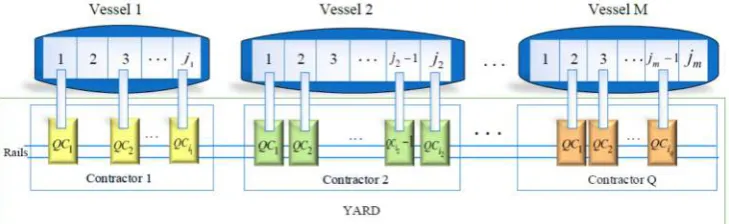
Since all cranes move on one rail, it is important to keep in mind that the cranes do not physically collide with
each other. To prevent collisions, the cranes are indexed in an ascending order from left to right. Cranes with a smaller index should not be placed in the right side of the cranes with a higher index. This can be seen in Figure 1. For example, if QC1 of the first contractor is assigned to the second bay of the first ship, QC2 of the first contractor cannot be assigned to the first bay of the first ship, as it leads to interference of the cranes.
The proposed optimization model is based on the following assumptions:
Each vessel is partitioned into several bays.
Each vessel is assigned to a maximum of one contractor for servicing.
Each ship bay is allocated to a maximum of one crane for loading/unloading.
The crane activity can be loading or unloading.
Consider multiple contractors for assigning to vessels.
Each contractor runs and operates several quay cranes
The performance rate of each contractor's cranes is varying with another contractor's cranes.
Consider soft time window to serve each ship.
Pre-emption is considered by this study.
Cranes can move freely to the left and right (Bidirectional is allowed).
Several times are considered.
The cost of moving cranes between ship bays is considered.
Creating balance in the number of remaining containers on every ship's bay is considered. We define the indexes, parameters and decision variables as follows:
Sets
M number of vessels (m=1,2,…,M) Q number of contactors (q=1,2,…,Q) T number of planning period (t=1,2,…,T) Jm number of bays of vessel m (j=1,2,…,Jm)
Iq number of quay crane of contractor q Parameters
µq the identical rate of operation for contractor q
ωjm workload in containers at bay j of vessel m to be handled
Dm due date of vessel m
Rm tardiness cost of vessel m
R´m earliness income of vessel m
C the cost of difference between the workload
remaining for every bays of vessels
C´ fixed cost of using (allocating) the QC
Cʺqm fixed cost of using (allocating) the contractor
q-th contractor to m-th vessel
λijj´qm travel cost of the i-th QC of Q-th contractor from j-th bay to j'-th bay from vessel m
Im variable cost of using QC on vessel m
M A large number
Variables
xt ijqm
A binary decision variable which is 1 if i-th QC of q-th contractor is assigned to j-th bay of vessel m at time t, and0otherwise
wt
jm the unhandled workload at time t in j-th bay of m-th vessel
w´t
jj´m the difference between the workload existing in bay j and bay j' of vessel m at time t
Zqm
A binary decision variable which is 1 if Q-th contractor is assigned to m-th vessel, and 0 otherwise
yt ijj´qm
A binary decision variable which is 1 if i-th QC of q-th contractor is moved from bay j to bay j' of vessel m at time t, and 0 otherwise
Tjmt
A binary decision variable which is 1 if bay j
of vessel m is handled at time t, and 0 otherwise
vt
jm level of inventory at time t in j-th bay of m-th vessel
αt jm
A binary decision variable which is 1 if level of inventory in j-th bay of m-th vessel at time
t is positive, and 0 otherwise
T´m completion time of vessel m
Fm tardiness of vessel m
Em earliness of vessel m
' '
min .
q
m m m
q m m
I
J J Q J Q
M T M T M
t t t
jm j m ijqm qm qm m j j t m q i j t q m
I J J Q
M T
t
ijj qm ijj qm m m m m m m m q i j j t m m m
C w w C tx C Z
y F R E R I T
(1)In this model, the objective function (1) in all vessels minimizes the sum of difference in the remaining workload on both bays of the ship, in addition, it prevents the allocation of cranes to ship bays in the subsequent
periods. It also minimizes the costs related to assigning the contractor, displacing the cranes between bays, deviating from due date and processing (loading or unloading) on each vessel, while also maximizing the profit from earliness. Since the objective function is nonlinear, it is converted to a linear relation with the aid of Equations (30), (31), (32) and (33), which will be explained in more detail.
1 1
1 1,..., , 1,..., , 1,...,
m J M t ijqm q m j
x q Q i I t T
(2)
1 1
1 1,..., , 1,..., , 1,...,
q I Q t ijqm m q i
x j J t T m M
(3)
1 1 1
1,..., , 1,...,
q
I Q T
t
q ijqm jm m
t q i
x j J m M
(4) 1 1 1 1. 1,..., , 1,...,
q
I Q
jm jm q ijqm m
i q
v x j J m M
(5)
1
1 1
. 1,..., , 1,..., , 2,...,
q
I Q t t t
jm jm q ijqm m
i q
v v x j J m M t T
(6). 1,..., , 1,..., , 1,...,
t t
jm jm m
v M j J m M t T (7)
. 1 1,..., , 1,..., , 1,...,
t t
jm jm m
v M j J m M t T (8)
. 1 1,..., , 1,..., , 1,...,
t t t
jm jm jm m
w v M j J m M t T (9)
. 1 1,..., , 1,..., , 1,...,
t t t
jm jm jm m
w v M j J m M t T (10)
. 1,..., , 1,..., , 1,...,
t t
jm jm m
wM j J m M t T (11)
1
1 1
(1 ) 1,..., , 1,..., , 1,..., , 1,..., , 1,...,
q m
I J
t t
i j qm ijqm q m
i i j
x M x q Q i I j J t T m M
(12) 1 1 1
(1 ) 1,..., , 1,..., 1
Qm
qm qm
q q m
Z M Z m M q Q
(13)
1 11
. 1,..., , 1,...,
q
mI
J T t ijqm qm j i t
x Z M q Q m M
(14) 1 1 1,..., M qm m
Z q Q
(15) 1 1 1,..., Q qm q
Z m M
(16) 1 1 11
1,..., , 1,...,
q
I Q
ijqm jm m
q i
x T j J m M
(17)
1
11 1
. 1,..., , 1,..., , 1,...,
q
I
Q T
t
ijqm jm jmt m
q i
x M T T j J m M t T
(18)
. 1,..., , 1,..., , 1,...,
m jmt m
1,...,
m m m m
E F D T m M (20)
1
1 1,..., , 1,..., , 1,..., , , 1,..., , 1,..., , 1,..., 1
t t t
ijjqm ijqm ijqm q m m
y x x i I j J j J j j q Q m M t T
(21)
0,1 1,..., , 1,..., , 1,..., , 1,..., , 1,...,
t
ijqm q m
x i I j J q Q m M t T (22)
0 1,..., , 1,..., , 1,...,
t
jm m
w j J m M t T (23)
, , 0 1,...,
m m m
E F T m M (24)
0,1 1,..., , 1,...,qm
Z q Q m M (25)
'
0,1 1,..., , 1,..., , 1,..., , 1,..., , 1,..., t
ijjqm q m m
y i I j J j J q Q m M (26)
0,1 1,..., , 1,..., , 1,...,
mjt m
T m M j J t T (27)
0,1 1,..., , 1,..., , 1,..., tjm m M j J tm T
(28)
1,..., , 1,..., , 1,...,
t
jm m
vfree m M j J t T (29)
Constraint (2) shows that each crane of each contractor is assigned at any time to a maximum of one ship bay. Constraint (3) shows that each ship bay can be serviced by at most one crane of one contractor at any given time. Constraint (4) ensures that the number of cranes assigned to each bay is sufficient to complete the operation on that bay. With the help of constraints (5) and (6), the inventory level of ships bays is calculated for all time periods. By using constraints (7) and (8), if the inventory level is positive, ( t 0)
jm
v , the constraint (8) is deactivated and t
jm
is equal to 1, and if vtjm0, the constraint (7) is deactivated and t
jm
isequal to 0. The constraints (9), (10), and (11) determine the relationships between variables,
t jm
,
v
tjm,and wtjm. If 1 t jm , the variables
v
tjm, t jmw
arethe same and if t 0
jm
, then t 0
jm
w . Constraint (12)
prevents the cranes interference in allocation to the ships bays. The indexing of ship bays and cranes is arranged in ascending order based on their position, so that, it is not allowed to place a high index crane on the left side of lower index crane. Constraint (13) prevents interference of contractors with their ship assignments. Similar to the constraint (12), the indexing of contractors and ships is arranged in ascending order according to their position. Constraint (14) indicates that if the contractor q is not assigned to the vessel m, there is no possibility of assigning cranes of contractor q to the vessel m, and if the contractor q is assigned to the vessel m, the cranes of the contractor q can be assigned to the vessel m. Constraint (15) indicates that each contractor can be assigned to at most one vessel, and constraint (16) ensures that each vessel is assigned exactly to one contractor for servicing. Constraints (17) and (18) compute the completion time
of each bay. Because the service to any vessel ends when the loading/unloading of all bays of that vessel is completed, the constraint (19) calculates the completion time of each ship. With obtaining the completion time of the vessel and calculating the time difference with the due date constraint (20) determines the tardiness or earliness of each ship. Constraint (21) determines the movements carried out by each crane of a contractor. Constraints (22) to (29) determine the range of decision variables. In order to linearize the objective function, we rewrite the objective function (1) as (30) and add constraints (31) to (33) to it.
(30)
'
'
min .
q
m m m
q m m
I
J J Q J Q
M T M T M
t t
jj m ijqm qm qm
m j j t m q i j t q m
I J J Q
M T M M M
t
ijj qm ijj qm m m m m m m
m q i j j t m m m
C w C tx C Z
y F R E R I T
(31)
1,..., , 1,..., , 1,..., , 1,..., t t t
jjm jm jm m m
w w w j J j J m M t T
(32)
1,..., , 1,..., , 1,..., , 1,...,
t t t
jjm jm jm m m
ww w j J j J m M t T
(33)
0 1,..., , 1,..., , 1,..., , 1,..., t
jjm m m
w j J j J m M t T
3. RED DEER ALGORITHM (RDA)
This is the first attempt to employ the Red Deer Algorithm (RDA) firstly introduced by Fathollahi Fard and Hajiaghaei-Keshteli [15] to solve the proposed CQCSAP. Similar to other metaheuristics, the RDA generates a random population divided into two types: “male RDs” as the best solutions and “hinds” as the rest of solutions. Generally, roaring, fighting and mating are three main behaviours of RDs during the breeding season [16]. During this competition, the better solutions as the winners chosen again as the commanders to form the harems, which are a group of hinds. First, the commanders should mate with a number of hinds in the harem and a few ones in another harem to extent his territory. The stags can mate with the nearest hind without the limitation of harems [16]. Regarding the evolutionary concepts in the RDA, a set of better solutions will be chosen as the next generation of algorithm by roulette wheel selection or tournament selection mechanisms. At the end, the stop condition of this algorithm based on the maximum number of iterations should be satisfied. More details about this algorithm is referred to literature [15, 17].
4. COMPUTATIONAL EXPERIMENTS
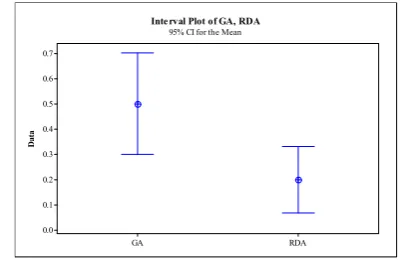
In this section, the performance of the CQCSAP model is presented, then the RDA developed is verified through 8 numerical instances in small and large sizes. The range of parameters are bechmaked from Agra and Oliveira [20]. Because of the number of λijj՛qm values is very high and it is not possible to demonstrate them in this study, the value of λijj՛qm for all vessel, bays, contractors and cranes are considered to be 1 in order to easily display the values of this parameter. Note that each test problem is solved for 20 times by the RDA. To approve the quality of RDA statistically, we have employed Genetic Algorithm (GA) as already applied succesfuly in the literature based on statistical analyses shown in Figure 2. This indicates the performance of RDA compared with GA.
RDA GA
0.7
0.6
0.5
0.4
0.3
0.2
0.1
0.0
D
a
ta
Inte rval Plot of GA, RDA
95% CI for the Mean
Figure 2. Statistical analyses based on interval plots for RDA and GA
5. CONCLUSIONS
In this research, a Coordinated Quary Crane Scheduling and Assignment Problem (QCAP) was addressed by the Red Deer Algorithm (RDA). To verify the accuracy and verification of the proposed model and the RDA performance, some instances were solved and compared with GA statistically. The results show the high-efficiency of proposed RDA.
For future works, more in-depth analyses and sensitivities can be ordered for the proposed model. Other metaheuristics can be utilized to address the proposed QCAP.
6. REFERENCES
1. Frojan, P., Correcher, J.F., Alvarez-Valdes, R., Koulouris, G. and Tamarit, J.M., "The continuous berth allocation problem in a container terminal with multiple quays", Expert Systems with Applications, Vol. 42, No. 21, (2015), 7356-7366.
2. Hajiaghaei-Keshteli, M. and Fathollahi-Fard, A.M., "A set of efficient heuristics and metaheuristics to solve a two-stage
stochastic bi-level decision-making model for the distribution network problem", Computers & Industrial Engineering, Vol. 123, (2018), 378-395.
3. Lalla-Ruiz, E., González-Velarde, J.L., Melián-Batista, B. and Moreno-Vega, J.M., "Biased random key genetic algorithm for the tactical berth allocation problem", Applied Soft Computing, Vol. 22, (2014), 60-76.
4. Fathollahi-Fard, A.M., Hajiaghaei-Keshteli, M. and Tavakkoli-Moghaddam, R., "A bi-objective green home health care routing problem", Journal of Cleaner Production, Vol. 200, (2018), 423-443.
5. Al-Dhaheri, N. and Diabat, A., "The quay crane scheduling problem", Journal of Manufacturing Systems, Vol. 36, (2015), 87-94.
6. Daganzo, C.F., "The crane scheduling problem", Transportation Research Part B: Methodological, Vol. 23, No. 3, (1989), 159-175.
7. Kim, K.H. and Park, Y.-M., "A crane scheduling method for port container terminals", European Journal of operational research, Vol. 156, No. 3, (2004), 752-768.
8. Imai, A., Chen, H.C., Nishimura, E. and Papadimitriou, S., "The simultaneous berth and quay crane allocation problem",
Transportation Research Part E: Logistics and Transportation Review, Vol. 44, No. 5, (2008), 900-920.
9. Goodchild, A.V. and Daganzo, C., "Crane double cycling in
container ports: Planning methods and evaluation",
Transportation Research Part B: Methodological, Vol. 41, No. 8, (2007), 875-891.
10. Wu, L. and Ma, W., "Quay crane scheduling with draft and trim constraints", Transportation Research Part E: Logistics and Transportation Review, Vol. 97, (2017), 38-68.
11. Agra, A. and Oliveira, M., "Mip approaches for the integrated berth allocation and quay crane assignment and scheduling problem", European Journal of Operational Research, Vol. 264, No. 1, (2018), 138-148.
12. Azevedo, A.T., de Salles Neto, L.L., Chaves, A.A. and Moretti, A.C., "Solving the 3d stowage planning problem integrated with the quay crane scheduling problem by representation by rules and genetic algorithm", Applied Soft Computing, Vol. 65, (2018), 495-516.
13. Kasm, O.A., Diabat, A. and Cheng, T., "The integrated berth allocation, quay crane assignment and scheduling problem: Mathematical formulations and a case study", Annals of Operations Research, (2019), 1-27.
14. Correcher, J.F., Alvarez-Valdes, R. and Tamarit, J.M., "New exact methods for the time-invariant berth allocation and quay crane assignment problem", European Journal of Operational Research, Vol. 275, No. 1, (2019), 80-92.
15. Fard, A.F. and Hajiaghaei-Keshteli, M., "Red deer algorithm (rda); a new optimization algorithm inspired by red deers’ mating", in International Conference on Industrial Engineering, IEEE.,(2016 e)., (2016), 33-34.
16. Fathollahi-Fard, A.M., Hajiaghaei-Keshteli, M. and Mirjalili, S., "A set of efficient heuristics for a home healthcare problem",
Neural Computing and Applications, (2019), 1-21.
17. Fu, Y., Tian, G., Fathollahi-Fard, A.M., Ahmadi, A. and Zhang, C., "Stochastic multi-objective modelling and optimization of an energy-conscious distributed permutation flow shop scheduling problem with the total tardiness constraint", Journal of Cleaner Production, Vol. 226, (2019), 515-525.
18. Hajiaghaei-Keshteli, M., Abdallah, K. and Fathollahi-Fard, A., "A collaborative stochastic closed-loop supply chain network design for tire industry", International Journal of Engineering,
19. Tian, G., Ren, Y., Feng, Y., Zhou, M., Zhang, H. and Tan, J., "Modeling and planning for dual-objective selective disassembly using and/or graph and discrete artificial bee colony", IEEE Transactions on Industrial Informatics, Vol. 15, No. 4, (2018), 2456-2468.
20. Fathollahi-Fard, A., Hajiaghaei-Keshteli, M. and Tavakkoli-Moghaddam, R., "A lagrangian relaxation-based algorithm to
solve a home health care routing problem", International Journal of Engineering, Transactions A: Basics, Vol. 31, No. 10, (2018), 1734-1740.
21. Tian, G., Zhou, M. and Li, P., "Disassembly sequence planning considering fuzzy component quality and varying operational
cost", IEEE Transactions on Automation Science and
Engineering, Vol. 15, No. 2, (2017), 748-760.
Addressing a Coordinated Quay Crane Schediling and Assignment Problem by Red
Deer Algorithm
M. Fazlia, A. M. Fathollahi-Fardb, G. Tianc,d
a Department of Industrial Engineering, Shomal University, Amol, Iran
b Department of Industrial Engineering and Management Systems, Amirkabir University of Technology, Tehran, Iran c School of Mechanical Engineering, Shandong University, Jinan, China
d Key Laboratory of High Efficiency and Clean Mechanical Manufacture (Ministry of Education), Shandong University, Jinan, China
P A P E R I N F O
Paper history:
Received 28 April 2019
Received in revised form 13 June 2019 Accepted 05 July 2019
Keywords: Container Terminals Optimization
Coordinated Quay Crane Scheduling and Assignment Problem
Nature-inspired Algorithm Red Deer Algorithm
. ! " ! ! # $ % #& !
& ' (! &
) *+ "$, -$./ # " ! 0 $ )0 1 $! ' + 2!
& 3 .4 5 67 " ! 8 2 9 #$: ; 0< =! ; <& >1 0< =! ; . ?$ @0! ; :
< ! ; A &B$ . # 6 ! C !#
# )D + E < F) $A< 8 # ' G)
# >H)4! I J! : $/ D$! F) $A< ; . K '#$+ F) $A< E 0 C,
( #$: ; F) $A< ; # G) LM ; <& ; . C 0N & ' '$+ $+
$ ) ! 7 & 8 ' 9 . 3 .4 & C !# 5 67 < J! :
. 2 9 ,$ ! : L& & 2 9 # < J! $N O ;)D + P