92
International Journal of Applied Exercise Physiology
2322-3537 www.ijaep.com Vol.8 No.1
Received: September 2018 , Accepted: December 2018 , Available online: March 2019
DOI: 10. 30472 /ijaep.v8i1.303
The influence of coordination abilities on the development of the volume of dynamic
attention in children with different types of nervous system
Polevoy Georgiy
Vyatka State University, Kirov, Russia
ABSTRACT:
Background: Indicators of the volume of dynamic attention in children 7-8 years improves under the influence of differentiated coordination
training, which is based on the strength of the nervous system.
Objective: to determine the effect of coordination abilities on the level of development of the volume of dynamic attention in children with
different types of nervous system.
Method: In the pedagogical experiment involved 60 children 7-8 years old, who study in 1 class. The children were divided into 3 equal groups of 20 people in each group. The type of nervous system was determined by the “Tapping test”. Coordination abilities of schoolchildren were
determined by the test “Shuttle run”. The volume of dynamic attention was determined by the method of “Schulte Table”. Mathematical and
statistical processing of the results was carried out by T-student.
Results: After 7 months of pedagogical research, there were changes in all groups. In KG, in which children were engaged in the usual methodic,
despite the fact that the indicators in the test “Schulte Table” improved by 1,2 s. (p>0,05), in the test “Shuttle run” indicators deteriorated from
10,3±0,6 s. to 10,4±0,6 s. (p>0,05). In EG-1, in which schoolchildren performed exercises to develop coordination abilities, the indicators
improved in both tests, but not significantly. In the test for the volume of dynamic attention indicators increased by 2,7 s. (p>0,05). In the
coordination test, the indicators improved by 0,2 s. (p>0,05). In EG-2, in which schoolchildren performed coordination exercises with the type of nervous system indicators significantly improved in the test “Shuttle run” by 0,6 s. (p<0,05) and in the test “Schulte Tables” indicators improved
from 38,1±1,7 s. to 30,6±2,1 s. (p<0,05).
Conclusion: The volume of dynamic attention will develop more effectively if the physical culture to engage in the development of coordination
abilities. A differentiated approach based on the typology of the nervous system will be particularly effective.
KEY WORDS dynamic attention, differential approach, nervous system, schoolchildren, coordination abilities
INTRODUCTION
The level of development of coordination abilities shows the ability
of a person to perform the most complex movements. Due to the high
level of coordination abilities, a person is able to solve complex and
unexpected tasks [1, 2].
All coordination abilities are important in a person's life and develop,
93
general, special and specific. Based on development of general coordination abilities other abilities develop [3-5].
It is known that the general coordination ability to develop better in
primary school age, it is 7-8 years [6-8].
Attention - the ability of a person to concentrate on an object for the
purpose of its study. The higher the level of attention development, the
more successful we are in the surrounding world [9].
On the relationship of cognitive processes and the development of physical abilities, coordination abilities say some studies [10-11].
However, we have not been able to find data that reflect the impact of
coordination ability of children on the volume of dynamic attention. The value of differentiated approach in teaching is very high. A
differentiated approach in physical education involves the most
complete development of the individual abilities of children [12-14]. Criteria for differentiation of schoolchildren into groups in the
classroom for physical education can be very diverse [15-17]. The
typology of the nervous system is one of the effective criteria for the
division of children into groups [18-20].
Thus, many specialists from different countries deal with the problem
of studying coordination abilities of children. Also, a lot of research is
devoted to the problem of the development of mental qualities of schoolchildren. However, their relationship is not sufficiently
established.
Studies that have been conducted previously have shown the relationship of coordination abilities and mental processes, so the
objective of the study is to determine the effect of coordination abilities
on the level of development of the volume of dynamic attention in
children with different types of nervous system.
Hypothesis of the study-it is assumed that if the physical education
classes in schoolchildren 7-8 years to develop coordination abilities
using a differentiated approach, it will improve the performance of coordination abilities and indicators of the volume of dynamic
attention, especially in children who are engaged in taking into account
the typological features of the nervous system.
METHODS
The study lasted 7 months, it was attended by 60 schoolchildren from
grade 1, age 7-8 years (boys and girls). Physical education classes were
2 times a week, duration-45 minutes each class (total 59 sessions). By random sampling all schoolchildren were differentiated into 3 groups of
20 people [21].
1 – KG (control group), 20 schoolchildren were engaged in physical culture on a regular program for class 1 [22].
2-EG-1 (experimental group - 1), 20 schoolchildren, engaged in the
standard program, but at the same time each lesson in physical culture
were given exercises (12-15 minutes) for the development of coordination abilities.
3-EG-2 (experimental group - 2), 20 schoolchildren were
differentiated into 2 subgroups according to the type of nervous system. They performed exercises (12-15 minutes) for the development of
coordination abilities taking into account different loads.
Schoolchildren with a weak nervous system were offered volume load,
and schoolchildren with a strong nervous system – intensive.
The intensity of the load could be increased by increasing the number
of exercises and reducing the rest time. The volume was increased by
increasing the rest time and the number of repetitions of exercises. Physical exercises for the development of coordination abilities were
very diverse (without objects – running, jumping and somersaults; with
objects – exercises with balls, jump ropes, gymnastic sticks). At the same time, at the beginning the method of standard-repeated exercise
was used, then – the variable method. After that, the game and
competitive method was used.
The difficulty of performing physical exercises increased due to changes in the spatial, temporal and dynamic parameters of movement.
And also, changes in external conditions, the order of the shells, their
weight and height. The area changed, and the height of the support or increased its mobility; combined walking with jumping or running,
catching different objects in motion [23].
Before the beginning of the pedagogical experiment, all schoolchildren passed control tests, which determined the level of
development of coordination abilities (Shuttle run), the level of
development of the volume of dynamic attention (Schulte Tables). In
EG-2 schoolchildren took a test that determines the strength of the nervous system by the process of excitation (Tapping test).
“Tapping test” [24].
On a sheet of paper (size A4) shows 6 squares, of which 3 are located on top and 3 below. By the command “Started” all schoolchildren begin
to quickly put points with a pencil in the first square, after 5 seconds, the command “Next”, schoolchildren move to another square. This continues all 6 squares, then the command “Stop”. After work, the
number of points that put schoolchildren in each square is calculated
and a graph is built, which determines the strength of the nervous
system.
“Shuttle run” [22].
2 lines at a distance of 10 meters from each other are designated as the start and finish. On command “Go” the schoolchildren runs from
the start line and touches the finish line hand, then returns to the start
line and again a touch on the arm. After that, the schoolchildren
overcomes the last section from start to finish. The result is the time in
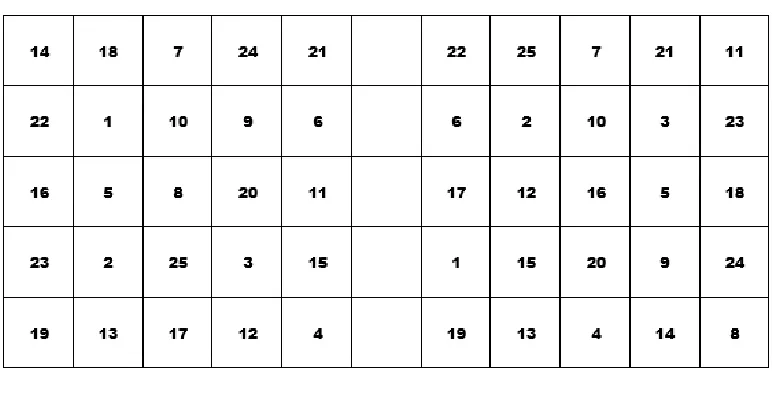
On a sheet of paper shows a table of 25 cells. In the cells, randomly depicted numbers from 1 to 25 (table 1).
At the signal “Go” schoolchildren have to cross out all the 25
numbers, from 1 to 25. After the last digit is crossed out, the stopwatch stops. The result is the time for which the schoolchildren completed the
task.
Since the samples were independent, to determine the statistical significance of the differences in the mean values was carried out using
the parametric t-student test. Correlation analysis was performed using
BIOSTAT 2009 program. The result was considered significant at P<0,05 [21, 26].
STATISTICAL RESULTS
Before the study, all children were divided into 3 groups.
Schoolchildren in EG-2 were differentiated into 2 subgroups according
to the strength of the nervous system. The level of development of
coordination abilities in the Shuttle run test was approximately the same
(p>0,05). After the pedagogical experiment the following results were
obtained (table 2).
Table 2 shows that after the pedagogical experiment there were positive changes in all groups in the test “Schulte Tables”. In the control test on
95
did not perform any additional exercises worsened their performance in the test “Shuttle run” from 10.3±0.6 s. to 10.4±0.6 s. (p>0,05). However, in the test of the “Schulte Table” indicators, though slightly,
but improved by 1,2 s. (p>0,05).
In EG-1, in which schoolchildren were engaged in the usual program,
but additionally performed exercises to develop coordination abilities, improved performance in both tests. In the “Shuttle run” test, the result
improved from 10,3±0,6 s. to 10,1±0,5 s. (p>0,05). And in the text of the “Schulte Table” indicators improved from 41,4±1,9 s. to 38,7±1,8 s.
(p>0.05).
In EG-2, in which schoolchildren were engaged in a standard program, while performing exercises for the development of coordination
abilities, taking into account the differentiation of the load on the
strength of the nervous system, the indicators in both tests improved significantly. In the “Shuttle run” test, the result improved by 0,6 s. (p<0,05), and in the “Schulte Table” test the indicators improved from
38,1±1,7 s. to 30,6±2,1 s. (p<0,05).
DISCUSSION
Coordination abilities are diverse and they play an important role in the management of human movements. The higher the level of
coordination abilities, the easier it is for a person to solve motor
problems, especially those that arise suddenly. For example, in sports activities, coordination abilities are the Foundation of the development
and formation of technical training of the athlete [1-5, 27, 37]. It is
known that before developing special coordination abilities, general
coordination of movement should be sufficiently developed. And the general coordination abilities are better developed at primary school
age [6-8, 28].
The surrounding world is filled with information. Attention performs the function of "filter" for the correct operation of memory and
thinking. To successfully perform the work necessary to keep their
attention on the current activities [9].
There are studies that are devoted to the relationship of mental processes and processes of development of the body, the processes of
development of physical qualities and abilities of a person [10-11, 29].
At the same time, it is not possible to find data among such studies that reflect the influence of coordination abilities on the volume of
dynamic attention.
The differentiated approach in training and physical culture has been used for a long time, its effectiveness is estimated quite high. This
approach allows you to fully display the individual abilities of a person
or athlete [12-14].
At the same time, the criterion of differentiation of children and athletes into groups may be different. For example, biological age,
somatotype, role in the game [30-32].
One of the criteria for differentiation of children into groups is the type of nervous system. Some studies have proved its effectiveness
[18-20, 33]. Including our studies [34-36].
The specificity of the typology is that children go to the same aim in different ways. When performing physical activity, people with a strong
nervous system are given an intensive load more easily, and for people
with a weak nervous system it will be more effective – volume load.
For the first time, a study of the influence of coordination abilities on the level of development of the volume of dynamic attention of children
7-8 years old, who have different strength of the nervous system in the
process of excitation, was conducted. The study provides specific recommendations for the development of coordination abilities and
mental processes of younger schoolchildren.
Thus, the aim of the study is achieved, and the hypothesis is completely solved by the results of the pedagogical experiment. At the
same time, if you systematically perform physical exercises for the
development of coordination abilities, taking into account the strength
of the nervous system, the effect will be higher and the indicators of the volume of dynamic attention will increase.
CONCLUSION
In conclusion, several important points should be noted. First, if we
develop coordination abilities, we improve not only coordination abilities, but also mental processes, such as the volume of dynamic
attention. Secondly, if we use the power of the nervous system as a
criterion for differentiating children into groups and use exercises to
develop coordination abilities, the effect will be significant.
The results of the study are new, relevant and promising for the study
of new influences and relationships of different physical and mental
indicators of schoolchildren. Such results can be useful for teachers, trainers and physical education teachers.
RECOMMENDATIONS
It is recommended to use a differentiated approach in the classroom
in the school of physical education. To differentiate children into
groups, we use a typological criterion. The load for children with strong and weak nervous system should be different. If we take into account
these simple requirements, the indicators of coordination abilities and
REFERENCES