Please cite this article as: H. Javdanian, Behavioral Interference of Vibrating Machines Foundations Constructed on Sandy Soils, International Journal of Engineering (IJE),IJE TRANSACTIONS A: Basics Vol. 31, No. 4, (April 2018) 548-553
International Journal of Engineering
J o u r n a l H o m e p a g e : w w w . i j e . i rBehavioral Interference of Vibrating Machines Foundations Constructed on Sandy
Soils
H. Javdanian*
Department of Civil Engineering, Shahrekord University, Shahrekord, Iran
P A P E R I N F O
Paper history:
Received 30 Novomber 2017
Received in revised form 09 December 2017 Accepted 04 Januray 2018
Keywords:
Dynamic Bearing Capacity Machine Foundation Sandy Soil Interference Effect FLAC
A B S T R A C T
In this study, dynamic bearing capacity of adjacent shallow strip foundations located on sandy soil was examined using a numerical finite difference modeling, FLAC. The behavioral interference of shallow strip foundations under different conditions was investigated. The effect of soil strength parameters, geometric characteristics of shallow foundations and cyclic loads at different distance ratios on the bearing capacity of foundations were evaluated. The results indicated the noticeable effect of behavioral interference on the performance of shallow foundations under cyclic loading. As the distance ratio between the foundations increases, the interference effect increased and then decreased. The greatest influence of behavioral interference on the dynamic bearing capacity of foundations was obtained at distance ratio of 2. The interference effect canceled out at the distance ratio of larger than 5. Furthermore, the effect of behavioral interference on the bearing capacity of shallow foundations increased with increasing internal friction angle, soil elasticity modulus, and foundation depth. An increase in the foundation width and loading frequency led to lower interference coefficient. In general, the results demonstrate the necessity of considering the interference effect in the assessment of the bearing capacity of shallow foundations under cyclic loading such as vibrating machines foundation.
doi: 10.5829/ije.2018.31.04a.05
1. INTRODUCTION1
Accurate assessment of the behavior of foundations has a substantial role in the appropriate performance of structures and the mounted equipment [1-4]. In the meantime, the machine foundations require in-depth and precise examination. In addition to the static loads arising from the weight of foundations and machines, the soil is affected by the dynamic loads caused by vibrating machines [5-8]. Researchers have studied the behavior of foundations under dynamic loads [9, 10].
Gazetas [11] proposed a chart-based method to assess the behavior of foundations under vibrations. Anteneh [12] examined the effect of soil properties on the behavior of foundations under dynamic loading. Prakash and Puri [13] investigated the response of machines foundation to dynamic loading using spring-mass system. Chandrakaran et al. [14] proposed a
*Corresponding Author Email: [email protected] (H. Javdanian)
simple approach to design of machines foundation under vertical vibration. The results of analytical and laboratory studies indicated the effect of soil layering on the performance of vibrating foundations [15].
Since most foundations are adjacent with each other, their behavioral interference can significantly affect the bearing capacity of foundations. In this case, adjacent foundations demonstrate a behavior different from individual foundations [16]. Therefore, some researchers focused on the behavior of adjacent foundations [17, 18]. Adopting the limit equilibrium method, Stuart [19] investigated the effect of interference on the bearing capacity of adjacent foundations under static loads. Das and Larbi-Cherif [20] experimentally investigated the effect of behavioral interference coefficient on the bearing capacity of shallow foundations. The interference coefficient (IC) was defined as follows:
int
sin
u erfering
u gle
q IC
q
(1)
where qu-interfering is the ultimate bearing capacity of interfering (adjacent) foundations and qu-singleis the ultimate bearing capacity of the single foundation.
The interference effect on the bearing capacity of adjacent strip foundations was examined through stress characteristics method [21] and upper boundary limit analysis [22]. The results showed that the ultimate bearing capacity reaches its maximum at distance ratio about 2. The results of laboratory studies on the behavior of interfering strip foundations located on sandy soil suggested that interference effect intensified as the soil density increased [23]. Javdanian and co-workers [24, 25] investigated the behavior of interfering shallow strip foundations on reinforced sandy soils through laboratory studies and numerical modeling. Their results indicated that the interference effect should be included in the behavioral analysis of foundations.
Review of the previous research reveals that the behavioral interference of foundations under vibrating loads has less frequently been examined. In the current study, the behavioral interference of vibrating machines foundations was investigated using numerical modeling. The adjacent strip foundations under cyclic loading and rested on sandy soil were modeled under different conditions. The effects of strength parameters of sandy soil [26] (i.e. elasticity modulus and internal friction angle), frequency and amplitude of cyclic load, and the geometric characteristics of shallow strip foundations on the bearing capacity of foundations were examined at various distance ratios.
2. NUMERICAL MODELING
A finite difference program, FLAC, was employed to evaluate the bearing capacity of shallow strip foundations rested on sandy soil under cyclic loads [27]. The FLAC program is widely used in deformation analysis and stabilities in geotechnical engineering problems [28, 29]. The Mohr–Coulomb's criterion was utilized for behavioral modeling of sandy soil. The geometry of the model has been displayed in Figure 1. In this figure, B is the strip foundation width and S is the center-to-center distance between shallow foundations.
Figure 1. Geometrical properties of model of adjacent shallow strip foundations
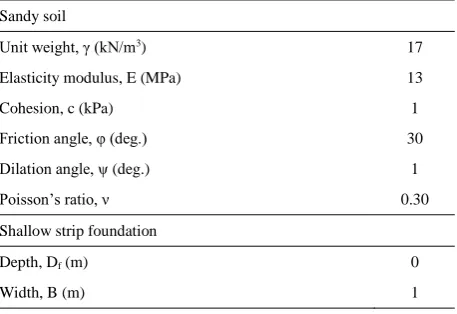
The deformations were fixed in the horizontal direction for side boundaries and both directions for the lower boundary of the model. Absorbed boundaries were used to prevent wave reflection. Table 1 presents the characteristics of sandy soil and shallow strip foundations in the numerical modeling. The effect of each parameter on the behavioral interference of shallow strip foundations was evaluated while the values of other parameters were fixed and equal to those provided in Table 1.
In the numerical modeling, the loading on foundations involved two static and harmonic loads. The static load, including the weight of foundation and machines, was considered to be 8 kN/m2 [30]. The
harmonic loading from the operation of machines mounted on the foundation includes two important components namely load amplitude and loading frequency defined as Equations (2) and (3), respectively:
0exp( )
QQ i t (2)
2 f
(3)
where, Q0 is loading amplitude, ω is angular frequency, and f is ordinary frequency.
The Rayleigh damping coefficients (i.e., β and α) utilized in the dynamic analysis of the present study were calculated according to Equation (4):
CKM (4)
where, C, M, and K, are damping, mass matrices, and stiffness, respectively [27].
In the FLAC program, the values of β and α computes based on the Equations (5) and (6):
min
min
(5)
min min
(6)
TABLE 1. Properties of sandy soil and shallow foundations used in numerical modeling
Sandy soil
Unit weight, γ (kN/m3) 17
Elasticity modulus, E (MPa) 13
Cohesion, c (kPa) 1
Friction angle, φ (deg.) 30
Dilation angle, ψ (deg.) 1
Poisson’s ratio, ν 0.30
Shallow strip foundation
Depth, Df (m) 0
Width, B (m) 1
B B
S
Cyclic load Cyclic load
where, ξmin is minimum damping ratio that is selected equal to 0.05 [27].
Bearing capacity of shallow foundations under cyclic loading was obtained according to ACI recommendation [31]. Based on this method, the bearing capacity of machine foundations under vibrating is determined on the basis of loading frequency and recorded settlement.
3. RESULTS AND DISCUSIONS
Figure 2 illustrates the variations of interference coefficient (IC) of foundations versus the distance ratios (S/B) of foundations. The soil properties and the position of foundations are equal to values given in Table 1.
As shown in Figure 2, an increase in S/B led to increase and then decrease of interference coefficient,
IC. The value of interference coefficient at distance ratio of about S/B=2 is maximum (Figure 2). As the distance ratio of foundations widens over 2, the value of IC
decreases and the interference effect canceled out at distance ratio of S/B>5 (Figure 2). In fact, the foundations behave independently at distance ratios larger than 5.
3.1. The Effect of Soil Strength Properties
3.1.1. Elasticity Modulus The behavioral
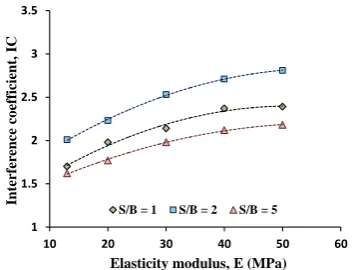
interference coefficient of shallow strip foundations under cyclic loading was determined for different values of elasticity modulus (E=13, 20, 30, 40 and 50 MPa) of sandy soil at distance ratios (S/B) of 1, 2 and 5 (Figure 3). As shown in Figure 3, the interference coefficient (IC) increased with increasing soil elasticity modulus (E).
3.1.2. Friction Angle The effect of soil friction
angle (φ) on the bearing capacity of adjacent shallow foundations under cyclic loading was presented in Figure 4. The internal friction angle of sandy soil was changed from 30 to 45 degrees to examine its effect on the interference coefficient (IC).
Figure 2. Variation of interference coefficient against distance ratio of foundations
Figure 3. Variation of interference coefficient against soil elasticity modulus
Figure 4 indicates the variation of interference coefficient versus distance ratios of foundations for friction angles of 30, 37 and 45 degrees. As seen in this figure, an increase in the soil friction angle led to higher interference coefficient. This finding is in good agreement with experimental studies of Kumar and Bhoi [23]. In fact, Kumar and Bhoi [23] investigated the influence of soil density on the bearing capacity of interfering foundations rested on sandy soil under static loads. They concluded that an increase in soil density and subsequently the soil internal friction angle led to higher behavioral interference.
3.2. The Effect of Loading Characteristics
3.2.1. Loading Frequency Loading frequency
is one of the most important factors that affect the performance of a vibrational system. Therefore, it is essential to examine the effect of harmonic load frequency on the bearing capacity of adjacent shallow foundations.
Figure 5 demonstrates the effect of loading frequency (f=10, 50 and 250 Hz) on the interference coefficient at distance ratios of 1, 2 and 5. Interference coefficient decreases with increasing loading frequency. The decreasing rate of interference coefficient tends to be higher at smaller frequencies (Figure 5).
Figure 4. Variation of interference coefficient against soil friction angle
0 0.5 1 1.5 2 2.5 3
1 2 3 4 5 6 7
Interfer
ence
coefficie
nt,
IC
Distance ratio, S/B
1 1.5 2 2.5 3 3.5
10 20 30 40 50 60
Interfer
ence
coefficie
nt,
IC
Elasticity modulus, E (MPa)
S/B = 1 S/B = 2 S/B = 5
0.5 1 1.5 2 2.5 3 3.5 4
1 2 3 4 5 6 7
Interfer
ence
coefficie
nt,
IC
Distance ratio, S/B
φ = 45 deg.
φ = 37 deg.
Figure 5. The effect of loading frequency on the interference coefficient
As depicted in Figure 5, at frequencies larger than 50 Hz, the variations rate of IC significantly decreases.
3.2.2. Loading Amplitude In this section, the
effect of loading amplitude on the behavioral interference of strip foundations was modeled under cyclic loads. The behavior of foundations at amplitudes of 50, 100 and 150 kN was investigated at distance ratios of 1, 2 and 5. As shown in Figure 6, the interference coefficient increased as loading amplitude increases. For different loading amplitudes, the highest interference coefficient was obtained at a distance ratio of about S/B=2 (Figure 6).
3.3. The Effect of Geometrical Characteristics of Foundations
3.3.1. Foundation Width The bearing capacity of strip foundations with the widths of 0.5, 1, 1.5 and 2 m and at distance ratios of 1, 2 and 5 was investigated through numerical modeling. Figure 7 illustrates the effect of variations in foundation width (B) on the interference coefficient (IC). An increase in strip foundation width led to lower interference coefficient (Figure 7).
3.3.2. Foundation Depth In this section, the
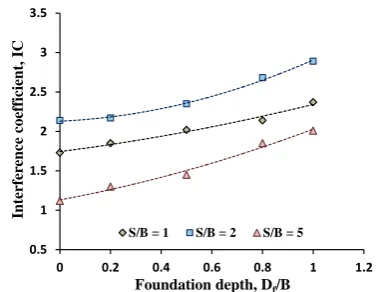
effect of embedded depth on the bearing capacity of adjacent strip foundations was examined. For this purpose, the interference coefficients were evaluated for different embedded depth ratios (Df/B). The numerical modeling involved Df/B ratios of 0, 0.2, 0.5, 0.8 and 1. Figure 8 illustrates the effect of embedded depth on the interference coefficient at the various distance ratios. The results indicated that an increase in foundation depth led to greater behavioral interference coefficient (Figure 8).
Figure 6. The effect of loading amplitude on the interference coefficient
Figure 7. Variation of interference coefficient against foundation width
Figure 8. The effect of foundation depth on the interference coefficient
4. CONCLUSIONS
In this study, the dynamic bearing capacity of interfering shallow foundations was explored. The strip foundations of vibrating machines were numerically modeled using finite difference program of FLAC. The Mohr-Coulomb criterion was adopted to control the
0 0.5 1 1.5 2 2.5 3
0 30 60 90 120 150 180
Interfer
ence
co
effi
ci
ent,
IC
Loading frequency, f (Hz)
S/B = 1 S/B = 2 S/B = 5
0 0.5 1 1.5 2 2.5 3 3.5
20 50 80 110 140 170
Interfer
ence
coefficie
nt,
IC
Loading amplitude (kN)
S/B = 1 S/B = 2 S/B = 5
1 1.5 2 2.5
0 0.5 1 1.5 2 2.5
Interfer
ence
coefficient
,
IC
Foundation width, B (m)
S/B = 1 S/B = 2 S/B = 5
0.5 1 1.5 2 2.5 3 3.5
0 0.2 0.4 0.6 0.8 1 1.2
Interfer
ence
coefficie
nt,
IC
Foundation depth, Df/B
failure stage of sandy soil beneath the foundations. The effect of soil strength properties, geometric characteristics of foundations, loading frequency and loading amplitude on the behavioral interference of foundations were investigated. Based on the numerical analyses conducted in this study, the following results were obtained:
The variation in distance ratio between foundations changes their bearing capacities. This is due to the impact of failure wedges on each other.
The highest interference coefficient was observed at distance ratio about S/B=2. At distance ratios above 5 (i.e., S/B>5), the amount of interference coefficient reached IC=1, where foundations behave independently.
As the soil elasticity modulus (E) increased, the interference coefficient increased. Moreover, increasing rate of IC decreases with increasing E.
An increase in internal friction angle of sandy soil beneath foundations led to greater dynamic bearing capacity of interfering foundations.
An increase in loading frequency was accompanied by a reduction in behavioral interference coefficient in adjacent strip foundations.
The interference coefficient increased with increasing loading amplitude.
As the foundation width increased, the interference coefficient decreased even though it was insignificant.
An increase in foundation depth led to higher interference coefficient. This indicated an acceptable confidence factor for the interference coefficient values calculated at zero embedded depth.
5. ACKNOWLEDGEMENT
This work was financially supported under grant number 96GRD1M39422 by the research deputy of Shahrekord University.
6. REFERENCES
1. Bandyopadhyay, B. and Meek, J.L., "Harmonic response of pile groups to dynamic loading", International Journal of
Engineering, Vol. 1, No. 1, (1988), 29-36.
2. Makarchian, M., "An experimental study of foundation underpinning by piles", International Journal of Engineering
Transaction B: Applications, Vol. 15, No. 1, (2002), 11-22.
3. Gupta, R. and Trivedi, A., "Behavior of model circular footings on silty soils with cellular supports", International Journal of
Engineering Transaction B: Applications, Vol. 23, No. 1,
(2010), 21-35.
4. Gheyratmand, C., "Employing foundation nonlinearity to mitigate seismic demand in superstructure", International
Journal of Engineering Transaction B: Applications, Vol. 29,
No. 5, (2016), 606-614
5. Hassaan, G.A., "Optimal Design of Machinery Shallow Foundations With Clay Soils", International Journal of
Mechanical Engineering & Technology, Vol. 5, No. 3, (2014),
91-103.
6. Ha, I.S. and Han, J.T., "Evaluation of the allowable axial bearing capacity of a single pile subjected to machine vibration by numerical analysis", International Journal of
Geo-Engineering, Vol. 7, No. 1, (2016), 22.
7. Bounds, W.L. and Wong, S.S. "Comparison of Foundation Design Specifications for Vibratory Machines", Practice
Periodical on Structural Design and Construction, Vol. 21,
No. 3, (2016), 04016009.
8. Chen, S.S., Liao, K.H. and Shi, J.Y. "A dimensionless parametric study for forced vibrations of foundation–soil systems", Computers and Geotechnics, Vol. 76, (2016), 184-193.
9. Chowdhury, I. and Dasgupta, S.P. "Dynamic Bearing Capacity of Shallow Foundation Under Earthquake Force”, Indian
Geotechnical Journal, Vol. 47, No. 1, (2017), 35-46.
10. Conti, R., "Simplified formulas for the seismic bearing capacity of shallow strip foundations", Soil Dynamics and Earthquake
Engineering, Vol. 104, (2018), 64-74.
11. Gazetas, G., "Analysis of machine foundation vibrations: state of the art", International Journal of Soil Dynamics and
Earthquake Engineering, Vol. 2, No. 1, (1983), 2-42.
12. Anteneh, M., "Vibration analysis and design of block-type machine foundation interacting with soil", Ph.D. Thesis, School of Graduate Studies, Addis Ababa University, (2003).
13. Prakash, S. and Puri, V.K., "Foundations for vibrating machines", Journal of structural Engineering, Vol. 33, No. 1, (2006), 13-29.
14. Chandrakaran, S., Vijayan, P. and Ganesan, N., "A simplified procedure for design of machine foundations subjected to vertical vibrations", Journal of the Institution of Engineers. India. Civil Engineering Division, Vol. 88, No. 5, (2007), 3-12. 15. Pradhan, P.K., Mandal, A., Baidya, D.K. and Ghosh, D.P.,
"Dynamic response of machine foundation on layered soil: cone model versus experiments", Geotechnical and geological
engineering, Vol. 26, No. 4, (2008), 453-468.
16. Marandi, S.M., Javdanian, H., "Laboratory studies on bearing capacity of strip interfering shallow foundations supported by geogrid-reinforced sand", Advanced Materials Research, Vol. 472, (2012), 1856-1869.
17. Lee, J. and Eun, J., "Estimation of bearing capacity for multiple footings in sand", Computers and geotechnics, Vol. 36, No. 6, (2009), 1000-1008.
18. Javdanian, H., Haddad, A. and Mehrzad, B., "Interference effect on bearing capacity of multiple shallow foundations supported by geosynthetic-reinforced sand", 5th Asian Regional Conference on Geosynthetics, 13 December, Bangkok, Thailand, (2012).
19. Stuart, J.G., "Interference between foundations, with special reference to surface footings in sand", Geotechnique, Vol. 12, No. 1, (1962), 5-22.
20. Das, B.M. and Larbi-Cherif, S., "Bearing capacity of two closely-spaced shallow foundations on sand", Soils and
Foundations, Vol. 23, No. 1, (1983), 1-7.
21. Kumar, J. and Ghosh, P., "Ultimate bearing capacity of two interfering rough strip footings", International Journal of
Geomechanics, Vol. 7, No. 1, (2007), 53-62.
Geotechnical and Geological Engineering, Vol. 25, No. 5, (2007), doi: https://doi.org/10.1007/s10706-007-9124-9
23. Kumar, J. and Bhoi, M.K., "Interference of two closely spaced strip footings on sand using model tests", Journal of
Geotechnical and Geoenvironmental Engineering, Vol. 135,
No. 4, (2009), 595-604.
24. Javdanian, H., Haddad, A. and Mehrzad, B., "Experimental and numerical investigation of the bearing capacity of adjacent footings on reinforced soil", Electronic Journal of
Geotechnical Engineering, Vol. 17, No. R, (2012), 2597-2617.
25. Javdanian, H., Hamedi, A. and Ayoubi, H., "Interference effect on bearing capacity of shallow foundations constructed on geosynthetic-reinforced soil", 9th International Congress on Civil Engineering, 8 May, Isfahan, Iran, (2012).
26. Javdanian, H., "The effect of geopolymerization on the unconfined compressive strength of stabilized fine-grained soils", International Journal of Engineering Transaction B:
Applications, Vol. 30, No. 11, (2017), 1673-1680.
27. Itasca, FLAC: fast lagrangian analysis of continua. Version 7.0 [computer program]. Minneapolis, Minn: Itasca Consulting Group Inc. (2011).
28. Marandi, S.M. and Rasti, A.R. "Parametric study of the covering soil of tunnels constructed in liquefiable soil", International
Journal of Engineering Transaction A: Basics, Vol. 25, No. 4,
(2012), 333-346.
29. Hassani, R. and Basirat, R., "The investigation of subsidence effect on buried pipes in 3D space", International Journal of
Engineering Transaction B: Applications, Vol. 30, No. 8,
(2017), 1182-1189
30. Baidya, D. K. and Mandal, A., “Dynamic response of footing resting on a layered soil system", West Indian journal of
engineering, Vol. 28, No. 2, (2006), 65-79.
31. American Concrete Institute (ACI), "Foundations for dynamic equipment", ACI 351.3R-94, Farmington Hills, MI, (2004).
Behavioral Interference of Vibrating Machines Foundations Constructed
on Sandy Soils
RESEARCH NOTE
H. Javdanian
Department of Civil Engineering, Shahrekord University, Shahrekord, Iran
P A P E R I N F O
Paper history:
Received 30 Novomber 2017
Received in revised form 09 December 2017 Accepted 04 Januray 2018
Keywords:
Dynamic Bearing Capacity Machine Foundation Sandy Soil Interference Effect FLAC
هديكچ
همانرب اب دودحم لضافت یددع یزاسلدم زا هدافتسا اب هعلاطم نیا رد ی
FLAC ید یربراب تیفرظ یسررب هب یپ یکیمان
یحطس یاه
هسام کاخ رب رقتسم مه رواجم یراون یپ نیا یراتفر لخادت رثا .دش هتخادرپ یا
ررب فلتخم طیارش تحت اه ا .دش یس
رث
یپ یسدنه تاصخشم ،کاخ یتمواقم یاهرتماراپ رظ رب فلتخم لصاوف تبسن رد یلکیس راب تاصخشم و ،یحطس یاه
تیف
یپ یربراب یپ درکلمع رب یراتفر لخادت رثا رگنایب لصاح جیاتن .دش یبایزرا اه س یاهراب تحت یحطس یاه
یم یلکی ب اب .دشا
هلصاف تبسن شیازفا یپ نیب ی
شیازفا لخادت رثا ،اه یم شهاک سپس و
پ یراتفر لخادت رثا نیرتشیب .دبای ی
ن رد اه هلصاف تبس ی
2 زا رتگرزب لصاوف تبسن رد .تسا هدش هدهاشم یپ ضرع ربارب 5
.دوریم نیب زا لخادت رثا ،یپ ضرع ربارب ا اب نینچمه
شیازف
هسام کاخ هتیسیتسلاا لودم ،یلخاد کاکطصا هیواز پ نوفدم قمع نینچمه و ،یپ ریز یا
فرظ رب لخادت رثا ی براب تی
یپ یر اه
روطب .تسا هتشاد لابند هب ار لخادت بیرض شهاک یراذگراب سناکرف و یپ ضرع شیازفا .تسا هتفای شیازفا ک
اتن یل لصاح جی
دشاب یم شعترم تلاآ نیشام یپ یربراب تیفرظ یبایزرا رد لخادت رثا ظاحل موزل رگنایب .
doi: 10.5829/ije.2018.31.04a.05