JOURNAL OF MATHEMATICAL NANOSCIENCE
JMNS
Vol. 4, No. 1, 2014, 19-2519
Jou
rnal
of
M
athematic
al Nano
Scie
nc
e
Differences between Wiener and modified Wiener
indices
MARDJAN HAKIMI-NEZHAAD AND MODJTABA GHORBANI
Department of Mathematics, Faculty of Science, Shahid Rajaee Teacher Training University, Tehran, 16785 – 136, I R. Iran
ABSTRACT. The Wiener index is the oldest topological index introduced by H. Wiener for anticipating the boiling point of Paraffin and some other alkenes. An algebraic approach for generalizing the Wiener index is proposed by Graovac and Pisanski for the first time. In this paper, we compute the difference between these topological indices for a class of fullerene graphs.
Keywords: Wiener index, molecular graph, automorphism of graph.
1. INTRODUCTION
A graph is a collection of points and lines connecting them. We call these points and lines by vertices and edges and we denote them by V(Γ) and E(Γ), respectively. Two vertices x and y are adjacent if xyE(Γ).
The distance between any pair of vertices x,yV(Γ) is defined as the length of the shortest path between them denoted by d(x,y). A connected graph is one whose all pairs of vertices are connected by a path. A simple graph is a graph without loop and parallel edges. A molecular graph or a chemical graph is a labeled simple graph whose
20
Jou
rnal
of
M
athematic
al Nano
Scie
nc
e
molecular graph, it is convenient to omit hydrogen atoms.
Let Ω be the class of all connected graphs, a topological index for a graph Γ is a function f : Ω →r+
which is invariant under its automorphisms. The Wiener index is the first reported distance based topological index and is defined as half sum of the distances between all the pairs of vertices in a molecular graph, see [14,18]. We can consider the Wiener index as a function W: Ω → Z+ which is not onto. For example there is no graph such as G with W(G) = 2. Milan Randić in 1993 de ined the hyperWiener index of acyclic graphs and then Klein et al. [15] generalized Randić’s definition for all connected graphs, as a generalization of the Wiener index. It is defined as
2 { , }
(Γ) 1/ 2 (Γ) 1/ 2 x y ( , ) .
WW W
d x yWe refer to [11-13] for mathematical properties and chemical meaning of this topological index.
2. RESULTS AND DISCUSSIONS
An automorphism of the graph is a bijection on which preserves the edge set Ei.e., if e=uv is an edge, then eσ u vσ σis an edge of E. Here the image of vertex u is denoted by uσ. We denote the set of all automorphisms of by Aut() and this set under the composition of mappings forms a group. We say Aut() acts transitively on V, if for any pair of vertices u v V, , there is an automorphism α Aut (Γ) such that
α
u v.
Graovac and Pisanski [10] proposed an algebraic approach for generalizing the Wiener index by automorphism group of the graph under consideration. Assume that
is a graph with automorphism group G = Aut(), then the modified Wiener index of
is defined as:
x y
WW W d x y 2
{ , }
(Γ) 1/ 2 (Γ) 1/ 2
( , ) .They introduced this generalization of the classical Wiener index to consider into account the symmetry structure of the graph . Koorehpazan-Moftakhar et al. in [16] defined the modified hyperWiener index of as follows:
u V α G
V
WW W d u α u
G
2 (Γ),
1 | (Γ)|
(Γ) (Γ) ( , ( )) .
2 4| |
Theorem 1 [10]. Let is a graph with automorphism group G = Aut() and vertex set
V(). Let V1, V2, …, Vk be all orbits of action G on V(). Then
k
i i i
V
V
W
V
W
1
. | |
) ( |
21
Jou
rnal
of
M
athematic
al Nano
Scie
nc
e
Corollary 2. Let is a vertex-transitive graph, then W(Γ)Wˆ(Γ).
Throughout this paper we use standard notations of graph theory. It is easy to see that the Wiener index is equal with modified Wiener index if and only if is vertex-transitive and the modified Wiener index is zero if and only if Aut() is trivial. For given graph the difference between Wiener and modified Wiener indices can be defined as follows:
δ(Γ) W(Γ) W(Γ).
Similarly, the difference between hyperWiener and modified hyperWiener indices can be defined as follows:
δδ(Γ) WW(Γ) WW(Γ).
Example 1. It is easy to see that the symmetry group of complete graph Kn is
isomorphic to the symmetric group Sn and so Kn is vertex-transitive. Thus Corollary 2
implies that δ(Γ) 0.
Example 2. Let ST(n) is a star on n vertices, then the vertices of ST(n) can be divided into sets: the vertex of degree n1 compose an orbit and the other vertices compose the second orbit. On the other hand, Aut ST n( ( ))Sn-1 and hence,
n
u V v V n
α Aut S v V n
W ST n d u v n
V S
W ST n d v α v
Aut S n
n n n n n
n
2
^
( ) 1
( ) ( , ) 1 ,
2
| ( )|
( ( )) ( , ( ))
2| ( )|
( 1) 2 ( 2)( 2)! ( 2). 2( 1)!
(
)
This leads us to conclude that δ ST n n 2 n n
( ( )) ( 1) ( 1) 1.
A fullerene is a molecule composed of carbon atoms in the form of many shapes such as hollow sphere, ellipsoid, tube, etc. The most important fullerenes are spherical fullerenes or buckyballs. Carbon nanotubes or buckytubes are cylindrical fullerenes, [6,17]. Fullerenes are similar in structure to graphite, but they may also contain triangle, square, pentagonal, hexagonal or sometimes heptagonal rings, [7]. The molecular graph of a given fullerene molecule is called a fullerene graph.
Theorem 3 (Euler’s Formula). Let Γ be a planar graph and n, m, f are the number of vertices, edges and faces, respectively. Then
n m + f = 2.
22
Jou
rnal
of
M
athematic
al Nano
Scie
nc
e
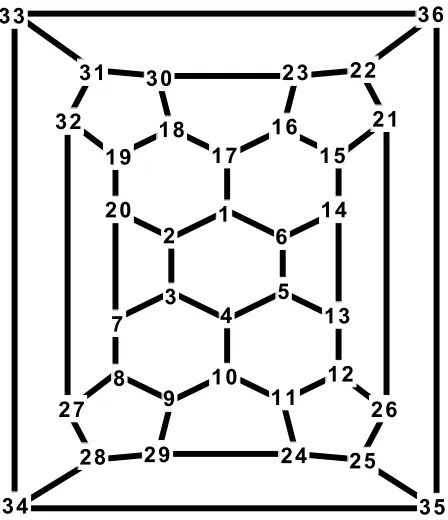
generalization of fullerenes, see Refs [2-5]. In the mentioned papers several deep results by Deza and his co-authors about these molecular graphs were introduced. Following their method Ghorbani in [7] introduced a new class of fullerene with pentagons and heptagons. In this paper, we also introduce an infinite class of fullerene with squares, pentagons and hexagons, see Figure 1. This class of fullerenes has exactly 16n + 4 vertices where n is an integer greater than or equal with 2. That’s why we name this new family of fullerene graphs by C16n+4. Let s, p, h, n and m be the
number of squares, pentagons, hexagons, carbon atoms and bonds between them, in a given (4,5,6) fullerene F. Since each atom lies in exactly 3 faces and each edge lies in 2 faces, the number of atoms is n = (4s + 5p + 6h)/3, the number of edges is m = (4s + 5p
+ 6h)/2 = 3/2n and the number of faces is f = s+ p + h. By the Euler’s formula n − m + f
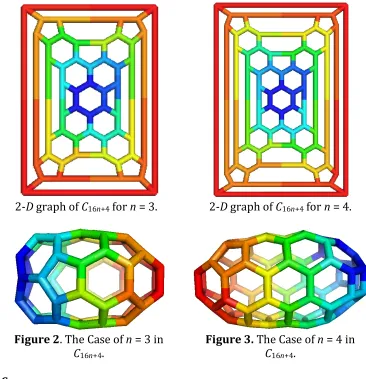
= 2, one can deduce that s + p + h = 2 + n/2. This leads up to conclude that s=3 and p= 6 and h = 8n-5, for n ≥ 2. Two members of this class of fullerenes are depicted in Figures 2, 3.
Theorem 4. Aut(C16n+4)≅ Z2× Z2 .
Proof. We calculate the order of the group G = Aut(C16n+4) of symmetries of the
fullerene C16n+4, for n=2 depicted in Figure 1 and the automorphism group of C16n+4 in
general can be computed similarly. Suppose α is a reflection as follows:
α=(1,4) (2,3) (5,6) (7,20) (8,19)(9,18)(10,17)(11,16)(12,15)(13,14)(21,26) (22,25) (23,24)(27,32)(28,31)(29,30)(33,34)(35,36).
Thus the orbit of the subgroup <α> is 1<α> ={1,4}. Now, consider the axis symmetry element which ixes vertices {1,4,10,17}, it is as follows:
β=(2,6)(3,5)(7,13)(8,12)(9,11)(14,20)(15,19)(16,18)(21,32)(22,31)(23,30)(24,29) (25,28)(26,27)(33,36)(34,35).
Clearly, G α β, . Now the orbit-stabilizer property shows that
G
G G1
| | |1 | | |.Next consider the action of subgroup G1. Any symmetry of the fullerene C16n+4 which ixes vertex 1 must also ix the opposite vertex 4. Then applying
again orbit-stabilizer property states that |G1||4G1 ||G14|. It is easy to prove that
|G14| = 1, |4G1 |2 and hence |G| = 4. On the other hand, |α β, | 4 where
. ,
1 2
2
This leads us to conclude that Aut(C16n+4)≅ Z2×Z2 .
Corollary 5. For the fullerene graph C16n+4 for n ≥ 3, we have
n n
δ C n n n
δδ C n n n n
3 2
16 4
4 3 2
16 4
256 1808
( ) 192 390,
3 3
128 4046
( ) 256 3504 2375.
3 3
Proof. At first by a direct computation, we have W C( 36) 2330 andWW C( 36) 6221 .
23
Jou
rnal
of
M
athematic
al Nano
Scie
nc
e
n n
W C n n n
WW C n n n n
3 2
16 4
4 3 2
16 4
256 1184
( ) 320 474,
3 3
128 1792
( ) 256 1824 2917. (1)
3 3
On the other hand, by using Theorem 4, W Cˆ ( 36) 1620 ,WW C( 36) 4464
and for n≥3
we have:
n n
W C n n
WW C n n
2 16 4
2 16 4
ˆ ( ) 512 208 84,
( ) 1952 1680 542. (2)
The proof can be resulted from Eq. (1) and Eq. (2).
1 2
3 4
5 6
7
8 9
1 0 1 1
1 2 1 3 1 4 1 5 1 6 1 7 1 8 1 9
2 0
2 1 2 2 2 3
2 4 2 5
2 6 2 7
2 8 2 9
3 0 3 1
3 2 3 3
3 4 3 5
3 6
24
Jou
rnal
of
M
athematic
al Nano
Scie
nc
e
2-D graph of C16n+4 for n = 3. 2-D graph of C16n+4 for n = 4.
Figure 2. The Case of n = 3 in
C16n+4.
Figure 3.The Case of n = 4 in
C16n+4.
3. CONCLUSION
In this paper, we studied some properties of the modified Wiener and modified hyper-Wiener indices. We also introduced a new family of fullerene graphs and then we computed these new topological indices for them. Finally, we proposed two new topological indices regarding to the modified Wiener indices groups and we studied some properties of them.
REFERENCES
[1] A. Behmaram, Matching in fullerene and molecular graphs, Ph. D thesis, University of Tehran, 2013.
[2] M. Deza, M. Dutour Sikirić and P. W. Fowler, Zigzags, railroads, and knots in fullerenes, J. Chem. Inf. Comp. Sci. 44 (2004) 1282-1293.
25
Jou
rnal
of
M
athematic
al Nano
Scie
nc
e
[4] M. Dutour Sikirić and M. Deza, Space fullerenes: computer search for new Frank-Kasper structures II, Structural Chemistry, 23 (2012) 1103-1114.
[5] M. Dutour Sikirić, O. Delgado-Friedrichs, and M. Deza, Space fullerenes: computer search for new Frank-Kasper structures, Acta Crystallogr. A, 66 (2010) 602-615.
[6] P. W. Fowler and D. E. Manolopoulos, An Atlas of Fullerenes, Oxford Univ. Press, Oxford, 1995.
[7] M. Ghorbani, Fullerene graphs with pentagons and heptagons, J. Math. Nanosci. 3 (2013) 33-37.
[8] M. Ghorbani and T. Ghorbani, Computing the Wiener index of an infinite class of fullerenes, Studia Ubb Chemia LVIII (2013) 43.
[9] M. Ghorbani and M. Songhori, Computing Wiener index of C12n Fullerenes, Ars.
Combin. (accepted).
[10] A. Graovac and T. Pisanski, On the Wiener index of a graph, J. Math. Chem. 8 (1991) 53.
[11] J. E. Graver, Catalog of all fullerenes with ten or more symmetries, Graphs and discovery, 167188, DIMACS Ser. Discrete Math. Theoret. Comput. Sci. 69 Amer. Math. Soc., Providence, RI, 2005.
[12] I. Gutman, W. Linert, I. Lukovits and A. A. Dobrynin, Trees with extremal hyper-Wiener index: Mathematical basis and chemical applications, J. Chem. Inf. Comput. Sci. 37 (1997) 349-354.
[13] I. Gutman and L. Šoltés, The range of the Wiener index and its mean isomer degeneracy,Z. Naturforsch., 46a (1991) 865-868.
[14] F. Harary, Graph Theory, Addison-Wesley, Reading, Massachusetts, 1969.
[15] D. J. Klein, I. Lukovits and I. Gutman, On the definition of the hyper-Wiener index for cycle-containing structures, J. Chem. Inf. Comput. Sci. 35 (1995) 50-52.
[16] F. Koorepazan-Moftakhar, A. R. Ashra i, Distance under Symmetry, Match, 75 (2015) 259-272.
[17] H. W. Kroto, J. R. Heath, S. C. O’Brien, R. F. Curl and R. E. Smalley, C60: buckminsterfullerene, Nature 318 (1985) 162-163.