* Corresponding author: Abdul Rahman Bahrami, E-mail: [email protected]
NEMATULLAH KURD1, ABDULRAHMAN BAHRAMI2٭, FARSHID GHORBANI SHAHNA2, and
MAHMOUD HEIDARI3
1
Department of Occupational Health Engineering, Hamedan University of Medical Sciences, Hamadan, Iran;
2
Research Centre for Health Sciences, Faculty of Health, Hamedan University of Medical Sciences, Hamadan, Iran;
3
Department of Occupational Health, Faculty of Health, Guilan University of Medical Sciences, Rasht, Iran.
Received May 27, 2013; Revised July 4, 2013; Accepted August 15, 2013
This paper is available on-line at http://ijoh.tums.ac.ir
ABSTRACT
Acetonitrile used as a solvent in manufactures and affects to central nervous system from inhalation exposure. The aim of this study was to develop a micro-solid phase extraction method for the determination of acetonitrile in the air matrix. The sampling was performed with a small diameter fused silica fiber coated with a thin film of stationary phase and was subsequently desorbed and analyzed by gas chromatograph equipped with a flame ionization detector (GC/FID). The effects of laboratory and sampling parameters were investigated and applied to the determination of acetonitrile in air matrix. The Carboxen/PDMS as the coating fiber showed better analytical performances compared to the PDMS fiber. Analysis of the data by ANOVA test at a 0.05 level of accuracy showed that the peak area of the sampler was significantly affected by temperature and humidity so that the optimum temperature was 20°C and the optimum humidity was 35%. Besides, the limit of detection (LOD) and limit of quantification (LOQ) for acetonitrile in the GC system were 0.05 and 0.15 μg/ml, respectively. The solid phase microextraction (SPME) has been shown a suitable technique for sampling and analysis of acetonitrile in air. There was a good correlation between the SPME and national institute occupational safety and health (NIOSH) 1010 method under the optimum conditions.
Keywords:Acetonitrile, Solid Phase Micro Extraction, Gas Chromatography
INTRODUCTION
Acetonitrile is a by-product of the manufacture of acrylonitrile mainly used as a solvent in the purification of butadiene in refineries. It is also usesd in battery applications and as a solvent in pharmaceuticals and photographic film [1]. Acute inhalation exposure results in irritation of mucous membranes. Chronic exposure of acetonitrile cause effects on central nervous system [2].
Occupational/environmental exposure with acetonitrile could have adverse health effects for human [2]. Therefore, introducing a rapid, cost effective and modern technique for sampling and analysis of acetonrilite in air is a very important issue for occupational and environmental exposure assessment.
effects for operators and also after being discarded, have environmental concerns. One of the usual method is NIOSH 1606 issued for sampling and analysis of acetonitrile in air [3]. In modern techniques microextraction (SPME) first introduced by Pawliszyn a relatively new extraction technique that is gaining acceptance for solvent less extraction of water and air samples [4]. Unlike conventional extraction methods that aim for quantitative analyte from a sample (i.e., purge and trap, solid phase extraction and liquid-liquid extraction), SPME is an equilibrium method that relies on analyte partitioning between a sample matrix phase and headspace above water [5], solid sample [6], or on air sample [7], and a fused-silica fiber coated with a liquid-polymeric phase [e.g., poly (dimethylsiloxane)] or solid sorbent [e.g., Carboxen/PDMS]. SPME is a cost effective, solvent less one-step sampling, technique for sampling different compounds in different matrixes. Based on our knowledge, there is no planned similar study based on application of SPME for determination of acetonitrile.
In this study, we have worked on the application of SPME technique for sampling and analysis of acetonitrile in air. A comparison between the proposed method and the NIOSH 1606 method also was carried out in the laboratory.
MATERIALS AND METHODS Instrument
All analyses were performed on a GC-2010 (Shimadzu, Kyoto, Japan) gas chromatograph equipped
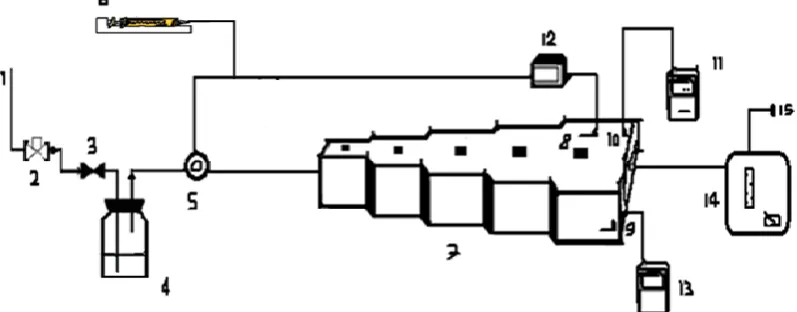
with a split/splitless injection port and a flame ionization detector (FID). The split/splitless injection port in split mode was equipped with a 0.75 mm id liner (dedicated to SPME) and with the purge valve closed for 150 s. The column was a 60 m × 0.25 mm ID, 1.50 mm film thickness chemically bounded fused-silica capillary VOCOL column (Supelco, Bellefonte, PA). The carrier gas was nitrogen with a flow rate of 0.3 ml/min for 1 min, in a 1:8 split-injection mode. The column temperature was programmed at 40°C for 1 min, and then increased to 180°C with 8°C/min ramp. The temperature for the injector port was 280°C in 1:8 split ratio for all analyses. Signals were collected and recorded with an 223-00930 GC solution software (Shimadzu, Kyoto, Japan). A manual SPME holder was used with SPME fibres including 100 µm Polydimethylsiloxane (PDMS), 75 µm Carboxen/ Polydimethylsiloxane (carboxen/PDMS), and manual holders were supplied from Supelco (Bellefonte, PA, USA). The PDMS coating is a non-porous, viscous liquid like polymeric phase, while Carboxen/PDMS is considered for predominantly porous polymeric phases. Extraction of analytes on PDMS is via absorption, while it is adsorbed and is likely to be capillary condensation for Carboxen/PDMS [8]. All new fibres were conditioned by being inseried in the GC injector port according to Data Sheet which contains important information about the product (SUPELCO Bellefonte, PA) [9].Beforeeachsampling,fibreswereconditioned for 5 min in the injection port at 280°C to avoid contamination from the laboratory atmosphere [10]. Syringe pump (SP-510, JMS, Hiroshima, Japan) was used in standard atmosphere generation system. Fig 1. Schematic diagram of the system for generation known concentration of acetonitrile
Where:
Personal sampling pump model 222-3 and sorbent tubes containing active chacoal for active sampling were prepared from SKC (SKC Inc., 84, PA).
Standard atmosphere generating device
To enable quantitative analysis of acetonitrile in field air sampling, calibration curves for the target compoundweredeterminedwithselectedSPMEfibers. To achieve this, a standard gas generating device with a flow through sampling chamber was constructed to provide a wide range of acetonitrile concentrations (Fig 1). In addition, this device was also used for validation of the SPME with the NIOSH method, and provided a mechanism for daily quality control of instrumental parameters and sampling set. Chamber consists of the continuous injection of acetonitrile, using a syringe pump (SP-510, JMS, Hiroshima, Japan), into a controlled air flow where the compounds were vaporized. By the thermocouple and electrical coil (Samwon eng, model SU-105) air was heated to a specified temperature before entering the chamber. An impinger, heater, and bypass valves as humidity generation system for changing airflow rate and temperature of water in impinger were used. The temperature and relative humidity were measured by a thermo-hydrometer from (Model Testo 601, Testoterm GmbH & Co., Germany). Moreover, a dry test meter (Elster-Handel, Germany) was used for continuously checking the diluents gas flow rate in the system.
Delivered of analyte to the chamber with syringe pump at predetermined injection rate and calculated by down Equation [11].
C = (ρ×Vm × IR × 10
6) ⁄ (MW ×Q ×60) (1)
Where
:
ρ: density of analyte (g/ml) MW: molecular weight of analyte
IR: injection rate (ml/hr)
C: desirable concentration in the chamber in ppm Vm: molar volume (24.45 L in standard condition) Q: diluent gas flow rate (L/min)
Preparation of standard solutions
A stock solution of acetonitrile was prepared in methanol to yield a final concentration of 1 mg/mL. Standard solutions for the calibration curve were prepared from the stock solution in the following concentrations: 10, 15, 20, 50, 100, 200, and 400 μg/ml. GC/FID external calibration was done by preparation of standard solutions and injection of the solution.
Active sampling
Active sampling was performed based on NIOSH 1606 method. According to this method, a personal pump calibrated at 0.2 L/min flow rate, specified volume of air was drawn to the charcoal tubes. After sampling, the front and back sections of each charcoal tube were transferred to separate sample vials. Samples were extracted for 45 minutes by 2 ml of methanol. 1 µl of this extract was directly injected to the GC/FID by the 1 µl syringe (no dead volume) for quantification.
RESULTS
Selection of suitable fiber related to acetonitrile sampling and analysis
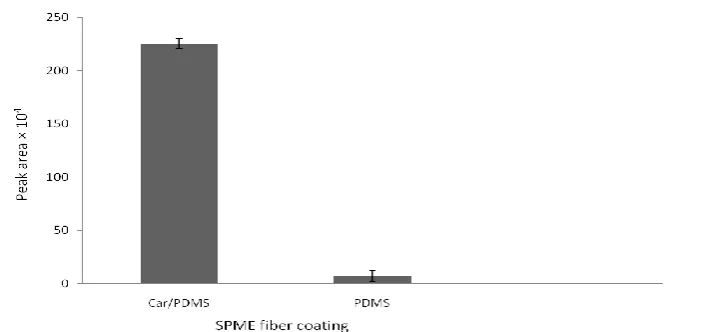
One of the main variables of this study was determining the suitable SPME coating fiber for sampling and analysis of acetonitrile in air. For this purpose two types of commercial fiber Carboxen/PDMS and PDMS were used. The results of comparing the peak area was shown in Fig 2. The results revealed that, the extracted mass of airborne acetonitrile (at 200 ppm) Fig 2. Theeffectoftwodifferentfibers on sum of peak area (at 250 ppm). The extraction was performed at 20±2C for 5 minutes; desorption
onto the Carboxen/PDMS fibers was much higher than the mass loading onto the 100 µmPDMSfiber.
Optimization of SPME extraction and desorption conditions
In order to examine this performance parameter, sampling was performed at optimum condition and then analysis was carried out at the time between 30 to 180 s, inside GC injection port. The maximum peak was at 2 minuts and selected as optimum desorption time at injection port of gas chromatography. To study the desorption conditions, acetonitrile solution were injected into atmosphere generator. Acetonitrile at constant concentration inside standard chamber were absorbed by a Carboxen/PDMS fiber at 20±2°C for 5 min. Desorption was carried out from a GC injector held at 280°C for different times of 30, 60, 120 and 180 s. Desorption of the acetonitrile was carried out for 60 s, at 280°C. The optimum conditions were determined by the sum of peak areas obtained under different desorption times. Extraction time profile for acetonitrile in exposed mode showed that the analyte reaches equilibrium within 300 s (Fig 3). These experiments were performed in standard chamber with constant
concentration of acetonitrile with relative humidity of 30±2% and sampling temperature of 20±2°C.
Influence of environmental factors on sampling rate
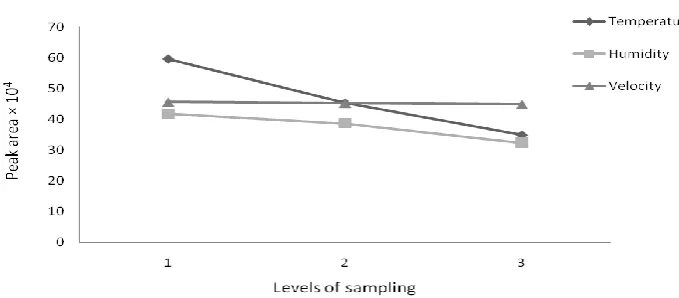
The effect of each environmental factor on Carboxen/PDMS sampling rate was investigated at three levels. At each level three measurements were performed in exposed mode. Analysis of the results by ANOVA test at the 0.05 level of accuracy showed that the peak area of the sampler was significantly affected by temperature from 20 to 30°C in this study (F = 41.17, P≤0.002). Besides, the effect of relative humidity on sampling of acetonitrile by Carboxen/PDMS fiber has been investigated at three different humidities (35±2%, 50±2% and 65±2%). At each level, three measurements were performed in exposed mode at 50 ppm. Analysis of the results showed that humidity has a significant negative effect on the mass uptake of Carboxen/PDMS. For sampling under different velocities, a chamber was configured; the velocity in the chamber was measured with a calibrated thermo anemometer. In this study, velocity was studied in the range of 1.81 to 3.03 cm/s. ANOVA test was performed to examine the statistical Fig 3. Extraction of acetonitrile in air matrix (at 200 ppm) was performed by using a Carboxen/Polydimethylsiloxane fiber at 20±2C for 30
min. The desorption temperature in injection port was 280C
Fig 4. InfluenceofEnvironmentalfactorsonsamplingrate(at50ppm).Absorptionofacetonitrile in air matrix was performed by using a Carboxen/Polydimethylsiloxanefiberat20±2
difference between uptake rates at different air velocities. Results showed that dynamic sampling with exposed SPME in at different air velocities does not have a significant effect on mass uptake (Fig 4).
LOD and LOQ
The limit of LOD and LOQ were estimated on the basis of the signal-to-noise ratios obtained with standards containing the compounds of interest at low concentrations. To estimate the quantity of LOD, the low concentration of acetonitrile was prepared and then sampled at the same time. Results showed that eth LOD and LOQ for acetonitrile in the GC system was 0.05 and 0.15μg/ml,respectively.
Comparison of solid-phase micro extraction with NIOSH 1606 sample preparation methods
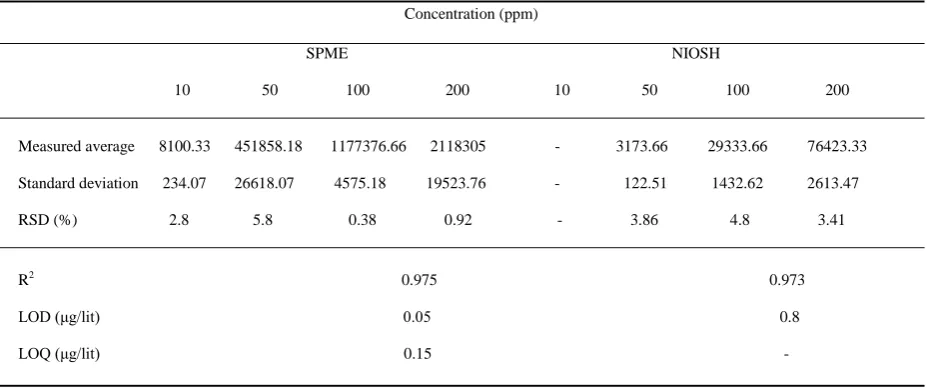
The SPME method was compared with the standard NIOSH method. Laboratory samples (n=3) were taken at 20°C, 35% RH and 2.27cm/s velocity for 4 hours. The concentrations determined by SPME method were found to be higher than that of the NIOSH method. Mean temperature and relative humidity in the field were 20±2°C and 35±2% respectively. Air velocity measured by a calibrated thermo-anemometer was less than 5cm/s at all times. Comparison of the results obtained by the SPME and NIOSH 1010 method under these conditions has a good correlation and the regression line slope was also near unity(y = 82512, r2
= 0.975 and y = 36625x- 73564, r2 = 0.973 respectively). Table 1 compares the target acetonitrile concentrations obtained from air sampling with the use of the SPME and NIOSH methods. A paired t test indicated that there was no significantly difference
between the SPME and NIOSH-based results for n =3 replicated at the 95% confidence level. The results in Table 1 also indicate that the reproducibility of the SPME method was generally better than that of the conventional charcoal tube method.
DISCUSSION
This research showed that the SPME method based on the optimum procedure could be used for sampling and determination of acetonitrile in occupational exposure. To determine, the optimum condition, a number of experimental parameters such as temperature, humidity and velocity must be considered. The optimal condition depends on the nature and composition of the matrix, properties of the analytes [11-12].
The results revealed that the extracted mass of airborne acetonitrile (at 200 ppm) onto the Carboxen/PDMS fibers was much higher than the mass loading onto the 100μm PDMS fiber. This result has been proven in similar studies [13-16]. The Carboxen/PDMS fiber coating was selected for fast sampling of acetonitrile in air matrix. Carboxen/PDMS is mixed coating with complementary properties in comparison with PDMS fiber. It is mainly composed of micro porous structure and its specific adsorption process in multilayer of sorbent leads to maximum recovery of analyte [8, 17].
Desorption time and temperature are two important analytical performances that deal with the time of analysis and life span of the sorbent. Increasing desorption time can reduce the carry over and memory effect of the adsorbed analytes on sorbent surface but it
R2 0.975 0.973
LOD(μg/lit)0.05 0.8
LOQ(μg/lit) 0.15 -
Note: RSD = Relative Standard Deviation.
also can reduce the life span of the sorbent and the time that sorbent could be applied for consecutive analysis. Desorption of the acetonitrile was carried out for 60 sec, at 280°C. This result has been proven in studies such as Heidari studies [18-19] and Shahtaheri study [20] also Penalver [21].
Extraction time profile for acetonitrile in exposed mode showed that, the analyte reaches equilibrium within 300 s. This is similar to the result obtained by Zare studies [13-14] and somewhat similar to Heidari study [18-19] and Shahtaheri study [20] that, in 6 min extraction time was obtained. Besides, results show that the values obtained for the theoretical SR were bigger than the experimental values. A possible explanation for this behavior, which was also observed by Khaled and Pawliszyn [11], is the volatilization of the compounds before the thermal desorption.
The effect of each environmental factor on Carboxen/PDMS sampling rate showed that humidity had a significant negative effect on the mass uptake of Carboxen/PDMS that was consistent with other studies [13, 14, 21-22]. The increase of water vapour molecules decreases the adsorption sites of coating and therefore decreases the sorption capacity of the fiber [17, 22].
For sampling under different velocities, a chamber was configured according to the design proposed by Koziel et al. [24]. Velocity was studied in the range of 1.81 to 3.03 cm/s. This range was selected according to the results of the study conducted by Baldwin that revealed mean air velocities in about 85% of workplaces is less than 0.35 m/s [25].
Many papers have been published on the effect of air velocity on the sampling property of passive samplers. Results showed that air velocities do not have a significant effect on mass uptake. Many of these papers conclude that air velocity does not have a significant effect on passive samplers [22, 26]. It seems that, the convective effect and boundary layer on mass transfer have negligible role in this process. In the retracted SPME, the effect of air velocity may be even smaller than that of other passive samplers because of the unique configuration and aspect ratio of SPME fiber.
In order to study the quality of the method proposed, calibration curves, accuracy and LOD and LOQ were estimated. LOD and LOQ for acetonitrile in theGCsystemwere0.05and0.15μg/lit,respectively.It is good in comparison with the LOD proposed by NIOSH 1606 method which is about 0.8 μgpersample [3]. Result also shows that comparison of the results obtained by the SPME and NIOSH 1010 method under these conditions shows a good correlation that is similar to the result obtained by parreira [27] and Pragst [28] studies.
CONCLUSIONS
SPME method sampling can be used for the screening of acetonitrile in indoor air. The limits of
detection obtained for environmental factors such as air humidity and temperature are significant influence in absorbed rate of analyte by SPME fiber. Comparison of the results obtained by the SPME and NIOSH 1010 method under optimum conditions shows a good correlation between two methods.
ACKNOWLEDGEMENTS
The authors thank the Hamadan University of Medical Sciences for financial support of this research. The authors declare that there is no conflict of interest.
REFERENCES
1. Hashimoto K. ACETONITRILE. In: Morimoto K, and Dobson S. Physical and chemical characterizes of acetonitrile. International Labour organization and the World Health Organization Publishing, Geneva, USA, 1993; 149-154. 2. Greenberg M. Toxicological review of acetonitrile. In: Katherine
A, and David L. Risk Assessment Division. U.S. Environmental Protection Agency Publishing, Washington, USA, 1999; 25-31. 3. NIOSH. Acetonitrile: method 1606. Manual of Analytical
Methods Report Niosh/ NMAM. 15 January 1998.
4. Wercinski M, Scheppers S. Solid Phase Microextraction. CRC Press.1999; 1:244-57.
5. Arthur CL, Pratt K, Motlagh S, Pawliszyn J, Belardi RP. Environmental analysis of organic compounds in water using solid phase micro extraction. Journal of High Resolution Chromatography 1992; 15(11):741–4.
6. Poerschmann J, Zhang Z, Kopinke F-D, Pawliszyn J. Solid Phase Microextraction for Determining the Distribution of Chemicals in Aqueous Matrices. Anal Chem 1997; 69(4):597– 600.
7. Chai M, Pawliszyn J. Analysis of Environmental Air Samples by Solid-Phase Microextraction and Gas Chromatography/Ion Trap Mass Spectrometry. Environ Sci Technol 1995; 29(3):693–701. 8. Hook GL, Kimm GL, Hall T, Smith PA. Solid-phase
microextraction(SPME)forrapidfieldsamplingandanalysisby gas chromatography-mass spectrometry (GC-MS). Trends In Analytical Chemistry 2002; 21(8):534-44.
9. Supelco. Solid phase microextraction application guide and additional SPME literature. Sigma-Aldrich Report Supelco/guide. June 1999; 1-7.
10. Xue R, Dong L, Zhang S, Deng C, Liu T, Wang J, et al. Investigation of volatile biomarkers in liver cancer blood using solid-phase microextraction and gas chromatography/mass spectrometry. Rapid Commun Mass Spectrom. 2008; 22:1181– 6.
11. Koziel JA, Jia M, Khaled A, Noah J, Pawliszyn J. Field air analysis with SPME device. Anal Chim Acta 1999; 400:153-62 12. Liu Y, Muralidhara S, Bruckner JV, Bartlett MG. Trace level
determination of trichloroethylene in biological samples by headspace solid-phase microextraction gas chromatography/negative chemical ionization mass spectrometry. Rapid Commun Mass Spectrom. 2008; 22:797– 806.
13. Sakhvidi MJZ, Bahrami A, Ghiasvand A, Mahjub H, Tuduri L. Determination of Inhalational Anesthetics in Field and Laboratory by SPME GC/MS. Analytical Letters 2012; 45:375– 85.
19. Heidari HR, Shahtaheri SJ, Golbabaei F, Alimohamadi M, Rahimi-Froushani A. Headspace solid phase micoextraction for trace analysis of ethyl benzene in human exposure. Qom University of Medical Sciences Journal 2009; 3(2):5-12. 20. Shahtaheri SJ, Heidari HR, Golbabaei F, Alimohamadi M,
Rahimi-Froushani A. Solid phase micoextraction for trace analysis of benzene in environmental monitoring. Iranian Journal of Environmental Health Science & Engineering 2006; 3(3):169-176.
21. Penalver A, Pocurull E, Borrull F, Marce RM. Solid-phase microextraction coupled to high-performance liquid
25. Baldwin P, Maynard A. A survey of wind speeds in indoor workplaces. Ann Occup Hyg 1998; 42(5):303-13.
26. Lestremau FO, Andersson FA, Desauziers V, Fanlo Jl. Evaluation of Solid-Phase Microextraction for Time-Weighted Average Sampling of Volatile Sulfur Compounds at ppb Concentration. Anal Chem. 2003; 75:26-32.
27. Parreira F, Souza P. Analysis of amides in the air by sampling with SPME and detection by GC-FID. J Sep Sci. 2006; 29:346-50.