J Health Sci Technol. 2017 July;1(2):75-79.
Published online 2017 July 28 . Research Article
Application of the Theory of Planned Behavior to predict
low-nutrient junk food consumption among male students
Elham Charoghchian Khorasani
1, Nooshin Peyman
*2, Mohammad Moghzi
31
MSc, Student Research Committee, Department of Health Education & Health Promotion, Social Determinants of Health Research Center, Faculty of Health, Mashhad University of MedicalSciences, Mashhad, IR Iran
2
Social Determinants of Health Research Center, Mashhad University of Medical Sciences, Mashhad, IR Iran 3
BSc in Public Health, Health Education and Health Promotion health center of Chenaran, Mashhad University of Medical Sciences, Mashhad, IR Iran
*Corresponding author: Nooshin Peyman, Associate Professor, Department of Health Education and Health Promotion, School of Health, Social Determinants of Health Research Center, Mashhad University of Medical Sciences, Mashhad, Iran, Tel: +9838544633, Fax: +9838544643, Email: [email protected]
Received 2017 June 17; Revised 2017 July 10, 2017; Accepted 2017 July 18
Abstract
Background: Students are highly tended to consume junk foods. This study aimed to predict the consumption of
low-nutrient junk foods based on the constructs of the Theory of Planned Behavior among male students across Chenaran city in 2015.
Methods: This descriptive-analytic study incorporated 143 eighth-grade students who were selected via simple
randomization method. They completed the relevant questionnaire. The data were analyzed in SPSS (version 18) using one-way analysis of variance, regression analysis, and Pearson correlation test. Significance level was 0.05.
Results: The junk foods most frequently consumed comprised of chocolate, cake, and fizzy drinks. Results indicated that
subjective norms and perceived behavioral control could predict 9 percent of changes in low-nutrient junk food consumption. From among the constructs of the theory of planned behavior, attitude, subjective norms, and perceived behavioral control are able to predict 16 percent of behavioral intention changes.
Conclusions: Given the tendency of students towards the consumption of low-nutrient junk foods, administration of
theory-based educational interventions such as the theory of planned behavior seems necessary.
Keywords: Theory of Planned Behavior; Junk food; Students
1. Introduction
One of the nutritional problems among adolescents is excessive use of low-nutrient junk foods, which are mainly characterized to be of low nutritional value and high levels of energy due to salt or sugar. Junk foods are estimated to account for 40 percent of the daily energy intake in Iranian students (1). The consequences of excessive consumption of these foods in children such as obesity, tooth decay and chronic diseases have been well established (2).Nutritional problems stand as the root for several major chronic diseases in both the developed and developing countries. Changes in lifestyle among which the dietary factors, play an important role in the prevalence or incidence of obesity and other risk factors for non-communicable diseases (3).
A nationwide survey in Iran showed that 51 percent of children used some type of junk foods, industrial juices, carbonated drinks, candies and chocolates since a week prior to the survey. Another study in 23 cities across Iran indicated poor nutritional habits among 6- to 18-year-old students (4).It goes without saying that human behavior is a reflection of various factors and that health education as the canon of health activities and programs requires knowledge of behavior and contributors to behavioral modification as well as replacement of poor behaviors with proper ones; this highlights the role of models and theories in health behavior education (5).
Corina introduced the theory of planned behavior (TPB) in 2000 as a comprehensive and rational model to explain why people change their health-related behaviors (6). TPB
in terms of food choices stands as a prominent theory (1), which was initially introduced by Ajzen and Fishbein (7). It is a model of socio-cognitive expected value that considers intention as the main determinant of behavior (8), proposing that three factors impact behavioral intention (2). These include attitude, subjective norms, and perceived behavioral control. One’s belief in and evaluation of the outcome of a certain behavior are conducive to the formation of his/her attitude. Subjective norms are influenced by perceptions about the judgment of others as well as the motivation to meet their expectations. Perceived behavioral control represents a degree of an individual’s perception concerning to what degree (non) performance of a certain behavior follows his/her control. Overall, TPB can explain about 40% of the relationship between intention and health behavior (9).
In addition to the main constructs of TPB, several empirical studies have considered other variables contributory to food intake. Among these variables is previous behavior which is usually a strong predictor of intention and behavior (10). The aim of this study was to explore the predictors of low nutrient junk food consumption among eighth-grade students in Chenran city using TPB as well as the additional variable of previous behavior.
2. Methods
This cross-sectional study incorporated 143 eighth-grade male students in Chenaran in February and March 2015. Inclusion criteria consisted of being in the eighth grade in boys' school and tendency to participate in the study. Exclusion criterion included provision of flawed questionnaire.
The sample size was determined as 143 following a similar study (11).Based on multi-stage cluster sampling; two high schools were randomly selected from among all high schools in the city. Afterwards, the required number of participants from every class was selected randomly from the attendance list. Approvals were already obtained from the education department of the city and the students. Thereafter, the questionnaires were completed by the students.
The questionnaire used in this study consisted of four parts. The first part covered demographic characteristics, i.e., age, weight, height, number of family members, education level and occupation of parents, and the amount
of pocket money per week. The second part held items related to knowledge about junk foods with low nutritional value (e.g., Consumption of these foods leads to overweight and obesity.). At the beginning, the students were explained about the meaning and type of junk foods including chocolate, falafel, cheese puffs, fizzy drinks, crisps, caramel cream, sweets, biscuits, gummies, cake, ice drink, and factory-made fruit juice. To assess knowledge, there were nine (true/false/I don’t know) items where a correct answer was scored 1, and other options were scored 0. Score range of knowledge was from 0 to 9. The third section of the questionnaire assessed the frequency of junk food consumption on a weekly scale (from I never use to I use
more than once a week). The forth section directly assessed
TPB constructs. There were 9 items on attitude (e.g., the foods are delicious), 2 items on behavioral intention (e.g., Next month, I'm going to cut on these junk foods), 4 items on subjective norms (e.g., My parents believe that I can have these foods.), and 4 items on perceived behavioral control (e.g., I'm sure if I intend, I can cut on these foods.).
The constructs were scored on a five-point Likert rating scale (strongly agree, agree, no comment, disagree, strongly disagree). Score range for attitude was between 9 and 45, for behavioral intention between 2 and 10, for subjective norms from 4 to 20, and for perceived behavioral control from 4 to 20. The questionnaire was designed on the basis of the study objectives and with due consideration of the existing papers and theses (5, 6, 15). Content validity was ensured via face validity as well as quantitative methods of content validity ratio (CVR) and content validity index (CVI). First, to determine the CVR, 10 experts in health education assessed each item based on a three-point scale (necessary; useful but not necessary; it is not necessary).Based on Lawche’s table, items whose CVR values were greater than 62% were considered significant and thus retained (p <0.05). Moreover, items whose CVI based on content validity index of Walts and Bausell were greater than 0.7 were considered acceptable and the rest were removed (12). To determine the reliability of the questionnaire, a pilot study was conducted on 11 students, and internal consistency was calculated with Cronbach's alpha as α=0.74.
The collected data were analyzed in SPSS version 18. Pearson test was used to determine the relationship between the mean score of TPB constructs, quantitative demographic variables, and mean consumption of
nutrient junk foods. One-way analysis of variance was used to ddetermine the significant relationship between mean consumption junk food and qualitative demographic variables. The regression analysis (backward method) was applied to predict the behavior and intention of low-nutrient fast food consumption. It should be noted that in linear regression analysis using the backward method, the constructs whose significance coefficients were between 0.05 and 0.1 were retained in the model in order to obtain the optimal model for prediction of behavior response and intention variables.
3. Results
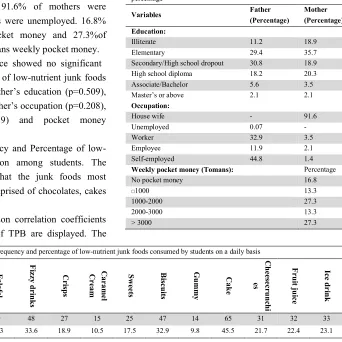
Results of this study showed that the number of family members of students was 5.39±1.70 on average, and their mean age was 14.17±0.83 years. The mean body mass index was 19.89±4.83 and they watched television for 2.74±0.95 hours on average. According table 1, 18.9% of mothers and 11.2% of fathers were illiterate. 54.6% of mothers and 60.2% of fathers were below high school diploma. 20.3% of mothers and 18.2% of fathers were diploma and 5.6% of mothers and 7.7% of fathers were above high school diploma. 91.6% of mothers were housewife and 0.07% of fathers were unemployed. 16.8% of students did not have pocket money and 27.3%of students have more of 3000 tomans weekly pocket money.
One-way analysis of variance showed no significant difference between mean scores of low-nutrient junk foods and qualitative variables of mother’s education (p=0.509), father’s education (p=0.422), father’s occupation (p=0.208), mother’s occupation (p=0.459) and pocket money (p=0.234).
Table 2 reports the Frequency and Percentage of low-nutrient junk food consumption among students. The findings of this table show that the junk foods most frequently used by students comprised of chocolates, cakes and fizzy drinks.
In Table 3, pair wise Pearson correlation coefficients between each two constructs of TPB are displayed. The
data in this table show negative correlation between junk food consumption behavior and any of the TPB constructs, although the associations between intention, subjective norms, and perceived behavioral control constructs and the behavior of junk food consumption is significant. In addition, there was a significant positive correlation between behavioral intention and both subjective norms and perceived behavioral control.
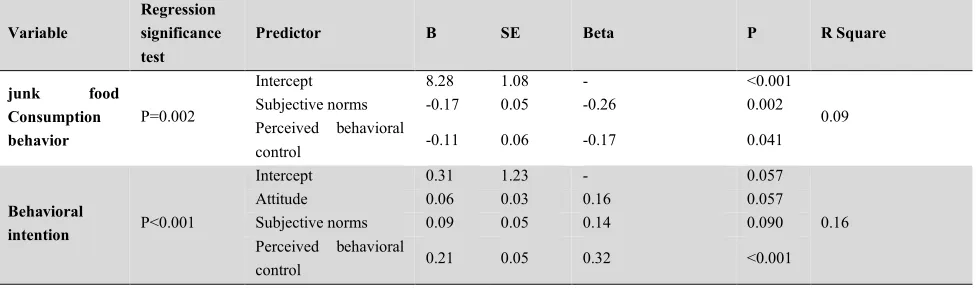
To predict consumption behavior, inverse linear regression model was used. Table 3 shows the results of the linear regression test between consumption intention and behavior based on TPB. The results from the table indicate that subjective norms and perceived behavioral control are significant predictors of low-nutrient junk food consumption behavior, accounting for 9% of its change. Other constructs were no significantly predictive in the linear regression model. On the other hand, attitude, subjective norms, and perceived behavioral control are also meaningful predictors of behavioral intention, which in total can explain 16 percent of variations in low-nutrientjunk food intention.
Table 1: Demographic characteristics of the participating students in
percentage
Variables Father
(Percentage)
Mother (Percentage) Education:
Illiterate 11.2 18.9
Elementary 29.4 35.7
Secondary/High school dropout 30.8 18.9
High school diploma 18.2 20.3
Associate/Bachelor 5.6 3.5
Master’s or above 2.1 2.1
Occupation:
House wife - 91.6
Unemployed 0.07 -
Worker 32.9 3.5
Employee 11.9 2.1
Self-employed 44.8 1.4
Weekly pocket money (Tomans): Percentage
No pocket money 16.8
1000 13.3
1000-2000 27.3
2000-3000 13.3
> 3000 27.3
Table 2: Frequency and percentage of low-nutrient junk foods consumed by students on a daily basis
Ju nk fo od C ho co la te C hees e pu ffs F ala fel F izzy d ri nk s C ri sp s C ara m el C rea m Sw eet s B iscu its G um m y C ak e C hees ecru nc hi es F ru it j uice Ice dri nk
Frequency 77 30 9 48 27 15 25 47 14 65 31 32 33
Percentage 53.8 21 6.3 33.6 18.9 10.5 17.5 32.9 9.8 45.5 21.7 22.4 23.1
Table 3: Pairwise Pearson coefficients between the Theory of Planned Behavior constructs and junk food consumption
Component
Behavioral intention Subjective norms Attitude Perceived behavioral control Junk food consumption r
P-value
r P-value
R P-value
r P-value
r P-value
Behavioral intention 0.15 0.64 0.22* 0.013 0.32* <0.001 0.20 0.017
Subjective norms 0.23* 0.012 -0.09 0.324 -0.25 0.003
Attitude 0.101 0.306 -0.19* 0.021
Perceived behavioral control
-0.15 0.08 Junk food consumption
*significant level is set at 0.05. r=Pearson correlation coefficient
Table 4: Results of linear regression between low-nutrient junk food consumption intention, junk food consumption behavior, and constructs of the theory of planned behavior
Variable
Regression significance test
Predictor B SE Beta P R Square
junk food
Consumption behavior
P=0.002
Intercept 8.28 1.08 - <0.001
0.09 Subjective norms -0.17 0.05 -0.26 0.002 Perceived behavioral
control -0.11 0.06 -0.17 0.041
Behavioral
intention P<0.001
Intercept 0.31 1.23 - 0.057
0.16
Attitude 0.06 0.03 0.16 0.057
Subjective norms 0.09 0.05 0.14 0.090 Perceived behavioral
control 0.21 0.05 0.32 <0.001
4. Discussion
This study showed that the mean consumption of sweets, cakes and fizzy drinks among the students were more frequent than other junk foods. In Dehdari et al.’s study, which was conducted on female students in Kermanshah in 2011, the more frequently consumed junk foods comprised of chocolate, cheese puffs, falafel, and fizzy drinks (12). Rezakhani and colleagues showed that cakes and cookies accounted for 58.1 percent of all junk foods consumed and were the most widely used junk foods among students in Qazvin (13).
Kelishadiet al. reported that Iranian adolescents consumed sweets 10 times a week on average and various fatty and salty junk foods 4.9 times a week. Side-effects of too much junk food consumption such as obesity, tooth decay and chronic diseases in children and adolescents have been demonstrated (1). In Santich et al.’s study on American teenagers, the most consumed snacks consisted of all kinds of candy and fizzy drinks (14).Many studies have shown that consumption of unhealthy snacks among students is growing. In recent years, the prevalence of obesity associated with the consumption of fast foods and
sweet drinks among Iranian children has exceeded expectations, and the rate increases along with age. Therefore, students stand as a major target group for interventional planning and policy-making concerning overweight and obesity prevention and modified lifestyle (15).
The results of this study showed that the two constructs of subjective norms and perceived behavioral control can predict 9 percent of changes in low-nutrient junk food consumption. Moreover, attitude, subjective norm, and perceived behavior control were significant predictors of behavioral intention, which in total can explain 16 percent of consumption behavior changes. Dehdari et al. showed that from among the TPB constructs, it is only the perceived behavioral control that can predict change in behavioral intention (with 44 percent predictive power)and that attitude and subjective norms were not predictive of intention to use low-nutrient fast foods (12). The difference in the predictive power of the construct can be attributable to the gender and culture of participants, as the present study incorporated boys and was performed in Chenran in northeast of Iran, whereas Dehdari et al.’s study was conducted on girls and
Kermanshah in western Iran. In Barati et al.’s study on low-nutrient junk food consumption among primary school students in Arak in 2015, perceived behavioral control was able to predict 23% of behavior change (16).
The current study was limited as it failed to incorporate girls and other age groups. Therefore, the same is suggested to be fulfilled in future research. Another limitation of this study was self-report on the part of students.
5. Conclusion
Results showed that students will become less inclined to use low-nutrient junk foods in case they have more negative attitudes towards these foods, and their intentions, or pressures on them, to use low-nutrient junk foods is low. Furthermore, the greater the perceived behavioral control in students, the less likely they are to use low-nutrientjunk foods. Therefore, negative attitude towards these junk foods should be reinforced in practice via the media and educational interventions. A decrease in the students’ intention and social pressures exerted on them to use the junk foods can also be very beneficial. Thereby, a greater level of perceived behavioral control can incur in the students against low-nutrientjunk foods.
6. Acknowledgements
We deem it necessary to express our gratitude to the participating students, the education department of Chenaran, and managers of the schools.
References
1. Karimi Shahanjarini A, Shojaezadeh D, Majdzadeh R, Rashidian A, Omidvar N. Application of an integrative approach to identify determinants of junk food consumption among female adolescents. Iranian Journal of Nutrition Sciences & Food Technology 2009; 4(2):61-70.
2. Mohammadi Zeidi I, Pakpour Hajiaghaye A, Mohammadi Zeidi B. Investigating the effect of education based on the theory of planned behavioron employee safety behaviors. Journal of knowledge Health 2013;8(3):105-111.
3. Hosseini Esfahani F, Asghari G, Mirmiran P, JalaliFarahani S, Azizi F. Reproducibility and relative validity of food group intake in a food frequency questionnaire developed for the Tehran lipid and glucose study. Journal of Iran university of medical sciences 2010;17(71):41-55.
4. ZamaniAlavijeh F, Faghihzadeh S, Sadeghi F. Application of the health belief model for unhealthyeating prevention among primary school children in Arak. Journal of Kermanshah university of medical sciences 2008:11(4):1-15.
5. Bashirian S, Hidarnia A, Allahverdi Pour H, Hajizadeh E. Application of Theory of Planned Behavior in Predicting Factors of Substance Abuse in Adolescents. Journal of Fasa University of Medical Sciences2012; 2(3):156-162.
6. Yekaninejad MS, Akaberi A, Pakpour A. Factors associated with physical activity in adolescents in Qazvin. An application of the theory of planned behavior. Journal of North Khorasan university of medical sciences 2012;4(3):449-456.
7. Gasemi M, Dehdari T, Mohagheghi P, Gohari MR. The effect of educational intervention based on theory of planned behavior (TPB) for improving method of care of premature infant by mother,2013. Razi journal of medical sciences2014;20(115):39-48.
8. Delshad Noghabi A, Darabi F, Moshki M.The impact of education on the basis of the theory of planned behavior on the level and method of supervision of their parents on watching television by students. Journal of Torbat Heydariyeh university of medical sciences2013;1(4):7-17.
9. Pakpour Hajiagha A, Saffari M. Application of planned behavior theory in predicting dental brush behavior among Iranian adolescents in Qazvin. The Journal of Islamic Dental Association of IRAN 2012; 24(3):201-207.
10. Yarmohammadi P, Sharifirad G R, Azadbakht L, Morovati Sharifabad M A, Hassanzadeh AP. Predictors of Fast Food Consumption among High School Students based on the Theory of Planned Behavior. Health system research 2011;7(4):1-10.
11. Fila S A, Smith Ch. Applying the Theory of Planned Behavior to healthy eating behaviors in urban Native American youth. International Journal of Behavioral Nutrition and Physical Activity 2006; 3(11):1-10.
12. Dehdari T, Chegni M, Dehdari L. Application Planned Behavior in theory Predicting Junk Food Consumption among Female Students. PCNM 2013:2(2):18-24.
13. Rezakhani H, Soheili Azad A, Razaghi M, Nemati A. Pattern of breakfast and snak consumption and their effective factors among primary school students, Qazvin. Journal of health Ardabil university of medical sciences 2012; 2(4):57-63.
14. Ghiasvand R, Ashrafi M, Ashrafzadeh E, Asgari Gh R, Hasanzadeh A. Relationship between junk foods intake and weight in 6-7 years old children, Shahinshahr and Meimeh,2009. Health system research 2010; 6(2):335-343.
15. Mohammadi Zeidi I, Pakpour A. Effectiveness of educational intervention based on theory of planned behavior for promoting breakfast and healthy junk food eating among elementary school students .RJMS2013; 20(112):67-78.
16. Barati F, Shamsi M, Khorsandi M, Ranjbaran M. Measuring the Constructs of Planned Behavior Theory Regarding the Behaviors Preventing of Junk Food Consumption in Elementary Students in Arak in 2015. Arak Medical University Journal (AMUJ) 2016; 18(104): 10-18.