DOI: 10.22111/tpnms.2019.30871.1181
23
Role of Graphene Sheet Agglomeration in the Macroscopic Elastic Properties of
Metal Matrix Nanocomposites
Roozbeh Pouyanmehr1, Reza Ansari1, Mohammad Kazem Hassanzadeh-Aghdam2,*
1Department of Mechanical Engineering, University of Guilan, Rasht, Iran
2 Department of Engineering Sciences, Faculty of Technology and Engineering, East of Guilan, University of Guilan,
Rudsar-Vajargah, Iran
Received 10 July 2019; revised 15 November 2019; accepted 25 November 2019; available online 22 February 2020
ABSTRACT: The purpose of the present work is to analyze the modulus of elasticity of graphene (Gr) sheet-reinforced metal matrix nanocomposites (MMNCs) using a homogenized model based on the Mori-Tanaka micromechanics approach. The main focus is to investigate the effects of Gr sheet agglomeration on the MMNC macroscopic elastic modulus. Also, the role of aligning Gr sheets in the mechanical performance of MMNC is explored. It is found that a small amount of Gr sheets can increase the elastic properties of the MMNCs. Addition of 5% by volume fraction of Gr sheet in an aluminum (Al) matrix improves the MMNC elastic modulus by 31%. The mechanical properties of MMNCs are very sensitive to the Gr sheet agglomeration. Formation of sheet agglomeration can significantly decrease the MMNC elastic modulus. It is observed that the Gr sheet alignment plays a superior role in enhancing the MMNC elastic properties. Generally, alignment of Gr sheets leads to the maximum level of MMNC mechanical properties in axial direction. As compared to the uniform dispersion type, aligning the 5 vol% Gr sheets can improve the elastic of Al nanocomposite by as much as 20%. The elastic modulus calculated from the present micromechanical model for different types of MMNCs is compared with available experimental data. In addition, the results from the Mori-Tanaka method are also compared with other analytical results acquired from semi-empirical Halpin-Tsai (H-T) model and the rule of mixture (ROM).
KEYWORDS: Agglomeration; Elastic properties; Graphene sheet; Metal matrix nanocomposite; Micromechanics
INTRODUCTION
In the past decade, studies on the overall mechanical characteristics of graphene (Gr)-reinforced metal matrix nanocomposites (MMNCs) have obtained high interest because of their high strength and elastic modulus [1-2]. Gr is one of the strongest reinforcements in the world [3]. It has some exceptional features: excellent electric properties, great thermal conductivity, and high tensile strength. Furthermore, Gr is very light. These special properties make it a perfect reinforcement for metal matrixes. Many investigations have been carried out on using Gr as reinforcement in both polymers and metal matrices. A number of studies on the
effective properties of Gr-reinforced polymer
nanocomposites were reported [4-5]. Newly, extensive research has been done in the case of Gr-reinforced MMNCs [6].
These materials have been widely used in the aerospace and automobile industries, such as Gr-reinforced aluminum (Al) matrix nanocomposites [7], Gr-reinforced copper (Cu) matrix nanocomposite [8], Gr-reinforced titanium (Ti) matrix nanocomposites [9]. Generally, Gr-reinforced metal-based composites can play a significant role in improving the mechanical properties of metallic materials, such as their modulus and strength.
*Corresponding Author Email: [email protected]
Tel.: +981426584365; Note. This manuscript was submitted on July 10, 2019; approved on November 25, 2019; published online February 22, 2020.
Recently, many efforts have been focused on the experimental synthesis and characterization of Gr sheet-reinforced nanocomposites to analyze the effective properties of Gr-reinforced MMNCs. In a study conducted by Song et al. [9], instrumented spherical micro-indentation /scratch tests were used to explore the microscopic mechanical properties of multilayer graphene (MLG)-reinforced Ti based metal matrix composites synthesized by means of spark plasma sintering. Their results showed that most of the additive MLGs improved the mechanical properties such as elastic modulus. In another study, Hwang et al. [10] suggested a molecular-level mixing modification and spark plasma sintering (SPS) methods to analyze the elastic modulus and yield strength for Gr-reinforced Cu matrix nanocomposites. The elastic modulus and the yield strength of the resultant Cu MMNC containing 2.5 vol% Gr were 131 GPa and 284 MPa, respectively, which were 30% and 80% higher than the values for pure Cu. In another research, Yolshina et al. [11] reported that the hardness, strength and ductility of Al MMNCs containing Gr sheets are at least 2-3 times higher than the initial Al material. It can be found that few papers were published in numerical analysis of Gr-reinforced nanocomposites. In 2016, Ji et al. [12] applied a micromechanics method to predicate the effective
elastic modulus of Gr sheet-reinforced polymer
nanocomposites. They supposed that all the graphene sheets
24 Nomenclature
C stiffness tensor 𝑁 Number of reinforcements
𝑐𝑚 Volume fractions of the matrix S Eshelby tensor
cr Volume fractions of the Gr phase V Volume of the representative volume element
E Young’s moduli of composite v12, v13 Poisson ratio
E1 Young’s moduli in longitudinal direction Greek Symbols
𝐸3 Young’s moduli in transverse direction 𝜀𝑚 Average strain
Em Young’s moduli of matrix 𝜇 shear modulus of composite
𝐺13 Shear modulus 𝜇𝑚 shear modulus of matrix
𝑘 Bulk modulus of composite 𝑣𝑚 Poisson ratio of matrix
𝑘𝑚 Bulk modulus of matrix σm Average stress
are either aligned or randomly oriented in the polymer matrix. Then, the influences of several critical mechanisms that may affect the polymer nanocomposite mechanical behaviour were analysed. In general, the micromechanical methods are an efficient approach to estimate the effective properties of the composite materials from the behaviour of their constituents. This is very cost-effective, particularly for various filler/matrix combinations [13-15].
Mokhalingam et al. [16] studied mechanical behaviour of Gr-reinforced Al nanocomposites by using molecular dynamics (MD) simulations. Their analysis showed that the incorporation of Gr nano-sheet into the Al matrix can increase Young's modulus of the nanocomposite noticeably. The nanocomposite containing 6.7 vol.% of Gr sheet exhibits Young’s modulus of 143.8 GPa and 116.8 GPa along longitudinal and transverse directions, respectively, that are 82.8% and 46.5% higher than pure Al. A literature survey evidently reveals that there is no substantial work that exactly analyzes the mechanical properties of Gr
sheet-reinforced MMNCs considering the important
microstructural features. Generally, the effective mechanical properties of Gr sheet-reinforced MMNCs are significantly dependent on some critical microstructural features such as the amount and distribution type of Gr sheets, Gr/metal interfacial region and constituent material properties [17-19]. For example, Gr nano-sheets tend to agglomerate together due to the presence of van der Waals forces between them [20-22].
The formation of Gr sheet agglomeration -encountered in real engineering situations, degrades the mechanical properties of metal-based composites [23-24].
In this paper, we explore the macroscopic elastic modulus of Gr sheet-reinforced MMNCs by utilizing the Mori-Tanaka homogenization scheme. The obtained values are compared with the available experimental data and other numerical results to verify the validity of the micromechanical process. Furthermore, some parametric studies are performed to examine the role of amount and dispersion types of Gr nano-sheets in the mechanical properties of MMNCs. The suggested micromechanical simulation process with obtained results could be useful to guide design of Gr sheet-reinforced MMNCs with superior elastic properties.
MICROMECHANICAL MODELLING
Elastic parameters of Gr sheets
The three-dimensional elastic parameters of both metal matrix and Gr are essential for theoretically calculating the effective moduli of nanocomposites. However, a Gr sheet is actually a two-dimensional structure and its out-of-plane elastic properties do not have well accepted description in the previous works.
The assignment of the elastic parameters of a single Gr sheet is vital as the main problem to be discussed here. A Gr sheet, along with bulk Gr, could be considered as a transversely isotropic material. There are five dependent parameters that elastic behaviour can be defined, Young’s moduli 𝐸1and 𝐸3, shear modulus 𝐺13, Poisson’s ratios 𝑣12
and 𝑣13, in engineering symbolization. These assumptions
are confirmed by a quantitative investigation accomplished in the following that tests the sensitivity of the elastic constants of the composite system to the values of the out-of-plane parameters of Gr sheets. The fourth-order transversely isotropic tensors are implicated to simplify the mathematical operations. We present Hill’s elastic moduli,
𝑘, 𝑙, 𝑛, 𝑚 and 𝑝 [25] demonstrated by another expression for the constitutive relation,
𝜎 = 𝐶: 𝜀 (1)
where 𝜎𝑖𝑗, 𝜀𝑖𝑗 and 𝐶𝑖𝑗𝑘𝑙 refer to the stress tensor, strain
tensor, and fourth-rank elastic stiffness tensor, respectively.
𝑘 means the plane-strain bulk modulus under lateral dilatation in the (𝑥1, 𝑥2) plane, 𝑛 is the modulus under
uniaxial tension in the 𝑥3 direction, 𝑙 is the associated cross
modulus, 𝑚 specifies the shear modulus in the (𝑥1, 𝑥2) plane
and 𝑝 stands for the shear modulus in the (𝑥1, 𝑥3) or (𝑥2, 𝑥3)
plane.
The stiffness tensor is given in terms of Hill’s parameters as
𝐶 = (2𝑘, 𝑙, 𝑛, 2𝑚, 2𝑝) (2)
25
𝐸1=
4𝑚(𝑘𝑛 − 𝑙2)
(𝑘 + 𝑚)𝑛 − 𝑙2,
𝐸3= 𝑛 −
𝑙2
𝑘, 𝐺13= 𝑝
𝑣
12=
(𝑘−𝑚)𝑛−𝑙2
(𝑘+𝑚)𝑛−𝑙2
, 𝑣
13=
𝑙 2𝑘
(3)
Herein, it is selected that metal matrix to be the isotropic material. Its Hill’s moduli can be obtained by
𝑘𝑚=
𝐸𝑚
2(1+𝑣𝑚)(1−2𝑣𝑚), 𝑙𝑚=
𝑣𝐸𝑚
(1+𝑣𝑚)(1−2𝑣𝑚),
𝑚𝑚= 𝑝𝑚=
𝐸𝑚
2(1+𝑣𝑚), 𝑛𝑚=
(1−𝑣𝑚)𝐸𝑚
(1+𝑣𝑚)(1−2𝑣𝑚)
(4)
Effective elastic moduli of Gr-reinforced MMNCs
The Mori-Tanaka method is employed to compute the effective elastic moduli of composites.It is assumed in the Mori-Tanaka theory that each inclusion to be embedded in an infinite pristine matrix under the average stress or average strain of the matrix indicated by
𝜎𝑚 and 𝜀𝑚, respectively. Based on the Eshelby equivalent
inclusion theory [26], the average strain of a graphene part can be specified, as follows
𝜀𝑟= 𝐴𝑟∶ 𝜀𝑚 (5)
Where
𝐴𝑟= [𝐼 + (𝑆 ∶ 𝐶𝑚−1) ∶ (𝐶𝑟− 𝐶𝑚)] −1
(6)
6 is referred to the strain-concentration tensor. Also, S is the Eshelby tensor. The effective stiffness tensor C for the homogenized multiphase composite system is set by 𝜎̅ = 𝐶: 𝜀̅, where 𝜎̅ and 𝜀̅ stand for the operative or average stress and strain tensors of the composite, respectively. They can be given by
𝜎̅ = 𝑐𝑚𝜎𝑚+ ∑ 𝑐𝑟𝜎𝑟 𝑁
𝑟=1
,
𝜀̅ = 𝑐𝑚𝜀𝑚+ ∑𝑁𝑟=1𝑐𝑟𝜀𝑟,
(7)
where 𝑐𝑚 and 𝑐𝑟 denote the volume fractions of the matrix
and the Gr phase, respectively, and 𝑁 indicates the number of reinforcements which may have different shapes or elastic properties. 𝐶 can then be presented as
𝐶 = (𝑐𝑚𝐶𝑚+ ∑𝑁𝑟=1𝑐𝑟𝐶𝑟 : 𝐴𝑟) ∶ (𝑐𝑚 𝐼 +
∑𝑁𝑟=1𝑐𝑟 𝐴𝑟) (8)
Under the condition that all fillers are aligned.
In other words, equation 8 provides the effective elastic tensor for an aligned Gr sheet-reinforced composite. For a platelet-reinforced composite with every phase being transversely isotropic, the effective moduli can be expressed in terms of Hill’s elastic parameters as
𝑘 = 𝑐𝑟𝑘𝑟+ 𝑐𝑚𝑘𝑚−
𝑐𝑚𝑐𝑟(𝑙𝑟− 𝑙𝑚)2
𝑐𝑟𝑛𝑚+ 𝑐𝑚𝑛𝑟
,
𝑙 =𝑐𝑟𝑙𝑟𝑛𝑚+ 𝑐𝑚𝑙𝑚𝑛𝑟 𝑛𝑟𝑐𝑚+ 𝑛𝑚𝑐𝑟
, 𝑛 = 𝑛𝑚𝑛𝑟 𝑛𝑟𝑐𝑚+ 𝑛𝑚𝑐𝑟
,
𝑚 = 𝑐𝑟𝑚𝑟+ 𝑐𝑚𝑚𝑚, 𝑝 =
𝑝𝑚𝑝𝑟
𝑐𝑟𝑝𝑚+ 𝑐𝑚𝑝𝑟
(9)
As all Gr sheets are randomly distributed in the metal matrix, the overall elastic property of the hybrid material can be considered as an isotropic material as an average effect of orientation. Hence, an effort is made to modify equation 5 as
〈𝜀𝑟〉 = [∫ ∫ 1
2𝜋𝐴𝑟(𝜃, 𝜑) 𝑠𝑖𝑛 𝜃 𝑑𝜃 𝑑𝜑 2𝜋
0 2𝜋
0 ] : 𝜀𝑚=
〈𝐴𝑟(𝜃, 𝜑)〉: 𝜀𝑚
(10)
where the angular brackets 〈𝑥 〉 means the orientation average of a physical quantity 𝑥. The effective stiffness tensor can be given by
𝐶 = (𝑐𝑚𝐶𝑚+ ∑𝑁𝑟=1𝑐𝑟〈𝐶𝑟∶ 𝐴𝑟(𝜃, 𝜑)〉): (𝑐𝑚𝐼 +
∑𝑁𝑟=1𝑐𝑟〈𝐴𝑟(𝜃, 𝜑)〉)
(11)
For the platelet-reinforced composites, the expressions for effective bulk modulus and shear modulus are
𝑘 = 𝑘
𝑚+
𝑐𝑟(𝛿𝑟−3𝑘𝑚𝛼𝑟)
3(𝑐𝑚+𝑐𝑟𝛼𝑟)
, 𝜇 = 𝜇
𝑚+
𝑐𝑟(𝜂𝑟−2𝜇𝑚𝛽𝑟)
2(𝑐𝑚+𝑐𝑟𝛽𝑟)
(12)
With
𝛼𝑟=
3𝑘𝑚+2𝑛𝑟−2𝑙𝑟
3𝑛𝑟 ,𝛽𝑟=
4𝜇𝑚+7𝑛𝑟+2𝑙𝑟
15𝑛𝑟 +
2𝜇𝑚
2𝑝𝑟,
𝛿𝑟=
3𝑘𝑚(𝑛𝑟+2𝑙𝑟)+4(𝑘𝑟𝑛𝑟−𝑙𝑟2)
3𝑛𝑟 ,
𝑛𝑟= 2
15(𝑘𝑟+ 6𝑚𝑟+ 8𝜇𝑚−
𝑙𝑟2+2𝜇𝑚𝑙𝑟
𝑛𝑟 )
(13)
)
The effective elastic modulus 𝐸 is derived as
𝐸 =
9𝑘𝜇3𝑘+𝜇
(14)
)
Influence of agglomeration of Gr sheets
As illustrated, the improvement of the elastic behaviour resulting from adding favourably shaped and dispersed Gr
sheets is captivating. But, the ideal conditions
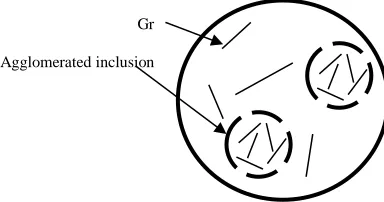
26 affect the stiffening effect of nano-scale particles [27]. First, the nanoparticles tend to agglomerate, causing a spatially non-uniform distribution of the Gr sheets in composite systems. In order to theoretically examine the agglomeration effect, it is assumed that some Gr sheets are concentrated in some spherical regions in the metal matrix, while the rest keep a desired uniform dispersion. This division is shown in Figure 1. Then, the composite is divided into two parts with different loadings of reinforcement which can be considered two different phases in calculation.
We give the names agglomeration phase and effective matrix phase to the regions inside and outside the spheres, respectively.
In both phases, the Gr sheets are randomly oriented. In the current simulation, a two-parameter description is used to describe such a special distribution [28], where the agglomeration factors are expressed as
𝜉 =𝑉𝑎𝑔𝑔𝑙𝑜𝑚𝑒𝑟
𝑉 , 𝜁 =
𝑉𝑟𝑎𝑔𝑔𝑙𝑜𝑚𝑒𝑟
𝑉𝑟
(15)
where 𝑉 and 𝑉𝑎𝑔𝑔𝑙𝑜𝑚𝑒𝑟 specify the total volumes of the
representative volume element of the nanocomposite and its agglomeration part, respectively. 𝑉𝑟and 𝑉𝑟
𝑎𝑔𝑔𝑙𝑜𝑚𝑒𝑟
denote the volumes of Gr sheets merged in the entire nanocomposite and that in the agglomeration phase, respectively.
Fig. 1. Micromechanics model for the Gr sheet agglomeration
Then, the volume fractions of Gr sheets in the agglomeration phase and that in the operative matrix phase are expressed as
𝑐𝑟 𝑎𝑔𝑔𝑙𝑜𝑚𝑒𝑟
=𝑉𝑟𝑎𝑔𝑔𝑙𝑜𝑚𝑒𝑟
𝑉𝑎𝑔𝑔𝑙𝑜𝑚𝑒𝑟=
𝜁𝑐𝑟
𝜉 ,
𝑐𝑟𝑜𝑢𝑡=
𝑉𝑟−𝑉𝑟𝑎𝑔𝑔𝑙𝑜𝑚𝑒𝑟
𝑉−𝑉𝑟 =
(1−𝜁)𝑐𝑟
(1−𝜉)
(16)
when the average loading of fillers, 𝑐𝑟, is fixed. A two-step
procedure is utilized to enumerate the above model.
At first, the equivalent elastic properties of the agglomeration and the equivalent matrix phases are determined from equation12 by replacing 𝑐𝑟 with 𝑐𝑟
agglomer
and 𝑐𝑟𝑜𝑢𝑡 known in equation16, respectively.
Therefore, it can be written
𝑘𝑎𝑔𝑔𝑙𝑜𝑚𝑒𝑟 = 𝑘𝑚+ [
(𝛿𝑟− 3𝑘𝑚𝛼𝑟)𝑐𝑟𝜁
3(𝜉 − 𝑐𝑟𝜁 + 𝑐𝑟𝜁𝛼𝑟)
],
𝑘𝑜𝑢𝑡= 𝑘𝑚+ [
𝑐𝑟(𝛿𝑟−3𝑘𝑚𝛼𝑟)(1−𝜁)
3(1−𝜉−𝑐𝑟(1−𝜁)+𝑐𝑟(1−𝜁)𝛼𝑟)],
𝜇𝑎𝑔𝑔𝑙𝑜𝑚𝑒𝑟 = 𝜇𝑚+ [
𝑐𝑟𝜉(𝜂𝑟−2𝜇𝑚𝛽𝑟)
2(𝜉−𝑐𝑟𝜁+𝑐𝑟𝜁𝛽𝑟)],
𝜇𝑜𝑢𝑡= 𝜇𝑚+ [
𝑐𝑟(1−𝜁)(𝜂𝑟−2𝜇𝑚𝛽𝑟)
2(1−𝜉−𝑐𝑟(1−𝜁)+𝑐𝑟(1−𝜁)𝛽𝑟)]
(17)
Next, the agglomeration phase is considered as spherical inclusions embedded in the enriched matrix. So, the effective elastic moduli for the whole Gr sheet-reinforced MMNCs are extracted as
𝑘 = 𝑘𝑜𝑢𝑡[1 +
𝜉((𝑘𝑎𝑔𝑔𝑙𝑜𝑚𝑒𝑟⁄𝑘𝑜𝑢𝑡)−1)
1+𝛼(1−𝜉)((𝑘𝑎𝑔𝑔𝑙𝑜𝑚𝑒𝑟⁄𝑘𝑜𝑢𝑡)−1)],
𝜇 = 𝜇𝑜𝑢𝑡[1 +
𝜉((𝜇𝑎𝑔𝑔𝑙𝑜𝑚𝑒𝑟⁄𝜇𝑜𝑢𝑡)−1)
1+𝛽(1−𝜉)((𝜇𝑎𝑔𝑔𝑙𝑜𝑚𝑒𝑟⁄𝑘𝜇𝑜𝑢𝑡)−1)]
(18)
in which
𝛼 = 3𝐾𝑜𝑢𝑡/(3𝐾𝑜𝑢𝑡 + 4𝜇𝑜𝑢𝑡)
𝛽 = 6(𝐾𝑜𝑢𝑡 + 2𝜇𝑜𝑢𝑡) 5(3𝐾𝑜𝑢𝑡+ 4𝜇𝑜𝑢𝑡)
(19)
RESULTS
In this section, the predictions by the present micromechanics modelling approach are compared with existing experimental and numerical results of the Gr sheet-reinforced MMNCs. Then, the effects of some critical microstructural features on effective elastic properties of the MMNCs containing Gr sheets have been explored.
Model validation
First, the results of the current investigation for the elastic modulus of Gr sheet-reinforced Cu nanocomposites are compared with those tested by Hwang et al. [10]. They reported that the tensile modulus of the 2.5 vol% Gr-reinforced Cu nanocomposite is about 30% greater than that of pure Cu. According to Ref. [10], the Gr sheets were not agglomerated and a homogeneous dispersion of Gr sheets within the Cu matrix was reported. The comparison is
accomplished mainly to validate the developed
micromechanical model which is given in Figure 2. In the micromechanical simulation, the elastic parameters of Ge sheet are taken as [29]
𝐶 = (1240, 15, 36.5, 880, 8) (20)
Also, the elastic modulus and Poisson’s ratio of Cu matrix are 120 GPa and 0.36, respectively. Also, a uniform dispersion of Gr sheets is considered in the micromechanical Gr
27 modeling process (𝜉 = 𝜁= 0.5). In the case where all Gr sheets are uniformly dispersed, one has that 𝜉 = 𝜁. The variation of elastic modulus with the Gr sheet volume fraction is shown in Figure 2.
Fig. 2. Comparison between the model predictions and experimental data
[10] of Gr sheet-reinforced Cu MMNCs
It is observed that the results of this investigation are in good agreement with the experimental measurements conducted by Hwang et al. [10]. Figure 2 clearly shows the stiffing effect as a function of Gr amount in the Cu matrix. By a uniform dispersion of Gr nanoparticles, increasing the Gr volume fraction leads to a significant improvement of mechanical performance. It is due to the fact that the elastic modulus of Gr sheet is very higher than that of the metal matrix. In order to further validate the presented micromechanical model, the modulus of elasticity of the Gr-reinforced Al nanocomposite is compared with that of experimental data performed by Su et al. [30]. They fabricated some coupons of Gr-reinforced Al MMNCs by flaky powder metallurgy, and then evaluated the mechanical properties under tensile test [30]. The elastic modulus and Poisson’s ratio of Al matrix are 70 GPa and 0.33, respectively.
Fig. 3. Comparison between the model predictions and experimental data
[30] of Gr sheet-reinforced Al MMNCs
Figure 3 shows the comparison between the
micromechanical model estimations and experiment [30]. The Figure discloses that the elastic modulus estimated by the present micromechanics model agrees properly fine with the experimental data [30]. The disparity between the two sets of results may be due to the values of constituent material properties of MMNC (Gr sheet and Al matrix) in the micromechanical modeling, alignment of Gr sheets within the Al matrix during the fabrication process. It is noted that as the value of elastic moduli of Gr sheet or Al matrix increases, the elastic modulus of MMNCs can be increased. Another verification with experiment is related to perform a comparison between the present micromechanical predictions and tested data of elastic modulus for a Ti MMNC containing Gr sheets [9] as shown in Figure 4.
Fig. 4. Comparison between the model predictions and experimental data
[9] of Gr sheet-reinforced Ti MMNCs
The micromechanical results provided in Figure 4 have been obtained considering Gr sheet agglomeration. To this end, it is assumed that the values of 𝜁 and 𝜉 to be 0.8 and 0.02, respectively. Note that these values are obtained with applying the correlation between the model results and experiment data [9].
Also, for a comparison purpose, the micromechanical predictions are provided considering 𝜁 =0.9, 𝜉 =0.01 and
𝜁 =0.7, 𝜉 =0.03. The severe agglomeration of Gr
nanoparticles occurs in the experimental process [9]. When
𝜁 and 𝜉 are equal to 0.8 and 0.02, respectively, a good agreement between two sets of results occurs due to the fact that the Gr sheet agglomeration is accurately taken into account in the micromechanical simulation. It is illustrated that the predictions of the model considering 𝜁 =0.9 and
28 In Table 1, the elastic moduli calculated from presented study are compared with MD simulation [16] and other micromechanical models [16].
The elastic moduli are predicted for the aligned Gr-reinforced Al nanocomposite along the longitudinal (𝐸𝑙) and
transverse (𝐸𝑡) directions. The volume fraction of Gr
nanoparticle is equal to 6.7% [16]. The semi-empirical H-T model and the ROM [16] are used in the present work to compare the modulus of Gr-Al nanocomposites.
The elastic properties of the Gr reinforcement and Al material are taken from Ref. [16]. Generally, good agreement is observed between the all theoretical predictions.
Table1
Comparison between the model predictions and MD simulation [31], H-T and ROM models [31] for Gr sheet-reinforced Al
MMNCs.
Another comparison between the model results and experimental measurements [31] for the elastic modulus of Al-based nanocomposites containing Gr nanoparticles is indicated in Figure 5.
Bisht et al. [31] synthesized the Al matrix nanocomposites containing Gr content by spark plasma sintering (SPS). Then, they evaluated the mechanical properties of the Gr-Al nanocomposites [31]. It is found from Figure 5 that, there is a good agreement between the experimental data [31] and the predictions of the micromechanical model. The results show that the nanocomposite elastic modulus increases with the increase of Gr amount.
Fig. 5. Comparison between the model predictions and experimental
data [32] of Gr-reinforced Al MMNCs
Parametric studies
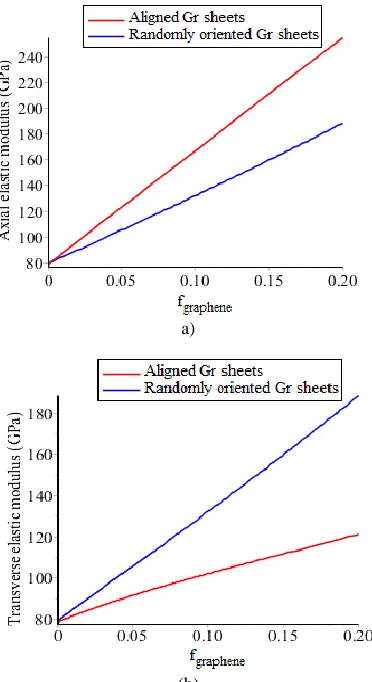
First, a parametric study is performed to investigate the effect of Gr sheet alignment on the mechanical performance of MMNCs. The variation of the axial elastic modulus and transverse elastic modulus of the Al nanocomposites with Gr sheet volume fraction is shown in Figures 6a and b, respectively.
Also, the results of the random Gr sheet dispersion into the MMNCs are added.
It is shown that the Gr alignment has significant effect on the MMNC elastic modulus. Comparison between the results of Figures 6a and 6b shows that the elastic modulus of MMNCs in axial direction is very higher than that of MMNC in transverse direction.
For example, when the volume fraction of Gr is 8%, Young’s modulus of the Al MMNC along the axial and transverse directions is determined to be 150 GPa and 96 GPa, respectively, which is 114% and 20.7% more than that of pure Al matrix.
It is attributed to the fact that the axial elastic modulus of the composite system is significantly dominated by the reinforcement, whereas, its transverse mechanical properties are greatly affected by the matrix properties. Also, it can be seen from Figure 6 that these elastic moduli linearly increase with increasing the Gr content.
It is noted that the effective material properties of a composite system can be varied from those of the reinforcement to those of the matrix. So, for the selected composite system; i.e. Gr sheet-reinforced Al matrix, the axial elastic modulus is varied from the Al elastic modulus to the axial elastic modulus of Gr sheet. Also, the transverse elastic modulus of Gr-Al composite is varied from the Al elastic modulus to the transverse elastic modulus of Gr sheet. It can be observed from Figure 6a that the elastic modulus of an aligned Gr sheet-reinforced MMNC in axial direction is significantly higher than that of a randomly oriented Gr sheet-reinforced MMNC.
However, Figure 6b reveals that the elastic modulus of a randomly oriented Gr sheet-reinforced MMNC is higher than the transverse elastic modulus of an aligned Gr sheet-reinforced MMNC.
Now, we study the influences of the agglomeration factors
𝜉 and 𝜁 on the Gr sheet-reinforced Al nanocomposite elastic modulus individually.
The variation of the effective Young’s modulus 𝐸 with increasing ξ under 𝜁 = 1 is shown in Figure 7a, and the variations of 𝐸 with 𝜁 under 𝜉 = 0.2 and 𝜉 = 0.5 are plotted in Figures 7b and 7c, respectively. 𝜁 = 1 indicates that all the Gr sheets agglomerate in some spherical sub-regions, a condition under which an increasing ξ enlarges the agglomeration region, modifying the non-uniformity. Elastic modulus
(GPa)
MD [31] H-T [31] ROM [31] Present study
𝐸𝑙 143.8 108.5 137.2 137.3
𝐸𝑡 116.8 107.2 132.6 95.97
80 86 92 98 104 110
0 0.4 0.8 1.2 1.6 2
El
astic m
o
d
u
lu
s
(G
P
a)
Gr weight fraction (%) Present model
29 a)
(b)
Fig. 6. Variation of (a) axial and (b) transverse elastic moduli of aligned Gr sheet-reinforced Al nanocomposites with Gr volume fraction It is found from Figure 7 that the elastic properties of MMNCs are significantly sensitive to the Gr sheet agglomeration. Formation of the nanoparticle agglomeration has a damaging effect on the MMNC mechanical properties. Overall, a uniform dispersion of Gr sheets within the MMNCs leads to the maximum level of mechanical performance.
(a)
(b)
(c)
Fig. 7. Effect of Gr sheet agglomeration on the elastic modulus of Al
MMNC, (a) 𝜁 =1, (b) 𝜉 = 0.2, (c) 𝜉 = 0.5
It must be noted when ζ= ξ, the Gr sheets are uniformly dispersed into the composites. In this condition no agglomeration exists. So, when the value of ζ becomes closer to that of ξ, the Gr sheets are more uniformly dispersed into the composites which lead to an increase in the elastic modulus. But, the contribution of agglomeration to the MMNC elastic properties increases as the value of ζ becomes more far from the value of ξ.
CONCLUSION
30 as compared to the experiment. The micromechanical analysis indicated that the agglomeration of the Gr sheets degrades the stiffness significantly. However, Gr sheet alignment was a more superior parameter that affects the macroscopic elastic properties of the MMNCs. The axial elastic modulus of aligned Gr sheet-reinforced MMNC was very high as compared to that of the randomly dispersed Gr sheet-reinforced MMNCs and transverse elastic modulus of aligned Gr sheet-reinforced MMNC.
REFERENCES
[1] Yehia HM, Nouh F, El-Kady O. Effective of graphene
nano-sheets content and sintering time on the microstructure coefficient of thermal expansion, and mechanical properties of (Cu/WC–TiC-Co) nano-composites. Journal of Alloys and Compounds. 2018 Oct 5:764:36–43.
[2] Ju JM, Wang G, Sim KH. (2017). Facile synthesis of
graphene reinforced Al matrix composites with improved dispersion of graphene and enhanced mechanical properties. Journal of Alloys and Compounds. 2017 May 15:704:585–592.
[3] Izadi M, Shahmardan MM, Behzadmehr A, Rashidi
AM, Amrollahi A. Modeling of effective thermal conductivity and viscosity of carbon structured nanofluid. Transp Phenom Nano Micro Scales. 2015 Jan 1:3(1):1–13.
[4] Young RJ, Liu M, Kinloch IA, Li S, Zhao X, Valles C,
Papageorgiou DG. The mechanics of reinforcement of polymers by graphene nanoplatelets. Composites Science and Technology. 2018 Jan 18:154:110–116.
[5] Gholami R, Ansari R. On the nonlinear vibrations of
polymer nanocomposite rectangular plates reinforced by graphene nanoplatelets: a unified higher-order shear deformable model. Iranian Journal of Science and
Technology. Transactions of Mechanical
Engineering.2018 May 21:43(1):1–18.
[6] Prashantha Kumar HG, Anthony Xavior M. Graphene
Reinforced Metal Matrix Composite (GRMMC): A Review. Procedia Engineering. 2014:97:1033–1040.
[7] Tian WM, Li SM, Wang B, Chen X, Liu JH, Yu M.
Graphene-reinforced aluminum matrix composites
prepared by spark plasma sintering. International
Journal of Minerals, Metallurgy, and Materials. 2016 June:23(6):723–729.
[8] Song G, Fu Q, Pan C. Copper-Graphene Composite
Foils via Electro-Deposition: A Mini Review, doi: 10.1557/adv.2018.28.
[9] Song Y, Chen Y, Liu WW, Li WL, Wang YG, Zhao D,
Liu XB. Microscopic mechanical properties of titanium
composites containing multi-layer graphene
nanofillers. Materials and Design. 2016 Nov 5:109: 256–263.
[10] Hwang J, Yoon T, Jin ST, Lee J, Kim TS, Hong SH,
Jeon S. Enhanced mechanical properties of
graphene/copper nanocomposites using a molecular-level mixing process. Advanced materials. 2013 Dec 10:25(46): 6724–6729.
[11] Yolshina LA, Muradymov RV, Korsun IV, Yakovlev
GA, Smirnov SV. Novel aluminum-graphene and aluminum-graphite metallic composite materials: synthesis and properties. Journal of Alloys and
Compounds. 2016 Apr 5:663:449–459.
[12] Hi XY, Cao YP, Feng XQ. Micromechanics prediction
of the effective elastic moduli of graphene sheet-reinforced polymer nanocomposites. Modelling and Simulation in Materials Science and Engineering. 2010 Mar 30:18(4):045005.
[13] Kundalwal SI, Ray MC. Effective properties of a novel
composite reinforced with short carbon fibers and radially aligned carbon nanotubes. Mechanics of Materials. 2012 Oct:53:47–60.
[14] Kari S, Berger H, Gabbert U, Guinovart-Dıaz R,
Bravo-Castillero J, Rodrıguez-Ramos R. Evaluation of influence of interphase material parameters on effective material properties of three phase composites. Composites Science and Technology. 2008 Mar:68(3-4):684–691.
[15] Hassanzadeh-Aghdam MK, Mahmoodi MJ, Jamali J,
Ansari R. A new micromechanical method for the analysis of thermal conductivities of unidirectional fiber/CNT-reinforced polymer hybrid nanocomposites.
Composites Part B: Engineering. 2019 Oct
15:175:107137.
[16] Mokhalingam A, Kumar D, Sirvastava A. Mechanical
behaviour of graphene reinforced aluminum
nanocomposites. Materials Today: Proceedings.
2017:4(2):3952–3958.
[17] Tiwari JK, Mandal A, Rudra A, Mukharji D, Sathish N.
Evaluation of mechanical and thermal properties of
bilayer graphene reinforced aluminum matrix
composite produced by hot accumulative roll bonding. Journal of Alloys and Compounds. 2019 Sept 15:801: 49–59.
[18] Behera AK, Mallik A. Ultrasound assisted
electroplating of nano-composite thin film of Cu matrix with electrochemically in-house synthesized few layer graphene nano-sheets as reinforcement. Journal of
Alloys and Compounds. 2018 June 25:750:587–598.
[19] Dixit S, Mahata A, Mahapatra DR, Kailas SV,
Chattopadhyay K. Multi-layer graphene reinforced aluminum–manufacturing of high strength composite by friction stir alloying. Composites Part B: Engineering. 2018 Mar 1:136:63–71.
[20] Ferreira F, Ferreira I, Camacho E, Lopes F, Marques
AC, Velhinho A. Graphene oxide-reinforced
aluminium-matrix nanostructured composites
fabricated by accumulative roll bonding. Composites Part B: Engineering. 2019 May 1:164:265–271.
[21] Jiang Y, Tan Z, Xu R, Fan G, Xiong DB, Guo Q, Su Y,
31
properties of graphene nanosheet/aluminum
composites by flake powder metallurgy via shift-speed ball milling. Composites Part A: Applied Science and
Manufacturing. 2018 Aug:111:73–82.
[22] Shao P, Yang W, Zhang Q, Meng Q, Tan X, Xiu Z, Qiao j, Yu Z, Wu G. Microstructure and tensile properties of 5083 Al matrix composites reinforced with graphene oxide and graphene nanoplates prepared by pressure infiltration method. Composites Part A:
Applied Science and Manufacturing. 2018
June:109:151–162.
[23] Li Y, Feng Z, Huang L, Essa K, Bilotti E, Zhang H, Peijs T, Hao L. Additive manufacturing high performance graphene-based composites: A review.
Composites Part A: Applied Science and
Manufacturing. 2019 Sept:124:105483.
[24] Vashist SK, Luong JH. Recent advances in
electrochemical biosensing schemes using graphene and graphene-based nanocomposites. Carbon. 2015 Apr: 84:519–550.
[25] Hill R, Theory of mechanical properties of fiber-strengthened materials: 1. Elastic behavior. Journal of the Mechanics and Physics of Solids. 1964 Sept:12(4):199–212.
[26] Eshelby JD. The determination of the elastic field of an ellipsoidal inclusion, and related problems. Proceeding of The Royal Society A: Mathematical Physical and
Engineering Sciences. 1957 Aug 20:241(1226):376–
396.
[27] Fu SY, Feng XQ, Lauke B,Mai YW. Effects of particle
size, particle/matrix interface adhesion and particle loading on mechanical properties of particulate– polymer composites. Composites: Part B. 2008 Sept:39(6):933–961.
[28] Shi DL, Feng XQ, Huang YY, Hwang KC, Gao H. The
effect of nanotube waviness and agglomeration on the elastic property of carbon nanotube reinforced composites. Journal of Engineering Materials and Technology. 2004 July:126(3):250–257.
[29] Blakslee OL, Proctor DG, Seldin EJ, Spence GB, Weng
T. Elastic constants of compression‐annealed pyrolytic graphite. Journal of applied physics. 1970:41(8):3373– 3382.
[30] Su Y, Li Z, Yu Y, Zhao L, Li Z, Guo Q, Xiong D, Zhang D. Composite structural modeling and tensile mechanical behavior of graphene reinforced metal matrix composites. Science China Materials. 2018 Jan:61(1):112–124.
[31] Mokhalingam A, Kumar D, Srivastava A. Mechanical
behaviour of graphene reinforced aluminum nano composites. Materials Today: Proceedings. 2017 Jan 1;4(2):3952-8.
[32] Bisht A, Srivastava M, Kumar RM, Lahiri I, Lahiri D.
Strengthening mechanism in graphene nanoplatelets reinforced aluminum composite fabricated through
![Fig. 2. Comparison between the model predictions and experimental data [10] of Gr sheet-reinforced Cu MMNCs](https://thumb-us.123doks.com/thumbv2/123dok_us/41751.2004941/5.612.92.274.542.697/fig-comparison-model-predictions-experimental-sheet-reinforced-mmncs.webp)
![Fig. 5. Comparison between the model predictions and experimental data [32] of Gr-reinforced Al MMNCs](https://thumb-us.123doks.com/thumbv2/123dok_us/41751.2004941/6.612.79.280.501.650/fig-comparison-model-predictions-experimental-data-reinforced-mmncs.webp)