Original Article
A model for assessment and development of the credibility of Iran Academy of Medical Sciences
Bahareh Malekafzali1, Mohammad Hossein Rajaeefar2, Hossein Malek-Afzali3, Farshad Pourmalek4*
1
Booali Hospital, School of Medicine, Tehran Branch, Islamic Azad University, Tehran, Iran
2
Department of Disaster and Emergency Health, National Institute of Health Research, Tehran University of Medical Sciences, Tehran, Iran
3
Department of Epidemiology and Biostatistics, School of Public Health, Tehran University of Medical Sciences, Tehran, Iran
4
Department of Urologic Sciences, School of Medicine, University of British Columbia, Vancouver, Canada
ARTICLE INFO ABSTRACT
Available online at: http://jbe.tums.ac.ir
Background & Aim: Assessment could be assumed as a valuable mean of highlighting the
organization strengths and spotting its weaknesses. Academies are not exceptions in this regard. Knowing the items, which entail more concentrated attention, the leadership of the academy will shift the resources to compensate the extenuations. This study aimed to provide the Iran Academy of Medical Sciences (AMS) a model of assessment and development of its credibility.
Methods & Materials: Reviewing the scientific literatures about the components of credibility of
an organization, three components were elected, 1. Structure, 2. Performance, and 3. Acceptability. Assessing this academy, a framework for summarizing the information of other academies was developed. For the next steps, to improve the quality of the framework and to study more AMS, we decided to search the internet for more countries and academies.
Results: We find that 16 indices and their 77 measures could be used to assess the AMS.
Conclusion: Establishing a well-defined system with a trained staff devoted to assess the AMS
activities, would be in the favor of evaluating the AMS annually; and by publication of strategic reports, AMS strengths would be reinforced and its weaknesses would be reformed.
Key words:
Academy of Medical Sciences,
Acceptability, Structure, Performance, Credibility
Introduction1
The Academy of Medical Sciences (AMS) is an independent organization that represents the spectrum of medical sciences, from basic sciences through health policy and healthcare delivery (1). It is composed of elites of medical sciences who are concurrently pioneers in their professions as academicians, practitioners, and/or researchers.
By reviewing the Iranian AMS articles of
* Corresponding Author: Farshad Pourmalek, Postal Address: Department of Urologic Sciences, University of British Columbia, Vancouver, Canada. Email: [email protected]
association, it would be apparent that it has been compiled to be compatible with strategic aims of Ministry of Health and Medical Education. As the Iran’s Ministry of Health and Medical Education is concurrently governing medical education and healthcare delivery (2), Iran’s AMS resources are also dedicated to medical science research and education along with development of healthcare delivery. These important strategic goals were asserted by many other AMS around the world. They have defined specific yet to some extent similar strategic aims and objectives for their organizations. Some popular examples are (1, 3-6):
1. Influencing medical sciences policies
J Biostat Epidemiol. 2015; 1(3-4): 93-99.
2. Supporting the development of timely, informed, and strategic advices on urgent health issues
3. Strengthening the healthcare workforce
4. Measuring nation’s health status
5. Serve as a credible, expert, independent assessor of science and technology issues relevant to the health of community
6. Recognizing excellences
7. Linking academia and industry
8. Promote and maintain liaison between
medicine and other sciences 9. Shaping research priorities
10. Recognizing and encouraging medical
scientists
11. Improving global health
12. And…
AMS have to utilize all of their resources in the favor of their objectives to promote their national and international credit among other counterparts. Each and every organization would have the benefits of enhanced credibility if they assessed what they have done and the efficacy of their activities. Assessment could be assumed as
a valuable means of highlighting the
organization strengths and spotting its
weaknesses. Academies are not exceptions in this regard. Knowing the items, which entail more concentrated attention, the leadership of the academy will shift the resources to compensate the extenuations.
This study was about to provide the Iran AMS a model of assessment and development of its credibility.
Methods
By reviewing the scientific literatures about the components of credibility of an organization three components have been elected as they were more inclusive and comprehensive than other components for our purpose:
1. Structure: The objectives and the
mechanism of achieving them should have been defined properly in the organization. The responsibilities must be clear
2. Performance: Responsibilities must have
been defined in favor of the objectives to become true
3. Acceptability: Stakeholders and
collaborative organizations should have a satisfactory perspective on the existential philosophy and prosperity of the organization.
According to all of these facts, the articles of association of Iran’s AMS and online scientific materials about some other AMS from different countries were studied while we were focusing
on their strategic objectives, structures,
performances, and acceptability. For the 1st step, “The AMS” of Great Britain was searched as the United Kingdom was the leading country in which an academy was established, The Royal Society in 1660 (7). The following search strategy was adopted using Google and Google Scholar:
By assessment of this academy, a framework for summarizing the information of other academies was developed. The framework contained some outlines, such as: Academy organizational chart, it’s scientific and financial
structures, academy strategic goals and
programs, and academy activities.
For the next steps, to improve the quality of the framework and to study more AMS, we decided to search the internet for more countries and academies. The criterion of including the AMS in our study was the availability of sufficient and citable contents and articles by reviewing their web pages. Many other countries such as United States, Canada, India, Brazil, Argentina, Mexico, Sweden, Norway, Finland, Australia, Japan, Singapore, Malaysia, France,
South Africa, Russia, and China were
investigated in order to spot a potential presence of AMS. Europe Union was also surveyed for any organization representing the whole Europe’s AMS. Many countries did not have AMS. Some have constructed their web pages in a language other than English. A few of them had nothing special to add to improve the framework. Australia and Japan had subcommittees or working groups related to medical sciences in the structure of their national academy of sciences. Ultimately, the following countries had a citable, useful information about their AMS:
1. United States (Institute of Medicine or IOM)
Sciences or CAHS)
3. France (National Academy of Medicine) (8)
4. Europe Union (Academy of Europe and
Federation of European AMS or FEAM) (9, 10)
5. India (National AMS) (5)
6. Malaysia (Academy of Medicine of
Malaysia) (11).
While studying the mentioned academies, the 1st edition of the framework has been changed and improved so other subjects and implications
could be accounted in the framework. Finally, a framework with 16 indices and 77 measures was developed for assessing the Iran’s AMS.
Results
Table 1 demonstrates the 16 indices.
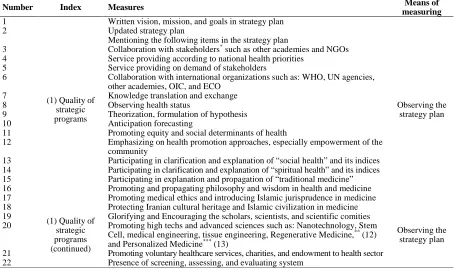
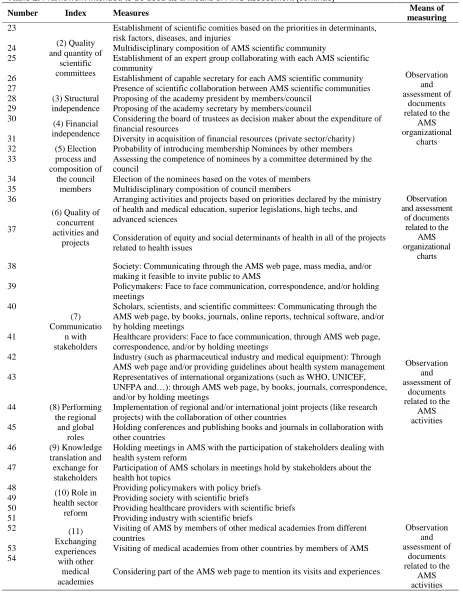
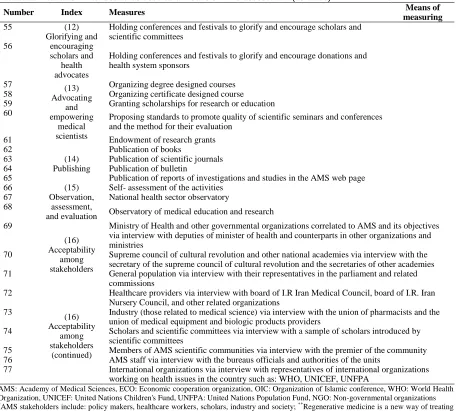
Table 2 indicates the framework containing 16 indices and their 77 measures could be used to assess the AMS.
Table 1. Indices for assessing AMS
Number Index
1 Quality of strategic programs
2 Quality and quantity of scientific committees 3 Structural independence
4 Financial independence
5 Election process and composition of the council members 6 Quality of concurrent activities and projects
7 Communication with stakeholders 8 Performing the regional and global roles
9 Knowledge translation and exchange for stakeholders 10 Role in health sector reform
11 Exchanging experiences with other medical academies 12 Glorifying and encouraging scholars and health advocates 13 Advocating and empowering medical scientists
14 Publishing
15 Observatory, assessment, and evaluation 16 Acceptability among stakeholders
AMS: Academy of Medical Sciences
Table 2. Framework intended to be used as a means of AMS assessment
Number Index Measures measuring Means of
1
(1) Quality of strategic programs
Written vision, mission, and goals in strategy plan
Observing the strategy plan 2 Updated strategy plan
Mentioning the following items in the strategy plan
3 Collaboration with stakeholders* such as other academies and NGOs 4 Service providing according to national health priorities
5 Service providing on demand of stakeholders
6 Collaboration with international organizations such as: WHO, UN agencies, other academies, OIC, and ECO
7 Knowledge translation and exchange 8 Observing health status
9 Theorization, formulation of hypothesis 10 Anticipation forecasting
11 Promoting equity and social determinants of health
12 Emphasizing on health promotion approaches, especially empowerment of the community
13 Participating in clarification and explanation of “social health” and its indices 14 Participating in clarification and explanation of “spiritual health” and its indices 15 Participating in explanation and propagation of “traditional medicine” 16 Promoting and propagating philosophy and wisdom in health and medicine 17 Promoting medical ethics and introducing Islamic jurisprudence in medicine 18
(1) Quality of strategic programs (continued)
Protecting Iranian cultural heritage and Islamic civilization in medicine
Observing the strategy plan 19 Glorifying and Encouraging the scholars, scientists, and scientific comities
20 Promoting high techs and advanced sciences such as: Nanotechnology, Stem Cell, medical engineering, tissue engineering, Regenerative Medicine,** (12) and Personalized Medicine*** (13)
Table 2. Framework intended to be used as a means of AMS assessment(continue)
Number Index Measures Means of
measuring
23
(2) Quality and quantity of
scientific committees
Establishment of scientific comities based on the priorities in determinants, risk factors, diseases, and injuries
Observation and assessment of
documents related to the
AMS organizational
charts 24 Multidisciplinary composition of AMS scientific community
25 Establishment of an expert group collaborating with each AMS scientific community
26 Establishment of capable secretary for each AMS scientific community 27 Presence of scientific collaboration between AMS scientific communities 28 (3) Structural
independence
Proposing of the academy president by members/council 29 Proposing of the academy secretary by members/council 30
(4) Financial independence
Considering the board of trustees as decision maker about the expenditure of financial resources
31 Diversity in acquisition of financial resources (private sector/charity) 32 (5) Election
process and composition of
the council members
Probability of introducing membership Nominees by other members 33 Assessing the competence of nominees by a committee determined by the
council
34 Election of the nominees based on the votes of members 35 Multidisciplinary composition of council members 36
(6) Quality of concurrent activities and
projects
Arranging activities and projects based on priorities declared by the ministry of health and medical education, superior legislations, high techs, and advanced sciences
Observation and assessment
of documents related to the
AMS organizational
charts 37
Consideration of equity and social determinants of health in all of the projects related to health issues
38
(7) Communicatio
n with stakeholders
Society: Communicating through the AMS web page, mass media, and/or making it feasible to invite public to AMS
Observation and assessment of
documents related to the
AMS activities 39 Policymakers: Face to face communication, correspondence, and/or holding
meetings
40 Scholars, scientists, and scientific committees: Communicating through the AMS web page, by books, journals, online reports, technical software, and/or by holding meetings
41 Healthcare providers: Face to face communication, through AMS web page, correspondence, and/or by holding meetings
42 Industry (such as pharmaceutical industry and medical equipment): Through AMS web page and/or providing guidelines about health system management 43 Representatives of international organizations (such as WHO, UNICEF,
UNFPA and…): through AMS web page, by books, journals, correspondence, and/or by holding meetings
44 (8) Performing the regional
and global roles
Implementation of regional and/or international joint projects (like research projects) with the collaboration of other countries
45 Holding conferences and publishing books and journals in collaboration with other countries
46 (9) Knowledge translation and exchange for
stakeholders
Holding meetings in AMS with the participation of stakeholders dealing with health system reform
47 Participation of AMS scholars in meetings hold by stakeholders about the health hot topics
48
(10) Role in health sector
reform
Providing policymakers with policy briefs 49 Providing society with scientific briefs
50 Providing healthcare providers with scientific briefs 51 Providing industry with scientific briefs
52 (11) Exchanging experiences with other
medical academies
Visiting of AMS by members of other medical academies from different countries
Observation and assessment of
documents related to the
AMS activities 53 Visiting of medical academies from other countries by members of AMS
54
Table 2. Framework intended to be used as a means of AMS assessment(continue)
Number Index Measures Means of
measuring
55 (12) Glorifying and
encouraging scholars and
health advocates
Holding conferences and festivals to glorify and encourage scholars and scientific committees
56
Holding conferences and festivals to glorify and encourage donations and health system sponsors
57 (13) Advocating
and empowering
medical scientists
Organizing degree designed courses 58 Organizing certificate designed course 59 Granting scholarships for research or education
60 Proposing standards to promote quality of scientific seminars and conferences and the method for their evaluation
61 Endowment of research grants 62
(14) Publishing
Publication of books
63 Publication of scientific journals 64 Publication of bulletin
65 Publication of reports of investigations and studies in the AMS web page 66 (15)
Observation, assessment, and evaluation
Self- assessment of the activities 67 National health sector observatory 68
Observatory of medical education and research 69
(16) Acceptability
among stakeholders
Ministry of Health and other governmental organizations correlated to AMS and its objectives via interview with deputies of minister of health and counterparts in other organizations and ministries
70 Supreme council of cultural revolution and other national academies via interview with the secretary of the supreme council of cultural revolution and the secretaries of other academies 71 General population via interview with their representatives in the parliament and related
commissions 72
(16) Acceptability
among stakeholders
(continued)
Healthcare providers via interview with board of I.R Iran Medical Council, board of I.R. Iran Nursery Council, and other related organizations
73 Industry (those related to medical science) via interview with the union of pharmacists and the union of medical equipment and biologic products providers
74 Scholars and scientific committees via interview with a sample of scholars introduced by scientific committees
75 Members of AMS scientific communities via interview with the premier of the community 76 AMS staff via interview with the bureaus officials and authorities of the units
77 International organizations via interview with representatives of international organizations working on health issues in the country such as: WHO, UNICEF, UNFPA
AMS: Academy of Medical Sciences, ECO: Economic cooperation organization, OIC: Organization of Islamic conference, WHO: World Health Organization, UNICEF: United Nations Children's Fund, UNFPA: United Nations Population Fund, NGO: Non-governmental organizations
*AMS stakeholders include: policy makers, healthcare workers, scholars, industry and society; **Regenerative medicine is a new way of treating
injuries and diseases that uses specially-grown tissues and cells (including stem cells), laboratory-made compounds, and artificial organs. Combinations of these approaches can amplify our natural healing process in the places it's needed most, or take over the function of a permanently damaged organ; ***Personalized Medicine” refers to the tailoring of medical treatment to the individual characteristics of each
patient to classify individuals into subpopulations that differ in their susceptibility to a particular disease or their response to a specific treatment. Preventative or therapeutic interventions can then be concentrated on those who will benefit, sparing expense and side effects for those who will not
Discussion
The objective of this study was to define a model according to which the Iran AMS could be assessed thoroughly, and so the AMS strengths and weaknesses could be spotted precisely. This would assist improving the credibility of our medical academy. During our study, there were a few items that have not been accounted in the articles of association of the Iran AMS. It is highly recommended to include
them in the next revision of AMS articles of association and strategy plans:
1. Although the strategy plan of the Iran AMS seems comprehensive enough, but revising of it biennially according to successful strategies implemented by other medical academies around the world would be essential
2. Scientific and organizational collaboration
promoting the national, regional, and international level. Considering the AMS in the conjoint activities of Iran’s authorities with these organizations is recommended
3. It is suggested that Iran AMS strongly advocates donations and voluntary working in the health sector. This will be both in the favor of health system funds and helping the AMS to become financially independent
4. AMS web page should be designed and
developed in a user-friendly format for all of the stakeholders, including: Scholars, policy makers,
healthcare providers, general population,
industrial parties, other academies, academic centers, research institutes, and international organizations collaborating with AMS
5. It is proposed to revise the structure of scientific communities of the AMS and to organize working groups focusing on hot topics of health issues such as: Drug abuse, nutrition and obesity, accidents and injuries, ecosystem pollutions, and mental health. It would have the
advantage of providing health system
policymakers with evidence-based solutions 6. Dedication to a multidisciplinary council and scientific communities would enhance the probability of implementation, and the efficacy of AMS advices due to its comprehensive nature 7. Establishment of capable secretary with 1 or 2 expert along with AMS scientific communities would increase the efficacy of them
8. Scientific collaboration between AMS
scientific communities would enhance holistic view of problems and facilitate offering comprehensive solutions
9. Considering the growing demand of the
society for medical high techs, it is strongly recommended that the AMS adopt a suitable strategy to collaborate with medical industries and their productions, imports, and exports. It would have the benefit of avoiding unnecessary inquiries and provisions and makes the science of “health technology assessment” become improved
10. It is good to mention that international connections of the AMS should be reinforced, so the presence of AMS members in other academies of medical science around the world and the presence of their peers from other academies in AMS become facilitated. I would
be in the favor of working on conjoint scientific projects, publication, and meetings
11. Participation of representatives of
stakeholders in seminars hold in AMS makes its environment and activities more familiar with them and by participation of them the AMS activities will be more demand-oriented based on their priorities
12. AMS in developed countries such as
United States and Great Britain exhibit various certificated-oriented or degree-oriented training courses. Many “PhDs by research” are also granted frequently. These courses draw so many young research scholars and talented scientists to the academy who serve to compensate the insufficiencies of academy in human resources
13. Members of scientific communities of
French National Academy of Medicine
participate proactively in seminars and
conferences of reviewing items that have been discussed. This would promote the scientific level of conferences and seminars. It is highly suggested to implement such disciplines with the collaboration of Deputy of Health Minister in education
14. Bulletin plays an important role in
introducing AMS to stakeholders. Bulletin are ideal to have some specific topics clarified in, such as: AMS financial balance, completed projects, and activities, news about seminars and meetings, introducing newly elected members and retired ones, intercalating condolence and greeting messages, and publication of scientific material in a plain language. Regular publication of them would better introduce AMS to its stakeholder.
As the aim of this study was to develop a mode to evaluate Iran AMS, it is recommended to evaluate the concurrent organizational structure and activities of AMS according to indices and measures listed in table 2 in order to determine the probable applicability and feasibility of the model itself and to revise it.
Acknowledgments
The authors gratefully acknowledge the financial support for this work provided by Tehran University of Medical Sciences.
References
1. Academy of Medical Sciences. Annual
report and financial statements [Online].
[cited 2011]; Available from: URL:
http://www.acmedsci.ac.uk/publications/
2. Ministry of Health and Medical Education.
Legislation of establishment of ministry of health and medical education [Online].
[cited 1988]; Available from: URL:
http://www.behdasht.gov.ir/?siteid=1&pagei d=13384&newsview=5195
3. Canadian Academy of Health Sciences. A
new resource for Canada [Online]. [cited 2006]; Available from: URL:
http://www.cahs-acss.ca/wp- content/uploads/2013/08/CAHS-English-Brochure_2013-update.pdf
4. Institute of Medicine. Informing the future. Washington, D.C: The National Academies; 2011.
5. The Indian Institute of Tropical
Meteorology. Memorandum of association and rules and regulations [Online]. [cited 2005]; Available from: URL:
http://www.tropmet.res.in/ria/Memorandum _of_Association.pdf
6. Azizi F, Zahedi L. Bulletin of Iran Academy
of Medical Sciences. [Online]. [cited 2011]; Available from: URL: http://www.ams.ac.ir/
[In Persian].
7. The Royal Society. History [Online]. [cited 2012]; Available from: URL:
https://royalsociety.org/about-us/history/
8. National Academy of Medicine. History,
statutes and working procedures [Online]. [cited 2012]; Available from: URL:
http://www.academie-medecine.fr/
9. Academia Europaea. Academia Europaea |
Graz Information Centre [Online]. [cited 2012]; Available from: URL:
http://www.ae-info.org/
10. The Academy of Medical Sciences. The
Federation of European Academies of Medicine [Online]. [cited 2005]; Available from: URL:
http://www.acmedsci.ac.uk/policy/policy- projects/federation-of-european-academies-of-medicine/
11. Academy of Medicine of Malaysia.
Introduction [Online]. [cited 2012];
Available from: URL:
http://www.acadmed.org.my/index.cfm?&m enuid=9
12. University of Pittsburgh Medical Center.
What Is Regenerative Medicine? [Online]. [cited 2012]; Available from: URL:
http://www.health.pitt.edu/
13. Personalized Medicine Coalition. About The
Personalized Medicine Coalition (PMC) [Online]. [cited 2010]; Available from: URL: