The Effect of Bandwidth Modeling on the
Learning of Movement Components
Sepideh Hamedi*1
PhD Candidate of Motor Behavior, Faculty of Physical Education and Sport Sciences, Shahid Beheshti University, Tehran, Iran
Abass Bahram*
Associate Professor of Sport Management and Motor Behavior, Faculty of Physical Education and Sport Sciences, Kharazmi University, Tehran, Iran
Elham Shirzad Araghi ***
Assistant Professor of Health & Sports Medicine, Faculty of Physical Educationand Sports Science, University of Tehran, Tehran, Iran
Faeze Babaei****
M.Sc. of Motor Behavior, Faculty of Physical Education and Sport Sciences, Kharazmi University, Tehran, Iran
Received: July 25, 2018; Accepted: December 16,2018 Abstract
Background: The authors assessed the effect of bandwidth modeling in learning relative timing and absolute timing. Method: Participants were 10 male high school students who volunteered to participate in the experiment (M age = 16 years, SD = 0.942 years). None of the participants had prior experience with the task or was informed about the purpose of the experiment. They had to learn soccer chip shot under either a bandwidth (model delivered when participant’s performance was outside a predefined bandwidth or rang) or yoked (same number of model provided as bandwidth group) modeling procedure. Results: The results show that the bandwidth group was more effective in learning relative timing than the yoked group. Conclusions: It indicated that benefits of feedback frequency reduction is generalizable to observational learning context. The authors propose that this method may be an appropriate method for relative timing learning.
Keywords:Bandwidth modeling, Observational learning, Soccer chip shot
INTRODUCTION
In the motor control and learning domain, theoretical models suggest that two distinct and independent mechanisms are involved in action production (Badets & Blandin, 2010). One mechanism defines the relationship between elements in the movement sequence, and another responsible for the activities is required for the scaling of the individual elements. The relationship between elements in the motor sequence reflects a coordination structure (Kelso, 1997), which is stored in an abstract representation (Schmidt, 1975; Vogt, 1995). However, the scaling representation emphasizes the control of action execution (Schmidt, 1975; Mattar & Gribble, 2005) and implies mechanisms of detection and correction of errors are independent of the abstract representation (Blandin & Proteau, 2000; Shea & Wulf, 2005).
Physical practice is not the only way to acquire new motor skill and observation of a model can facilitate learning a wide range of behavior (Bandura, 1986; Blandin & Proteau, 2000; Mattar & Gribble, 2005). Numerous experimental manipulations have been shown to impact observational learning in a manner very similar to that for physical practice, and hence reinforce the seminal suggestion that similar cognitive processes are involved between the two practice conditions (Adams, 1986).
Scully and Newell (1985) proposed that when individuals observe a moving demonstration, the visual system perceives and automatically minimizes relative motion. When the learner attempts to reenact the observed movement, the relative motion pattern acts to constrain the emergence of coordination through its informational or instructional properties. The observation enhances in a wide part the abstract coordination learning of a task such as relative timing (Buchanan, Ryu, Zihlman & Wright, 2008; Shea, Wright, Wulf, & Whitacre 2000).
Among the different variables known to improve learning of the abstract structure, feedback (knowledge of results [KR]) is one of the most important (Schmidt & Lee, 2005; Shea & Wulf, 2005).
According to Challenge Point Torey, learning loses in the presence of excessive or very low information and reduces the amount of provided information via model must be according to the skill level of the learner and difficulty of task (Guadagnali & Lee, 2004), and a person can learn temporal-spatial complex acts when movement pattern was determined by task constraints (Hays, Ashford & Benet, 2008).
Observation with a low KR frequency might have enhanced the capacity of participants to extract important information about relative characteristics of movement such as relative timing, because it is accepted that a low KR frequency enhances the sensory and perceptual process during skill acquisition (Winstein & Schmidt, 1990; Badets, Blandin, Wright, & Shea, 2006; Blandin, Toussaint & Shea, 2008).
Bandwidth KR appears to be a particularly fruitful schedule for relative timing learning (Lai & Shea, 1999). Bandwidth KR schedule during both observational and physical practice was beneficial to the participant’s relative timing goal learning (Badet & Blandin; 2010). But in the field of observational learning, the impact of feedback reduction has been less studied in the form of bandwidth modeling (re-presentation of model in case of departure from the specified range). In this regard, only Bahrampoor (2010) has investigated the impact of bandwidth modeling on relative and absolute timing learning of a sequential timing task and showed that this method has influence on absolute timing learning. However, Bahrampoor’s results contradict previous findings concerning the impact of observational learning on learning movement components (Buchanan et al. 2008; Shea et al., 2000).
METHOD
Participants were 10 male high school students who volunteered to participate in the experiment (M age = 16 years, SD = 0.942 years). None of the participants had prior experience with the task or was informed about the purpose of the experiment. Each participant was requested to read and sign a consent form prior to participation. They were randomly divided to bandwidth and yoked groups. All participants were self-declared right-footed individuals, and they had normal vision.
The students’ task was to chip a soccer ball over a barrier 0.50 m in height at a distance of 4.0 m. We selected that movement to increase the novelty of the task. Whereas kicking might be considered a fundamental motor pattern, chipping is a context-specific skill (Clark, 1994). That means that without soccer experience, the participants were not likely to adapt the basic kicking pattern into a chipping action (Horn, Williams, Scott, & Hodges, 2005). Also, this type of multi-articular task involves multiple biomechanical degrees of freedom. Therefore, it offered the opportunity to investigate not only performance outcomes but also changes to movement form as a consequence of practice (Chow, Davids, Button, & Koh, 2007).
We constructed a target area of a circle 80 cm in diameter; a red cross indicated the target center. The center of the target was 8 m away from the ball starting position. An Astroturf mat was placed on the start position of the shots to minimize friction between the sole of the kicking foot and the floor (Uehara, Button, & Davids, 2008).
The model was a college-level male soccer player (age = 17 years). After a period of practice, we filmed the model in the sagittal plane using a video camera (Canon Powers hot G9) during the performance of a successful chip for demonstration of participant. The viewing time of the videotape recording was approximately 30 seconds. The view of the demonstrations in this videotape recording contained the model’s whole body movement, the target, and the trajectory of the ball (Al-Abood, Davids, Bennett, Ashford, & Marin, 2001).
femur (knee), and middle of the thighbone. The motion analysis calculations were performed using motion analysis software of Tak Arsh (see and compare the output with Winanalyze software in www.sportseng.com).
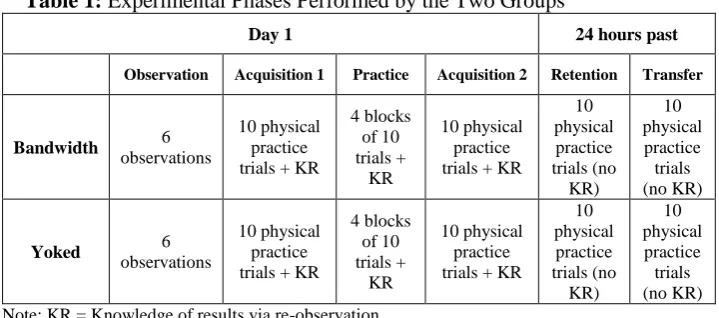
A summary of the experimental design is provided in Table 1. The participants were assigned at random to one of two experimental treatment groups (n = 5): Bandwidth and yoked group. All participants followed the same experimental procedures but differed in the reason of observation of model (KR) during acquisition and practice phases. All participants observed the model performance for six times before physical practice trials. The bandwidth group received a video of the model again, only when his performance fell outside the circle area, but the yoked group received the model on the same trial as the bandwidth group, whereas they did not know its reason. The participants were allowed a 1 min rest after every block (Al-Abood et al., 2001). Each trial was initiated by a ready command given by the experimenter approximately 2 s before the `go’ command to start the movement.
Other phases, called retention, were performed approximately 24 hours after the end of the acquisition. 2 and 10 minutes after retention was performed, the transfer test with distance reduction to 630 cm was taken.
Dependent Measures and Data Analysis
Movement coordination (relative timing): To examine the effect of bandwidth modeling on movement coordination, we computed the participants’ relative timing pattern to those of the model. The task was segmented into three steps: First or before kicking (start of knee flexion to end of knee flexion), second or during kicking (start of knee extension to first contact with the ball), and third step or after kicking (start of kicking the ball to the end of hip flexion). Due to variation in the time it took participants to begin the movement, the start and end points of the movement were normalized across trials. We used the following formula:
Relative timing error (AE prop) = |R1-T1|+|R2-T2|+|R3-T3|
complete the action in comparison to the model. The start point was when the knee started to flex, and the end point was when the hip fully flexed after ball shot and follow-through.
Statistical Analysis
All control and coordination variables were analyzed by using separate factorial analyses of variance (ANOVA) in both groups. For all analyses, means and standard deviations were computed for each participant for the first six Acquisition 1 trials, the last six Acquisition 2 trials, and the first six retention and transfer trials. We used the Bonferroni test to follow up significant effects as appropriate (alpha = p < .05). When we observed violations of the assumption of sphericity for repeated measures ANOVA, we adjusted data with a Greenhouse-Geisser correction.
RESULTS
Table 1: Experimental Phases Performed by the Two Groups
Day 1 24 hours past
Observation Acquisition 1 Practice Acquisition 2 Retention Transfer
Bandwidth 6
observations
10 physical practice trials + KR
4 blocks of 10 trials + KR 10 physical practice trials + KR
10 physical practice trials (no KR) 10 physical practice trials (no KR)
Yoked 6
observations
10 physical practice trials + KR
4 blocks of 10 trials + KR 10 physical practice trials + KR
10 physical practice trials (no KR) 10 physical practice trials (no KR) Note: KR = Knowledge of results via re-observation
Table 2: Mean (M) and Standard Deviation (SD) of Relative Timing Error
Test Period
Acquisition 1 Acquisition 2 Retention Transfer
Group M S M S M S M S
Bandwidth 23.38 11.78 22.39 11.06 25.11 16.30 24.85 15.81
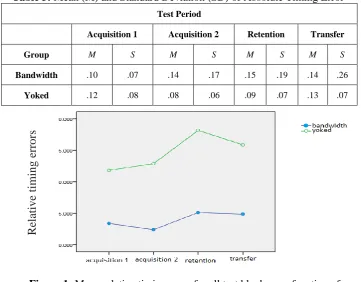
Table 3: Mean (M) and Standard Deviation (SD) of Absolute Timing Error
Test Period
Acquisition 1 Acquisition 2 Retention Transfer
Group M S M S M S M S
Bandwidth .10 .07 .14 .17 .15 .19 .14 .26
Yoked .12 .08 .08 .06 .09 .07 .13 .07
Figure 1: Mean relative timing error for all test blocks as a function of display for the two groups
Figure 2: Mean absolute timing error for all test blocks as a function of display for the two groups
R
elative
ti
mi
ng e
rr
ors
Absolut
e
ti
mi
ng e
rr
Movement coordination (relative timing): We analyzed the mean data for between and within group differences. No significant main effect was observed for trial blocks, F (2.631, 152.579) = 2.330, p = .085 and groups × trial blocks Interactions F (2.631, 152.579) = 0.511, p = 0.651. However, there was a significant main effect for groups F (3.56, 103.3) = 7.097, p = 0.001. Follow-up Bonferroni tests revealed significant differences between the two groups in Acquisition 1 (p = 0.031) and Acquisition 2 (p = 0.014). Also, there were significant differences between the two groups in retention block (p = 0.0004) and transfer block (p = 0.005), as shown in Table 2 and Figure 1.
Movement control (absolute timing): The ANOVA on mean absolute timing scores showed no significant effect for groups F(3.057, 88.64) = 1.354, P = 0.262 or groups × trial blocks Interactions F(2.512, 145.691) = 2.139, p = 0.109. Moreover, there was no significant main effect for trial blocks F (2.512, 145.691) = 2.139, p = 0.109. The results are shown in Table 3 and Figure 2.
DISCUSSION
The aim of the present study was to investigate the effect of bandwidth modeling on learning the soccer chip task via the comparison of a bandwidth group with a yoked group. We expected to see further advance of relative timing learning in the bandwidth group in comparison with the yoked group. As expected, we observed less relative timing error in the bandwidth group for the stages of acquisition, retention and transfer relative to the yoked group, while there was no difference between these two groups regarding absolute timing error. The results indicated that, in case of departure from the specified range, providing bandwidth feedback information in the form of re-demonstration of a skilled model and then having physical practice again to acquire soccer chip shot skill had a positive impact on relative timing learning of the movement. Thus, bandwidth learning is introduced as an effective method to increase relative timing learning within the field of observational learning (Buchanan et al., 2008; Shea et al. 2000).
be provided based on challenge point theory (Guadagnoli & Lee, 2004) which let the subject have more effective performance in the absence of a model by an optimal use of information proportional to the conditions of the practice and the experience level of the learner. One possible reason for the lower-level learning of relative timing in the yoked group in comparison with the bandwidth group could be attributed to the determination of a specific limit for the landing point of ball and re-demonstration of a skilled model upon departure from that specified limit. This is so because according to exploratory learning theory (Hayes, Ashford & Bennett, 2008), complex temporal-spatial motor actions are faster acquired if movement pattern is restricted. Our results are in agreement with the views of Scully and Newell (1985).
They stated that information acquired from observation is an aspect of coordination. On the other side, our results are inconsistent with those of Bahrampoor’s (2010). The study of the effect of bandwidth modeling in his work indicates the influence of this method on absolute timing, for which the reason could be the type of the task (sequential timing task). Since the ultimate goal of the task was set as the total time based on goal-directed imitation theory of Wohlschläger, Gattis, and Bekkering (2003), the ultimate goal of the task is the main restrictor that reduces the attention of the performer to other aspects.
However, in the present study, by selecting the task of soccer chip, putting emphasis on a specific component of movement was prevented. Furthermore, the circumstances made the test closer to the real sports situation.
CONCLUSIONS
movements, other sport techniques, and other types of feedback to introduce the best observational learning method.
REFERENCES
Adams, J. A. (1986). Use of model’s knowledge of results to increase the observer’s performance. Journal of Human Movement Studies, 12(2), 89-98.
Al-Abood, S. A., Davids, K., Bennett, S. J., Ashford, D. & Marin, M. M. (2001). Effects of manipulating relative and absolute motion information during observational learning of an aiming task. Journal of Sports Sciences, 19(7), 507-520. doi:10.1080/026404101750238962
Badets, A., & Blandin, Y. (2010). Feedback schedules for motor-skill learning: The similarities and differences between physical and observational practice. Journal of Motor Behavior, 42(4), 257-268.
doi:10.1080/00222895.2010.497512
Badets, A., Blandin, Y., Wright, D. L., & Shea, C. H. (2006). Error detection processes during observational learning. Research Quarterly for Exercise and Sport, 77(2), 177-184. doi:10.1080/02701367.2006.10599352 Bahrampoor, S. (2010). [Effect of bandwidth modelling on learning via
observational practice of a sequential timing task] (Unpublished master’s
thesis). Kharazmi University, Tehran, Iran. [In Persian]
Bandura, A. (1986). Social foundations of thought and action: A social cognitive theory. Englewood Cliffs, NJ: Prentice-Hall.
Blandin, Y., & Proteau, L. (2000). On the cognitive basis of observational learning: development of mechanisms for the detection and correction of errors. The Quarterly Journal of Experimental Psychology: Section A, 53(3), 846-867. doi:10.1080/713755917
Blandin, Y., Toussaint, L., & Shea, C. H. (2008). Specificity of practice: interaction between concurrent sensory information and terminal feedback. Journal of Experimental Psychology: Learning, Memory and Cognition, 34(4), 994-1000. doi:10.1037/0278-7393.34.4.994
Buchanan, J. J., Ryu, Y. U., Zihlman, K., & Wright, D. L. (2008). Observational practice of relative but not absolute motion features in a single-limb multi-joint coordination task. Experimental Brain Research, 191(2), 157-169. doi:10.1007/s00221-008-1512-8
Chow, J. Y., Davids, K., Button, C., & Koh, M. (2007). Variation in coordination of a discrete multi-articular action as a function of skill level.
Clark, J. E. (1994). Motor development. In: V. S. Ramachandran (Ed.),
Encyclopedia of Human Behaviour (Vol. 3, pp. 245-255). New York: Academic Press.
Dominey, P. F., Lelekov, T., Ventre-Dominey, J., & Jeannerod, M. (1998). Dissociable processes for learning the surface structure and abstract structure of sensorimotor sequences. Journal of Cognitive Neuroscience,
10(6), 734-751. doi:10.1162/089892998563130
Guadagnoli, M. A., & Lee, T. D. (2004). Challenge point: A framework for conceptualizing the effects of various practice conditions in motor learning. Journal of Motor Behavior, 36(2), 212-224. doi:10.3200/JMBR.36.2.212-224
Hayes, S. J., Ashford. D., & Bennett, S. J. (2008). Goal-directed imitation: The means to an end. Acta Psychologica, 127(2), 407-415. doi:10.1016/j.actpsy.2007.07.009
Horn, R. R., Williams, A. M., Scott, M. A., & Hodges, N. J. (2005). Visual search and coordination changes in response to video and point-light demonstrations without KR. Journal of Motor Behavior, 37(4), 265-274. Retrieved from http://europepmc.org/abstract/MED/15967752
Kelso, J. A. S. (1997). Relative timing in brain and behavior: some observations about the generalized motor program and self-organized coordination dynamics. Human Movement Science, 16(4), 453-460. doi:10.1016/S0167-9457(96)00044-9
Lai, Q., & Shea, C. H. (1999). Bandwidth knowledge of results enhances generalized motor program learning. Research Quarterly for Exercise and Sport, 70(1), 79-83. doi:10.1080/02701367.1999.10607734
Mattar, A. A. G., & Gribble, P. L. (2005). Motor learning by observing. Neuron,
46(1), 153-160. doi:10.1016/j.neuron.2005.02.009
Newell, K. M. (1985). Coordination, control and skill. In D. Goodman, R. B. Wilberg, & I. M. Franks (Eds.). Differing perspectives in motor learning, memory, and control (pp. 295-317). Amsterdam: North-Holland.
Schmidt, R. A. (1975). A schema theory of discrete motor skill learning.
Psychological Review, 82(4), 225-260. doi:10.1037/h0076770
Schmidt, R. A., & Lee, T. D. (2005). Motor control and learning: A behavioral emphasis (4th ed.). Champaign, IL: Human Kinetics.
Scully, D. M., & Newell, K. M. (1985). The acquisition of motor skills: Toward a visual perception perspective. Journal of Human Movement Studies,
11(4), 169-187.
Shea, C. H., Wright, D. L., Wulf, G., & Whitacre, C. (2000). Physical and observational practice affords unique learning opportunities. Journal of Motor Behavior, 32(1), 27-36. doi:10.1080/00222890009601357
Uehara, L. A., Button, C., & Davids, K. (2008).The effects of focus of attention instructions on novices learning soccer chip. Brazilian Journal of Biomotricity, 2(1), 63-77. Retrieved from http://www.redalyc.org/pdf/930/93020205.pdf
Vogt, S. (1995). On relations between perceiving, imaging and performing in the learning of cyclical movement sequences. British Journal of Psychology, 86(2), 191-216. doi:10.1111/j.2044-8295.1995.tb02556.x Winstein, C. J., & Schmidt, R., A. (1990). Reduced frequency of knowledge of
results enhances motor skill learning. Journal of Experimental Psychology: Learning, Memory, and Cognition, 16(4), 667-691. doi:10.3389/fpsyg.2010.00226