Please cite this article in press as: Alaba. L.S, Ajibola, Shohaimi S, Bakri Adam M, et al. Partial Least Square Path analysis of knowledge, attitude and practice regarding dengue. J Biostat Epidemiol. 2018; 4(4): 222-231
J Biostat Epidemiol. 2018;4(4): 222-231
Original Article
Partial Least Square Path analysis of knowledge, attitude and practice regarding dengue
Lamidi-Sarumoh Alaba Ajibola1,3, Shamarina Shohaimi1,2* Mohd. Bakri Adam2 Mohd. Noor Hisham Mohd. Nadzir1,
Oguntade Emmanuel Segun2
1 Department of Biology, Faculty of Science, Universiti Putra Malaysia, 43400 Serdang, Selangor, Malaysia 2 Institute for Mathematical Research, Universiti Putra Malaysia, 43400 Serdang, Selangor,Malaysia
3 Department of Mathematics, Faculty of Science, Gombe State University, P.M.B 127, Tundun Wada, Gombe, Nigeria
ARTICLE INFO ABSTRACT
Received 25.04.2018 Revised 27.10.2018 Accepted 02.12.2018 Published 20.12.2018
Key words:
Knowledge, Attitude, Practices, Dengue, Path analysis,
Introduction: Knowledge, attitude and practices regarding dengue are latent variables which are substantiated through manifest variables. The manifest variables that form the indicative construct of knowledge, attitude and practice can be factored into sub-constructs such that the impact of each indicative variable can be verified.
Method: Evaluation of the sub-constructs of knowledge, attitude and practices regarding dengue using a Partial least square path models with R programming language.
Result: The measurement model revealed the sub-constructs that are negatively affecting the latent variables and the ones that are having low impact.
Conclusion: This analysis gives the possibility of observing the exact knowledge, attitude and practices regarding dengue that are inadequate among respondents. The result from this methodological approach can be used as an aid for the community health programs and campaigns on how to enlighten the populace of interest on the required awareness about dengue, attitude towards dengue and the preventive practices that are deficient among them.
Introduction
Dengue fever (DF) is a viral infection spreading among humans through the bite of infected female Aedes mosquitoes (1). The specific vectors are Aedes aegypti and Aedes albopictus (2). Cartographic techniques used in exploring spatial information on the prevalence and incidence of DF had revealed that the spread of dengue could be as high as approximately 400 million per annum across the globe (3). Knowledge, attitude and practice (KAP) regarding DF and its vectors had been known to be an advantageous way of reducing the vectors population and curtail the spread of the infection.
http://jbe.tums.ac.ir 223 difficulty in breathing, low blood pressure or
collapse in people who had no previous history of DF (7). Aiming mostly at the dengue vectors to curtail the menace of dengue infection spread, KAP regarding dengue vectors and infection remain the cheapest and safest way of curtailing possible dengue outbreak compare to the disease risk, economic burden and possible eventual mortality after the incidence of the infection. During the 1950s and 1960s in Americas (8), dengue vectors were effectively eliminated through an eradication program named “eradication of open source breeding site” and another study from northern Thailand had also shown that the appropriate knowledge and awareness, the right attitude and habitual preventive practices against possible breeding sites of dengue vectors had reduced the dengue vectors and subsequent infection (9).
Presently, there is a break by the World Health Organization (WHO) on the first dengue vaccine because of the severe reaction caused by the vaccine on people who had never had DF (10,11). Curtailing the morbidity and mortality attributed to DF still lies within KAP regarding dengue although the prospect of KAP regarding dengue studies may depend on the methodological approach used in analyzing the data collected.
Materials and method
2.1 Data and instrumentData used in this study were sampled from a real-life data collected from an intercept sampling survey decisively to explain the how the Partial least square path analysis (PLS-path analysis) methodological approach can be used to improve KAP regarding dengue studies. The validated structured bilingual questionnaire (Malay and English language) used during the survey has 30 questions on knowledge which were factored into 6 sub-constructs, 13 questions on the attitude were factored into 4 sub-constructs and 14 questions on practices were also factored into 4 sub-constructs. All the sub-constructs were formed based on factor analysis. Partial least square path analysis was used to verify the weights of each sub-construct on the main construct via R programming language.
2.2 Latent constructs and definition of sub-constructs
Let x1, x2, …, xn be the manifest variables
which are used to indirectly measure approximate representation of the sub-constructs such that each question xi is 1 or 0 and
n=number of questions. The latent constructs were considered to be caused by the sub-constructs (cause-effect relationship).
𝑥
1… 𝑥
3𝑥
1… 𝑥
5𝑥
1… 𝑥
5𝑥
1… 𝑥
5𝑥
1… 𝑥
7𝑥
1… 𝑥
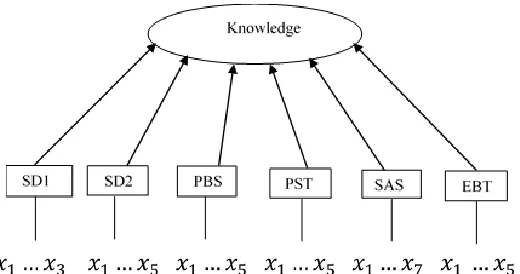
5Figure 1: Knowledge was measured by formative sub-constructs and the sub-constructs
http://jbe.tums.ac.ir 224 knowledge are staidness of dengue infection
(SD1), the severity of dengue fever and vectors (SD2), possible breeding site (PBS), primary and secondary transmission (PST), signs and
symptoms (SAS), elimination and biting time (EBT).
𝑥
1… 𝑥
3𝑥
1… 𝑥
4𝑥
1… 𝑥
3𝑥
1… 𝑥
3Figure 2: Attitude was measured by formative sub -constructs and the sub -constructs were also measured by manifest variables of attitude towa rds dengue. The sub
-constructs of attitude are staidness of dengue infection and prevention (SD3), elimination of dengue vectors (EDV), infection and re -infection (IAR) and consci ousness (CON).
𝑥
1… 𝑥
3𝑥
1… 𝑥
4𝑥
1… 𝑥
3𝑥
1… 𝑥
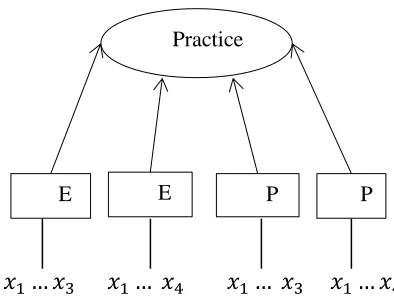
4Figure 3: Practices is measured by formative sub-constructs and the sub-constructs are also measured by the manifest variable of practices regarding dengue. The sub-constructs of practices
are the elimination of larval mosquitoes (ELM), elimination of adult mosquitoes (EAM), prevention from mosquitoes bite (PMB), and protective practices (PPT)
Practice s
E LM
E AM
P PT P
http://jbe.tums.ac.ir 225
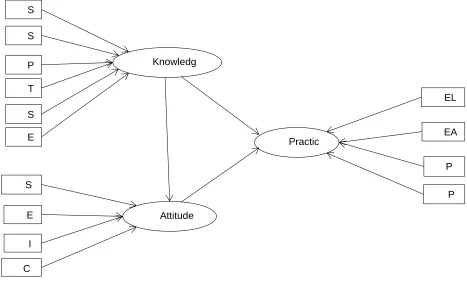
Figure 4: Path diagram depicting the knowledge, attitude and practices regarding dengue model.
Figure 4 showed that the ellipses are the inner models or structure showing the relationship between the latent constructs. The rectangles are the outer model showing the relationship between each construct and its indicative sub-constructs which form blocks for each of the latent variables.
The arrows represent the relationship between the variables.
The two simple KAP model was formulated based on the concept of KAP studies:1). The better the knowledge and attitude, the better practices and 2). The better the knowledge, the better the attitude.
𝑃𝑅𝐴𝐶𝑇𝐼𝐶𝐸𝑆1 = 𝑓( 𝐾𝑁𝑂𝑊𝐿𝐸𝐷𝐺𝐸1, 𝐴𝑇𝑇𝐼𝑇𝑈𝐷𝐸1 ) (2.2.1)
𝐴𝑇𝑇𝐼𝑇𝑈𝐷𝐸1 = 𝑓(𝐾𝑁𝑂𝑊𝐿𝐸𝐷𝐺𝐸1) (2.2.2)
The algorithm of PLS on KAP regarding dengue
Start: Answered validated structured KAP questionnaires regarding dengue Step 1: Factor the indicative sub-construct for each latent variable
Weight =1 for the correct answer Weight = 0 for the wrong answer
Step 2: Sum each of the correct sub-construct independently Step 3: Standardize the indicative sub-constructs scores Step 4: Calculate the outer approximation of latent variables Step 5: Obtain the inner weights
Attitude
suppressin
Knowledg esuppressing
S D1
S D2
P BS
T ST
S AS
E BT
S D3
E DV
I
C
Practic es
EL M
EA M
P MB
http://jbe.tums.ac.ir 226 Step 6: Calculate the internal approximation of the latent variables
Step 7: Obtain new outer weights
Repeat the last four steps until convergence of the outer weights End.
2.3 Framework for PLS-PM for KAP regarding dengue with R
Step 1: Install plspm and colortools
Install.package (“plspm”) Install.package (“colortools”)
After installation, the library can be used to load the package library (“plspm”)
Step 2: Import your data
data (KAP)
Figure (1), (2), (3) elucidates the variables and their descriptions
In order to accomplish a PLS-path model with the functions of plspm(), 3 elements had to be in place 1) data set, 2) the inner model and 3) the outer model.
2.3.1 The inner model matrix
The inner model is mostly referred to as structural model; it represents the connection of the latent variables somehow depicting a causal process or a network that can be represented in a path matrix format. The path matrix must be a square matrix (number of rows is equal to columns) and must also be a lower triangular Boolean matrix. The elements in the diagonal and above it must be zero but the element below the diagonal can either choose the value of zeros or ones.
Step 3: Definition of the inner matrix
> KNOWLEDGE1 = c (0,0,0) > ATTITUDE1 = c (1,0,0) > PRACTICES1 = c (1,1,0)
The matrix is created by row binding
> KAP_path = rbind (KNOWLEDGE1, ATTITUDE1, PRACTICES1) > colnames(KAP_path) = rownames(KAP_path)
> KAP_path
KNOWLEDGE1 ATTITUDE1 PRACTICES1
KNOWLEDGE1 0 0 0 ATTITUDE1 1 0 0 PRACTICES1 1 1 0
The matrix is read by columns affecting rows. In this case “Knowledge affect Attitude and Practices” and “Attitude affects Practices” the zeros in the diagonal means that no latent variable can affect itself (PLS-path models is solely meant for recursive models).
>
innerplot(KAP_path)
to
visualize the inner model.2.3.2 The outer model
The outer model specifies the set of indicative sub-constructs that form each blocks of the latent variables (KAP)
Step 4:
Definition of the indicative sub-constructs associated with the latent variable to form the outer model.
http://jbe.tums.ac.ir 227
The list above has three blocks; one per each block represents the indicative sub-constructs. The first block (1:6) corresponds to the latent variable knowledge (Figure 1) which is associated with the first six column of the data set. The second block (7:10) is associated with attitude (Figure 2) formed by column 7 to 10 of the data set and lastly, the third block (11:14) is associated with practices (Figure 3) formed by column 11 to 14 of the same data set.
Step 5: Definition of the vector mode
There are two possible modes in
plspm()namely Mode “A” and Mode “B”.
Mode A means that the indicative sub-constructs are reflective (cause-effect from the latent variable). Mode B means the indicative sub-constructs are formative (cause-effect to the latent variable).
In this case, all are latent variables are formative, thus the required vector mode is;
KAP_modes = c ("B", "B", "B")
Step 6: Run plspm analysis>KAP_pls =plspm(KAP,KAP_path, KAP_block,modes = KAP_modes)
>KAP_pls
Results and Discussion
Examining a PLS- Path model involves two phases: Assessment of the outer model
(measurement model) and the inner model (structural model). Assessing the outer model of
a formative indicator requires comparison of the outer weights in order to determine which of the indicative sub-constructs contributes mostly to the latent constructs, in other words, correlation of the “loadings” are not required (10).
3.1 Plot the measurement model
>plot(KAP_pls, what = "weights")
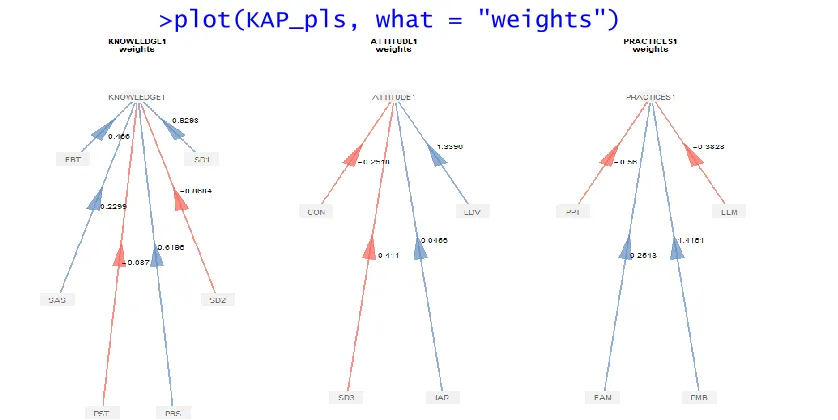
Figure 5: Measurement model showing the weights of each indicative sub -construct on the latent variables (red arrows signify negative influence while blue arrows signify positive influence).
From Figure 5, weights on KNOWLEDGE1 showed the two of indicative sub-constructs (PST and SD2) that are having a negative impact on the
http://jbe.tums.ac.ir 228 and vectors (SD2) are inadequate among the
respondents. SD2 has the weight of -0.8684 which means knowledge on primary and secondary transmission of dengue (PST = -0.087) is inadequate among the respondents but not as much the knowledge on the severity of dengue fever and vectors (SD2). In descending order, SD1, PBS, EBT and SAS had a positive impact on the latent variable of KNOWLEDGE1. Weights on ATTITUDE1 also revealed the two indicative sub-constructs (SD3 and CON) are having negative impact on the latent variable which means that attitude towards how serious dengue infection could be and prevention (SD3) and consciousness of being infected with dengue (CON) is inadequate among the respondents. Comparing both negative sub-constructs, CON has less weight than SD3. The indicative
sub-construct that have positive contribution to the latent variable is the attitude towards infection and re-infection (IAR) although positive but very low compare to attitude about the elimination of dengue vectors (EDV).
Weights on PRACTICES1 indicated that practices on the elimination of the larval mosquitoes (ELM) and protective practices (PPT) are inadequate among the respondents because of their negative impact on the latent variables. The positive indicative sub-constructs are protection from mosquitoes bite (PMB) and the elimination of adult mosquitoes (EAM). The two positive sub-constructs (PMB and EAM) are already known among the respondents although EAM was lower among the respondents than PMB.
3.2 Plot the structural model
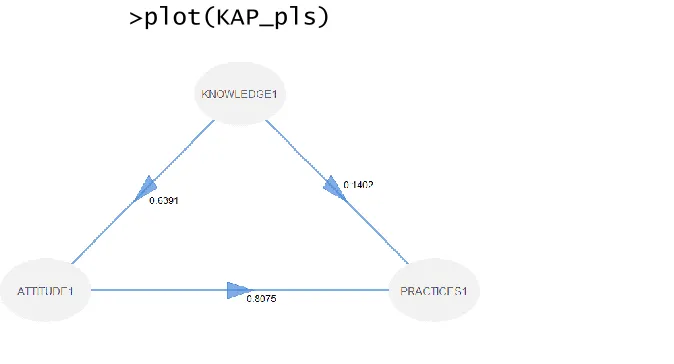
>plot(KAP_pls)
Figure 6: Structural model sho wing the relationship between the latent variables.
>KAP_pls$inner_model to extract the
estimates which can be used to calculate the scores of the latent variables. From equation
http://jbe.tums.ac.ir 229
ATTITUDE1 = 4.761375𝑒−16+ 6.391013𝑒−01(KNOWLEDGE1 ) + 𝑒𝑟𝑟𝑜𝑟 (4.2.1)
$ATTITUDE1
Estimate Std. Error t value Pr(>|t|)
Intercept 4.761375e-16 0.1812839 2.626474e-15 1.000000000
KNOWLEDGE1 6.391013e-01 0.1812839 3.525416e+00 0.002416401 From equation (2.2.1), the model
PRACTICES1 as a function of KNOWLEDGE1
and ATTITUDE1 can be estimated with the equation below:
PRACTICES1 = −1.111388𝑒−15+ 1.402388𝑒−01 (KNOWLEDGE1) + 8.074686𝑒−01(ATTITUDE1)
+ 𝑒𝑟𝑟𝑜𝑟 (4.2.2)
$PRACTICES1
Estimate Std. Error t value Pr(>|t|)
Intercept -1.111388e-15 0.1039191 -1.069475e-14 1.000000e+00 KNOWLEDGE1 1.402388e-01 0.1351138 1.037931e+00 3.138408e-01 ATTITUDE1 8.074686e-01 0.1351138 5.976212e+00 1.502835e-05
>KAP_pls$inner_summary[, "R2", drop = FALSE] to extract the coefficient of determination 𝑅2
R2
KNOWLEDGE1 0.0000000 ATTITUDE1 0.4084505 PRACTICES1 0.8164141
The estimated model from equation (4.2.1) has a coefficient of determination 𝑅2of 0.41 which means that the amount of variability in ATTITUDE1 can be explained by 41% of KNOWLEDGE1 of the respondents.The estimated model from equation (4.2.2) has a coefficient of determination 𝑅2 of 0.82which
http://jbe.tums.ac.ir 230 coefficient (figure 7), the above extraction will
also give indirect effects and total effects.
relationships direct indirect total
1 KNOWLEDGE1 -> ATTITUDE1 0.6391013 0.0000000 0.6391013
2 KNOWLEDGE1 -> PRACTICES1 0.1402388 0.5160542 0.6562930
3 ATTITUDE1 -> PRACTICES1 0.8074686 0.0000000 0.8074686
Among the latent variables of the structural model, it is was shown that the relationship between KNOWLEDGE1 and PRACTICES1 has indirect effects which make the total effect of their relationship to be 0.6562930. The total effect of KNOWLEDGE1 to ATTITUDE1 and ATTITUDE1 to PRACTICES1 remains the same as the direct effects because there were no indirect effects existing between both relationships. Furthermore, the relationship between KNOWLEDGE1 to ATTITUDE1 and ATTITUDE1 to PRACTICES1 were significant.
Conclusion
The conceptual motive for assuming all the latent variables was formed by their indicative sub-constructs was based on the fact that there are some KAP regarding dengue that is already famous among some populace while some are still lacking. With the formative latent variable, the extractions of the weight of each indicative sub-constructs on the latent variables were verified. In conclusion, it is not always appropriate to add up all the test scores of latent variables together and make conclusions without
considering the effects and weights of the indicative sub-constructs on the latent variable which may assist to project into the future of community health and vector reduction programs on dengue.
What was known before?
Majority of KAP regarding dengue studies (14) based the scores of the latent variables on the overall composite score, analysis and conclusions were made without verifying the impacts of the sub-constructs.
The novelty of the study
Indicative sub-constructs were factored and scored independently; their impacts on the main latent variables were verified by using Partial least square path model analysis in a formative mode
References
1.Gubler DJ. Epidemic dengue / dengue hemorrhagic fever as a public health , social and economic problem in the 21st century. Trends Microbiol. 2002;10(2):100–3.
http://jbe.tums.ac.ir 231 Entomol [Internet]. 2005;42(5):821–5. Available
from:
http://www.ncbi.nlm.nih.gov/pubmed/16363166 3.Murray NEA, Quam MB, Wilder-Smith A. Epidemiology of dengue: Past, present and future prospects. Clin Epidemiol. 2013;5(1):299–309. 4.Malavige GN. Dengue viral infections. Postgrad Med J [Internet]. 2004;80(948):588–
601. Available from:
http://pmj.bmj.com/cgi/doi/10.1136/pgmj.2004. 019638
5.Rothman AL. Immunity to dengue virus: A tale of original antigenic sin and tropical cytokine storms. Nat Rev Immunol [Internet]. 2011;11(8):532–43. Available from: http://dx.doi.org/10.1038/nri3014
6.Flasche S, Jit M, Rodríguez-Barraquer I, Coudeville L, Recker M, Koelle K, et al. The Long-Term Safety, Public Health Impact, and Cost-Effectiveness of Routine Vaccination with a Recombinant, Live-Attenuated Dengue Vaccine (Dengvaxia): A Model Comparison Study. PLoS Med. 2016;13(11):1–19.
7.Khunsha Fatima, Syed NI. Dengvaxia controversy: impact on vaccine hesitancy. J Glob Health. 2018;8(2):8–10.
8.Schliessmann DJ. Aedes aegypti eradication program of the United States--progress report 1965. Am J Public Health Nations Health [Internet]. 1967;57(3):460–5. Available from: https://www.ncbi.nlm.nih.gov/pmc/articles/PMC
1227178/pdf/amjphnation00071-0078.pdf%0Ahttp://www.pubmedcentral.nih.go v/articlerender.fcgi?artid=1227178&tool=pmcen trez&rendertype=abstract
9.Benthem BHB Van, Khantikul N, Panart K, Kessels PJ, Somboon P, Oskam L. Knowledge and use of prevention measures related to dengue in northern Thailand. Trop Med Int Heal. 2002;7(11):993–1000.
10.Aguiar M, Halstead SB, Stollenwerk N. Consider stopping dengvaxia administration without immunological screening. Expert Rev Vaccines [Internet]. 2017;16(4):301–2. Available
from:
http://dx.doi.org/10.1080/14760584.2017.12768 31
11.Robinson ML, Durbin AP. Dengue vaccines: Implications for dengue control. Curr Opin Infect Dis. 2017;30(5):449–54.
12.Kaliyaperuma K. Guideline for Conducting a Knowledge, Attitude and Practice (KAP) Study. Community Ophthalmol [Internet]. 2004;IV(1):7–9. Available from: http://v2020eresource.org/content/files/guideline _kap_Jan_mar04.pdf
13.Sanchez G. PLS Path Modeling with R [Internet]. R Package Notes. 2013. 235 p.
Available from:
http://gastonsanchez.com/PLS_Path_Modeling_ with_R.pdf