2008-5435/14/63-132-141
INTERNATIONAL JOURNAL OF OCCUPATIONAL HYGIENE Copyright © 2008 by Iranian Occupational Health Association (IOHA) IJOH 9: 132-141, 2017
ORIGINAL ARTICLE
Assessing and Comparing Human Errors in Technical Operations
in Petroleum Wells using Basic and Extended CREAM Technique
HASTI BORGHEIPOUR
1*, IRAJ MOHAMADFAM
2, MOHSEN ASADIAN NARENJI
31
Department of Environment, Islamic Azad University, Parand Branch, Parand, Iran; 2
Department of Occupational Health, School of Public Health, Hamadan University of Medical Sciences,
Hamadan, Iran; 3
MSc. of Management of Health, Safety, and Environment (HSE), Central Tehran Branch, Islamic Azad
University, Tehran, Iran.
Received June 08, 2017; Revised July 15, 2017; Accepted Agust 23, 2017
This paper is available on-line at http://ijoh.tums.ac.ir
ABSTRACT
Excavating operations are among operations with high risk of accidents. Human errors have been identified as the main reason of such hazardous accidents. The present essay is going to scrutinize human errors type and probability in technical services in petroleum wells focusing on comparing acidizing and cementing operations. The basic and extended CREAM method was applied in this research. Initially, the main tasks and sub-tasks were identified in both operations. Then, control modes, common performance condition, cognitive failure probability were determined. In acidizing operations, 61.63% of the control modes were strategic and 7.69% of the opportunistic mode, while they were 25% and 12.5% in cementing operation, respectively. In acidization and cementation operations, the time of day, number of simultaneous goals and sufficiency of training and experience were considered as factors reducing performance. Furthermore, the cognitive failure probability has been more than 0.005 in 34% of sub-tasks in acidization operation, whereas in cementing, the failure probability has been more than this amount in 50% of the sub-tasks. The strategic control mode has held the highest percentage of control modes. In addition, in investigating the comparison of the more hazardous, the percentage of more strategic control in acidization operation indicates that acidization is safer than the cementation one. Considering the higher probability of cognitive failure under the sub-tasks of cementing operations, the probability of failure in the cementing is higher than that of acidization and is more hazardous. Therefore, it needs to implement some measures for decreasing human errors at these hazardous operations.
KEYWORDS: CREAM technique, Technical operations in petroleum wells, Human error, Cognitive failure
INTRODUCTION
Texas City Disaster in 1947, Bhopal in 1984, Piper Alpha disaster in 1988, and Texaco Refinery fire in 1994 all have human errors either as a direct cause or an indirect cause. In fact, the human role in safety has not been adequately addressed [1]. Human errors are identified as one of the main reasons for accidents and possible negative impacts on most complex technical sectors [2].
Corresponding author: Hasti Borgheipour Email:[email protected]
An occupational accident will temporarily and permanently disrupt the balance in the working environment in which it occurs [3]. Moreover, they are the main factor of accidents in high-risk industries like gas and oil industries [4].
133| IJOH | September 2017 | Vol. 9 | No. 3 Borgheipour, et al
one of the top priorities in their plans so as to prevent such disasters in planning stages, gas, and petroleum excavating operations. The companies can provide different engineering and technical services such as wiring, acidizing, mechanical drilling steam test, infectivity, casing running, liner hanger, well testing, coil tubing, and air drilling.
Several accidents have occurred in recent years in excavating operations and human errors have been one of the most important reasons of these accidents’ occurrence. Some of these human errors including distraction while cutting cement leading to damage to the face and jaw; being careless about opening the valves respectively and pipe burst; not putting a quoin under the tire resulting in movement of pump truck, breaking the valves and pips, and oil leaking; lack of proper shoes and slipping and falling in oil pit; lack of training in acid mixing leading to the corrosion of the pipes and valves immediately; inattention to the direction of wind blowing leading to the drop of the box’s door; inattention to maintenance and bursting the hose of compressor; inattention to using of mask that led to pulmonary diseases; and no use of anti-acid gloves that lead to Acid burn [6]. Therefore, since human errors will end in disastrous accidents, it is necessary to identify and evaluating them.
In this regard, the current study was conducted with the aim of assessing and comparing the acidization and cementation operations in petroleum wells by the Cognitive Reliability and Error Analysis Method (CREAM). The application of CREAM technique to evaluate human errors has many advantages including a systematic structure for defining and quantifying human errors, classification scheme, contextual control model of cognition, and definition of the cause of human errors based on factors related to human, technology and organization [7].
Several studies have been done on human errors using CREAM technique. In 2015, human error using cognitive ergonomics approach was studied in the control room of cement industry. Human errors can be identified by the method of two or more tasks simultaneously, the quality of work experience, training, and comprehensive knowledge of errors [8].
The cognitive human error analysis was scrutinized in the control room of petrochemical industry. As a result, empowerment, the working hours, and common performance conditions (CPCs) identified as factors diminishing work efficiency. It is also important to adopt priority in activities, conduct meetings, announce staff about work permits’ due time, hold training sessions, and assess the polluting elements [9].
Another study was conducted on human errors in control room of petrochemical industry
using CREAM technique by ergonomics approach. The most cognitive failure includes performance error. Additionally, the most important cognitive activities dealt with control process in control room, communicating activity, monitoring, and planning [7].
The other research evaluated nurses’ human errors in I.C.U by CREAM technique. Modifying nurses’ working shifts and taking applied training courses can be directed to the decrease in the rate of human errors [10].
The effect of work conditions was investigated on the performance of operator (CPCs) and considered the total error probability by CREAM technique in one of the operating regions of gas Transition Company. Any of the CPCs factors were not able to decline operator performance [11]. The CREAM technique was applied to identify that the most effective factors decreasing the operation include working conditions, the available time, and the compatibility between human systems and machines [5].
Because of the nature of the materials and the types of existing work in the acidification and cementing of oil wells, the occurrence of a human error can have irreparable consequences for humans and environmental resources. This is the reason why this operation has been selected in this study. The selection of these two operations was based on incident records and consultation by the specialists of Iran’s National Excavation Company.
MATERIALS AND METHODS
The present essay has scrutinized human errors related to cementation and acidization of petroleum wells using CREAM technique. This method holds both the basic and extended ones. The following steps are taken to investigate human errors by CREAM method.
Defining the task steps by Hierarchical Task Analysis (HTA) method: Annett and Ducan developed HTA in 1967. The method explains the main task steps that, in principle, can be analyzed in further detail until the most elementary actions have been found [12]. The hierarchal analysis structure focuses on the intended job and analyzes the necessary steps to do that activity. In fact, the analysis task is commenced by targeting the final goal and the task is divided into smaller components to achieve the goal [14].
Assessing and Comparing Human Errors … ijoh.tums.ac.ir | 134
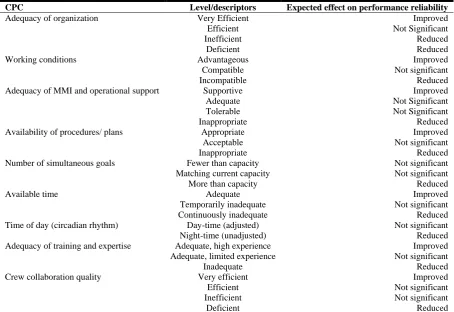
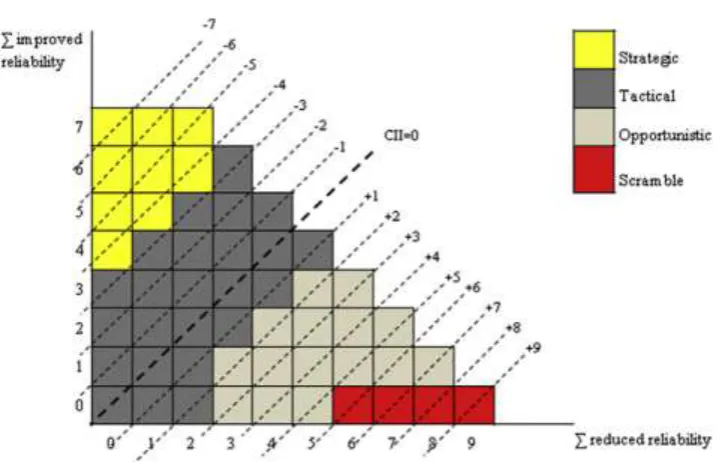
error probability (HEP) interval of strategic mode is ranged from 0.5 E-5 to 1.0 E-2 and the tactical mode distance is placed between1.0 2 and 0.5 E-0, 1.0 E-1. The intervals of scrambled and opportunistic mode are marked from1.0 E-2 and 0.5 E-0, 1.0 E-1 and 1.0 E-0 respectively. Fig. 1 displays the basic operator control modes. Common performance conditions can contribute to determining the cognition of human and action circumstance, which maintain a well-organized foundation for defining the conditions in which the performances are expected to be held. Furthermore, the CPCs have been practiced by CREAM technique to specify sets of probable modes and errors. Table 1 illustrates the CPCs and related Expected effect on performance [12].
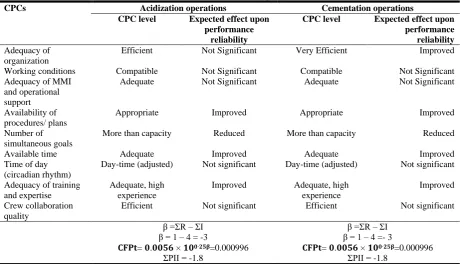
In order to obtain CPCs scores, first, the number of times that is expected to reduce or increase performance reliability and not having any significant effect on performance reliability are counted. After gaining total CPCs scores, basic operator control modes are defined to evaluate human performance reliability. The total number of activities optimizing the performance has been subtracted from the total number of activities decreasing the performance (β = ΣR - ΣI). The equation 1 is used to determine the total cognitive failure probability [12].
Equation 1:
CFPt = 0.0056 × 10 0.25β
Table 1. CPCs and performance reliability
CPC Level/descriptors Expected effect on performance reliability
Adequacy of organization Very Efficient Improved
Efficient Not Significant
Inefficient Reduced
Deficient Reduced
Working conditions Advantageous Improved
Compatible Not significant
Incompatible Reduced
Adequacy of MMI and operational support Supportive Improved
Adequate Not Significant
Tolerable Not Significant
Inappropriate Reduced
Availability of procedures/ plans Appropriate Improved
Acceptable Not significant
Inappropriate Reduced
Number of simultaneous goals Fewer than capacity Not significant Matching current capacity Not significant
More than capacity Reduced
Available time Adequate Improved
Temporarily inadequate Not significant
Continuously inadequate Reduced
Time of day (circadian rhythm) Day-time (adjusted) Not significant
Night-time (unadjusted) Reduced
Adequacy of training and expertise Adequate, high experience Improved Adequate, limited experience Not significant
Inadequate Reduced
Crew collaboration quality Very efficient Improved
Efficient Not significant
Inefficient Not significant
Deficient Reduced
Detecting Cognitive Failure Probability (CFP): The cognitive failure probability shows probability of failure for each cognitive failure type. The amounts of cognitive failure probability are added to the system operation action in order to gain the probability of human error. Considerably, the characteristics of common performance conditions are practiced to adapt the nominal Cognitive failure Probability as shown in Table 2 [12]. Equation 2 is used to calculate the CFP representing the probability of final cognitive function. In this equation, CFP0 denotes to the probability of nominal cognitive failure due to
135| IJOH | September 2017 | Vol. 9 | No. 3 Borgheipour, et al
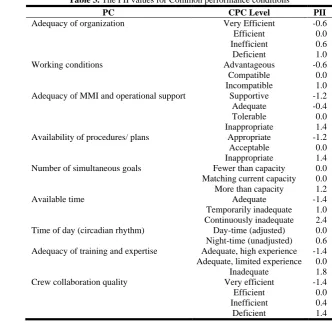
scores where the control modes are divided into region to estimate the CII value. The CPCs combined scores for Σ not significant have no effect upon human performance reliability, the value of context influence index is considered as zero. In case CII reaches zero, CFP equals CFP0. Since this condition is for screening stage only, the extended CREAM can be employed in order to execute detailed reliability analysis. As shown in Equation 4, PII has been applied to estimate the specific quantitative effects of the CPCs rather than linguistic cluster of the CPCs effect upon performance reliability. Table 3 presents the values of PII for common performance conditions [15].
Equation 2:
CFP = CFP0. 10 0:25 CII
Equation 3:
CII = Σreduced - Σimproved
Equation 4:
(4)
Table 2. Nominal cognitive failure probability
Cognitive
function Generic failure type
Basic value
Observation O1. Wrong object
observed 1.0 E_3 O2. Wrong
identification 7.0 E_2 O3. Observation not
made 7.0 E_2 Interpretation I1. Faulty diagnosis 2.0 E_1 I2. Decision error 1.0 E_2
I3. Delayed
interpretation 1.0 E_2 Planning P1.Priority error 1.0 E_2 P2.Inadequate plan 1.0 E_2
Execution E1. Action of wrong
type 3.0 E_3 E2. Action at wrong
time 3.0 E_3 E3. Action on wrong
object 5.0 E_4 E4. Action out of
sequence 3.0 E_3 E5. Missed action 3.0 E_2
Table 3. The PII values for Common performance conditions
PC CPC Level PII
Adequacy of organization Very Efficient -0.6 Efficient 0.0 Inefficient 0.6 Deficient 1.0
Working conditions Advantageous -0.6
Compatible 0.0 Incompatible 1.0 Adequacy of MMI and operational support Supportive -1.2 Adequate -0.4 Tolerable 0.0 Inappropriate 1.4 Availability of procedures/ plans Appropriate -1.2 Acceptable 0.0 Inappropriate 1.4 Number of simultaneous goals Fewer than capacity 0.0 Matching current capacity 0.0 More than capacity 1.2
Available time Adequate -1.4
Assessing and Comparing Human Errors … ijoh.tums.ac.ir | 136
Fig. 1. Context influence index and control modes
RESULTS
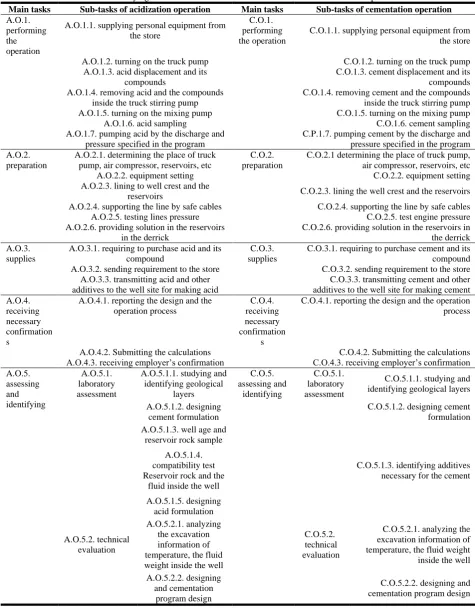
Hierarchical Task Analysis in acidization and cementation operations: Table 4 illustrates the results of task identification and the sub-tasks of acidization and cementation services of petroleum wells. Holistically, 5 main tasks and 26 sub-ones have been identified for acidization operation (A.O), 5 main tasks, and 24 sub-ones detected for cementation operation (C.O).
Reliability analysis based on basic version: Based on the steps mentioned in section two, this section specified the relationship between CPCs, the level of performance reliability for each one of the sub-tasks in the cementation and acidization operations as well as the final result of basic CREAM for the above-mentioned operation. For example, Table 5 illustrates the relationship between the CPCs and the level of performance reliability for the sub-task of turning on the truck pump. Notably, the expected effect on the level of performance reliability has been scrutinized. In both cementation and acidization operations, the sub-tasks included 9 and 6 strategic control, 15 sub-tasks had tactical control, 2 and 3 sub-tasks had opportunistic control. In acidization operation, the sub-tasks included compatibility test, acid formulation design, identifying geological layers with (β) control level index equal to -6 and CFPt equal to 0.000177. Remarkably, they scored the
highest control level, while the sub-task of identifying the geological layers with (β) control level index equal to -6 and CFPt equal to 0.000177 had the highest control level (strategic control) in cementation operation. Regarding to the lowest control level, the sub-tasks of transmitting acid and other materials to the well location for producing acid had the control level index of 4 and the total error probability of 0.056. Furthermore, the sub-task of displacing acid and its compounds held the control level index of 2 and the total error probability of 0.0177. Hence, they were identified as the lowest control level (opportunistic control) in acidization operation. The lowest control level (opportunistic control) was related to the sub-task of transmitting cement and other additives to the well site for making cement with the control level index of 3 and the total error probability of 0.031489 AND ALSO the sub-task of supplying solution in the present reservoirs at the derrick or at well and adjusting the equipment with the control level index of 2 and the total error probability of 0.0177 in cementation process. Other results are presented in Table 6.
137| IJOH | September 2017 | Vol. 9 | No. 3 Borgheipour, et al
Table 4. Identifying the main tasks and sub-ones in acidization and cementation operation
Main tasks Sub-tasks of acidization operation Main tasks Sub-tasks of cementation operation
A.O.1. performing the operation
A.O.1.1. supplying personal equipment from the store
C.O.1. performing the operation
C.O.1.1. supplying personal equipment from the store
A.O.1.2. turning on the truck pump C.O.1.2. turning on the truck pump A.O.1.3. acid displacement and its
compounds
C.O.1.3. cement displacement and its compounds A.O.1.4. removing acid and the compounds
inside the truck stirring pump
C.O.1.4. removing cement and the compounds inside the truck stirring pump A.O.1.5. turning on the mixing pump C.O.1.5. turning on the mixing pump
A.O.1.6. acid sampling C.O.1.6. cement sampling
A.O.1.7. pumping acid by the discharge and pressure specified in the program
C.P.1.7. pumping cement by the discharge and pressure specified in the program A.O.2.
preparation
A.O.2.1. determining the place of truck pump, air compressor, reservoirs, etc
C.O.2. preparation
C.O.2.1 determining the place of truck pump, air compressor, reservoirs, etc A.O.2.2. equipment setting C.O.2.2. equipment setting A.O.2.3. lining to well crest and the
reservoirs C.O.2.3. lining the well crest and the reservoirs A.O.2.4. supporting the line by safe cables C.O.2.4. supporting the line by safe cables A.O.2.5. testing lines pressure C.O.2.5. test engine pressure A.O.2.6. providing solution in the reservoirs
in the derrick
C.O.2.6. providing solution in the reservoirs in the derrick A.O.3.
supplies
A.O.3.1. requiring to purchase acid and its compound
C.O.3. supplies
C.O.3.1. requiring to purchase cement and its compound A.O.3.2. sending requirement to the store C.O.3.2. sending requirement to the store
A.O.3.3. transmitting acid and other additives to the well site for making acid
C.O.3.3. transmitting cement and other additives to the well site for making cement A.O.4.
receiving necessary confirmation s
A.O.4.1. reporting the design and the operation process
C.O.4. receiving necessary confirmation
s
C.O.4.1. reporting the design and the operation process
A.O.4.2. Submitting the calculations C.O.4.2. Submitting the calculations A.O.4.3. receiving employer’s confirmation C.O.4.3. receiving employer’s confirmation A.O.5.
assessing and identifying
A.O.5.1. laboratory assessment
A.O.5.1.1. studying and identifying geological
layers
C.O.5. assessing and
identifying
C.O.5.1. laboratory assessment
C.O.5.1.1. studying and identifying geological layers
A.O.5.1.2. designing cement formulation
C.O.5.1.2. designing cement formulation A.O.5.1.3. well age and
reservoir rock sample
C.O.5.1.3. identifying additives necessary for the cement A.O.5.1.4.
compatibility test Reservoir rock and the
fluid inside the well
A.O.5.1.5. designing acid formulation
A.O.5.2. technical evaluation
A.O.5.2.1. analyzing the excavation information of temperature, the fluid weight inside the well
C.O.5.2. technical evaluation
C.O.5.2.1. analyzing the excavation information of temperature, the fluid weight inside the well
A.O.5.2.2. designing and cementation
program design
Assessing and Comparing Human Errors … ijoh.tums.ac.ir | 138
Table 5. The relationship between CPCs and the performance reliability level for the sub-task of turning on truck pump in
acidization and cementation operations
CPCs Acidization operations Cementation operations
CPC level Expected effect upon
performance reliability
CPC level Expected effect upon
performance reliability Adequacy of
organization
Efficient Not Significant Very Efficient Improved
Working conditions Compatible Not Significant Compatible Not Significant Adequacy of MMI
and operational support
Adequate Not Significant Adequate Not Significant
Availability of procedures/ plans
Appropriate Improved Appropriate Improved
Number of simultaneous goals
More than capacity Reduced More than capacity Reduced
Available time Adequate Improved Adequate Improved
Time of day (circadian rhythm)
Day-time (adjusted) Not significant Day-time (adjusted) Not significant
Adequacy of training and expertise
Adequate, high experience
Improved Adequate, high experience
Improved
Crew collaboration quality
Efficient Not significant Efficient Not significant
β =ΣR – ΣI β = 1 – 4 = -3
= . × .
=0.000996 ΣPII = -1.8
β =ΣR – ΣI β = 1 – 4 =- 3
= . × .
=0.000996 ΣPII = -1.8
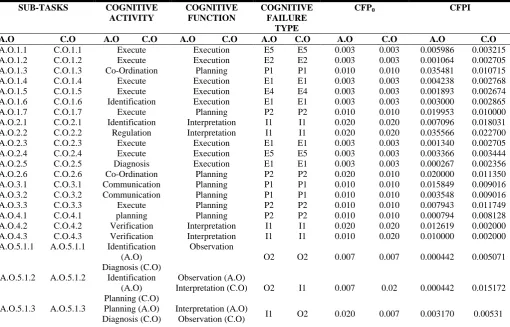
Reliability analysis based on extended version: Table 7 indicates the results related to the extended version of CREAM for cementation and acidization operations. Acidization operation specified that from all the identified errors, 35% (9 tasks) related to execution error, 31% (8 tasks) made by planning error, 23% (6 tasks) caused by interpretation error and 11% (3 errors) affected by observation error. From cognitive activities included 31% of execute, 15% of planning and identification each one of them, 8% of diagnosis, communication and verification, 7% of coordination and 4% of monitoring and regulation. The highest level in human errors was detected in the reservoirs by the cognitive failure probability (CFPi) of 0.02 and acid pumping with specific discharge and pressure in the program along with the cognitive failure probability of 0.0199. As a result, errors related to execution and planning were identified as the most important human’s errors in acidization operation.
In cementation operation, results related to assessing human errors using the extended CREAM method revealed that from all the identified errors, 34% made by planning error, 33% related to execution error, 25% caused by interpretation error and 8% affected by observation error. Cognitive activities included 13% of diagnosis and planning and 8% of identification, verification, coordination and communication. Finally, cognitive activities like monitoring and regulation scored 4% of the errors. The most
significant tasks identified with high error probability include the sub-tasks of adjusting the equipment with CFPi of 0.0227 (cognitive activity of regulation and cognitive failure of interpretation), locating the pump, truck, air compressor and reservoirs (cognitive activities of identification and cognitive failure of interpretation) with the error probability of 0.0180 and analyzing the excavation information of temperature, the fluid weight inside the well.
DISCUSSION
139| IJOH | September 2017 | Vol. 9 | No. 3 Borgheipour, et al
conditions, available time and adequacy of MMI and operational support were mentioned as the most effective decreasing factor of performance [5].
Difference of tasks in different jobs could also be the reason of differences in the results of various researches. Therefore, it is necessary to diminish human errors and increase performance reliability in both operations by reducing the performance reduction factors. As a result, the manager of project should study and edit operating guidelines and schedule. In this way, there will be enough time between each operation to prepare. Besides, because of the different conditions of each well, the personnel should be trained to be ready for operation repeatedly. It is demonstrated that moving forward to strategic control is to enhance the performance reliability. In other words, reduce the overall probability of a cognitive error [12].
Strategic control involves controlling all elements of the organization at the subjective and conceptual level. Since organizational elements are made up of purposes and strategy, technology, structure, human source, environment, culture, and etc., strategic control is considered the most vital and significant among all these elements [13].
In this research, the lowest control level (opportunistic control) was related to the sub-task of transmitting acid/cement and other additives to the well site for making acid/cement in both acidization and cementation operations and its reason is transportation unit.
There are problems in coordination between transportation and acidization and cementation units. Besides, the percentage of plug in is determined by employer’s final view. The kind and quantity of plug in are determined according to contractors’ experience, but sometimes the employer’s view remains and these two different views cause an error.
Tactical control scored the highest percentage in control modes in both cementation and acidization operations. Even though the performance was based on planning and followed a process with few rules in tactical control mode, the nature of the work needs to promote this type of control into a strategic one where the possibility of human error is much more limited compared to tactical kinds [5]. The percentage of the strategic control modes are less than the tactical control ones in both operations, so necessary measures should be conducted to move forward to strategic control. It comes off by training, updating of guidelines, administrative methods, and encouraging personnel. As the percentage of the strategic controls in acidization operation is more than the
cementation one from the viewpoint of being more hazardous, this operation is safer.
The most percentage of total declared errors in acidization operation have includes the failure of Execution, and in cementation operation have includes the failure of planning. The errors can be reduced by planning and consulting with experienced people, having more supervision before and during operations, accurate training and personnel selection based on the nature of work.
In acidization, preparation is one of the main task preparation includes two sub-tasks with high-risk probability. Therefore, setting the equipment and providing solution in the reservoirs in the derrick are among the critical sub-tasks. The considerable point is that setting the equipment in both studied operations has the highest cognitive failure probability. Therefore, it is essential to perform such activities as technical training and the holding of smell workshops repeatedly and has epidemically studying for knowing errors.
To reduce the errors and provide solutions in the reservoirs, professional personnel noticing properties of the well should be employed in the derrick. Pumping acid by the discharge and pressure specified in the program is one of decretive sub-tasks in acidization operation and for reducing probability.
Assessing and Comparing Human Errors … ijoh.tums.ac.ir | 140
Table 6. Results of basic CREAM for acidization and cementation operations
CONTROL MODE Σ R Σ I SUB-TASKS MAIN TASKS CONTROL MODE ΣR ΣI SUB-TASKS MAIN TASKS Cementation operations Acidization operation Tactical 0.056112 1 2 1 C.O.1.1 C. O.1 Tactical 0.009957 1 2 1 A.O.1.1 A.O.1 Tactical 0.000996 -3 1 4 C.O.1.2 Tactical 0.000996 -3 2 4 A.O.1.2 Tactical 0.056231 1 3 2 C.O.1.3 Tactical 0.017708 2 3 1 A.O.1.3 Tactical 0.003149 -1 1 2 C.O.1.4 Tactical 0.005612 0 2 2 A.O.1.4 Tactical 0.001771 -2 0 2 C.O.1.5 Tactical 0.003149 -1 1 2 A.O.1.5 Tactical 0.003149 -1 1 2 C.O.1.6 Tactical 0.005621 0 1 1 A.O.1.6 Tactical 0.005612 0 2 2 C.O.1.7 Tactical 0.009957 1 3 2 A.O.1.7 Tactical 0.001771 -2 1 3 C.O.2.1 C. O.2 Tactical 0.001771 -2 1 3 A.O.2.1 A.O.2 Opportunistic 0.017708 2 2 0 C.O.2.2 Tactical 0.009957 1 2 1 A.O.2.2 Tactical 0.003149 -1 2 3 C.O.2.3 Tactical 0.003149 -1 2 3 A.O.2.3 Tactical 0.001771 -2 3 1 C.O.2.4 Tactical 0.009957 1 3 2 A.O.2.4 Strategic 0.000315 -5 5 0 C.O.2.5 Strategic 0.000315 -5 5 0 A.O.2.5 Opportunistic 0.017708 2 3 1 C.O.2.6 Tactical 0.005611 0 2 2 A.O.2.6 Tactical 0.003149 -1 1 2 C.O.3.1 C. O.3 Tactical 0.009957 1 1 0 A.O.3.1
A.O.3 A.O.3.2 2 0 -2 0.001771 Tactical C.O.3.2 2 0 -2 0.001771 Tactical Opportunistic 0.031489 3 4 1 C.O.3.3 Opportunistic 0.056221 4 4 0 A.O.3.3 Strategic 0.000561 -4 0 4 C.O.4.1 C. O.4 Strategic 0.000315 -5 0 5 A.O.4.1 A.O.4 Tactical 0.005612 0 2 2 C.O.4.2 Tactical 0.003149 -1 2 3 A.O.4.2 Tactical 0.005621 0 1 1 C.O.4.3 Tactical 0.005612 0 1 1 A.O.4.3 Strategic 0.000177 -6 0 6 C.O.5.1.1 C. O.5. 1 C. O.5 Strategic 0.000177 -6 0 6 A.O.5.1.1 A.O.5. 1 A.O.5 Strategic 0.000315 -5 5 0 C.O.5.1.2 Strategic 0.000315 -5 0 5 A.O.5.1.2 Strategic 0.000315 -5 5 0 C.O.5.1.3 Strategic 0.000562 -4 0 4 A.O.5.1.3 Strategic 0.000177 -6 0 6 A.O.5.1.4 Strategic 0.000177 -6 0 6 A.O.5.1.5 Tactical 0.000996 -3 1 4 C.O.5.2.1 C. O.5. 2 Strategic 0.000315 -5 0 5 A.O.5.2.1 A.O.5. 2 Strategic 0.000315 -5 5 0 C.O.5.2.2 Strategic 0.000315 -5 0 5 A.O.5.2.2
Table 7. Results related to extended CREAM for cementation and acidization operations
141| IJOH | September 2017 | Vol. 9 | No. 3 Borgheipour, et al
0.000119 0.003
E1 Execution
Diagnosis A.O.5.1.4
0.000796 0.020
I1 Interpretation
Planning A.O.5.1.5
0.016257 0.000442
0.020 0.007
I1 O2 Observation (A.O) Interpretation (C.O) Monitoring
C.O.5.2.1 A.O.5.2.1
0.007586 0.000631
0.010 0.010
P2 P2 Planning
Planning C.O.5.2.2
A.O.5.2.2
CONCLUSION
According to cementation and acidization operations belongs to critical processes and human error in them will cause irrecoverable effects, it's recommended to do control measures for those of tasks and sub-tasks that have high probability of human errors. Appropriate control measures are taken based on the risk factors that exist in the risk management documentation. In short, the needed measures to decrease human errors are:
doing precision inspections employment and choosing the most suitable ones for each position, especially sensitive jobs.
Employment education and individual acquaintance with risk centers and public and expertise security guidelines.
setting up daily and periodic educations proportional to operating actions.
Issuing work permits before starting of non-routine work.
Full understanding of the workforce with the instructions of Simultaneous operations– SIMOP.
Management of work environment risks through the implementation of codified programs shifting and correct shifts in such a way that, in addition to overcoming the dangers of individuals, excessive fatigue and human error can be prevented.
ACKNOWLEDGMENTS
Authors wish to extend their gratitude to Iran’s national excavating company.
REFERENCES
1. Kariuki SG, Löwe K. Integrating human factors into process hazard analysis. Reliab Eng Syst Safe. 2007, 92(12):1764-73.
2. Noroozi A, Khakzad N, Khan F, MacKinnon S, Abbassi R. The role of human error in risk
analysis: Application to pre-and
post-maintenance procedures of process facilities. Reliab Eng Syst Safe. 2013, 119:251-8.
3. Mohammadfam I, Mahjub H, Hamidi O, Tapak
L. Interventions to Promote of Safety
Participation Using Generalized Estimating Equations. Int J of Occup Hyg. 2015 Oct 14; 7(2):69-75.
4. Dadgar P, Tehrani GM, Borgheipour H. Identification and Assessment of Human Error in CNG Stations with SHERPA Technique. Int J Env Sci Ed. 2017 Apr 29.
5. Mohammadfam I, Amid M, Hajiakbari M. The Study of Human Errors in De-mining Operations Using the CREAM. J Military Med. 2016;17 (4):241-7.
6. http://www.nidc.ir/HomePage.aspx?TabID=5273 &Site=DouranPortal&Lang=fa-IR#
7. Mazlomi A, Hamzeiyan Ziarane M, Dadkhah A, Jahangiri M, Maghsoudipour M, Mohadesy P, Ghasemi M. Assessment of Human Errors in an Industrial Petrochemical Control Room using the CREAM Method with a Cognitive Ergonomics Approach. Scientific Journal of School of Public Health and Institute of Public Health Research, 2011, 8(4):15-30.
8. Pouya AB, Habibi E. using CREAM techniques for investigating human error with cognative ergonomics approach in the control room of cement industry. IJBPAS. 2015, 4(3): 1480-1484.
9. Shokri S, Varmazyar S, Heydari P. A Cognitive Human Error Analysis with CREAM in Control Room of Petrochemical Industry. Biotech Health Sci. 2016 Oct (1).
10. Mohammadfam I, Movafagh M, Soltanian A, Salavati M, Bashirian S. Identification and Evaluation of Human Errors among the nurses of Coronary Care Unit Using CREAM Techniques. J Ergon. 2014 Jun 15; 2(1):27-35.
11. Kiani M, Allahviranloo T, Mohammadfam I .Research of common performance conditions (CPCs) and determination of cognitive failure probability total (CFPt) using fuzzy CREAM. Occup Med J. 2015, 7(3):46-56.
12. Hollnagel E. Cognitive reliability and error analysis method (CREAM). Elsevier; 1998. 13. Mohammadfam I, Nikoomaram H, Faridan M.
Evaluation of health, safety and environment (HSE) culture. Int J of Occup Hyg. 2015 Oct 11; 5(1):1-5.
14. Lane R, Stanton NA, Harrison D. Applying hierarchical task analysis to medication administration errors. Appl Ergon. 2006, 37(5):669-79.