Running Head: INTEGER MANIPULATIVES
Using Integer Manipulatives: Representational Determinism Michael J. Bossé
Department of Mathematical Sciences; Appalachian State University; Boone, NC; [email protected]; (828) 262-2862
Kathleen Lynch-Davis
Spadoni College of Education; Coastal Carolina University; Conway, SC; [email protected]; (843) 349-6494
Kwaku Adu-Gyamfi
Department of Mathematics, Science, and Instructional Technology Education; East Carolina University; Greenville, NC; [email protected]; (252) 328-9369
Kayla Chandler
Department of Science, Technology, Engineering, and Mathematics Education; North Carolina State University; Raleigh, NC; [email protected]
Abstract
Using Integer Manipulatives: Representational Determinism
In the K-5 classroom, mathematical representations often take the form of manipulatives. However, with each mathematical representation and manipulative possessing its own representational determinism (Zhang, 1997), care must be taken to ensure that they are used properly to appropriately model integer arithmetic operations. This understanding is both important and nontrivial. Teachers must understand well the determinism of manipulatives in order to properly model integer operations and promote student understanding.
This paper investigates teachers’ understanding of the determinism of a number of common manipulatives. With this foundation in place, teachers then provide their own characterizations of the determinism of some manipulatives and define the integer operations for which each manipulative can appropriately model.
Brief Background Literature
The purpose of this literature review is to meet the needs and interests of elementary mathematics teachers, rather than researchers investigating cognitive issues surrounding student learning regarding manipulatives. Thus, this review of the literature is concise and focused on the essentials associated with the use of integer manipulatives. These essentials include: representations, manipulatives, and representational determinism.
Representations and Manipulatives
Researchers have promoted the centrality of representations in mathematics (e.g., Brenner et al., 1997; Brenner, Herman, Ho, & Zimmer, 1999; Knuth, 2000). McKendree, Small, and Stenning (2002) contend that the whole of mathematics instruction is about exploring representation systems and their inter-relations. Many assert that mathematics deals in abstraction and that mathematics discourse necessarily involves representation of these abstractions. Some contend that mathematical concepts are not available to perception and that the only way to access, interact with, communicate about, or learn mathematical ideas is through representations (e.g., Duval, 2002, 2006; Greeno & Hall, 1997). Therefore, representations serve as an essential system for coding and describing mathematical relations, communicating mathematical ideas, and operating with mathematical constructs (Zhang, 1997).
Representations, herein, refer to any external object or embodiment (e.g., concrete; pictorial, diagrammatic, or graphical; algebraic or symbolic; verbal, oral or written; and numeric or tabular) that can be used to denote and transform mathematical ideas through conventions established by the mathematics community (Duval, 2006; Goldin, 1998). Concrete representations, also known as manipulatives, serve as a system for coding, revealing, communicating, and operating on mathematical notions; each possesses a set of recognized rules regarding how to properly operate with the manipulative. Representations can be utilized to help students understand abstract mathematical concepts and processes, increase flexibility of thinking, facilitate problem solving, and reduce anxiety while doing mathematics (Goldin, 2002). Lesh, Post, and Behr (1987) thus argue that representations such as number lines enable a two-way communication between teacher and pupil in terms of mathematical ideas and mathematical understanding.
concrete and virtual manipulatives possess recognized rules of proper employment, many concrete manipulatives can be misapplied, whereas the ability to misapply virtual manipulatives is often programmed out as an option to users.
Using Manipulatives
Bruner (1966) suggests that in order for students to develop images and operations for abstract mathematical ideas, they need to develop an appreciation of mathematical ideas through concrete construction, form perceptual images of the mathematical idea in terms of the constructed form, and develop notation to describe the construction. Clements (1999) shares similar sentiments and argues that concrete, semi-concrete, and algebraic representations be used in combination with each other to facilitate student learning. In order to ensure that the use of these representations are appropriately aligned with the mathematical relations they are supposed to model, Dienes (1960) suggests instructional practices that are aligned with four principles: construction (abstract mathematical ideas formed through reflective abstraction through physical and mental actions on concrete representations); multiple embodiment (varying the contexts, situations, and frames – multiple representations – in which isomorphic structures occur to abstract structural mathematical similarities); dynamic (the utilization of different representations of the same mathematical idea in order for students to observe that transformations within one model correspond to transformations in an isomorphic, albeit, different model); and perceptual variability (including perceptual distracters to link structurally similar problems).
The literature indicates that representation misuses do not only pertain to those commonly associated with the domain of integers but to also algebraic, graphical, numeric, pictorial, and verbal representations in other mathematical domains. For example, literature documents the many different misuses of representations in the mathematical domain of functions. Some restrict the abstract mathematical idea of functions singularly to symbolic rules or algebraic formulation, while others use graphical representations as icons for either displaying a function or for extracting point-wise information (Sfard, 1992). Therefore, as misuses of representations are possible, and manipulatives are representations, misuses of representations are also possible.
Representational Determinism
be directly perceived and used, but also limits the range of possible cognitive actions by allowing some, prohibiting others, and impacting behavior. Similarly, as will later be seen, while some integer manipulatives are isomorphic in nature and are designed to model a similar set of binary operations, other manipulatives model a different set of operations.
The term, representational determinism (Zhang, 1997), defines how the form of a representation affects: what mathematical information can be perceived or distorted; what mathematical processes can be activated; and what mathematical structures can be explored and discovered. Thus, the selection and use of a representation resides not only in the mathematics being addressed but also in the determinism of the representation. In order for representations to be used correctly, users must understand each representation’s associated, contextualized determinism. Unfortunately, the seeming simplicity with which concrete representations can be utilized can lull some to: use them beyond their intended design, misrepresent important mathematical concepts, and violate Dienes’s Principles.
Investigational Background
Rather than the more common practice of focusing on ways to use representations and what can be learned through such (e.g., Adams, 1996; Berman & Friederwitzer, 1985; Fuson & Briars, 1990; Harris-Sharples, 1993), this discussion on appropriate uses of manipulatives takes a different tack. Specifically, we focus on the determinisms of the manipulatives themselves and the relations/transformations they afford or constrain under the domain of integers. To accomplish this, we report some activities and discussions observed among teacher participants in a research project regarding their uses of manipulatives.
Different opinions have been proffered regarding misuses of representations in mathematics instruction. Berenson et al. (1997) opine that a teacher’s knowledge of mathematical content, teaching, and learning are intertwined; therefore, teachers with limited content knowledge are less effective in appropriately using resources and representations in developing students’ understanding. Duval (2006), on the other hand, suggests a need for the representations themselves to also be taken into consideration since comprehension does not lie sequentially from the content of a representation to the pure mathematical concept. This paper agrees with Duval and approaches the question of misuses of representations and how focusing on the representations themselves through the construct of representational determinism can mitigate them. Our aim is to investigate the following questions:
Are the participants’ modeling the binary operations consistent with, or contrary to, the representational determinism of the manipulative?
How do the participants explain their manipulative models?
Are there common misunderstandings of the representational determinism of particular manipulatives?
Methodology
As previously stated, the research component of this project evolved from a considerable amount of professional development offered by the authors to in-service elementary mathematics teachers. As common experiences were observed in teacher communication and activity, the authors decided to begin formally researching these events through the lens of representational determinism. An outline of details regarding this process follows.
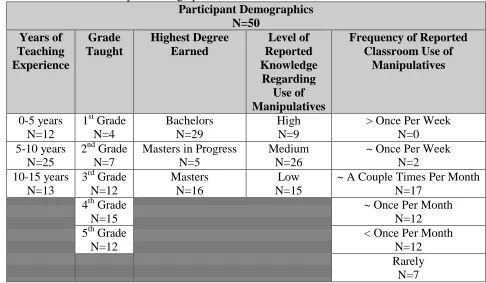
after their participation and their data was recorded, they would receive professional development regarding the appropriate use of manipulatives in respect to their classrooms. These teachers had between two and fifteen years of elementary teaching experience, with approximately 1/3 of them with Masters Degrees in Elementary Education or Mathematics Education. Table 1 represents some demographic information regarding the study participants.
Table 1. Participant demographics.
Participant Demographics N=50 Years of Teaching Experience Grade Taught Highest Degree Earned Level of Reported Knowledge Regarding Use of Manipulatives
Frequency of Reported Classroom Use of
Manipulatives
0-5 years N=12
1st Grade N=4
Bachelors N=29
High N=9
> Once Per Week N=0 5-10 years
N=25
2nd Grade N=7
Masters in Progress N=5
Medium N=26
~ Once Per Week N=2 10-15 years
N=13
3rd Grade N=12
Masters N=16
Low N=15
~ A Couple Times Per Month N=17
4th Grade N=15
~ Once Per Month N=12 5th Grade
N=12
< Once Per Month N=12 Rarely
N=7
Using a task-based interview design (Goldin, 2000), participants were asked to complete a task where they model arithmetic operations using five different manipulatives. Participants were required to attempt to perform arithmetic operations in the following arrangements with positive (P) and negative (N) integers: P+P, P+N, N+P, N+N, P–P, P–N, N–P, N–N, P×P, P×N,
N×P, N×N, P÷P, N÷P, P÷N, and N÷N. The set of manipulatives that participants were able to choose from were: number line, base 10 blocks, Unifix cubes, colored tiles, Cuisenaire rods, pattern blocks, two-colored counters, and BossÉCUbes. Each participant was required to use the number line, two colored counters or BossÉCUbes, and three other manipulatives from the list. While participants were completing the tasks by modeling these operations, they were observed, questioned and video-recorded. Observation notes were completed for each participant. Questions asked were meant to clarify and expound on the participants’ use of the models/manipulatives.
harmonized leading to the refinement of initial codes (Strauss & Corbin, 1990). Data was analyzed for similar modeling with manipulative techniques and similar models were grouped together and named. This grouping helped us develop the following codes: correct model/representation, re-defining operands, introducing new conventions, changing operators, and competing models. Each of these constructs is expanded upon in the following results.
Results
The only operations for which all participants correctly employed the representational determinism for each manipulative were P+P and P×P. In all other cases, errors arose in the work and communication of some of the participants. Types of errors that arose in participant work and responses are provided through the following sequence of transcripts from individuals followed by global summaries. The categories of observed errors include: re-defining operands; introducing new conventions; changing operators; and general representational misuse. In all reported transcripts, P represents a participant while I represents an interviewer.
Re-defining Operands
P1: (Modeling -3×5 using two color counters.) Well, if a×b means a groups of b, then we run into a problem. We can’t have -3 groups of something. We have to have a counting number of groups.
I: So, do you have a recommendation?
P1: I think that I can use 5×(-3) instead, since both those expressions are equal. That will give us 5 groups of -3.
I: So, -3 groups of 5 is the same as 5 groups of -3? P1: Yes. Well, at least the result is the same.
I: So, can you show that to me using the counters?
P1: (She organizes three red counters into each of five groups.) Does that work? I: What are you showing me?
P1: 5 groups of -3.
I: Is that what I asked for?
P1: No. You asked for -3×5. But I can’t make negative groups. So I did it this way. It comes out to the same answer.
I: But, are you showing me the same operation I asked for? P1: I guess not. But your way is impossible.
I: If it is impossible, then why do it?
P1: Because we need an answer. Are there other ways to do it with the counters without grouping? This is the only way I know.
I: Yes, there is another way using a coordinate system. But I wanted to see your way.
In an attempt to use manipulatives to model integer relations, some participants inadvertently redefined operands in given mathematical expression (e.g., P1). For example, most participants recognized that under multiplication by grouping (where a×b means a groups of b elements) any product where the first factor was negative was nonsensical. Thus, they attempted to model P×N
the unary operation “negative” as the binary operation “subtraction”. A few participants modeled multiplication as repeated addition, with each operand serving a distinct role in the process. For instance, a×b can be defined as a addends of b (e.g., ). With this
definition in place, it is readily recognizable that a×b and b×a would be modeled differently through most manipulatives.
Since operations involving these manipulatives are properly modeled in specific ways, re-defining the operands does not always carry an equivalent meaning and alters the depiction and manipulation of the model as well as the meaning of the operation. Therefore, redefining operands leads to an inappropriate association of the operation on the representation and the concept being modeled and may ultimately reinforce misconceptions. Thus, redefining operands in order to alter expressions perturbs Dienes’s construction principal.
Introducing New Conventions
P2: (Attempting to model (-3)–(-5) on a number line.) I’m starting at -3. (Figure 1A) Then, since subtraction means to go left, I’m turning my little guy to face left. (Figure 1B) Then, since we have -5, I’m going to make him walk backwards 5 steps. (Figure 1C) This brings us to positive two.
I: Why did you turn your little guy to the left? P2: Because subtraction means go to the left. I: Why does subtraction mean go to the left? P2: It means that we need to get a smaller number. I: Will subtraction always produce a smaller number? P2: Yes. It should.
I: OK. So why then did you have your little guy walk backwards?
P2: Because I am subtracting negative five. Because 5 is negative, I’ve got to go backwards instead of forwards.
I: But then you end up with a larger number. I thought that subtracting makes a smaller number?
P2: But, for -3–(-5), we are not really subtracting. We are really adding. Since we know that -3–(-5) is really -3+5, we need to make sure that we end up at the same place on the number line.
I: Where does the direction and facing come from and the “walking”? What does that have to do with the number line?
P2: Well, I guess it is simply a mechanism to explain movement on the number line. I: But is there movement on the number line? Isn’t it really static?
P2: It is static. That is why I need to add some movement to it.
I: So, are your direction and movement really part of the number line, or are these notions that you add to the number line?
P2: Something I add.
I: Then how do you know that what you add to the manipulative is correct in respect to the proper use of the manipulative?
Figure 1. Model of (-3)–(-5) on a number line.
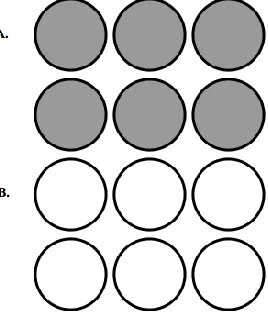
P3: (Attempting to model (-2)×(-3) using two-colored counters.) I’m putting down 3 pairs of -2. (Shown in Figure 2A as 3 pairs of grey (negative) counters (valuing (-6)).
I: So, what are you showing me?
P3: -2 times -3 is … Wait a minute. It is supposed to be positive 6.
I: How do you know that it is supposed to be positive 6 if you used the counters and came up with -6?
P3: I must need one more step. (He flips all the counters to the positive (white) side. Figure 2B)
I: So, flipping the counters is a step in the operation? P3: It must be. I need to do it to get the correct answer. I: Where does this step come from?
P3: It must come from the fact that it’s a negative times a negative. I: Is it a valid step in respect to this manipulative?
P3: I don’t know. It must be. It gives us the right answer.
All too often, attempting to use a manipulative to model operations, participants did not follow agreed upon conventions and extemporaneously invented techniques that often either confused the mathematical operation or the meaning of such (e.g., P2 and P3). These actions can contradict Dienes’s dynamic and perceptual variability principles. While introducing new conventions to model abstract mathematical ideas may be seductive, by doing so, fundamental mathematical ideas can be lost and students can become confused, thus failing to link representation use to the concept in its more traditional mathematical form.
Changing Operators
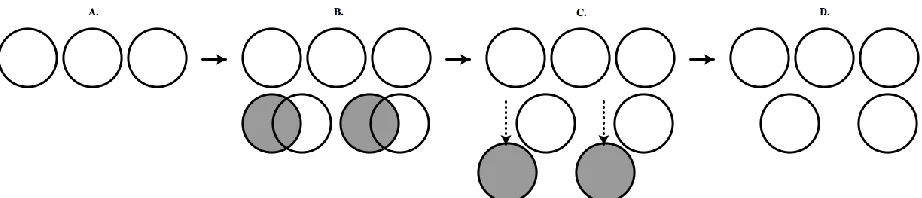
P4: (Attempting to model 8–(-3) using two color counters.) Well, we know that 8–(-3) is the same as 8+3. (He places a group of 8 white (positive) counters on the table and adds another group of 3 white counters.) The answer is 11.
I: You did addition rather than subtraction.
P4: I know. We know that the answer will be the same. I: But how do you know that?
P4: I know how to do the arithmetic.
I: But are you correctly modeling the operation of eight minus negative three using these counters?
P4: I guess that I am actually modeling eight plus three. But… (thinking for a few moments) … since minus means takeaway, and I don’t have any negative counters to takeaway, it must be impossible to do 8–(-3).
I: So, is it OK to then simply change what you are modeling: changing from modeling subtraction to modeling addition?
P4: I’m not sure that I have any other options. I: How do you know this is valid?
P4: I guess that I don’t. But it is just a manipulative. Does it really matter, as long as we get the right answer?
Figure 3. Model of 3 – (-2) with two-colored counters.
Figure 4. Model of 3+2
While the statements a−b=a+(-b) and a−(-b)=a+b provide useful procedural algorithms for symbolic manipulation, these notions can unfortunately be disconnected from conceptual understandings of the negative sign and integers. Thus, by rewriting a–b into a+(-b) or a–(-b) into a+b, students may not know when: to use the technique, when it is most valuable, or the connection between subtraction and adding the additive inverse. Moreover, rewriting a–b into
a+(-b) or a–(-b) into a+b in order to model these operations is contrary to Dienes’s dynamic principle and can become meaningless for students (Bruner, 1966).
Competing Models
Occasionally, when the determinism of a manipulative was understood, participants wrestled among themselves with different models for operations. This was particularly the case for division. The following transcript records the extemporaneous interaction of two participants as they examined how to perform division with two color counters.
P5: Let’s try 12÷4… (With 12 white counter of the table.) I’m going to move each of the counter into one of 4 groups. (Moves the first counter to one area on the table, the second counter to another area, the third counter to a third area, and the fourth counter to a fourth area. Then, one at a time, she brings another counter to each area and repeats this process. She now has 4 groups, each with 3 counters.)
P6: Why did you do it that way? Since you are dividing by 4, why not grab 4 counters at a time and see how many groups of 4 you get? That will give you 3 groups of 4 instead of 4 groups of 3.
P5: I think that we are doing the same thing. I took the 12 and divided them into 4 groups and you divided them into groups of 4.
P6: But, even if that gives us the same results that is not the same thing. Remember, with multiplication we had that a×b means a groups of b. So, order mattered for multiplication – whether we used grouping or repeated addition. Shouldn’t order matter here?
the number of groups of elements.
P6: How about if we try -12÷(-4)? (Has 12 gray counters on the table.) Well, we can’t make -4 groups. Just like in multiplication, that doesn’t work. We need to make groups of -4.
P5: But for -12÷4, we need to make 4 groups of -3.
P6: So, I think we can do either way, but some problems can only be done one way or another… at least if we use a grouping model. I think that there is an array model
that would give us more options.
Notably, without employing the language of such, these participants are discussing the determinism of this manipulative. They are investigating what two color counter can and cannot do in respect to integer division. They are discussing what is or is not allowable under the dual conditions of this manipulative and this operation.
Summary
Participants modeled mathematical, integer, operations with select manipulatives. While many correctly utilized these representations when modeling positive integer relations, this was not the case in the domain of negative integers. Teachers: attempted to use some manipulatives to model every combination of operations, even if it was not appropriate for such; were unsure which manipulative was appropriate for modeling particular integer situations; and inappropriately used manipulatives beyond their intended design.
Discussion
The determinism of a representation or manipulative affords it the power to model particular mathematical concepts and operations and constrains it from effectively, and often correctly, modeling others (McKendree, Small, Stenning, 2002). This exploration considered some common mathematical manipulatives found in K-5 classrooms through dimensions in which they are all too infrequently considered. First, these manipulatives are rightly considered mathematical representations, albeit concrete in nature, to be considered alongside tables, graphs, and symbolic elements. Second, they are considered through the lens of representational determinism. Thus, rather than the common practice of investigating how students interact with materials and what they learn through such, this investigation has considered these concrete representations themselves and the operations (+, −, ×, ÷) they afford or constrain in the context of integers. Therefore, this paper considers uses and misuses of manipulatives through the dimension of representational determinism – not what users do with representations, but what the representations allow users to do.
students should be able to perceive via the representation; what students should be able to do with a particular representation; what aspects of a representation are more prone to misinterpretation and misuse; and the limitations of each representation and what is not discernible in, or actionable on, each representation.
Improper representational choices or misuse of any representation can potentially lead to gaps in conceptual comprehension as well as student misunderstandings of seminal concepts (Goldin, 2003). Altogether, therefore, the selection and use of a representation resides not only in the mathematics being addressed but also in the determinism of the representation. Seemingly all too often, teachers, students, and textbooks misuse representations in order to model mathematical situations and demonstrate some mathematical operations. This may be an unanticipated result of eagerly attempting to use particular types of representations throughout all mathematical experiences. Additionally, teachers may zealously wish to facilitate students’ learning through the use of representations and may be tempted to use a representation beyond its determinism. Recalling that mathematical concepts are only communicable and interacted with via representations (Duval, 2006), instructors and students may: be lulled into a sense that all representations are appropriate at all times; not recognize the determinism of a representation; or even recognize and dismiss a representation’s determinism in the desire to promote an idea at all costs.
As previously stated regarding the misuse of representations and, thereby, abusing Dienes’s principles, it should also be stated that the proper use of representations could fulfill these principles and significantly affect student learning. The proper use of representations can assist students in: constructing abstract understandings from physical and cognitive actions; recognizing and interacting with mathematical concepts through multiple representations; and performing transformations within one representation which translates to another representation. Teacher understanding of representational determinism should guide all instructional selections of mathematical representations. Considering the determinism of representations in the planning phase of a lesson ensures that the representations: are not misused, follow Dienes’s principles, do not ask questions which they are not intended to answer, and avoid student confusion. There is need of further investigation in this dimension to support both teacher instruction and student learning.
Appropriate Uses of Representations in the Domain of Integers
Recognizing Unary and Binary Operations
A key concept in the mathematical domain of integers is the negative sign and its different functions: unary, binary, and symmetric (Vlassis, 2008). In the unary function, the negative sign serves as a characteristic of an object (e.g., -2). In the binary function, the negative (or subtraction) sign serves as an action to be performed or a transformation to be executed (i.e., taking away, completing, difference). In the symmetric interpretation, the negative sign signifies taking the opposite of a number (e.g., -(-5) = 5). That is, the negative sign can be viewed as either a characteristic or state of an object and as a transformation or an operator.
In the subsequent sections, we analyze and explicate the determinism of concrete representations commonly associated with the domain of integers. Specifically, we examine and discuss how the form of these representations not only influences what key ideas in the domain of integers can be perceived or distorted but also what processes associated with this domain can be activated and what structures can be discovered.
Determinism of Base 10 Blocks
Before discussing the representational determinism of base 10 blocks, it is necessary to discuss the operational isomorphic nature of a number of concrete representations. Four concrete representations in this investigation are operationally isomorphic to the base 10 blocks (i.e., Unifix cubes, colored tiles, Cuisenaire rods, and pattern blocks); that is, they can all model exactly the same combinations of operations on positive integers with the same restrictions where positive and negative are denoted by P and N respectively: P+P, P−P, P×P, and P÷P, with the additional limitations for subtraction that we can perform a–b when a≥b>0. While these concrete representations are isomorphic in respect to permissible integer operations and can exemplify the group, each has additional characteristics affecting representational determinism. For instance, base 10 blocks have an additional dimension in which place value is readily observable. While place value is accomplishable through these other representations through grouping, base 10 blocks are constructed so that the grouping inherently exists. Thus, without deeply investigating each of these representations, it is sufficient to state that representational determinism transcends merely considering permissible operations under the integers and that all representations have somewhat different determinism.
Information that can be perceived. Base 10 bocks can depict the magnitude, ordinal nature, and comparative sizes of respective numbers. Additionally, and beyond the reach of the other isomorphic representations, they can clearly depict the value of each digit in a particular place value. This concrete representation can be used to model concepts regarding numbers and operations and for demonstrating appropriate properties associated with operations (e.g., commutative, associative, and distributive properties).
Information that can be distorted. Base 10 blocks are incapable of representing negative integer values and are not intended to represent non-integer rational numbers. When users attempt to depict negative values with base 10 blocks, the result may appear that -a = a, since, for instance, the construction of -215 will appear exactly the same as 215. Therefore, students could not distinguish positive from negative numbers and attempting to mix the two may result in confusion.
Operations that can and cannot be activated. Based on its determinism, base 10 blocks can be used to model arithmetic operations while simultaneously considering place value ideas. When operating with integers, users are allowed to consider only the options P+P, P−P,
the form a−b, where a≥b>0; otherwise, P−P produces a negative value which cannot be appropriately represented by the blocks. Extending this understanding, the determinism associated with this concrete representation insists that all operations containing or creating negative integers are automatically discounted and inappropriate for base 10 blocks. However, although subtraction is only provisionally possible, division holds no such provisions, even though the division of one integer by another can potentially create rational, non-integer solutions. This is because when division is performed on physical objects, remainders can be visibly represented. Note that a≥b is unnecessary for a÷b; for instance 6÷9 = 0 R6 is a valid example with base 10 blocks.
Determinism of the Number Line
The number line has three potentially important characteristics: it continues indefinitely in both positive and negative directions, it recognizes intermediate values between those which they are developed or labeled to demonstrate, and it recognizes the existence of numbers and systems beyond the ones they are created or labeled to demonstrate. Herbst (1997) argued that, on a number line, a unit segment is translated consecutively from a fixed origin in such a way that each point of division is sequentially matched with a number. On the number line, numbers are represented by positions on the line with every point on the line assumed to correspond to a single real number and every single real number to a point. Numbers are also represented by displacements from zero on the number line.
Information that can be perceived. The number line can be used as an ordinal representation of a number system (Herbst, 1997) on which numbers, integers, rational, irrational, and real, can be represented, where any given number can be said to represent a position relative to another number or zero. For example, as articulated by Stephan and Akyuz (2012), a number such as -3 can be modeled as: a position on the number line, a movement of 3 units to the left on the number line, or the position opposite that of +3. The number line can thus serve as a medium through which the unary, binary, and symmetry function of the negative sign can be developed alongside the ordering of negative numbers. Subsequently, the number line can be utilized as a model for developing numeracy skills and teaching concepts regarding numbers, operations, and relations, and for solving mathematical problems and providing justification for mathematical ideas. The number line can also allow for the ordering and comparison of the relative sizes of integers and can be utilized as a model to perform arithmetic operations on integers (Ernest, 1985).
Information that can be distorted. The number line, by virtue of its form, represents real numbers as discrete units. Thus, students may not perceive the continuity of real numbers. Moreover, the number line combines visual and symbolic information; thereby, the connection between intervals and marks on the number line may be distorted. For example, students may focus on marks and ignore the intervals in between. Additionally, students may abstract meanings from the number line different from what is investigated in the classroom and may fail to see the connection between mathematical domain and indications on the number line. Further, students may apply whole number knowledge when they order or identify integers, and they may incorrectly associate whole numbers to points on the number line (Merenluoto, 2003).
as (6)–(-3) cannot be appropriately modeled using the number line since the positive value has no negative parts from which to account for the negative value. Similarly, subtracting negative
integers from negative integers (N–N) is only valid on a limited basis. For example, for (-6)–(-3), we can take (-3) away from (-6) without circumventing the meaning of subtraction and
negative integers and without calling the subtraction of a negative as the addition of a positive; however, for (-4)–(-8), this is not the case, since (-8) cannot be taken away from (-4).
On the number line, multiplication, a×b, can be related as “a number of steps or jumps of size and direction b.” Since it is possible to take a positive number of steps on the number line in
either direction, problems such as 5×8 and 7×(-8) (i.e., P×P and P×N) can be modeled. However, taking a negative number of steps in either direction does not make sense on the number line. Unfortunately, many resources ignore this apparent determinism and try to model statements such as “(-3)×2” as three jumps in the negative direction of length 2.
Regarding integer division, an operation such as a÷b can be appropriately modeled as either “a jumping back toward zero by b even length steps” or “a jumping back toward zero a
number of b-sized steps.” Examples such as 20÷5, (-27)÷3, and (-10)÷(-2) (i.e., P÷P, N÷P, and
N÷N) can similarly be modeled. However, the number line cannot appropriately model (-20)÷5 (i.e., N÷P), since is it unclear what a negative number of jumps means.
Thus, based on the determinism of the number line, N–N integer subtraction (a–b) can be appropriately modeled only when |a|>|b|. However, for a−b, where a and b are both negative integers and |a|< |b|, this is not the case since there is not enough in a to take b away. Similarly, the number line cannot be utilized to model N×P and N×N.
Determinism of Two-Colored Counters
Two-color counters are examples of what Janvier (1983) terms Equilibrium model. In this model, adding is defined as combining while subtracting is described as taking away.
Information that can be perceived. An important feature of the two-color counters is that they can be used to depict positive quantities, negative quantities, and zero. Negative numbers are depicted by using the red or black side of the counter. For instance, -3 is depicted as three counters red or black side up. Thus two-color counters can serve as a medium through which the unary interpretation of the negative sign can be brought to light. Moreover, while most other representations can only depict zero by an absence of elements, two-color counters allow zeros to be depicted through a neutralization model commonly denoted as zero pairs. For instance, when one yellow counter is paired with one red counter, the pair forms a zero pair (i.e., 1+(-1) = 0). Thus, two-color counters can also serve as a tool for developing the binary meaning of the negative (or subtraction) sign.
Information that can be distorted. The concepts of cardinality and neutralization can be confused when using the two-color counters. For instance, to depict 5+(-3), five yellow counters are combined with three red counters. However, this may lead to a student counting eight total counters rather than combining three zero pairs and recognizing the sum as 2. Also, it is often necessary to add zero pairs to a system in order to perform an operation (e.g., (-3)×2). Rather than recognizing the introduction of one or more zero pairs, students may count the total number of counters, which are added to the system.
negative (N) (e.g., P+P, P+N, N+P, and N+N). Two-color counters allow for the modeling of all cases for subtraction: P–P, P–N, N–P, and N–N. Additional operations are possible using two-colored counters, namely: P×P, P×N, N×P, N×N, P÷P, N÷P, and N÷N. However, two-colored counters cannot be used to model operations of the form, P÷N, since we begin only with positive values and can neither count the number of negative values in groups nor form a negative number of groups.
Determinism of BossÉCUbes
BossÉCUbes are essentially two sets of base 10 blocks with the blue colored set representing positive values and the red set representing negative values. (For depictions of BossÉCUbes, search for BossÉCUbes at www.Enasco.com.)
Information that can be perceived. Altogether, BossÉCUbes can be used to depict multi-digit integers. BossÉCUbes allow for the depiction of the magnitude, ordinal nature, and comparative sizes of multi-digit integers. Additionally, they can be used to depict the value of each digit in a particular place. Subsequently, BossÉCUbes can be used to model concepts regarding numbers and operations and for demonstrating appropriate properties associated with operations (e.g., commutative, associative, and distributive properties). BossÉCUbes allow the creation of zero pairs for each digit in a multi-digit integer. The addition of zero pairs in each digit greatly assists in performing multi-digit integer arithmetic. Based on this determinism, BossÉCUbes allow for the modeling of the unary, binary and symmetric function of the negative sign on multi-digit integers.
Information that can be distorted. Base ideas and place value ideas (of a place value base ten number system) may be confused when using BossÉCUbes. For example due in part to its determinism, base ideas such as grouping and being able to make trades (110100 trades) may be seen as isomorphic to an understanding of place value ideas such as position and magnitude relations, direction and unit relations, and face value and position relations. Moreover, through its use of different colors and the simple assessment of comparative magnitude of positive and negative values, BossÉCUbes facilitate the comparison of the absolute values of positive and negative values. However, it is still possible for students to fail to distinguish between colors and believe that a is symmetric to –a.
Integer operations that can and cannot be activated. In respect to binary operations involving integers, BossÉCUbes allow users to consider the options positive (P) or negative (N)
for multi-digit integers; P+P, P+N, N+P, N+N, P–P, P–N, N–P, N–N, P×P, P×N, P÷P, N÷P, and N÷N. For example, multi-digit integer operations such as 324+(-123), (-34)–(-124), etc., may be performed through a combination of trading and regrouping of units, longs and flats and through the addition and removal of zero pairs. However, BossÉCUbes cannot be used to model operations of the form P÷N, since it is impossible to conceptualize the number of negative groups in a given positive set.
Summary of Operational Determinism
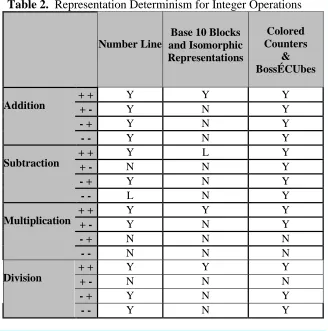
representations (number line; base 10 blocks, Unifix cubes, colored tiles, Cuisenaire rods, and pattern blocks; and two-colored counters and BossÉCUbes) under four operators (+, –, ×, ÷) together with the consideration of the signs of the integer operands (P and N). Thus, for each operator (for example, +), four possibilities are considered: P+P, P+N, N+P, and N+N. The table is read as such: the “Addition + −” row denotes adding a positive integer to a negative integer, in that order. The letters in the table denote: Y = the operation can be modeled with the respective concrete representation; N = the operation cannot be modeled with the respective concrete representation; and L = the operation can be modeled with the concrete representation, however with limitations. This table can aid teachers in the selection and use of appropriate concrete representations in respect to integer arithmetic.
Conclusions and Implications
Representation in mathematics is central for providing students’ appropriate ways to assimilate and accommodate new mathematics understanding while building deep conceptual underpinnings of that knowledge (e.g., Brenner et al., 1997; Brenner, Herman, Ho, & Zimmer, 1999; Knuth, 2000). Therefore, teachers’ understanding of the appropriate uses of representations and manipulatives is paramount in providing rich, mathematical experiences for students.
From our research, we know that inappropriate representations for operations are demonstrable. However, fundamental mathematical concepts are lost and users become more confused by the use of the representation. We take the position that representations are often
Table 2. Representation Determinism for Integer Operations
Number Line
Base 10 Blocks and Isomorphic Representations
Colored Counters
& BossÉCUbes
Addition
+ + Y Y Y
+ - Y N Y
- + Y N Y
- - Y N Y
Subtraction
+ + Y L Y
+ - N N Y
- + Y N Y
- - L N Y
Multiplication
+ + Y Y Y
+ - Y N Y
- + N N N
- - N N N
Division
+ + Y Y Y
+ - N N N
- + Y N Y
misused, not only because of limited mathematical knowledge, but also because users do not understand their associated determinism with respect to the mathematical concept under consideration. Our findings further support that these discussions should be occurring in the professional development of both in service and pre-service teachers and further points to the specialized content that is needed for the teaching of mathematics (Ball, Thames, & Phelps, 2008; Rowland, Huckstep, & Twaites, 2005). Discussions that not only share different types of representations and manipulatives but the emphasis on when and why certain representations are more appropriate and powerful is necessary with teachers. Thus, it is hoped that the content of this article provides an avenue through which the issue of why such recurrent misuses of representations could be addressed, as well as ideas for how to help teachers and students enter the functioning of representation without misuses.
References
Adams, J. (1996). The super source: Tangrams. NY: Cuisenaire Company of America, Inc. Ainsworth, S. E., Bibby, P. A., & Wood, D. J. (2002). Examining the effects of different multiple
representational systems in learning primary mathematics. The Journal of the Learning Sciences, 11(1), 25-62.
Ball, D. L., Thames, M., & Phelps, G. (2008). Content knowledge for teaching: What makes it special? Journal of Teacher Education, 59, 389-407.
Berenson, S. B., Valk, T. V. D., Oldham, E., Runesson, U., Moreira, C. Q., & Broekman, H. (1997). An international study to investigate prospective teachers’ content knowledge of the area concept. European Journal of Teacher Education, 20(2), 137–150.
Berman, B., & Friederwitzer, F. (1985). Color tile activities. NY: Cuisenaire Company of America, Inc.
Bogdan, R. C., & Biklen, S. K. (2003). Qualitative research for education: An introduction to
theories and methods (4 ed.). Boston: Allyn and Bacon.
Brenner, M. E., Herman, S., Ho, H. -Z., & Zimmer, J. M. (1999). Cross-national comparison of representational competence. Journal for Research in Mathematics Education, 30(5), 541-557.
Brenner, M. E., Mayer, R. E., Moseley, B., Brar, T., Durán, R., Reed, B. S., & Webb, D. (1997). Learning by understanding: The role of multiple representations in learning algebra.
American Educational Research Journal, 34(4),663-689.
Bruner, J. (1966). Toward a theory of instruction. Cambridge, MA: Belknap Press.
Clements, D. H. (1999). “Concrete” manipulatives, concrete ideas. Contemporary Issues in Early Childhood, 1(1), 45–60.
Creswell, W. J. (2003). Research Design: Qualitative, quantitative and mixed methods
approaches (2 ed.). London: Sage Publications.
Dienes, Z. P. (1960). Building up mathematics. London: Hutchinson Educational.
Duval, R. (2002). The cognitive analysis of problems of comprehension in the learning of mathematics. Mediterranean Journal for Research in Mathematics Education, 1(2), 1-16. Duval, R. (2006). A cognitive analysis of problems of comprehension in the learning of
mathematics. Educational Studies in Mathematics, 61, 103-131.
Ernest, P. (1985). The numbers line as a teaching aid. Educational Studies in Mathematics, 16, 411-424.
Mathematics Education, 21, 180-206.
Goldin, G. (2000). A scientific perspective on structured, task-based, interviews in mathematics education research. In A. Kelly & R. Lesh (Eds.), Handbook of Research Design in
Mathematics and Science Education. Mahwah, NJ: Lawrence Erlbaum Associates.
Goldin, G. A. (2002). Representation in mathematical learning and problem solving. Handbook
of international research in mathematics education, 197-218.
Goldin, G. A. (2003). Representation in school mathematics: A unifying research perspective. A
research companion to principles and standards for school mathematics, 275-285.
Goldin, G., & Shteingold, N. (2001). Systems of representations and the development of mathematical concepts. The roles of representation in school mathematics, 2001, 1-23. Goldin, G.A. (1998). Representational systems, learning, and problem solving in mathematics.
Journal of Mathematical Behavior, 17(2), 137-165.
Greeno, J. G., & Hall, R. P. (1997). Practicing representation: Learning with and about representational forms. Phi Delta Kappan, 78, 361-367.
Harris-Sharples, S. (1993). Introduction. In A. Hoffman, & A. Glannon (Eds.), Kits, games and
manipulatives for the elementary school classroom: A source book. New York: Garland
Publishing.
Herbst, P. (1997). The number-line metaphor in the discourse of a textbook series. For the Learning of Mathematics, 17(3), 36-45.
Janvier, C. (1983). The understanding of directed number. In J. C. Bergeron & N. Herscovics (Eds.), Proceedings of the Fifth Annual Meeting of the North American Chapter of the
International Group for the Psychology of Mathematics Education (Vol. 2, pp. 295-301).
Montréal: Université de Montréal, Faculté de Sciences de l’Education.
Knuth, E. J. (2000). Understanding connections between equations and graphs. Mathematics Teacher,93(1).
Larkin, J. H., & Simon, H. A. (1987).Why a diagram is (sometimes) worth ten thousand words.
Cognitive Science, 11, 65-99.
Lesh, R., Post, T., & Behr, M. (1987). Representations and translations among representations in mathematics learning and problem solving. In C. Janvier (Ed.), Problems of representation in the teaching and learning of mathematics (pp. 33-40). Hillsdale, NJ: Lawrence Erlbaum Associates.
McKendree, J., Small, C., & Stenning, K. (2002). The role of representation in teaching and learning critical thinking. Educational Review, 54, 57-67.
Merenluoto, K. (2003). Abstracting the density of numbers on the number line--A quasi-experimental study. In N. A. Pateman, B. J. Dougherty, & J. Zilliox (Eds.), Proceedings of the 2003 joint meeting of PME and PMENA (Vol. 3, pp. 285-292). Honolulu, HI: CRDG, College of Education, University of Hawai’i.
Miles, M. B. & Huberman, M. N. (1994). Qualitative data analysis: an expanded sourcebook.
Thousand Oaks, CA: Sage.
Rowland, T., Huckstep, P., & Thwaites, A. (2005). Elementary teachers' mathematics subject knowledge: The knowledge quartet and the case of Naomi. Journal of Mathematics
Teacher Education, 8, 255-281.
Sfard, A. (1992). Operational origins of mathematical objects and the quandary of reification- The case of function. In E. Dubinsky, & G. Harel (Eds.), The concept of function: Aspects
of epistemology and pedagogy (pp. 59-85). Washington DC: Mathematical Association of
Stephan, M., & Akyuz, D. (2012). A proposed instructional theory for integer addition and subtraction. Journal for Research in Mathematics Education,43(4), 428-464.
Strauss, A., & Corbin, J. (1990). Basics of qualitative research. London, England: Sage Publications Ltd.
Vlassis, J. (2008). The role of mathematical symbols in the development of number conceptualization: The case of the minus sign. Philosophical Psychology, 21, 555–570. Zhang, J. (1997). The nature of external representations in problem solving. Cognitive Science,
21(2), 179-217.
Author Information
Michael. J. Bossé is the Distinguished Professor of Mathematics Education and MELT Program Director at Appalachian State University, Boone, NC. He teaches undergraduate and graduate courses and is active in providing professional development to teachers in North Carolina and around the nation. His research focuses on learning, cognition, and curriculum in K-16 mathematics.
Kathleen Lynch-Davis is an Associate Dean and professor of mathematics education in the Spadoni College of Education at Coastal Carolina University. Her research interests focus on the use of written communication in mathematics, mathematics content knowledge for teaching, specifically, the knowledge teachers require for the teaching of proportional reasoning, and online course delivery in mathematics education.
Kwaku Adu-Gyamfi is an Associate Professor of Mathematics Education at East Carolina University. His research interests include multiple representations and the appropriate use of technology in mathematics teaching and learning. His research focuses on the ways in which students and teachers reason about mathematics when using representations and technology tools in instruction.