Nathan David
Lecturer, Electronic Engineering, University of Nigeria
ABSTRACT
This paper presents the blue print and detailed implementation of a campus-wide network backbone for the University of Nigeria, Nsukka as a case study. The need for a campus network for this particular community has been long overdue. The University of Nigeria, Nsukka needs this method of communication and access to volumes of information now available on the Internet at an affordable cost, and needs to perform research through collaboration at the national and international levels rather than remain in isolation. This paper shows that this access can be provided affordably and efficiently. It also shows that this access will be provided through a combination of local area networks inter connected by both fiber optic cable links and by wireless (radio) antennae. Access to the Internet backbone was achieved via the VSAT at the Computer Communications Center (CCC) with the creation of the local backbone and a propagation of the service to outlying areas thereafter. The detailed network evaluation is also presented.
INTRODUCTION
As the popularity of the Internet continues to grow at an exponential rate, easy and affordable access is quickly becoming a necessity of life [1]. To obtain these benefits University of Nigeria urgently requires an expandable campus-wide network backbone. The individual faculties and departments are allowed the autonomy to require their own networks and hook up to the backbone.
The University of Nigeria is located in Enugu State and comprises of two campuses; the primary campus is in a rural setting at Nsukka with a secondary urban campus at Enugu, the capital of Enugu State, about 75 km to the south. Nsukka campus land mass is 871.38 hectares in an asymmetrical shape lying to the north east of Nsukka town. In the Nsukka campus, the bulk of the buildings occupy the western half of the site leaving the gently sloping valley, lying between the northeast and southern hills relatively free of buildings. The farm buildings and cultivation, which is located
there, does not affect the essentially rural character of the terrain. In addition there are three areas that are designated conservation areas. These areas are the three grass covered hills at the extreme northern tip of the campus, the large hill to the northeast and the northern slopes of the hill to the south.
SURVEY OF THE UNIVERSITY OF NIGERIA
CAMPUS AT NSUKKA
Determination of the position of the central server location was undertaken using Google Maps (Fig. 1). At the same time, the heights of all of the trees and all of the buildings in the area were also noted.
As a result of this rather rough and ready reckoning, it was determined that the highest tree in the intended area was roughly 20 meters tall; also, the tallest buildings in the area were four stories, or approximately 21 meters, tall. By this means, it was determined that if a radio mast with a minim
um height of 25 meters was installed, the signal from it could reach every part of this area of campus. The convenience of this location was further underscored when the distance map was examined. It was determined that nearly none of the buildings to be connected to the network was further than 1000 meters from the CCC. This meant that use of fiber optic cable to allow for connectivity was nearly ideal, since the distance of 1000 meters is well within the maximum allowable distance of 1500 meters. Any farther than that would entail the use of repeaters to boost the attenuated light signal.
Fig. 1. Aerial view of University of Nigeria, Nsukka. ©2007 GoogleTM ESTIMATION OF BANDWIDTH
The bandwidth required by the network depends upon a number of factors which include the type of topology employed, applications to be used, the number of users etc.
The adopted topology is a star topology. This topology has the advantage of speedy setup and easy extension. As for the kind of applications that the network will accommodate, it is expected that, initially,
the network will be exclusively used for distribution of Internet access campus-wide. As time goes on, however, it is fully expected that the network will be utilized for other, non-Internet related applications. It is a fact that, as the English philosopher J. Northcote Parkinson [2] put it, “work expands to fill the time allocated for it”; similarly, the use of the network will with time expand in ways as yet unforeseen.
helpful of all concepts of time and life management. It was discovered in 1906 by an Italian economist Vilfredo Pareto [3] and states that, ‘when left to a natural progression, 80 percent of efforts yield 20 percent of results’. The locations of servers in each faculty will help to concentrate 80% of the traffic locally to the faculty and 20% traffic will then have to flow across the backbone to centrally located resources which will be remote to the local faculty network, thereby reducing the issue of congestion over the backbone. This is called the 80/20-design rule (80 percent local, 20 percent over the network).
Therefore, faculty servers can be physically located in a central place while only faculty members and other select users will be given the proper rights to access them. This can be achieved using virtual local area networks (VLANs) and server operating system configuration.
For the various Internet applications, all of which use Internet Protocol (IP) as the transmission mechanism, there are different demands upon the resources available [4]. They have different impacts on the network’s bandwidth as well as on the network’s responsiveness.
Electronic mail (e-mail) is not interactive – one does not need to be constantly in front of the PC to know that mail has arrived – and thus has minimal
impact on throughput or on bandwidth. While Online information retrieval is fairly sensitive to the delay of packet information. Latency of communication is important since these protocols need to employ an “acknowledge and retransmit” scheme in order to work [5].
Two options for achieving the connectivity required were considered:
a. an all-radio network b. an all-fiber optic network
DESIGN OF AN ALL-RADIO NETWORK
Fig. 2. The radio network for the University
COST IMPLICATIONS
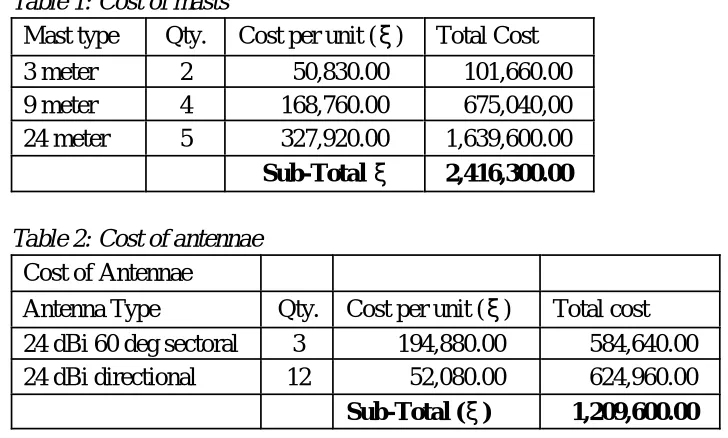
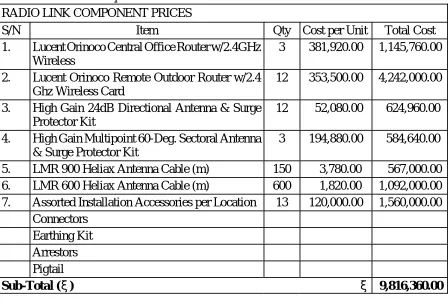
Given the above antenna and mast needs, we can calculate the cost of implementing a radio-based network for the campus. (Tables 1-4)
Table 1: Cost of masts
Mast type Qty. Cost per unit (x) Total Cost
3 meter 2 50,830.00 101,660.00
9 meter 4 168,760.00 675,040,00
24 meter 5 327,920.00 1,639,600.00 Sub-Total x 2,416,300.00
Table 2: Cost of antennae
Cost of Antennae
Table 3: Radio link component cost
RADIO LINK COMPONENT PRICES
S/N Item Qty Cost per Unit Total Cost
1. Lucent Orinoco Central Office Router w/2.4GHz Wireless
3 381,920.00 1,145,760.00
2. Lucent Orinoco Remote Outdoor Router w/2.4 Ghz Wireless Card
12 353,500.00 4,242,000.00
3. High Gain 24dB Directional Antenna & Surge Protector Kit
12 52,080.00 624,960.00
4. High Gain Multipoint 60-Deg. Sectoral Antenna & Surge Protector Kit
3 194,880.00 584,640.00
5. LMR 900 Heliax Antenna Cable (m) 150 3,780.00 567,000.00 6. LMR 600 Heliax Antenna Cable (m) 600 1,820.00 1,092,000.00 7. Assorted Installation Accessories per Location 13 120,000.00 1,560,000.00
Connectors Earthing Kit Arrestors Pigtail
Sub-Total (x) x 9,816,360.00
Table 4: Total costs involved in radio link
Total Costs Involved (Radio)
Masts 2,146,300.00
Antennae 1,209,600.00
Components 9,816,260.00
Subtotal 13,172,160.00
Installation Costs 10% of subtotal
1,317,216.00
TOTAL COSTS 14,489,376.00
DESIGN OF AN ALL-FIBER NETWORK
The use of fiber optic cable to achieve a high-speed, high-reliability connectivity solution for this network would be a whole lot more expensive and tedious to implement [7]. The infrastructure needed would be quite daunting to contemplate. First of all, the lengths of cable must be properly calculated. Second, the proper type of fiber optic cable
connect each of the buildings must be laid, tested and certified to be working to specification. The overriding disadvantage of using fiber is however, the high cost of the cable itself as well as of the other accessories.
All is not dark, however. Despite the disadvantages enumerated above, the use of fiber optic cable can be justified. For one thing, since the means of communication is via light pulses (photons), fiber is totally immune from electrical or electromagnetic crosstalk. Fiber is much harder to tap, making it quite secure, and it is inherently
safer than coaxial cable. It is transmitting light waves not electricity, and so users are free from the danger of electrical shock. It has a much higher bandwidth rate, and a much lower loss rate than coaxial cable.
Table 5 shows the distances involved in laying fiber optic cables and the trenches that need to be dug in order to lay the cables, (all distances are with respect to the CCC as the focal point).
Table 5: Distances involved
Fiber Optic Option
Building Dist. (m) Trench(m
)
Cable (m)
Agric Sciences 1,200.00 600.00 1,250.00
Arts 1,285.00 700.00 1,335.00
Biological Sciences 600.00 100.00 650.00
Energy Center 1,400.00 200.00 1,450.00
Engineering 150.00 150.00 150.00
Library 325.00 150.00 375.00
PG School 1,285.00 200.00 1,335.00
Pharmacy 300.00 100.00 350.00
Physical Sciences 700.00 650.00 700.00 Social Sciences 885.00 400.00 935.00
VC’s Office 565.00 565.00 615.00
Vet. Medicine 1,600.00 200.00 1,650.00
Communication Center
Fig. 3. Design of an All-Fiber Network
COST IMPLICATIONS
Below find the cost of implementing an all-fiber optic cable-based network for the campus.
Table 6: Cost of implementing an all-fiber network
FIBER BACKBONE COST
ITEM QTY UNIT
PRICE
COST
Switch-24 10/100 port w/2 100BASE-FX ports 12 350,000.00 4,200,000.00 Switch-24 10/100 ports w/4 100BASE-FX ports 3 490,000.00 1,470,000.00 Telecoms cabinet - Datanet 15U, 600mm, Fan Tray 5 40,000.00 200,000.00 Telecoms cabinet - Datanet 25U, 600mm, Fan Tray 7 105,000.00 735,000.00 Telecoms cabinet - Datanet 38U, 600mm, Fan Tray 1 125,000.00 125,000.00 Patch Panel w/Trough - Lucent, Fiber, SC Panel, 12-Port w/4 connects 12 40,674.00 488,088.00 Patch Panel w/Trough - Lucent, Fiber, SC Panel, 24-Port w/24
connectors
2 60,674.00 121,348.00
Patch Cord - Lucent, Fiber, SC-SC, 1.8m 24 8,213.00 197,112.00 Cable - Lucent, Fiber, Indoor/Outdoor, 8-core (m) 10,795 1,051.00 11,345,545.00
MATERIAL COST 18,882,093.00
Fiber Backbone Installation Accessories (2.5% of cabling material
cost) 472,052.33
EXCAVATION
Material Charge per meter 4,015 2,000.00 8,030,000.00
TOTAL COST 27,384,145.33
CHARGE
Structured Cabling Installation Charge (10% of total cost) 2,738,414.53
COST OF IMPLEMENTING FIBER OPTIC NETWORK 30,122,559.86
At the end of it all, the two options were compared to see which one is the most cost-effective:
Table 7: Networking options: comparison of costs
NETWORKING OPTIONS - COMPARISON OF COSTS
Radio-Based Network 14,489,376.00
Fiber Optic-Based Network 30,122,559,86
Going strictly by costs, table 7, it could be recommended that an all-radio wireless network be implemented. However, there are other things to take into consideration apart from cost. Radio links will guarantee a maximum of 11 Mbps bandwidth, which practically comes to about 8-9 Mbps due to Ethernet frame collisions at a frequency of 2.4 GHz.
A fiber optic design provides for higher bandwidth on the backbone (up to 10 Gbps). It is a more scalable and preferred design in the campus-networking arena. Although it involves more civil works, it requires less management than a radio link, which is more open to environmental conditions such as humidity, rain and temperature changes. Again, the lifespan of the fiber optic link is longer than that of radio components. A well-installed fiber optic cable has a lifespan of up to 20 years while the radio antenna is good for up to 5 years. Fiber optic cables can be laid in different topologies. These include star, ring, daisy chain or a combination of them. In addition we have the advantage of speed and reliability when using fiber. Though, the initial cost of using fiber is higher, but it makes up for it in the much lower support costs incurred. Also, since the cables can
utilize the fastest-possible communications signal (nothing can travel faster than light, after all) if one wishes to upgrade the speed of the network, one need only change the speed at which the active devices operate. Contrast this with a wireless link, in which to upgrade speed, one would need to change practically everything (the antennae, the receivers, etc.) Though wireless has an advantage of being good for hard-to-reach places and for speedy installation, since we are considering an infrastructure, which we hope will last for a long time, fiber is a practical option.
CONCLUSION
While in the course of this paper, there are other factors to consider apart from the strictly technical ones. Amongst them is the fact that, although this particular network is not being setup as a profit-making venture, it would be nice if it could pay its way. This leads to a potential conflict of interest. Charging the users would of course be necessary (if only to ameliorate the large capital outlay), and yet to charge the users exorbitantly would go against the “non-profit” philosophy by which this enterprise is governed. Also, even if we strictly go by charging what the market would bear, there is no real easy way to prevent any person within the University community from attempting to exploit this service for their own material gain, save by installing draconian, access rules. Too much freedom of access might lead to unfair exploitation; too little freedom violates the one unwritten Internet convention: ‘information wants to be free’ [8].
working campus-wide network. It also analysed the pros and cons of the various means of generating a Net connection, of distributing it over a fairly wide area, and did it within the limitations of cost, speed and power. It has also sought to show that the network in hand will have great and lasting benefits for the university.
REFERNCES
1. Darren Waters, Net grows to meet fresh demands, http://news.bbc. co.uk/2/hi/technology/6342063.stm, 2007
2. Northcote Parkinson , Parkinson's Law – How Limits Help You , h t t p : / / www. t i mem an agem en t -success.com/parkinsons-law.html, 1995
3. Shelley Doll, 80/20 rule helps you w o r k s m a r t er, n o t h a r d e r , http://articles.techrepublic.com.com /5100-10878_11-1050248.html, 2002 4. Clemmer, Joel, “Internet Bandwidth
for Macalaster: Current Progress, Future Planning”, Macalester College Information Services, 2002
5. Yongguang Z., Dante De Lucia, Bo Ryu, and Son K. Dao, “Satellite Communications in the Global Internet: Issues, Pitfalls, and Potentials”, Hughes Research Laboratories, 2002
6. Walter Konhäuser, Broadband Wireless Access Solutions -Progressive Challenges and Potential Value of Next Generation Mobile Networks, Wireless Personal C o m m u n i c a t i o n s , S p r i n g e r Netherlands, Volume 37, Numbers 3-4 / May, 2006
7. http://www.bridgewave.com/downl oads/education_at_a_glance_brochu re.pdf