https://doi.org/10.5194/we-17-51-2017
© Author(s) 2017. This work is distributed under the Creative Commons Attribution 4.0 License.
The ecology of subindividual variability in plants:
patterns, processes, and prospects
Carlos M. Herrera
Department of Evolutionary Ecology, Estación Biológica de Doñana, CSIC, Avda. Americo Vespucio 26, Isla de La Cartuja, 41092 Seville, Spain
Correspondence to:Carlos M. Herrera ([email protected])
Received: 8 November 2017 – Accepted: 5 December 2017 – Published: 8 December 2017
Abstract. Diversification of ecology into subdisciplines that run from macroecology to landscape, community, and population ecology largely reflects its specialization on different segments of the spatial gradient over which recognizable ecological patterns and processes occur. In all these cases, the elemental units involved in the pat-terns and processes of interest to ecologists are individuals from the same or different species. No distinct flavor of ecology has yet emerged that focuses on patterns and processes revolving around the lowermost end of the spatial gradient, which in the case of plants corresponds to the within-individual domain. Intraindividual hetero-geneity in organ traits, however, is quantitatively important and has multiple consequences for plant individuals, populations, and communities, and for animal consumers as well. This paper first provides an overview of cur-rent knowledge on plant traits that vary subindividually, the magnitude of subindividual variation, and its spatial patterning. Examples will then be presented on the consequences of subindividual variation for plants and animal consumers at individual, population, or community levels. Finally, the recently emerging links between genetics, epigenetics, subindividual variation, and population ecology will be illustrated using results on variation in seed size, a functional plant trait playing an important role in plant population dynamics. Further observational and experimental studies are needed which link ecological and phenotypic measurements of plants to their epigenetic and genetic characteristics, in order to understand the three-way relationships between subindividual variabil-ity, genetic features, and epigenetic mosaicism. Another proposed line of inquiry should focus on evaluating whether subindividual epigenetic mosaics eventually translate into epigenetically heterogeneous progeny, thus contributing to the maintenance of population and community functional diversity.
1 Introduction
Following its formal definition by Ernst Haeckel as the sci-ence that studies the relationships between organisms and the environment, ecology steadily experienced a process of diversification that eventually led to the appearance of a se-ries of distinct subdisciplines. To a considerable extent, the historical diversification of ecology into subdisciplines re-flects a progressive specialization on different segments of the broad gradient of spatial scales on which pertinent eco-logical patterns and processes can be identified and studied. At the high end of the spatial-scale gradient, the mission of macroecology is to describe and understand the causes and consequences of ecological processes on very large spatial scales (say, 106–107m) such as, e.g., biome differences in
sig-nificance of patterns and processes that take place around the lowermost end (100–101m) of the macroscopic spatial gradient envisaged above. This segment of the spatial scale would roughly correspond to within-individual variation, and its predominant neglect is well exemplified by the unambigu-ous subtitle, “From individuals to ecosystems”, on the cover of one of the most authoritative ecology textbooks (Begon et al., 2006). In recent years, however, increasing evidence has shown that such very small-scale, intraindividual variation may have manifold ecological consequences for the popu-lation and community ecology of both animals and plants (Herrera et al., 2015; Alonso et al., 2017; Arceo-Gómez et al., 2017, and references therein).
In most animals, subindividual variation of ecological rel-evance is mostly sequential in nature, as it generally arises from ontogenetic and/or seasonal changes in the organismal features of individuals. Sequentiality of subindividual varia-tion means that, at different moments or ontogenetic stages in an animal’s adult life, a given individual will exhibit vari-able states of functional or structural features (e.g., behav-ior, coloration, digestive organ size; Piersma and Lindström, 1997; Delhey and Kempenaers, 2006; Stamps et al., 2012). Plants differ from animals with respect to within-individual variation in a most profound way. As noted long ago by Lloyd (1984, p. 379), “a plant produces a considerable num-ber of structures of one kind [and] this simple feature can ex-plain a major difference in the variation patterns exhibited by plants and animals.” Although plants and animals share the sequential (seasonal or ontogenetic) component of subindi-vidual variation (e.g., contrasting leaf size and shape between juveniles and adults in some heterophyllous plants), vascu-lar plants stand uniquely apart because of the existence of a strongsimultaneouscomponent of subindividual variation that arises naturally from their modular construction.
The modular construction of plant bodies by contin-ual organogenesis and reiterated production of homologous, functionally equivalent structures is a truly quintessential, ancestral feature of the body plan of vascular plants (Her-rera, 2009). The ecological consequences of plant modu-larity have been addressed from three main angles. First, following White’s (1979) pioneering treatment of plant in-dividuals as metapopulations of repeated modules, demo-graphically inspired investigations have dealt with the con-sequences of differential growth and survival of modular subunits, particularly in long-lived species characterized by extensive clonal proliferation. Second, there are physiologi-cally inspired studies that have examined the effects of mod-ularity on small-scale spatial patterns of within-plant dis-tribution of water, photosynthates and other products (Mar-shall, 1996; Price et al., 1996), and the resulting compart-mentalization of plant bodies into a series of relatively inde-pendent “integrated physiological units” (Watson, 1986; Ori-ans and Jones, 2001). The third perspective on plant modu-larity, and the one this paper will be exclusively concerned with, emphasizes the appearance of a distinctive source of
phenotypic variance, namely the within-plant or subindivid-ual component. An inevitable consequence of a multiplicity of modules being simultaneously borne by individual plants is a certain variability in the characteristics of the copies of the same organ (leaves, flowers, fruits, seeds) produced in different modules of the same individual. As first suggested by Suomela and Ayres (1994) and documented at length by Herrera (2009), within-individual variability in organ traits is an emergent property of plant individuals brought about by their modular construction through reiteration of elemen-tal subunits (metamers) and the associated repetition of ho-mologous structures that perform the same function (leaves, flowers, fruits, seeds).
In this paper, I will first provide a concise review of cur-rent knowledge on the nature of plant traits that vary subindi-vidually, the magnitude of subindividual variation relative to variation between individuals, and its spatial patterning. Next I will highlight some of the ecological consequences of subindividual variation for plants and their animal con-sumers at the individual, population, and community lev-els. All the preceding aspects were thoroughly reviewed by Herrera (2009); thus, whenever possible I will consider here preferentially those findings obtained by more recent investi-gations that complement, expand, or corroborate the conclu-sions of that earlier review. Finally, I will consider the little explored connections between subindividual variation, pop-ulation ecology, genetics, and epigenetics, which will be il-lustrated by results of recent investigations on the epigenetic correlates of seed mass variation.
2 Traits and magnitude of subindividual variation
Studies on subindividual variation in plants have tradition-ally tended to focus on the relatively infrequent instances of discontinuous variation involving morphologically or func-tionally distinct variants of reiterated homologous struc-tures, typically leaves (heterophylly), fruits (heterocarpy), and seeds (heteromorphism) (see Wells and Pigliucci, 2000, Imbert, 2002, and Matilla et al., 2005, for reviews). Exam-ples include the coexistence of prickly and nonprickly leaves in the same crown of individual trees (Herrera and Bazaga, 2013) or the simultaneous production by individual plants of distinct seed morphs with contrasting dispersal ability (Im-bert, 2002). Ecologists interested in the evolution of plant gender and mating systems have long scrutinized the causes and consequences of the production of distinct floral sex morphs by the same individual (Barrett, 1998). In contrast, continuous within-plant variation in quantitative traits of ho-mologous organs remains comparatively unexplored from an ecological perspective despite being a quintessential plant feature (Herrera, 2009). I will focus on this ubiquitous form of subindividual variation for the rest of this paper.
homol-ogous structure (Herrera, 2009). Importantly, many of the traits that vary within individual plants are known for their functional nature; i.e., they have potential effects on the fit-ness of individuals or the environment (Pérez-Harguindeguy et al., 2013). These include simple traits like leaf length, fruit size, or seed mass, but also less apparent features such as con-centration of nutrients and secondary compounds in leaves, length of seed dormancy, or sugar concentration in floral nectar or the pulp of berries. Recent studies have continued furnishing examples of relatively cryptic continuous traits that, when properly sampled, exhibit substantial subindivid-ual variation. These include, among other things, leaf stom-atal traits (Herrera et al., 2015), leaf nutrients (Wetzel et al., 2016), sugar composition of floral nectar (Herrera et al., 2006; Canto et al., 2007; Zywiec et al., 2012), distance be-tween anthers and stigma (Dai et al., 2016; Arceo-Gómez et al., 2017), tannin content of seeds (Shimada et al., 2015), fruit shape (Larrinaga and Guitián, 2016), and global DNA cytosine methylation of the genome (Alonso et al., 2017).
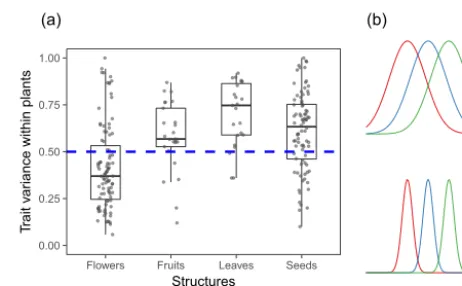
Subindividual variability in functional traits, however, is not ecologically interesting in itself, since even tightly con-trolled industrial processes fail to produce perfect copies of simple items due to minor stochastic fluctuations in the production equipment. It is intuitive to postulate that the greater the subindividual variability in a given trait, the more likely it will be that a such variation may have some eco-logical relevance. One method for assessing the extent of subindividual variation is to gauge it by comparison with the extent of variation between individual means for the same trait. This can be achieved, for instance, by estimat-ing the proportion of population-wide variance contributed by subindividual variation, or in other words, by partition-ing the population-wide variance of the trait of interest into its within- and among-individual components (Herrera et al., 2015). Estimates of the within-individual variance compo-nent (VARwithinhereafter) for a variety of flower, fruit, leaf, and seed traits are shown in Fig. 1a. There was considerable spread of VARwithin within each organ type, which reflects variation across species and also between different traits for the same organ (Herrera et al., 2015). Despite the broad spread, however, there was a clear trend for VARwithinto ex-ceed the variance between individual means for all organs except flowers. This implies that most population-wide vari-ance in functional organ traits occurs within the restricted spatial domain of individual plants; that organ trait value dis-tributions for different individuals tend to overlap extensively (Fig. 1b); and that neglecting subindividual variation to fo-cus exclusively on individual means is bound to miss a large fraction of the range of functional variation represented in plant populations. Insofar as the organ traits concerned pos-sess some ecological relevance, e.g., by influencing some im-portant ecological process or playing a role in the appear-ance of ecological patterns, the preceding implications call for a consideration of the ecological significance of subindi-vidual variation. In the following sections I will present a
(a) (b)
Trait value 0.00
0.25 0.50 0.75 1.00
Flowers Fruits Leaves Seeds Structures
Tr
ait v
ar
iance within plants
Figure 1.(a)Within-plant variability for a variety of continuously varying flower, fruit, leaf, and seed traits, as estimated by the pro-portion of population-wide variance in the trait that is accounted for by differences between organs produced by the same plant. The horizontal dashed line denotes the level above which subindividual variance is greater than variance between individual means. Each dot corresponds to an independent estimate (N=95, 25, 23, and 84 estimates for flower, fruit, leaf, and seed traits, respectively). Re-drawn from Fig. 3.2 in Herrera (2009).(b)Schematic comparison of hypothetical extremes of high (top) vs. low (bottom) levels of subindividual variation in a continuously varying organ trait for a given set of invariant individual means. Curves represent within-plant frequency distributions of trait values for three different indi-viduals (color coded). Individual means are the same in the upper and lower graphs.
non-exhaustive review of ecological patterns and processes, either established or putative, that are potentially under the influence of subindividual variation in functional traits of re-iterated organs.
3 Spatial patterns: microgradients and environmental grain
●
● ●
● ●
● ●
● ●
● ●
● ●
● ●
● ●
● ●
● ●
● ●
● ●
● ●
● ●
● ●
● ●
● ●
● ●
● ●
● ●
● ●
● ●
● ●
● ●
●
Bottom Top
60 65
Leaf water content (%)
P
osition in cro
wn
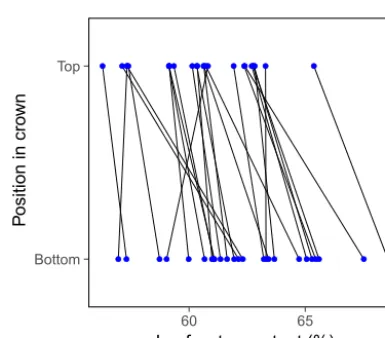
Figure 2.Vertical gradients in leaf water content within the crowns ofPrunus mahalebtrees. Each line connects mean values for water content in leaves from the top and bottom positions of an individ-ual (N=25 trees). Based on data from Alonso (1997, and unpub-lished).
microgradients will also arise when organ trait values vary regularly along nodal positions of linear supporting struc-tures such as branches or inflorescences. Traits that vary pre-dictably along these linear plant axes include anatomical fea-tures and chemical composition of leaves, nutritional char-acteristics of seeds, and structural and functional floral traits (Bennett et al., 2003; Guitián et al., 2004; Young et al., 2010; Austen et al., 2015; Herrera et al., 2015). For example, in the perennial herbHelleborus foetidus, leaf stomatal density increases, and mean stomatal size decreases, from basal to distal nodal positions along vegetative ramets (Herrera et al., 2015).
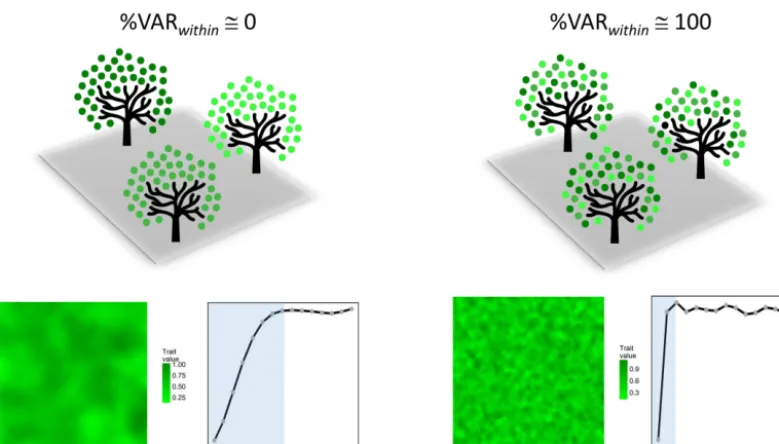
Irrespective of the specific details on how it is spatially or-ganized within individual plants or plant parts, subindividual variation in functional traits of organs will have the crucial ecological consequence of altering environmental grain size for ecologically relevant parameters. It will promote “fine-grainedness”, or small-scale “granularity”, of the environ-mentrelative toa hypothetical situation where within-plant homogeneity prevailed, as proposed schematically in Fig. 3. Very low and very high VARwithinvalues for a trait will cor-respond by definition to situations where organs resemble strongly and weakly, respectively, other organs in the same plant with regard to that trait (i.e., high and low intraclass correlations, respectively). Strong trait correlations between organs in the same plant will produce coarser grained envi-ronments than weak correlations, and the corresponding var-iograms will also differ widely (Fig. 3).
4 Individual-centered patterns: variability as an individual property
From an ecological perspective, an important aspect of subindividual variation in functional organ traits is that con-specific individuals in a population differ in the degree of internal heterogeneity. In other words, subindividual vari-ability should be considered in itself as an individual prop-erty, because “individual plants not only have their charac-teristic means, but their characcharac-teristic standard deviations” as well (Haldane, 1957, p. 312; see also Haldane, 1959, Roy, 1959, Paxman, 1956, and Suomela and Ayres, 1994, for further antecedents to this view). This general principle was named the “Haldane-Roy conjecture” by Herrera (2009), where data for a broad variety of functional organ traits from many species were gathered which unequivocally supported the generality of the phenomenon in plant populations. In addition, a within-plant variability continuum was shown to occur in most species, with populations generally compris-ing phenotypically constant to highly variable individuals, which ultimately means that the component of population-wide variance in an organ trait caused by within-plant vari-ation is not distributed equally among individuals. Recent studies have corroborated and expanded these conclusions by showing that conspecific individuals differ in variability of leaf functional traits (Herrera et al., 2015), seed mass (Her-rera et al., 2014; Shimada et al., 2015), fruit size (Sobral et al., 2013), seed tannin content (Shimada et al., 2015), and stigma–anther separation of flowers (Dai et al., 2016; Arceo-Gómez et al., 2017). In a large sample of plants of the peren-nial herbHelleborus foetidus, the within-plant coefficient of variation (within-plant standard deviation/individual mean) for stomatal index, stomatal density, stomatal length, and specific leaf area all ranged widely between plants (Fig. 4), thus denoting considerable individual variation in the magni-tude of subindividual functional heterogeneity.
5 Ecological effects of subindividual variation
ex-Figure 3.Schematic representation of two extreme situations in which most population-wide variance in a given quantitative trait of a reiterated organ occurs between (left, %VARwithin∼=0) and within (right, %VARwithin∼=100) individual plants. Trait values are denoted by variable color intensities. Hypothetical maps of spatially autocorrelated variation in trait values and its associated variogram plots are shown for the two situations. The variogram function for lag distanceh,γ(h), is the average squared difference of values separated byh. Blue areas denote the interval of distances between points within which trait values are spatially autocorrelated.
Stomata length Specific leaf area
Stomatal index Stomatal density
0.00 0.05 0.10 0.15 0.20 0.0 0.1 0.2 0.3
0.00 0.05 0.10 0.15 0.20 0.25 0.0 0.1 0.2 0.3 0.4 0.5
0 5 10 15 20 25
0 10 20 30 0
5 10 15
0 5 10 15 20
Within−plant coefficient of variation
Number of plants
Figure 4. Frequency distributions of within-plant coefficients of variation (standard deviation/mean, a measurement of variability) for four functional leaf traits in a sample of N=138 individuals of the perennial herb Helleborus foetidus. Data from Herrera et al. (2015).
amples with the aim of illustrating the variety of mechanisms whereby within-plant heterogeneity in organ traits can im-pinge in complex ways on individual fecundity and perfor-mance, population dynamics, plant community functionality, and the behavior of animal consumers. Just for convenience of presentation, these effects will be split into two classes,
Individual
fecundity
Within-plant CV
Stomatal density
Within-plant CV
Stomatal index
Within-plant CV
Stomatal length
Within-plant CV
Specific leaf area
R
2= 0.13
P < 0.001
Figure 5.Simplified path diagram quantifying the effects of within-plant variability in four functional leaf traits on the fecundity (num-ber of seeds produced) ofHelleborus foetidusplants (N=138). Arrow widths are proportional to the magnitude of path coefficients (shown beside arrows;∗∗P <0.01). Continuous and discontinuous lines reflect direct and inverse relationships, respectively. Based on data from Herrera et al. (2015) and M. Medrano and C. M. Herrera (unpublished).
5.1 Effects on plant individuals, populations, and communities
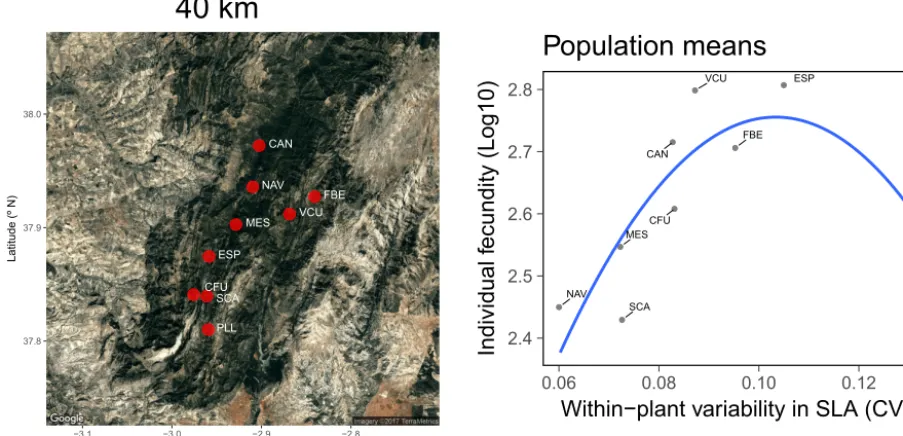
Within-plant variation in leaf, flower, fruit, or seed charac-teristics can affect diverse aspects of plant vegetative (e.g., growth rate, carbon assimilation) and reproductive (e.g., fe-cundity) performance of individuals, as shown by signifi-cant correlations across plants between subindividual vari-ability and diverse measurements of individual performance (Herrera, 2009). In the case of leaves, it has been frequently suggested that subindividual variation in some of their func-tional traits may be advantageous to individuals by enhanc-ing whole-plant photosynthetic performance and optimiz-ing the exploitation of environmental variation (e.g., canopy light gradients; Givnish, 1988; Hollinger, 1996; Osada et al., 2014). For the perennial herbHelleborus foetidus, Herrera et al. (2015) suggested that variation in size, specific leaf area, and stomatal traits across leaves borne in different nodal po-sitions along ramets could influence the water economy and carbon assimilation efficiency of whole plants, and suggested possible mechanisms in support of this explanation. Indirect support for their interpretation is provided by the significant relationships existing across individuals between seed fecun-dity and within-plant leaf variability (Fig. 5). The broad dif-ferences between individuals in subindividual variability of stomatal index, stomatal density, stomatal length, and spe-cific leaf area illustrated in Fig. 4 collectively account for 13 % of the variance in seed fecundity (Fig. 5). The higher the within-plant variability in stomatal index, stomatal length, and specific area, and the lower the variability in stomatal density, the higher was the total number of seeds produced by individual plants, perhaps as a consequence of improved water economy and/or carbon assimilation. Relationships be-tween subindividual variability and fecundity can also hold across populations of the same species, as exemplified by the significant nonlinear relationship between mean individual fecundity and mean subindividual variability in specific leaf area across the populations ofHelleborus foetidussampled by Herrera et al. (2015) (Fig. 6).
Subindividual variability in flower, fruit, and seed traits may also influence the reproductive success of individuals, as illustrated by correlations across conspecific individuals between variability and some measurement of reproductive performance. For example, in plants of the southern Spanish violetViola cazorlensis, subindividual variability in length of floral spur was related to fruit set (Herrera, 2009). In the trop-ical treeIpomoea wolcottianaand the vinePassiflora incar-nata, differences between plants in subindividual variability of anther–stigma separation were correlated with differences in fruit set and seed mass (Arceo-Gómez et al., 2017; Dai et al., 2017). In European populations of the bird-dispersed tree Crataegus monogyna, the magnitude of within-tree variation in fruit size was significantly related to the number of seeds effectively dispersed (Sobral et al., 2013). Further examples can be found in Herrera (2009).
Insofar as most organ traits involved in subindividual vari-ation have some functional implicvari-ations, varivari-ation within in-dividuals will be consequential for the functional ecology of plant populations and communities. It is currently acknowl-edged that individual variation in functional traits broadens the ecological breadth of species (Sides et al., 2014) and is an important factor enhancing community-wide functional diversity (Siefert et al., 2015). In the same way that the incor-poration of measurements of individual differences into trait-based plant ecology has improved our understanding of the role of trait variation in species distribution and plant com-munity organization (Violle et al., 2012; Sides et al., 2014), I contend that the incorporation of subindividual variability into trait-based ecological studies will help to further sharpen the focus of, and lend biological realism to, functional ecol-ogy investigations. Subindividual variation will contribute to expanding the range of the biotic and abiotic resources which can be successfully exploited by single individuals (Herrera, 2009), and its neglect will tend to exaggerate the importance of individual differences as a source of total population- or community-wide functional diversity. To date, however, the subindividual component remains virtually unexplored from the perspective of its contribution to the functional diver-sity and trait-based organization of plant communities (Her-rera et al., 2015). In the few studies where leaf trait vari-ances between species, between individuals within species, and within individuals were quantified simultaneously for a plant community, the contribution of subindividual variation to total community-wide variance was sometimes compara-ble or even superior to that of individual variation (Auger and Shipley 2013; Kang et al., 2014).
5.2 Effects on animal consumers
●
●
●
●
●
●
●
●
●
CAN
CFU
ESP
FBE
MES
NAV
PLL
SCA
VCU
2.4 2.5 2.6 2.7 2.8
0.06 0.08 0.10 0.12
Within−plant variability in SLA (CV)
Individual f
ecundity (Log10)
Population means
CAN
MES
ESP NAV
CFU
VCU FBE
SCA
PLL
37.8 37.9 38.0
−3.1 −3.0 −2.9 −2.8 Longitude (º W)
Latitude (º N)
40 km
Figure 6.Geographical distribution ofHelleborus foetiduspopulations sampled by Herrera et al. (2015) in the Sierra de Cazorla, southeastern Spain (left), and relationship across populations between mean individual fecundity (seeds produced per plant, log transformed) and mean within-individual variability (coefficient of variation, CV) of specific leaf area (SLA; right). Based on data from Herrera et al. (2015) and M. Medrano and C. M. Herrera (unpublished).
only in the mean value of organ traits, but also in the variance as noted earlier, consumer discrimination and choice among individual plants will also be influenced by individual differ-ences in variability levels.
Within-plant variation in reiterated structures is generally comparable to or even greater in magnitude than variation among plants, as noted above. Therefore, discrimination and selection by animal consumers among organs that differ in morphological, chemical, or nutritional properties are likely to be the rule rather than the exception. This will apply equally to situations in which animals maintain predomi-nantly antagonistic and predomipredomi-nantly mutualistic relation-ships with plants. It is well known, for instance, that after ap-proaching a plant pollinators eventually visit only a subset of the flowers available, probing preferentially the most reward-ing flowers and skippreward-ing the least rewardreward-ing ones (Duffield et al., 1993; Møller, 1995; Harder et al., 2004). Small-scale flower selection exerted by pollinators can be strong, with individual foragers rejecting up to 10–25 % of approached flowers (Heinrich, 1979; Kadmon et al., 1991). Following ar-rival at a plant, frugivorous vertebrates also discern and re-spond to within-plant variation in fruit features related to en-ergetic reward such as pulp mass or pulp-to-seed mass ratio (Wheelwright, 1985; Sallabanks, 1993; Palacio et al., 2017). Likewise, egg-laying females of invertebrate fruit and seed predators discriminate between the fruits borne by a plant on the basis of their size, number of enclosed seeds, or other traits potentially influencing the viability of their progeny (Herrera, 1984; Nalepa and Grissell, 1993). Similarly, leaf
miners, sap feeders, or folivorous insects tend to select those particular leaves in a plant crown that provide greater nutri-tional reward and/or a lower load of toxic or deterrent com-pounds (Roslin et al., 2006; Young et al., 2010). In short, ani-mal consumers generally do not treat individual plants as ho-mogeneous feeding patches, but rather discriminate between organs borne on the same plant on the basis of differences in quality.
sugar solutions), they most often develop variance-averse be-haviors which lead them to prefer the least variable patches (Herrera, 2009; Nakamura and Kudo, 2016). In the fleshy-fruited treeCrataegus monogyna, inverse relationships link-ing within-plant variability in fruit and seed mass, on the one hand, and proportional fruit removal by frugivorous birds and seed predation by rodents, on the other, have been reported (Sobral et al., 2013, 2014). Likewise, within-plant variances in the mass and tannin content of seeds in the oakQuercus serratawere significantly related to between-tree differences in seed removal by rodents (Shimada et al., 2015). Variable chemical defenses within plants will also have a negative im-pact on the performance of insect herbivores and favor the evolution of variance-driven host selection behaviors (Ten-humberg et al., 2000; Shelton, 2004; Wetzel et al., 2016).
6 Evolutionary implications of subindividual variation: a canonical perspective
The ecological processes associated with within-plant vari-ation described above, particularly those related to the dis-criminating behavior of animals toward individual plants, can also have some evolutionary repercussions (Herrera, 2009). The two most important of these can be easily formulated using conventional tools from the realm of population ge-netics, and their consequences inferred from ordinary con-cepts of quantitative genetics and phenotypic selection mod-els: subindividual variability will constrain responses to se-lection on individual organ traits, and phenotypic sese-lection will operate not only on individual means, but also on within-individual variances.
Simple quantitative genetics considerations reveal that within-plant variation in a given organ trait will generally act by constraining the responses to selection by the envi-ronment, including animals, on that trait. Repeatability (r) of any organ trait in a plant population will approximately equal 1 – VARwithin, and will set an upper-bound estimate to the trait’s broad-sense heritability (H2), or the fraction of the to-tal phenotypic variance that has a genetic basis, both additive and nonadditive. Broad-sense heritability, in turn, sets an up-per limit to narrow-sense heritability (h2), a central element in the familiar breeder’s equation 1µ=h2S, where1µ is the response to selection across generations andS is the se-lection differential (see, e.g., Falconer and MacKay, 1996, and Lynch and Walsh, 1998, for further details). By setting an upper limit onh2, repeatability of a trait will thus set an up-per limit to the response to selection across generations. With the predominantly high values of VARwithinthat characterize variation in the majority of organ traits (Fig. 1), repeatabil-ities for leaf, fruit, and seed traits will often be low enough to predict low heritabilities and thus intrinsically small re-sponses to selection.
The most interesting and consequential evolutionary im-plication of within-plant variation in organ traits is that it opens the possibility for animals or the abiotic environment to exert selection on levels of within-plant variance through some of the mechanisms mentioned earlier. Selection on subindividual variability can be inferred from some results reviewed above (e.g., the relationship between leaf variabil-ity and individual fecundvariabil-ity in Helleborus foetidus plants shown in Fig. 5). More explicit tests, however, can be un-dertaken by expanding phenotypic selection models devel-oped for evaluating selection on quantitative traits (King-solver and Pfennig, 2007) to incorporate subindividual vari-abilities just as another set of descriptors of a plant’s phe-notype in addition to customarily used means. Application of these “variability-aware”, expanded phenotypic selection models to different plant species, organ traits, and types of plant–animal interactions has revealed the existence of significant directional selection on subindividual variability even in cases where selection on individual means was not evident (Herrera, 2009; Sobral et al., 2014; Arceo-Gómez et al., 2017; Palacio et al., 2017). Furthermore, function-valued trait analyses have revealed that the shape of gradients of variation in flower traits along inflorescences is also subject to phenotypic selection (Kulbaba et al., 2017).
subindi-vidual variability in leaf features might have a causal genetic basis.
7 Emerging connections: epigenetics and subindividual variation
The evolutionary and ecological implications of within-plant variation in continuous traits of reiterated structures will ul-timately depend on its underlying causes and maintenance mechanisms. A combination of position along growth axes, developmental history, short-term responses to the external environment, and developmental stochasticity has been pro-posed as a major proximate cause of subindividual varia-tion, but its mechanistic basis is far from being well es-tablished (Herrera, 2009). Genetic mosaicism (i.e., within-plant heterogeneity in DNA sequences) caused by the vegeta-tive propagation within individuals of somatic mutations was once proposed as a major driver of subindividual heterogene-ity in plants (Whitham and Slobodchikoff, 1981). The rarheterogene-ity of documented instances of genetic mosaicism in wild plants, however, makes it unlikely that this will provide a universal mechanism for ubiquitous subindividual variation in plant communities (O’Connell and Ritland, 2004; Herrera, 2009; Padovan et al., 2013; Ranade et al., 2015). Nevertheless, ge-netic mosaicism is not the only possible mechanism causing stable or metastable subindividual genomic heterogeneity in plants. One further, hitherto almost unexplored source of ge-nomic heterogeneity within plants isepigeneticmosaicism. A handful of studies have shown that the genomes of homol-ogous organs in the same plant may differ in their patterns of DNA cytosine methylation despite homogeneity in the DNA sequence (Bitonti et al., 1996, 2002; Gao et al., 2010; Bian et al., 2013; Spens and Douhovnikoff, 2016; Ahn et al., 2017). Cytosine methylation is a major epigenetic mechanism in plants that plays important roles in gene expression and plant growth and development (Finnegan et al., 2000; Cokus et al., 2008; Lister et al., 2008), and it is well established that DNA methylation variants independent of DNA sequences are causally related to individual differences in continuous traits (Zhang et al., 2013; Cortijo et al., 2014; Hu et al., 2015; Kooke et al., 2015). Extrapolating from the between-individual to within-between-individual domains, the hypothesis has been recently formulated that subindividual heterogeneity in patterns and extent of DNA methylation can sometimes ac-count for within-plant variation in organ traits (Herrera and Bazaga, 2013; Alonso et al., 2017). The few tests of this hy-pothesis conducted so far support a relationship between epi-genetic mosaicism and subindividual heterogeneity in both discontinuously and continuously varying organ traits.
Individual holly trees (Ilex aquifolium) often bear a mixture of nonprickly and prickly leaves, the latter be-ing produced facultatively as a plastic response to brows-ing by mammals (Obeso, 1997). By comparbrows-ing genomic DNA methylation profiles in pairs of contiguous prickly
and nonprickly leaves on the same branchlets using a methylation-sensitive amplified fragment polymorphism (MSAP) method, Herrera and Bazaga (2013) found that ad-jacent nonprickly and prickly leaves differed significantly in their genome-wide patterns of DNA methylation. Methyla-tion differences between leaf types did not occur randomly across the genome, but affected predominantly some spe-cific markers whose methylation probability declined signif-icantly from nonprickly to contiguous prickly leaves. In this case, therefore, spatial correspondence within tree crowns between epigenotypes and leaf phenotypes was consistent with the hypothesis of epigenetic mosaicism as a contribut-ing factor to subindividual variation.
Seeds are one of the most subindividually variable struc-tures in plants, and in the vast majority of instances the within-plant component of population-wide variance in seed mass exceeds the variance between individuals (Fig. 1). The ecological significance of the large variation in seed mass occurring within crops was emphasized long ago by Janzen (1977a, b), and largely stems from the manifold im-plications of seed mass for population persistence and com-munity dynamics through its pervasive effects on seed pre-dation, seed dispersal, and seedling emergence and survival (Harper, 1977). The important ecological effects of seed mass variation thus confer particular interest to some recent results which link epigenetic mosaicism with subindividual variation in seed mass. In the evergreen shrub Lavandula latifolia, analyses of global DNA cytosine methylation lev-els using a HPLC method revealed that leaves from differ-ent modules in the same plant (one “module”=one inflores-cence plus its associated set of subtending leaves) differed in global DNA cytosine methylation (Alonso et al., 2017). The magnitude of such epigenetic mosaicism was substantial, as variance in DNA methylation among modules of the same shrub was greater than variance between individuals. As pre-dicted by the epigenetic mosaicism hypothesis, subindivid-ual variation in the size and number of seeds produced per module was significantly related to subindividual variation in genome-wide DNA cytosine methylation level (Alonso et al., 2017).
trans-missibility of DNA methylation patterns was characterized by low subindividual variance in seed mass, and vice versa (Herrera et al., 2014).
8 Synthesis and perspectives
As noted by Herrera (2009, p. 339), “subindividual varia-tion in plants seems to have succumbed so far to the risk of looking and yet overlooking.” What is one of the most obvious sources of phenotypic variation in plant populations has been traditionally neglected, if not explicitly dismissed as a statistical nuisance, on the misguided understanding that such variation is the product of the same genotype and thus invisible to natural selection, or on the unproven implicit assumption that it is devoid of ecological relevance. Con-tinuous subindividual variation is only rarely considered in ecology textbooks, and it is not even considered among the levels of biological diversity contributing to “biodiversity” (Contoli and Luiselli, 2015), an omission that will system-atically underestimate the phenetic component of biodiver-sity in populations and communities. The preceding sections have summarized current knowledge on the magnitude, pat-terns, and ecological effects of subindividual variation in functional traits of all major classes of homologous, reiter-ated structures. Irrespective of the particular structure consid-ered, whenever subindividual variation has been placed un-der the focus of ecological research and its correlates exam-ined in sufficient detail, it has been found to be quantitatively important and ecologically significant at the population and community levels.
In addition to an immediate effect on the spatial struc-ture of functional plant traits by enhancing environmental “fine-grainedness”, the production by plants of nonidenti-cal homologous structures has a number of more subtle eco-logical effects on both the plants themselves and their an-imal consumers. On the plant side, effects include broad-ening the ecological breadth of individuals and species; en-hancing the functional diversity of populations and commu-nities; improving the exploitation of limiting resources such as light or nutrients; modifying the outcome of interactions with antagonists (e.g., herbivores) and mutualists (e.g., polli-nators); coping with environmental uncertainty in biotic and abiotic factors; and enhancing the exploitation of biotically and abiotically heterogeneous environments through “divi-sion of labor” effects (Herrera, 2009). Furthermore, differ-ences between conspecific plants in subindividual variability are correlated with fitness surrogates and seem transgenera-tionally heritable, which lends plausibility to the hypothesis that variable levels of subindividual variability across popu-lations may have been shaped by divergent natural selection (Herrera et al., 2014). On the side of animal consumers, the main predicted effect of subindividual variance in features of reiterated plant structures will be to elicit variance-sensitive foraging behaviors and to promote selectivity among plant
individuals based on local trait variances rather than, or in ad-dition to, local trait means. In the case of mutualists such as pollinators or seed dispersers, variance-averse behaviors will result in selection against the most subindividually variable individuals, whereas variance aversion by antagonists such as folivores or seed predators will select for increased subindi-vidual variability (Herrera, 2009). In either case, in the long run the expected consequence for plants of such directional selection will be to shape natural patterns of subindivid-ual variation in plant populations according to some organ-specific trade-off representing a balance between the reduc-tion promoted by plant–mutualist interacreduc-tions and the en-hancement arising from plant–antagonist interactions. Future studies aimed at understanding the ecological bases of popu-lation differentiation in plants should therefore consider not only population differences in trait means, but also popu-lation differences in subindividual trait variability and how these relate to spatially variable selection exerted by mutual-istic and antagonmutual-istic animal consumers.
methyla-tion patterns are inherited across generamethyla-tions and subindivid-ual epigenetic mosaics do eventsubindivid-ually translate into epigenet-ically heterogeneous progeny. Were these effects eventually proven, epigenetic mosaicism and its associated subindivid-ual phenotypic variation would emerge as powerful, hitherto unrecognized factors contributing to the short- and long-term dynamics and functional diversity of plant populations and communities. And as a sequel, some ecology textbook would then choose “From organs to ecosystems” as a subtitle.
Data availability. See captions to Figs. 1, 2, 4, 5 and 6 for main data sources used in this paper.
Competing interests. The author declares that he has no conflict of interest.
Edited by: Daniel Montesinos Reviewed by: two anonymous referees
References
Ahn, J., Franklin, S. B., and Douhovnikoff, V.: Epigenetic variation in clonal stands of aspen, Folia Geobot., 1–7, https://doi.org/10.1007/s12224-017-9308-x, online first, 2017. Alonso, C.: Variaciones en las relaciones planta-insectos fitófagos:
efectos de factores bióticos y abióticos, Unpubl. PhD Thesis, University of Sevilla, Sevilla, Spain, 1997.
Alonso, C., Pérez, R., Bazaga, P., Medrano, M., and Herrera, C. M.: Individual variation in size and fecundity is correlated with differences in global DNA cytosine methylation in the peren-nial herbHelleborus foetidus(Ranunculaceae), Am. J. Bot., 101, 1309–1313, 2014.
Alonso, C., Pérez, R., Bazaga, P., Medrano, M., and Her-rera, C. M.: Within-plant variation in seed size and inflores-cence fecundity is associated with epigenetic mosaicism in the shrub Lavandula latifolia (Lamiaceae), Ann. Bot., in press, https://doi.org/10.1093/aob/mcx140, 2017.
Arceo-Gómez, G., Vargas, C. F., and Parra-Tabla, V.: Selection on intra-individual variation in stigma-anther distance in the tropi-cal treeIpomoea wolcottiana(Convolvulaceae), Plant Biol., 19, 454–459, 2017.
Auger, S. and Shipley, B.: Inter-specific and intra-specific trait vari-ation along short environmental gradients in an old-growth tem-perate forest, J. Veg. Sci., 24, 419–428, 2013.
Austen, E. J., Forrest, J. R. K., and Weis, A. E.: Within-plant vari-ation in reproductive investment: consequences for selection on flowering time, J. Evol. Biol., 28, 65–79, 2015.
Bagchi, S. K., Sharma, V. P., and Gupta, P. K.: Developmental insta-bility in leaves ofTectona grandis, Silvae Genet., 38, 1–6, 1989. Banks, J. A. and Fedoroff, N.: Patterns of developmental and herita-ble change in methylation of the suppressor-mutator transposaherita-ble element, Dev. Genet., 10, 425–437, 1989.
Barrett, S. C. H.: The evolution of mating strategies in flowering plants, Trends Plant Sci., 3, 335–341, 1998.
Begon, M., Townsend, C. R., and Harper, J. L.: Ecology, From in-dividuals to ecosystems, 4th edn., Blackwell, Oxford, UK, 2006. Bennett, J. O., Krishnan, A. H., Wiebold, W. J., and Krishnan, H. B.: Positional effect on protein and oil content and composition of soybeans, J. Agr. Food Chem., 51, 6882–6886, 2003. Bian, R. J., Nie, D. D., Xing, F., Zhou, X. L., Gao, Y., Bai, Z. J., and
Liu, B.: Adaptational significance of variations in DNA methy-lation in clonal plantHierochloe glabra(Poaceae) in heteroge-neous habitats, Aust. J. Bot., 61, 274–282, 2013.
Biere, A.: Parental effects inLychnis flos-cuculi, I: seed size, ger-mination and seedling performance in a controlled environment, J. Evol. Biol., 3, 447–465, 1991.
Bitonti, M. B., Cozza, R., Wang, G., Ruffini-Castiglione, M., Maz-zuca, S., Castiglione, S., Sala, F., and Innocenti, A. M.: Nuclear and genomic changes in floating and submerged buds and leaves of heterophyllous waterchestnut (Trapa natans), Physiol. Plant., 97, 21–27, 1996.
Bitonti, M. B., Cozza, R., Chiappetta, A., Giannino, D., Castiglione, M. R., Dewitte, W., Mariotti, D., Van Onckelen, H., and Inno-centi, A. M.: Distinct nuclear organization, DNA methylation pattern and cytokinin distribution mark juvenile, juvenile-like and adult vegetative apical meristems in peach (Prunus persica (L.) Batsch), J. Exp. Bot., 53, 1047–1054, 2002.
Canto, A., Pérez, R., Medrano, M., Castellanos, M. C., and Herrera, C. M.: Intraplant variation in nectar sugar composition in two Aquilegiaspecies (Ranunculaceae): contrasting patterns under field and greenhouse conditions, Ann. Bot., 99, 653–660, 2007. Casella, E. and Ceulemans, R.: Spatial distribution of leaf
morpho-logical and physiomorpho-logical characteristics in relation to local radi-ation regime within the canopies of 3-year-oldPopulusclones in coppice culture, Tree Physiol., 22, 1277–1288, 2002.
Cokus, S. J., Feng, S. H., Zhang, X. Y., Chen, Z. G., Merriman, B., Haudenschild, C. D., Pradhan, S., Nelson, S. F., Pellegrini, M., and Jacobsen, S. E.: Shotgun bisulphite sequencing of the Ara-bidopsisgenome reveals DNA methylation patterning, Nature, 452, 215–219, 2008.
Contoli, L. and Luiselli, L.: Contributions to biodiversity the-ory: the importance of formal rigor, Web Ecol., 15, 33–37, https://doi.org/10.5194/we-15-33-2015, 2015.
Cortijo, S., Wardenaar, R., Colomé-Tatché, M., Gilly, A., Etchev-erry, M., Labadie, K., Caillieux, E., Hospital, F., Aury, J. M., Wincker, P., Roudier, F., Jansen, R. C., Colot, V., and Johannes, F.: Mapping the epigenetic basis of complex traits, Science, 343, 1145–1148, 2014.
Dai, C., Liang, X. J., Ren, J., Liao, M. L., Li, J. Y., and Galloway, L. F.: The mean and variability of a floral trait have opposing effects on fitness traits, Ann. Bot., 117, 421–429, 2016.
Das, O. P. and Messing, J.: Variegated phenotype and developmen-tal methylation changes of a maize allele originating from epimu-tation, Genetics, 136, 1121–1141, 1994.
Delhey, K. and Kempenaers, B.: Age differences in blue titParus caeruleusplumage colour: within-individual changes or colour-biased survival?, J. Avian Biol., 37, 339–348, 2006.
Ellsworth, D. S. and Reich, P. B.: Canopy structure and vertical pat-terns of photosynthesis and related leaf traits in a deciduous for-est, Oecologia, 96, 169–178, 1993.
Escribano-Rocafort, A. G., Ventre-Lespiaucq, A. B., Granado-Yela, C., Rubio de Casas, R., Delgado, J. A., and Balaguer, L.: The expression of light-related leaf functional traits depends on the location of individual leaves within the crown of isolatedOlea europaeatrees, Ann. Bot., 117, 643–651, 2016.
Escribano-Rocafort, A. G., Ventre-Lespiaucq, A. B., Granado-Yela, C., Rubio de Casas, R., Delgado, J. A., Escudero, A., and Bal-aguer, L.: Intraindividual variation in light-related functional traits: magnitude and structure of leaf trait variability across global scales in Olea europaea trees, Trees, 31, 1505–1517, 2017.
Falconer, D. S. and MacKay, T. F. C.: Introduction to quantitative genetics, 4th edn., Addison Wesley Longman, Harlow, Essex, UK, 1996.
Finnegan, E. J., Peacock, W. J., and Dennis, E. S.: DNA methyla-tion, a key regulator of plant development and other processes, Curr. Opin. Genet. Dev., 10, 217–223, 2000.
Gao, L. X., Geng, Y. P., Li, B., Chen, J. K., and Yang, J.: Genome-wide DNA methylation alterations of Alternanthera philoxe-roidesin natural and manipulated habitats: implications for epi-genetic regulation of rapid responses to environmental fluctu-ation and phenotypic varifluctu-ation, Plant Cell Environ., 33, 1820– 1827, 2010.
Gijbels, P., Van den Ende, W., and Honnay, O.: Landscape scale variation in nectar amino acid and sugar composition in a Lepi-doptera pollinated orchid species and its relation with fruit set, J. Ecol., 102, 136–144, 2014.
Givnish, T. J.: Adaptation to sun and shade: a whole-plant perspec-tive, Aust. J. Plant Physiol., 15, 63–92, 1988.
Guitián, J., Medrano, M., and Oti, J. E.: Variation in floral sex allo-cation inPolygonatum odoratum(Liliaceae), Ann. Bot., 94, 433– 440, 2004.
Haldane, J. B. S.: Karl Pearson, 1857–1957, Biometrika, 44, 303– 313, 1957.
Haldane, J. B. S.: The theory of natural selection to-day, Nature, 183, 710–713, 1959.
Harder, L. D., Jordan, C. Y., Gross, W. E., and Routley, M. B.: Be-yond floricentrism: The pollination function of inflorescences, Plant Spec. Biol., 19, 137–148, 2004.
Harper, J. L.: Population biology of plants, Academic Press, Lon-don, UK, 1977.
Heinrich, B.: Resource heterogeneity and patterns of movement in foraging bumblebees, Oecologia, 40, 235–245, 1979.
Herrera, C. M.: Selective pressures on fruit seediness: differential predation of fly larvae on the fruits ofBerberis hispanica, Oikos, 42, 166–170, 1984.
Herrera, C. M.: Multiplicity in unity. Plant subindividual varia-tion and interacvaria-tions with animals, University of Chicago Press, Chicago, USA, 2009.
Herrera, C. M. and Bazaga, P.: Epigenetic correlates of plant phe-notypic plasticity: DNA methylation differs between prickly and nonprickly leaves in heterophyllous Ilex aquifolium (Aquifoli-aceae) trees, Bot. J. Linn. Soc., 171, 441–452, 2013.
Herrera, C. M., Pérez, R., and Alonso, C.: Extreme intraplant varia-tion in nectar sugar composivaria-tion in an insect-pollinated perennial herb, Am. J. Bot., 93, 575–581, 2006.
Herrera, C. M., Medrano, M., and Bazaga, P.: Variation in DNA methylation transmissibility, genetic heterogeneity and fecundity-related traits in natural populations of the perennial herbHelleborus foetidus, Mol. Ecol., 23, 1085–1095, 2014. Herrera, C. M., Medrano, M., and Bazaga, P.: Continuous
within-plant variation as a source of intraspecific functional diversity: patterns, magnitude, and genetic correlates of leaf variability in Helleborus foetidus(Ranunculaceae), Am. J. Bot. 102, 225–232, 2015.
Herrera, C. M., Medrano, M., and Bazaga, P.: Epigenetic and ge-netic spatial structure of the perennial herbHelleborus foetidus: isolation by environment, isolation by distance, and functional trait divergence, Am. J. Bot., 104, 1195–1204, 2017.
Herrera, C. M., Alonso, C., Medrano, M., Pérez, R., and Bazaga, P.: Transgenerational epigenetics: inheritance of global cytosine methylation and methylation-related epigenetic markers in the shrubLavandula latifolia, Am. J. Bot, submitted, 2018. Hollinger, D. Y.: Optimality and nitrogen allocation in a tree
canopy, Tree Physiol., 16, 627–634, 1996.
Hu, Y. D., Morota, G., Rosa, G. J. M., and Gianola, D.: Prediction of plant height inArabidopsis thalianausing DNA methylation data, Genetics, 201, 779–793, 2015.
Imbert, E.: Ecological consequences and ontogeny of seed hetero-morphism, Perspect. Plant Ecol., 5, 13–36, 2002.
Janzen, D. H.: Variation in seed size within a crop of a Costa Ri-canMucuna andreana(Leguminosae), Am. J. Bot., 64, 347–349, 1977a.
Janzen, D. H.: Variation in seed weight in Costa RicanCassia gran-dis(Leguminosae), Trop. Ecol., 18, 177–186, 1977b.
Kacelnik, A. and Bateson, M.: Risky theories – the effects of vari-ance on foraging decisions, Am. Zool., 36, 402–434, 1996. Kadmon, R., Shmida, A., and Selten, R.: Within-plant foraging
be-havior of bees and its relationship to nectar distribution in An-chusa strigosa, Israel J. Bot., 40, 283–94, 1991.
Kang, M., Chang, S. X., Yan, E. R., and Wang, X. H.: Trait variabil-ity differs between leaf and wood tissues across ecological scales in subtropical forests, J. Veg. Sci., 25, 703–714, 2014.
Kingsolver, J. G. and Pfennig, D. W.: Patterns and power of pheno-typic selection in nature, Bioscience, 57, 561–572, 2007. Kooke, R., Johannes, F., Wardenaar, R., Becker, F., Etcheverry, M.,
Colot, V., Vreugdenhil, D., and Keurentjes, J. J. B.: Epigenetic basis of morphological variation and phenotypic plasticity in Arabidopsis thaliana, Plant Cell, 27, 337–348, 2015.
Kulbaba, M. W., Clocher, I. C., and Harder, L. D.: Inflorescence characteristics as function-valued traits: analysis of heritability and selection on architectural effects, J. Syst. Evol., 55, 559–565, https://doi.org/10.1111/jse.12252, 2017.
Larrinaga, A. R. and Guitián, P.: Intraspecific variation in fruit size and shape inCorema album(Ericaceae) along a latitudinal gradi-ent: from fruits to populations, Biol. J. Linn. Soc., 118, 940–950, 2016.
Le Roux, X., Sinoquet, H., and Vandame, M.: Spatial distribution of leaf dry weight per area and leaf nitrogen concentration in relation to local radiation regime within an isolated tree crown, Tree Physiol., 19, 181–188, 1999.
Lloyd, D. G.: Variation strategies of plants in heterogeneous envi-ronments, Biol. J. Linn. Soc., 21, 357–385, 1984.
Lynch, M. and Walsh, B.: Genetics and analysis of quantitative traits, Sinauer, Sunderland, Masachusetts, USA, 1998.
Marshall, C.: Sectoriality and physiological organisation in herba-ceous plants: An overview, Vegetatio, 127, 9–16, 1996. Matilla, A., Gallardo, M., and Puga-Hermida, M. I.: Structural,
physiological and molecular aspects of heterogeneity in seeds: a review, Seed Sci. Res., 15, 63–76, 2005.
McClintock, B.: The origin and behavior of mutable loci in maize, P. Natl. Acad. Sci. USA, 36, 344–355, 1950.
Medrano, M., Herrera, C. M., and Bazaga, P.: Epigenetic variation predicts regional and local intraspecific functional diversity in a perennial herb, Mol. Ecol., 23, 4926–4938, 2014.
Møller, A. P.: Bumblebee preference for symmetrical flowers, P. Natl. Acad. Sci. USA, 92, 2288–2292, 1995.
Nakamura, S. and Kudo, G.: Foraging responses of bum-ble bees to rewardless floral patches: importance of within-plant variance in nectar presentation, AoB Plants, 8, plw037, https://doi.org/10.1093/aobpla/plw037, 2016.
Nalepa, C. A. and Grissell, E. E.: Host seed size and adult size, emergence, and morphology ofMegastigmus aculeatus ni-groflavus (Hymenoptera: Torymidae), Environ. Entomol., 22, 1313–1317, 1993.
Obeso, J. R.: The induction of spinescence in European holly leaves by browsing ungulates, Plant Ecol., 129, 149–156, 1997. O’Connell, L. M. and Ritland, K.: Somatic mutations at
microsatel-lite loci in western redcedar (Thuja plicata: Cupressaceae), J. Hered., 95, 172–176, 2004.
Orians, C. M. and Jones, C. G.: Plants as resource mosaics: a func-tional model for predicting patterns of within-plant resource het-erogeneity to consumers based on vascular architecture and local environmental variability, Oikos, 94, 493–504, 2001.
Osada, N., Yasumura, Y., and Ishida, A.: Leaf nitrogen distribution in relation to crown architecture in the tall canopy species,Fagus crenata, Oecologia, 175, 1093–1106, 2014.
Padovan, A., Keszei, A., Foley, W. J., and Külheim, C.: Differences in gene expression within a striking phenotypic mosaic Euca-lyptustree that varies in susceptibility to herbivory, BMC Plant Biol., 13, 29–29, 2013.
Palacio, F. X., Girini, J. M., and Ordano, M.: Linking the hierarchi-cal decision-making process of fruit choice and the phenotypic selection strength on fruit traits by birds, J. Plant Ecol., 10, 713– 720, 2017.
Paxman, G. J.: Differentiation and stability in the development of Nicotiana rustica, Ann. Bot.-London, 20, 331–347, 1956. Pérez-Harguindeguy, N., Díaz, S., Garnier, E., Lavorel, S., Poorter,
H., Jaureguiberry, P., Bret-Harte, M. S., Cornwell, W. K., Craine, J. M., Gurvich, D. E., Urcelay, C., Veneklaas, E. J., Reich, P. B., Poorter, L., Wright, I. J., Ray, P., Enrico, L., Pausas, J. G., de Vos, A. C., Buchmann, N., Funes, G., Quétier, F., Hodgson, J. G., Thompson, K., Morgan, H. D., ter Steege, H., van der Heijden, M. G. A., Sack, L., Blonder, B., Poschlod, P., Vaieretti, M. V., Conti, G., Staver, A. C., Aquino, S., and Cornelissen, J. H. C.: New handbook for standardised measurement of plant functional traits worldwide, Aust. J. Bot., 61, 167–234, 2013.
Perica, S.: Seasonal fluctuation and intracanopy variation in leaf ni-trogen level in olive, J. Plant Nutr., 24, 779–787, 2001.
Piersma, T. and Lindström, Å.: Rapid reversible changes in organ size as a component of adaptive behaviour, Trends Ecol. Evol., 12, 134–138, 1997.
Platt, A., Vilhjálmsson, B. J., and Nordborg, M.: Conditions under which genome-wide association studies will be positively mis-leading, Genetics, 186, 1045–1052, 2010.
Price, E. A. C., Hutchings, M. J., and Marshall, C.: Causes and con-sequences of sectoriality in the clonal herbGlechoma hederacea, Vegetatio, 127, 41–54, 1996.
Ranade, S. S., Ganea, L. S., Razzak, A. M., and Gil, M. R. G.: Fun-gal infection increases the rate of somatic mutation in Scots Pine (Pinus sylvestrisL.), J. Hered., 106, 386–394, 2015.
Roslin, T., Gripenberg, S., Salminen, J. P., Karonen, M., O’Hara, R. B., Pihlaja, K., and Pulkkinen, P.: Seeing the trees for the leaves – oaks as mosaics for a host-specific moth, Oikos, 113, 106–120, 2006.
Roy, S. K.: Regulation of morphogenesis in an oleaceous tree, Nyc-tanthes arbor-tristis, Nature, 183, 1410–1411, 1959.
Sakai, K. I. and Shimamoto, Y.: Developmental instability in leaves and flowers ofNicotiana tabacum, Genetics, 51, 801–813, 1965. Sallabanks, R.: Hierarchical mechanisms of fruit selection by an
avian frugivore, Ecology, 74, 1326–1336, 1993.
Schulz, B., Eckstein, R. L., and Durka, W.: Epigenetic variation re-flects dynamic habitat conditions in a rare floodplain herb, Mol. Ecol., 23, 3523–3537, 2014.
Seyffert, W.: Homeostasis in defined genotypes of Matthiola in-cana, Theor. Appl. Genet., 64, 205–212, 1983.
Shelton, A. L.: Variation in chemical defences of plants may im-prove the effectiveness of defence, Evol. Ecol. Res., 6, 709–726, 2004.
Shimada, T., Takahashi, A., Shibata, M., and Yagihashi, T.: Effects of within-plant variability in seed weight and tannin content on foraging behaviour of seed consumers, Funct. Ecol., 29, 1513– 1521, 2015.
Sides, C. B., Enquist, B. J., Ebersole, J. J., Smith, M. N., Hen-derson, A. N., and Sloat, L. L.: Revisiting Darwin’s hypothesis: Does greater intraspecific variability increase species’ ecological breadth?, Am. J. Bot., 101, 56–62, 2014.
Siefert, A., Violle, C., Chalmandrier, L., Albert, C. H., Taudiere, A., Fajardo, A., Aarssen, L. W., Baraloto, C., Carlucci, M. B., Cianciaruso, M. V., Dantas, V. D., de Bello, F., Duarte, L. D. S., Fonseca, C. R., Freschet, G. T., Gaucherand, S., Gross, N., Hikosaka, K., Jackson, B., Jung, V., Kamiyama, C., Katabuchi, M., Kembel, S. W., Kichenin, E., Kraft, N. J. B., Lagerstrom, A., Le Bagousse-Pinguet, Y., Li, Y. Z., Mason, N., Messier, J., Nakashizuka, T., Overton, J. McC., Peltzer, D. A., Perez-Ramos, I. M., Pillar, V. D., Prentice, H. C., Richardson, S., Sasaki, T., Schamp, B. S., Schöb, C., Shipley, B., Sundqvist, M., Sykes, M. T., Vandewalle, M., and Wardle, D. A.: A global meta-analysis of the relative extent of intraspecific trait variation in plant com-munities, Ecol. Lett., 18, 1406–1419, 2015.
Smallwood, P. D.: An introduction to risk sensitivity: the use of Jensen’s inequality to clarify evolutionary arguments of adapta-tion and constraint, Am. Zool., 36, 392–401, 1996.
Sobral, M., Guitián, J., Guitián, P., and Larrinaga, A. R.: Seed predators exert selection on the subindividual variation of seed size, Plant Biol., 16, 836–842, 2014.
Spens, A. E. and Douhovnikoff, V.: Epigenetic variation within Phragmites australis among lineages, genotypes, and ramets, Biol. Invasions, 18, 2457–2462, 2016.
Stamps, J. A., Briffa, M., and Biro, P. A.: Unpredictable animals: individual differences in intraindividual variability (IIV), Anim. Behav., 83, 1325–1334, 2012.
Suomela, J. and Ayres, M. P.: Within-tree and among-tree variation in leaf characteristics of mountain birch and its implications for herbivory, Oikos, 70, 212–222, 1994.
Sutherland, W. J., Freckleton, R. P., Godfray, H. C. J., Beissinger, S. R., Benton, T., Cameron, D. D., Carmel, Y., Coomes, D. A., Coulson, T., Emmerson, M. C., Hails, R. S., Hays, G. C., Hodg-son, D. J., Hutchings, M. J., JohnHodg-son, D., Jones, J. P. G., Keel-ing, M. J., Kokko, H., Kunin, W. E., Lambin, X., Lewis, O. T., Malhi, Y., Mieszkowska, N., Milner-Gulland, E. J., Norris, K., Phillimore, A. B., Purves, D. W., Reid, J. M., Reuman, D. C., Thompson, K., Travis, J. M. J., Turnbull, L. A., Wardle, D. A., and Wiegand, T.: Identification of 100 fundamental ecological questions, J. Ecol., 101, 58–67, 2013.
Tenhumberg, B., Tyre, A. J., and Roitberg, B.: Stochastic varia-tion in food availability influences weight and age at maturity, J. Theor. Biol., 202, 257–272, 2000.
Violle, C., Enquist, B. J., McGill, B. J., Jiang, L., Albert, C. H., Hul-shof, C., Jung, V., and Messier, J.: The return of the variance: in-traspecific variability in community ecology, Trends Ecol. Evol., 27, 244–252, 2012.
Watson, M. A.: Integrated physiological units in plants, Trends Ecol. Evol., 1, 119–123, 1986.
Wells, C. L. and Pigliucci, M.: Adaptive phenotypic plasticity: the case of heterophylly in aquatic plants, Perspect. Plant Ecol., 3, 1–18, 2000.
Wetzel, W. C., Kharouba, H. M., Robinson, M., Holyoak, M., and Karban, R.: Variability in plant nutrients reduces insect herbivore performance, Nature, 539, 425–427, 2016.
Wheelwright, N. T.: Fruit size, gape width, and the diets of fruit-eating birds, Ecology, 66, 808–818, 1985.
White, J.: The plant as a metapopulation, Annu. Rev. Ecol. Syst., 10, 109–145, 1979.
Whitham, T. G. and Slobodchikoff, C. N.: Evolution by individuals, plant-herbivore interactions, and mosaics of genetic variability: the adaptive significance of somatic mutations in plants, Oecolo-gia, 49, 287–292, 1981.
Winn, A. A.: Adaptation to fine-grained environmental variation: an analysis of within-individual leaf variation in an annual plant, Evolution, 50, 1111–1118, 1996.
Young, B., Wagner, D., Doak, P., and Clausen, T.: Within-plant dis-tribution of phenolic glycosides and extrafloral nectaries in trem-bling aspen (Populus tremuloides; Salicaceae), Am. J. Bot., 97, 601–610, 2010.
Zhang, Y. Y., Fischer, M., Colot, V., and Bossdorf, O.: Epigenetic variation creates potential for evolution of plant phenotypic plas-ticity, New Phytol., 197, 314–322, 2013.