ISSN 2185-3762
Studies in Self-Access Learning Journal http://sisaljournal.org
CEFR-J Based Speaking Program for a Self-Access Learning Center
Alexander Worth, Osaka Institute of Technology, Osaka, Japan
Dani Fischer, Osaka Institute of Technology, Osaka, Japan
Erik Fritz, Kwansei Gakuin University, Osaka, Japan Ashley R. Moore, Osaka Institute of Technology, Osaka, Japan
Corresponding author: [email protected]
Publication date: March, 2017.
To cite this article
Worth, A., Fischer, D., Fritz, E., & Moore, A. R. (2017). CEFR-J based speaking program for a self-access learning center. Studies in Self-Access Learning Journal, 8(1), 44-59.
To link to this article
http://sisaljournal.org/archives/mar17/worth_et_at
This article may be used for research, teaching and private study purposes. Please contact the authors for permission to re-print elsewhere.
SiSAL Journal Vol. 8, No. 1, March 2017, 44-59.
A CEFR-J Based Speaking Program for a Self-Access Learning Center
Alexander Worth, Osaka Institute of Technology, Osaka, Japan Dani Fischer, Osaka Institute of Technology, Osaka, Japan Erik Fritz, Kwansei Gakuin University, Osaka, Japan
Ashley R. Moore, Osaka Institute of Technology, Osaka, Japan
Abstract
The following paper is a summary of a work in progress at a Self-Access Learning Center (SALC) called the Speaking Program, including the design process carried out to create it, and how the material is used and revised. Additionally, the paper provides some initial data on how the Speaking Program may have impacted the center’s overall user numbers, number of repeat users, and the number of requests for each type of service offered in the consultation service. The data collected has implications regarding how interactional spaces that provide access to learning advisors and teachers can be efficiently used and how they might be better served by using more structured activities in certain educational contexts such as a technical university.
Keywords: conversation practice, CEFR-J, materials design, SALC usage
SiSAL Journal Vol. 8, No. 1, March 2017, 44-59.
years of running the consultation service, teachers began to notice a number of issues relating to the service and its ‘general conversation’ function in particular.
Historically, the consultation service has had regular users and consistent bookings during the beginning and middle of the first semester, followed by a decline in numbers towards the end of semester one, and lower overall numbers of users in semester two. For example, the percentage of the available reservations used by students during semester one 2014 was 86.9% whereas in semester two it was 66.5% (76.4% and 74.9% in 2013 and 2012 respectively). Additionally, as Lui (2013) noted of a similar student-centered service at a university in China, “only students with strong motivation are able to stay committed” (p. 32) and we indeed found that a large proportion of students used the consultation service just once. Although our students have a general awareness of the importance of English for success in their field, their motivation to continue studying wanes throughout the semester as they must prioritize more and more time for their research and laboratory work. Thus, the teachers felt that a speaking program that broke down the long-term goal of acquiring conversational fluency in English into a series of sub-stages (with rewards for completing each sub-stage) might help students to maintain their motivation for longer periods of time.
SiSAL Journal Vol. 8, No. 1, March 2017, 44-59.
situation, the teachers thought it may be helpful to provide students with a range of topics, designed to gradually push them out of their comfort zone and into the zone of proximal development.
Lastly, as Medding and Thornbury (2009, p. 9) note, conversation is a pre-requisite for grammatical acquisition, and thus the authors were keen to provide students with opportunities to practice general conversation in English. However, teachers anecdotally noted that students engaging in repeated general conversation sessions did not always demonstrate improvements in lexical range and grammatical complexity and accuracy. This phenomenon could also be linked to the prevalence of recurrent generic topics linked above. A need for some method of scaffolding students towards greater complexity was thus
identified.
To address these issues in the consultation service, we decided to create and implement the Speaking Program in the LLC. It has three principal goals; firstly, to break down the long-term process of acquiring conversational fluency into a series of more manageable sub-stages. Related to the first goal, our second goal was to use this more formalized system to help students maintain their motivation over time and thus both decrease the number of students accessing the service only once and increase reservation rates for the consultation service across both semesters. Thirdly, we wished to create a program that pushed students gradually outside of their comfort zones in terms of the topics they talked about, and their lexical and grammatical range and accuracy. This article will go on to summarize how the materials were designed, the annual review and revision process, and how the materials are currently being used in the consultation service.
Design Process: Speaking Program
A team of four whose work is divided between teaching regular classes and
SiSAL Journal Vol. 8, No. 1, March 2017, 44-59.
formation of the program’s four levels: SA1, SA2, SB1, and SB2. Each level was assigned a color that matches one of the 4 color-coded levels LLC had already been using to label its other materials (yellow, green, blue and red, in order of increasing difficulty). The
worksheets are kept in colored self-access folders that match with the level of difficulty. This system makes it easy for students to find the appropriate materials for their level.
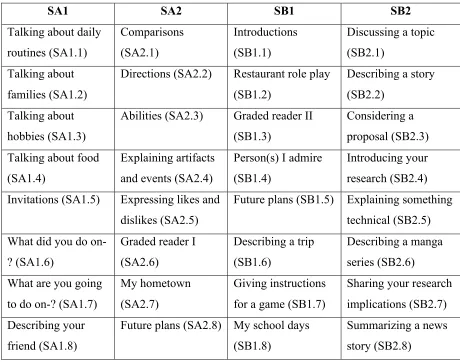
The rationale for using CEFR-J was to maintain the Speaking Program’s validity at an institutional level and, with regard to materials design, provide a consistency to the language used in each worksheet. Using CEFR-J descriptors for spoken interaction, the team selected competencies from the different bands that contained a variety of language forms that could be developed into a discussion topic. For example, the CEFR-J A2 spoken interaction band requires that the learner be able to ‘understand sentences and frequently used expressions related to areas of immediate relevance (e.g. very basic personal and family information, shopping, local geography, employment)’. Thus, the Speaking Program features topics that include describing family members (family information) and describing one’s hometown (local geography). Initially, five worksheets were created for each level. However, it was always the team’s intention to add further worksheets to each level as it would be somewhat naïve to expect students to be able to move from one level to another having possibly only completed five 15-minute speaking tasks. The current total is eight worksheets per level with further additions expected in the future. We limited the content of each topic to fit on both sides of a single A4 sheet (Appendix 1) in order to keep within the 15-minute consultation service time.
SiSAL Journal Vol. 8, No. 1, March 2017, 44-59.
Table 1. The Four Levels and Topics for Each of the Eight Worksheets
SA1 SA2 SB1 SB2
Talking about daily routines (SA1.1)
Comparisons (SA2.1)
Introductions (SB1.1)
Discussing a topic (SB2.1)
Talking about families (SA1.2)
Directions (SA2.2) Restaurant role play (SB1.2)
Describing a story (SB2.2)
Talking about hobbies (SA1.3)
Abilities (SA2.3) Graded reader II (SB1.3)
Considering a proposal (SB2.3) Talking about food
(SA1.4)
Explaining artifacts and events (SA2.4)
Person(s) I admire (SB1.4)
Introducing your research (SB2.4) Invitations (SA1.5) Expressing likes and
dislikes (SA2.5)
Future plans (SB1.5) Explaining something technical (SB2.5) What did you do
on-? (SA1.6)
Graded reader I (SA2.6)
Describing a trip (SB1.6)
Describing a manga series (SB2.6) What are you going
to do on-? (SA1.7)
My hometown (SA2.7)
Giving instructions for a game (SB1.7)
Sharing your research implications (SB2.7) Describing your
friend (SA1.8)
Future plans (SA2.8) My school days (SB1.8)
Summarizing a news story (SB2.8)
SiSAL Journal Vol. 8, No. 1, March 2017, 44-59.
below titled “How the material is used.” The next stage of the design process required that the team review all of the material and make any alterations necessary. Once completely edited in English, the instructions for each worksheet were translated into Japanese.
The Speaking Program material is reviewed every year during an annual meeting and any necessary edits are made. For example, a particular task may not be working and might need changes, or a completely different task might be suggested. Also, as was the case during the most recent review stage, when the grammar book linked to each worksheet (the Japanese bilingual edition of Basic Grammar in Use by Raymond Murphy) was
replaced with a newer edition which included a restructuring of the units, the materials had to be altered to reflect the newer edition.
How the Material Is Used
Each worksheet of the Speaking Program is organized into the following sections (see Appendix A for an example worksheet):
- Title
- The worksheet aims
- Short task description
- Homework component
- Preparatory section
- A task (making statements, answering and asking questions)
- Brief cultural or grammatical note
SiSAL Journal Vol. 8, No. 1, March 2017, 44-59.
translation exercises and gap fills, to matching exercises and role plays. On almost all of the worksheets, there is also a reference to the relevant units of a grammar book held
permanently in the LLC (the Japanese bilingual edition of Basic Grammar in Use by Raymond Murphy), should the students require additional support. The homework
component for each worksheet was designed to introduce the language focus to the students and provide the opportunity to practice the language in a controlled manner. At the
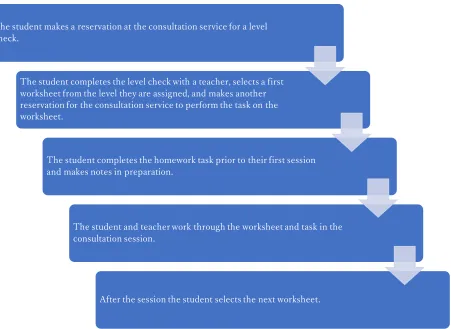
beginning of the session the teacher checks the homework to ensure the student’s comprehension of the language form; in addition, the preparatory stage might also be checked if errors were detected by the teacher during the task stage. The worksheets also contain a ‘Did You Know?’ section that includes cultural information or further grammar support. In short, the process from the level check to the first session is as shown in Figure 1.
Figure 1. Work Flow for Speaking Program
The student makes a reservation at the consultation service for a level check.
The student completes the level check with a teacher, selects a first worksheet from the level they are assigned, and makes another reservation for the consultation service to perform the task on the worksheet.
The student completes the homework task prior to their first session and makes notes in preparation.
The student and teacher work through the worksheet and task in the consultation session.
SiSAL Journal Vol. 8, No. 1, March 2017, 44-59.
Once a session has been completed, the teacher makes a comment on the student’s ‘progress chart’ (Appendix B), a sheet of paper on which the teacher writes notes for the student to keep a record of the sessions they have completed and their performance. This record also shows how many times a student repeated a task before being able to proceed to the next worksheet. The tasks are designed to be repeated if necessary. The teachers also record comments in a secure Google database which exists for all LLC teaching staff to check an individual student’s progress before meeting in the consultation service. The progress report and the Google database are used by student and teacher respectively to prepare for the assessment test. When a student feels ready, they can opt to take the
assessment test in order to move up to the next level. The assessment test assesses students on three tasks drawn from the eight topics within a level. The teacher tests the student’s ability to produce and respond to certain language forms from the three chosen tasks. The teacher chooses the three assessment tasks based on comments made on the student’s progress charts or, more commonly, comments recorded in the Google database. A student can fail the assessment test if he or she does not perform to the required standard stated in the CEFR-J competencies and fails to provide correct utterances based on the language contained in the worksheets. The aim of the assessment test is to confirm students can understand and appropriately respond to questions in English, as well as ask appropriate questions to their interlocutor(s).
The teacher records any errors during the assessment test and then provides feedback immediately afterwards, pointing out errors and giving explicit instructions on how to improve if the assessment test must be retaken. It is not uncommon for students to fail the assessment test the first time but most pass the second time. When students pass the assessment test they are given a certificate to recognize their achievement and they move on to the next level.
SiSAL Journal Vol. 8, No. 1, March 2017, 44-59.
Initial Impact of the Speaking Program on the Consultation Service Usage
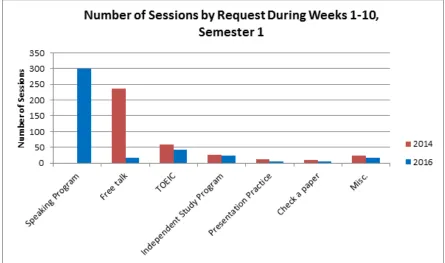
Early data suggests that the Speaking Program has had an impact on the consultation service in the following three areas: firstly, the type of student request, secondly, the consistency of consultation service users over semesters one and two, and finally the number of students making repeat visits to the consultation service. Figure 2 shows that reservations for the Speaking Program have all but replaced ‘free talk’ whereas reservations for the other services have largely remained the same (semester one of years 2016 and 2014 were chosen for comparison as 2015 involved the gradual integration of the Speaking Program in the first semester and a full integration in the second semester).
Figure 2. A Comparison of the Services Provided by the LLC in the Consultation Service
SiSAL Journal Vol. 8, No. 1, March 2017, 44-59.
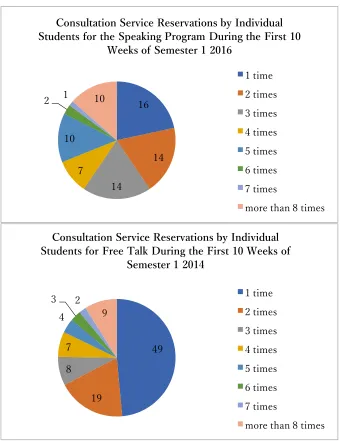
positive shift towards achieving the goal of more consistent consultation service usage over semesters one and two. Another goal of the Speaking Program was to increase the number of students who make repeat visits to the consultation service, and by design the LLC. In the first ten weeks of semester one 2014, 49 students came to the consultation service for a single visit to practice free talk, with a large drop in repeat users beyond that initial visit. In the first ten weeks of semester one 2016 the number of students making repeat visits for the Speaking Program has increased with one time users at only 16 (Figure 3). A longer study would be required to fully evaluate whether there is any correlation between the number of times that students use the consultation service and the introduction of the Speaking
SiSAL Journal Vol. 8, No. 1, March 2017, 44-59.
Figure 3. Free Talk / Speaking Program Reservations per Student
Conclusion
The Speaking Program has proven to be successful in terms of popularity amongst consultation service visitors and increasing the number of repeat visitors to the LLC. Such has been the demand for the program that reservations are fully booked weeks in advance and teachers have had to add extra consultation sessions in order to address the increased
16
14
14 7
10
2 1 10
$POTVMUBUJPO4FSWJDF3FTFSWBUJPOTCZ*OEJWJEVBM 4UVEFOUTGPSUIF4QFBLJOH1SPHSBN%VSJOHUIF'JSTU 8FFLTPG4FNFTUFS 1 time 2 times 3 times 4 times 5 times 6 times 7 times
more than 8 times
49 19 8 7 4 3 2 9 $POTVMUBUJPO4FSWJDF3FTFSWBUJPOTCZ*OEJWJEVBM 4UVEFOUTGPS'SFF5BML%VSJOHUIF'JSTU8FFLTPG 4FNFTUFS 1 time 2 times 3 times 4 times 5 times 6 times 7 times
SiSAL Journal Vol. 8, No. 1, March 2017, 44-59.
demand. Most importantly, the Speaking Program has provided structured activities with clear goals that form the basis of the consultation sessions. At once the Speaking Program removes both the pressure for students to consistently generate more topics as they were required to for ‘free talk’ whilst also providing more tangible means for students to check their language progress.
Acknowledgments
Special thanks to Akiko Miyama and Junko Murao of the English Department at Osaka Institute of Technology and Misato Tachibana of the Language Learning Center for their help with translating the program.
Notes on the Contributors
Alex Worth is a learning advisor and lecturer at Osaka Institute of Technology, Japan. His primary area of study is materials design, with a recent focus on the use of tablet
technology.
Danielle Fischer is currently employed at Osaka Institute of Technology’s Language Learning Center. She has been working in the field of EFL for 13 years. Her main interest is English for Scientific purposes, especially in the field of Engineering. She is currently focused on designing training materials for academic presentations.
Erik Fritz has taught ESL for 12 years and currently teaches at Kwansei Gakuin University. His research interests include study abroad, nationalism, and second language writing.
SiSAL Journal Vol. 8, No. 1, March 2017, 44-59.
References
Lui, M. (2013). English Bar as a venue to boost students’ speaking self-efficacy at the tertiary level. English Language Teaching, 6(12), 27-37. doi:10.5539/elt.v6n12p27 Meddings, L., & Thornbury, L. (2009). Teaching unplugged: Dogme in English language
teaching. Surrey, UK: Delta Publishing.
Moore, A., & Thornton, K. (2011). The ELI Practice Centre: Investigating role, purpose and satisfaction in a complex interactional space. The Journal of Kanda University
of International Studies, 22, 77-110. Retrieved from
http://id.nii.ac.jp/1092/00000934/
SiSAL Journal Vol. 8, No. 1, March 2017, 44-59.
Appendices
Appendix A A sample worksheet
SiSAL Journal Vol. 8, No. 1, March 2017, 44-59.