V
OLUMEN
O.
9
(2019),
I
SSUEN
O.
10
(O
CTOBER)
ISSN
2231-5756
A Monthly Double-Blind Peer Reviewed (Refereed/Juried) Open Access International e-Journal - Included in the International Serial Directories
Indexed & Listed at:
Ulrich's Periodicals Directory ©, ProQuest, U.S.A., Cabell’s Directories of Publishing Opportunities, U.S.A., Google Scholar, Indian Citation Index (ICI), J-Gage, India [link of the same is duly available at Inflibnet of University Grants Commission (U.G.C.)],
Index Copernicus Publishers Panel, Poland with IC Value of 5.09 (2012) & number of libraries all around the world.
V
N
.
9
(2019),
I
N
.
10
(O
)
INTERNATIONAL JOURNAL OF RESEARCH IN COMMERCE, IT & MANAGEMENT
CONTENTS
Sr.
No.
TITLE & NAME OF THE AUTHOR (S)
Page
No.
1
.
A STUDY ON THE IMPACT OF THE CHILI MARKET ON THE PEOPLE OF
BYADGI REGION, KARNATAKA, INDIA
Dr. GURUBASAVARYA HIREMATH & SUNITA
1
2
.
PERCEPTION OF INSTITUTIONAL CUSTOMERS’ TOWARDS COURIER
SERVICES IN TAMILNADU
Dr. S. SELVAKUMAR
8
3
.
A STUDY ON ASSESSING THE EFFECTIVENESS OF INTERNAL AUDIT
PRACTICE IN PUBLIC DEVELOPMENTAL AGENCIES IN ETHIOPIA WITH
REFERENCE TO DEVELOPMENT BANK OF ETHIOPIA
SEFIWSEW ZELEKE BELAY
15
V
OLUMEN
O.
9
(2019),
I
SSUEN
O.
10
(O
CTOBER)
ISSN
2231-5756
INTERNATIONAL JOURNAL OF RESEARCH IN COMMERCE, IT & MANAGEMENT
FOUNDER PATRON
Late Sh. RAM BHAJAN AGGARWAL
Former State Minister for Home & Tourism, Government of Haryana
Former Vice-President, Dadri Education Society, Charkhi Dadri
Former President, Chinar Syntex Ltd. (Textile Mills), Bhiwani
CO-ORDINATOR
Dr. BHAVET
Former Faculty, Shree Ram Institute of Engineering & Technology, Urjani
ADVISOR
Prof. S. L. MAHANDRU
Principal (Retd.), Maharaja Agrasen College, Jagadhri
EDITOR
Dr. PARVEEN KUMAR
Professor, Department of Computer Science, NIMS University, Jaipur
CO-EDITOR
Dr. A. SASI KUMAR
Professor, Vels Institute of Science, Technology & Advanced Studies (Deemed to be University), Pallavaram
EDITORIAL ADVISORY BOARD
Dr. S. P. TIWARI
Head, Department of Economics & Rural Development, Dr. Ram Manohar Lohia Avadh University, Faizabad
Dr. CHRISTIAN EHIOBUCHE
Professor of Global Business/Management, Larry L Luing School of Business, Berkeley College, USA
Dr. SIKANDER KUMAR
Vice Chancellor, Himachal Pradesh University, Shimla, Himachal Pradesh
Dr. JOSÉ G. VARGAS-HERNÁNDEZ
Research Professor, University Center for Economic & Managerial Sciences, University of Guadalajara,
Guadala-jara, Mexico
Dr. TEGUH WIDODO
Dean, Faculty of Applied Science, Telkom University, Bandung Technoplex, Jl. Telekomunikasi, Indonesia
Dr. M. S. SENAM RAJU
Professor, School of Management Studies, I.G.N.O.U., New Delhi
Dr. A SAJEEVAN RAO
Professor & Director, Accurate Institute of Advanced Management, Greater Noida
Dr. D. S. CHAUBEY
Professor & Dean (Research & Studies), Uttaranchal University, Dehradun
Dr. CLIFFORD OBIYO OFURUM
Professor of Accounting & Finance, Faculty of Management Sciences, University of Port Harcourt, Nigeria
Dr. KAUP MOHAMED
Dean & Managing Director, London American City College/ICBEST, United Arab Emirates
Dr. VIRENDRA KUMAR SHRIVASTAVA
Director, Asia Pacific Institute of Information Technology, Panipat
Dr. MIKE AMUHAYA IRAVO
Principal, Jomo Kenyatta University of Agriculture & Tech., Westlands Campus, Nairobi-Kenya
Dr. SYED TABASSUM SULTANA
Principal, Matrusri Institute of Post Graduate Studies, Hyderabad
Dr. BOYINA RUPINI
Director, School of ITS, Indira Gandhi National Open University, New Delhi
Dr. NEPOMUCENO TIU
V
N
.
9
(2019),
I
N
.
10
(O
)
INTERNATIONAL JOURNAL OF RESEARCH IN COMMERCE, IT & MANAGEMENT
Dr. SANJIV MITTAL
Professor & Dean, University School of Management Studies, GGS Indraprastha University, Delhi
Dr. RAJENDER GUPTA
Convener, Board of Studies in Economics, University of Jammu, Jammu
Dr. SHIB SHANKAR ROY
Professor, Department of Marketing, University of Rajshahi, Rajshahi, Bangladesh
Dr. SRINIVAS MADISHETTI
Professor, School of Business, Mzumbe University, Tanzania
Dr. NAWAB ALI KHAN
Professor & Dean, Faculty of Commerce, Aligarh Muslim University, Aligarh, U.P.
MUDENDA COLLINS
Head, Operations & Supply Chain, School of Business, The Copperbelt University, Zambia
Dr. EGWAKHE A. JOHNSON
Professor & Director, Babcock Centre for Executive Development, Babcock University, Nigeria
Dr. A. SURYANARAYANA
Professor, Department of Business Management, Osmania University, Hyderabad
P. SARVAHARANA
Asst. Registrar, Indian Institute of Technology (IIT), Madras
Dr. MURAT DARÇIN
Associate Dean, Gendarmerie and Coast Guard Academy, Ankara, Turkey
Dr. ABHAY BANSAL
Head, Department of Information Technology, Amity School of Engg. & Tech., Amity University, Noida
Dr. YOUNOS VAKIL ALROAIA
Head of International Center, DOS in Management, Semnan Branch, Islamic Azad University, Semnan, Iran
WILLIAM NKOMO
Asst. Head of the Department, Faculty of Computing, Botho University, Francistown, Botswana
Dr. JAYASHREE SHANTARAM PATIL (DAKE)
Faculty in Economics, KPB Hinduja College of Commerce, Mumbai
SHASHI KHURANA
Associate Professor, S. M. S. Khalsa Lubana Girls College, Barara, Ambala
Dr. SEOW TA WEEA
Associate Professor, Universiti Tun Hussein Onn Malaysia, Parit Raja, Malaysia
Dr. OKAN VELI ŞAFAKLI
Professor & Dean, European University of Lefke, Lefke, Cyprus
Dr. MOHENDER KUMAR GUPTA
Associate Professor, Government College, Hodal
Dr. BORIS MILOVIC
Associate Professor, Faculty of Sport, Union Nikola Tesla University, Belgrade, Serbia
Dr. LALIT KUMAR
Course Director, Faculty of Financial Management, Haryana Institute of Public Administration, Gurugram
Dr. MOHAMMAD TALHA
Associate Professor, Department of Accounting & MIS, College of Industrial Management, King Fahd University
of Petroleum & Minerals, Dhahran, Saudi Arabia
Dr. V. SELVAM
Associate Professor, SSL, VIT University, Vellore
Dr. IQBAL THONSE HAWALDAR
Associate Professor, College of Business Administration, Kingdom University, Bahrain
Dr. PARDEEP AHLAWAT
Associate Professor, Institute of Management Studies & Research, Maharshi Dayanand University, Rohtak
Dr. ALEXANDER MOSESOV
V
OLUMEN
O.
9
(2019),
I
SSUEN
O.
10
(O
CTOBER)
ISSN
2231-5756
INTERNATIONAL JOURNAL OF RESEARCH IN COMMERCE, IT & MANAGEMENT
Dr. ASHOK KUMAR CHAUHAN
Reader, Department of Economics, Kurukshetra University, Kurukshetra
Dr. BHAVET
Former Faculty, Shree Ram Institute of Engineering & Technology, Urjani
YU-BING WANG
Faculty, department of Marketing, Feng Chia University, Taichung, Taiwan
SURJEET SINGH
Faculty, Department of Computer Science, G. M. N. (P.G.) College, Ambala Cantt.
Dr. TITUS AMODU UMORU
Professor, Kwara State University, Kwara State, Nigeria
Dr. RAJESH MODI
Faculty, Yanbu Industrial College, Kingdom of Saudi Arabia
Dr. SAMBHAVNA
Faculty, I.I.T.M., Delhi
Dr. THAMPOE MANAGALESWARAN
Faculty, Vavuniya Campus, University of Jaffna, Sri Lanka
Dr. SHIVAKUMAR DEENE
Faculty, Dept. of Commerce, School of Business Studies, Central University of Karnataka, Gulbarga
SURAJ GAUDEL
BBA Program Coordinator, LA GRANDEE International College, Simalchaur - 8, Pokhara, Nepal
FORMER TECHNICAL ADVISOR
AMITA
FINANCIAL ADVISORS
DICKEN GOYAL
Advocate & Tax Adviser, Panchkula
NEENA
Investment Consultant, Chambaghat, Solan, Himachal Pradesh
LEGAL ADVISORS
JITENDER S. CHAHAL
Advocate, Punjab & Haryana High Court, Chandigarh U.T.
CHANDER BHUSHAN SHARMA
Advocate & Consultant, District Courts, Yamunanagar at Jagadhri
SUPERINTENDENT
V
N
.
9
(2019),
I
N
.
10
(O
)
INTERNATIONAL JOURNAL OF RESEARCH IN COMMERCE, IT & MANAGEMENT
CALL FOR MANUSCRIPTS
We invite unpublished novel, original, empirical and high quality research work pertaining to the recent developments & practices in the areas of Com-puter Science & Applications; Commerce; Business; Finance; Marketing; Human Resource Management; General Management; Banking; Economics; Tourism Administration & Management; Education; Law; Library & Information Science; Defence & Strategic Studies; Electronic Science; Corporate Gov-ernance; Industrial Relations; and emerging paradigms in allied subjects like Accounting; Accounting Information Systems; Accounting Theory & Practice; Auditing; Behavioral Accounting; Behavioral Economics; Corporate Finance; Cost Accounting; Econometrics; Economic Development; Economic History; Financial Institutions & Markets; Financial Services; Fiscal Policy; Government & Non Profit Accounting; Industrial Organization; International Economics & Trade; International Finance; Macro Economics; Micro Economics; Rural Economics; Co-operation; Demography: Development Planning; Development Studies; Applied Economics; Development Economics; Business Economics; Monetary Policy; Public Policy Economics; Real Estate; Regional Economics; Political Science; Continuing Education; Labour Welfare; Philosophy; Psychology; Sociology; Tax Accounting; Advertising & Promotion Management; Management Information Systems (MIS); Business Law; Public Responsibility & Ethics; Communication; Direct Marketing; E-Commerce; Global Business; Health Care Administration; Labour Relations & Human Resource Management; Marketing Research; Marketing Theory & Applications; Non-Profit Or-ganizations; Office Administration/Management; Operations Research/Statistics; Organizational Behavior & Theory; Organizational Development; Pro-duction/Operations; International Relations; Human Rights & Duties; Public Administration; Population Studies; Purchasing/Materials Management; Re-tailing; Sales/Selling; Services; Small Business Entrepreneurship; Strategic Management Policy; Technology/Innovation; Tourism & Hospitality; Transpor-tation Distribution; Algorithms; Artificial Intelligence; Compilers & Translation; Computer Aided Design (CAD); Computer Aided Manufacturing; Computer Graphics; Computer Organization & Architecture; Database Structures & Systems; Discrete Structures; Internet; Management Information Systems; Mod-eling & Simulation; Neural Systems/Neural Networks; Numerical Analysis/Scientific Computing; Object Oriented Programming; Operating Systems; Pro-gramming Languages; Robotics; Symbolic & Formal Logic; Web Design and emerging paradigms in allied subjects.
Anybody can submit the soft copy of unpublished novel; original; empirical and high quality research work/manuscriptanytime in M.S. Word format
after preparing the same as per our GUIDELINES FOR SUBMISSION; at our email address i.e. [email protected] or online by clicking the link online submission as given on our website (FOR ONLINE SUBMISSION, CLICK HERE).
GUIDELINES FOR SUBMISSION OF MANUSCRIPT
1. COVERING LETTER FOR SUBMISSION:
DATED: _____________
THE EDITOR
IJRCM
Subject: SUBMISSION OF MANUSCRIPT IN THE AREA OF______________________________________________________________.
(e.g. Finance/Mkt./HRM/General Mgt./Engineering/Economics/Computer/IT/ Education/Psychology/Law/Math/other, please specify)
DEAR SIR/MADAM
Please find my submission of manuscript titled ‘___________________________________________’ for likely publication in one of your journals.
I hereby affirm that the contents of this manuscript are original. Furthermore, it has neither been published anywhere in any language fully or partly, nor it is under review for publication elsewhere.
I affirm that all the co-authors of this manuscript have seen the submitted version of the manuscript and have agreed to inclusion of their names as co-authors.
Also, if my/our manuscript is accepted, I agree to comply with the formalities as given on the website of the journal. The Journal has discretion to publish our contribution in any of its journals.
NAME OF CORRESPONDING AUTHOR :
Designation/Post* :
Institution/College/University with full address & Pin Code : Residential address with Pin Code : Mobile Number (s) with country ISD code : Is WhatsApp or Viber active on your above noted Mobile Number (Yes/No) : Landline Number (s) with country ISD code :
E-mail Address :
Alternate E-mail Address :
Nationality :
V
OLUMEN
O.
9
(2019),
I
SSUEN
O.
10
(O
CTOBER)
ISSN
2231-5756
INTERNATIONAL JOURNAL OF RESEARCH IN COMMERCE, IT & MANAGEMENT
NOTES:a) The whole manuscript has to be in ONE MS WORD FILE only, which will start from the covering letter, inside the manuscript. pdf. version is liable to be rejected without any consideration.
b) The sender is required to mention the following in the SUBJECT COLUMNof the mail:
New Manuscript for Review in the area of (e.g. Finance/Marketing/HRM/General Mgt./Engineering/Economics/Computer/IT/ Education/Psychology/Law/Math/other, please specify)
c) There is no need to give any text in the body of the mail, except the cases where the author wishes to give any specific message
w.r.t. to the manuscript.
d) The total size of the file containing the manuscript is expected to be below 1000 KB.
e) Only the Abstract will not be considered for review and the author is required to submit the complete manuscript in the first instance.
f) The journal gives acknowledgement w.r.t. the receipt of every email within twenty-four hours and in case of non-receipt of acknowledgment from the journal, w.r.t. the submission of the manuscript, within two days of its submission, the corresponding author is required to demand for the same by sending a separate mail to the journal.
g) The author (s) name or details should not appear anywhere on the body of the manuscript, except on the covering letter and the cover page of the manuscript, in the manner as mentioned in the guidelines.
2. MANUSCRIPT TITLE: The title of the paper should be typed in bold letters, centered and fully capitalised.
3. AUTHOR NAME (S) & AFFILIATIONS: Author (s) name, designation, affiliation (s), address, mobile/landline number (s), and email/al-ternate email address should be given underneath the title.
4. ACKNOWLEDGMENTS: Acknowledgements can be given to reviewers, guides, funding institutions, etc., if any.
5. ABSTRACT: Abstract should be in fully Italic printing, ranging between 150 to 300 words. The abstract must be informative and eluci-dating the background, aims, methods, results & conclusion in a SINGLE PARA. Abbreviations must be mentioned in full.
6. KEYWORDS: Abstract must be followed by a list of keywords, subject to the maximum of five. These should be arranged in alphabetic order separated by commas and full stop at the end. All words of the keywords, including the first one should be in small letters, except special words e.g. name of the Countries, abbreviations etc.
7. JEL CODE: Provide the appropriate Journal of Economic Literature Classification System code (s). JEL codes are available at www.aea-web.org/econlit/jelCodes.php. However, mentioning of JEL Code is not mandatory.
8. MANUSCRIPT: Manuscript must be in BRITISH ENGLISH prepared on a standard A4 size PORTRAIT SETTING PAPER. It should be free
from any errors i.e. grammatical, spelling or punctuation. It must be thoroughly edited at your end.
9. HEADINGS: All the headings must be bold-faced, aligned left and fully capitalised. Leave a blank line before each heading. 10. SUB-HEADINGS: All the sub-headings must be bold-faced, aligned left and fully capitalised.
11. MAIN TEXT:
THE MAIN TEXT SHOULD FOLLOW THE FOLLOWING SEQUENCE:
INTRODUCTION REVIEW OF LITERATURE
NEED/IMPORTANCE OF THE STUDY STATEMENT OF THE PROBLEM OBJECTIVES
HYPOTHESIS (ES)
RESEARCH METHODOLOGY RESULTS & DISCUSSION FINDINGS
RECOMMENDATIONS/SUGGESTIONS CONCLUSIONS
LIMITATIONS
SCOPE FOR FURTHER RESEARCH REFERENCES
APPENDIX/ANNEXURE
V
N
.
9
(2019),
I
N
.
10
(O
)
INTERNATIONAL JOURNAL OF RESEARCH IN COMMERCE, IT & MANAGEMENT
12. FIGURES & TABLES: These should be simple, crystal CLEAR, centered, separately numbered & self-explained, and the titles must be above the table/figure. Sources of data should be mentioned below the table/figure. It should be ensured that the tables/figures are
referred to from the main text.
13. EQUATIONS/FORMULAE: These should be consecutively numbered in parenthesis, left aligned with equation/formulae number placed at the right. The equation editor provided with standard versions of Microsoft Word may be utilised. If any other equation editor is utilised, author must confirm that these equations may be viewed and edited in versions of Microsoft Office that does not have the editor.
14. ACRONYMS: These should not be used in the abstract. The use of acronyms is elsewhere is acceptable. Acronyms should be defined on its first use in each section e.g. Reserve Bank of India (RBI). Acronyms should be redefined on first use in subsequent sections. 15. REFERENCES: The list of all references should be alphabetically arranged. The author (s) should mention only the actually utilised
references in the preparation of manuscript and they may follow Harvard Style of Referencing. Also check to ensure that everything that you are including in the reference section is duly cited in the paper. The author (s) are supposed to follow the references as per the following:
•
All works cited in the text (including sources for tables and figures) should be listed alphabetically.•
Use (ed.) for one editor, and (ed.s) for multiple editors.•
When listing two or more works by one author, use --- (20xx), such as after Kohl (1997), use --- (2001), etc., in chronologically ascending order.•
Indicate (opening and closing) page numbers for articles in journals and for chapters in books.•
The title of books and journals should be in italic printing. Double quotation marks are used for titles of journal articles, book chapters, dissertations, reports, working papers, unpublished material, etc.•
For titles in a language other than English, provide an English translation in parenthesis.•
Headers, footers, endnotes and footnotes should not be used in the document. However, you can mention short notes to elucidate some specific point, which may be placed in number orders before the references.PLEASE USE THE FOLLOWING FOR STYLE AND PUNCTUATION IN REFERENCES: BOOKS
•
Bowersox, Donald J., Closs, David J., (1996), "Logistical Management." Tata McGraw, Hill, New Delhi.•
Hunker, H.L. and A.J. Wright (1963), "Factors of Industrial Location in Ohio" Ohio State University, Nigeria.CONTRIBUTIONS TO BOOKS
•
Sharma T., Kwatra, G. (2008) Effectiveness of Social Advertising: A Study of Selected Campaigns, Corporate Social Responsibility, Edited by David Crowther & Nicholas Capaldi, Ashgate Research Companion to Corporate Social Responsibility, Chapter 15, pp 287-303.JOURNAL AND OTHER ARTICLES
•
Schemenner, R.W., Huber, J.C. and Cook, R.L. (1987), "Geographic Differences and the Location of New Manufacturing Facilities," Jour-nal of Urban Economics, Vol. 21, No. 1, pp. 83-104.CONFERENCE PAPERS
•
Garg, Sambhav (2011): "Business Ethics" Paper presented at the Annual International Conference for the All India Management Asso-ciation, New Delhi, India, 19–23UNPUBLISHED DISSERTATIONS
•
Kumar S. (2011): "Customer Value: A Comparative Study of Rural and Urban Customers," Thesis, Kurukshetra University, Kurukshetra.ONLINE RESOURCES
•
Always indicate the date that the source was accessed, as online resources are frequently updated or removed.WEBSITES
V
OLUMEN
O.
9
(2019),
I
SSUEN
O.
10
(O
CTOBER)
ISSN
2231-5756
INTERNATIONAL JOURNAL OF RESEARCH IN COMMERCE, IT & MANAGEMENT
A STUDY ON ASSESSING THE EFFECTIVENESS OF INTERNAL AUDIT PRACTICE IN PUBLIC DEVELOPMENTAL
AGENCIES IN ETHIOPIA WITH REFERENCE TO DEVELOPMENT BANK OF ETHIOPIA
SEFIWSEW ZELEKE BELAY
LECTURER
DEPARTMENT OF ACCOUNTING & FINANCE
DEBRE TABOR UNIVERSITY
AMHARA REGION
ABSTRACT
Despite audit is required for all organizations to survive grow and remain prosperous. It has not received the degree of concern it deserves in public developmental agencies (PDAs) in Ethiopia. This study is conducted under a title of Assessing the effectiveness of internal audit practice of Public developmental agencies in Ethiopia in case of Development bank of Ethiopia. “The major objective of the research was to evaluate the effectiveness of internal audit practice in Development bank of Ethiopia by studying audit as a process, assessing the perceptions of employees towards the effectiveness of internal audit. To achieve this objective, both primary and secondary information were obtained via questionnaires and from its documentation using both descriptive and explanatory research design with quantitative and qualitative methods, the type of sampling techniques applied is census and the information gathered was analyzed according using SPSS. Data from 30 internal auditors and 85 Accountants. The study revealed that the internal auditors receive management support and majority of the internal auditors did have requisite skills and experience. The Development bank of Ethiopia also experienced inadequate resources allocation and trainings on the required professions. This suggests that the internal audit in the bank is effective as existed limitations. To enhance more the effect of the bank internal audit practice the study recommended that the bank should have to strive hard in order to improve their internal audit effectiveness by developing and implementing internal audit trainings periodically and adequate resources which will best suit their specific needs. The findings of the study have important implication for the bank, other public organizations and future research by academics, consultants and researches.
KEYWORDS
public developmental agencies, internal audit effectiveness, development bank of Ethiopia.
JEL CODES
H83, M42.
INTRODUCTION
INTRODUCTION ABOUT TOPIC
he issues of globalization transparency, integrity and improvement of service delivery increase the need for governance and accountability. Consequently, this phenomenon leads the increasing interest of internal audit function in organization Dittenhofer (2001) and Goodwin in (2004) have both shown that internal auditing is promising as an important component of management and a control mechanism both private and public sectors. Still, Montondon and Fischer (2005.) have both asserted that the credibility of the internal audit function is significantly important especially in public entities as they are held responsible to diverse stakeholders compared to private entities.
Therefore, the nature of the service sought from the internal auditor has been transforming over the years from an emphasis on compliance audit where inde-pendence has been the core paradigm, to both compliance and consulting role where partnering with management is accorded greater significance (Trulea and Stefanescu, 2009; Nagy and Cenker 2002,). The government of Ethiopian as part of its development strategy to stop various corrupted officials and other criminal activities, it is becoming, obvious that addressing the problem of economic crime is vital. Due to this, issuing proclamation no 68/1997 and the issuance of internal audit procedure manual for public sectors back the relevance of Internal audit functions (IAF). Moreover the issuance of proclamation no- 235/2001 to establish the federal ethics and anticorruption commission and the implementation of the civil service reform plan are clean indicators of governments concern to embed good governance system in the public sectors of Ethiopia.
STATEMENT OF THE PROBLEM
Internal audit is a cornerstone of good public sector governance and it is essential for ensuring the operation and appropriateness of controls. According to Zeleke (2007) the internal audit activities help to prevent corruption, misappropriation of funds and other financial irregularities and ensure effective and efficient utili-zation of resources to achieve the objectives of the organiutili-zation. Misappropriation of funds and corruption are now the order of the day in the public develop-mental agencies in all countries due to weak internal control systems (Van Gansberghe, 2005) and internal audit implemented in Developdevelop-mental Bank of Ethiopia were also challenged by problems like lack of obtaining proper attention from managers, resistance from staffs and increasing number of customer complaints. Internal auditing also is handicapped by a critical shortage of appropriately trained and skilled manpower, inadequate organizational status, and a lack of profes-sional independence.
OBJECTIVES
This paper focuses on to assessing the effectiveness of internal audit practice in public developmental agencies in Ethiopia with reference to Development bank of Ethiopia.
RESEARCH QUESTIONS
This research has tried to give answers to the following research questions.
1. What does implementation and effectiveness of internal audit look like in Development Bank of Ethiopia? 2. How do employees perceive the effectiveness of internal audit practice in Development Bank of Ethiopia? 3. What factors make the internal audit units effective?
4. What is the strength and direction of the relationship between effectiveness of internal audit practice with process of internal audit?
SPECIFIC OBJECTIVES
1. To investigate implementation of internal audit in Development bank and to see whether these Banks adhere to theoretical guidelines for managing internal audit or not.
2. To analyze and determine the level of internal audit practice effectiveness based on factors common for successful internal audit. 3. To determine whether Development Bank have any formal policy on internal audit or not.
4. To examine the relationship between effectiveness of internal audit practice and factors of effective internal audit practice.
V
N
.
9
(2019),
I
N
.
10
(O
)
INTERNATIONAL JOURNAL OF RESEARCH IN COMMERCE, IT & MANAGEMENT
SCOPE
The scope of the study covers the conceptual, geographical and the time scope.
Conceptual Scope - the study was focus on examining issues related to identify on impact of the effectiveness of internal audit practice in public developmental agencies in Ethiopia with reference to Development bank of Ethiopia.
Geographical Scope -the research was carried out geographically Ethiopia.
Time Scope -The study used the most recent year data from the fiscal year of 2009 up to 2010 e.c
METHODOLOGY
This paper focuses on to assess the effectiveness of internal audit practice in public developmental agencies in Ethiopia with reference to Development bank of Ethiopia.
RESEARCH DESIGN
The study was employed by using both descriptive and explanatory research design with quantitative and qualitative methods. The quantitative aspect of the data focused on description of the state of affairs related with implementation and effectiveness of internal audit practice as it exists currently inDevelopment bank of Ethiopia and analysis of a relationship among the dependent and explanatory variables of the Bank.
POPULATION AND SAMPLING TECHNIQUE
Currently the total numbers of the study comprised all Development bank of Ethiopia internal auditors and Accountants. The type of sampling techniques applied is census method, the structure of this population enabled the researcher to collect objective and detailed information from internal auditors and Accountants who are responsible for ensuring the effectiveness of the internal audit. The Accountants were chosen because they deal with the financial affairs of the banks and implementation of internal audits which help them to have enough exposure to the internal audit practice of their bank. The total number of the targeted population was at 115 (which constituted 30 internal auditors, 85 Accountants).
METHODS OF DATA COLLECTION
Data were collected using primary data gathering tools of questionnaire and the researcher’s onsite observation. Questionnaires that contain both open and closed ended questions are prepared and distributed to all staff members of the bank. The researcher ratings summarized by likert with a five-point scale from strongly agree to neutral to obtain information on attitudes and to examine the effectiveness of internal audit practice.
Primary data
This is system of data collection tool that was got directly from the field. It was collected using questionnaires.
Secondary data
The researcher was read related literature relevant to the subject before and during the study (internal audit) in public developmental agencies, obtained from previous studies, text books, internet, journals and reports from the bank itself.
METHODS OF DATA COLLECTION AND INSTRUMENTS
Administered questionnaires were given to a selected internal auditors and accountants who are currently working in the bank, the questionnaire investigates opinions on the effectiveness of internal audit based on factors and how the audits were carried out as experienced and perceived by respondents.
DATA ANALYSIS METHOD
It is the most important component of this study. The responses of the respondents that have been collected using the above methods were organized, analyzed, and interpreted in a sensible way.To meet the objectives of the research correlation analysis and regression analysis as well as descriptive statistics have been used to analyze findings.
Regression analysis is a statistical tool for the investigation of relationships between dependent and independent variables. Usually, the investigator seeks to ascertain the causal effect of one variable upon another to examine the relationship between effectiveness of internal audit practice and factors of effective internal audit practice. The investigator also typically assesses the “statistical significance” of the estimated relationships, that is, the degree of confidence that the true relationship is close to the estimated relationship.
In multiple linear regression there are P explanatory variables and the relationship between the dependent variable and the explanatory variables is represented by the following equation:
= + + + ⋯ … … … . + +
Where:
Yi is the dependent variable and X1, X2, ………., Xp are the independent variables
β is the constant term and β to β are the coefficients relating the p explanatory variables to the variables of interest. The term ‘linear’ is used because in multiple linear regressions we assume that y is directly related to a linear combination of the explanatory variables.
MODEL ASSUMPTIONS
Dependent variables Y
Independent (explanatory) variables: X1, X2, ……..Xn Assumptions
• The true model is Y!= β + β X!+ β#X#!+ ⋯ … … … . +β X!+ ε!, i = 1, 2, … … … . n
• Homoscedasticity: Var+ε!, = E+ε!#, = σ# for all i
• No error autocorrelation: cov1ε!, ε23 = E1ε! ε23 = 0 for all i ≠ j
• Each of the explanatory variables X1, X2, ……Xn is non-stochastic.
• No multicollinearity: No exact linear relationship exists between any of the explanatory variables.
• Normality: ε! are normally distributed with mean zero and variance σ# for all i +ε!~N+0, σ#,,
Correlation Analysis
It deals with the measurement of the closeness of the relationship which is described in the regression equation. We say there is correlation when the two series of items vary together directly or inversely.
TYPES OF DATA COLLECTED
This study was mainly based on primary data and supported by secondary data when available. The sources of primary data are the employees; Secondary data are collected from the banks,personal files, websites and reports.
ANALYSIS & FINDINGS
This research sought to assess the effectiveness of internal Audit practice in the development bank of Ethiopia, according to the total respondents 0% of them lies between an age of 21-25,48.6% of them are between 26-30 years,42.2%of them are between 31-40 years and the rest 8.3% of the respondents are aged above 40.
The occupation of respondents can contribute a lot towards the effectiveness of internal audit practice. As it is depicted in the table 26% of the respondents are engaged in internal auditors and 74% Accountants within the bank, also reveal that 75% of the respondents are males and 25% of the respondents are females, Regarding the educational level of the respondents 45% of them are BA(BSC) holders,55% of the respondents are MA(MSC) holders.
V
OLUMEN
O.
9
(2019),
I
SSUEN
O.
10
(O
CTOBER)
ISSN
2231-5756
INTERNATIONAL JOURNAL OF RESEARCH IN COMMERCE, IT & MANAGEMENT
have policies and procedures are not clearly defined for the internal audit department,0%)of the respondents agreed,11.7% disagree 0% of them strongly agree and 88.6%) respond strongly disagree this showed us the bank have clear policies and procedures for internal audit departments, management also perceived internal auditors as fault-finders rather than adding value to promote good corporate governance from the total of the respondents 8% agreed,0% strongly agree,14.7% disagree and 77.3% strongly disagree
The respondents also agreed that there is no regular in-service training for them. the respondents representing 89% agree 11.0%)strongly disagree. The internal auditors are not allowed pre-transaction audit, the respondents representing 70.6% agreed,15.6% disagree,11.0% strongly agree and 2.8% representing strongly disagree and didn’t free to choose any transaction of their choice 4% agreed,25.5% disagree,5% strongly agree and 65.5% strongly disagree. The respondents also agreed that no opportunity to seek the assistance of experts during audit process especially when assessing value of a contract, property 9.3%) strongly agree, 62.4% agree,10% disagree and 19.3% strongly disagree.
As to whether the units have adequate resources including utilization and availability of appropriate technology the respondents representing 21.1% strongly agreed that they have no adequate resources including appropriate technology and 78.9% also agreed that the resources available are not adequate. Evidence from the study showed that 59.6% of the respondents expressed that the number is inadequate while 21.1% of them stated the number is somehow adequate, 10.1% adequate,6.4% very adequate and 2.8% very inadequate.
The respondents also respond and a review of audit reports reveal that the internal auditors concentrated and Accountants agreed on compliance of law 76.4%), checking budget implementation 85.3%,assessing reliability and soundness of financial information 77% of accounting errors and fraud detection 82(75.2),evalu-ating management’s efforts to the recovery of receivable, taxes and other collectables 79(72.5%),examine use of organization resources and safeguard of assets 86(78.9%),assessing unethical behavior of management and recommend best practice 71(65.1%). The internal auditors also agreed to risk management 85.1%, evaluation of project and productivity 94%, examine and assess the polices, procurers, and manuals 86.2%), test the organizations conformity with objective requirement 79.7%. The documents that the internal auditors draw their powers, functions, mandate and administrative lines include Financial Administration Act, 2003(Act 654), Public Procurement Act, 2003 (Act 663), Internal Audit Charter and Internal Audit Manual. 82.6% of the Development bank of Ethiopia do have Internal Audit Charter and the internal auditors relied on Internal Audit Agency Act. This Act defined the responsibilities and duties of the internal auditors and to define the scope of internal work and powers of internal auditors. The internal audit charter binds management to allow internal auditors to execute their work without any restrictions and implement internal audit recommendations. From the responses 84.4% of the respondents expressed agreed about the implementa-tion of internal audit recommendaimplementa-tions by management and the respondents agreed that the relaimplementa-tionship with management that is 80.7%. On commitment of management in supporting budgetary status of the internal audit units representing 76.1% of the respondents stated agreed. Management sometimes interferes with the work of the internal auditors as 76.1% indicated agreed about management interference.
The evidence suggests that the internal audit units receive management support in the Development bank of Ethiopia.
The researcher wanted to know the extent to which the external auditors rely on internal auditors in the bank. The external Auditors indicated that they occasion-ally rely on the internal auditors 65.9%. They explained that the internal auditors do have necessary expertise and experience. It can be deduced that, there is collaboration between internal auditors and external auditors in the bank. In this regard, there would be effective auditing.
From the statistical evidence showed that the internal auditors play advisory roles in the bank. The internal auditors agree to advise management on good corpo-rate governance systems 74.3%, Ethical practice and anticorruption 72.5%. They also agree management on effective risk management 75.2% and management on designing and implementing internal control systems 78% and sound business practice 75.2%. From the above analysis, one can say that the internal audit units in the bank are meeting the modern definition of internal audit by IIA, 2009 as consulting activity and adding value to an organization. These advisory services are necessary to ensure good corporate governance in the bank. It is important to add that the internal audit units may have good advisory services to offer, but the benefits of it may depend on the quality of the service and how relevant is it to the bank. The expertise and the experience of the internal auditors would determine the quality of advisory services they can offer.
As it has been shown the mean score for the effectiveness of internal audit practice in Development bank of Ethiopia was 4.04 and the standard deviation was 0.44 with maximum and minimum values of 4.92 and 2 respectively.
The respondents agreed that, approved internal audit standards, Act or charter 69.7%, Organizational independence 62.4%, Management support 57.8% Imple-mentation of audit recommendations 64.2, No adequate resources 67.9%, Unrestricted access to records 60.6%, Quality leadership of chief internal auditors 65.1% and No regular training of internal audit staffs 64.2% make the internal audit units effective. The respondent also agreed that Rotations of internal audit staffs 60.6%, Job satisfaction 64.2%and Opportunity to take part in the decision making 65.1% could make internal auditors effective.
REGRESSION ANALYSIS
A regression analysis was conducted and Pearson product-moment correlation (r) were calculated in order to establish whether or not there was any statistically significant relationship between effectiveness of internal audit practice and important factors of effective internal audit practices, which provides a correlation coefficient that indicates the strength and direction of the linear relationship.
Here we have the dependent variable (effectiveness of internal auditing (EIA)) and independent variables (Organizational setting (OS), internal audit quality (IAQ), Existence of Formal Mandate (EFM), Management Support (MS), Adding Value and Advisory Role of Internal Audit (AVARIA)). Therefore, we have to do a correla-tion and regression analysis between the EIA and OS, IAQ, MS, and AVARIA. Let us star with correlacorrela-tion analysis or to test the correlacorrela-tion/ associacorrela-tion between the dependent and independent variable.
TABLE 1: PEARSON CORRELATION BETWEEN IMPORTANT FACTORS OF EFFECTIVE INTERNAL AUDIT PRACTICE AND INTERNAL AUDIT EFFECTIVENESS (CORRELATION OUTPUT FOR EIA WITH OS, IAQ, MS, AND AVARIA)
OS IAQ EFM MS AVARIA EIA Pearson Correlation .726** .699** .596** .704** .808**
Sig. (2-tailed) .000 .000 .000 .000 .000 Source: SPSS
As we have seen in the above table, all P value 0.00 which is less than the 5% level of significance. Therefore, it is highly significant meaning that is strong and positive correlation between EIA and OS, IAQ, MS, and AVARIA.
REGRESSION ANALYSIS
In this part we are going to describe the relationship between EIA and OS, IAQ, MS, and AVARIA in mathematical equation. To do this, let us start with the overall significance of the regression model test.
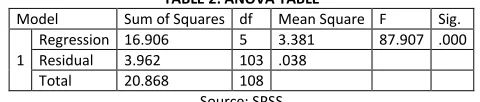
TABLE 2: ANOVA TABLE
Model Sum of Squares df Mean Square F Sig. 1
Regression 16.906 5 3.381 87.907 .000 Residual 3.962 103 .038
Total 20.868 108 Source: SPSS
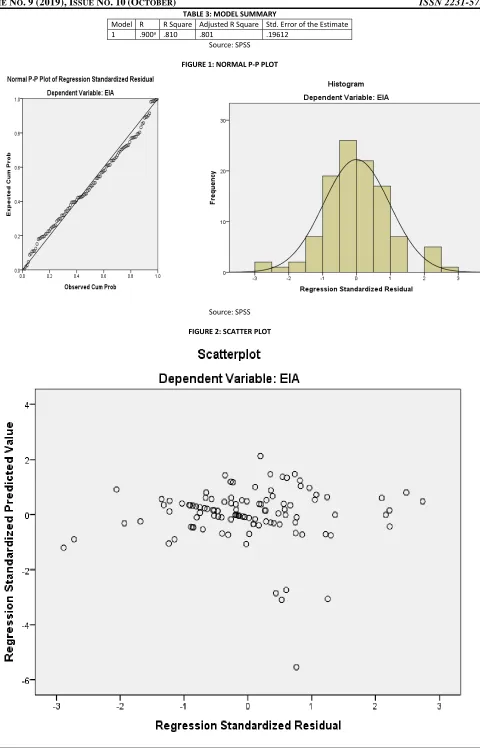
As we see from the above ANOVA table the P value is 0.000 which is less that the level of significance or 0.05. Therefore, the overall regression model is significant. The value of R2 is 0.810 which implies that about 81 % of variation in EIA is expressed by the variation in OS, IAQ, MS, and AVARIA. But the remaining around 19 %
V
N
.
9
(2019),
I
N
.
10
(O
)
INTERNATIONAL JOURNAL OF RESEARCH IN COMMERCE, IT & MANAGEMENT
TABLE 3: MODEL SUMMARYModel R R Square Adjusted R Square Std. Error of the Estimate 1 .900a .810 .801 .19612
Source: SPSS
FIGURE 1: NORMAL P-P PLOT
Source: SPSS
V
OLUMEN
O.
9
(2019),
I
SSUEN
O.
10
(O
CTOBER)
ISSN
2231-5756
INTERNATIONAL JOURNAL OF RESEARCH IN COMMERCE, IT & MANAGEMENT
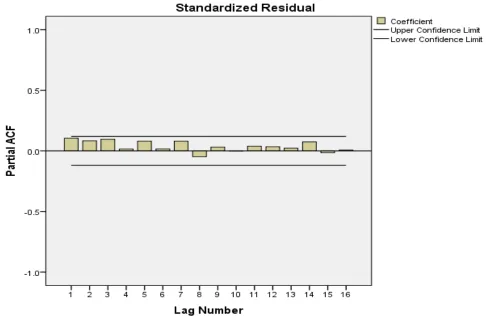
FIGURE 3: PARTIAL AUTOCORRELATION FUNCTION (PACF)Source: SPSS
As we have seen the assumption of multicollinearity, normality, hetroscedastic, linearity and autocorrelation, there is no any kind of problem or all assumptions are full field. Then after let us come to the individual variable coefficient that is whether it is significant or not on the basis of P value. The following table 4 shows the coefficient of individual independent variable with corresponding to its P value.
TABLE 4: COEFFICIENTS OF THE SELECTED VARIABLE
Unstandardized Coefficients Sig. Collinearity Statistics B Std. Error Tolerance VIF (Constant) 1.065 .259 .000
OS .384 .069 .000 .562 1.780 IAQ .120 .086 .016 .410 2.440 EFM .062 .067 .035 .559 1.789 MS .174 .084 .041 .440 2.274 AVARIA .533 .065 .000 .536 1.866
Source: SPSS
As we stated in the methodology part Y is the dependent variable (EIA) and the independent variables are denoted by X letter and X1= OS, X2= IAQ, X3= EFM, X4=
MS and X5= AVARIA. Based on the above denotation we can fit the multiple linear regression as follows:
:;= . <=+. >?@A;+ . A ;+ . < A>;+ . B@A@;+ . =>>A=;
From the above simple linear regression model, all the coefficient of independent variable is positive and we can recognize that if we improve OS, IAQ, EFM, MS and AVARIA inside automatically the dependent variables EIA is also improved by some extent.
CONCLUSION AND RECOMMENDATION
Based on the already concluded information, it is possible to make recommendations to correct deficiencies in existing internal audit practices of Development bank of Ethiopia.
The internal control activities of the internal audit unit in the Development bank of Ethiopia internal audit functions that focuses on compliance with laws and regulations, evaluating accounting errors and fraud, addressing risk management and productivity. Management do give the internal auditors the necessary sup-port. The internal audit recommendations are implemented even though the units lack adequate resources and technology to employ auditing lack of manpower and there is no regular in-service training for them.
V
N
.
9
(2019),
I
N
.
10
(O
)
INTERNATIONAL JOURNAL OF RESEARCH IN COMMERCE, IT & MANAGEMENT
Based on the already concluded information, it is possible to make recommendations to correct deficiencies in existing internal audit practices of Development bank of Ethiopia:
The internal audit units need to be adequately resourced including the use of appropriate technology. The availability of resources would enable the internal auditors to do quality work within the timeframe.
The Development Bank of Ethiopia had limitations in development of skilled, certified, and professional auditors. In this regard, give a chance and opportunity to take Certified Public Accountant or other Internal Audit related certification can be considered as a good solution. Similarly, extending in-source trainings can have a great contribution in the competence of Internal Audit teams especially to new comers.
In the modern audit, using Internal Audit soft wares is not luxurious instead inelastic item. In the process of advancing the Internal Audit process; Internal Audit soft wares play the crucial role through making the audit activity simple. Therefore, ECBs are recommended to work in using Internal Audit soft wares to enhance the quality Internal Audit work. Correspondingly, provide trainings related with such soft wares are under consider.
REFERENCES
1. Adams, M. B. (1994). Agency theory and internal audit. Managerial Auditing Journal, 9(8), 8-12. 2. Andrew Chambers (1992). Effective Internal Audits (First Edition). London: Pitman Publishing.
3. Belay, Z. (2007). A study on effective implementation of internal audit function to promote Good Governance in the public sector. Managerial Auditing Journal.
4. Bethelehem Zemene (2006). Perception of Auditors Independence. Addis Ababa University.
5. Bishop, W., Hermanson, D., Lapides, P., & RiVenberg, L. (2000). ― The year of the audit commiVee‖. Internal Auditor, 46-51.
6. Committee of the Sponsoring Organization of the Treadway Commission (COSO) (1992). Internal Control-Integrated Framework. Jersey City: New Jersey. Available at http://www.coso.org (accessed on 20th April, 2009).
7. David Flint (1992). Philosophy and Principles of Auditing. Hong Kong.
8. Diamond, J. (2002). The role of internal audit in Government financial management: An internal perspective. IMF working paper WP/02/94. 9. Dittenhofer, M. (2001). Internal audit effectiveness: An expansion of present methods. Managerial Auditing Journal, 16(8), 443-450. 10. Goodwin, J. (2004). A comparison of internal audit in the private sector and public sector. Managerial Auditing Journal, 19(5),640-650.
11. Goodwin, J., & Yeo, T. Y. (2001). Two factors affecting internal audit independence and objectivity: Evidence from Singapore, International Journal of Auditors, 5(2),107-125.
12. Gray, I., & Manson, S. (2000). The audit process: Principles practice and cases (2nd ed.). Bedford, London: Thomson Learning, 9-12. 13. Lawrence B Sawyer (1988). The Practice of Modern Internal Auditing Revised & Enlarged (Third Edition). USA: IIA INC.