72
Volume 9, No. 27, Sept. 2015, pages 72–77
DOI: 10.12913/22998624/59087
Research Article
Received: 2015.05.31 Accepted: 2015.08.05 Published: 2015.09.01
BLANK SHAPE OPTIMIZATION ON DEEP DRAWING OF A TWIN ELLIPTICAL
CUP USING THE REDUCED BASIS TECHNIQUE METHOD
Mahdi Hasanzadeh Golshani
1, Ali Jabbari
21 Faculty of Engineering, Department of Mechanical Engineering, Islamic Azad University of Arak, Arak, Iran, e-mail: [email protected]
2 Faculty of Engineering, Department of Mechanical Engineering, Arak University, Arak, Iran, e-mail: a-jabbari@ araku.ac.ir
ABSTRACT
In this project thesis, initial blank shape optimization of a twin elliptical cup to re-duce earring phenomenon in anisotropic sheet deep drawing process was studied .The purpose of this study is optimization of initial blank for reduction of the ears height value. The optimization process carried out using finite element method ap-proach, which is coupled with Taguchi design of experiments and reduced basis tech-nique methods. The deep drawing process was simulated in FEM software ABAQUS 6.12. The results of optimization show earring height and, in addition, a number of design variables and time of process can be reduced by using this methods. After op-timization process with the proposed method, the maximum reduction of the earring height would be from 21.08 mm to 0.07 mm and also it could be reduced to 0 in some of the directions. The proposed optimization design in this article allows the design-ers to select the practical basis shapes. This leads to obtain better results at the end of the optimization process, to reduce design variables, and also to prevent repeating the optimization steps for indirect shapes.
Keywords: deep drawing; twin elliptical cup; reduce basic technique; anisotropic sheet; earring.
INTRODUCTION
Deep drawing process is one of the metal
form-ing processes. Durform-ing deep drawform-ing process, blank
under the blank holder was drawn into the
defor-mation by the punch. Deep drawing process of the
twin elliptical cups used in the medical instrument,
automotive, aerospace and packaging industries
have increased recently in order to reduce
manu-facturing costs and times, and It is widely used
for mass production. However, the earring defect
caused by anisotropy behavior of sheet metal
seri-ously affects the process results. In deep drawing of
anisotropic sheets, the blank shape is an important
factor. Since the earring defect is generated by the
sheet metal anisotropy, it is greatly influenced by
the initial blank shape. Earring height minimization
can be performed using blank shape optimization to
obtain better stress distribution and also to reduce
the number of production stages [1–7].
A
theoreti-cal analysis was presented for minimizing earing
behavior in cylindrical deep drawing, They used
the different blank shape optimization for reducing
earings. It was observed that optimized blank shape
reduced the punch load using experimental work
for aluminum and low carbon steel sheets [11].
Among all the process parameters in deep
drawing its optimum shape is one of the
impor-tant factors, because it minimizes the forming
de-fects, improves the formability of the sheet metal,
the quality and thickness distribution of the drawn
cup and also reduces the material cost.
73
Recently deep drawing process has been
widely used because of high deformation rate
compared to other production methods,
includ-ing castinclud-ing and machininclud-ing. All parameters of the
forming process should be controlled for the
de-sired shape. These parameters are the velocity of
the punch, the friction factor, the blank holding
force, the initial shape of the blank and others.
Since the earring defect is generated by the sheet
metal anisotropy, it is greatly influenced by the
initial blank shape. Earring height minimization
can be performed using blank shape optimization
to obtain better stress distribution and also to
re-duce the number of production stages [3, 7].
The proposed optimization design in this
pa-per is an integrated algorithm and it is
conduct-ed to blank shape optimization in a sheet metal
deep drawing process of a twin elliptical cup. An
innovative, comprehensive way of using an effi
-cient design variables linking method, termed as
reduced basis technique [9, 10], is demonstrated
for blank shape optimization. In
the
reduced
ba-sis technique, many initial blank shapes, called
basis shapes, are combined linearly by
assign-ing weight factors. Different resultant shapes
can be generated by changing their weight
fac-tors. Therefore, the number of design variables
required to define the blank shape is reduced to
the number of basic shapes. So, the weights
as-signed for each basis shapes are the design
vari-ables and the optimization goal is to find the best
possible combination of these weights to
mini-mize earring height. The algorithm presented in
this paper focuses on the Taguchi design of
ex-periments method. The effect of many different
parameters on the performance characteristic in
a condensed set of experiments can be examined
by using the orthogonal array experimental
de-sign proposed by Taguchi.
MATERIALS AND METHODS
Although the reduced basis technique is
widely used in shape optimization in permanent
magnet motors [9, 10], but it is suggested for
blank shape optimization in this work. However,
it should be adopted for shape optimization of
Twin Elliptical shape deep drawing process.
The optimization process was carried out
using finite element method approach which is
coupled with Taguchi design of experiments and
Reduced Basis Technique methods.
Sheet metal anisotropy and earring
phenomenon
A material is isotropic if its mechanical and
elastic properties are the same in all directions,
When this is not true, the material is anisotropic
and it is due to cold roll forming of sheet metal.
In the deep drawing of anisotropic sheet,
mate-rial flow is variable in various directions, and cup
height is high in direction that the sheet is drawn
further. For anisotropic sheet metals, the ratio of
true plastic strain is defined as follows:
2 the optimum blank shape has been designed using the slip-line field theory The method is capable of predicting an optimal blank shape within few seconds but assumes the blank material as isotropic, rigid perfectly plastic,[12].
Recently deep drawing process has been widely used because of high deformation rate compared to other production methods, including casting and Machining. All parameters of the forming process should be controlled for the desired shape. These parameters are the velocity of the punch, the friction factor, the blank holding force, the initial shape of the blank and others. Since the earring defect is generated by the sheet metal anisotropy, it is greatly influenced
by the initial blank shape. Earring height minimization
can be performed using blank shape optimization to obtain better stress distribution and also to reduce the number of production stages.[ 3,7].
The proposed optimization design in this paper is an integrated algorithm and it is conducted to blank shape optimization in a sheet metal deep drawing process of a twin elliptical cup. An innovative, comprehensive way of using an efficient design variables linking method, termed as reduced basis technique[9,10], is demonstrated for blank shape optimization. In the reduced basis technique, many initial blank shapes, called basis shapes, are combined linearly by assigning weight factors. Different resultant shapes can be generated by changing their weight factors. Therefore, the number of design variables required to define the blank shape is reduced to the number of basis shapes. So, the weights assigned for each basis shapes are the design variables and the optimization goal is to find the best possible combination of these weights to minimize earring height. The algorithm presented in this paper focuses on the Taguchi design of experiments method. The effect of many different parameters on the performance characteristic in a condensed set of experiments can be examined by using the orthogonal array experimental design proposed by Taguchi.
Materials and Methods
Although the reduced basis technique is widely used in shape optimization in permanent magnet motors [9,10], but it is suggested for blank shape optimization in this work. However, it should be adopted for shape optimization of Twin Elliptical
shape deep drawing process.
The optimization process was carried out using finite element method approach which is coupled with Taguchi design of experiments and Reduced Basis Technique methods.
Sheet Metal Anisotropy and Earring
Phenomenon
Material is isotropic if its mechanical and elastic properties are the same in all directions, When this is not true, the material is anisotropic and it is due to cold roll forming of sheet metal. In the deep drawing of anisotropic sheet, material flow is variable in various directions, and cup height is high in direction that the sheet is drawn further. For anisotropic sheet metals, the ratio of true plastic strain is defined as follow.
𝑟𝑟 =εε𝑤𝑤
𝑡𝑡 (1)
A measure of the variation of r with direction is
known as the planar anisotropy coefficient. Eq. (2)
show planar anisotropy which predict earrings directions. If r is positive, earrings are created in zero and 90 degrees respect to the direction of rolling. If r is negative, earring is created in 45 degree respect to direction of rolling. In an ideal sheet metal with zero planar anisotropy, earring defect is not appeared.
Δ𝑟𝑟 =𝑟𝑟0− 2𝑟𝑟452 + 𝑟𝑟90 (2)
The normal anisotropy coefficient is obtained from the equation (3). Higher the normal anisotropy, sheet
metal drawing will be improved.
𝑟𝑟̅ =𝑟𝑟0+ 2𝑟𝑟454 + 𝑟𝑟90 (3)
Finite Element Analysis of Deep Drawing
Modeling of deep drawing process was developedusing Abaqus/CAE and commercial explicit software of Abaqus was used in the 3D simulation.
All tools (i.e punch, die and blank holder) were
modeled using a discrete rigid type R3D4 and the material were modeled using S4R (a 4-node quadrilateral in-plane general purpose shell, reduced
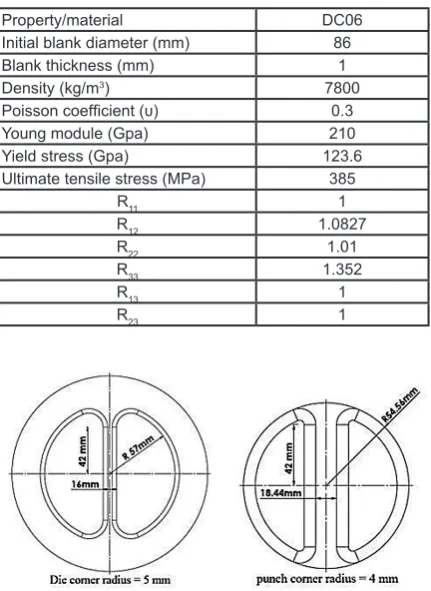
integration). Material properties are listed in Table1
[14].
Die and punch dimension as shown in Fig1.die and punch clearance is 1.22mm. As well as, in order to obtain desired mesh size and calculate earring height, the blank was partitioned to required form.
(1)
A measure of the variation of r with
direc-tion is known as the planar anisotropy coefficient.
Equation (2) shows planar anisotropy which pre
-dicts earrings directions. If r is positive, earrings
are created in zero and 90 degrees respect to the
direction of rolling. If r is negative, earring is
created in 45 degree respect to the direction of
rolling. In an ideal sheet metal with zero planar
anisotropy, earring defect does not appear.
2 the optimum blank shape has been designed using the slip-line field theory The method is capable of predicting an optimal blank shape within few seconds but assumes the blank material as isotropic, rigid perfectly plastic,[12].
Recently deep drawing process has been widely used because of high deformation rate compared to other production methods, including casting and Machining. All parameters of the forming process should be controlled for the desired shape. These parameters are the velocity of the punch, the friction factor, the blank holding force, the initial shape of the blank and others. Since the earring defect is generated by the sheet metal anisotropy, it is greatly influenced
by the initial blank shape. Earring height minimization
can be performed using blank shape optimization to obtain better stress distribution and also to reduce the number of production stages.[ 3,7].
The proposed optimization design in this paper is an integrated algorithm and it is conducted to blank shape optimization in a sheet metal deep drawing process of a twin elliptical cup. An innovative, comprehensive way of using an efficient design variables linking method, termed as reduced basis technique[9,10], is demonstrated for blank shape optimization. In the reduced basis technique, many initial blank shapes, called basis shapes, are combined linearly by assigning weight factors. Different resultant shapes can be generated by changing their weight factors. Therefore, the number of design variables required to define the blank shape is reduced to the number of basis shapes. So, the weights assigned for each basis shapes are the design variables and the optimization goal is to find the best possible combination of these weights to minimize earring height. The algorithm presented in this paper focuses on the Taguchi design of experiments method. The effect of many different parameters on the performance characteristic in a condensed set of experiments can be examined by using the orthogonal array experimental design proposed by Taguchi.
Materials and Methods
Although the reduced basis technique is widely used in shape optimization in permanent magnet motors [9,10], but it is suggested for blank shape optimization in this work. However, it should be adopted for shape optimization of Twin Elliptical
shape deep drawing process.
The optimization process was carried out using finite element method approach which is coupled with Taguchi design of experiments and Reduced Basis Technique methods.
Sheet Metal Anisotropy and Earring
Phenomenon
Material is isotropic if its mechanical and elastic properties are the same in all directions, When this is not true, the material is anisotropic and it is due to cold roll forming of sheet metal. In the deep drawing of anisotropic sheet, material flow is variable in various directions, and cup height is high in direction that the sheet is drawn further. For anisotropic sheet metals, the ratio of true plastic strain is defined as follow.
𝑟𝑟 =εε𝑤𝑤
𝑡𝑡 (1)
A measure of the variation of r with direction is
known as the planar anisotropy coefficient. Eq. (2)
show planar anisotropy which predict earrings directions. If r is positive, earrings are created in zero and 90 degrees respect to the direction of rolling. If r is negative, earring is created in 45 degree respect to direction of rolling. In an ideal sheet metal with zero planar anisotropy, earring defect is not appeared.
Δ𝑟𝑟 =𝑟𝑟0− 2𝑟𝑟452 + 𝑟𝑟90 (2)
The normal anisotropy coefficient is obtained from the equation (3). Higher the normal anisotropy, sheet
metal drawing will be improved.
𝑟𝑟̅ =𝑟𝑟0+ 2𝑟𝑟454 + 𝑟𝑟90 (3)
Finite Element Analysis of Deep Drawing
Modeling of deep drawing process was developedusing Abaqus/CAE and commercial explicit software of Abaqus was used in the 3D simulation.
All tools (i.e punch, die and blank holder) were
modeled using a discrete rigid type R3D4 and the material were modeled using S4R (a 4-node quadrilateral in-plane general purpose shell, reduced
integration). Material properties are listed in Table1
[14].
Die and punch dimension as shown in Fig1.die and punch clearance is 1.22mm. As well as, in order to obtain desired mesh size and calculate earring height, the blank was partitioned to required form.
(2)
The normal anisotropy coefficient is obtained
from the equation (3). Higher normal anisotropy,
sheet metal drawing will be improved.
2 the optimum blank shape has been designed using the slip-line field theory The method is capable of predicting an optimal blank shape within few seconds but assumes the blank material as isotropic, rigid perfectly plastic,[12].
Recently deep drawing process has been widely used because of high deformation rate compared to other production methods, including casting and Machining. All parameters of the forming process should be controlled for the desired shape. These parameters are the velocity of the punch, the friction factor, the blank holding force, the initial shape of the blank and others. Since the earring defect is generated by the sheet metal anisotropy, it is greatly influenced
by the initial blank shape. Earring height minimization
can be performed using blank shape optimization to obtain better stress distribution and also to reduce the number of production stages.[ 3,7].
The proposed optimization design in this paper is an integrated algorithm and it is conducted to blank shape optimization in a sheet metal deep drawing process of a twin elliptical cup. An innovative, comprehensive way of using an efficient design variables linking method, termed as reduced basis technique[9,10], is demonstrated for blank shape optimization. In the reduced basis technique, many initial blank shapes, called basis shapes, are combined linearly by assigning weight factors. Different resultant shapes can be generated by changing their weight factors. Therefore, the number of design variables required to define the blank shape is reduced to the number of basis shapes. So, the weights assigned for each basis shapes are the design variables and the optimization goal is to find the best possible combination of these weights to minimize earring height. The algorithm presented in this paper focuses on the Taguchi design of experiments method. The effect of many different parameters on the performance characteristic in a condensed set of experiments can be examined by using the orthogonal array experimental design proposed by Taguchi.
Materials and Methods
Although the reduced basis technique is widely used in shape optimization in permanent magnet motors [9,10], but it is suggested for blank shape optimization in this work. However, it should be adopted for shape optimization of Twin Elliptical
shape deep drawing process.
The optimization process was carried out using finite element method approach which is coupled with Taguchi design of experiments and Reduced Basis Technique methods.
Sheet Metal Anisotropy and Earring
Phenomenon
Material is isotropic if its mechanical and elastic properties are the same in all directions, When this is not true, the material is anisotropic and it is due to cold roll forming of sheet metal. In the deep drawing of anisotropic sheet, material flow is variable in various directions, and cup height is high in direction that the sheet is drawn further. For anisotropic sheet metals, the ratio of true plastic strain is defined as follow.
𝑟𝑟 =εε𝑤𝑤
𝑡𝑡 (1)
A measure of the variation of r with direction is
known as the planar anisotropy coefficient. Eq. (2)
show planar anisotropy which predict earrings directions. If r is positive, earrings are created in zero and 90 degrees respect to the direction of rolling. If r is negative, earring is created in 45 degree respect to direction of rolling. In an ideal sheet metal with zero planar anisotropy, earring defect is not appeared.
Δ𝑟𝑟 =𝑟𝑟0− 2𝑟𝑟452 + 𝑟𝑟90 (2)
The normal anisotropy coefficient is obtained from the equation (3). Higher the normal anisotropy, sheet
metal drawing will be improved.
𝑟𝑟̅ =𝑟𝑟0+ 2𝑟𝑟454 + 𝑟𝑟90 (3)
Finite Element Analysis of Deep Drawing
Modeling of deep drawing process was developedusing Abaqus/CAE and commercial explicit software of Abaqus was used in the 3D simulation.
All tools (i.e punch, die and blank holder) were
modeled using a discrete rigid type R3D4 and the material were modeled using S4R (a 4-node quadrilateral in-plane general purpose shell, reduced
integration). Material properties are listed in Table1
[14].
Die and punch dimension as shown in Fig1.die and punch clearance is 1.22mm. As well as, in order to obtain desired mesh size and calculate earring height, the blank was partitioned to required form.
(3)
Finite element analysis of deep drawing
Modeling of deep drawing process was
devel-oped using Abaqus/CAE and commercial explicit
software of Abaqus was used in the 3D simulation.
All tools (i.e. punch, die and blank holder) were
modeled using a discrete rigid type R3D4 and the
material were modeled using S4R (a 4-node
quad-rilateral in-plane general purpose shell, reduced
integration). Material properties are listed in Table
1 [14]. Die and punch dimension as shown in
Fig-ure 1 die and punch clearance is 1.22 mm. As well
as, in order to obtain desired mesh size and
cal-culate earring height, the blank was partitioned to
the required form. A view of the twin elliptical cup
deep drawing model is shown in Figure 2.
Assigning weighting factors and Design of
Experiment (DOE)
The initial blank shape optimization was
74
ABAQUS is used to simulate the process and
to calculate the earring height. DOE performed
with Taguchi method. A view of the twin
ellipti-cal cup deep drawing model is shown in Figure
2. 3-D FEA simulations of the basis shapes are
performed in ABAQUS software to find the ear
-ring height for preliminary analysis as shown in
Figure 2. These basis vectors is combined with
the weighting factors, a
1, a
2and a
3that
corre-spond to each basis vector based on the
follow-ing equation:
Table 1 Specification of the investigated sheet metals
DC06 Property/material
86
Initial Blank Diameter(mm)
1
Blank thickness(mm)
7800
)
3
Density(kg/m
0.3
Poisson coefficient(υ)
210
Young module (Gpa)
123.6
Yield stress (Gpa)
385
Ultimate tensile stress (MPa)
1 11
R
1.0827 12
R
1.01 22
R
1.352 33
R
1 13
R
1 23
R
Fig.1 .Die and punch dimensions
A view of the twin elliptical cup deep drawing model is shown in Figure 2.
Fig.2 .A view of deep drawing process finite element
modeling, (a) meshed blank, (b) final cup with earring defect
Assigning weighting factors and Design of
Experiment (DOE)
The initial blank shape optimization has been performed in this work. The finite element package ABAQUS is used to simulate the process and to
calculate the earring height. DOE performed with Taguchi method. A view of the twin elliptical cup deep drawing model is shown in Figure2.
3-D FEA simulations of the basis shapes are
performed in ABAQUS software to find the earring height for preliminary analysis as shown in Figure 2. These basis vectors is combined with the weighting factors, a1, a2 and a3 that correspond to each basis vector based on the following equation.
R =A1Rmax+A2Rmid+A3Rmin
A1+A2+A3 )4 (
Where, 0 ≤ Ai≤ 1 and n is number of basis shapes. The reduced basis technique is applied to three basis vectors and the number of design variables is decreased to Three, which are the weights for each basis vector. By changing these weights, it is possible to obtain various resultant blank shapes for the optimizer to find the best combination of these
weights. 9 DOE points are generated to conduct
simulation. All of the resultant blank shapes are scaled to maintain in a limited area. Simulations are conducted at these DOE points to find the earring
height and to build the Taguchi models for
optimization. Optimization is performed in QualiTek-4 to minimize the earring height [13].
Procedure of ANOVA
A DOE/Taguchi approach is used to study the
effects of multiple variables simultaneously. Three factors including Basis shapes weighting factors will be investigated and their optimum values will be
specified through ANOVA. Based on known variation
of earring height with respect to different factors, each factor is considered to have three levels. Therefore, an L-9 orthogonal array has been selected to run the experiments. Table 2 shows the initial weighting factors and their levels for 0 and 90 directions. and the layout for the selected array is also presented in Table 3[13].
Table 2 Initial Weighting factors and their selected values for 0 and 90 directions.
L3 L2
L1 0 degree
0.04 0.03
0.02
R max=86mm
0.4 0.42
0.48
R mid=85mm
0.56 0.55
0.5
R min=84mm
L3 L2
L1 90 degree
0.03 0.04
0.05
R max=86mm
0.62 0.6
0.5
R mid=75mm
0.35 0.36
0.45
R min=64mm
(4)
Where 0 ≤
A
i≤ 1 and
n
is the number of basis
shapes. The reduced basis technique is applied to
three basis vectors and the number of design
vari-ables is limited to three, which are the weights for
each basis vector. By changing these weights, it is
possible to obtain various resultant blank shapes
for the optimizer to find the best combination of
these weights. 9 DOE points are generated to con
-duct simulation. All of the resultant blank shapes
are scaled to maintain in a limited area.
Simula-tions are conducted at these DOE points to find
the earring height and to build the Taguchi
mod-els for optimization. Optimization is performed in
QualiTek-4 to minimize the earring height [13].
Procedure of ANOVA
A DOE/Taguchi approach is used to study
the effects of multiple variables simultaneously.
Three factors including Basis shapes weighting
factors will be investigated and their optimum
values will be specified through ANOVA. Based
on known variation of earring height with respect
to different factors, each factor is considered to
have three levels. Therefore, an L-9 orthogonal
array was selected to run the experiments. Table 2
shows the initial weighting factors and their
lev-els for 0 and 90 directions. and the layout for the
selected array is also presented in Table 3 [13].
RESULTS AND DISCUSSION
When the analysis of the experiment is
com-plete, one must verify that the predictions are
good, These are called confirmation runs. Having
performed the analysis of results, the predicted
optimum result must be verified through carry
-ing out experiments at optimum combination of
Table 1. Specification of the investigated sheet metalsDC06 Property/material
86 Initial blank diameter (mm)
1 Blank thickness (mm)
7800
Density (kg/m3)
0.3 Poisson coefficient (υ)
210 Young module (Gpa)
123.6 Yield stress (Gpa)
385 Ultimate tensile stress (MPa)
1 R11
1.0827 R12
1.01 R22
1.352 R33
1 R13
1 R23
Fig. 1. .Die and punch dimensions
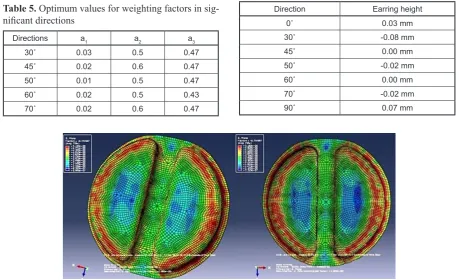
Fig. 2. A view of deep drawing process finite element modeling, (a) meshed blank, (b) final cup with earring defect
75
factors. If the result of optimum experiment is
within the permissible limit, the predicted result
will be verified and otherwise, the DOE experi
-ments must be redesigned and return considering
interactions between factors.
Acceptable tolerance for earring height in
all direction in this work is ±0.08 mm, this value
is within the permissible limit and the predicted
result is confirmed. Confirmation means that for
90% confidence level, there is no need to repeat
the procedure of DOE with counting for interac
-tions between factors.
Optimum curve designing
After two iterations in 0 degree the optimum
values for weighting factor a
1, a
2and a
3are 0.02,
0.42, 0.56, respectively and optimum radius is
84.21 mm. After four iterations in 90 degree the
optimum values for weighting factor a
1, a
2and a
3are 0.01, 0.65, 0.45, respectively, and optimum
radius is 64.21 mm at the end of this stage, the
initial blank shape was drawn by using optimal
weighting factor in 0 and 90 direction (Fig. 3).
The finite element model after applying opti
-mization in 0 and 90 directions as shown in
Fig-ure 4. Blank was partitioned once again (Fig. 5),
and the coordinates of the edges were measured
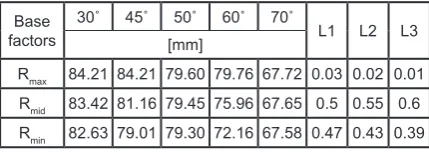
from important angles. Initial weighting factors
and basic shapes were characterized for signifi
-cant directions (Table 4).
Achieving this shape (Fig. 3) is an important
step of the optimization because it reduces design
variable and prevents repeating the optimization
for other directions. After calculation, the
opti-mum values for weighting factor a
1, a
2and a
3in
30 degree, are 0.03, 0.5, and 0.47, respectively,
Table 2. Initial weighting factors and their selectedvalues for 0 and 90 directions
L3 L2
L1 0 degree
0.04 0.03
0.02
Rmax = 86 mm
0.4 0.42
0.48
Rmid = 85 mm
0.56 0.55
0.5
Rmin = 84 mm
L3 L2
L1 90 degree
0.03 0.04
0.05
Rmax = 86 mm
0.62 0.6
0.5
Rmid = 75 mm
0.35 0.36
0.45
Rmin = 64 mm
Table 3. A standard L-9 (9 Experiments Runs) array for three levels factors
3 2
1 Trial no.
1 1
1 1
2 2
1 2
3 3
1 3
2 1
2 4
3 2
2 5
1 3
2 6
3 1
3 7
1 2
3 8
2 3
3 9
Table 4. Initial weighting factors and their selected values for significant directions
L3 L2 L1 70˚ 60˚ 50˚ 45˚ 30˚ Base
factors [mm]
0.01 0.02 0.03 67.72 79.76 79.60 84.21 84.21 Rmax
0.6 0.55 0.5 67.65 75.96 79.45 81.16 83.42 Rmid
0.39 0.43 0.47 67.58 72.16 79.30 79.01 82.63 Rmin
Fig. 3. After applying optimization on initial blank shape in 0 and 90 directions
76
and these values for significant directions in this
step, as shown in Table 5.
The points coordination for optimal curve
drawing is reported in Table 6, and optimum
blank shape and final drawn cup as shown in Fig
-ures 6 and 7 respectively.
Optimal earring height in all directions as
shown in Table 7. Earring height in all of direc
-tions is within the permissible limit and the
pre-dicted result is confirmed. Confirmation means
that for 90% confidence level, there is no need
Fig. 5. A view of partitioned blank at the end of opti-mization step for 0 and 90 directions
Table 5. Optimum values for weighting factors in sig -nificant directions
Directions a1 a2 a3
30˚ 0.03 0.5 0.47
45˚ 0.02 0.6 0.47
50˚ 0.01 0.5 0.47
60˚ 0.02 0.5 0.43
70˚ 0.02 0.6 0.47
Table 6. Point coordination for optimal curve drawing
Optimal radius Point
84.21 mm P1 = 20˚
83.13 mm P2 = 30˚
80.53 mm P3 = 45˚
79.37 mm P4 = 50˚
74.31 mm P5 = 60˚
67.60 mm P6 = 70˚
64.21 mm P7 = 80˚
Table 7. Optimal Earring height in significant direc-tions
Direction Earring height
0˚ 0.03 mm
30˚ -0.08 mm
45˚ 0.00 mm
50˚ -0.02 mm
60˚ 0.00 mm
70˚ -0.02 mm
90˚ 0.07 mm
Fig. 6. Optimal blank shape at the end of optimization
77
to repeat the procedure of DOE with counting
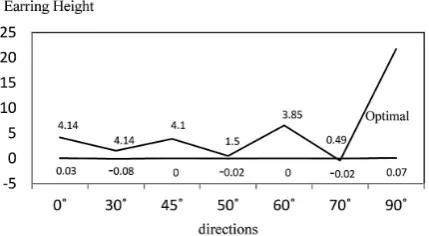
for interactions between factors. Earring height
diagram for initial and optimal blank as shown
in Figure 8
.
CONCLUSION
A method for determining optimum blank
shapes for the production of twin elliptical cup
with deep drawing process was proposed in this
paper is the reduced basis technique. Reducing
the earring height, design variable and
selec-tion of the applied basis shapes are a significant
advantage of this method. The reduced basis
method aids in the use of the Taguchi design of
experiments models for optimization. The
pre-sented algorithm was applied on blank shape
op-timization of a twin elliptical cup as a case study.
The proposed optimization design in this article
allows the designers to select the practical basis
shapes. This leads to obtain better results at the
end of the optimization process, to reduce design
variables, and also to prevent repeating the
opti-mization steps for indirect shapes. An optimum
blank shape was achieved by the implemented
al-gorithms starting from tow circular arc and at the
next level it completed with the point collection.
REFERENCES
1. Kishor N. and Kumar D.R., Optimization of initial blank shape to minimize earing in deep drawing using finite element method. Journal of Materials Processing Technology, 130, 2002, 20–30.
2. Paunoiu V., Blank shape optimization in deep drawing with combined restraint. Innovative Man-ufacturing Engineering, 371, 2013, 178–182. 3. Kumar J.P., Tanveer M.B., Makwana S.A.,
Si-vakumar R., Experimental Investigation and Fig. 8. Earring height diagram for initial and optimal
blank
Optimization of Process Parameters on the Deep Drawing of AISI202 Stainless Steel. International Journal of Engineering Research and Technology, 2(4), 2013.
4. Iordache M., Teaca M., Charpentier I., Martiny M., Ferron G., Identification of sheet metal plastic an -isotropy of initial blank shape and optimization in deep drawing. The Annals of „Dunarea De JOS” University of Galati Fascicle V, Technologies in Machine Building, 2009, 149–154.
5. Mole N., Cafuta G., Štok B., A method for optimal blank shape determination in sheet metal forming based on numerical simulations. Strojniški Vestnik Journal of Mechanical Engineering, 59(4), 2013, 237–250.
6. Das P., Panda S.K., Pratihar D.K., Modification of initial blank shape to minimize earing in deep drawing process. Advanced Materials Manufactur-ing and Characterization, 3(1), 2013, 99–104. 7. Desai S.G., Pardeshi R.H., Date P.P., Study of
vari-ous initial blank shapes to minimize the earing in the different shaped formed parts using finite el -ement analysis. American Institute of Physics A, 2005, 855–860.
8. Jabbari A., Shakeri M., Gholamian A.S., Rotor pole shape optimization of permanent blank brushless DC Motors using the Reduced Basis Technique. Advances in Electrical and Computer Engineering Journal, 9(2), 2009, 75–81.
9. Jabbari A., Shakeri M., Niaki A.N., Iron pole shape optimization of IPM Motors using an Integrated Method. Advances in Electrical and Computer En -gineering Journal, 10(1), 2010, 67–70.
10. Jabbari A., Shakeri M., Niaki A.N., Pole shape op-timization of permanent magnet synchronous mo-tors using the Reduced Basis Technique. Advances in Iranian Journal of Electrical and Electronic En -gineering, 6(1), 2010, 48–55.
11. Zaky A.M., Nassr A.B., El-Sebaie M.G., Optimum blank shape of cylindrical cups in deep drawing of anisotropic sheet metal. J. Mater. Process. Technol-ogy. 76(1-3), 1998, 203–211.
12. Kuwabara T., Wen-hua Si, PC-based blank design system for deep-drawing irregularly shaped pris-matic shells with arbitrarily shaped flange. Journal of Materials Processing Technology 63(1-3), 1997, 89–94.
13. Jabbari A., Salimi S.: Tailor welded blank shape optimization in rectangular cup deep drawing. Journal of Mechatronics, 2 (3), 2014, 1–6.