DOI: 10.5098/hmt.13.6 ISSN: 2151-8629
1
Frontiers in Heat and Mass Transfer
Available at www.ThermalFluidsCentral.org
MHD FLOW IN A CIRCULAR HORIZONTAL PIPE UNDER
HEAT SOURCE/SINK WITH SUCTION/INJECTION ON WALL
G. Nagarajua,∗, Mahesh Garvandhab, J.V. Ramana Murthyc a
Center for Research and Strategic Studies, Lebanese French University, Kurdistan Region Erbil, Iraq
b
Research Scholar, Dept. of Mathematics, GITAM Deemed to be University, Hyderabad, India.
cDepartment of Mathematics, NIT Warangal, Telangana, India
ABSTRACT
This paper analyzes a hypothesis of the 2−dimensional thermal transport behavior of Newtonian axisymmetric, viscous heating flow in a horizontal pipe. The flow is subjected to an externally applied uniform suction across the pipe wall in the polar direction, a constant magnetic field perpendicular to the wall and a uniform heat source/sink on the surface of the cylinder. The thermal boundary condition is imposed as a uniform heat flux. The Velocity fields are expressed in terms of stream function and the solution is obtained using the homotopy analysis method (HAM). Graphs are designed to analyze the significant effect on temperature and velocity fields of different flow and geometric parameters. Streamline, isotherm and pressure contours are also presented. It is observed that the temperature distribution increases with an increase in Prandtl number, whereas it decreases with an increase in Eckert number (viscous dissipation effect).
Keywords:Magnetohydrodynamics, Circular pipe, HAM, Suction, Heat source/sink, Nusselt number, Stokes operator, Stream function.
1. INTRODUCTION
Newtonian channels or pipes are abundant in industrial applications, in-cluding cooling systems, petrochemical transport (natural gas and heavy oil) and biotechnology. The aforementioned flows are often accompanied by heat transport with a classic example being the expulsion of thermal energy from the hydronic space heating framework (Rhee et al., 2011) by spreading water in the heater and then by funnels to the applicable areas. Other heat transport systems in the viscous tube flow are heat exchang-ers, space heating management (Walker et al., 2013), and solar collector arrangements ( Hussein et al., 1999).
In recent past, engineers have also investigated the modification of viscous flows via wall permeability of the pipe/channel. Injecting or removing fluid through pores is a robust flow control mechanism (Tien (1975)). The present technology has great potential in engineering areas like rocket and cooling technology, and food protection. Mathematical modelling about flows in channel or tubes with wall suction has therefore stimulated some interest in the research community. Berman (1953) first introduced a progression of answer for uniform infusion and/or suction impacts of the Newtonian stream in a penetrable straight channel. Bansal (1967) enlarged this work for steady viscous fluid through a permeable pipe. He acquired an investigative articulation for velocity and skin fric-tion affected by a sucfric-tion parameter on the pressure gradient. In addifric-tion, (Terril, 1982, 1983), detailed a scientific response for moving through a horizontal pipe with consistent suction/infusion at the wall. Tsangaris
∗Corresponding author. Email: [email protected]
and Kondaxakis (2007) checked the time-dependent viscous flow in a suction porous pipe. They introduced a correct answer as time-differing suction on the porous wall. Cox and Hill (2011) have examined the vis-cous liquid flow crosswise over carbon nanotubes went with Navier slip condition at wall. Ramana Murthy et al., (2012) have examined micropo-lar flow created by a permeable vertical pipe displaying rotatory motions. Magentohydrodynamics (MHD) is also an active area of modern en-gineering sciences and involves the interaction of magnetic forces and electrical fluids. MHD tube flows occur in ionized accelerators, flow re-striction in nuclear reactors, generators of energy, processes of manufac-turing of liquid metals, levitation of bubbles, etc. (Anwar et al., 2011). MHD flows with wall effects of absorption/injection have attracted con-siderable attention. In a channel affected by a Lorenz force, Terrill and Shrestha (1963) showed a systematic examination of laminar flow. They found that surface contact upgrades with an expansion in magnetic pa-rameter. Attia (2003) investigated the time dependent non-Newtonian flow across a tube with pressure gradient in flow direction. Attia and Ahmed (2005) computed solutions for unsteady magnetic viscoplastic flow in a straight tube. They found that skin friction is hoisted because of an ascent in molecule stage thickness. Moustafa (2006) has consid-ered the partial viscoelastic fluid in a roundabout cylinder. He introduced velocity arrangements as far as Fox’s H-work. Two−dimensional dou-ble diffusive magnetized Non−newtonian fluid through a stretching sheet with radiation, hear source and chemical reaction was investigated by Nagaraju et al., (2016). Amanulla et al., (2018) examined a theoretical study of Mhd free convection flow of a Williamson fluid through vertical cylinder with momentum and thermal slips. They observe that increasing thermal slip parameter, decelerates temperature.
in liquids with small thermal conductivity and greater viscosity. Histori-cally Brinkman (1951) initiated studies of viscous heating. An important study about viscous dissipation was communicated by Gebhart (1962), in occurrence of boundary layer flows. Ou and Cheng (1973) examined the impact of viscous heating at the passage for a round pipe with consistent heat flux. Aydin (2005) has presented closed-form solutions for viscous heating effects in fully developed heat transfer pipe flow. Anwar et al., (2009) computed electro-thermal numerical solutions for nonlinear MHD transient flow and energy transport in Darcian channel through Ohmic dissipation (Joule heating). Other motivating and current investigations into pipe thermofluid dynamics have been communicated in (Nabil et al., (2002); Ahmet et al., (2003); Rached et al., (2005); Srinivas et al., (2014); Nagaraju et al.,(2017) ).
In the present article, we inspect hypothetically the 2D heat transport responses in a horizontal pipe under related magnetic field, constant suc-tion and heat source/sink forced at surface of the tube. With the Homo-topy Investigation Technique (HAM) (Lio (2003)), the transformed over, dimensionless boundary value problem (BVP) is solved. The present work sums up past examinations by considering heat source impacts and moreover gives a strong analytical benchmark against which numerical arrangements might be contrasted and an examination is relevant with MHD vitality structures.
2. MATHEMATICAL HYDROMAGNETIC HEAT TRANSFER MODEL
Consider an electrically leading Newtonian (viscous) liquid in an infinitely long cylinder of radiusa, is exposed to a remotely related uniform suction over the divider the typical way as appeared in Fig. 1. As the tube is of semi infinite length, the flow is considered to be fully developed. This flow is exposed to an outwardly applied perpendicular suction across the wall and a constant magnetic force fieldB0in polar direction. The
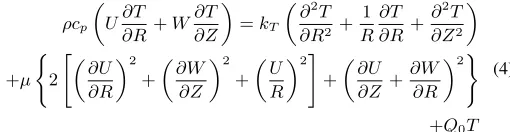
num-ber of magnets is small enough to neglect the effects of the magnetic field being induced. The primitive equations for viscous flow (Bird et al., (1960)) are:
Fig. 1Schematic diagram
∂U ∂R+
U R+
∂W
∂Z = 0 (1)
ρ
U∂U ∂R+W
∂W ∂Z
=−∂P
∂R−µ ∂ ∂Z ∂U ∂Z + ∂W ∂Z
−σB02U (2)
ρ
U∂W ∂R +W
∂W ∂Z
=−∂P
∂Z+ µ R ∂ ∂R R ∂U ∂Z − ∂W ∂R
−σB02W
(3)
ρcp
U∂T ∂R+W
∂T ∂Z
=kT
∂2T ∂R2 +
1
R ∂T ∂R+
∂2T ∂Z2 +µ ( 2 " ∂U ∂R 2 + ∂W ∂Z 2 + U R 2# + ∂U ∂Z + ∂W ∂R 2)
+Q0T
(4)
The boundary conditions on the axis are obtained by taking the flow to be symmetrical, so that
AtR= 0,∂W
∂R =U=
∂T
∂R= 0
AtR=a, W = 0, U=v0, and KT∂T∂R=qw
To continue, we present the accompanying transformations: (Na-garaju et al., (2018))
u= U
v0
, w= W
v0
, r=R
a, p= P ρv2
0
, z= Z
a, θ= T T1
(5)
Substituting relations Eq. (5) into Eqs. (1) -(4), following dimensionless system of equations, emerge:
∂u ∂r +
u r +
∂w
∂z = 0 (6)
Re
u∂u ∂r +w
∂u ∂z
=−Re∂p ∂r − ∂ ∂z ∂u ∂z− ∂w ∂r
−M2u (7)
Re
u∂w ∂r +w
∂w ∂z
=−Re∂p ∂z+ 1 r ∂ ∂r r ∂u ∂z − ∂w ∂r
−M2w
(8)
ReP r
u∂θ ∂r +w
∂θ ∂z
=Ecϕ+52θ+QP rθ (9)
whereϕ= 2h ∂u ∂r 2 + ∂w ∂z 2 + u r 2i + ∂u ∂z+ ∂w ∂r 2 ,
52=∂2θ ∂r2 +
1
r ∂θ
∂r+
∂2θ ∂z2
, Re=σv0a
µ , M
2= ρB2 0a2
µ , P r= µcp
kT , Ec= µv20
kTT1, Q=
Q0a2 µcp
A stream functionψmight be characterized to satisfy the mass conserva-tion Eq. (6):
u=−1
r ∂ψ ∂z, w=
1
r ∂ψ
∂r (10)
Eliminating the pressure gradient terms from Eq. (7) and Eq. (8), yields:
Re
−21
r3
∂ψ ∂zE
2
ψ+ 1
r2
∂ψ ∂z
∂E2ψ ∂r −
∂ψ ∂r
∂E2ψ ∂z
=−1
rE
2
E2ψ
+M 2 r E 2 ψ (11)
whereE2=∂r∂22 −
1 r ∂ ∂r+ ∂2 ∂z2
Assume ψ= (N−z)f(r) (Terril and Shresta (1963)) (12)
Using Eq. (12) in Eq. (11) we get,
Re 3f f 00 r2 −
3f f0 r3 −
f f000
r +
f0f00
r −
(f0)2
r2
!
=D2 M2−D2
f
(13) whereD2 =drd22 −
1
r d
dris a differential operator. The corresponding boundary conditions are
f=D2f=θ0
= 0at r= 0, f0= 0, f =θ0= 1, at r= 1.
DOI: 10.5098/hmt.13.6 ISSN: 2151-8629
2.1. Pressure Distribution
The pressure(p) is the result of Eqs. (7) - (8),
Re∂p ∂r =Re
f2 r3 −
f f0 r2
− D
2−M2
f
r (15)
Re∂p ∂z=
−N−z
r
(
d dr D
2−
M2
f−Re f f 00
r −
f f0 r2 −
(f0)2
r
!)
(16)
Assumingp=p1(r) + (N−z)2p2(r), inspection gives:
p2 = constant ,
p1=R
n
−1
r
f f0
r −
f2 r2
− 1
rRe D
2−
M2
fodr
)
(17)
2.2. Skin Friction
The wall shear stress(τrz)of the pipe is known by:
τrz=µ
∂W ∂R +
∂U ∂R
= µ
av0
(N−z)
r D
2
f (18)
Thus the skin-friction coefficientCf =2ρvτrz2 0
onr= 1is given by:
Cf =
2 (N−z)
Re D
2
f (19)
2.3. Nusselt number
The wall thermal flux (or heat flux) is known by:
qw=−kT
∂T
∂R|(R=1) (20)
The dimensionless heat transfer rate may be couched by:
N u= aqw
kTT1
(21)
From Eq. (20) and Eq. (21), the Nusselt number (Nu) obtained in the form:
N u=−∂θ
∂r|(r=1)= constant (22)
3. HOMOTOPY SOLUTION
The initial approximations of the velocityf(r)and temperatureθ(r)are chosen for HAM solutions as:
f0=r2 2−r2
and θ00(r) = 1 (23)
with the auxiliary linear operators are:L1(f) =D4and L2(θ) =52.
With
L1c1r4+c2r2(2logr−1) +c3r2+c4
L2(N−z)2(c5+c6logr) +c7r2+c8(logr−1)
(24)
WhereCi(i = 1 to 8) are constants.h1andh2(the convergence control
parameters) are introduced in zeroth-order deformations.
The zeroth-order deformations; non-linear operatorsN1andN2are
con-sidered as explained in the work of (Nagaraju et al., (2018); Nagaraju and Mahesh (2019)).
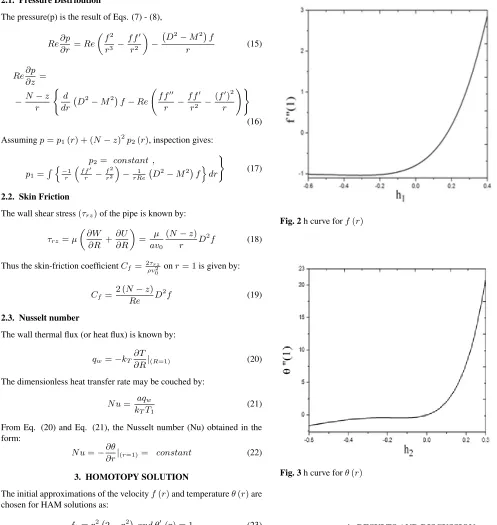
h-curves are plotted withM = 5, Re = 10, Pr = 0.7, Ec = 0.05, Q = 0.5, N=2, z=0.75andr =0.25for the optimal values ofh1 andh2 and are
shown in Figs. 2-3. The admissible values ofh1 andh1 are noted as
h1=h2=-0.1.
Fig. 2h curve forf(r)
Fig. 3h curve forθ(r)
4. RESULTS AND DISCUSSION
Fig. 4Response ofMonf
Fig. 5Response ofMonf ’
Fig. 6Response ofMonθ
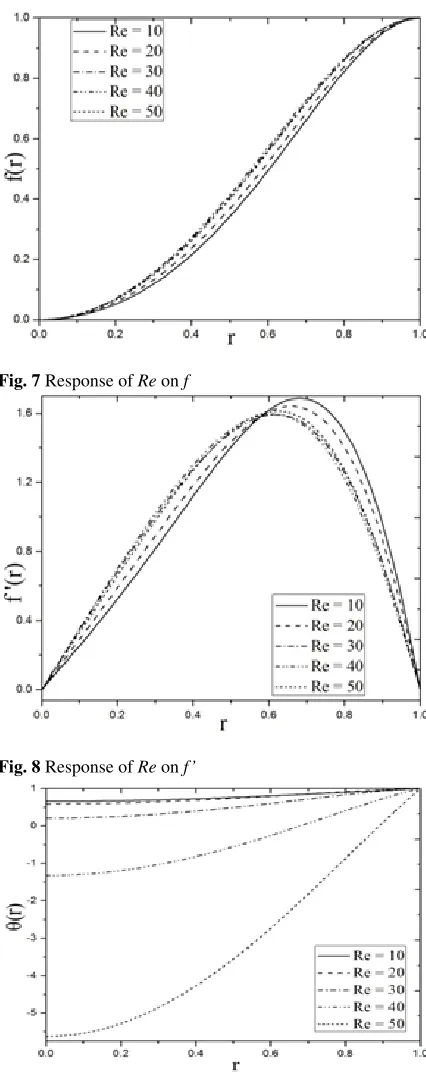
From Fig. 7, clearly the velocity of ther-direction increases asRe
increases. From Fig. 8, we notice that whileReincreases, the maximum values off0are reduced. This finding is opposite to the response ofM
which enhances the maximum values off0. This may occur despite the fact that greaterReimplies a greater inertial force in the regime relative to viscous force, thereby decelerating the radial flow. Recan not induce a force in perpendicular direction as in the case of magnetic number. It is also evident from Fig. 9 that as theReincreases, the temperature dis-tribution decreases near axis of cylinder. This indicates that whenRe
increases, thermal diffusion in the laminar regime is inhibited.
Fig. 7Response ofReonf
Fig. 8Response ofReonf ’
Fig. 9Response ofReonθ
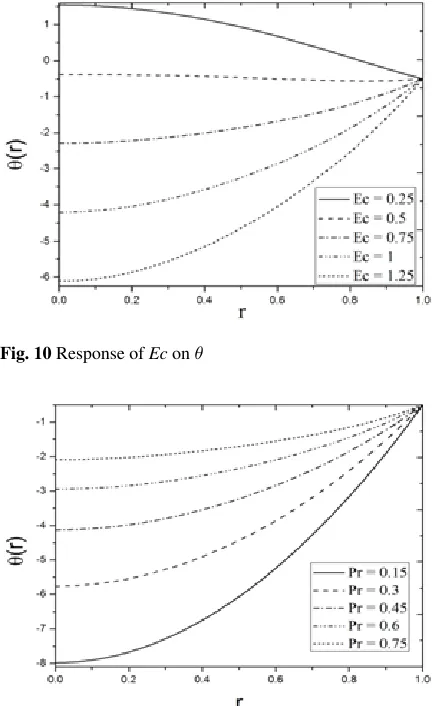
From Fig. 10 and Fig. 11, we observe that when the Eckert number (Ec) increases the temperature near the axis of a pipe and as the number of Prandtl (Pr) increases,θincreases. The conflicting behavior ofPrand
DOI: 10.5098/hmt.13.6 ISSN: 2151-8629
Fig. 10Response ofEconθ
Fig. 11Response ofPronθ
Fig. 12Response ofQonθ
The Eq. (22) is identical to that considered in Srinivas et al., (2014) and Nagaraju et al., (2018). The solution comparison is documented in Table 2 excellent correlation is accomplished and therefore confidence in the current alternatives is reasonably high.
Table 1Variation of Nusselt number for different values of various flow parameters.
Re Q M Ec N u
P r = 0.15
P r = 0.3
P r = 0.45
P r = 0.6 2
-0.5 3 0.75
9.3001 9.33229 9.36449 9.39668
4 6.1585 6.07011 5.98171 5.89331
6 1.3988 0.931253 0.463653 -0.00395
8 -5.4808 -6.71935 -7.95793 -9.19651
3 -0.5 3
0.2 0.9126 -0.57783 -2.42565 -4.68941
0.4 4.2547 3.03265 1.4799 -0.45998
0.6 7.5968 6.64313 5.38545 3.76944
0.8 10.9388 10.2536 9.291 7.99887
3 -0.5 2
0.75
10.0251 9.27069 8.23334 6.86049
4 10.2318 9.48261 8.44786 7.07462
6 10.7348 9.99673 8.96841 7.59626
8 11.8436 11.1269 10.1125 8.74594
3 -1.5
3 0.75
10.0906 9.33353 8.30318 6.94999
-0.5 10.1033 9.35099 8.31461 6.94151
0.5 10.1161 9.36849 8.32606 6.93286
1.5 10.1289 9.38605 8.33752 6.92402
Table 2Comparison of Nusselt number for various values ofPrwithRe =10, M = 0.25, Ec=0.3, Q = 0
P r N u
Nagaraju et al., (2018) Srinivas et al., (2014) Present
0.15 -1.7123 -1.7093 -1.72282
0.3 -11.5664 -11.5694 -11.5868
0.45 -28.9654 -29.0964 -29.2861
0.6 -57.8920 -58.4890 -58.74
It is evident from Fig. 13 that streamlines are non-positive forz > N and positive forz≤N. Numerically, the streamlines for thez=N
line are symmetrical. The streamlines are more clustered for lower z
values and more dispersed for greaterzvalues indicating that the intensity of the flow is greater at lowerz(axial coordinate).
Fig. 13Velocity Stream lines:
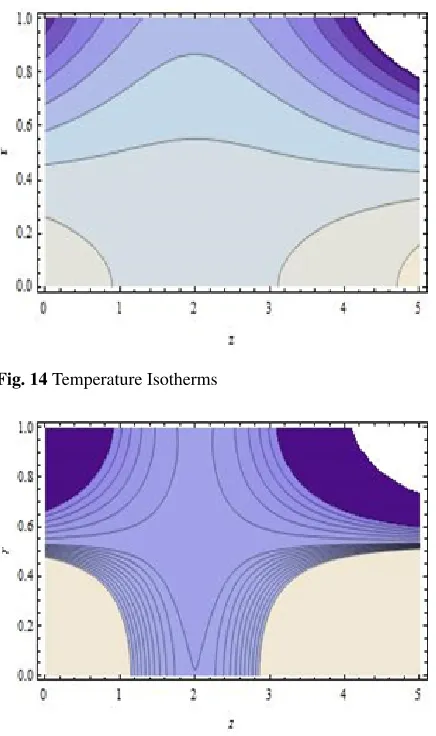
for higher estimations of spiral arrange (r). Figure. 15 shows that the pressure onz =N is symmetrical and decreases as ranger≥1/2and increases asr <1/2. Pressure increments to higher qualities close to the pipe birthplace aszincrements or diminish.
Fig. 14Temperature Isotherms
Fig. 15Pressure contours
5. CONCLUSIONS
Analytical solutions are obtained in the viscous magnetohydrodynamic pipe flow for heat transfer using the HAM method. Viscous heating, injection/absorption of walls and internal heat source/sink effects have been incorporated in the energy equation. The observations from the fig-ures show that:
(i) Increasing magnetic body force parameter accelerates the radial flow, whereas it tends to decelerate axial flow. This means that external magnetic force decelerates the flow in axial direction and enhances the flow in radial direction.
(ii) As magnetic ParameterMincreases velocity in axial direction in-creases and hence dissipation of energy inin-creases and this causes raise in temperature.
(iii) Increase suction Reynolds number slow down axial velocity and enhances the radial velocity. This may be due to conservation of mass law, because in flow and out flow are to be balanced.
(iv) As the Eckert number or Prandtl number increases, the temperature on the axis of the pipe decreases.
(v) AsQincreases temperature on the axis of the tube numerically increases. WhenQis fixed the temperature increases in the radial direction and suddenly decreases near the surface of the tube.
ACKNOWLEDGEMENTS
The Authors wish to thank the reviewers for their positive comments which improved the quality of the paper.
NOMENCLATURE
W, U velocity components in (Z, R) directions (m/s)
w, u Dimensionless axial and radial velocity coefficients
P, p Dimensional and dimensionless presure (Pa)
cp specific heat at constant pressure (J/kg·K)
ρ density (kg/m3)
µ Viscosity (m2/s)
σ specific conductance(W/m2·K4)
kT thermal conductivity (W/m·K)
Q0 heat source/sink (j)
T1 temperature at surface (K)
π dissipation function
v0 Suction velocity
Re suction Reynolds number
M Magnetic parameter
P r Prandtl number
Ec Eckert number (viscous heating parameter)
Q Heat source/sink parameter
E2 stoke’s stream function operator
N =U0/v0
U0 entrance velocity 52 Laplacian operator
qw uniform wall heat flux per unit area(W/m2)
REFERENCES
Ahmet, Z.Sahin., Rached, Ben-Mansour., 2003, " Entropy Generation in Laminar Fluid Flow Through a Circular Pipe,"Entropy,5, 404-416. https://doi.org/10.3390/e5050404
Amanulla, Ch., Nagendra, N., Suryanarayana Reddy, M., 2018, "Nu-merical Simulation of Slip Influence on Electric Conducting Viscoelas-tic Fluid Past an Isothermal Cylinder," Frontiers in Heat and Mass Transfer,10, 1–13.
https://doi.10.5098/hmt.10.10
Anwar Beg, O., Takhar, H.S., Tasveer, A. Beg., Bhargava, R., Rawat, S., 2008, "Nonlinear Magneto-Heat Transfer in a Fluid Particle Suspension Flowing in a Non-Darcian Channel with Heat Source and Buoyancy Effects: Numerical Study,"JKAU: Engineering Science,19(1), 63-89. https://doi.10.4197/Eng.19-1.4
Anwar Beg, O., Zueco, J., Takhar, H.S., 2009, "Unsteady Magneto-hydrodynamic Hartmann Couette Flow and Heat Transfer in a Darcian Channel with Hall Current, Ionslip, Viscous and Joule Heating Effects: Network Numerical Solutions,"Communications in Nonlinear Science and Numerical Simulation,14, 1082-1097.
https://doi.org/10.1016/j.cnsns.2008.03.015
Anwar Beg, O., Ghosh, S.K., Beg, T.A., 2011, "Applied Magnetofluid Dynamics: Modelling and Computation,"Lambert, Germany,445. ISBN 10: 3846508659/ ISBN 13: 9783846508657
Attia, H.A., 2003, "Unsteady Flow of a Dusty Conducting Non-Newtonian Fluid Through a Pipe,"Candian Journal of Physics,81, 789-795.
DOI: 10.5098/hmt.13.6 ISSN: 2151-8629
Aydin, O., 2005, "Effects of Viscous Dissipation on the Heat Transfer in Forced Pipe Flow. Part 1: Both Hydrodynamically and Thermally Fully Developed Flow,"Energy Conversion and Management,46, 757-769. https://doi.org/10.1016/j.enconman.2004.05.004
Bansal, J.L., 1967, "Laminar Flow Through a Uniform Circular Pipe with Small Suction,"Proc. Natn. Acad. Sci.,32A(4), 368-378.
Berman, A.S.,1953, "Laminar Flow in Channels with Porous Walls,"
Journal of Applied Physics,24, 1232-1235. https://doi.org/10.1063/1.1721476
Bird, R.B., Stewart, W.E., Lightfoot, E.N., 1960, "Transport Phenom-ena,"John Wiley and Sons, New York.
Brinkman,H.C.,1951, "Heat Effects in Capillary Flow,"Applied Scien-tific Research, A2 , 120-124.
https://doi.org/10.1007/BF00411976
Cox, B.J., Hill, J.M., 2011, "Flow Through a Circular Tube with Perme-able Navier Slip Boundary,"Nanoscale Research Letters.6, 1-9. https://doi.org/10.1186/1556-276X-6-389
Davaa, G., Shigechi, T., Momoki, S., 2004, "Effect of Viscous Dissi-pation on Fully-Developed Heat Transfer of Non-Newtonian Fluids in Plane Laminar Poiseuille-Couetteflow,"International Journal of Heat and Mass Transfer31, 663-672.
https://doi.org/10.1016/S0735-1933(04)00053-3
Gebhart, B., 1962, "Effects of Viscous Dissipation in Natural Convec-tion,"Journal of Fluid Mechanics,14, 225-232.
https://doi.org/10.1017/S0022112062001196
Hazem, A. Attia., Mohamed, Ahmed, E.S., 2005, "Circular Pipe MHD Flow of a Dusty Bingham Fluid,"Tamkang Journal of Science and En-gineering,8(4), 257-265.
http://www2.tku.edu.tw/ tkjse/8-4/8-4-1.pdf
Hussein, H.M.S., Mohamad, M.A., El-Asfouri, A.S., 1999, "Optimiza-tion of a Wickless Heat Pipe Flat Plate Solar Collector,"Energy Con-version and Management,40, 1949-1961.
https://doi.org/10.1016/S0196-8904(99)00082-5
Leonard L.Vasilev, 2005, "Heat Pipes in Modern Heat Exchangers," Ap-plied Thermal Engineering,25, 1-19.
https://doi.org/10.1016/j.applthermaleng.2003.12.004
Liao, S.J., 2003, "Beyond Perturbation: Introduction to Homotopy Analysis Method,"Chapman and Hall/CRC Press, Boca Raton.
https://www.crcpress.com/Beyond-Perturbation-Introduction-to-the-Homotopy-Analysis-ethod/Liao/p/book/9781584884071
Moustafa, EL-Shahed., 2006, "MHD of a Fractional Viscoelastic Fluid in a Circular Tube,"Mechanics Research Communication,33, 261-268. https://doi.org/10.1016/j.mechrescom.2005.02.017
Nabil, T. El Dabe., Galal, M.Moatimid., Hoda, S.M. Ali., 2002, "Rivlin-Eriksen Fluid in Tube of Varying Cross Section with Mass and Heat Transfer,"Zeitschrift fur Naturforschung A,57a, 863-873.
https://doi.org/10.1515/zna-2002-1105
Nagaraju, G., Anjanna, Matta., Kaladhar, K., 2016, "Effects of Chemi-cal Reaction and Thermal Radiation on Heat Generated Stretching Sheet in a Couple Stress Fluid Flow,"Frontiers in Heat and Mass Transfer,
7(11), 1-5.
https://doi.org/10.5098/hmt.7.11
Nagaraju, G., Srinivas, J., Ramana Murthy, J.V., Rashad, A.M., 2017, "Entropy Generation Analysis of the MHD Flow of Couple Stress Fluid Between Two Concentric Rotating Cylinders with Porous Lining,"Heat Transfer-Asian Research,46(4), 316-330.
https://doi.org/10.1002/htj.21214
Nagaraju, G., Srinivas Jangili., Ramana Murthy, J.V., Beg, O.A., Kadir, A., 2018, "Second Law Analysis of Flow in a Circular Pipe with Uni-form Suction and Magnetic Field,"Journal of Heat transfer,141(1)
http//doi.10.1115/1.4041796.
Nagaraju, G., Mahesh Garvandha, 2019, "Magnetohydrodynamic Vis-cous Fluid Flow and Heat Transfer in a Circular Pipe Under an Exter-nally Applied Constant Suction,"Heliyon,5, (2019)e01281.
http//doi.10.1016/j.heliyon.2019.e01281.
Ou, J.W., Cheng, K.C., 1973, "Viscous Dissipation Effects on Thermal Entrance Heat Transfer in Pipe Flows with Uniform Wall Heat Flux,"
Applied Scientific Research,28, 289-301. https://doi.org/10.1007/BF00413074
Rached, Ben-Mansour., Ahmet, Z.Sahin., 2005, "Entropy Generation in Developing Laminar Fluid Flow Through a Circular Pipe with Variable Properties,"Heat and Mass Transfer,42, 1-11.
https://doi.org/10.1007/s00231-005-0637-6
RamanaMurthy, J.V., Nagaraju, G., Muthu, P., 2012, "Micropolar Fluid Flow Generated by a Circular Cylinder Subject to Longitudinal and Tor-sional Oscillations with Suction/Injection,"Tamkang Journal of Math-ematics,43(3), 339-356.
https://doi.10.5556/j.tkjm.43.2012.339-356
Rhee, K.N., Yeo, M.S., Kim, K.W., 2011, "Evaluation of the Control Performance of Hydronic Radiant Heating Systems Based on the Em-ulation Using Hardware in the Loop,"Building and Environment,46, 2012 - 2022.
https://doi.org/10.1016/j.buildenv.2011.04.012
Srinivas, S., Subramanyam Reddy, A., Ramamohan, T.R., Anant Kant Shukla., 2014, "Influence of Heat Transfer on MHD Flow in a Pipe with Expanding or Contracting Permeable Wall,"Ain Shams Engineer-ing Journal,5, 817 - 830.
https://doi.org/10.1016/j.asej.2014.01.006
Terril, R.M., Shrestha, G.M., 1963, "Laminar Flow Through Channels With Porous Walls and with an Applied Transverse Magnetic Field,"
Applied Scientific Research,11, 134-144. https://doi.org/10.1007/BF02922219
Terril, R.M., 1982, "An Exact Solution for Flow in a Porous Pipe,"
ZAMP,33, 547-542.
https://doi.org/10.1007/BF00955703
Terril,R.M., 1983, "Laminar Flow Through a Porous Tube,"ASME Jour-nal of Fluids Engineering,105, 303-306.
https://doi.10.1115/1.3240992
Tien, C.L., 1975, "Fluid Mechanics of Heat Pipes,"Annual Review of Fluid Mechanics,7, 167-185.
Tsangaris, S., Kondaxakis, D., 2007, "Exact Solution for Flow in a Porous Pipe with Unsteady Wall Suction/Injection,"Communications in Nonlinear Science and Numerical Simulations,12, 1181-1189. https://doi.org/10.1016/j.cnsns.2005.12.009
Walker, K.L., Tarau, C., Anderson, W.G., 2013, " Grooved and Self-Venting Arterial Heat Pipes for Space Fission Power Systems," 17th International Heat Pipe Conference, October, 13-17.