87
SCADA Application in Density Based Traffic
Light System
Ashwani Sangwan
1, Vivek Kumar
21
M.Tech. Scholar, Electrical and Electronics Engg. Deptt. BRCMCET, Bahal, Haryana 2
Asst. Professor Electrical and Electronics Engg. Deptt. BRCMCET, Bahal, Haryana
ABSTRACT
Due to increase in urban traffic has resulted in traffic congestions, long travelling time and increase hazards to pedestrians due to inefficient traffic light controls. This problem necessitate the use of new methods in the design of traffic light control for vehicles and pedestrian crossings. This project is used to develop a density based dynamic traffic signal system. The signal timing changes automatically on sensing the traffic density at the junction. In many major cities Traffic congestion is the biggest problem all around the world and become a nightmare for the commuters in these cities. Conventional traffic light system is a fixed time concept on each side of road which cannot be varied traffic density. Sometimes higher traffic density at one side of the road demands longer green time as compared to standard time. By using SCADA which is mainly used for the automation purpose in the industries and also at the other places to do work without man power. Here is the scope of SCADA is that to control traffic on “Density Bases” which avoid the traffic Jam situations in metro cities as we face in our daily life and also it can control the traffic remotely by visualizing (monitoring) the traffic situation and provide the clear path (road) in case of emergency like ambulance, fire brigade etc. The system is able to sense the presence or absence of vehicles in range to react according to traffic signals. By using mathematical functions for calculating the timing for the green signal which help to solve the problem of traffic congestion. The new timing scheme that was implemented in the current traffic light system which is feasible, affordable and ready to implement during peak hours. Another chance of improvement is to use the infrared sensors and replaced the imaging system/camera system so that it has a wide range of detection capabilities which can be enhanced and ventured into a perfect traffic system. By analyze and study about the previous researches, its help more to understand the concept and the application to be use for this prototype. This Project can be categorized to three main criteria which is mechanical, electrical and programming.
Keywords: SCADA, IR sensor, Adaptive Traffic light System, Traffic sign Recognisation, Traffic Density.
1. INTRODUCTION
In today’s modern life, we are facing so many problems in which traffic congestion is becoming more serious day after day. Due to high volume of vehicles, the inadequate infrastructure and irrational distribution of the development are main reasons for increasing traffic jam. The major cause leading to traffic congestion is the high number of vehicle which was caused due to increase in population and due to the development of economy. Traffic congestion on road networks occurs as use increases, and is characterized by slower speeds, longer trip times, and due to increased vehicular queuing. Traffic congestion is now considered to be one of the biggest problems in the urban environments. Traffic problems will be also much more widely increasing as an expected result of the growing number of transportation means and current low-quality infrastructure of the roads. The most common example is the physical use of roads by vehicles. When traffic demand is great during interaction between vehicles which slows the speed of the traffic stream, results in road congestion. When vehicles are fully stopped for periods of time, known as traffic jam or traffic snarl-up. Traffic congestion can lead to drivers as frustrated and engaging in road rage. In order to avoid the congestion in the traffic we use traffic lights. Traffic light which is one of the vital public facilities plays an important role to the road users.
88 interest of many researchers, due to the frequent traffic jams at major junctions and its resulting wastage of time. Instead of depending on information generated by costly sensors, economic situation calls for using available video cameras in an efficient way for effective traffic congestion estimation. Researchers may focus on one or more of these tasks, and they may also choose different measures for traffic structure or add measures. Due to the massive growth in urbanization and traffic congestion, intelligent vision based traffic light controller is needed to reduce the traffic delay and travel time especially in developing countries as the current automatic time based control is not realistic while sensor based traffic light controller is not reliable in developing countries. This research exposed the operational of traffic light such as understanding the flow of th e traffic system and the program itself. Traffic signal light is used to control the movement of vehicles and passengers, so that traffic can flow smoothly and safely. Traffic signal lights have been around for years and are used to efficiently control traffic through intersections.
Although traffic signal lights are relatively simple and commonplace, they are critical for ensuring the safety of the driving area. The growing use of traffic lights attests to their effectiveness in directing traffic flow, reducing the number of acci dents, and the most recently to their utility in controlling the flow of traffic through metropolitan areas when have been used together with computer systems.
Traffic signal lights will improve the road safety and reduce congestion by providing, the signals orderly through junctions. Traffic control lights are provided for traffic control on streets and highways, especially at junctions. The traffic signals are cyclically displayed through a suitable timing and control mechanism.
A traffic light has three colors which are red, yellow and green. Every color carries a certain sign. The red light means the road user has to stop driving and not crossing or pursuing the ride while the yellow light show that the road user has to ready to stop their ride. However if the user is too close to the line that is not safe for a stop they have to continue the ride. The green light shows the road user can continue their journey only with the absence of any hindrance.
Driving through a red light without justification may be a citation able traffic offense. The transition of the light is controlled by PLC to help the traffic movement run smooth from one direction to the other. PLC reduces traffic congestion especially in the morning and evening. Besides, it also helps to reduce the accident rate especially in town. This idea of controlling the traffic light efficiently in real time has attracted many researchers to work in this field with the goal of creating automatic tool that can estimate the traffic congestion and based on this Variable, the traffic sign time interval is forecasted.
2. METHODOLOGY
This Paper is design to develop a density base traffic light system. As prescribed in previous chapter , density base method is made up of time base + density base , so if strength of traffic is normal than simple time management base system is work continuously and switch to mode on density base if strength of vehicle is increasing rapidly. The signal timing changes automatically on sensing the traffic density at the junction. Traffic congestion is a severe problem in many major cities acr oss the world and it has become a nightmare for the commuters in these cities. Conventional traffic light system is based on fixed time concept allotted to each side of the junction which cannot be varied as per varying traffic density. Sometimes higher traffic density at one side of the junction demands longer green time as compared to standard allotted time, A sensor sense the area that allocated to it by programming and pass a message to SCADA (Software junction) that density of signal cross the limit and according to that clear a particular lane by show green signal to same lane junction.
When traffic demand is great enough that the interaction between vehicles slows the speed of the traffic stream, these results in some congestion. As demand approaches the capacity of a road (or of the intersections along the road), extreme traffic congestion sets in. When vehicles are fully stopped for periods of time, this is colloquially known as a traffic jam or traffic snarl-up. Traffic congestion can lead to drivers becoming frustrated and engaging in road rage in order to avoid the congestion
in the traffic.
89 Fig.1: Traffic Congestion Control
3) Problem Definition and Limitation: They used spot sensors such as loop detectors and pneumatic sensors to quantify the traffic flow However; the sensors are very expensive and need a lot of maintenance especially in developing countries because of the road ground de-formations. In addition, metal barriers near the road might prevent effective detection using radar sensors. It is also found that traffic congestion also occurred while using the electronic sensors for controlling the traffic. In contrast, video based systems are much better compared to all other techniques as they provide more traffic information and they are much more scalable with the progress in image progressing techniques. This is the main reason for the motivation to develop vision based tool for traffic light control in this work. In recent years, vision based traffic light control, which is based on video processing for traffic flow or traffic density estimation, has attracted the attention of many researchers. The value of traffic density measures only the ratio between the density of the vehicles and the total density of the road. So based on his measure, the traffic control system will compare between different roads in the intersection to take the decision for the traffic light and the time interval given.
However, most of the previous vision based monitoring systems suffered from lack of robustness on dealing with continuously changing environment such as lighting conditions, weather conditions and unattended vehicles. All these mentioned factors considerably affect the traffic density estimation.
4) Architecture for the Control System: In this architecture Sensor is placed on the top of the signal and side view of road to get the clear view of traffic on the particular side of the signal so that it will Sense the traffic strength and analyze the traffic in that particular side and get indication to the junction .
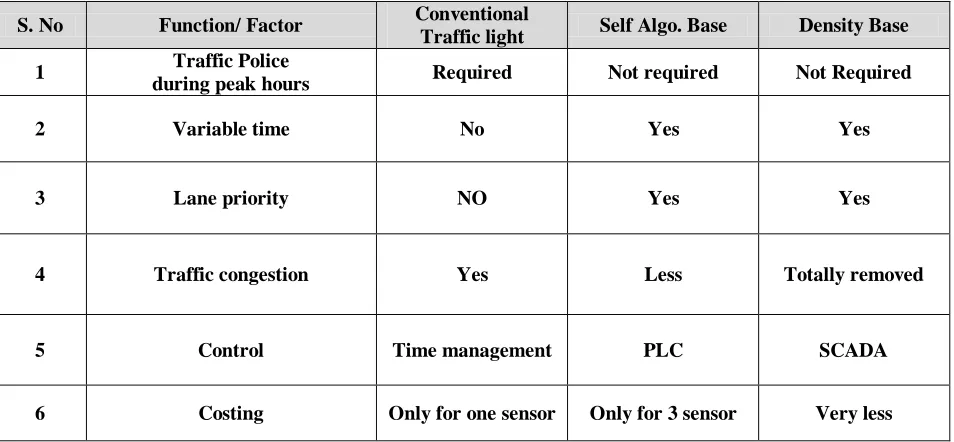
90 COMPARISON TABLE
Table 1: traffic flow or traffic density estimation
S. No Function/ Factor Conventional
Traffic light Self Algo. Base Density Base
1 Traffic Police
during peak hours Required Not required Not Required
2 Variable time No Yes Yes
3 Lane priority NO Yes Yes
4 Traffic congestion Yes Less Totally removed
5 Control Time management PLC SCADA
6 Costing Only for one sensor Only for 3 sensor Very less
CONCLUSIONS
In my paper work, I conclude that the density base traffic control system using SCADA (as software) applications for performing the control action on heavy traffic during peak hours is measured and define the result in form of graphical representation.
I tried to stimulate the result for different time duration and different input values to find out a situation when density base method is not to be satisfied (in real impatience). This method is used to avoid the small disadvantages of real time applications and other method algorithm base because it require a complete system simultaneously with manual operation but not be required in density base system.
Real time application process is very slow and also the software is not free of cost like opener CV to overcome the disadvantage of manual system in the same way to avoid the drawback of heal fire application. I try to design a new approach that describe all above.
FUTURE WORK
In this paper, focus on a concept how we can reduce heavy traffic. During the process we find out this work is not be properly applicable if one side traffic is under control then this side’s sensor did not define the density of traffic is high (disadvantage). So, In future there is being possibility to work on this concept to avoid a point on single side traffic.
REFERENCES
[1]. K. vidhya, A.Bazila Banu, “Density Based Traffic Signal System”, International Journal of Innovative Research in Science, Engineering and Technology,3,March 2014.
[2]. Ganiyu.A, Arulogun O.T, Okediran O.O, “Development of a Microcontroller – Based Traffic Light System For Road Intersection Control”, International Journal of Scientific & technology research, volume -3, issue 5.may 2014, ISSN 2277-8616.
91
[4]. Javed Alam, Prof. (Dr.) M. K. Pandey, “Advance Traffic Light System Based On Congestion Estimation Using Fuzzy Logic” International Journal of Emerging Technology and Advanced Engineering , Volume 4, Issue 3, March 2014, ISSN 2250-2459, ISO 9001:2008.
[5]. Rashid Hussian, Sandhya Sharma, Vinita Sharma, Sandhya Sharma, “WSN Applications:Automated Intelligent Traffic Control System Using Sensors”, International Journal of Soft Computing and Engineering (IJSCE) Volume-3, Issue-3, July 2013, ISSN: 2231-2307.
[6]. Vishakha S. Thakre, Snehal R. Jadhav, Sananaj G. Sayyed, Poonam V. Pawar, “ Design of Smart Traffic Light Controller Using Embedded System”, IOSR Journal of Computer Engineering (IOSR-JCE), Volume 10, Issue 1(Mar.-Apr.2013) e-ISSN: 2278-0661, p- ISSN : 2278-8727.
[7]. Sachin Jaiswal, Tushar Agarwal, Akansha Singh and Lakshita, “ Intelligent Traffic Control Unit”, International Journal of Electrical, Electronics & Computer Engineering 2(2): 66-72 (2013) ISSN No.(Online) 2277-2626.
[8]. Fei Zhong, Jutao Wang, Xudong Cheng , Fei Zhong, Jutao Wang , Xudong Cheng“Application of Intelligent Traffic Control Based on PLC”, Proceedings of the 2nd International Conference on Computer Science and Electronics Engineering, ICCSEE- 2013.
[9]. Bilal Ahmed Khan, Nai Shyan Lai, “ An Intelligent Traffic Controller Based on Fuzzy Logic”, Asia Pacific University of Technology and Innovation, ISBN: 978-0-9853483-8-0, 2013.
[10]. Ovidiu Tomescu, Ilona Madalina moise, Alina Elena stanciu, Iulian batros, “Adaptive Traffic Light Control System using Ad- Hoc vehicular communications network”, U.P.B.Sci. Bull., Series D, Iss. 2, 2012, ISSN: 1454-2358.
[11]. Mohit Dev Srivastava, Prerna, Shubhendu Sachin, Sumedha Sharma, Utkarsh Tyagi “Smart Traffic Control System Using PLC and SCADA”, International Journal of Innovative Research in Science, Engineering and Technology Vol. 1, Issue 2, December 2012.