1. Introduction
pilepsyis known as a common neurologi-cal disorder affecting about one percent of the world's population(Zhang, Frank-lin, & Murray, 1993).The most common epileptic syndrome in adults is temporal lobe epilepsy (TLE) and one of the most commonly used animal models of TLE seizures, is the kindling model of epilepsy(French et al., 1993). Kin-dling is defined as a chronic model in which the repeated application of electrical stimulation, with a depth elec-trode in particular brain sites, induces permanently
en-Comparing the Anticonvulsant Effects of Low Frequency
Stimulation of Different Brain Sites on the Amygdala
Kindling Acquisition in Rats
Khadijeh Esmaeilpour1, Yaser Masoumi-Ardakani2, Vahid Sheibani1*, Amir Shojaei1,3, Shaahin Harandi1, Javad Mirnajafi-Zadeh3
1. Neuroscience Research Center, Kerman University of Medical Sciences, Kerman, Iran. 2. Physiology Research Center, Kerman University of Medical Sciences, Kerman, Iran.
3. Department of Physiology, School of Medical Sciences, Tarbiat Modares University, Tehran, Iran.
* Corresponding Author:
Vahid Sheibani, PhD.
Neuroscience Research Center, Kerman University of Medical Sciences, Kerman, Iran. Tel: +98 341 2264196/ Fax: +98 341 2264198
E-mail: [email protected]/ [email protected]
Low frequency stimulation (LFS) is a potential alternative therapy for epilepsy. However, it seems that the anticonvulsant effects of LFS depend on its target sites in the brain. Thus,
the present study was designed to compare the anticonvulsant effects of LFS administered to
amygdala, piriform cortex and substantia nigra on amygdala kindling acquisition. In control group, rats were kindled in a chronic manner (one stimulation per 24 h). In other experimental groups, animals received low-frequency stimulation (8 packages at 100 s intervals, each package contained 200 monophasic square-wave pulses, 0.1 ms pulse duration at 1 Hz andAD threshold intensity) in amygdala, piriform cortex or substantia nigra 60 seconds after the kindling stimulation, the AD duration and daily seizure stages were recorded. The obtained
results showed that administration of LFS in all three regions reduced electrical and behavioral
parameters of the kindling procedure. However LFS has a stronger inhibitory effect on kindling
development when applied in substantia nigra compared to the amygdala and piriform cortex which reinforce the view that the substantia nigra mediates a crucial role in amygdala-kindled
seizures. LFS had also greater inhibitory effects when applied to the amygdala compared to piriform cortex. Thus, it may be suggested that antiepileptogenic effect of LFS depends on its
target site and different brain areas exert different inhibitory effects on kindling acquisition
according to the seizure focus.
A B S T R A C T
Article info:Received: 28 January 2013 First Revision: 10 February 2013 Accepted: 11 March 2013
Key Words:
Low-Frequency Stimulation, Epilepsy,
Kindling, Amygdala, Piriform Cortex, Substantia Nigra.
E
hanced seizure susceptibility and other enduring brain alterations that are similar to those occurring in human TLE(Sato, Racine, & McIntyre, 1990). Among brain sites, the amygdala is one of the most sensitive areas for induction of kindled seizures(Mohapel, Dufresne, Kelly, & McIntyre, 1996).is thought to inhibit the activity by increasing the thresh-old for the firing of neuronal action potentials through more complex mechanisms(Albensi, Ata, Schmidt, Wa-terman, & Janigro, 2004; Schrader et al., 2006). More-over, LFS requires fewer pulses per second compared to other forms of deep brain stimulation therapies, thereby lowering the required current injection and minimiz-ing the potential for the stimulation-induced damage of the target tissue(Kile et al., 2010). LFS is reported to be an antiepileptic and antiepileptogenic electrical stimulation(Ghorbani, Mohammad-Zadeh, Mirnajafi-Zadeh, & Fathollahi, 2007). Application of LFS as an inhibitory factor on kindling acquisition was first re-ported in 1980s by Gaito(Gaito, 1980; Gaito, Nobrega, & Gaito, 1980). Nowadays, LFS has been determined as an alternative to the brain surgery for refractory epi-lepsy, due to its titratability, reversibility and low risk of complications(Li & Mogul, 2007). However, it seems that the effects of LFS on amygdala kindled seizures de-pend on its target sites.
Stimulation of inappropriate brain structures may result in no effect on or even aggravation of evoked seizures(Wu, Zhu-Ge, et al., 2008). In most of the previ-ous studies the LFS was applied at the kindling focus. However LFS at other target sites can also produce in-hibitory effects against kindling seizures.Many studies showed that application of LFS at the kindling focus,such as amygdala (Ghotbedin, Janahmadi, et al, 2012; Ve-lisek, Veliskova, & Stanton, 2002; Wu, Xu, et al., 2008) and piriform cortex (Ghorbani et al., 2007; Yang et al., 2006)results in a significant increase of seizure thresh-old and suppression of behavioral seizures. However, the brain areas which are important in epileptic seizure spreading may also be considered as the possible targets of LFS application site. Among these area piriform cor-tex and substantia nigra have important role on amyg-dala kindled seizures (Ghorbani et al., 2007; Jahanshahi, Mirnajafi-Zadeh, Javan, Mohammad-Zadeh, & Rohani, 2009; Mohammad-Zadeh et al., 2009; Sadegh et al., 2007; Shi, Luo, Woodward, & Chang, 2006; Velisek, Veliskova, & Moshe, 2002; Yang et al., 2006).Thus, the present study was designed to compare the anticonvul-sant effects of low frequency stimulation administered to different brain sites on the amygdala kindled seizures in male rats. Amygdala, piriform cortex and substantia nigra were considered as the target sites for the LFS ap-plication.
2. Methods
2.1. AnimalsMale Wistar rats (weighing 250-300 g, provided by the Kerman Neuroscience Research Center) were caged in-dividually and maintained under constant temperature (23 ± 1 °C) and 12-h light–dark cycle (light on at 07:00). They had free access to standard food and water. All experimental protocols and treatments were approved by Ethical Committee of the Kerman Neuroscience Re-search Center (EC/KNRC/89-4) that was completely co-inciding with the “NIH Guide for the Care and Use of Laboratory Animals”.
2.2. Surgical Procedure
Under ketamine (100mg/kg) and xylazine (10mg/kg) anesthesia, rats were mounted in a stereotaxic apparatus and bipolar stimulating and monopolar recording elec-trodes (twisted into tripolar configuration) were implant-ed into the right basolateral amygdala (-2.5 mm poste-rior and 4.8 mm lateral from bregma and 8.5 mm below skull) according to atlas of Paxinos and Watson (Paxi-nos & Watson, 2007). Two other groups of animals were also subjected to an implantation of a bipolar electrode into the piriform cortex (-0.8mm posterior and 4.9mm lateral from bregma and 8.8 mm below skull), or sub-stantia nigra (-4.8 mm posterior and 1.6 mm lateral from bregma and 8.2 mm below skull) of the same hemisphere (Paxinos & Watson, 2007). In the amygdala group, the same electrodes were used for delivering kindling and low-frequency stimulations. Electrodes (teflon-coated, 125 μm in diameter; A.M. system Inc., USA) were insu-lated except for 0.5 mm at their tips. Another electrode was connected to the skull screws and placed above the left cortical surface as earth electrode. The pins attached to the electrodes were inserted to a socket which was em-bedded in the skull with dental cement.
2.3. Kindling and LFS
Following at least 7 days post-surgical recovery, the afterdischarge (AD) threshold was determined by appli-cation of 1 ms monophasic square wave of 60 Hz at the train duration of 2 s. The stimulating current was initially delivered at 25 µA and was increased in increments of 25 µA at 5 min intervals until at least 5 s of ADs was recorded. This intensity was considered as AD threshold and used for daily stimulation.
isolator (A365; WPI, USA) and electroencephalograms (EEGs) at the amygdala were amplified with an ampli-fier (DAM80; WPI, USA) and recorded by means of data acquisition (D3108; ScienceBeam Co., Iran) and the biochart software (v 1.53; ScienceBeam Co., Iran). The seizure severity was classified according to Racine scores (1972) as follows: (1) facial movement; (2) head nodding; (3) unilateral forelimb clonus; (4) bilateral forelimb clonus and rearing; and (5) rearing and falling. AD duration (ADD) was also measured and expressed as the increased percentage relative to the first day of stimulation. Kindling stimulations were continued until animals showed a stage 5 seizure for the first time. 60 sec after termination of the kindling stimulation, eight packages of LFS was daily administered at 100 sec in-tervals. Each LFS package contained 200 monophasic square-wave pulses, 0.1 ms pulse duration at 1 Hz and AD threshold intensity at the end of experiments, the po-sition of electrodes was histologically verified and only animals with correct electrode implantation in the stimu-lated sites were included in the statistical analysis.
2.4. Experimental Design
In this experiment, rats were divided into four groups. In control group the animals were subjected to daily kin-dling stimulations. In amygdala-LFS, piriform-LFS and substantia nigra-LFS (SN-LFS) groups, daily LFS was applied after each amygdala kindling stimulation at the amygdala, piriform cortex and SN respectively.
2.5. Statistical Analysis
Data were expressed as the mean±SEM and accompa-nied by the number of observations. Two-way analysis of variance (ANOVA) was used to compare the changes in the increased percentage of ADD and one-way ANOVA was used to compare the number of stimulation days to achieve different seizure stages in different groups. The significant differences were evaluated further by a Tukey post-test. The changes in behavioral seizure scores were analyzed in the same manner by using the nonparametric Kruskal–Wallis and Mann–Whitney U test. A p-value of less than 0.05 was considered as statistically significant difference.
3. Results
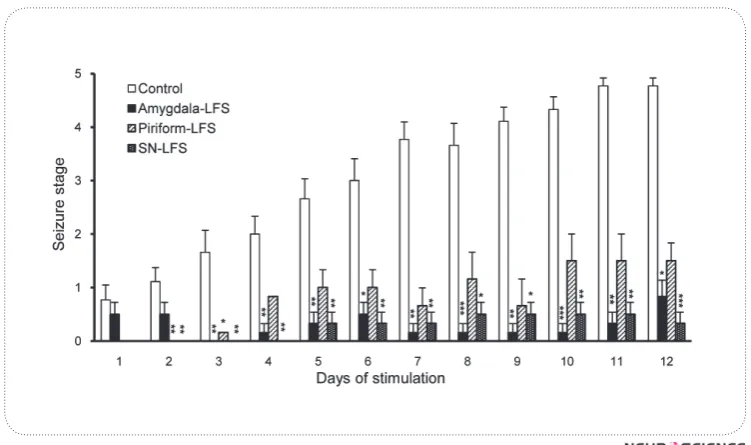
The obtained results showed no significant differences in the mean seizure stage of animals in different groups after the first stimulation (0.77±0.27 in control group, 0.5±0.22 in amygdala-LFS group and 0 in piriform-LFS and SN-LFS groups). In addition, there were not any sig-nificant difference in the duration and threshold of ADs between different experimental groups.
LFS application induced a significant reduction in the behavioral seizure stages in different groups. This re-duction was seen only in 2nd and 3rd days of kindling procedure in the piriform-LFS group. However amyg-dala-LFS and SN-LFS groups showed significant lower
Figure 2. The effects of LFS administration in different brain sites on the number of stimulations re-quired to achieve different seizure stages. Values are mean±SEM (n=6). * p<0.05, ** p<0.01 and *** p<0.001 in comparison with the control.
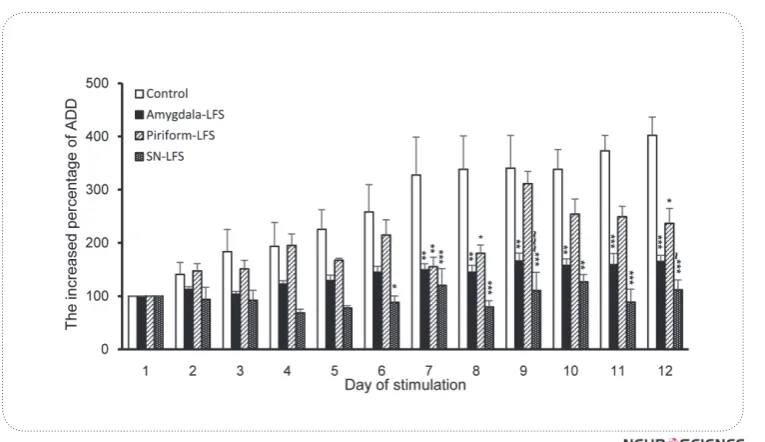
Figure 3. The effects of LFS administration in different brain sites on the daily increased percentage of afterdischarge duration (ADD) upon daily stimulation of the amygdala. Values are mean±SEM (n=6). * p<0.05, ** p<0.01 and *** p<0.001 in comparison with the control. ~ p<0.05 and ~~~ p<0.001 compared to the piriform-LFS.
seizure stages in comparison with the control group until the 12th day of the kindling procedure (Fig. 1). For a better comparison, the number of stimulations needed to reach different seizure stages, have been also shown in Fig. 2. As the figure shows, the number of electrical
for stage 5). Only SN-LFS group showed higher re-quired days of stimulation to reach stage one seizure in comparison with the control group.
In addition, LFS application in all brain areas pre-vented the increase percentage of ADD during first 12 days of the kindling stimulations (F (44, 286) = 4.097, P<0.001) (Fig. 3). As the Fig.3 shows, LFS application had a preventing effect on progression of ADD follow-ing the kindlfollow-ing stimulations. The daily application of LFS at amygdala reduced the increased percentage of ADD from day 7 to 12 of the kindling procedure sig-nificantly. The SN-LFS group showed a significant re-duction in the increased percentage of ADD compared to the control group in 6th to 12th day of stimulations. This reduction in piriform-LFS group was just at the 12th day of the kindling procedure compared to the control group.
LFS had stronger antiepileptogenic effect when ap-plied in the substantia nigra compared to amygdala and piriform cortex. ATukey post-hoc test showed that there was a significant difference between the ADD parameter of SN-LFS group compared to the piriform-LFS group on days 9 (P<0.001) and 12 (P<0.05) of the kindling pro-cedure.
4. Discussion
The results of the present study indicated that adminis-tration of LFS either in the kindling focus or other target sites can retard amygdala kindled seizures acquisition. All LFS administered groups showed significant lower daily seizure stages compared to control group from the 2nd day of the kindling procedure. However in the case of the piriform-LFS group the difference was significant only in the 2ndand 3rdday. Moreover, all the LFS admin-istered groups required more stimulation days to achieve different seizure stages. In addition, LFS prevented the increased percentage of ADD in all LFS administered groups.
Our obtained results from the amygdala-LFS group are in line with previous studies. Application of LFS to the amygdala as the kindling focus can provoke a dramatic elevation in the local AD threshold. The mechanism of anticonvulsant actions of LFS is unknown, however, the mechanisms involved in long-term depression or depo-tentiation may have a role in reducing the excitability and elevating the AD threshold (Albensi et al., 2004; Cheong, Yun, Mook-Jung, Kang, & Jung, 2002; Kemp & Bashir, 2001). Moreover, LFS administration could result in changing of some receptors involved in the ex-pression of the seizures. The possible alterations in
re-ceptor binding may be associated with suppressed excit-ability, reduced recruitment, and elevated AD thresholds during kindling acquisition (Ackermann, Finch, Babb, & Engel, 1984). Recently, it has also been shown that application of LFS in amygdala as the kindling focus preserves the electrophysiological properties of the rat hippocampal CA1 pyramidal neurons from the destruc-tive effects of amygdala kindling and provided further support for the use of LFS as a very beneficial alternative treatment method for epilepsy (Ghotbedin et al., 2012).
The piriform cortex has strong connections to limbic structures, including the amygdala, hippocampus, and entorhinal cortex. It has a significant modulating effect on seizures (Loscher & Ebert, 1996) and during initial phase of kindling in each brain regions, piriform cortex is the first to show the epileptic activity (Ebert & Loscher, 1995). This structure is critically involved in generation and propagation of epileptic discharges that induced by electrical stimulation of other brain sites (Loscher & Eb-ert, 1996). Therefore it could be considered as a suitable candidate to interfere with kindling procedure by LFS administration. The results of our study are in line with the previous studies which showed that the administra-tion of LFS in the piriform cortex can retard the progres-sion of seizure stage and reduce AD duration induced by amygdaloid kindling in rats (Ghorbani et al., 2007; Yang et al., 2006; Zhu-Ge et al., 2007). However, it is of interest that in previous studies the LFS administration to the piriform cortex had greater inhibitory effect than what we observed in the present research. Although it is very difficult to compare the inhibitory action of LFS in various studies, the difference in LFS pattern could be the main reason for the difference between their results and ours.
that substantia nigra neurons can led subthalamic nucleus and hippocampus neurons in synchronized firing during amygdala-kindled seizures (Shi et al., 2006) reinforcing the view that the substantia nigra mediates a crucial role in amygdala-kindled seizures.
In the present study there was a significant difference in antiepileptogenic effect of LFS when applied in dif-ferent experimental groups. It has a stronger inhibitory effect on kindling development when applied in substan-tia nigra compared to the amygdala and piriform cortex. On the other hand, LFS had also greater inhibitory ef-fect on percentage increase of the ADD when applied to the amygdala compared to piriform cortex. Considering the fact that piriform cortex is more sensitive to kindled seizures than amygdala (Loscher & Ebert, 1996), the de-creasing effect of LFS on seizure activity may be more difficult when applied in the piriform cortex than that of amygdala. In contrast, administration of LFS to the sub-stantia nigra significantly decreased both behavioral and electrophysiological parameters of seizures. SN-LFS group was the only group which significantly increased the required number of stimulations to reach seizure stage one. The increased percentage of ADD was signifi-cantly lower from the 6th day the kindling procedure. In addition, SN-LFS group showed significant lower ADD parameter on the 9th and 12th day of the kindling pro-cedure in comparison with the piriform-LFS group. Our results introduce the substantia nigra as a suitable brain region for LFS anticonvulsant action. However, further studies are required to confirm these findings and also determine the role of substantia nigra in mediating the anticonvulsant action of LFS.
In conclusion, the inhibitory effects of LFS on kindled seizures depend on the target site for LFS administra-tion. In this study, we observed that administration of LFS to the substantia nigra produced somehow stronger anticonvulsant effects compared to the kindling focus (amygdala) and piriform cortex. However, beside the target site for LFS application, there are many other fac-tors which must be taken into consideration when using brain stimulation as a therapeutic approach.
Acknowledgement
This study was supported by the grant No 89/4 from Kerman Neuroscience Research Center.
References
Ackermann, R. F., Finch, D. M., Babb, T. L., & Engel, J., Jr. (1984). Increased glucose metabolism during long-duration recurrent inhibition of hippocampal pyramidal cells. Re-search Support, U.S. Gov't, P.H.S.]. J Neurosci, 4(1), 251-264.
Albensi, B. C., Ata, G., Schmidt, E., Waterman, J. D., & Janigro, D. (2004). Activation of long-term synaptic plasticity causes suppression of epileptiform activity in rat hippocampal slices. [Comparative StudyIn Vitro Research Support, U.S. Gov't, P.H.S.]. Brain Res, 998(1), 56-64.
Boda, B., & Szente, M. B. (1992). Stimulation of substantia ni-gra pars reticulata suppresses neocortical seizures. [Research Support, Non-U.S. Gov't]. Brain Res, 574(1-2), 237-243.
Cheong, M. Y., Yun, S. H., Mook-Jung, I., Kang, Y., & Jung, M. W. (2002). Induction of homosynaptic long-term depression in entorhinal cortex. [Research Support, Non-U.S. Gov't]. Brain Res, 954(2), 308-310.
Ebert, U., & Loscher, W. (1995). Strong induction of c-fos in the piriform cortex during focal seizures evoked from different limbic brain sites. [Research Support, Non-U.S. Gov't]. Brain Res, 671(2), 338-344.
French, J. A., Williamson, P. D., Thadani, V. M., Darcey, T. M., Mattson, R. H., Spencer, S. S., & Spencer, D. D. (1993). Characteristics of medial temporal lobe epilepsy: I. Results of history and physical examination. [Research Support, U.S. Gov't, P.H.S.]. Ann Neurol, 34(6), 774-780. doi: 10.1002/ ana.410340604
Gaito, J. (1980). The effect of variable duration one hertz inter-ference on kindling. [Comparative Study]. Can J Neurol Sci, 7(1), 59-64.
Gaito, J., Nobrega, J. N., & Gaito, S. T. (1980). Interference effect of 3 Hz brain stimulation on kindling behavior induced by 60 Hz stimulation. Epilepsia, 21(1), 73-84.
Ghorbani, P., Mohammad-Zadeh, M., Mirnajafi-Zadeh, J., & Fathollahi, Y. (2007). Effect of different patterns of low-fre-quency stimulation on piriform cortex kindled seizures. Neu-rosci Lett, 425(3), 162-166. doi: 10.1016/j.neulet.2007.08.023
Ghotbedin, Z., Janahmadi, M., Mirnajafi-Zadeh, J., Behzadi, G., & Semnanian, S. (2012). Electrical low frequency stimu-lation of the kindling site preserves the electrophysiological properties of the rat hippocampal CA1 pyramidal neurons from the destructive effects of amygdala kindling: The basis for a possible promising epilepsy therapy. Brain Stimul. doi: 10.1016/j.brs.2012.11.001
Jahanshahi, A., Mirnajafi-Zadeh, J., Javan, M., Mohammad-Zadeh, M., & Rohani, R. (2009). The antiepileptogenic effect of electrical stimulation at different low frequencies is accom-panied with change in adenosine receptors gene expression in rats. [Research Support, Non-U.S. Gov't]. Epilepsia, 50(7), 1768-1779. doi: 10.1111/j.1528-1167.2009.02088.x
Kemp, N., & Bashir, Z. I. (2001). Long-term depression: a cas-cade of induction and expression mechanisms. [Review]. Prog Neurobiol, 65(4), 339-365.
Non-U.S. Gov't]. Epilepsia, 51(9), 1745-1753. doi: 10.1111/j.1528-1167.2010.02679.x
Li, Y., & Mogul, D. J. (2007). Electrical control of epileptic sei-zures. [Review]. J Clin Neurophysiol, 24(2), 197-204. doi: 10.1097/WNP.0b013e31803991c3
Loscher, W., & Ebert, U. (1996). The role of the piriform cor-tex in kindling. [Research Support, Non-U.S. Gov't Review]. Prog Neurobiol, 50(5-6), 427-481.
Mohammad-Zadeh, M., Mirnajafi-Zadeh, J., Fathollahi, Y., Ja-van, M., Jahanshahi, A., Noorbakhsh, S. M., & Motamedi, F. (2009). The role of adenosine A(1) receptors in mediating the inhibitory effects of low frequency stimulation of perforant path on kindling acquisition in rats. [Research Support, Non-U.S. Gov't]. Neuroscience, 158(4), 1632-1643. doi: 10.1016/j. neuroscience.2008.11.008
Mohapel, P., Dufresne, C., Kelly, M. E., & McIntyre, D. C. (1996). Differential sensitivity of various temporal lobe struc-tures in the rat to kindling and status epilepticus induction. [Comparative Study]. Epilepsy Res, 23(3), 179-187.
Paxinos, G., & Watson, C. (2007). The Rat Brain in Stereotaxic Coordinates: Hard Cover Edition: Academic press.
Racine, R. J. (1972). Modification of seizure activity by electrical stimulation. II. Motor seizure. Electroencephalogr Clin Neu-rophysiol, 32(3), 281-294.
Sabatino, M., Gravante, G., Ferraro, G., Savatteri, V., & La Grutta, V. (1988). Inhibitory control by substantia nigra of generalized epilepsy in the cat. [Research Support, Non-U.S. Gov't]. Epilepsy Res, 2(6), 380-386.
Sadegh, M., Mirnajafi-Zadeh, J., Javan, M., Fathollahi, Y., Mohammad-Zadeh, M., Jahanshahi, A., & Noorbakhsh, S. M. (2007). The role of galanin receptors in anticonvulsant ef-fects of low-frequency stimulation in perforant path-kindled rats. Neuroscience, 150(2), 396-403. doi: 10.1016/j.neurosci-ence.2007.09.068
Sato, M., Racine, R. J., & McIntyre, D. C. (1990). Kindling: basic mechanisms and clinical validity. [Review]. Electroencepha-logr Clin Neurophysiol, 76(5), 459-472.
Schrader, L. M., Stern, J. M., Wilson, C. L., Fields, T. A., Sala-mon, N., Nuwer, M. R., . . . Fried, I. (2006). Low frequency electrical stimulation through subdural electrodes in a case of refractory status epilepticus. [Case Reports]. Clin Neuro-physiol, 117(4), 781-788. doi: 10.1016/j.clinph.2005.12.010
Shi, L. H., Luo, F., Woodward, D., & Chang, J. Y. (2006). Deep brain stimulation of the substantia nigra pars reticulata ex-erts long lasting suppression of amygdala-kindled seizures. Research Support, Non-U.S. Gov't]. Brain Res, 1090(1), 202-207. doi: 10.1016/j.brainres.2006.03.050
Shin, C., Silver, J. M., Bonhaus, D. W., & McNamara, J. O. (1987). The role of substantia nigra in the development of kindling: pharmacologic and lesion studies. [Research Sup-port, U.S. Gov't, Non-P.H.S. Research SupSup-port, U.S. Gov't, P.H.S.]. Brain Res, 412(2), 311-317.
Velisek, L., Veliskova, J., & Moshe, S. L. (2002). Electrical stimu-lation of substantia nigra pars reticulata is anticonvulsant in adult and young male rats. [Research Support, Non-U.S. Gov't Research Support, U.S. Gov't, P.H.S.]. Exp Neurol, 173(1), 145-152. doi: 10.1006/exnr.2001.7830
Velisek, L., Veliskova, J., & Stanton, P. K. (2002). Low-frequen-cy stimulation of the kindling focus delays basolateral amyg-dala kindling in immature rats. [Research Support, Non-U.S. Gov't Research Support, U.S. Gov't, P.H.S.]. Neurosci Lett, 326(1), 61-63.
Wu, D. C., Xu, Z. H., Wang, S., Fang, Q., Hu, D. Q., Li, Q., Chen, Z. (2008). Time-dependent effect of low-frequency stimula-tion on amygdaloid-kindling seizures in rats. [Research Support, Non-U.S. Gov't]. Neurobiol Dis, 31(1), 74-79. doi: 10.1016/j.nbd.2008.03.007
Wu, D. C., Zhu-Ge, Z. B., Yu, C. Y., Fang, Q., Wang, S., Jin, C. L., . . . Chen, Z. (2008). Low-frequency stimulation of the tu-beromammillary nucleus facilitates electrical amygdaloid-kindling acquisition in Sprague-Dawley rats. [Comparative Study Research Support, Non-U.S. Gov't]. Neurobiol Dis, 32(1), 151-156. doi: 10.1016/j.nbd.2008.07.002
Yang, L. X., Jin, C. L., Zhu-Ge, Z. B., Wang, S., Wei, E. Q., Bruce, I. C., & Chen, Z. (2006). Unilateral low-frequency stimula-tion of central piriform cortex delays seizure development induced by amygdaloid kindling in rats. [Research Sup-port, Non-U.S. Gov't]. Neuroscience, 138(4), 1089-1096. doi: 10.1016/j.neuroscience.2005.12.006
Zhang, G., Franklin, P. H., & Murray, T. F. (1993). Manipulation of endogenous adenosine in the rat prepiriform cortex mod-ulates seizure susceptibility. [Research Support, U.S. Gov't, P.H.S.]. J Pharmacol Exp Ther, 264(3), 1415-1424.