Available Online at www.ijpret.com 1
INTERNATIONAL JOURNAL OF PURE AND
APPLIED RESEARCH IN ENGINEERING AND
TECHNOLOGY
A PATH FOR HORIZING YOUR INNOVATIVE WORK
OPTIMIZATION OF CHIP LOAD IN CNC MILLING MACHINE OF INCONEL 718
FAISAL. M. ALI 1, S. C. BORSE 2
1. P.G. Student, Department of Mechanical Engineering, DIEMS Engineering College, Station Road, Aurangabad, India. 2. Assistant Professor, Department of Mechanical Engineering, DIEMS Engineering College, Station Road, Aurangabad, India.
Accepted Date: 03/12/2015; Published Date: 01/01/2016
\
Abstract: -CNC machine tool is widely used by manufacturing engineers and production personnel to quickly and effectively set up manufacturing processes for new products. This study discusses an investigation into the use of Taguchi Parameter Design methodology for Parametric Study of CNC milling operation for Surface Roughness and as a response variable. The Taguchi parameter design method is an efficient experimental method in which a response variable can be study, using fewer experimental runs than a factorial design method. The control parameters for this operation included: Cutting speed, Chip load & depth of cut. A experimental runs were conducted using an orthogonal array, and the ideal combination of controllable factor levels was determined for the surface roughness. Taking significant cutting parameters into consideration and using multiple linear- regressions, mathematical models relating to surface roughness (Ra) are established to investigate the influence of cutting parameters during milling. A confirmation run was used to verify the results, which indicated that this method was both efficient and effective in determining the best milling parameters for the surface roughness. Confirmation test results established the fact that the mathematical models are appropriate for effectively representing machining performance criteria, e.g. surface roughness during CNC milling.
Keywords: Chip load, End Milling, surface Finish
Corresponding Author: MR. FAISAL. M. ALI
Access Online On:
www.ijpret.com
How to Cite This Article:
Available Online at www.ijpret.com 2
INTRODUCTION
The focus on this project is to obtain an optimum process parameter consider as Chip load, cutting speed and depth of cut which provides the optimum value of surface finish. The experimentation plan was created using Taguchi‟s L9 Orthogonal Array (OA) and Minitab 14.0 statistical software is employed. Optimal values of process parameter with regard to desired performance characteristic are received by Taguchi design of experiment. Milling is often a versatile in addition to useful machining operation. End milling is the main milling operation which is widely used in a lot of the manufacturing industries automobile capability involving producing complex geometric surfaces with reasonable accuracy in addition to surface finish. However, with the inventions of CNC milling machine, the flexibility may be adopted in addition to versatility within end milling process.
It is common knowledge that a chip produced through a milling process is not of uniform thickness. Assuming climb milling, the chip is thicker towards its beginning than its end. Every chip has a maximum thickness at a single point and gets gradually thinner from there. Given a constant spindle speed and feed rate, the thickness of a chip is a function of its length; the longer the chip, the thicker the chip. And the length of a chip is a function of the radial depth of cut, or cut width, established in most CAM systems with the step over parameter.
Chip load is often confused with chip thickness. In reality, however, chip load, in the prevalent use of the term, is nothing more than a feed rate expressed in inches per tooth (IPT). IPT × RPM × #flutes = IPM. The IPT value is equal to the thickness of the chip if and only if the width of cut is greater than or equal to 50% of the tool diameter. When the cut width is less than 50% of tool diameter, the maximum chip thickness is less than the IPT value. The feed per tooth values that cutting tool manufacturers recommend are valuable in calculating a feed rate, but they are not the thickness of the chips that will be produced.
Milling processes comprise a very big portion of metal cutting process in industry. For the determination of ideal machinability properties, those parameters such as mechanical material properties, machine tool rigidity, Chip load, cutting speed and cutting tool geometry play an important role in machining. Chip load is the main parameters that affect machinability properties of the material. Although Inconel718 can be machined by using cemented carbide tools at low cutting speeds, it must be machined by ceramic tools at higher cutting speeds. But the problem of machining inconel718 is one of ever increasing magnitude due to extreme toughness and work hardening characteristics of the alloy.
Available Online at www.ijpret.com 3 Super alloy, Inconel718 is used for manufacturing components in most of the advanced and critical application due to its superior properties .Surface quality of machined component play a vital role in function characteristics and life of product .Due to its peculiar characteristics machining of super alloy Inconel718 is difficult and costly .Inconel718 material is widely used in as aircraft engine parts, steam turbine power plants, space vehicles, medical applications, marine applications, pollution control equipment, automotive sector etc. Since machining is basically a finishing process with specified dimensions, tolerances and surface finish, the type of surface that a machining operation generates and its characteristics are of great importance in manufacturing. Carbide cutting tools are the oldest amongst the hard cutting tool materials. Tungsten carbides are mainly used for continuous cutting operations Carbide tools are used to machine nickel-base super alloys in the speed range of 800-5000 Several research efforts have been conducted in order to improve the machined surface accuracy. which directly affects to the cost of machining and productivity.
Taguchi Proposed that the engineering optimization of a process should be carried out in a three steps approach; system design parameters design and tolerance design Taguchi method is a powerful design of experiment tool for engineering optimization of a process. The application in which the concept of S/N ratio is the useful are the improvement of quality through variability reduction and improvement of measurement.
2 Literature Review
The challenge and difficulty to machine Inconel718 are due to its profound characteristics such as high sheer strength, tendency to weld and form build-up edge low thermal conductivity and high chemical affinity. Inconel718 also has the tendency to work harden and retain major part of its strength during machining. Due to these characteristics, Inconel718 is not easy to cut and thus has been regarded as difficult-to-cut material. Inconel718 are widely employed in aerospace industry. In particular, for the hot sections of gas turbine engines due to their high temp strength and high corrosion resistance. we focus our study on the inconel718 alloys.
Available Online at www.ijpret.com 4 & the roughness average in end milling process for high purity graphite. Additionally, the tool worn surfaces after machining were examined by the optical zoom scope.
Bala murugan gopalsamy (2009) In this investigation, Taguchi method is applied to find optimum process parameters for end milling while hard machining of hardened steel. A L 18 array signal to noise ratio & analysis of variance(ANOVA) are applied to study performance characteristics of machining parameters (cutting speed, feed rate Depth of cut) with consideration of surface finish & Tool wear. chipping & adhesion are observed to be main cause of wear. Results obtained taguchi method match closely with ANOVA & cutting speed is most important parameter.
Domnita Fratila (2010) This work outlines the Taguchi optimization methodology, which is applied to optimize the cutting parameters in face milling when machining AlMg3 (EN AW 5754) with HSS (high speed steel) tool under semi-finishing conditions in order to get the best surface roughness and the minimum power consumption. Beside the conventional flood lubrication, the investigations include the minimal quantity lubrication and the dry milling. These environment-friendly cutting techniques are considered two practical ways to the cleaner manufacturing in the context of the sustainable production. The parameters evaluated are the cutting speed, the depth of cut, the feed rate and the cooling lubrication techniques (cutting fluid flow). The appropriate orthogonal array, signal to noise (S/N) ratio and Pareto analysis of variance (ANOVA) are employed to analyze the effect of the mentioned parameters on the good surface finish (surface roughness).
Nilrudra Mandal (2011) In this experiment, Taguchi method and Regression analysis have been applied to assess machine- ability of AISI 4340 steel with newly developed Zirconia Toughened Alumina (ZTA) ceramic inserts. Several experiments have been carried out based on an orthogonal array L9 with three parameters (depth of cut feed rate, cutting speed) at three levels (low, medium and high). Based on the mean response and signal to noise ratio (SNR), the best optimal cutting condition has been arrived at A2B1C1 i.e. cutting speed is 280 m/min, depth of cut is 0.5 mm and feed rate is 0.12 mm/rev considering the condition smaller is the better approach. Analysis of Variance (ANOVA) is applied to find out the significance and percent- age contribution of each parameter. It has been observed that depth of cut has maximum contribution on tool wear.
Available Online at www.ijpret.com 5 roughness were studied and tool flank wears observed. In this study, the comparison between different coolants’ effect to the milling of AISI 304 stainless steel is done and the results from the study can provide very useful information in manufacturing field. The experiment results showed that water-based emulsion gave better surface finish and lower cutting force followed by synthetic oil and compressed cold air. Different cooling condition required different parameters in order to obtain lower surface roughness and cutting force. Chipping was the initial wear mode in the milling of AISI 304 stainless steel.
N.N. Bhopale (2012) This work addresses the effects of cutting speed and feed on the work piece deflection and surface integrity during milling of cantilever shaped Inconel718 plate under different cutter orientations. The experiments were conducted on a CNC vertical milling machine using 10 mm diameter TiAlN coated solid carbide ball end milling cutter. Surface integrity is assessed in terms of micro hardness beneath the machined surface. The micro-hardness profile shows different patterns at various cutting parameters. It is observed that at large cutting speed as well as feeds, thicker work piece with larger work piece inclination shows higher micro hardness as compared to the other machining conditions.
M.Z.A. Yazid, (2013) In this experimental works, Inconel718, a highly corrosive resistant nickel-based super alloy was finish- turning with CNC lathe using PVD coated carbide tools under Minimum Quantity Lubrication (MQL) conditions. The machining process was performed initially with two levels of cutting speed (Vc=90 and 150 m/min), two levels of cutting depth (d=0.30 and 0.50 mm), two levels of feed rate (f=0.10 and 0.15 mm/rev) and two levels of MQL volume flow rate (MQL 50 and MQL 100 mL/h). The levels of design were then augmented by adding center point and axial point runs as in Central Composite Design (CCD). This paper describes the development of a Tool-Life modeling using Factorial Design of Experiments and Response Surface Methodology (RSM) in terms of machining parameters: cutting speed, feed, cutting depth and MQL volume flow rate. Tool life data, which is measured based on flank wear, from the experimental runs were analyzed and processed using statistical method into first-order model, at 95% confidence level.
Available Online at www.ijpret.com 6 0.1 μm and 0.3 μm under most of the conditions. Roughness is generally higher in step-over direction than feed direction.
Mohamad Amir shafique (2014) This work proposes several architectures of single and multi-layer back propagation neural network methods, to predict tool wear progression within the end milling process of Inconel 718. The end milling process was carried out in a cryogenic environment, with cutting parameters of cutting speed, Vc (140 - 170 mm/min), feed rate, Fz (0.05 - 0.1 mm/tooth), axial depth of cut, ap (0.3 - 0.5 mm), and radial depth of cut, ae (0.2 - 1 mm). A coated carbide end ball nose, with a diameter of 5 mm, was used as a cutting tool. The cutting forces exerted during the milling process were measured using a strain gauge based dynamometer in x, y, and z directions. In order to apply a feed forward back propagation neural network method to predict tool wear; Vc, Fz, ap, ae, and the resultant force (FR), were taken as inputs, and tool wear was obtained as an output.
Sourabh Kuamr Soni (2015) In this work the effect of machining parameters speed, feed, depth of cut, are studied on surface roughness for milling operation. For surface roughness, our observation is based on smaller is better for s/n ratio. Cutting speed has Optimization of Milling Process Parameter for Surface Roughness of Inconel718 by Using Taguchi Method. Greater effect than feed and depth of cut, our observation is based on smaller is better for s/n ratio. The lowest surface roughness (Ra) of 0.80 μm was achieved corresponding to: f: 0.12 mm/rev, Vc: 55m/min. and d: 1.6 mm. Taguchi robust design is suitable for modeling surface finish in CNC milling.
3. Experimental Procedure
The work piece material used in the machining test was Inconel718.Its chemical composition confirms to the following specification in table 1
Table 1 Chemical Composition of inconel718
Elements Percentage (%)
Ni (+Co) 50 – 55
Fe Bal
Mo 2.3 – 3.3
Ti 0.65 – 1.15
C 0.08
Si 0.35
Cu 0.3
Available Online at www.ijpret.com 7
Co 1
Nb (+Ta) 4.75 – 5.5
Al 0.2 – 0.8
Mn 0.35
B 0.006
4 Design of Experiment
For the experimentation three levels of cutting speed, Chip load and depth of cut are chosen. The experiment was conducted by considering orthogonal array of Taguchi design.
4.1 Taguchi method
Taguchi method is a powerful tool for the design of high quality systems. It provides simple, efficient and systematic approach to optimize designs for performance, quality and cost. Taguchi method is efficient method for designing process that operates consistently and optimally over a variety of conditions. To determine the best design it requires the use of a strategically designed experiment. Taguchi approach to design of experiments in easy to adopt and apply for users with limited knowledge of statistics, hence gained wide popularity in the engineering and scientific community.
Taguchi method are the most recent additions to the tool kit of design, process and manufacturing engineers, and quality assurance experts. In contrast to statistical process con- trol, which attempts to control the factors that adversely affect the quality of production, Taguchi methods focus on design – the development of superior performance designs (of products and manufacturing processes) to deliver quality. Taguchi’s orthogonal arrays, in general, are available in various sizes like L4, L9, L12, L16, L18 and L27.
4.2 Signal to Noise Ratio
Available Online at www.ijpret.com 8 1. Smaller the better characteristics;
S/ N = −10 log1
𝑛 (∑ 𝑦
2)
2. larger the better characteristics;
S/N = −10 log1
𝑛 (∑
1
𝑦2)
3. Nominal the best characteristics;
S/N = 10 log 𝑦̅
𝑠𝑦2
4.3 Taguchi L9 Orthogonal Array
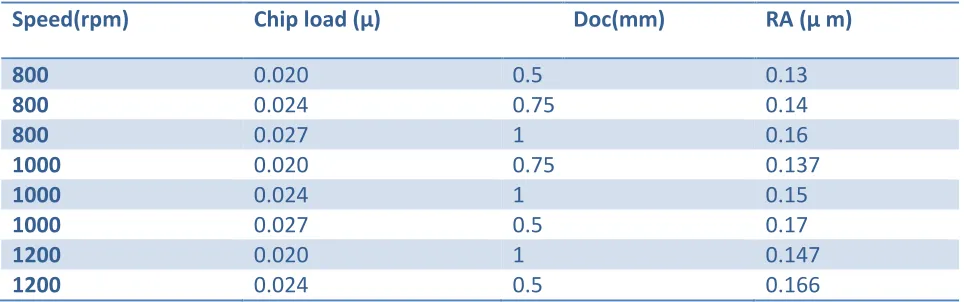
To perform the experimental design, three levels of the machining parameters were selected as shown in table 2. An L9 orthogonal array table is used to specify the experiments. This array table has 3 columns and 9 rows. Therefore, only 9 experiments are required to investigate the entire machining parameters space using the L9 orthogonal array shown in table3.
Table 2 Cutting parameters
Level Cutting speed (rpm)
Chip Load (µ)
Doc (mm)
1 800 0.020 0.5
2 1000 0.024 0.75
3 1200 0.027 1
Table 3 Orthogonal array and experimental result
Speed(rpm) Chip load (µ) Doc(mm) RA (μ m)
800 0.020 0.5 0.13
800 0.024 0.75 0.14
800 0.027 1 0.16
1000 0.020 0.75 0.137
1000 0.024 1 0.15
1000 0.027 0.5 0.17
1200 0.020 1 0.147
Available Online at www.ijpret.com 9
1200 0.027 0.75 0.18
5. Result and Discussions
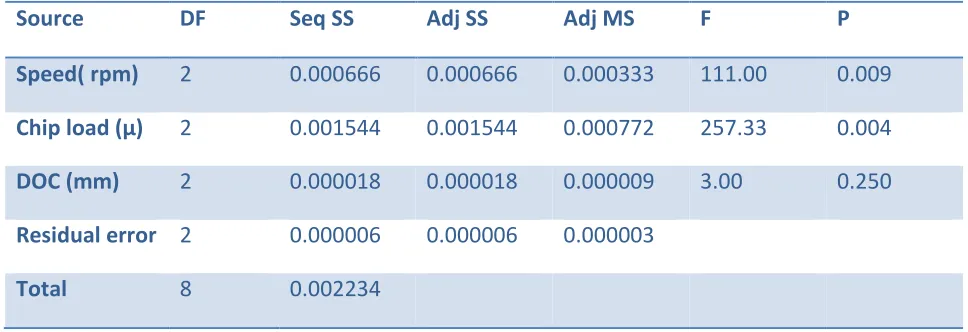
The purpose of the statistical analysis of variance is to investigate which design parameter significantly effects the surface roughness. Based on the ANOVA the relative importance of machining parameter with respect to surface roughness was investigated to determine to obtain combination of machining parameter table 4 show the result of the ANOVA analysis of surface roughness. The purpose of the ANOVA is to determine the process parameters which significantly affect the performance characteristic. It has absorbed that the depth of cut has insignificant effect on surface roughness It has found that Chip load and cutting speed has significant effect on Ra. Based on ANOVA analysis the optimum cutting parameters for surface roughness are the cutting speed, Chip load and depth of cut.
Table 4 ANOVA table for surface roughness
Source DF Seq SS Adj SS Adj MS F P
Speed( rpm) 2 0.000666 0.000666 0.000333 111.00 0.009
Chip load (µ) 2 0.001544 0.001544 0.000772 257.33 0.004
DOC (mm) 2 0.000018 0.000018 0.000009 3.00 0.250
Residual error 2 0.000006 0.000006 0.000003
Total 8 0.002234
5.1 Regression analysis
Available Online at www.ijpret.com 10 1 The obtain equation is as follows
RA μ = - 0.0015 + 0.000052 Speed (rpm) + 4.51 Chip load (µ) - 0.00600 Doc(mm)………1
5.2 Taguchi optimization analysis of surface roughness
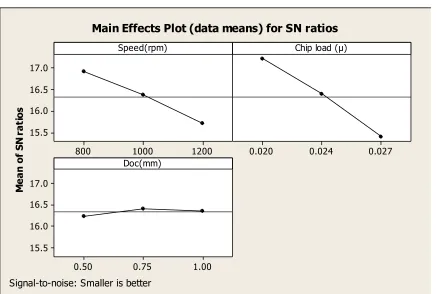
Taguchi recomendates analyzing means of S/N ratio using conceptual approach that involves graphical method for study the effect the surface roughness are analyzed using statistical software the mean S/N ratio for each level of the machining parameter were calculated based upon the data present in table the optimal performance for the surface roughness of milling process was obtain at a cutting speed (800 rpm) chip load (0.020 µ) DOC (0.5 mm) ranking of machining parameter are also calculated based of difference in S/N ratio. The rank indicates the dominant machining parameter that effects surface roughness. Figure 1 shows the plot for surface roughness which indicate that the surface roughness increases with increases of Chip load, cutting speed and very low influence on the depth of cut since delta value is very low.
Table 5 Response Table for Signal to Noise Ratios Smaller is better
Detail Machining parameters Mean SN ratio
Speed(rpm) Chip Load (µ) Doc (mm)
Level 1 16.19 17.21 16.24
Level 2 16.38 16.38 16.41
Level 3 15.72 15.40 16.35
Delta 1.19 1.81 0.18
Rank 2 1 3
Available Online at www.ijpret.com 11
Fig 1 Mean effect plot for SN ratios
6. CONCLUSION
An L9 orthogonal array table is used to specify the experiments and taguchi optimization analysis was carried out for selecting the optimum machining parameter.
1. Based on the taguchi design of experiments an analysis the Chip load and cutting speed is the main factor that has highest influence on surface roughness.
2. Optimum machining parameter for minimum surface roughness was determined. 3. For surface roughness, our observation is based on smaller is better for s/n ratio.
4. The lowest surface roughness (Ra) of 0.13μm was achieved corresponding to cutting speed (800 rpm) chip load (0.020 µ) DOC (0.5 mm.
REFERENCES
1. Yungkuang yang, mingT sanChaung, “optimization of dry machining parameters for high -purity graphite in end milling process via design of experiments method”, Journal of Materials Processing Technology 209 (2008) 4395–4400.
M e a n o f S N r a ti o s 1200 1000 800 17.0 16.5 16.0 15.5 0.027 0.024 0.020 1.00 0.75 0.50 17.0 16.5 16.0 15.5
Speed(rpm) Chip load (µ)
Doc(mm)
Main Effects Plot (data means) for SN ratios
Available Online at www.ijpret.com 12 2. Bala murugan gopalsamy, “An approach for process parameters optimization of hard machining while machining hardened steel” , Journal of scientific Technology & industrial research Vol 68 (2009)PP 686-695.
3. Domnita Fratila, “Application of Taguchi method to selection of optimal lubrication and cutting conditions in face milling of AlMg3”,Journal of cleaner production 19 (2011) pp640 645.
4. Nilrudra Mandal, “Optimization of flank wear using Zirconia Toughened Alumina (ZTA) cutting tool”, Measurement 44 (2011) PP 2149-2155..
5. N. N. Bhople” Investigation of surface integrity in high-speed ball end milling of cantilever shaped thin plate of Inconel 718” Journal of Achievements in Engineering of Achievements, 5(2012) PP 616-622.
6. M. Z. A. Yazid,” Tool Life Modeling of Inconel718under MQL with Coated Carbide Tool”, Journal of Applied Sciences Research 9 (2013) PP 2597-2597.
7. W. Li, Y.B. Guo,” Effect Tool Wear during End Milling on the Surface Integrity and Fatigue Life of Inconel 718”, International Conference on High Performance Cutting, HPC2014 PP 546-551.
8. Mohamad Amir Shafiq Tahir, “Prediction of Tool Wear for Ball End Nose in Milling Inconel 718 Using a Feed Forward Back Propagation Neural Network” Australian Journal of Basic and Applied Sciences 8(2014) PP 383-390.
9. Sourabh Kuamr Soni, “Optimization of Milling Process Parameter for Surface Roughness of Inconel 718 By Using Taguchi Method, IJSRD” International Journal for Scientific Research & Development2 (2015) PP 57-63.