Available Online at www.ijpret.com
941
INTERNATIONAL JOURNAL OF PURE AND
APPLIED RESEARCH IN ENGINEERING AND
TECHNOLOGY
A PATH FOR HORIZING YOUR INNOVATIVE WORK
DATA INTEGRITY PROOF IN CLOUD STORAGE
MR. S. S. SHEKAPURE, MS S. A. MAHALLE PRMIT&R, Badnera.
Accepted Date: 27/02/2014 ; Published Date: 01/05/2014
\
Abstract: The growing need of Information Technology in every field has lead to the evolution of cloud computing for highly efficient usage of IT resources. Cloud provides services through internet. The computing power to the cloud environment is provided through collection of data centers or cloud data storages present at different location and connected by high speed networks. Data storage in cloud is an emerging technology and facing an important issue that is security. The integrity of data centers or cloud storage is an extremely important issue. Data encoding is one of the basic mechanism of providing security. Cloud faithfully stores the data and return back to the owner whenever needed. Cloud computing has been envisioned as the de-facto solution to the rising storage costs of IT Enterprises. With the high costs of data storage devices as well as the rapid rate at which data is being generated it proves costly for enterprises or individual users to frequently update their hardware. Cloud storage moves the user’s data to large data centers, which are remotely located, on which user does not have any control. However, this unique feature of the cloud poses many new security challenges which need to be clearly understood and resolved.
Keywords: Cloud Storage, Data Integrity
Corresponding Author: MR. S. S. SHEKAPURE
Access Online On:
www.ijpret.com
How to Cite This Article:
Available Online at www.ijpret.com
942 INTRODUCTION
Cloud computing is an emerging technology that is derived from Grid computing. Data outsourcing to cloud storage servers is raising trend among many firms and users owing to its economic advantages. This essentially means that the owner (client) of the data moves its data to a third party cloud storage server which is supposed to - presumably for a fee - faithfully store the data with it and provide it back to the owner whenever required.
Cloud Computing can be defined as a computing paradigm that provides dynamic computing environment for end users that is reliable and
customized and also guarantees quality of service (QoS). Cloud computing provides service oriented applications in form of infrastructure as a service (IaaS), platform as a service (PaaS), and software as a service (SaaS) over internet.
As far as data generation is concerned it proves costly for small firms to frequently update their hardware whenever additional data is created. Also maintaining the storages can be a difficult task. Storage outsourcing of data to a cloud storage helps such firms by reducing the costs of storage, maintenance and personnel. It can also assure a reliable storage of important data by keeping multiple copies of the data thereby reducing the chance of losing data by hardware failures.
Storing of user data in the cloud despite its advantages has many interesting security concerns which need to be extensively investigated for making it a reliable solution to the problem of avoiding local storage of data. Many problems like data authentication and integrity (i.e., how to efficiently and securely ensure that the cloud storage server returns correct and complete results in response to its clients’ queries), outsourcing encrypted data and associated difficult problems dealing with querying over encrypted domain were discussed in research literature. The aim of this researches twofold ensuring the integrity of the data and provides the proof that data is in secured manner. Providing Cryptographic key to secure the data in the cloud. The proposed approach is been implemented and the test results are promising.
In this paper we will first provide an introduction about the cloud computing and methodologies which will be used by us. Then we will be giving the work we have done related to our proposed model and further describe about the future work in this area. Also
Available Online at www.ijpret.com
943 integrity of the data is assured. Such kinds of proofs are very much helpful in peer-to-peer storage systems, network file systems, long-term archives, web-service object stores, and database systems. Such verification systems prevent the cloud storage archives from misrepresenting or modifying the data stored at it without the consent of the data owner by using frequent checks on the storage archives. Such checks must allow the data owner to efficiently, frequently, quickly and securely verify that the cloud archive is not cheating the owner. Cheating in this context, means that the storage archive might delete some of the data or may modify some of the data. It must be noted that the storage server might not be malicious; instead, it might be simply unreliable and lose or inadvertently corrupt the hosted data. But the data integrity schemes that are to be developed need to be equally applicable for malicious as well as unreliable cloud storage servers. Any such proofs of data possession schemes do not, by it, protect the data from corruption by the archive. It just allows detection of tampering or deletion of a remotely located file at an unreliable cloud storage server. To ensure file robustness other kind of techniques like data redundancy across multiple systems can be maintained.
While developing proofs for data possession at untrusted cloud storage servers we are often limited by the resources at the cloud server as well as at the client. Given that the data sizes are large and are stored at remote servers, accessing the entire file can be expensive in I/O costs to the storage server. Also transmitting the file across the network to the client can consume heavy bandwidths. Since growth in storage capacity has far outpaced the growth in data access as well as network bandwidth, accessing and transmitting the entire archive even occasionally greatly limits the scalability of the
Available Online at www.ijpret.com
944 (personal digital assist) or a mobile phone, which have limited CPU power, battery power and communication bandwidth. Hence a data integrity proof that has to be developed needs to take the above limitations into consideration. The scheme should be able to produce a proof without the need for the server to access the entire file or the client retrieving the entire file from the server. Also the scheme should minimize the local computation at the client as well as the bandwidth consumed at the client.
II. RELATED WORK
The simplest Proof of retrievability (POR) scheme can be made using a keyed hash function hk(F). In this scheme the verifier, before archiving the data file F in the cloud storage, pre-computes the cryptographic hash of F using hk(F ) and stores this hash as well as the secret key K. To check if the integrity of the file F is lost the verifier releases the secret key K to the cloud archive and asks it to compute and return the value of hk(F ). By storing multiple hash values for different keys the verifier can check for the integrity of the file F for multiple times, each one being an independent proof.
Though this scheme is very simple and easily implementable the main drawback of this scheme are the high re-source costs it requires for the implementation. At the verifier side this involves storing as many keys as the number of checks it want to perform as well as the hash value of the data file F with each hash key. Also computing hash value for even a moderately large data files can be computationally burdensome for some clients (PDAs, mobile phones,). As the archive side, each invocation of the protocol requires the archive to process the entire file F. This can be computationally burdensome for the archive even for a lightweight operation like hashing. Furthermore, it requires that each proof requires the prover to read the entire file F - a significant overhead for an archive whose intended load is only an occasional read per file, were every file to be tested frequently[3].
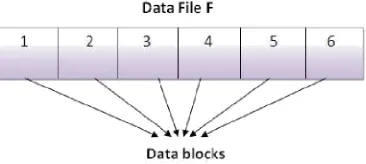
Fig. 2. A data file F with 6 data blocks
Available Online at www.ijpret.com
945 Ari Jules and Burton S.Kaliski proposed a scheme called Proof of retrievability for large files using ”sentinels”. In this scheme, unlike in the key-hash approach scheme, only a single key can be used irrespective of the size of the file or the number of files whose retrievability it wants to verify. Also the archive needs to access only a small portion of the file F unlike in the key-has scheme which required the archive to process the entire file F for each protocol verification. This small portion of the file F is in fact independent of the length of F. The schematic view of this approach is shown in Figure 1.
In this scheme special blocks (called sentinels) are hidden among other blocks in the data file F . In the setup phase, the verifier randomly embeds these sentinels among the data blocks. During the verification phase, to check the integrity of the data file F, the verifier challenges the prover (cloud archive) by specifying the positions of a collection of sentinels and asking the prover to return the associated sentinel values. If the prover has modified or deleted a substantial portion of F , then with high probability it will also have suppressed a number of sentinels. It is therefore unlikely to respond correctly to the verifier. To make the sentinels indistinguishable from the data blocks, the whole modified file is encrypted and stored at the archive. The use of encryption here renders the sentinels indistinguishable from other file blocks. This scheme is best suited for storing encrypted files.
As this scheme involves the encryption of the file F using a secret key it becomes computationally cumbersome especially when the data to be encrypted is large. Hence, this scheme proves disadvantages to small users with limited computational power (PDAs, mobile phones etc.). There will also be storage overhead at the server, partly due to the newly inserted sentinels and partly due to the error correcting codes that are inserted. Also the client needs to store all the sentinels with it, which may be storage overhead to thin clients (PDAs, low power devices etc.).
III. OUR CONTRIBUTION
We present a scheme which does not involve the encryption of the whole data. We encrypt only few bits of data per data block thus reducing the computational overhead on the clients.
The client storage overhead is also minimized as it does not store any data with it. Hence our scheme suits well for thin clients.
Available Online at www.ijpret.com
946 important to note that our proof of data integrity protocol just checks the integrity of data i.e. if the data has been illegally modified or deleted. It does not prevent the archive from modifying the data. In order to prevent such modifications or deletions other schemes like redundant storing etc, can be implemented which is not a scope of discussion in this paper.
IV. A DATA INTEGRITY PROOF IN CLOUD BASED ON
SELECTING RANDOM BITS IN DATA BLOCKS
The client before storing its data file F at the client should process it and create suitable meta data which is used in the later stage of verification the data integrity at the cloud storage. When checking for data integrity the client queries the cloud storage for suitable replies based on which it concludes the integrity of its data stored in the client.
A. Setup phase
Let the verifier V wishes to the store the file F with the archive. Let this file F consist of n file blocks. We initially preprocess the file and create metadata to be appended to the file. Let each of the n data blocks have m bits in them. A typical data file F which the client wishes to store in the cloud is shown in Figure 2. The initial setup phase can be described in the following steps
1) Generation of meta-data: Let g be a function defined as follows
g(i, j) → {1..m}, i ∈ {1..n}, j ∈ {1..k} (1)
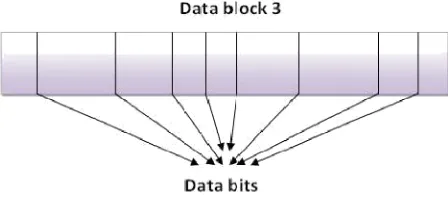
Where k is the number of bits per data block which we wish to read as meta-data. The function g generates for each data block a set of k bit positions within the m bits that are in the data block. Hence g(i, j) gives the jth bit in the ith data block. The value of k is in the choice of the verifier and is a secret known only to him. Therefore for each data block we get a set of k bits
and in total for all the n blocks we get n ∗ k bits. Let mi represent the k bits of meta data for the
ith block. Figure 3 shows a data block of the file F with random bits selected using the function g.
2) Encrypting the meta data: Each of the meta data from the data blocks mi is encrypted by using a suitable algorithm to give a new modified meta data Mi.
Without loss of generality we show this process by using a simple XOR operation. Let h be a function which generates a k bit integer αi for each i. This function is a secret and is known only to the verifier V .
h : i → αi, αi ∈ {0..2n} (2)
Available Online at www.ijpret.com
947 Mi = mi + αi (3)
In this way we get a set of n new meta data bit blocks. The encryption method can be improvised to provide still stronger protection for verifier’s data.
3) Appending of meta data: All the meta data bit blocks that are generated using the above procedure are to be concatenated together. This concatenated meta data should be appended to the file F before storing it at the cloud server. The file F along with the appended meta data Fe is archived with the cloud. Figure 4 shows the encrypted file Fe after appending the meta data to the data file F .
B. Verification phase
Let the verifier V want to verify the integrity of the file F . It throws a challenge to the archive and asks it to respond. The challenge and the response are compared and the verifier accepts or rejects the integrity proof.
Suppose the verifier wishes to check the integrity of nth block. The verifier challenges the cloud storage server by
Fig. 3. A data block of the file F with random bits selected in it
Available Online at www.ijpret.com
948 The meta data sent by the cloud is decrypted by using the number αi and the corresponding bit in this decrypted meta data is compared with the bit that is sent by the cloud. Any mismatch between the two would mean a loss of the integrity of the client’s data at the cloud storage.
V. CONCLUSION AND FUTURE WORKS
In this paper we have worked to facilitate the client in getting a proof of integrity of the data which he wishes to store in the cloud storage servers with bare minimum costs and efforts. Our scheme was developed to reduce the computational and storage overhead of the client as well as to minimize the computational overhead of the cloud storage server. We also minimized the size of the proof of data integrity so as to reduce the network bandwidth consumption.
At the client we only store two functions, the bit generator function g, and the function h which is used for encrypting the data. Hence the storage at the client is very much minimal compared to all other schemes that were developed. Hence this scheme proves advantageous to thin clients like PDAs and mobile phones.
The operation of encryption of data generally consumes a large computational power. In our scheme the encrypting process is very much limited to only a fraction of the whole data thereby saving on the computational time of the client.
Many of the schemes proposed earlier require the archive to perform tasks that need a lot of computational power to generate the proof of data integrity. But in our scheme the archive just need to fetch and send few bits of data to the client.
The network bandwidth is also minimized as the size of the proof is comparatively very less (k+1 bit for one proof).
It should be noted that our scheme applies only to static storage of data. It cannot handle to case when the data need to be dynamically changed. Hence developing on this will be a future challenge. Also the number of queries that can be asked by the client is fixed priory. But this number is quite large and can be sufficient if the period of data storage is short. It will be a challenge to increase the number of queries using this scheme.
REFERENCES
1. E. Mykletun, M. Narasimha, and G. Tsudik, “Authentication and integrity in outsourced
databases,” Trans. Storage, vol. 2, no. 2, pp. 107–138, 2006.
2. H. Shacham and B. Waters, “Compact Proofs of Retrievability,” In Proceedings.of Asiacrypt
Available Online at www.ijpret.com
949 3. A. Juels and B. S. Kaliski, Jr., “Pors: proofs of retrievability for large files,” in CCS ’07: Proceedings of the 14th ACM conference on Computer and communications security.
4. Dalia Attas and Omar Batrafi “Efficient integrity checking technique for securing client data in