57 | P a g e
Comparative, Evaluation Parameter for Toothpaste: A Review
*Nisha Devi
1, Dr. Bharat Parashar
2, Rahul Thakur
31Assistant Professor IEC School of Pharmacy, IEC University Baddi, Solan, H.P, India. 2Dean IEC School of Pharmacy, IEC University Baddi, Solan, H.P, India. 3StudentIEC School of Pharmacy, IEC University Baddi, Solan, H.P, India.
Abstract: We everyday use toothpaste for cleaning of teeth to protect it from germs and prevent bad odour and foul
smell. Toothpaste is a gel to be used with a toothbrush to maintain and improve oral health. There are so many marketed toothpaste are available in Indian market, so many brands represent their toothpaste is best than other and they advertise their brand to catch the population towards them. In this review article we focus on the best marketed toothpaste by doing comparison study on so popular two marketed brands of India one is Colgate and other is Dant Kanti from Patanjali. The Colgate and Dantkanti toothpaste during stability study those the study show that, the formulation of toothpaste containing herbal extract can be possible which is used as good toothpaste.
Keywords: Introduction, Material & method, Result & Conclusion.
Introduction:
Toothpaste is a gel to be used with a tooth brush to maintain and improve oral health and aesthetics. Since their introduction several thousand years ago, toothpaste formulation have evolved cosiderably from suspension of crushed egg shells or ashes to complex formulation with often more than 20 ingredients. Among these can be compounds to combat dental caries, gum disease, malodor, calculus, erosion and dentin hypersensitivity further more toothpaste contain abrasives to clean and
whiten teeth, flavours for the purpose of teeth freshening and dyes for better visual appeal. Effective toothpastes are those that are formulated for maximum bioavailability of their actives. This however, can be challenging as compromises will have to be made when several different actives are formulated in one phase. Toothpaste development is by no mean complete as many challenges and especially the poor oral substantivity of most active ingredients are yet to overcome.
Comparison between Colgate and Dant Kanti:
Table: 1 (Ingredients of both toothpaste)
Toothpaste Ingredients
Dantkanti (Herbal toothpaste) a) Anacyclus pyrethrum,
b) Azadirachta indica, c) Accacia Arabica, d) Xanthoxylum alatum, e) Mentha Spicata, f) Syzgium Aromaticum, g) Piper sylvaticum, h) Barleria prionitis, i) Mimusops elengi, j) Embelia ribes, k) Curcuma longa, l) Salvadora persica, m) Quercus infectoria
Base material: Cacl2base,
Preservative: Sodium benzoate
Colgate Calcium carbonate, Sorbitol, Sodium lauryl sulphate, silica, Titanium dioxide,
58 | P a g e
a) Anacyclus pyrethrum: Anacyclus pyrethrum
(pellitory, Spanish chamomile, or Mount Atlas daisy or Akarkara) is a perennial herb much like chamomile in habitat and appearance. It is in a different family (Asteraceae) from the plants known as pellitory-of-the-wall (Parietaria officinalis) and spreading pellitory (Parietaria judaica). It is found in North Africa, elsewhere in the Mediterranean region, in the Himalayas, in North India, and in Arabian countries
b) Azadirachta indica: Azadirachta indica, commonly
known as neem, nimtree or Indian lilac, is a tree in the mahogany family Meliaceae.
c) Accacia Arabica: Acacia species are commonly
known as ‘Babool’ in India and ethnomedicinally have long been used for the treatment of skin, sexual, stomach and tooth problems. Acacia nilotica (L.) Del. syn. Acacia arabica (Lam.) Willd. (Mimosaceae). Commonly known as babul, kikar or Indian gum Arabic tree has been recognized worldwide as a multipurpose tree.
d) Xanthoxylum alatum: Zanthoxylum armatum, also
called winged prickly ash, is a species of plant in the Rutaceae family. It is an aromatic, deciduous, spiny shrub growing to 3.5 meters in height, endemic to Nepal, China, Japan, Korea and Pakistan.
59 | P a g e
f) Syzgium Aromaticum: Cloves are the aromatic
flower buds of a tree in the family Myrtaceae, Syzygium aromaticum. They are native to the Maluku Islands (or Moluccas) in Indonesia, and are commonly used as a spice. Cloves are available throughout the year due to different harvest seasons in different countries.
g) Piper sylvaticum: Piper, the pepper plants or pepper vines (a term used for certain Clematis in older times), are an economically and ecologically important genus in the family Piperaceae.It contains about 1,000-2,000 species of shrubs, herbs, and lianas, many of which are dominant species in their native habitat. The diversification of this taxon is of interest to understanding the evolution of plants
h) Barleria prionitis: Barleria prionitis, also known as the porcupine flower, is a species of plants in the family Acanthaceae, native to India, Sri Lanka and Eastern Southern and Central Africa. It is used for various medicinal purposes in ayurvedic medicine.
i) Mimusops elengi: Mimusops elengi is a
60 | P a g e
j) Embelia ribes: Embelia ribes, commonly known as false black pepper, white-flowered embelia, vidanga, vaividang, vai vidang, or vavding, is a species in the Primulaceae family. It was originally described by Nicolaas Laurens Burman in his 1768 publication, Flora Indica.[2] It is widely distributed throughout India. In Ayurveda and Siddha, it is considered widely beneficial in variety of diseases.
k) Curcuma longa: Turmeric is a flowering plant,
Curcuma longa of the ginger family, Zingiberaceae, the roots of which are used in cooking.The plant is a perennial, rhizomatous, herbaceous plant native to the Indian subcontinent and Southeast Asia.
l) Salvadora persica: Salvadora persica is a small tree or shrub with a crooked trunk, typically 6–7 metres (20–23 ft) in height. Its bark is scabrous and cracked, whitish with pendulous extremities. The root bark of the tree is similar in colour to sand, and the inner surfaces are an even lighter shade of brown.
m) Quercus infectoria: Quercus infectoria, the Aleppo oak, is a species of oak, bearing galls that have been traditionally used for centuries in Asia medicinally. Manjakani is the name used in Malaysia for the galls; these have been used for centuries in softening leather and in making black dye and ink In India the galls are called majuphal among many other names.
Material & Method:
The formulated herbal toothpaste was compared with marketed preparation follows antimicrobial activity, foamability, phdetermination, % moisture content.
Relative humidity: It was determination by weight in gram taken in 10 ml formulation and 10 ml distilled water using specific gravity determinations gravity bottle.
Results and discussion appearance: No variation in
color was seen.
PH of the cream: The pH of the cream was found to be
in range of 7.2.
Homogenecity: The lab scale as well as marketed
formulations produces uniform distribution in the cream. This was confirmed by visual appearance and by touch.
Foamability: The foamability of formulated toothpaste
evaluated by taking small amount of formulation with water in measuring cylinder initial volume was noted and then shaken for 10 times. Final volume of foam was noted.
Determination of sharp and edge abrasive particles:
61 | P a g e
Determination of moisture and volatile matter: 5 g of
formulation placed in a porcelain dish in it. Dry the sample in an oven at 1050C. Calculation % by mass = 100MI/M, MI-Loss of mass (g) on drying M-Mass (g) of the material taken for the test.
Extrudability: In this method, the formulated paste were
filled in standard capped collapsible aluminum tube and sealed by crimping to the end. The weights of tubes were recorded. The tubes were placed between two glass slides and were clamped. 500g was placed over the slides and then cap was removed. The amount of the extruded paste was collected and weighed. The percent of the extruded paste was calculated.
Accelerated Stability Testing: Accelerated stability
testing of prepared formulations was conducted for 2 most stable formulations at room temperature, studied for 7 days, at 4000Cfor 20 days. The formulations were kept both at room and elevated temperature and observed on 0th, 10th, 20th, and 30th, determined various parameter (By using Remi Environmental Test Chamber, India).
Determination of Viscosity: By using a Brookfield
Viscometer, the viscosity of formulation was determining using spindle number 4 at a 50 rpm at a temperature of 250C.
Spreadability: In this method slip and drag
characteristics of paste involve. Formulated paste (2g) placed on the ground slide under study. The formulated paste placed like sandwich between this slide and another glass slides for 5min to expel air and to provide a uniform film of the paste between slides. Excess of the paste was scrapped off from the edges. The top plate was then subjected to pull of 80g with the help of string attached to the hook and time (sec) required by the top slide to cover a distance of 7.5cm was noted. A short interval indicated better spread ability. Formula was used to calculate spread ability
S=M× L /T
Where,
S= Spreadability; M= Weight in the pan (tied to the upper slide); L= Length moved by the glass slide; T=Time (sec) taken to separate the upper slide from the ground slide.
Determination of Microbial Content [12]: 5gm of cream
was dissolved in nutrient agar culture and volume adjusted to 100ml with the same medium. About 10ml of sample was transferred into 100ml of nutrient agar culture broth and incubated for 18-24 hours at 43-45°C. A subculture was prepared on a plate with nutrient agar culture and incubated at 43-45°C for 18-24 hours. The growth of red, generally non-mucoid colonies of gram negative rods appearing as reddish zones indicates the presence of E.coli if not then it indicates the absence of E.coli.
Comparison between Colgate and Dantkanti
Toothpaste: The formulated herbal toothpaste was
compared with marketed preparation follows Antimicrobial activity, Spreadability, Foamability, pH determination, % Moisture content.
Relative density: Relative density was determination by
weight in gram taken in 10 ml formulation and 10 ml distilled water using specific gravity determinations gravity bottle.
Results and Discussion:
Appearance: No variation in colour was seen
PH of the Cream: The pH of the cream was found to be
in range of 7-8.2
Homogenecity: Both formulations produce uniform
distribution in the toothpaste. This was confirmed by visual appearance and by touch
Viscosity: The viscosity of was cream was found to be in
the range of 70,000-100,000 cps which indicates that the cream is easily spreadable.
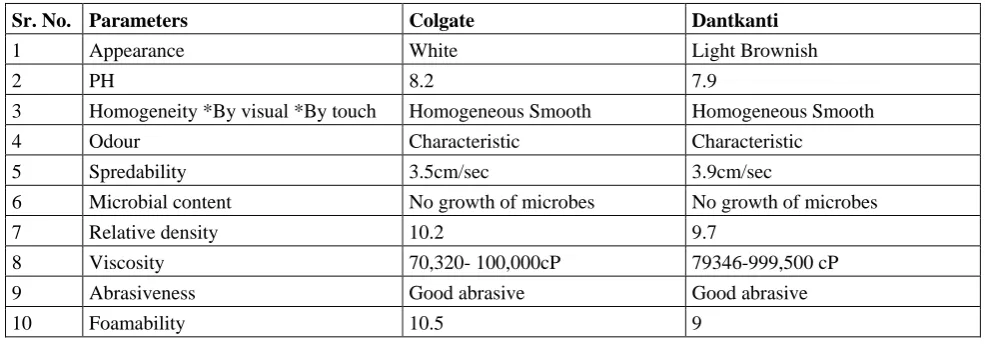
Table 3: Physicochemical parameters & Evaluation result
Sr. No. Parameters Colgate Dantkanti
1 Appearance White Light Brownish
2 PH 8.2 7.9
3 Homogeneity *By visual *By touch Homogeneous Smooth Homogeneous Smooth
4 Odour Characteristic Characteristic
5 Spredability 3.5cm/sec 3.9cm/sec
6 Microbial content No growth of microbes No growth of microbes
7 Relative density 10.2 9.7
8 Viscosity 70,320- 100,000cP 79346-999,500 cP
9 Abrasiveness Good abrasive Good abrasive
62 | P a g e
Physicochemical parameters & Evaluation results:
Color of the colgate was white whereas, Dantkanti has light brown color.
Colgate has a pH of 8.2 and 7.9 of Dantkanti.
Both the paste are Homogeneous by touch and visually too and posseses the Characteristic odour.
Spreadability of Dantkanti is high i.e 3.9cm/sec whereas colgate has 3.5cm/sec.
Relative density of colgate is high and other has low.
Viscosity of Dantkanti is high and colgate has low viscosity.
Both has a good abrasiveness activity.
Foamability of Colgate is more (10.5) and Dantkanti has 9.
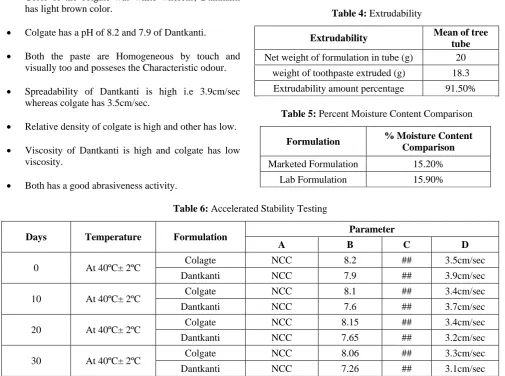
Table 4: Extrudability
Extrudability Mean of tree
tube
Net weight of formulation in tube (g) 20 weight of toothpaste extruded (g) 18.3
Extrudability amount percentage 91.50%
Table 5: Percent Moisture Content Comparison
Formulation % Moisture Content
Comparison
Marketed Formulation 15.20%
Lab Formulation 15.90%
Table 6: Accelerated Stability Testing
Days Temperature Formulation Parameter
A B C D
0 At 40ºC± 2ºC Colagte NCC 8.2 ## 3.5cm/sec
Dantkanti NCC 7.9 ## 3.9cm/sec
10 At 40ºC± 2ºC Colgate NCC 8.1 ## 3.4cm/sec
Dantkanti NCC 7.6 ## 3.7cm/sec
20 At 40ºC± 2ºC Colgate NCC 8.15 ## 3.4cm/sec
Dantkanti NCC 7.65 ## 3.2cm/sec
30 At 40ºC± 2ºC Colgate NCC 8.06 ## 3.3cm/sec
Dantkanti NCC 7.26 ## 3.1cm/sec
A= colour; B= pH; C= Homogeneity; D= Spredability; NCC = Not change in colour; ## = Homogenous
There was no characteristic change in the colour as well as in its homogeneity.
pH and spreadibility found to be decreased with tim.
Discussion:
The study revealed that the colgate as well as Dantkanti toothpaste found to be more stable. Both formulations had almost constant pH, homogeneous, Spredability appearance, and. The stable formulations were safe in respect to mouth problem and sensitization. The Curcuma longa has antiseptic activity and anti-inflammatory activity, and also increases whitening of teeth, the Mentha Spicata increases freshness of the mouth as well as anesthetic helps to reduce pain and good properties. Hence all these properties are beneficial to normal human tooth and mouth it is safe and stable too.
Conclusion:
Evaluation parameter of the toothpaste suggested that there was no large variation between Colgate and Dantkanti toothpaste. The colgate and Dantkanti toothpaste during stability study those the study show that, The formulation of toothpaste containing herbal extract can be possible which is used as good toothpaste.
References:
1. Jardim JJ, Alves LS, Maltz M: The history and global market of oral homecare products. Braz Oral Res 2009; 23(suppl 1):17–22.
2. Horseman RE: The her-story of toothpaste. J Calif Dent Assoc 2006; 34: 769–770.
3. http://www.h2g2.com/approved_entry/ A2818686; accessed November 2012.
63 | P a g e 5. https://files.nyu.edu/ssg280/public/toothpaste_history
.html; accessed November 2012.
6. http://www.huffingtonpost.com/ thomas-p-connelly-dds/mouth-healththe-history-_b_702332.html; accessed November 2012.
7. http://www.saveyoursmile.com/toothpaste/toothpast-a. html; accessed November 2012.
8. http://www.toothpasteworld.com/history.php; accessed November 2012.
9. http://www.buzzle.com/articles/historyoftoothpaste.h tml; accessed November 2012.
10. Wolfgang Weinert in "Oral Hygiene Products" Ullmann's Encyclopedia of Industrial Chemistry, 2005, Wiley-VCH, Weinheimdoi:10.1002/14356007. a18_209
11. Nevitt GA, Witter DH, Bowman WD (September 1958). "Topical applications of sodium fluoride and stannous fluoride". Public Health Reports. 73 (9): 847–50. doi:10.2307/4590256. JSTOR 4590256. PMC 1951625. PMID 13579125.
12. Perlich MA, Bacca LA, Bollmer BW, Lanzalaco AC, McClanahan SF, Sewak LK, Beiswanger BB, Eichold WA, Hull JR, Jackson RD (1995). "The clinical effect of a stabilized stannous fluoride dentifrice on plaque formation, gingivitis and gingival bleeding: a six-month study". The Journal of Clinical Dentistry. 6 Spec No (Special Issue): 54–8. PMID 8593194.
13. Jump up to:a b Walsh T, Worthington HV, Glenny AM, Appelbe P, Marinho VC, Shi X (January 2010). "Fluoride toothpastes of different concentrations for preventing dental caries in children and adolescents". The Cochrane Database of Systematic Reviews (1): CD007868. doi:10.1002/14651858.cd007868.pub2. PMID 20091655.
14. Ekstrand KR (April 22, 2016). "High Fluoride Dentifrices for Elderly and Vulnerable Adults: Does It Work and if So, Then Why?". Caries Research. 50 Suppl 1 (1): 15–21. doi:10.1159/000443021. PMID 27101401.
15. "Triclosan: What Consumers Should Know". April 17, 2010.
16. Gunsolley JC (December 2006). "A meta-analysis of six-month studies of antiplaque and antigingivitis agents". Journal of the American Dental Association. 137 (12): 1649–57. doi:10.14219/jada.archive.2006. 0110. PMID 17138709. Seventeen studies support the antiplaque, antigingivitis effects of dentifrices containing 0.30 percent triclosan, 2.0 percent Gantrez copolymer.
17. Riley P, Lamont T (December 2013). "Triclosan/copolymer containing toothpastes for oral
health". The Cochrane Database of Systematic Reviews (12): CD010514. doi:10.1002/14651858. CD010514.pub2. PMID 24310847.
18. Calcium Phosphate Technologies from. Dentist.net. Retrieved on April 4, 2013.
19. Simon Quellen Field "Why There's Antifreeze in Your Toothpaste: The Chemistry of Household Ingredients" 2008, Chicago Review Press. ISBN 1-55652-697-0
20. Yang ZY, Wang F, Lu K, Li YH, Zhou Z (January 7, 2016). "Arginine-containing desensitizing toothpaste for the treatment of dentin hypersensitivity: a meta-analysis". Clinical, Cosmetic and Investigational Dentistry. 8: 1–14. doi:10.2147/CCIDE.S95660. PMC 4708190. PMID 26793006.
21. Hu ML, Zheng G, Zhang YD, Yan X, Li XC, Lin H (May 2018). "Effect of desensitizing toothpastes on dentine hypersensitivity: A systematic review and meta-analysis". Journal of Dentistry. 75: 12–21. doi:10.1016/j.jdent.2018.05.012. PMID 29787782.
22. Hall C, Mason S, Cooke J (May 2017). "Exploratory randomised controlled clinical study to evaluate the comparative efficacy of two occluding toothpastes - a 5% calcium sodium phosphosilicate toothpaste and an 8% arginine/calcium carbonate toothpaste - for the longer-term relief of dentine hypersensitivity". Journal of Dentistry. 60: 36–43. doi:10.1016/j.jdent.2017.02.009. PMID 28219674.
23. Rantanen I, Tenovuo J, Pienihäkkinen K, Söderling E (May 2003). "Effects of a betaine-containing toothpaste on subjective symptoms of dry mouth: a randomized clinical trial". The Journal of Contemporary Dental Practice. 4 (2): 11–23. PMID 12761586.
24. Epstein JB, Emerton S, Le ND, Stevenson-Moore P (March 1999). "A double-blind crossover trial of Oral Balance gel and Biotene toothpaste versus placebo in patients with xerostomia following radiation therapy". Oral Oncology. 35 (2): 132–7. doi:10.1016/S1368-8375(98)00109-2.
25. James P, Worthington HV, Parnell C, Harding M, Lamont T, Cheung A, Whelton H, Riley P (March 2017). "Chlorhexidine mouthrinse as an adjunctive treatment for gingival health". The Cochrane Database of Systematic Reviews. 3: CD008676. doi:10.1002/14651858.CD008676.pub2. PMID 28362061.
64 | P a g e 27. Riley P, Moore D, Ahmed F, Sharif MO,