Available Online at www.ijpret.com 69
INTERNATIONAL JOURNAL OF PURE AND
APPLIED RESEARCH IN ENGINEERING AND
TECHNOLOGY
A PATH FOR HORIZING YOUR INNOVATIVE WORK
IMAGE RETRIEVAL WITH NON-SEPARABLE MULTI RESOLUTION WAVELET
TRANSFORM BASED ON LIFTING SCHEME
PATIL AM1, HARODE U2
1. Lecturer, Industrial Electronics Department, Bharati Vidyapeeth Institute of Technology. 2. Assistant Professor, Electronics Department, Pillai Institute of Information Technology.
Accepted Date: 12/09/2014; Published Date: 01/10/2014
\
Abstract:The Paper Image Retrieval with Non-separable Multiresolution Wavelet Transform based on Lifting Scheme is completely related with the nonseparable lifting scheme, genetic algorithm and CBIR [1]. The wavelet transform has been widely used in many applications for its flexibility: in particular, it is possible to adapt the wavelet basis to any specific problem. However, its use has usually been restricted to 1-dimensional signals, or to separable wavelets and separable subsampling lattices in the case of multidimensional signals. CBIR is a very active research topic in all the fields where images carry relevant information, particularly in medicine, where imaging is present for diagnosis, therapy or education. The principle of CBIR is to use images as queries to access relevant information in databases. Precisely, the goal is to retrieve similar images from these databases. The central point of CBIR is to define a similarity measure between images. In that purpose, relevant features from both the query image and images stored in the database are extracted. Typically, features characterizing shapes, edges in particular, color, or texture, are extracted. Then, the distances between feature vectors (also referred to as image signatures) are computed, and images minimizing the distance to the query are retrieved In CBIR we have used Texture feature for retrieving the image.
Keywords: CBIR, Genetic algorithms, Kullback-leibler Divergence, Lifting scheme, Multiresolution analysis, Quincunx grid on lifting scheme.
Corresponding Author: MR. AMIT M.PATIL
Access Online On:
www.ijpret.com
How to Cite This Article:
Patil AM,Harode U; IJPRET, 2014; Volume 3 (2): 69-81
Available Online at www.ijpret.com 70 INTRODUCTION
When designing a lifting scheme filter F (either a prediction or an update filter), by Kovacevic and Sweldens’s method, all the design degrees of freedom (nF degrees) are used to make the first nF moments of the corresponding wavelet vanish[2].
This is done by defining F as the simplest Neville filters of order nF , with a given shift. In order to make the method adaptive, we propose to define each lifting scheme filter F as a Neville filters of order nF , but not the simplest: we use n’F additional degrees of freedom to build a more complex Neville filter. Tuning these Neville filters, we can generate wavelet decompositions better suited to any specific application. Here Neville filters, in conjunction with Lagrange interpolation, have been used to design a non-adaptive wavelet family, also related to the one described in. In the method we propose, the design degrees of freedom that are not used to make the first wavelet moments vanish are tuned to optimize a high-level criterion. Typically, for a compression application, this criterion would be the signal-to-noise ratio; for classification, it may be the accuracy; and for information retrieval, it may be the mean precision. Lifting scheme on quincunx grids (LISQ) performs the wavelet decomposition of a 2D signal (image) and corresponding reconstruction. Prediction (and update) filters can be chosen from predefined sets, but custom-made filters are possible too. Additionally, means for the computation of moments (on both rectangular and quincunx grids) are present [3].
Genetic Algorithms are easy to apply to a wide range of problems, from optimization problems like the traveling salesperson problem, to inductive concept learning, scheduling, and layout problems. The results can be very good on some problems, and rather poor on others. If only mutation is used, the algorithm is very slow. Crossover makes the algorithm significantly faster. The divergence between two image signatures is defined as a weighted sum of the divergences between the coefficients distribution in the corresponding sub bands of two images. The kullback- Leibler divergence was used to estimate the divergence between two wavelet coefficient distributions. The aim of the CBIR is to retrieve images from a database, which are similar to an image placed as a query art in content-based image retrieval (CBIR). It is a technique for retrieving image on the basis of automatically derived features texture.
SCOPE OF THE STUDY
Available Online at www.ijpret.com 71 OBJECTIVE OF THE STUDY
To understand the concept of Non separable wavelet using lifting schemes.
To study the CBIR system and how the relevant images are retrieved from a large database.
The Fourier transform only retrieves the global frequency content of a signal. Therefore, the Fourier transform is only useful for stationary and pseudo-stationary signals. The Fourier transform does not give satisfactory results for signals that are highly non-stationary, noisy, a-periodic, etc. These types of signals can be analyzed using local analysis methods. These methods include the short time Fourier transform and the wavelet analysis. All analysis methods are based on the principle of computing the correlation between the signal and an analysis function. Since the wavelet transform is a new technique, the principles and analysis methods are not widely known.
RESEARCH METHODOLOGY
The methodology of this research paper is based on the lifting schemes. We have used the IEEE paper, which is modified by us. CBIR is introduced for retrieving of images from large content of database.
MULTIRESOLUTION ANALYSIS
Multiresolution analysis has received considerable attention in recent years by researchers in the fields of computer graphics, geometric modeling and visualization. Its attraction is its utility as a powerful tool for efficiently representing functions at multiple levels-of-detail with many inherent advantages, including compression, Level-Of-Details (LOD) display, progressive transmission and LOD editing.
I. One-dimensional Multiresolution Analysis II. D-dimensional Multiresolution Analysis III. Recursive Signal Analysis
By using an approach called multiresolution analysis (MRA), it is possible to analyze a signal at different frequencies with different resolutions [4].
WAVELET LIFTING SCHEME
Available Online at www.ijpret.com 72
obtained from the wavelet transform. Scaling coefficients are obtained by averaging two adjacent samples. These scaling coefficients represent a coarse approximation of the speech. Wavelet coefficients are obtained from the subtraction of two adjacent samples. Wavelet coefficients contain the fine details of the speech signal.
The Haar wavelet is famous for its simplicity and speed of computation. Computation of the scaling coefficients requires adding two samples values and dividing by two. Calculation of the wavelet coefficients requires subtracting two samples values and dividing by two. The inverse transform simply requires subtraction and addition. Using logical shifts to perform division eliminates the need for a complex divide unit. Implementing a logical shift in hardware requires much less power and space than an arithmetic logic unit (ALU). Given the computational requirements, the Haar wavelet is a simple and easy to implement transform.
Computational simplicity makes the Haar transform a perfect choice for an initial design implementation. All the desired properties of wavelets by reducing the problem to a set of simple relations between the wavelet and scaling filter coefficients, namely the lifting scheme. The lifting scheme called as the second generation wavelet. Is to use lifting instead of convolution, in order to further reduce the memory requirements of the transform. Wavelet algorithms are recursive [5].
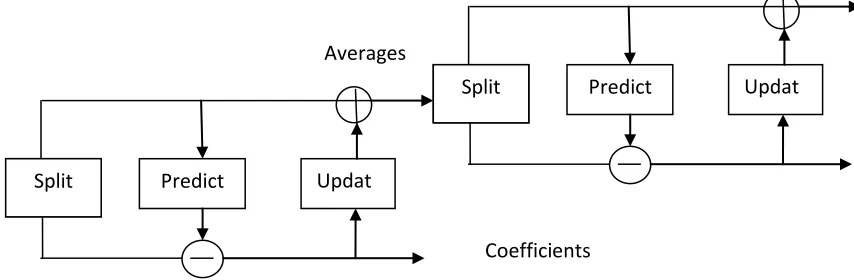
Lifting scheme are divided into three parts.
1) split step
2) predict wavelet
3) update step
Split: Divide the original data into two disjoint subsets .
For example, split the original data sets x[n] into xe[n] = x[2n] , the even indexed points, & xo[n]=x[2n+1],the odd indexed points.
Predict: Generate the wavelet coefficients d[n] as the error in predicting xo[n] from xe[n] using prediction operator P.
d[n]=xo[n]- P (xe[n])
Update: Combine xe[n] and d[n] to obtain scaling coefficients.
Available Online at www.ijpret.com 73 Fig. 1: Two steps in the wavelet lifting scheme forward transform
The update phase follows the predict phase. The original value of the odd elements has been overwritten by the difference between the odd element and its even "predictor".
NEVILLE FILTER AND QUINCUNX
Max min: a nonlinear transform the above described prediction and update filters are all linear ones. It includes a scheme which is nonlinear. It is very like the red-black transform, but for the prediction and update filters. When the scheme proceeds from a rectangular grid towards a quincunx grid, the prediction filter is defined by assigning the maximum value at the neighbouring gridpoints.
Fig. 2: Neville filter of order 4: rectangular (left) and quincunx (right)
When the scheme proceeds from a quincunx grid towards a rectangular grid the prediction filter is defined by assigning the minimum value at the neighbouring grid points. The update filters are similarly defined. The resulting nonlinear scheme is better in preserving in edges and local maxima and minima than the linear schemes which tends to blur the approximate images at coarser grids.
Predict Updat
e Split
Predict Updat
e Split
Averages
Available Online at www.ijpret.com 74 Table: Quincunx Neville filter coefficients
Here the numbers 1, 2 correspond to the values of the filter coefficients as given in V1and V2 respectively at that position. The left-hand filter can be used to transform a signal defined on a quincunx grid into a signal defined on a rectangular grid, the right-hand filter is the 45 degrees rotated version of the left-hand filter and can be used to transform a signal from a rectangular grid towards a quincunx grid [6]. We observe that the quincunx lattice yields a non separable 2D-wavelet transform, symmetric in both horizontal and vertical direction.
The rectangular grid is split into two quincunx grid as in figure 2 .the pixel on the red spots (0) are used to predict the sample on the black spot( ), while updating of the red spots is performed by using the detailed data on the black spots.
GENETIC ALGORITHEM
Genetic Algorithms are a family of computational models inspired by evolution. These algorithms encode a potential solution to a specific problem on a simple chromosome-like data structure and apply recombination operators to these structures as to preserve critical information [7].Genetic algorithms are often viewed as function optimizer, although the ranges of problems to which genetic algorithms have been applied are quite broad.
Basic Principle
The working principle of a canonical GA is illustrated in below The major steps involved are the generation of a population of solutions, finding the objective function and fitness function and the application of genetic operators. These aspects are described briefly below.
N V1 V2 V3 V4 V5
2 1/4 0 0 0 0
4 10/32 -1/32 0 0 0
Available Online at www.ijpret.com 75 Fig.3: The basic GA operations
In the first step, a population having P individuals and it is generated by pseudo random generators, whose individuals represent a feasible solution. This is a representation of solution vector in a solution space and is called initial solution. This ensures the search to be robust and unbiased, as it starts from wide range of points in the solution space. In the next step, individual members of the population are evaluated to find the objective function value [8]. In this step, the exterior penalty function method is utilized to transform a constrained optimization problem to an unconstrained one. This is exclusively problem specific. In the third step, the objective function is mapped into a fitness function that computes a fitness value for each member of the population.
The operation of GAs begins with a population of random strings representing design or decision variables. The population is then operated by three main operators; reproduction, crossover and mutation to create a new population of points.
IMAGE RETRIEVAL VIA KULLBACK–LEIBLER DIVERGENCE
Available Online at www.ijpret.com 76
reference (or example) image for a query-by-example task. Understanding how human perceive the similarity between images via perceptual studies is still a topic of active research. Thus, content-based image indexing systems relying on such studies may be subjective and very hard to implement. Here, we focus on developing an objective and mathematically defined measure that will be easily implementable.
The philosophy here is to use a sparse multiscale image description. The Kullback-Leibler (KL) divergence has already been used as a similarity measure between parameterized marginal distributions of wavelet coefficients at different scales. Nevertheless, independence between the coefficients was assumed, preventing from taking into account local image structures such as texture. In contrast, we propose to consider dependency by means of distributions of mixed intra/ interscale patches of the Laplacian pyramid coefficients.
In addition, for the case of color images, we take into account the statistical dependencies amongst the three color channels; hence patches of coefficients are also interchannel. This approach implies to deal with a high-dimensional statistical description space. The number of samples being too small to reasonably fill this space, fixed size kernel options to estimate distributions or divergences fails. Alternatively, we propose to estimate the KL divergence in the k-th nearest neighbor (kNN) framework.
CONTENT-BASED IMAGE RETRIEVAL
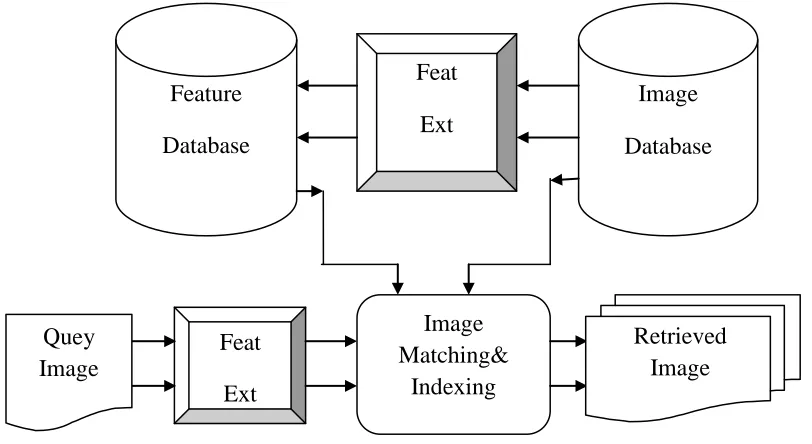
Available Online at www.ijpret.com 77 Fig. 4: CBIR System Architecture
The method for color analysis is the color histograms, and the information captured within histograms is extracted after a pre-processing phase that performs color transformation, quantization, and filtering. The features thus extracted and stored within feature vectors are later compared with an intersection-based method [10]. The system is also extended for pre-processing images to segment regions with different textural quality, rather than operating globally over the whole image. The system also includes a framework for object-based color and texture querying, which might be useful for reducing the similarity error while comparing rectangular regions as objects. It is shown through experimental results and precision-recall analysis that the content-based retrieval system is effective in terms of retrieval and scalability.
PRECISION VS RECALL FORMULA
result retrieved of number result relevent retrieved of Number ecision _ _ _ _ _ _ _ Pr result relevent of r totalNumbe result relevent retrieved of Number call _ _ _ _ _ _ _ Re RESULT
The query image is taken as input image. Depending on the texture features, most relevant images are retrieved first. Here the coding is written on the MATLAB softwere.This method is
Available Online at www.ijpret.com 78
used for various experiments in order to check its accuracy. If we add too many degrees of freedom, the objective function becomes more complex and it is harder to find the image, the system performance stops increasing and even decreases. One or two degrees of freedom for both the prediction and the update filter seem to be a reasonable choice.
Fig.5: Applying Nonseparable method
Available Online at www.ijpret.com 79 Fig.7: Precision vs Recall Graph
Fig.8: comparisons of retrieval rate
Using Nonseparable: 6082.546
Available Online at www.ijpret.com 80 CONCLUSION
The Paper entitled “Image Retrieval with Non-separable Multiresolution Wavelet Transform based on Lifting Scheme” has been developed satisfies all proposed requirements. The system is highly scalable and user friendly. Almost all the system objectives have been met. The system has been tested under all criteria. All phases of development were conceived using methodologies. Existing System contains a system of searching Image from database using its texture and shape and therefore the entire database get scanned and the process is time consuming. It doesn’t consider the filter bank method to any specific problem and don’t have lifting scheme for identifying best weights. In Proposed system some of the drawbacks of existing system removed. The proposed method we adapt multidimensional wavelet filter bank. It allows the design of filter bank with a desired number of degree of freedom. We are taking comparison between nonseparable and separable wavelet. By using nonseaprable, we get the good retrieval result as compare to the separable. The maximum features can be extracted using nonseparable. The Software executes successfully by fulfilling the objectives of the project. Further extensions to this system can be made required with minor modifications.
REFERENCES
1. Gwenole Quellec , Mathieu Lamard “Adaptive Nonseparable Wavelet Transform via Lifting and its Application to Content-Based Image Retrieval” IEEE Trans.Vol.19,Jan 2010.
2. J. Kovacevic and W. Sweldens “Wavelet families of increasing order in arbitrary dimensions,” IEEE Trans. SImage Process., vol.9 no.3, pp.480-496,Mar .2000.
3. D. Sersic and M. Varnkic “Adaptation in the Quincunx wavelet filter bank with application in image denoising,” in Proc. Int. TICSOP Work-shop on spectral method and multirate Signal processing,SMMSP 2004,2004,pp 245-253
4. H. J. A. M. Heijmans and J. Goutsias “nonlinear Multiresolution signal decomposition schemes-part II Morphological wavelet,” IEEE Trans. Image Process.,vol.9,no.11,pp.1897-1913,Nov.2000
5. R. Claypoole, R.Baraniuk ,and R. Nowak , “Adaptive Wavelet transform via lifting,” in Proc.IEEE Int.Conf.Acoustics,Speech and signal processing, May 1998,Vol.3,pp 661-664
Available Online at www.ijpret.com 81
7. D. E. Goldberg, Genetic Algorithms in search, optimization and machine Learning. Boston , MA : Kluwer,1989.
8. M. N. Do and M. Vetterli, “wavelet based texture retrieval using generalized Gaussion density and Kullback-Leibler distance,” IEEE Trans. Image process.,vol.11 no.2,pp 146-158,Feb.2002
9. H. muller, N. Michoux, D. Bandonand, A. Geissbuhler, “A review of content-based image retrieval system in medical application –Clinical benefits and future direction,” Int.J.Med.Inf.,vol.73,no.1,pp.1-23,Feb .2004