Available Online at www.ijpret.com 39
INTERNATIONAL JOURNAL OF PURE AND
APPLIED RESEARCH IN ENGINEERING AND
TECHNOLOGY
A PATH FOR HORIZING YOUR INNOVATIVE WORK
CLUSTER, GRID AND CLOUD COMPUTING: A REVIEW AND COMPARISION
SUNIL SAINI
Assistant Professor, Deptt. of Computer Sc. & Engg, Kurukshetra Institute of Technology & Management, Kurukshetra, Haryana. Accepted Date: 20/12/2017; Published Date: 01/01/2018
\
Abstract: - Cloud computing is largely growing computing technology these days. It is an interesting topic among various information technology based industries, business intelligence and the users. Various computer resources like hardware and software are collected into resource pool that can be assessed by the users through internet. However, its functioning is based on models of cluster, distributed and grid computing. In this paper author presents a direct comparison between Cluster Computing, Grid Computing and Cloud Computing including various aspects related to these computing. Cluster includes computers connected over a LAN on the other hand cloud and grids are geographically distributed on a larger scale.
Keywords: Cloud Computing, Cluster Computing, Grid Computing, Computing Model, SaaS, PaaS, IaaS
Corresponding Author: SUNIL SAINI Access Online On:
www.ijpret.com
How to Cite This Article:
Sunil Saini, IJPRET, 2017; Volume 6 (5): 39-46
Review Article CODEN: IJPAKY Impact Factor: 4.226 ISSN: 2319-507X Sunil Saini, IJPRET, 2017; Volume 6 (5): 39-46 IJPRET
Available Online at www.ijpret.com 40 I. INTRODUCTION
A tremendous change is observed in computing over the years. During the early years, operating of large computer was thought that only professional person can operate it accurately. Then a new concept name cluster computing came that works on homogeneous network and connect two or more than two computer in such a way that they work in a combination as one computing unit. Then another concept named grid computing came that allows the users for computing on demand as per their needs [1]. It work on heterogeneous network and also helps in building small scale architecture in low cost. Then finally we came to know of cloud computing in which a large pool of dynamically scalable and virtual resources provide services to user on demand. This can be happened with the help of internet.
II. CLUSTER COMPUTING
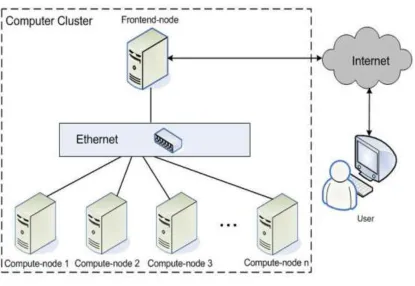
Available Online at www.ijpret.com 41 FIG. 1.
Fig. 1 shows the basic concept of cluster computing in which several nodes merge together and for any user it works as a single node.
Advantages of Cluster Computing
1)Easily Manage: It is very difficult to manage large number of different components but with
cluster computing these components are combined and work as single unit. So that it is easily manage.
2)Availability of components: In cluster computing all components are copy of each other so if
in any case one component goes down then the other component take its place and user’s work get not effected.
3)Image of Single System: In cluster computing, user feels like he/she working with a single
Review Article CODEN: IJPAKY Impact Factor: 4.226 ISSN: 2319-507X Sunil Saini, IJPRET, 2017; Volume 6 (5): 39-46 IJPRET
Available Online at www.ijpret.com 42 Disadvantages of Cluster Computing
1)Troubleshoot Issue: As user deal with single entity image, it is very hard to deal with problem
related to individual component.
2)Programmability Issue: This is the case when the different components are different from
one another in term of software. Then there may be issue when combining these to each other for single image.
3)Difficult for Non-Technical person: As cluster is combination of same or different component
together so it may be difficult for any non-technical person to deal and maintain this type of arrangement.
III. GRID COMPUTING
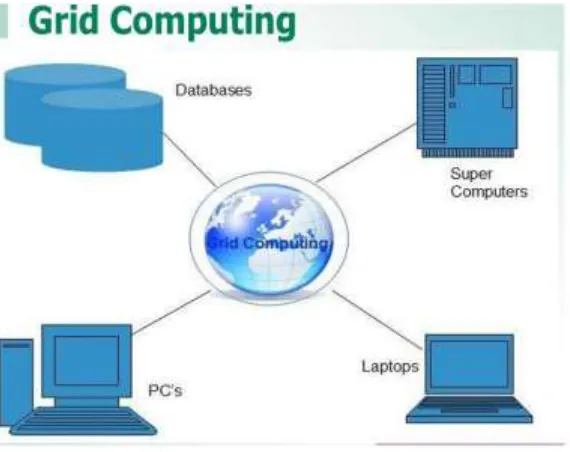
Available Online at www.ijpret.com 43 FIG. 2
Advantages of Grid Computing
1)Balancing of resources: Applications which are facilitated with grid performs the resource
balancing by scheduling grid jobs on machines that are showing less utilization.
2)Reduce failure point: Grid environments are much more modular so that it reducing the
points of failure.
3)Grid software: The grid policies in the grid can be easily accomplished by the grid software.
Disadvantages of Grid Computing
1)Low Stability: Grid software and the standards are not stable in comparison to other various
computing. Its standards are still growing [7].
2)Requirement of High speed internet: For collecting different resources from dispersed
Review Article CODEN: IJPAKY Impact Factor: 4.226 ISSN: 2319-507X Sunil Saini, IJPRET, 2017; Volume 6 (5): 39-46 IJPRET
Available Online at www.ijpret.com 44 IV. CLOUD COMPUTING
Cloud Computing is focuses on sharing the data over a scalable network of nodes. ``A Cloud is a type of distributed and parallel system that consists of a collaboration of inter-connected and computers which further are dynamically presented as one or more combined computing resource(s) based on service-level agreements (SLA’s) established through the negotiation between the consumers and the cloud service provider [8].”
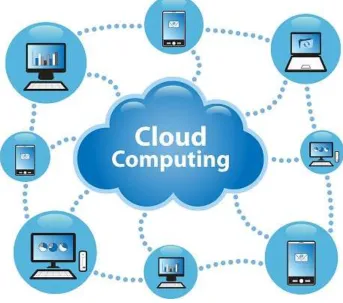
Fig. 3 shows that how users can connect to the cloud services that are provided by cloud service provider over the internet. Cloud infrastructure includes scalable resources in network, compute and storage.
Cloud computing provides following three kinds of service:
a) Software as a Service (SaaS):- Software as a Service (SaaS) is a software model in which
Available Online at www.ijpret.com 45
b)Platform as a Service (PaaS):- Platform as a Service (PaaS) is a way in which the hardware,
operating systems and storage on the lease over Internet.
c) Infrastructure as a Service (IaaS):- Infrastructure as a Service is a model in which an
organization outsources the various resources that are used to maintain operations and various networking components.
Advantages of Cloud Computing
1)Worldwide Access- Cloud computing increase the mobility, as anyone can access their
documents from any device and from any part of the world.
2)Large storage space - Cloud computing provides larger storage space, so anyone won’t have
to worry about the space on the hard drive.
3)Inexpensive- Cloud computing is often inexpensive. The software is already installed online,
so that the user won’t need to install it their machines.
Disadvantages of Cloud Computing
1)Security Issue- When using a cloud computing service generally the users are handing over
the whole data to the other party. So the security issue arises at this point.
2)Privacy Issue- In cloud computing the risk of unauthorized access of data of some users is
also a major concern.
V. COMPARISION
As far as comparison is concern between cluster, grid and cloud computing the following table successfully shows the comparison.
Cluster Computing Grid Computing Cloud Computing
Allocation Centralized Decentralized Both
Reliability No Half Full
Service Level
Agreement
Review Article CODEN: IJPAKY Impact Factor: 4.226 ISSN: 2319-507X Sunil Saini, IJPRET, 2017; Volume 6 (5): 39-46 IJPRET
Available Online at www.ijpret.com 46
User Friendly No Half Full
Interoperability Yes Yes Half
Loosely Coupled No Both Yes
Business Model No No Yes
Scalable No Half Yes
From the above table we easily conclude the comparison between these three computing systems.
VI. CONCLUSION
Cloud computing is a recent technology that provides web services at less cost comparing to other techniques. It also contributes to improve the services in various areas. Presently, the security in clouds is less than the model in grid environment. But continuous research is going on for improving it.
REFERENCES
1. Mladen A. Vouk, Department of Computer Science, North Carolina State University, Raleigh,
North Carolina, USA, Cloud Computing – Issues, Research And Implementations.
2. http://www.wisegeek.org/what-is-cluster- computing.htm
3. Gandotra Indu, Abrol Pawanesh, Gupta Pooja, Uppal Rohit and Singh Sandeep (2011) “Cloud
Computing Over Cluster, Grid Computing: a Comparative Analysis”, Journal of Grid and Distributed Computing, pp-01-04
4. Raicu Ion (2008), “Cloud Computing and Grid Computing 360 Computing 360—Degree
Compared”, Distributed Systems Laboratory.
5. Computer Science Department, University of Chicago Introduction to Grid Computing, Bart
Jacob, Michael Brown, Kentaro Fukui, Nihar Trivedi; IBM, Red books.
6. http://www.linkedin.com/answers/technology/enterprisesoftware/TCH_ENT/552522149410
35.
7. http://www.slideshare.net/TankBhavin/grid-computing-2007.
8. R. Buyya, et al., Cloud computing and emerging IT platforms: Vision, hype, and reality for