A study to assess the effectiveness of selected nursing interventions on the
level of postpartum depression among mothers in a selected hospital,
Tamil Nadu
1Dr. S. Usha, 2Dr. M. Gandhimathi,
1Lecturer, M.Sc.,(N)., Ph.D.,(N) & 2Professor cum Vice-Principal, M.Sc.,(N)., Ph.D., (N)
Department of Obstetrics and Gynecological Nursing,
Department of Obstetrics and Gynecological Nursing, Rani Meyyammai College of Nursing, Annamalai University, Annamalai Nagar (PO), Chidambaram, Tamilnadu (State), India, Pin: 608 002,
Email: 1[email protected], 2[email protected].
1. INTRODUCTION:
Pregnancy is the most exciting period of expectation and fulfillment in woman’s life and has major physiological and psychological changes. Child birth is a great event in the life of every woman which the woman aspires and longs for with great expectations(Jeyareka, 2011)1.Globally, the prevalence of psychosocial problems is high during pregnancy and after delivery. One in four women in developing countries suffers from anxiety or depression around the period of childbirth (Ali, Ali, Azam & Khuwaja, 2010)2. Postpartum depression (PPD) is a mood disorder affecting approximately 10-20% of mothers. PPD is mainly the result of sudden and significant hormonal changes in hypothalamo-pitutary-adrenal axis, reduction of estrogen and progesterone and dropping of thyroid hormone (Udangiu, Moldovan, Moţoescu & Papuc, 2010)3.
2. NEED FOR THE STUDY:
The prevalence of postpartum depression is up to 42% in resource-limited settings (Hegde, Latha, Bhat, Sharma, Kamath & Shetty, 2012)4. A study conducted by Munir, et al., (2009)5 among 133 postnatal mothers in Rawalpindi, Pakistan, reported about the prevalence of postnatal depression as 33%. Postpartum depression results in impairments in mother–infant interactions, disrupts emotional and cognitive development of the infant, prevents the mother from engaging in health promoting behaviors (Walden, 2013)6.
Research studies indicated that individual counseling and relaxation techniques (Ngai, Wong, Leung, Chau and Chung (2015)7, Nasiri, Kordi and Gharavi (2015)8, Daley, Jolly, Sharp, Turner, Blamey, Coleman, et.al. (2012)9, Udangiu, Moldovan, Moţoescu & Papuc (2010)3 were the effective treatment options for reducing ppd. nurses are available throughout the antenatal and postnatal period for mothers. This underscores the role of nurses in recognizing the signs and symptoms of postpartum depression and takes care of women suffering from ppd.
Mothers may be depressed due to hormonal changes, lack of knowledge about care of the baby and self care, lack of sleep and support system. Research studies indicated that individual counseling and relaxation techniques are the effective treatment options for reducing the level of PPD among women.
Abstract: Postpartum is the crucial period of developing relationship with the baby. Postnatal mothers are prone to get psychological problems like postpartum blues, postpartum depression and postpartum psychosis. Postpartum depression (PPD) is a mood disorder affecting approximately 10-20% of mothers. The purpose of the study was to assess the level of postpartum depression and determine the effectiveness of selected nursing interventions on the level of postpartum depression among the mothers. The study was a quasi experimental design with participation of 100 postpartum mothers in Rajah Muthiah Medical College Hospital in Chidambaram and used the Beck Depression Inventory-II to assess the level of postpartum depression. The baseline data were collected from mothers in labour and postnatal wards and followed up in home set-up at 1½, 3, 6 and 12 months intervals for the collection of research data. The interventions were Individual Counseling and Progressive Muscles Relaxation Technique. There was no significant difference in the level of post partum depression between experimental and control groups in pre-test. There was a significant reduction in the mean PPD from pre-test to post test III in the experimental group. The researcher concluded that creating awareness about the interventions and providing these measures will really help the mothers to enhance their health and ultimately make their home a happier one.
3. METHODS:
The selection of research approach is a basic procedure for the conduct of research study. As the aim of study was to assess the effectiveness of individual counseling and relaxation techniques in reducing the level of postpartum depression among mothers, the quantitative research approach was selected.
4. OBJECTIVES OF THE STUDY:
1. To assess the pre-test level of postpartum depression among the mothers.
2. To determine the effectiveness of selected nursing interventions on the level of postpartum depression among the mothers.
3. To associate the selected demographic and obstetrical variables with pre-test level of postpartum depression among the mothers.
5. HYPOTHESES:
H1: There is a significant difference in the level of postpartum depression between mothers in the experimental group
who have undergone the selected nursing interventions than in the control group.
H2: There is a significant association between pre-test level of postpartum depression with selected demographic
variables among postnatal mothers in experimental and control groups.
6. RESEARCH DESIGN :
The research design selected for this study was quasi experimental design. Data were collected in the labour ward, Rajah Muthiah Medical College Hospital (RMMCH), Annamalai University, Chidambaram in Cuddalore District, Tamil Nadu state in India.
6.1 Participants
Participants were all the postnatal women who were admitted in postnatal ward after the delivery and the mothers were followed in the home set up (6 kilometers away from Chidambaram town).
6.2 Sample and Sampling Technique
The sample consisted of 100 postnatal mothers and the ages ranged from 18 to 35 years. All participants felt their PPD symptoms start during their first month of postpartum, whereas the time until they felt they were recovered was from 6 months to 1½years. Inclusion criteria were postnatal mothers within 12 hours after delivery; 18 to 35 years, both primi para and multi para mothers, residing within 6 kilometers in and around Chidambaram, had normal vaginal delivery or forceps or vacuum delivery or cesarean section, who had chronic diseases under control, who had delivered normal and term babies and babies with mild sickness.Exclusion criteriawere postnatal mothers- with previous history of psychiatric illness, who developed obstetrical complications during labour / puerperium, who were sick during data collection period, who had occurrence of death of close relative, who had still born baby or whose baby died, who were not able to communicate in Tamil language and who were not willing to participate in the study. Convenience sampling technique was used to select the samples for study.
6.3 The Data Collection Instrument
The tool consist of socio-demographic data, past obstetrical data, present obstetrical data, salient features during delivery and salient features during puerperium and rating scale for postpartum depression (Beck Depression Inventory– II BDI-II ). The BDI-II had 21 items and each item had four options, scored from 0 to 3 (0- not depressed, 1-13 - minimally depressed, 14-19 - mildly depressed, 20-28 - moderately depressed, 29-63 - severely depressed). Maximum score was 63. The content validity was obtained from experts in the field of nursing and psychiatry. The tool has been modified based upon their valuable suggestions and recommendations.
6.4 Description of the Intervention
The intervention for the mothers in the experimental group was individual counseling and relaxation techniques ( Deep Breathing Exercise and Progressive Muscle Relaxation - Edmond Jacobson, 1929)provided in 3 sessions at 1½, 3 and 6 months after delivery.
6.5 Ethical Consideration
Formal approval was obtained from the institutional human ethical committee of RMMC, Annamalai University. Formal permission was obtained from the higher authorities and researcher explained about self and the purpose of the study. Informed written consent was obtained.
6.6 Pilot Study
The pilot study was conducted to ten mothers (5 for control group and 5 for experimental group). Baseline data were collected by interview method in labour ward and postnatal ward 12 hours after delivery and they were followed up till 3 months and the level of PPD was assessed.pilot study findings revealed that the tool was found to be feasible and practicable.
6.7 Data Collection Procedure
The data were collected from one hundred samples. The baseline data were collected from mothers in labour and postnatal wards 12 hours after delivery. Mothers were informed that they will be followed up in home set-up at 1½ (pre-test), 3, 6 and 12 months intervals (post-test) for the collection of research data. Fifty postnatal mothers were selected for the control group and the data was collected. The pretest level of PPD was assessed by using BDI-II at 1½ months and those who had minimal, mild and moderate level of postpartum depression were followed and post-test data regarding level of PPD was collected at 3, 6 and 12 months (Post-test I, II and III respectively). Fifty postnatal mothers were selected for the experimental group and data was collected and the pretest level of PPD was assessed by using BDI-II at 1½ months and those who had minimal, mild and moderate level of postpartum depression were selected as the samples. The intervention counseling was given at 1½, 3 and 6 months and the mothers were followed up at 3, 6 and 12 months. Relaxation techniques were given at 1½ months and the mothers practiced it under the supervision of the researcher. Their performance was assessed with a check list. When they were able to perform satisfactorily, they were allowed to practice on their own. Reinforcement was given by telephone follow up. The mothers were followed up at 3, 6 and 12 months (Post-test I, II and III respectively) and the data was collected. During counseling, all the subjects co-operated well and ventilated their accumulated feelings and got support from the researcher. All the mothers participated voluntarily and none of the mothers dropped out.
6.8 Data Analysis
Without statistics, quantitative data would be a chaotic mass of numbers. Statistical analysis helps the researcher to make sense of quantitative information (Polit and Beck, 2013).The collected data were assembled, analyzed and tested for their significance using descriptive statistics like frequency distribution, mean and standard deviation, inferential statistics like chi-square,‘t’ test, one way ANOVA test, two way ANCOVA test and simple contrast test by using SYSTAT 12 software. Descriptive statistics were used to characterize the sample.
6.9 Results
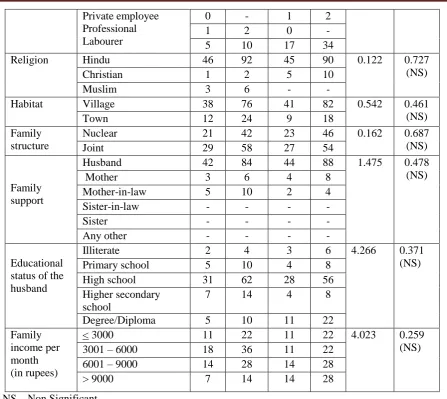
sample characteristics: Regarding socio-demographic variables and the obstetrical variables of postpartum mothers, 20(40%) mothers in the experimental group and 23(46%) in the control group belonged to the age group of 21-25 years, 28(56%) in the experimental group and 23(46%) in the control group had education up to high school level and 4(8%) mothers in both groups were illiterates. Majority of 44(88%) mothers 44(88%) in the experimental group and 32(64%) in the control group were housewives, 21(42%) mothers in the experimental group and 23 (46%) mothers in the control group belonged to nuclear families, 18 (36%) mothers in the experimental group and 11 (22%) in the control group were earning between Rs.3001–6000 (Table-1).
The ‘chi-square’ test and the ‘p’ value showed that no significant difference exist between the 2 groups. The groups were homogenous with regard to age, educational status, religion, habitat, family structure, family support, educational status of the husband and family income, except the variable occupation of the mothers.
Table-1: Distribution of Socio-Demographic Variables of Postpartum Mothers in the Experimental and
Control Groups
Demographic Variables
Experimental Group (n = 50)
Control Group (n = 50)
Chi-Square
p Value
No. % No. %
Age (in years)
18-20 5 10 6 12 1.612 0.657
(NS)
21-25 20 40 23 46
26-30 20 40 19 38
31-35 5 10 2 4
Educational Status
Illiterate 4 8 4 8 2.729 0.604 (NS) Primary school 2 4 2 4
Middle school 14 28 12 24 High school 14 28 11 22 Higher Secondary
school
10 20 17 34
Graduation/ Diploma 6 12 4 8 Occupation
of
the mother
Unemployed 44 88 32 64 7.89 0.005 (S)
Employed* Government
6 12 18 36
Private employee Professional Labourer
0 - 1 2
1 2 0 -
5 10 17 34
Religion Hindu 46 92 45 90 0.122 0.727 (NS)
Christian 1 2 5 10
Muslim 3 6 - -
Habitat Village 38 76 41 82 0.542 0.461 (NS)
Town 12 24 9 18
Family structure
Nuclear 21 42 23 46 0.162 0.687 (NS)
Joint 29 58 27 54
Family support
Husband 42 84 44 88 1.475 0.478 (NS)
Mother 3 6 4 8
Mother-in-law 5 10 2 4 Sister-in-law - - - -
Sister - - - -
Any other - - - -
Educational status of the husband
Illiterate 2 4 3 6 4.266 0.371 (NS) Primary school 5 10 4 8
High school 31 62 28 56 Higher secondary
school
7 14 4 8
Degree/Diploma 5 10 11 22 Family
income per month (in rupees)
< 3000 11 22 11 22 4.023 0.259 (NS) 3001 – 6000 18 36 11 22
6001 – 9000 14 28 14 28 > 9000 7 14 14 28
NS – Non Significant
Table - 2: Distribution of selected obstetrical variables of the postpartum mothers in the experimental and the control groups
N = 100 Obstetrical Variables Experimental
Group (n = 50)
Control Group
(n = 50)
Chi-Square
p Value
No. % No. %
Gravida
1 22 44 22 44 0.722 0.868 ( NS)
2 15 30 15 30 3 10 20 8 16 >3 3 6 5 10
Parity
1 25 50 24 48 0.333 0.847 (NS) 2 19 38 18 36
>2 6 12 8 16
Number of abortion
0 39 78 40 80 0.079 0.961 (NS)
1 8 16 7 14
2 3 6 3 6
Number of Male Child
0 40 80 38 76 0.274 0.872 (NS) 1 8 16 10 20
2 2 4 2 4
Number of Female Child
0 31 62 37 74 5.566 0.062 (NS) 1 14 28 13 26
2 5 10 - -
Regarding the distribution of selected obstetrical variables of mothers in the experimental and in the control groups (Table-2), the ‘chi-square’ test and the ‘p’ value revealed that there was no statistically significant difference found with regard to the obstetrical variables of mothers in experimental and control groups.
Regarding past history of obstetrical complications among the multi para mothers, one mother (4%) in the experimental group and 4 (15.4%) in the control group had intra uterine death and with regard to past history of variables affecting emotional health of the postpartum mothers such as problems related to husband, child’s health, stress due to chronic disease, occurrence of death in the family and financial problems in the family, except the variable financial problems in the family, other variables were non-significant and the groups were homogenous.
Regarding the variables of present obstetrical variables of the postpartum mothers such as wanted pregnancy, desirous of male child, mode of delivery, desired gender and the gender born actually, health condition of newborn and support of their husbands, there was a statistically significant difference between groups with regard to desired gender of the child (p<0.001) and desired gender and gender actually born, and Apgar score of the newborn. Regarding pretest level of PPD, there was no statistically significant difference found with regard to pretest level of postpartum depression among the mothers between the experimental and the control group in pre-test.
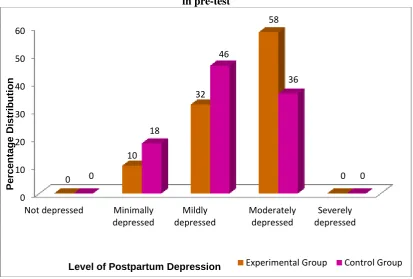
Figure – 1: The level of depression of postpartum mothers in the experimental and the control groups in pre-test
The level of post partum depression in pre-test
In pre-test 5 (10%) mothers in the experimental group and 9 (18%) mothers in the control group had minimal depression. Sixteen (32%) mothers in the experimental group, and nearly half of the mothers 23 (46%) in the control group had mild depression. More than half of the total mothers 29 (58%) in the experimental group had moderate depression whereas in the control group 18 (36%) mothers had moderate depression. None of the mothers had severe depression in both experimental group and control group. The ‘chi-square’ test and the ‘p’ value showed that, there was no statistically significant difference found with regard to pretest level of postpartum depression among the mothers between the experimental and the control group.
The level of post partum depression in post-test –I, II &III
In post-test-i at 3 months, the number of mothers with mild depression is lesser in the experimental group 9(18%) compared to nearly half of the mothers 22 (44%) in the control group. In the experimental group, more number of mothers 19(38%) had minimal depression compared to only 3(6%) mothers in the control group who had minimal depression in Post-test-II at 6 months. in the Posttest-III at 12 months, majority of the mothers progressed to the minimal depression. In the experimental group 37(74%) mothers and in the control group 33(66%) mothers had minimal level of depression. None of the mothers in the experimental group compared to 7(14%) mothers had mild depression in the control group.
Comparison of mean PPD score in the experimental group and control group showed that the interventions have been highly effective in reducing PPD level of the mothers in the experimental group (Figure-2).
0 10 20 30 40 50 60
Not depressed Minimally
depressed
Mildly depressed
Moderately depressed
Severely depressed 0
10
32
58
0 0
18
46
36
0
P
er
ce
n
tage
Distribu
tion
Fig- 1.2 Comparison of mean PPD score in the experimental group and control group
7. DISCUSSION:
Mean scores of postpartum depression among the mothers in the experimental group by assessment revealed that one way ANOVA repeated test revealed that there was a significant reduction in the mean PPD from Pre-test to Post test III in the experimental group.Simple contrast test showed that in all the 3 assessments (Post-test I, II and III) the reduction was statistically significant.
Comparison of the level of PPD in the control group showed that one way ANOVA repeated test revealed that in the control group also there was reduction in the mean PPD from pre-test to Post test III. Simple contrast test showed that there was no significant difference in pre-test versus post-test-I and in post-test II and III statistically significant difference was found.
Comparison of level of PPD between experimental and control groups showed that two way ANOVA and p value (<0.001) revealed there was a significant difference between subjects in the groups. Within subjects also there was significant difference. The assessment and group wise comparison also revealed that there was a significant difference in the reduction of PPD. “Simple Contrast Test” was used and it showed that mean reduction in PPD was higher in the experimental group at statistical significant levels in all the 3 assessments. The interaction effect revealed that in all the three comparisons, the reduction has been higher in the experimental group compared to the control group which indicated that the interventions were highly effective.
Association between pre-test scores of postpartum depression and demographic and obstetrical variables of the mothers,there was no significant association between socio-demographic and obstetrical variables except the variables educational status of mothers and gender desired and gender born.
Group wise and assessment wise mean scores of postpartum depression; Two Way ANCOVA Test revealed the covariate financial problems affected the postpartum depression.
8. NURSING IMPLICATIONS:
Nursing Practice
As part of antenatal and postnatal care, nurses should educate the mothers regarding postpartum depression as knowledge dispels fear and builds confidence.
Individual or group counseling can be arranged by nurses routinely in the antenatal OPD and antenatal and postnatal wards.
Relaxation technique brings a definite reduction in the level of depression. This message should be echoed by nurses in the clinical and community settings.
Nursing Education
The curriculum needs to be strengthened and more emphasis needs to be given on meeting the emotional health needs of mothers.
Nurse educators should highlight the importance of counseling and relaxation techniques while teaching students.
22.16
13.64
6.64
2.56
19.16 17.56
10.24
5.74
0 5 10 15 20 25
Pretest Posttest-I Posttest-II Posttest-III
Mean
P
os
tpa
rt
um
De
pr
es
si
o
n
Sc
or
e
Nursing Administration
Nurse Managers should provide facilities to display videos on relaxation techniques in the inpatient and outpatient departments.
Nurse Administrators should motivate the nurses by providing official permission to attend the CNE programme and training courses on counseling and relaxation techniques.
Nursing Research
Nurses can be motivated to bring innovative ideas in the implementation of complimentary therapies in clinical research.
Nurses should be encouraged to participate in the research activities regarding safe motherhood.
9. RECOMMENDATIONS:
Training need to be provided to the nurses on counseling and relaxation for the promotion of emotional health of postpartum mothers.
A survey should be carried out annually to find the incidence of PPD among the mothers.
A study comparing various relaxation techniques can be conducted in different settings.
A comparative study to assess the efficacy of individual counseling can be carried out between the primi para mothers and multi para mothers.
10. LIMITATIONS:
Home visits, as planned, could not be conducted and hence the investigator had to revisit the mothers on different dates.
Only 100 samples were selected.
The mothers lived in joint family, posed difficulties to carry out individual counseling.
Living in a small house posed difficulties to practice of relaxation techniques.
11. CONCLUSION:
The present study identified the mothers with PPD, explored the factors affecting PPD and found that individual counseling and relaxation techniques had positive impact on the emotional health of postpartum women. Individual counseling and relaxation techniques are cost effective, feasible measures and these should be administered routinely by nurses to the peripartum women.
REFERENCES:
1. Jeayareka J. (2011): Role of Jacobson’s relaxation therapy in reducing stress of antenatal mothers: Nightingale Nursing Times, 7(6), 5-6.
2. Ali N.S., Ali B.S., Azam I.S., andKhuwaja A.K. (2010): Effectiveness of counseling for anxiety and depression in mothers of children ages 0-30 months by community workers in Karachi, Pakistan: A quasi experimental study: BMC (BioMed Central) Psychiatry, 10(57).
3. Udangiu N.L., Moldovan M., Moţoescu P.E., and Papuc C. (2010): Clinical and therapeutic management in postpartum depression : Management in Health, 14(4).
4. Hegde S., Latha KS., Bhat M.S., Sharma P.S.V.N., Kamath A., and Shetty K.A. (2012): Postpartum depression: Prevalence and associated factors among women in India: Journal of Women's Health, Issues and Care, 1(1).
5. Munir A., Minhas F.A., Nizami A.T., Mujeeb F., and Usmani A.T. (2009): Frequency and associated factors for postnatal depression: Journal of College of Physicians and Surgeons Pakistan, 19(4), 236-39.
6. Walden R, (April 25, 2013): How can we help teen mothers avoid and cope with postpartum depression? www.ourbodiesourselves.org.
7. Ngai F.W., Wong P.W., Leung K.Y., Chau P.H., and Chung K.F.(2015): The effect of telephone-based cognitive-behavioral therapy on postnatal depression: A randomized controlled trial: Psychotherapy and psychosomatic, 84 (5), 294-303.
8. Nasiri S., Kordi M., and Gharavi M.M. (2015): A comparative study of the effects of problem-solving skills training and relaxation on the score of self-esteem in women with postpartum depression: Iranian Journal of Nursing and Midwifery Research, 20(1), 105–112.
9. Daley JA., Jolly K., Sharp J.D., Turner M.K., Blamey V.R., Coleman, S., et.al. (2012): The effectiveness of exercise as a treatment for postnatal depression: Study protocol: BMC Pregnancy and Childbirth, 12(45).